CHAPTER IV FINDINGS AND DISCUSSIONS
This chapter illustrates the finding and analysis of data collected for this study.
Data is obtained through structured and in-depth interviews which were undertaken with three creative directors of advertising agencies in Taiwan, and one executive creative director as well. This section of study outlines the chief findings and results, and sequentially their meanings and significance lead to the conclusion.
Introduction to the Cases
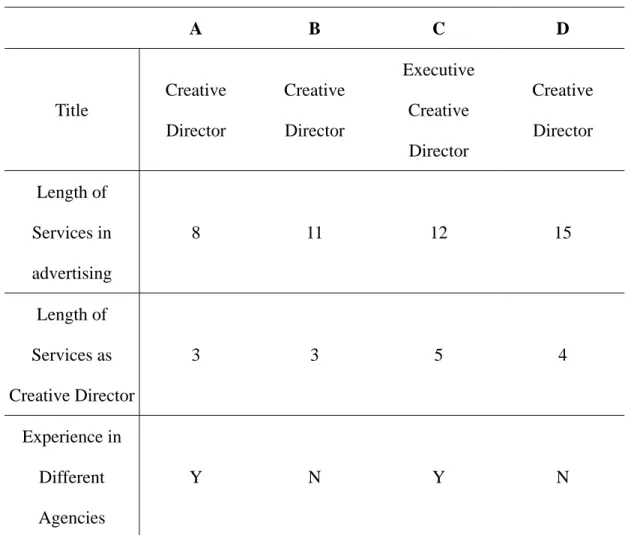
In order to understand the context of each interviewee, their backgrounds are enlisted as below table.
Table 4.1: Background of Interviewees
A B C D
Title
Creative Director
Creative Director
Executive Creative Director
Creative Director
Length of Services in advertising
8 11 12 15
Length of Services as Creative Director
3 3 5 4
Experience in Different Agencies
Y N Y N
Number of employees under
supervision
7 13 19 10
Creative Base Copywriter Art Art Art
The four interviewees are all advertising veterans. Each of them have more than 3 years experience as creative directors of advertising agencies in Taiwan. Case A and Case C had worked at other agencies before which is quite common in advertising industry. According to Case A, the high turnover rate in advertising industry is among the entry-level staff, which is acceptable for most of agencies. Sometimes, agencies embrace employees who ever left because employees may learn different cultures and earn more perspectives which rarely appear in a fixed environment. On the other hand, it is not usual to see Case B and Case D work at the same agencies ever since they got into advertising industry. Coincidentally, both Case B and Case D work in agencies with Japanese funds. Therefore, Case D concluded the Japanese management style did the impact to this phenomenon.
Another thing to addressed here is that only one Case A is copy-based. In other words, other cases are all art-based starting their career in advertising with graphic design and photography.
Furthermore, there are only two paths for creative staff. One is copywriter and is regarded as copy-based people. The other is art and is regarded as art-based people.
All interviewees mentioned their thinking patterns are related to their origin works.
For example, Case A named himself as a left-brained thinker who is good at logical thinking and verbal expressions. Case C heavily addressed that he is a right-brained thinker who focus graphic rather than verbal. Both B and C recognized themselves as
graphic thinkers, which sometimes refer to right-brained thinker or conceptual thinker as well. However, to define a person whether right-brained thinker or left-brained thinker needs specific and effective methods to measure up. Therefore, researcher suggested regarding their personal opinions as evident leads for future studies.
Analysis of Questionnaire Results
As stated in literature review section, job description of creative director is a reference prior to interview in order to identify the competencies for creative directors of advertising agencies, and the format of a dynamic process or projects groups would suit knowledge workers better, such as creative director, to present competencies they needed to perform works with excellence. Therefore, based on the results of study, the competencies needed by creative directors are as below table.
Table 4.2. Coding List for Competencies needed by Creative Directors
Issue Category Concept
1. Competencies 1-1 Creativity Management 1-1-1 Brain Storming
1-1-2 Directing
1-1-3 Conceptualizing
1-1-4 Quality Controlling 1-2 Project Management 1-2-1 Monitoring
1-2-2 Scheduling
1-2-3 Budget Controlling
1-2-4 Coordinating
1-2-5 Task Assigning
1-3 People Development 1-3-1 Identifying Talents
1-3-2 Developing Talents
1-3-3 Coaching
1-4 Account Management 1-4-1 Strategy Planning
1-4-1 Credibility
1-5 Others 1-5-1 Leadership
Issue Category Concept 1-5-2 Communications Skills
1-5-3 Interpersonal Skills
1-5-4 Passion
1-5-5 Learning Orientation
Competencies for Creativity Management
The product of creative department is creativity mostly in ways of TV
commercial and print commercial. Competencies for creativity management including brainstorming, directing, conceptualizing and last but not the least, quality controlling are needed for creative directors to perform works with excellence.
1. Brainstorming
All interviewees regarded brainstorming as initial work to generate creativity (A2-03-014, B2-02-008, C2-03-004, D2-03-002). It is crucial to obtain creativity both to high level of quality and quantity. Case B mentioned that some training courses are designed to make brainstorming efficient and effective, and to help creative team to unleash imagination. Creativity is the most important asset for agencies, and brainstorming is considered the initial step to generate the
creativity. Therefore, to a great degree, creative directors have to lead the entire creative team to brainstorming, which weights heavily in regards to the quality of creativity. Many methods are used in this stage of creativity management.
Creative directors also learn from training consultancies or self experience to help team mates to brain storming according to all the interviewees.
Usually the account department would give the briefing stating client’s specific needs for creativity, and creative director would conduct gathering to find out solution to client’s problems.
2. Directing
Unlike brainstorming represents an unlimited thinking to approach creativity, creative directors direct employees to hit the target and to achieve expected goals.
They usually direct team members based on their own experiences, which are combined with advertiser’s expectation and their professionalism. Questions like if the advertisement is feasible or the numbers to the return of investment would be seriously considered while this stage of creativity management.
3. Conceptualizing
Once creative team have a bunch of ideas waiting to be catalyzed as creativity. It is very important for creative director to help employees to condense their ideas.
Through conceptualizing, employees can have an overall understanding of problem or situation by linking information or applying existing frameworks.
Identify patterns and connections between situations are very essential about generating or shaping creativities.
4. Quality Controlling
To finalize the process of creativity management, creative directors have to control the quality of creativities. All interviewees think they do quality controlling based on their experiences, which is rather hard to be trained.
Competencies for Projects Management
Creative directors can be seen as project managers for their services --- Creativity production where the creativities are embodied to commercialize.
Production is the bridge between creative team and clients. Even though most of agencies have outsourced the function of productions, yet creative directors still play role to plan and to monitor the entire production as a project, as all interviewees agreed on that they are in charge of the whole projects. They are responsible for the projects including monitoring, scheduling, budget controlling, coordinating and task
assigning.
1. Monitoring
As mentioned earlier, creative director has responsibility to complete and carry out the projects. Therefore, it is creative director’s duty to monitor the whole processes of productions.
2. Scheduling
It is renowned that creative directors are tied up with many things. Tight schedule is one of their life characteristics. To arrange all the activities needed in production, creative directors have to know how to prioritize things. From the interviews, four interviewees had consensus that experience helped to prioritize things and put everything in order. In addition, creative directors have to be adaptive to changes, especially when they encounter changes during making productions. Other than that, advertising is very sensitive to changes. Therefore, creative directors have to make their schedule flexible to meet the needs to accomplish works on time.
3. Budget Controlling
According to Case A, the creative director has less empowerment on budget planning. Therefore, their most important work regarding budget is controlling.
Make budget effective and efficient to succeed the projects. From Case B’s perspective, it’s possible to increase the budge by proposing better and feasible ideas to clients. However, Case B, C and D agreed that budget is related to higher level’s decisions. In other words, creative directors are given limited budgets in advance they come up with creativities to clients in most of time.
Therefore, it becomes account executive’s work to negotiate the entire buying package of agency’s clients. As for creative directors, they can only do with the constraints. Only when they extraordinary ideas for creativities, they might
be changed to weigh heavier regarding budget issues.
4. Task Assigning
Creative department are composed of copywriters and arts. When a task or project is announced, the entire creative team would get together to come up with ideas, which is called brainstorm. After a series of generating ideas, and creative directors have made sure the projects should break down to work out.
Therefore, creative directors would assign work to make sure that project could be done by completing each task group’s duties.
5. Coordinating
Many coordination works are needed during the processes of productions.
Creative directors seek solution through coordinating different groups and make sure all the tasks are in the schedule and on the right track. In other words, coordination is to make sure the combination of people, tasks, time and cost are effective to work together. During my interview with Case B, I have witnessed how Case B coordinating a bunch of things in a short time.
Competencies for People Development
All the interviewees emphasized that once a creative is promoted to be a creative director, he or she is supposed to seek the achievement of team, instead of individuals.
This illustrated the role of creative director should have professionalism to support most of works to do the creativity management. However, one of the important values for creative directors is to develop people.
As a leader, the creative director should not only make quality creativities but also help the organization to train and develop people. Case B gave a good point that creative staff seek for outstanding work by oneself would never be good enough as a creative director. There is no good or wrong to choose managerial role or be
professional in a specific field. Some unqualified employees in Case B’s company became good artists after they left the company. However, if you choose to take the role of creative directors, it is no longer a show for oneself. You have to foster workforce by coaching and identifying, training and developing talents under your supervision.
1. Coaching
According to all interviewees the most used and effective training approach is on job training. Creative directors have responsibilities to coach staffs with practical
purposes. Through real life cases, employees are capable of learning from creative director’s perspectives and moreover experiences, which has been highlighted by all the interviewees during the interviews of study.
2. Identifying Talents
Advertising agencies usually attract many talents into it. However, the quality of talents are not all competitive, thus, it’s creative director’s job to identify real talents to create really talent pool for the agency. After all, people do advertising are all knowledge workers. They mostly live on their knowledge. Therefore, this is an essential issue for creative director with no question.
Based on the interviews, except Case C has been promoted to executive creative director, other creative directors recruited their own workforce. As they believe people have different talents and expertise. Besides to have creativity, they also look qualities to excel.
3. Developing Talent
Once talents are identified, creative director has to develop their competencies. All the measures applied to strengthen creative team’s workforce, according to Case A, would have positive feedback. Therefore, creative director has to facilitate the development of others on purpose of add entire team’s competitive advantage.
Apart from on job training, in case B and D’s companies, other forms of training are conducted for creative department with a regular basis. Case D pointed out that training effect is not very obvious to measure, but it works as everybody can sense the changes. Even from workshops where everyone exchanged viewpoints to analyze cases is a way to improve communication. Therefore, creative directors should create an environment where people are encouraged to learn, and make the team become a learning organization.
Competencies for Account Management
Account management refers to the relationship between client and the creative director in every way they may collaborate with each other. Even though advertising agencies have account executive served in account department to act the bridge between creative department and clients. However, three out of four interviewees didn’t think account executives were empowered enough to adequately play this role to manage account. Most of the time, they didn’t value the briefing from account department very much. Instead, they use their own way to study and explore client’s needs. Therefore, in account management process, four interviewees concluded following elements are very important to their works.
1. Strategy Planning
All the interviewees were fully aware of strategy planning should be ahead of generating creativities. However, strategy for a marketing campaign in most of time is very costly therefore decisions about that should be made carefully. Also, a good strategy should be deployed with affluent understanding of situations. Therefore, a good strategy is rare but valuable. Four interviewees think the brief or analysis
made by account executive are insufficient to make a sensation of creativity. Even sometimes clients have no idea about their next move on marketing, yet they still made mind to spend money on advertising. After being through cases like these a lot, creative directors realized that they have to enforce themselves to learn more about clients to come up with a good strategy which good creativities can align with.
2. Credibility
Creative directors are figurehead to clients no matter in pitches or the cooperation after won the pitches. Creative directors have to earn their respect by providing quality works within given time and constrained budget. Creative directors earn their credibility from two ways. One is their work. The other is how corporative for them to work with. Advertisers seek not only talented creative director leading a strong team, but also someone they feel comfortable to communicate with. Once creative director has credibility, he or she has invisible asset to build up own realm in advertising territory.
Being figurehead is also one of the responsibilities for managers. That gives
stakeholders and other associates a general impression of the teamwork. Within this concept, creative directors play the major role of communication channel between the advertiser and agencies.
Other Competencies
Passion is the key factor affecting a person to succeed or not. Passion is alike fuel to propel a person to keep going toward the goal he or she pursues. All the creative director who were interviewed all claimed that passion is the major reason to keep
them getting though all the difficulties at work. Working at advertising agencies represents a career with huge tense and without passion no one can take advantage from it while conquering challenge one after another. Also, creative director who have excellent communication skills can benefit from all the forms of communications.
Leadership is also needed for a competent creative director. They always achieve their goals through leadership. They can’t put the obligation aside, only focusing on
creativity. They lead people to complete the project through creativity in hope of satisfy their accounts of advertiser.
Besides, continuous learning makes sure their spring of creativity remain young and vigorous. Once they stopped learning, they lost the ability to well interpret the advertisement by means of a great variety of purposive ideas.
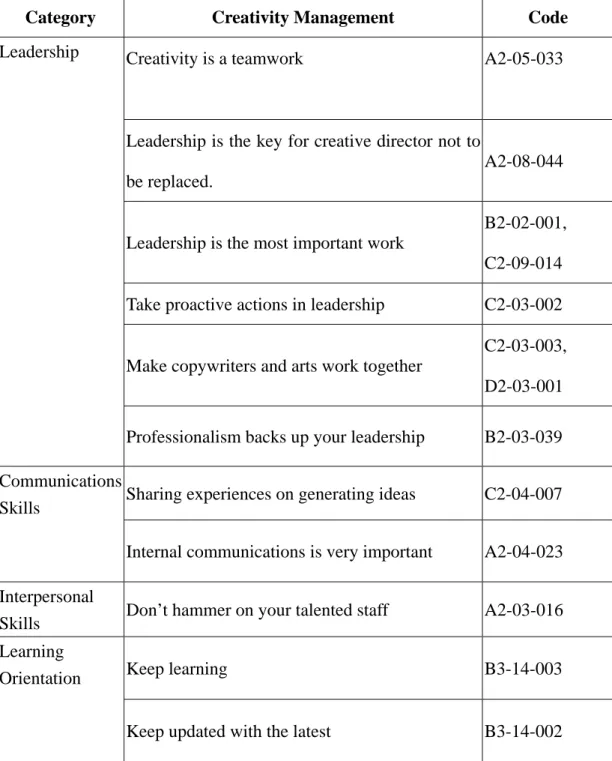
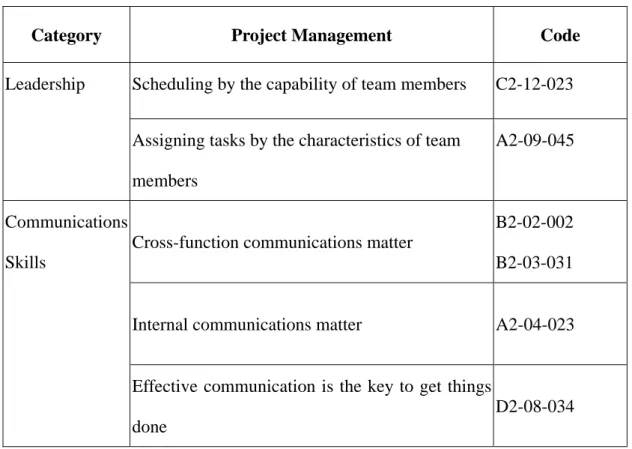
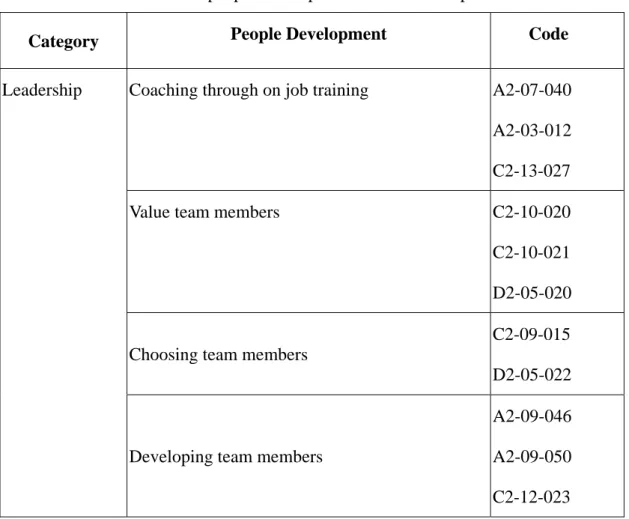
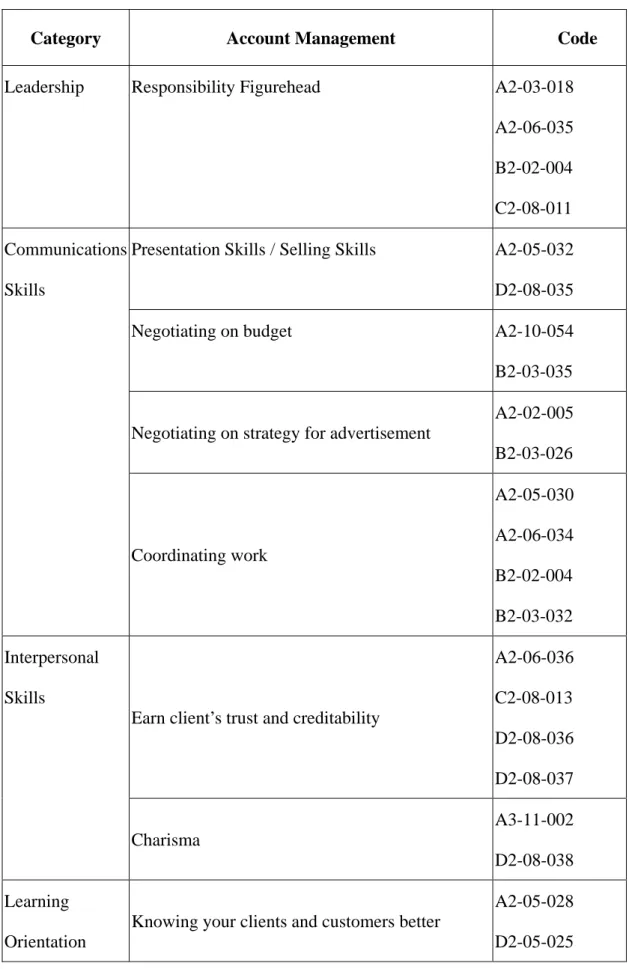
In addition, it’s also found that these other competencies have affected to the creativity management, project management, people development, and account management to a different degree. Below is the comparison goes in different competencies within specific tasks.
Table 4.3 Relations between creativity management and other competencies
Category Creativity Management Code
Creativity is a teamwork A2-05-033
Leadership is the key for creative director not to be replaced.
A2-08-044
Leadership is the most important work
B2-02-001, C2-09-014 Take proactive actions in leadership C2-03-002
Make copywriters and arts work together
C2-03-003, D2-03-001 Leadership
Professionalism backs up your leadership B2-03-039
Sharing experiences on generating ideas C2-04-007 Communications
Skills
Internal communications is very important A2-04-023 Interpersonal
Skills Don’t hammer on your talented staff A2-03-016
Keep learning B3-14-003
Learning Orientation
Keep updated with the latest B3-14-002
Table 4.4 Relations between project management and other competencies
Category Project Management Code Scheduling by the capability of team members C2-12-023
Leadership
Assigning tasks by the characteristics of team members
A2-09-045
Cross-function communications matter
B2-02-002 B2-03-031
Internal communications matter A2-04-023 Communications
Skills
Effective communication is the key to get things done
D2-08-034
Table 4.5 Relations between people development and other competencies Category People Development Code
Coaching through on job training A2-07-040 A2-03-012 C2-13-027
Value team members C2-10-020
C2-10-021 D2-05-020
Choosing team members
C2-09-015 D2-05-022 Leadership
Developing team members
A2-09-046 A2-09-050 C2-12-023
Table 4.6 Relations between account management and other competencies
Category Account Management Code
Leadership Responsibility Figurehead A2-03-018
A2-06-035 B2-02-004 C2-08-011 Presentation Skills / Selling Skills A2-05-032 D2-08-035
Negotiating on budget A2-10-054
B2-03-035
Negotiating on strategy for advertisement
A2-02-005 B2-03-026 Communications
Skills
Coordinating work
A2-05-030 A2-06-034 B2-02-004 B2-03-032
Earn client’s trust and creditability
A2-06-036 C2-08-013 D2-08-036 D2-08-037 Interpersonal
Skills
Charisma
A3-11-002 D2-08-038 Learning
Orientation
Knowing your clients and customers better
A2-05-028 D2-05-025