High-Detectivity GaN MSM Photodetectors with Low-Temperature GaN Cap Layers and Ir/Pt Contact Electrodes
Chia-Lin Yu, a Ping-Chuan Chang, b,z Shoou-Jinn Chang, a and San-Lein Wu c
a
Institute of Microelectronics and Department of Electrical Engineering, National Cheng Kung University, Tainan 701, Taiwan
b
Department of Electronic Engineering, Nan Jeon Institute of Technology, Yen-Hsui Township, Tainan County 737, Taiwan
c
Department of Electronic Engineering, Cheng Shiu University, Kaohsiung 830, Taiwan
GaN-based metal-semiconductor-metal 共MSM兲 UV photodetectors 共PDs兲 with a low-temperature 共LT兲 GaN cap layer and Ir/Pt contact electrodes were fabricated. Compared with the conventional Ni/Au contacts, we found that Ir/Pt contacts can reduce the dark current. Further, a smaller dark current and larger UV-to-visible rejection ratio obtained from the PD with LT GaN cap layer and Ir/Pt contact electrodes were determined. Furthermore, the noise equivalent power and detectivity 共D
*兲 were respectively obtained as 2.75 ⫻ 10
−13W and 1.76 ⫻ 10
12cm Hz
0.5W
−1for the aforementioned PDs.
© 2007 The Electrochemical Society. 关DOI: 10.1149/1.2718393兴 All rights reserved.
Manuscript submitted December 18, 2006; revised manuscript received January 26, 2007.
Available electronically March 26, 2007.
Recently, we have witnessed a great progress in III-nitride semi- conductors. With wide direct bandgap and high saturation velocity, III-nitride materials can be used for varieties of optical and elec- tronic devices.
1-3In fact, high-performance III-nitride short- wavelength light-emitting diodes 共LEDs兲 were already successfully commercialized.
1,2In addition, III-nitride materials are also useful for solar-blind UV photodetectors 共PDs兲 with various commercial and military applications. To date, several groups have reported promising results for GaN-based UV PDs with various structures such as p-n junction diodes, p-i-n PDs, Schottky barrier PDs, and metal-semiconductor-metal 共MSM兲 PDs.
4-7Compared with bipolar PDs, the fabrication process of MSM PDs is much simpler. How- ever, the reverse bias leakage current in a Schottky barrier junction diode is expected to be significantly higher than in a bipolar junction diode.
8,9Dark current is an important parameter to consider for PD applications. Therefore, the dark current of the devices must be sup- pressed first before high-performance MSM PDs can be realized.
To reduce the leakage current in MSM PDs, we need to enhance the Schottky barrier height at the metal/semiconductor interface. To achieve a large Schottky barrier height on GaN, one can choose metals with high work functions, such as Pt 共5.65 eV兲,
10Ni 共5.15 eV兲,
11and Pd 共5.12 eV兲.
12However, many of the high-work- function metals have been shown to be unstable at high tempera- tures. This is believed to be caused by severe interdiffusion.
13Pre- viously, it has been reported that iridium 共Ir, 5.46 eV兲 could form thermally stable Schottky contact on AlGaN/GaN heterostructure.
14GaN-based UV MSM PDs with IrO
2and Schottky diodes with oxi- dized Ir/Ni Schottky contacts were also demonstrated.
15,16Alterna- tively, the reduction of leakage current may also be achieved via the addition of an insulating gate layer by adopting a metal-insulator- semiconductor 共MIS兲 structure.
17,18To our knowledge, low- temperature 共LT兲 GaAs layer has ever been attempted in GaAs- based field transistors for the purpose of reducing gate leakage.
19For GaN-based devices, it has also been shown that one can signifi- cantly reduce the leakage current and achieve a much larger photo- current to dark current contrast ratio by introducing a LT GaN on top of the conventional nitride UV PDs.
20Keeping these advantages in mind, we hereby report the fabrication of nitride-based MSM PDs with LT GaN cap layers and Ir/Pt metal contacts. A detailed study on the properties of these MSM PDs is also discussed.
Samples used in this study were all grown by metallorganic chemical vapor deposition 共MOCVD兲 on c-face sapphire 共0001兲 substrates. Details of the growth conditions could be found else-
where. After annealing the sapphire substrate at 1100°C in H
2am- bient to remove surface contamination, a 30 nm thick GaN nucle- ation layer grown at 600°C was deposited on the sapphire substrate.
On top of the nucleation layer, a 2 m thick undoped GaN layer and a 30 nm thick 600°C-grown LT GaN cap layer were then epitaxially deposited 共i.e., sample I兲. Sheu et al.
21demonstrated that the LT GaN behaves like an insulator with a large sheet resistivity. For comparison, samples without the LT GaN cap layer 共i.e., sample II兲 were also prepared. From the Hall measurement, it was found that the electron concentration of the sample II was ⬃10
17cm
−3.
Next, MSM PDs were fabricated based on these two structures.
Standard photolithography and liftoff were implemented for the fab- rication of GaN-based MSM UV PDs. Ni 共10 nm兲/Au 共20 nm兲 and Ir 共10 nm兲/Pt共20 nm兲 contact electrodes were evaporated onto sample II 共i.e., PDគA and PDគB, respectively兲 for fabricating the conventional GaN-based MSM UV PDs. Similarly, Ir/Pt and Ni/Au contact electrodes with same thicknesses were also deposited onto sample I 共i.e., PDគC and PDគD, respectively兲. The fingers of the contact electrodes are 14 m wide, 100 m long, and spaced by 6 m apart. In this study, we kept the active area of fabricated PDs to be 100 ⫻ 234 m. The room temperature current-voltage 共I-V兲 curves of these devices were then measured by using an HP 4145 semiconductor parameter analyzer under conditions of dark and light illumination. The top-illuminated spectral responsivity of these devices was also quantified using a Xe arc lamp with a calibrated monochromator as the light source. The monochromatic light, cali- brated with an optical power meter, was collimated onto each PD via an optical fiber. The noise characteristics were measured using a low-noise current preamplifier equipped with a fast Fourier trans- form 共FFT兲 spectrum analyzer.
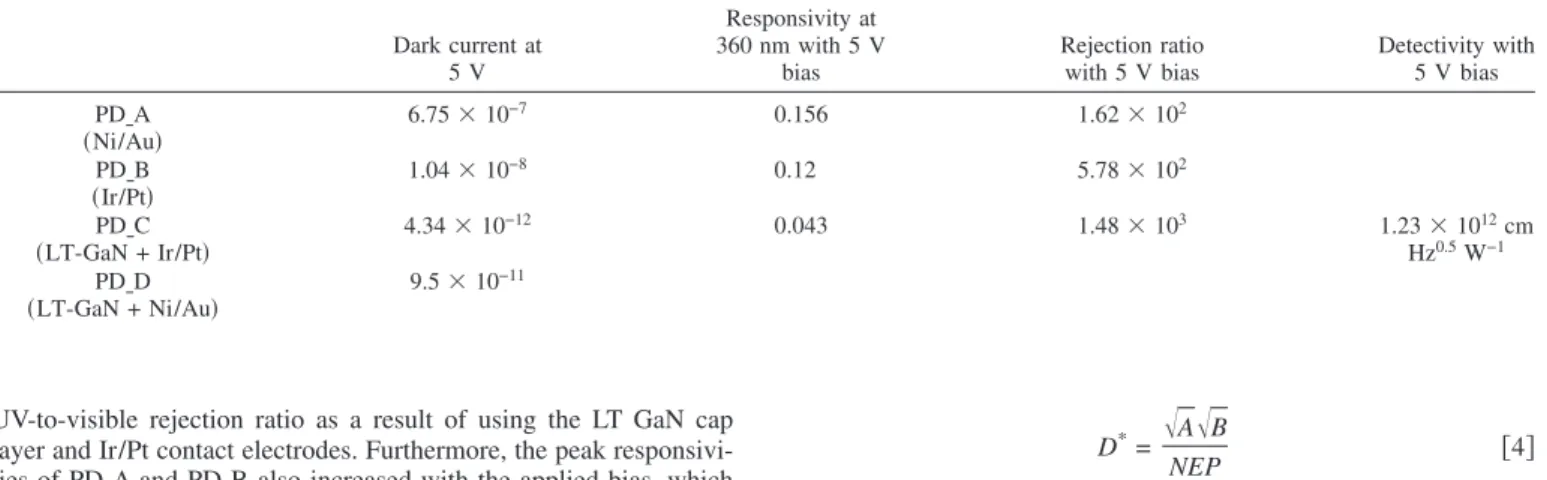
Figure 1 shows the measured I-V characteristics of the four MSM PDs. It could be seen that the dark current of PD គC is the lowest, while that of PD គA is the highest. Compared with PDគA, the PD គB exhibited smaller dark current, which is because the work function of Ir is larger than that of Ni. It is also possible that the metal-induced gap states 共MIGS兲 are less pronounced for PDគB,
22which explains the finding of smaller dark current for PD គB. It was also demonstrated that a significant reduction in dark current was achievable through the use of an additional LT GaN cap layer, chiefly responsible for a much smaller dark current observed for PD គC and PDគD. In fact, this result can be attributed to a thicker and higher potential barrier and large series resistance due to the inser- tion of the highly resistive LT GaN cap layer. Hence, the dark cur- rent for a given bias was reduced. It was also observed that the dark current of PD គC was smaller than that of PDគD, which is again attributed to the presence of fewer MIGS. Compared with the con-
z