論文撰寫必避條件
審稿經驗分享與 Publons 使用
盧光輝中國文化大學地學研究所教授 兼 理學院院長
內容大綱
1.
Publons 使用2.
審稿經驗分享3.
論文撰寫必避條件1. Publons 使用
•
科睿唯安 Clarivate Analytics•
碩睿資訊 Shou Ray Information Service•
登錄網站www.publons.com
•
審稿回報[email protected]
•
編輯回報[email protected]
2. 審稿經驗分享
•
約有 10 多年經驗•
經驗不足•
仍在學習當中42962 9 10 11 12 42370 2 3 4 5 6 7 8 9 10 11 12 42736 2 3 4 5 6 7 8 9 10 11 12 43101 2 3 4 5 6 7 8 9 10 11 12 43466 2 3 4 5 6 0
5 10 15 20 25 30 35 40 45
Paper Reviewed
Month
N u m b er
Good and Bad of Journal Paper Reviewin g
Good
• Updated on the most recent research findings
• Earn bonus/credit ($) for later journal publication
• Enhance career achievement
• Improve English writing skill
• Add points to biennial teachers performance assessme
nt
Bad
• Time consuming (3 1.5 hours)
• Irregular work load (more on weekends)
• Work even traveling oversea
• Waste lots of paper
3. 論文撰寫必避條件
Poor English
• Poor English
是國際期刊將台灣研究者之投稿退件最常見的理由。
一些審查委員針對英文不佳之評語:
• The author needs to focus on making his English mor e readable.
• His ideas may be worth publishing but until he can
communicate in an understandable and systematic for
mat, his ideas are not publishable.
• Please work on the English. It shouldn’t be the re
viewer’s job to rewrite your paper in understandab
le English. We are busy people. In its current form
the paper is unsuitable for this journal.
• Also, grammar, syntax and style all need improvemen
t. The author writes like a non-native. I hope that
he can improve his English to the level where his i
deas can be appreciated.
Writing errors that cause “rejection’ and “m ajor revision”
Sample taken from 64 reviewers and editor’s comments in the Ele
ctrical and Mechanical Engineering field over 3 year period. Ind
ividual author’s errors will differ.)
台灣人寫作常犯九項錯誤
1.
太常使用被動語態 (16%)2.
使用過多名詞而非動詞 (15%)3.
使用強 / 弱勢動詞 (13%)4.
過於使用 It 還有 There (11%)5.
不清楚的代名詞 (4%)6.
多餘和無用的詞句 (17%)7.
動詞時態變化 (13%)8.
不完整的對照比較 (4%)9.
主詞和動詞無法對應 (7%)Paper Size
• Best size 15-20 pages (R&D > 50%)
• Review article >20 pages
• Don’t include the whole thesis
Paper Title
• Must be less than 20 words
• Be informative as to the goal, method, and study area
of this study
Examples
Using Adaptive Neuro-Fuzzy Inference System, Robust regression, Bayesian
regression and multiple linear regression to estimate Reference Evapotranspiration in South region of Algeria (A comparative study)
Analysis of Physio-chemical and Microbiological Properties of Boreholes and Well Water Collected from Different Locations in Kuje Area Council, Abuja, Nigeria
Evaluation treatment performance of natural wetland for the water quality of Abaya Lake
Species diversity and relative abundance of avifauna in Lake Hawassa and its adjoining areas, southern Ethiopia
Prioritization of watershed using morphometric analysis in kulfo watershed
Abstract
• About 200 – 300 words (depends on Journals)
• Consists of objective, methodology, significant result s and implications
• No reference citations, too many quantitative results
• Vivid, attractive and easy to understand
Examples
Soil erosion is an important natural process for soil formation, while since Neolithic period it has record ed as environment and agricultural problem when human started modifying their natural environment. In Ethio pia, gully stage of erosion is very common and serious problem in different geological, physical and climat ic characteristics. A study on a specific watershed gives a chance to verify the national agricultural and natural resource conservation approach; therefore it is necessary to assess the drivers and dynamics of gul ly erosion in south- central Ethiopia. To achieve the objectives image analysis has been triangulated with the data obtained from group discussion, interview, house hold survey, field observation and field measurem ent. In the study watersheds gully erosion was initiated in the steep slope following the critical period o f land cover change from 1970s-1980s. In addition the soil properties and steep slope of the land have cont ribution in exacerbating the gully erosion. The gully erosion has brought physical, social and economic imp acts, mainly loss of soil, which is 1,080,782.6m3, injuries, loss of life, loss of soil fertility and decli ne of yield. But there are different opportunity to rehabilitate gullied area such as a better understandin g of the farmers, labour forces, transportation accesses and the presence of different civic societies.
Objective
Importance Methodology
Results and Implications
A study was carried in the Mounts Mandara area to assess on populations and it renewal status of Park ia biglobosa, a multi-purpose species. The aim of this study was to contribute to the sustainable man agement of this resource. The methodological approach was a count of individuals of P. biglobosa alon g transects. The study reveals that, the density of P. biglobosa was 7 individuals/ha-1. The basal ar ea of P. biglobosa varies in different zones from Méri (17.94) to Mokolo (21.41 m2/ha-1). P. boglobos a individuals were covered important area in Mokolo (21.41 m2/ha-1) and Roua-plateaux Zoulgo (20.06 m 2/ha-1). In these zones, big trees of P. biglobosa with a large diameter were quite numerous. The ave rage diameter was 79.14 ± 5.04 cm, and the average height was 13.60 ± 0.96 m. The structure of distri bution according to the diameters present generally bell shape, but this distribution varies in each zone. The greatest number of individuals was observed in ]50-70 and ]70-90 ] diameter classes with a remarkable presence of individuals in class ]130-150 ]. The scarcity of the individuals of diameter 1 0 to 30 cm was noted in the various zones with their whole absence in Roua- Plateaux Zoulgo and Méri zones. The rate of regeneration of P. biglobosa was 13 %. This rate was very weak compared to the soc io-economic importance of this species. This regeneration aptitude rate could not permit ensuring the strength of this multipurpose species. This species was of proven importance, but its capacity of reg eneration was low for ensures its sustainability. It becomes imperative to develop the strategies for its regeneration and its conservation.
Too much
quantitative results
Keywords
• 4 - 6 in numbers (according to the Journals)
• Do not repeat the same as in the paper title
• Specific terms related to the importance of the journa
l paper
Examples
Rainwater harvesting, Urban Water, Policy, Developing countries
Life Cycle Cost; Economic Feasibility; Sustainable Water; 21 Alternative Water Source;
Urban Water; Water Conservation
Rainwater harvesting system; stormwater retention; urban drainage system; flood risk Benggang, hypsometric integral, rainfall, altitude, lithology
Gully erosion, watershed slope, soil cohesion, shear strength, bulk density
Introduction
• About 10% of the total paper size
• Explain the importance of this study
• Define difficult concepts/terminologies to general rea ders
• Specify the objective of this study
• Point out the ultimate goal of this study
Example
Paper Title:
Challenges and Opportunities for Implementation of Integrate
d Water Resource Management in Omo-Gibe Basin, Ethiopia
Importance
The world’s freshwater resources are under increasing press
ure. Growth in population, increased economic activity and i
mproved standards of living lead to increased competition fo
r and conflicts over the limited freshwater resource. A comb
ination of social inequity, economic marginalization and lac
k of poverty alleviation program also force people living in
extreme poverty to overexploit soil and forestry resources,
which often results in negative impacts on water resources.
Concept Explanation
The concept of Integrated Water Resources Management – in c
ontrast to “traditional”, fragmented water resources manag
ement – at its most fundamental level is as concerned with
the management of water demand as with its supply. Thus, int
egration can be considered two basic categories: the natural
system and the human system.
Objective
Therefore, this study is designed to identify the major chal
lenges and opportunities for implementation of IWRM in Omo G
ibe basin in Ethiopia, and provided base line information an
d the fact to make management strategies for successful impl
ementation of IWRM.
Ultimate Goal
The recent (2006) flood damage of Omo- Gibe river basin and
Dire-dawa town are the indicators for ineffective implementa
tion of IWRM. Moreover, uncoordinated and competitive uses o
f water resources are causing the water sources to face a si
tuation approaching the “tragedy of the commons” (Yohannes
2012). To solve such problems, integrated water resource man
agement has great contribution. Hence, the role of effective
implementation of IWRM in to practice is indispensable.
Methodology
• About 20% of the total paper size
• Tells what materials and methods to conduct this study
• Explains data types, procedures and steps, analytical methods
• Details for new methods and supporting references for
well-known methods.
• Need to number all equations/formula
• Defines all acronym names (m.a.s.l. [?])
• If error is involved, includes statistical analysis (d on’t use ANOVA every time)
• Pay attention to logical thinking (geology data in urb
anization study)
Results
• Together with Discussions about 50% of the entire text
• Should combine with Discussions for not too many Resul ts
• Results are obtained from proper analysis of data info
rmation
• Good illustration techniques are useful to bring out g ood results
• Tables and figures should be self-explanatory
• Don’t use more than one techniques (table and figure)
to display the same dataset
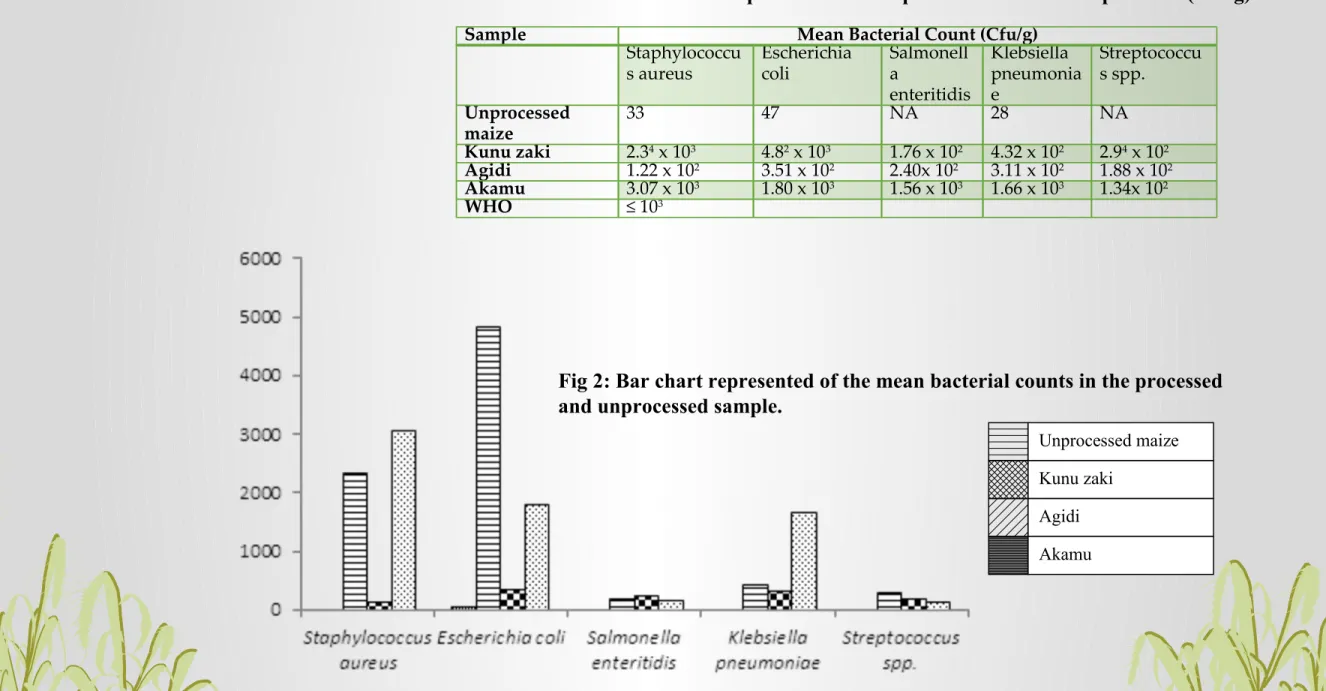
Sample Mean Bacterial Count (Cfu/g) Staphylococcu
s aureus
Escherichia coli
Salmonell a
enteritidis
Klebsiella pneumonia e
Streptococcu s spp.
Unprocessed maize
33 47 NA 28 NA
Kunu zaki 2.34 x 10³ 4.82 x 10³ 1.76 x 10² 4.32 x 10² 2.94 x 10² Agidi 1.22 x 10² 3.51 x 10² 2.40x 10² 3.11 x 10² 1.88 x 10² Akamu 3.07 x 10³ 1.80 x 10³ 1.56 x 10³ 1.66 x 10³ 1.34x 10²
WHO ≤ 103
Unprocessed maize Kunu zaki
Agidi Akamu
Table 3: Mean Bacteria counts in the processed and unprocessed maize meal products (Cfu/g).
Fig 2: Bar chart represented of the mean bacterial counts in the processed and unprocessed sample.
• Avoid large tables and complicated figures
C-I C-II C-III
Species IVI P-value Species IVI P-value Species IVI P-value
Prosopi juliflora 61 0.0002 Eriochloa fatmensis 84.6 0.0002 Aerva javanica 25.1 0
Acacia tortilis 34 0.0248 Abutilon fruticosum 61.9 0.0002 Acacia senegal 16.4 0
Salvadora persica 31 0.0102 Otostegia fruticosa 52.5 0.0002 Chrysopogon plumulosus 10 0.01
Seddera bongshawei 29 0.0358 Cadaba rotundifolia 48.3 0.0008 Eragrostis cylindriflora 13.3 0.04
Hypoestes forskaolii 27 0.2865 Erucastrum arabicum 42.8 0.0004 Seddera latifolia 11.5 0.1
Cynodon dactylon 24 0.0916 Parthenium hysterophorus 41.1 0.0044 Grewia tenax 16.1 0.36
Commelina diffusa 20 0.0254 Jatropha glauca 38.5 0.0004 Setaria verticillata 8.9 0.07
Cenchrus ciliaris 19 0.0662 Seddera latifolia 36 0.0268 Achyranthes aspera var var. pubeseens 11.5 0.17
Peristrophe paniculata 15 0.2919 Grewia villosa 30.3 0.0208 Solanum cordatum 11.6 0.17
Solanum incanum 14 0.1008 Acacia mellifera 23.4 0.0304 Dobera glabra 9.3 0.1
Senna obtusifolia 13 0.0462 Megalochlamys ogadensis 18 0.1892 Ocimum forskoli 10.6 0.29
Cryptostegia grandiflora 13 0.0564 Dactyloctenium scindicum 14.4 0.2817 Pupalia lappacea 4.36 0.24
Acacia nilotica 11 0.1418 Euphorbia longituberculosa 14.3 0.1044 Blepharis maderaspatensis 3.94 0.18
Tribulus parvispinus 10 0.1882 Acacia oerfota 8.6 0.2987 Cocculus pendulus 4.6 0.55
Pavonia propinqua 9 0.1574 Pavonia arabica 7.7 0.197 Solanum schimperianum 3.89 0.47
Leptadenia hastata 9 0.1592 Commiphora coronillifolia 7.7 0.197 Balanites aegyptiaca 3.87 0.41
Commicarpus plumbagingus 9 0.164 Leucas inflata 7.7 0.2004 Sansevieria ehrenbergii 3.01 0.34
Eriochloa fatmensis 9 0.1644 Setaria verticillata 7.7 0.201 Grewia schweinfurthii 3 0.35
Orthophon pallidus 9 0.1648 Eragrostis aethiopica 7.7 0.201 Leucas marticensis 2.88 0.35
Calotropis procera 9 0.1664 Achyranthes aspera var argentea 7.7 0.2024 Cadaba glandulosa 2.95 0.35
Solanum cordatum 9 0.178 Cynodon aethiopicus 7.7 0.2024 Commelina diffusa 2.98 0.36
Digitaria velutina 9 0.1848 Hibiscus calyphyllus 7.7 0.2024 Maerua angolensis 4.06 0.71
Table S3. Indicator values of each species for each group and Monte Carlo test of significance observed for each species.
• Bad results (if accounted for) are better than wrong r esults
• Simple, straight-forward results are much preferred an
d convincing
Discussions
• Discuss all study results and don’t skip any
• Provide personal views/opinions along with others (wit h references) on result findings
• Should gear towards the fulfillment of the objective s
tatements
• Should integrate different result findings to satisfy the ultimate goal of this study
• Use supporting illustrations to convince results valid ity/accuracy
• Avoid too many comparisons with other, previous study
results (different experimental design and conditions)
Conclusions
• About 10% of the total paper size
• Need to emphasize the most important and significant f indings supported by the study results
• Inclusions of possible practical application and impli
cations may booster study contribution and quality
The study showcased the result of an integrated remote sensing and GIS approach in the delineation of groundwater potential areas in hard rock. Geologically, the area is underlain by Migmatite, schist, banded gneiss and feldspartic sandstones. The hard rocks are generally massive, with little or no porosity and permeability, hence they neither store nor transmit considerable quantity of water except in areas with fractures or joints in it. Groundwater potential zones based on this study clearly indicated the combination of feldspartic sandstone and migmatite, ferralsols, high rainfall, gentle slope, plains and lowland, higher lineament density, lesser drainage density and vegetation areas are favorable terrain conditions having moderate and good groundwater potentials. The validation of the groundwater potential model produced was achieved via field investigation of existing boreholes in the study area.
This information on groundwater potential will be very useful for successful policy-planning, management, and sustainable use of
groundwater resources.
Results Summary Results Implications
• Recommendations and limitations are allowed to play a minor role in this section
• Avoid personal subjective opinions
• No reference citations
The results of the physico-chemical and microbiological tests within and very close to the Ilokun dumpsite indicate a very high level of contamination of the groundwater within the area. This portrays a potential high risk to human health.
The open dumping system of waste disposal brings along with it many disadvantages and hazards to human health. Moreover, in view of present trends of high population growth and land usage dynamics, areas possibly thought to be remote from urban access at the moment would come within urban reach only a few years from now. It is therefore recommended that there should be a shift from the open dumping system of waste disposal to the usage of engineered landfills designed according the geology, topography and other criteria as listed by the United Nations Environment Programme (UNEP, 2005).
In the meantime, water from wells within such an area that has once be subjected to exposure to contamination should be boiled or given other appropriate treatment to render them potable and fit for domestic use.
Personal view and
recommendations
References
• Always follow the format prescribed by the journal
• Don’t over-reference ( < 30 for regular papers; > 50 for review papers)
• Use initials for authors’ first names
• Use authors’ last name to alphabetize reference list
• Each listing must to complete and must be cited in the tex
t
Cornish, R. (2007). Statistics: Cluster analysis. Mathematics Learning Support Centre, 1-5.
FCS. (2015). Food Security Cluster core indicator Handbook. FCS.
Miscellaneous
• Proper spacing is “5 cm”, not “5cm”
• Unify use of “Fig.” and “Figure”; “Tab.” and “Table”
• Use “km
2” instead of “sq. km”
• It is “et al.”, not “et al” or “et. al.” or “et. al”
謝謝聆聽
HAPPY WRITING