Effect of TiO
2addition on the crystallization of
Li
2O–Al
2O
3–4SiO
2precursor powders by a sol-gel process
Shaw-Bing Wen
Department of Resources Engineering, National Cheng-Kung University, 1 Ta-Hsueh Road, Tainan, 70101, Taiwan, Republic of China
Nan-Chung Wu and Sheng Yang
Department of Materials Science and Engineering, National Cheng-Kung University, 1 Ta-Hsueh Road, Tainan, 70101, Taiwan, Republic of China
Moo-Chin Wang
Department of Mechanical Engineering, National Kaohsiung Institute of Technology, 415 Chien-Kung Road, Kaohsiung, 80782, Taiwan, Republic of China
(Received 14 March 1999; accepted 28 May 1999)
The activation energy for crystallization of -spodumene in TiO
2added
Li
2O–Al
2O
3–4SiO
2(LAS) precursor powders by a sol-gel process was studied by using isothermal and nonisothermal methods. Nonisothermal kinetics for the LAS precursor powder system were investigated using differential thermal analysis (DTA) and quantitative x-ray diffraction (XRD) analysis. The rate of crystallization of LAS precursor powders decreased as the TiO
2content increased. For samples with addition of 0, 5.0, and 10.0 wt% TiO
2, the activation energies for crystallization by DTA evaluation were 165.06, 194.46, and 205.38 kJ/mol, respectively. According to the quantitative XRD method, the values computed by the Johnson–Mehl–Avrami equation were 162.54, 189.42, and 196.14 kJ/mol, respectively. The values obtained by
isothermal and nonisothermal kinetic methods from DTA and XRD analyses were in good agreement. The growth morphology parameters were 0.59, 0.70, and 0.76, respectively, for the LAS precursor powder with TiO
2addition of 0, 5.0, and 10.0 wt%, showing a rodlike growth. In the LAS precursor powder system, TiO
2did not act as the nucleative agent.
I. INTRODUCTION
Glass-ceramics containing the -spodumene (Li
2O ⭈ Al
2O
3⭈ 4SiO
2, LAS) crystalline phase are used for cooktop panels, stove windows, cookware, and some precision parts.
1-Spodumene has a tetragonal dipyra- mid crystal structure
2which is uniaxial positive.
3A com- mon characteristic of -spodumene is the anisotropic thermal expansion. The thermal expansion of the c axis and a axis of -spodumene from 25 to 1200 °C is almost linear and parabolic, respectively.
3Conventionally, glass-ceramic is fabricated by the tra- ditional forming techniques, e.g., blowing, pressing, or casting, followed by nucleation and crystallization.
Glass-ceramic can also be produced by sintering and crystallizing glass powder. This permits the reduction of processing temperature and the fabrication of complex shape using a variety of ceramic formation techniques, e.g., dry pressing, slip casting, tap casting, extrusion, and injection molding.
2Several workers attempted to sinter -spodumene glass-ceramics by using spodumene glass powders.
4–6It
was shown that stoichiometric spodumene glass does not sinter well. Addition of a small amount of B
2O
3and/or P
2O
5was necessary to crystallize the -spodumene glass-ceramics. It is not easy to sinter and crystallize
-spodumene glass powder without a proper sintering agent unless the alkoxide-derived agents are used.
7–9The incorporation of sintering agent results in a large thermal expansion due to presence of deleterious and unneces- sary minor phases. Therefore, preparation of homoge- neous fine -spodumene precursor powders is desirable, in order to lower sintering temperature and obtain an appropriate phase.
Investigations of kinetics of crystallization of the glass and gel are of interest in preparation of glass-ceramics.
Techniques of differential thermal analysis (DTA), dif- ferential scanning calorimetry (DSC), and x-ray diffrac- tion (XRD) have been extensively used to study the devitrification of glass. Several methods have been pro- posed to obtain kinetic data from DTA and DSC curves
10–24and XRD patterns.
18,25–29In the present paper, the effect of addition of TiO
2on
kinetics of crystallization of -spodueme in Li
2O–
Al
2O
3–4SiO
2precursor powders was studied by us- ing DTA, XRD, and transmission electron micros- copy (TEM).
II. EXPERIMENTAL PROCEDURE A. Gel preparation
The precursor powders with a spodumene composition (Li
2O ⭈ Al
2O
3⭈ 4SiO
2) were prepared from tetraethyl orthosilicate [TEOS, Si(OC
2H
5)
4], aluminum tri- sec-butoxide [ASB, Al(OC
4H
9AlC)
3], and lithium nitrate (LiNO
3) as the starting materials. The TEOS, ASB, and LiNO
3were supplied by Janssen Chemical Co. (Bel- gium), Aldrich Co. (Milwaukee, WI), and Fluka Co.
(Switzerland), respectively. A schematic flow chart of the LAS ceramic powders prepared by the sol-gel process is shown in Fig. 1. The silica sol can be made by mixing TEOS, ethanol, deionized water, and hydrochloric acid in a molar ratio of 1:40:40:0.3. The alumina sol can be made by mixing Al(OC
4H
9)
3, deionized water, and hy- drochloric acid in a molar ratio of 1:100:0.2. The lithium nitrate solution can be made by dissolving lithium nitrate in deionized water. The LAS ceramic powder was pre- pared by sequentially premixed silica sol and alumina sol to form a mixture and then adding lithium nitrate into it.
The amounts of silica sol, alumina sol, and lithium nitrate solution make the molar ratio of Li
+:Al
3+:Si
4+as 1:1:2.
The mixture solution was refluxed for 70–90 min to obtain an insoluble gel. The gel was then dried at 323 K for 72–120 h and ground to obtain LAS precur- sor powder.
TiO
2powder was prepared from titanium tetrachloride (TiCl
4) as starting materials. TiCl
4was supplied by Freak Co. (Germany). The flow chart for preparation of the TiO
2powder by precipitation is shown in Fig. 2. TiCl
4was dissolved in chilled water, under stirring, and a stable titanyl aqueous solution was consequently formed at room temperature. NH
4OH solution was added to this solution under stirring until pH ⳱ 9 was reached and precipitation occurred. The precipitates were filtered out and washed several times with deionized water, followed by drying and calcining at 1073 K for 4 h.
Three batches of test samples, each representing a LAS precursor powder with 0, 5.0, or 10.0 wt% TiO
2, were prepared. Each mixture was agitated for 6 h in a laboratory ball mixer containing aluminum oxide balls and ethanol. The well-mixed powder was dried.
B. Characterization
Differential thermal analysis (DTA) was conducted on a 50 mg powder sample at heating rate of 3, 10, 15, and 20 K/min, respectively, in air. A SETARAM TG 24 Si- multaneous Symmetrical Thermoanalyzer was used.
Al
2O
3powder served as reference material.
FIG. 1. Schematic diagram of the sol-gel process for preparing-spodumene ceramic powders.
The crystalline phase was identified by XRD and ED analyses. The XRD work was performed with a Rigaku x-ray diffractometer using Cu K
␣radiation and a Ni fil- ter. The scanning rate was fixed at 0.25° (2)/min. The transmission electron microscopy was carried out using a JEM 200 microscope operating at 200 kV. Selected area electron diffraction examination was made on cal- cined powders.
III. RESULTS AND DISCUSSION
Typical DTA curves obtained for calcined LAS pre- cursor powders with varying TiO
2content at a heating rate of 3 K/min are shown in Fig. 3. These precursor powders show a single crystallization peak, which is at- tributed to crystallization of -spodumene. It can be seen that TiO
2addition progressively raises the temperature of exothermic peak, as 903, 930, and 940 K, for batches with 0, 5.0, and 10.0 wt% TiO
2, respectively. This find- ing is quite significant in that TiO
2addition does not appear to promote -spodumene crystallization. Accord- ing to the report of Ray et al.,
30the increase of nuclei in a glass causes a decrease in DTA peak temperature, which reaches a minimum at the temperature where the
maximum number of nuclei are formed. In this study, the addition ot TiO
2to LAS precursor powders does not increase nucleation sites, so it cannot decrease the tem- perature of formation of -spodumene phase.
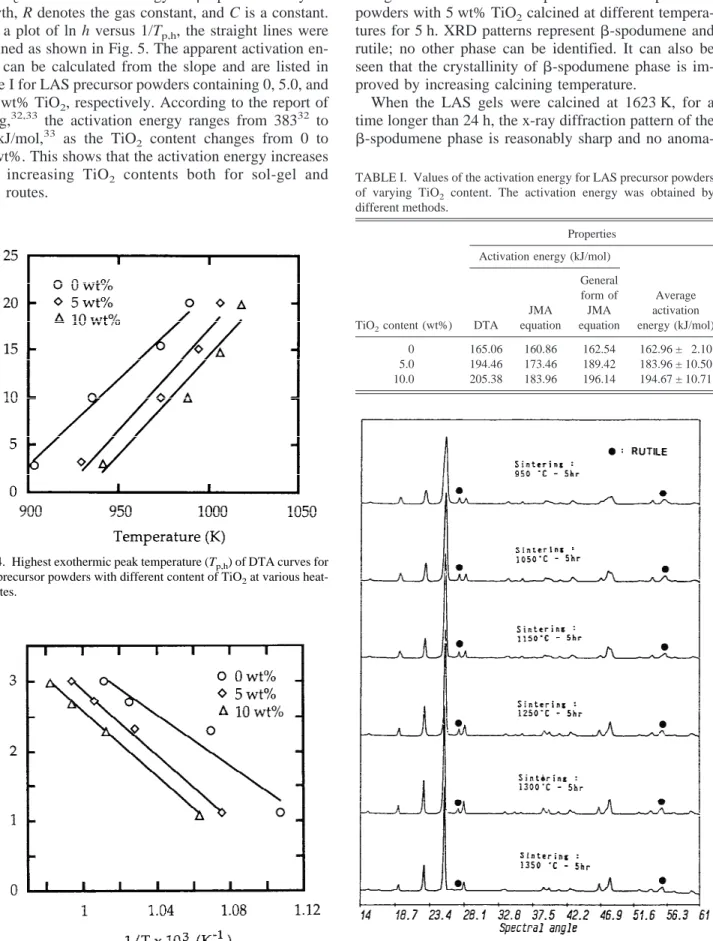
The exothermic peak temperatures (T
p,h) for LAS pre- cursor powders containing various contents of TiO
2at different heating rates are shown in Fig. 4. It is seen that as the heating rate increases, the T
p,hposition shifts to higher temperatures for the same TiO
2content.
The crystallization of LAS precursor powders repre- sents the rearrangement of the irregular spodumene frame structure into the periodic lattice of the growing crystal. The crystallization kinetics of the LAS precursor powders of different TiO
2contents was evaluated using DTA analysis with various heating rates, h, varying from 3 to 20 K/min. The degree of crystallization, ␣, reaches the same specific value at the DTA peak temperature, T
p,h, regardless of the heating rate, h.
31Therefore, the following equation can be derived:
ln h = − E
cRT
p,h+ C . (1)
FIG. 2. Schematic diagram of the wet–dry process for preparing TiO2
ceramic powders. FIG. 3. DTA curves of LAS precursor powders containign TiO2of 0,
5.0, and 10.0 wt% at a heating rate of 3 K/min, respectively: (a) 0%, (b) 5.0 wt%, (c) 10.0 wt%.
Here E
cis the activation energy for -spodumene crystal growth, R denotes the gas constant, and C is a constant.
In a plot of ln h versus 1/T
p,h, the straight lines were obtained as shown in Fig. 5. The apparent activation en- ergy can be calculated from the slope and are listed in Table I for LAS precursor powders containing 0, 5.0, and 10.0 wt% TiO
2, respectively. According to the report of Wang,
32,33the activation energy ranges from 383
32to 775 kJ/mol,
33as the TiO
2content changes from 0 to 8.0 wt%. This shows that the activation energy increases with increasing TiO
2contents both for sol-gel and glass routes.
Figure 6 shows the XRD patterns of LAS precursor powders with 5 wt% TiO
2calcined at different tempera- tures for 5 h. XRD patterns represent -spodumene and rutile; no other phase can be identified. It can also be seen that the crystallinity of -spodumene phase is im- proved by increasing calcining temperature.
When the LAS gels were calcined at 1623 K, for a time longer than 24 h, the x-ray diffraction pattern of the
-spodumene phase is reasonably sharp and no anoma-
TABLE I. Values of the activation energy for LAS precursor powders of varying TiO2 content. The activation energy was obtained by different methods.
TiO2content (wt%)
Properties Activation energy (kJ/mol)
Average activation energy (kJ/mol) DTA
JMA equation
General form of JMA equation
0 165.06 160.86 162.54 162.96 ± 2.10 5.0 194.46 173.46 189.42 183.96 ± 10.50 10.0 205.38 183.96 196.14 194.67 ± 10.71
FIG. 4. Highest exothermic peak temperature (Tp,h) of DTA curves for LAS precursor powders with different content of TiO2at various heat- ing rates.
FIG. 5. Plots of ln h versus 1/ Tp,h: (a) 0%, (b) 5.0 wt%, (c) 10.0 wt%.
FIG. 6. XRD patterns of LAS precursor powders containing TiO2of 5.0 wt% as calcined at various temperature for 5 h.
lous intensity changes for the major peak (201).
34Hence the intensity of this peak (2 from 24.5 to 26.1°) may be considered as the standard for comparing the relative crystallinity. The relative amount of -spodumene pres- ent in the calcined gels was determined by comparing the intensities of the major peak of the -spodumene with the standard specimens.
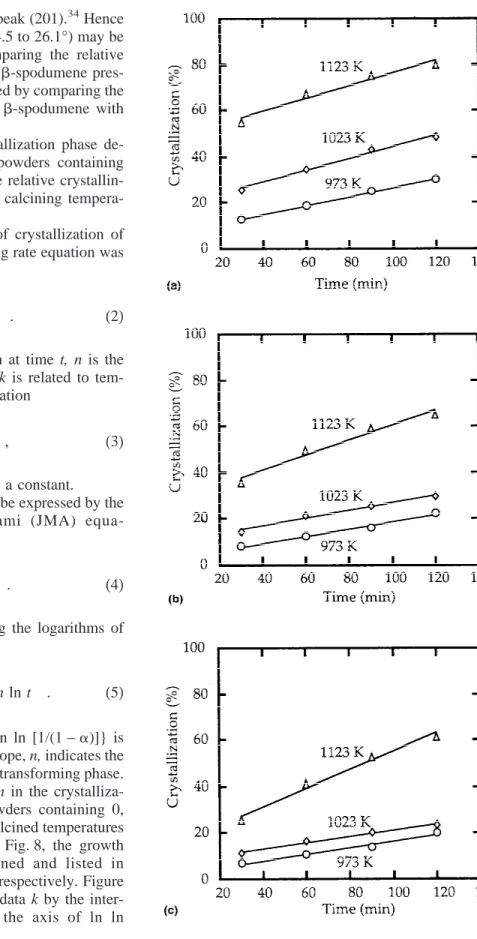
The volume fraction ( ␣) of crystallization phase de- tected by XRD in LAS precursor powders containing various TiO
2is shown in Fig. 7. The relative crystallin- ity of -spodumene is a function of calcining tempera- ture and time.
To obtain the kinetic parameter of crystallization of LAS precursor powders, the following rate equation was assumed:
15d ␣
dt = k
nt
n−1共1 − ␣兲 . (2) Here ␣ is the crystallization fraction at time t, n is the growth morphology parameter, and k is related to tem- perature T by an Arrhenius-type equation
k = A exp 冉 − RT E
c冊 , (3)
where R is the gas constant and A is a constant.
The integrated form of Eq. (2) can be expressed by the well-known Johnson–Mehl–Avrami (JMA) equa- tion:
15,35ln 冉 1 − 1 ␣ 冊 = 共kt兲
n. (4)
Equation (5) is obtained by taking the logarithms of both sides of Eq. (4)
ln ln 冉 1 − 1 ␣ 冊 = n ln k + n ln t . (5)
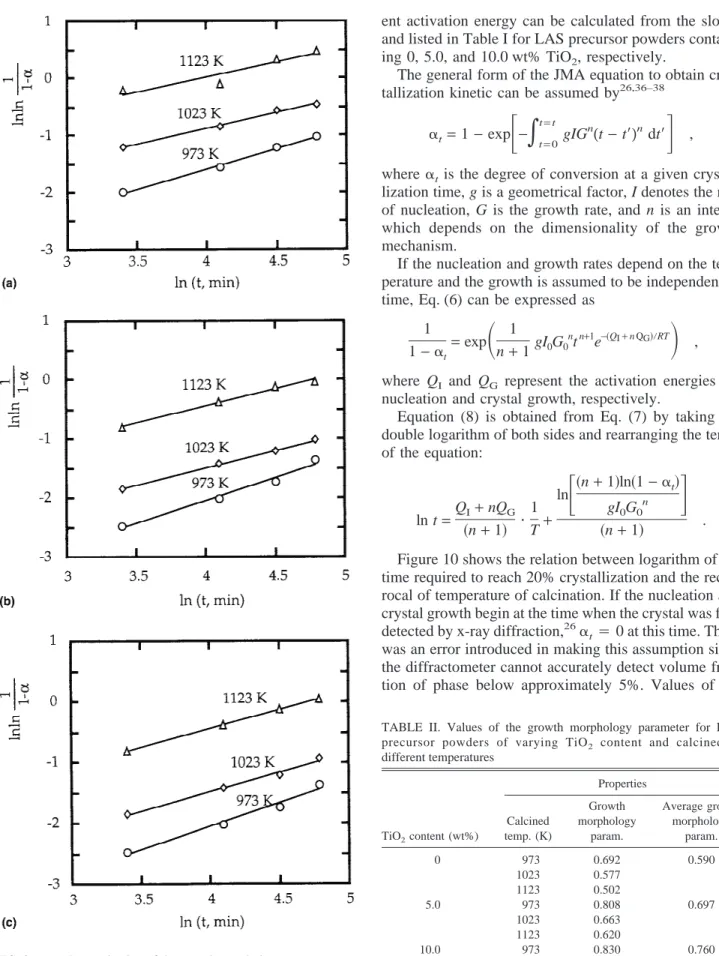
If the left hand side of Eq. (5) {ln ln [1/(1 − ␣)]} is plotted against ln t, the straight line slope, n, indicates the growth morphology parameter of the transforming phase.
The growth morphology parameter n in the crystalliza- tion process for LAS precursor powders containing 0, 5.0, and 10.0 wt% TiO
2at varying calcined temperatures is shown in Fig. 8. By Eq. (5) and Fig. 8, the growth morphology parameter n is obtained and listed in Table II, being 0.59, 0.70, and 0.76, respectively. Figure 8 also provides the kinetic constant data k by the inter- ception of the straight line with the axis of ln ln [1/(1 − ␣)].
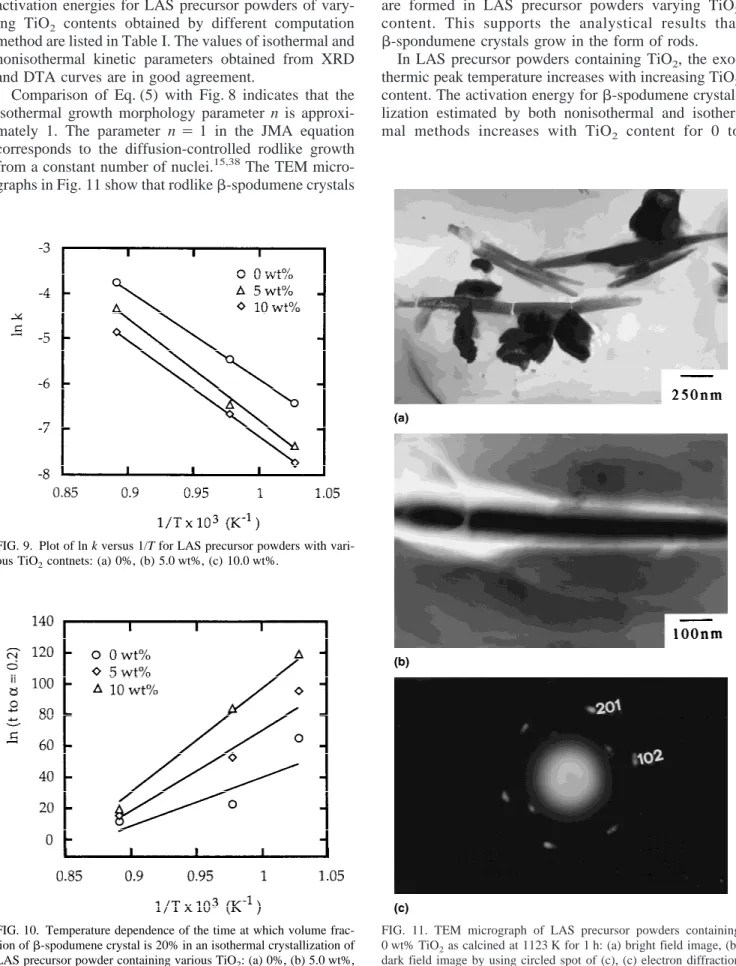
Figure 9 shows the relation between the logarithm of kinetic constant k and the reciprocal of calcined tempera- ture. The straight lines are obtained, and then the appar-
FIG. 7. Variation of volume fraction of -spodumene crystal with time in an isothermal crystallization of LAS precursor powders with different TiO2contents: (a) 0%, (b) 5.0 wt%, (c) 10.0 wt%.
ent activation energy can be calculated from the slopes and listed in Table I for LAS precursor powders contain- ing 0, 5.0, and 10.0 wt% TiO
2, respectively.
The general form of the JMA equation to obtain crys- tallization kinetic can be assumed by
26,36–38␣
t= 1 − exp 冋 −
兰t=0t=tgIG
n(t − t ⬘)
ndt ⬘ 册 , (6)
where ␣
tis the degree of conversion at a given crystal- lization time, g is a geometrical factor, I denotes the rate of nucleation, G is the growth rate, and n is an integer which depends on the dimensionality of the growth mechanism.
If the nucleation and growth rates depend on the tem- perature and the growth is assumed to be independent of time, Eq. (6) can be expressed as
1 1 − ␣
t= exp 冉 n 1 + 1 gI
0G
0nt
n+1e
−共QI+n QG兲ⲐRT冊 , (7)
where Q
Iand Q
Grepresent the activation energies for nucleation and crystal growth, respectively.
Equation (8) is obtained from Eq. (7) by taking the double logarithm of both sides and rearranging the terms of the equation:
ln t = Q
I+ nQ
G共n + 1 兲 ⭈
1 T +
ln 冋 共n + 1 gI 兲ln共1
0G
0n− ␣
t兲 册
共n + 1 兲 . (8) Figure 10 shows the relation between logarithm of the time required to reach 20% crystallization and the recip- rocal of temperature of calcination. If the nucleation and crystal growth begin at the time when the crystal was first detected by x-ray diffraction,
26␣
t⳱ 0 at this time. There was an error introduced in making this assumption since the diffractometer cannot accurately detect volume frac- tion of phase below approximately 5%. Values of the
TABLE II. Values of the growth morphology parameter for LAS precursor powders of varying TiO2 content and calcined at different temperatures
TiO2content (wt%)
Properties
Calcined temp. (K)
Growth morphology
param.
Average growth morphology
param.
0 973 0.692 0.590
1023 0.577
1123 0.502
5.0 973 0.808 0.697
1023 0.663
1123 0.620
10.0 973 0.830 0.760
1023 0.606
1123 0.845
FIG. 8. (a–c) Determination of the growth morphology parameter (n) in the crystallization process for LAS precursor powders with different TiO2contents.
activation energies for LAS precursor powders of vary- ing TiO
2contents obtained by different computation method are listed in Table I. The values of isothermal and nonisothermal kinetic parameters obtained from XRD and DTA curves are in good agreement.
Comparison of Eq. (5) with Fig. 8 indicates that the isothermal growth morphology parameter n is approxi- mately 1. The parameter n ⳱ 1 in the JMA equation corresponds to the diffusion-controlled rodlike growth from a constant number of nuclei.
15,38The TEM micro- graphs in Fig. 11 show that rodlike -spodumene crystals
are formed in LAS precursor powders varying TiO
2content. This supports the analystical results that
-spondumene crystals grow in the form of rods.
In LAS precursor powders containing TiO
2, the exo- thermic peak temperature increases with increasing TiO
2content. The activation energy for -spodumene crystal- lization estimated by both nonisothermal and isother- mal methods increases with TiO
2content for 0 to
FIG. 9. Plot of ln k versus 1/T for LAS precursor powders with vari- ous TiO2contnets: (a) 0%, (b) 5.0 wt%, (c) 10.0 wt%.
FIG. 10. Temperature dependence of the time at which volume frac- tion of-spodumene crystal is 20% in an isothermal crystallization of LAS precursor powder containing various TiO2: (a) 0%, (b) 5.0 wt%, (c) 10.0 wt%.
FIG. 11. TEM micrograph of LAS precursor powders containing 0 wt% TiO2as calcined at 1123 K for 1 h: (a) bright field image, (b) dark field image by using circled spot of (c), (c) electron diffraction pattern corresponding to the-spodumene phase.
10.0 wt% and the crystal contents decreases from 25.8%
to 11.0%, when the powders are calcined at 1023 K for 30 min.
These data indicate that addition of TiO
2to LAS precursor powders inhibits the evolution of the
-spodumene phase; that is, TiO
2does not act as the nucleation agents in LAS precursor powder systems. It is assumed that, in the process of mixing silica and alumina sol and lithium nitrate solution, the -spodumene skeleton is already formed, which facilitates the
-spodumene cyrstallization without the effect of nuclea- tion agent.
IV. CONCLUSION
The effect of TiO
2addition on the kinetics of crystal- lization of Li
2O–Al
2O
3–4SiO
2sol-gel precursor powders has been investigated. The following conclusions were obtained:
(1) The DTA highest exothermic peak temperature increases as the TiO
2content increases from 0 to 10.0 wt%.
(2) For LAS precursor powders with addition of 0, 5.0, and 10.0 wt% TiO
2, the activation energy for crystalli- zation of -spodumene is 162.96 ± 2.10, 183.96 ± 10.50, and 194.67 ± 10.71 kJ/mol, respectively.
(3) The growth morphology parameter for the LAS precursor powder with addition of 0, 5.0, and 10.0 wt%
TiO
2is 0.59, 0.70, and 0.76, respectively, which indi- cates the rodlike growth of -spodumene.
(4) In the LAS precursor powders, TiO
2does not act as the nucleation agent.
ACKNOWLEDGMENTS
This work was supported by the National Science Council, Taiwan, Republic of China, under Contract No.
81-0405-E006-09, which is gratefully acknowledged.
Help in experimental work and suggestions from Dr. M.H. Hon, Dr. H.S. Liu, and Mr. J.M. Chen, and Mr. S.Y. Yau are appreciated.
REFERENCES
1. H. Scheidler and E. Rodek, Am. Ceram. Soc. Bull. 68, 1926 (1989).
2. E.M. Rabinovich, J. Mater. Sci. 20, 4259 (1985).
3. W. Ostertag, G.R. Fischer, and J.P. Williams, J. Am. Ceram. Soc.
5, 651 (1968).
4. S. Knickerbocker, M.R. Tuzzolo, and S. Lawhorne, J. Am. Ceram.
Soc. 72, 1873 (1989).
5. J.J. Shyu and H.H. Lee, J. Am. Ceram. Soc. 78, 2161 (1995).
6. J.J. Shyu and C.T. Wang, J. Mater. Res. 11, 2518 (1996).
7. H. Kobayashi, N. Ishibachi, T. Akiba, and T. Mitamura, Nippon Seramikkusu Kyokai Gakujutsu Ronbunshi (J. Ceram. Soc. Jpn.) 98, 703 (1990).
8. J.S. Yang, S. Sakka, T. Yoko, and H. Kozuka, J. Mater. Sci. 26, 1827 (1991).
9. H. Suzuki, J.I. Takahashi, and H. Saito, Chem. Soc. Jpn. 10, 1319 (1991).
10. J. Sestak, Phys. Chem. Glasses. 15, 137 (1974).
11. W. Zdaniewski, J. Am. Ceram. Soc. 58, 163 (1975).
12. K. Matusita, S. Sakka, and Y. Matsui, J. Mater. Sci. 10, 961 (1975).
13. K. Matusita, S. Sakka, T. Maki, and M. Taskin, J. Mater. Sci. 10, 94 (1975).
14. A. Marotta and A. Buri, Thermochim. Acta 25, 155 (1978).
15. A. Marotta, A. Buri, and G.L. Valent, J. Mater. Sci. 13, 2483 (1978).
16. K. Matusita and S. Sakka, Phys. Chem. Glasses 20, 81 (1979).
17. K. Matusita and S. Sakka, J. Non-Cryst. Solids 38, 39, 741 (1980).
18. A. Marotta, A. Buir, and F. Branda, J. Mater. Sci. 16, 341 (1981).
19. K. Matusita, T. Komatsu, and R. Yokota, J. Mater. Sci. 19, 214 (1984).
20. F. Branda, A. Buir, A. Marotta, and S. Saiello, Thermochim. Acta 80, 269 (1984).
21. J.S. Lee, J-Ch. Perng, and Ch-W. Huang, Thermochim. Acta 161, 29 (1980).
22. S. Yannacopoulos and S.O. Kasap, J. Mater. Res. 5, 789 (1990).
23. E. Tkalcec, D. Senija, V. Dondur, and N. Petranovic, J. Am.
Ceram. Soc. 75, 1958 (1992).
24. C.S. Hsi and M.C. Wang, J. Mater. Res. 13, 2655 (1998).
25. F.P.H. Chen, J. Am. Ceram. Soc. 46, 476 (1963).
26. S.W. Freiman and L.L. Hench, J. Am. Ceram. Soc. 52, 382 (1968).
27. A.A. Marotta, A. Buri, and G.L. Valent, J. Mater. Sci. 13, 2483 (1978).
28. H.S. Kim, R.D. Rawlings, and P.S. Rogers, Br. Ceram. Proc. 42, 59 (1989).
29. M.C. Wang and M.H. Hon, J. Ceram. Soc. Jpn. 100, 1285 (1992).
30. C.R. Ray, W. Huang, and D.E. Day, J. Am. Ceram. Soc. 74, 160 (1991).
31. A. Marotta, A. Buri, and P. Pernice, Phys. Chem. Glasses 21, 94 (1980).
32. M.C. Wang, J. Ceram. Soc. Jpn. 102, 109 (1994).
33. M.C. Wang, J. Mater. Res. 14, 97 (1999).
34. S.B. Wen, S. Yang, J.M. Chen, N.C. Wu, and M.C. Wang, (un- published).
35. M. Avrami, J. Chem. Phys. 7, 1103 (1939).
36. W.A. Johnson and R.F. Mehl, Trans. Am. Inst. Met. Eng. 135, 416 (1938).
37. M. Avrami, J. Chem. Phys. 9, 177 (1941).
38. Z. Strnad, Glass-Ceramic Materials (Elsevier, Amsterdam, 1986), pp. 63–66.