行政院國家科學委員會專題研究計畫 成果報告
從科技-組織-環境觀點探討電子化企業發展資訊科技能力 影響因素之實證研究
研究成果報告(精簡版)
計 畫 類 別 : 個別型
計 畫 編 號 : NSC 100-2410-H-011-004-
執 行 期 間 : 100 年 08 月 01 日至 101 年 07 月 31 日 執 行 單 位 : 國立臺灣科技大學資訊管理系
計 畫 主 持 人 : 李國光
計畫參與人員: 碩士班研究生-兼任助理人員:陳郁慧 碩士班研究生-兼任助理人員:胡明傑 碩士班研究生-兼任助理人員:許之青
報 告 附 件 : 出席國際會議研究心得報告及發表論文
公 開 資 訊 : 本計畫涉及專利或其他智慧財產權,1 年後可公開查詢
中 華 民 國 101 年 10 月 30 日
中 文 摘 要 : 資訊技術的日新月異,如何發展及培養高的資訊科技能力 (Information Technology capabilities),並有效的提升組 織整體績效,已成為實務界在推動企業電子化的過程中所關 注的焦點。從相關的文獻可發現,已有學者專家從不同的角 度探討企業的資訊科技能力,以及資訊科技能力對組織績效 之影響的各項議題。然而彙整這些相關研究,可以瞭解到這 些研究大部份是以概念性架構,或是從技術應用的角度來探 討企業資訊科技能力的發展。而從科技-組織-環境
(Technological-Organization-Environmental,TOE)的觀 點,探討電子化企業發展資訊科技能力影響因素之實證研究 仍然相當的少。
本研究經由整理及歸納相關文獻之後,提出下列研究目的:
(1)以問卷調查之實證研究方式,從科技-組織-環境的觀點,
來探討影響電子化企業發展資訊科技能力之因素;(2)探討電 子化企業資訊科技能力對資訊科技策略實施成效的影響。由 於大型企業的資訊科技基礎建設以及資訊科技成熟度較一般 中小型企業完備,因此本研究主要以台灣一千大企業資訊部 門主管作為問卷調查之對象,並將所蒐集到的資料,採用結 構方程模型方法,來驗證研究假設的有效性。調查結果顯 示,科技面、組織面及環境面所包含的因素皆對電子化企業 資訊科技能力有顯著的影響;而電子化企業資訊科技能力對 資訊科技策略實施成效亦有直接顯著的影響。此研究結果與 發現,可提供企業未來在推動電子化的過程中,發展資訊科 技能力及實施資訊科技策略之重要參考。
中文關鍵詞: 電子化企業、資訊科技能力、「科技-組織-環境」架構、資 訊科技策略實施
英 文 摘 要 : 英文關鍵詞:
從科技-組織-環境觀點探討電子化企業發展資訊科技能力影響因素 之實證研究
Empirical Study on Factors of Development of Information Technology
Capability in E-business from the Technological-Organization-Environmental Perspective
計畫編號:100-2410-H-011-004
執行期間:100 年 8 月 1 日至 100 年 7 月 31 日 主持人:李國光,國立台灣科技大學資訊管理系
計畫參與人員:陳郁慧,國立台灣科技大學資管系碩士生 胡明傑,國立台灣科技大學資管系碩士生 許之青,國立台灣科技大學資管系碩士生
一、中文摘要
資 訊 技 術 的 日 新 月 異 , 如 何 發 展 及 培 養 高 的 資 訊 科 技 能 力 (Information Technology capabilities),並有效的提升組織整體績效,已成為實務界在推動企業 電子化的過程中所關注的焦點。從相關的文獻可發現,已有學者專家從不同的角 度探討企業的資訊科技能力,以及資訊科技能力對組織績效之影響的各項議題。
然而彙整這些相關研究,可以瞭解到這些研究大部份是以概念性架構,或是從技 術 應 用 的 角 度 來 探 討 企 業 資 訊 科 技 能 力 的 發 展 。 而 從 科 技 - 組 織 - 環 境 (Technological-Organization-Environmental,TOE)的觀點,探討電子化企業發展資 訊科技能力影響因素之實證研究仍然相當的少。
本研究經由整理及歸納相關文獻之後,提出下列研究目的:(1)以問卷調查 之實證研究方式,從科技-組織-環境的觀點,來探討影響電子化企業發展資訊科 技能力之因素;(2)探討電子化企業資訊科技能力對資訊科技策略實施成效的影 響。由於大型企業的資訊科技基礎建設以及資訊科技成熟度較一般中小型企業完 備,因此本研究主要以台灣一千大企業資訊部門主管作為問卷調查之對象,並將 所蒐集到的資料,採用結構方程模型方法,來驗證研究假設的有效性。調查結果 顯示,科技面、組織面及環境面所包含的因素皆對電子化企業資訊科技能力有顯 著的影響;而電子化企業資訊科技能力對資訊科技策略實施成效亦有直接顯著的 影響。此研究結果與發現,可提供企業未來在推動電子化的過程中,發展資訊科 技能力及實施資訊科技策略之重要參考。
關鍵詞: 電子化企業、資訊科技能力、「科技-組織-環境」架構、資訊科技策略實
施 二、緣由與目的
由於資訊科技的快速發展與通訊 和網路技術的發達,企業的資訊處理 速度不僅增快且成本低廉。因此透過
資 訊 科 技 的 應 用 , 讓 企 業 得 以 更 快 速、經濟的方式,提供多樣化的產品 和服務來滿足顧客的需求,同時創造 更多的企業價值。然而在不斷訊速變 遷的商業環境下,企業已發現若僅將
內部作業流程最佳化,是無法快速回 應市場的需求(Yang et al., 2005; Teo et al., 2006)。面對這個多變且複雜的競爭 環境,企業必須整合資訊科技和企業 策略,並改善營運模式,才能回應外 在的變化,時至今日已有許多的組織 已持續推動企業電子化(Zhu,2004;Zhu and Kraemer,2005)。企業電子化可說是 一種以資訊技術為基礎,整合組織內 外物流、金流與資訊流等相關連的活 動 , 以 滿 足 企 業 進 行 電 子 商 務 的 需 求,進而強化企業體質。因此企業電 子化所產生的影響,不僅只是以往資 訊科技所帶來的自動化而已,而是根 本改變了企業的經營模式,使得企業 必 須 重 新 思 考 該 如 何 提 升 組 織 的 能 力,才能在電子化企業年代下永續經 營(Kalakota and Robinson,1999)。
爲了提升資訊品質以及快速反應 競爭環境的變化,電子化企業往往運 用各種資訊系統將組織內部價值鏈與 外 部 交 易 相 關 的 活 動 加 以 整 合 (Eze,2008; Wang and Shi,2009)。然而許 多企業在採行新的資訊科技時,並沒 有制定出一個好的資訊科技策略,往 往忽略資訊科技與企業策略間的配適 問題,使得資訊科技的投資一直無法 達 成 期 望 的 價 值 (Henderson and Venkatramen,1993)。電子化企業必須以 不同的經營模式來提高競爭優勢,資 訊科技不僅只是一項輔助工具,應該 善 加 運 用 以 形 成 新 的 企 業 策 略 (Bharadwaj, 2000;Weill et al. ,2002 )。
因此企業在規劃資訊科技策略前,除 了須先審視企業內部現有的資訊系統 外,還需考量組織未來的資訊需求,
以制定出適合的資訊科技策略發展方 向 , 協 助 組 織 實 現 其 目 標 (Gottschalk,1999)。然而僅管有很多的 企業將資訊科技策略規劃成一份很好 的計畫書,但是卻很少將此計畫轉換 為 實 際 的 行 動 (Kalakota and Robinson,1999)。許多的企業強調藉由 資訊系統策略規劃活動,來推導產生
企業的資訊科技策略,但這些資訊科 技 策 略 往 往 未 能 被 有 效 實 施 (Gottschalk, 1999; Teo and Ang, 2001;
Salmela and Spil, 2002)。O'Brien(2004) 認為即使擁有規劃良好的資訊科技策 略,企業仍需有極為堅強的能力以確 保計畫的實施。而能力可以被視為是 一個企業使用企業流程來佈署資源以 便 順 利 完 成 組 織 中 的 某 些 工 作 或 活 動,因此組織若有好的能力,將能夠 有 效 的 實 施 所 規 劃 的 策 略 (Barney,1991;Grant, 1991;Amit and Schoemaker, 1993;Teece et al.,1997)。在 企業推動電子化的過程中,要確保所 制定的策略能被有效的實施,其中一 個重要的關鍵因素,便是要擁有具競 爭 力 的 資 訊 科 技 能 力 (Tarafdar and
Vaidya,2002;Sambamurthy et al.,2003)。企業在資訊科技的運用上,
有三個必須重視的課題,包括:資訊科 技架構的設計、資訊服務的傳遞與企 業和資訊科技的願景,而資訊科技能 力 與 上 述 三 項 課 題 有 著 密 切 的 關 係 (Fenny and Willcocks,1998) 。 Ravichandran and Lertwongsatien(2005) 也認為要把資訊科技服務傳遞到整個 組織,企業必須擁有高的資訊科技能 力。而企業資訊科技能力的高低,不 僅影響組織由外部取得所需新 IT 的能 力,還會影響利用和部署內部 IT 資源 的能力(Tian et al.,2010)。因此企業的資 訊科技能力愈高,對組織資訊系統的 應 用 與 發 展 , 愈 有 正 面 的 提 昇 效 果
(Sabherwal,1999;Santhanam and Hartono,2003;Abu-Musa,2004;Muhanna
and Stoel,2010)。
然而,彙整這些相關研究可以瞭 解,探討影響電子化企業資訊科技能 力之因素的相關實證研究仍不多見,
因此透過本研究的研究結果與發現,
將可彌補以往研究文獻不足之處,以 提供學界與實務界之重要參考。
三、結果與討論
Barney(1991) 認 為 企 業 持 有 某 些 獨特的資產和能力,使得在同業中能 夠創造競爭優勢上的差異,若是能有 效運用,將促進組織成長並創造市場 地位。IS/IT 的使用主要就是用來支援 組織經營,以提升組織競爭力,而組 織的結構、科技能力與所擬定的策略 等因素,均會影響 IS/IT 的採用與導入 (Orlikowski, 2000) 。 Peppard 和 Ward(2004)在研究中也指出,資訊科技 能力會影響企業策略、IS/IT 策略、企 業運作和 IT 運作與服務等構面,進而 影響到整體的組織績效。因此本研究 以 Peppard 和 Ward (2004)所提出之資 訊科技能力與組織績效關聯模式,以 及 TOE 架 構 (Tornatzky and Fleischer,1990)作為研究架構之理論基 礎,並以 Gottschalk(1999)所提出之資 訊科技策略實施量表做為發展概念性 架構的重要參考。本研究從 TOE 的觀 點,探討對電子化企業資訊科技能力 的影響;同時探究電子化企業資訊科 技能力對資訊科技策略實施成效之影 響。然而企業並不存在一個通用的策 略,每個組織必須依據所處的環境條 件,制定適合的策略。已有許多學者 從環境不確定性、組織結構、資訊密 度與資訊系統成熟度等不同的角度,
探討影響 IS/IT 的因素(Premkumar and King,1994; King and Teo, 1996; Gupta et al,1997)。綜合過去學者的研究,本 研究在科技構面將探討 IT 成熟度及 IT 基礎建設對電子化企業資訊科技能力 的影響;在組織構面將探討資訊人力 資源及高階主管支持度對電子化企業 資訊科技能力的影響;在環境構面將 探討夥伴關係品質及競爭壓力對電子 化企業資訊科技能力的影響。本研究 並提出下列研究假說:。
H1:電子化企業資訊科技能力與 資訊科技策略實施成效有正向顯著關 係。
H2:IT 成熟度與電子化企業資訊
科技能力有正向顯著關係。
H3:IT 基礎建設與電子化企業資 訊科技能力有正向顯著關係。
H4:資訊人力資源與電子化企業 資訊科技能力有正向顯著關係。
H5:高階主管支持度與電子化企 業資訊科技能力有正向顯著關係。
H6:夥伴關係品質與電子化企業 資訊科技能力有正向顯著關係。
H7:競爭壓力與電子化企業資訊 科技能力有正向顯著關係。
本研究以多個題項來衡量每一個 研究變數,並以過去專家學者所驗證 的變數做為本研究問卷設計之參考基 礎,除了企業基本資料之外,問卷主 要涵蓋五部分的內容,包括:科技構 面因素、組織構面因素、環境構面因 素、資訊科技能力以及資訊科技策略 實施成效等問項。問卷內容包含了封 閉與開放式問題交互運用,並依題目 的類型而定。有關封閉性問題,本研 究 採 用 李 克 特 (Likert) 的 五 點 尺 度 量 表,對所提出之問題已有各種可能答 案,答題者只需從中選擇一或數個他 認 為 適 當 的 答 案 即 可 ; 而 開 放 性 問 題,主要針對那些沒有辦法由選擇題 的方式瞭解企業所要表達的意思或概 念,所以答題者可發表其看法。
本研究以台灣一千大企業為研究 對象,共計發出 1000 份問卷,回收有 效樣本為 196 份,回收率為 19.6%。問 卷填答者皆為資訊高階主管,平均在 資訊領域之工作年資為 14.2 年,其中 推動企業電子化經驗 1 至 3 年的約佔 47.56%,3 至 5 年的約佔 35.82%,5 年以上的約佔 9.87%,其餘未滿 1 年者 約為 6.74%。這些填答者來自各個產 業,包括:製造業(25.22%)、金融/保險 (18.43%)、電腦/光電通訊(31.28%),以 及其它相關產業,例如:不動產、營建、
醫療和運輸等。本研究統計分析所採 用的統計分析軟體為 SPSS 15.0 與 AMOS 7.0。在研究假說檢定方面,由
分析結果發現 H1、H2、H3、H4、H5、
H6 及 H7 等假說皆獲得顯著之支持。
四、結論
經 由 本 研 究 統 計 資 料 分 析 後 發 現:(1)電子化企業資訊科技能力對資 訊科技策略實施成效有正向顯著的影 響;(2)IT 成熟度對電子化企業資訊科 技能力有正向顯著的影響;(3) IT 基礎 建設對電子化企業資訊科技能力有正 向顯著的影響;(4)資訊人力資源對電 子化企業資訊科技能力有正向顯著的 影響;(5)高階主管支持度對電子化企 業資訊科技能力有正向顯著的影響;(6) 夥伴關係品質對電子化企業資訊科技 能力有正向顯著的影響;(7)競爭壓力 對電子化企業資訊科技能力有正向顯 著的影響。
五、計畫成果自評
本研究以問卷調查方式進行實證 資料之蒐集,且研究時程均依照所提 之計畫進行。將所蒐集之資料進行統 計分析後,在信度與效度方面皆呈現 良 好 的 結 果 。 本 研 究 結 果 顯 示 「 科 技」、「組織」與「環境」因素對電子 化企業資訊科技能力有正向顯著之影 響,此研究結果可提供台灣企業導入 企業電子化之重要參考。在學術應用 價值方面,有關探討電子化企業發展 資訊科技能力影響因素之實證研究並 不多,因此本研究成果可作為未來學 術研究者評估企業電子化成效或建立 電子化企業資訊科技策略實施架構之 參考。本研究成果未來亦將投稿至國 際學術期刊,以提供國內、外學者在 研究企業電子化之相關議題的重要參 考。
六、參考文獻
1. Abu-Musa, A.A., 2004. Auditing e-business: new challenges for external auditors. Journal of American Academy of Business 4 (1), 28–41.
2. Amit, R. and Schoemaker, P.J.H.
(1993), “Strategic assets and organizational rent”, Strategic Management Journal, 14(1), pp.
33-46.
3. Barney, J. (1991), “Firm resources and sustained competitive advantage”, Journal of Management, 17(1), pp.
99-120.
4. Bharadwaj, A. (2000), “A resource-based perspective on information technology and firm performance: an empirical investigation”, MIS Quarterly, 24(1), pp. 169-196.
5. Eze,U.C.(2008),”E-Business
Deployment in Nigerian Financial Firms: An Empirical Analysis of Key Factors”, International Journal of E-Business Research,Vol.4 No.2, pp.29-47.
6. Fenny, D.F. and Willcocks, L.P.(1998),“Core IS capabilities for
exploiting information technology”,Sloan Management
Review,Vol.39 No.3,pp. 9-21.
7. Gottschalk, P. (1999), “Strategic information systems planning: IT strategy implementation matrix”, European Journal of Information Systems, 8, pp. 108-118.
8. Grant, R.M. (1991), “The resource-based theory of competitive advantage: Implications for strategy formulation”, California Management Review, 33(3), pp.
114-135.
9. Gupta, Y. P., Karimi, J., and Somers, T.
M.(1997),“Alignment of a Firm’s Competitive Strategy and Information
Technology Management Sophistication: The Missing
Link”,IEEE Transactions on Engineering Management,Vol.44 No.4, pp.399-412.
10. Henderson, J.C. and Venkatraman, N.(1993),“Strategic Alignment:
Leveraging Information Technology
for Transforming Organizations”,IBM Systems Journal,Vol.32 No.1,pp.4-16.
11. Kalakota, R. and Robinson, M.
(1999),” E-business: roadmap for success, Reading, MA”, Addison-Wesley.
12. King, W. R. and Teo, T. S. H.(1996),
“Key Dimensions of Facilitators and Inhibitors for the Strategic Use of Information Technology,” Journal of Management Information Systems, 12(4), pp.35-53.
13. Muhanna W. A. and Stoel M.D.(2010),” How Do Investors Value IT? An Empirical Investigation of the Value Relevance of IT Capability and IT Spending Across Industries”, Journal of Information Systems,Vol.24 No.1; pp.43-66.
14. O’Brien, J.A. (2004),”Management information systems: managing information technology in the business enterprise”, McGraw-Hill/Irwin.
15. Orlikowski,W.J.(2000),“Using
Technology and Constituting Structures: A Practice Lens for Studying Technology in Organizations”, Organization Science,Vol.11 No.4,pp.404-428.Pai, J.C.(2006),”An empirical study of the relationship between knowledge sharing and IS/IT strategic planning(ISSP)”,Management
Decision,Vol.44,No.1,pp.105-122.
16. Peppard, J. and Ward (2004) ,“Beyond strategic information systems: towards an IS capability”, Journal of Strategic Information Systems, 13, pp. 167-194.
17. Premkumar G. and King, W.R.
(1994),Organizational characteristics and information systems planning: an empirical study, Information Systems Research,5(2):pp.75-109.
18. Ravichandran, T. and Lertwongsatien, C. (2005), “Effect of information systems resources and capabilities on
firm performance: a resource-based perspective”, Journal of Management Information Systems, 21(4), pp. 237-276.
19. Salmela, H. and Spil, T.A.M. (2002),
“Dynamic and emergent information systems strategic formulation and implementation”, International Journal of Information Management, 22, pp. 441-460.
20. Sabherwal,R.(1999),”The relationship between information system planning sophistication and information system success: An empirical assessment”, Decision Sciences,Vol.30 No.1, pp.137 -167.
21. Sambamurthy, V., Bharadwaj, A., and Grover, V.(2003),”Shaping agility through digital options:
Reconceptualizing the role of information technology in contemporary Firms”,MIS Quarterly,Vol.27 No.2,pp.237-263..
22. Santhanam, R. and Hartono, E.(2003),“Issues in linking information technology capability to
firm performance”,MIS Quarterly,Vol.27 No.1, pp.125-153.
23. Sohal, A. S., Moss, L. N. (2001),
“Comparing IT success in manufacturing and service industries,”
International Journal of Operations &
Production Management,Vol. 21, No. 1, pp. 30-45.
24. Tarafdar,M. and Vaidya, S.
D.(2002),”Evolution of the use of IT for e-Business at Century Financial Services: An analysis of internal &
external facilitators and inhibitors”,Journal of Information Technology Case and Application Research;Vol. 4,No.4;pp.49-76.
25. Teece, D. J., Pisano, G. and Shuen, A.(1997),”Dynamic capabilities and strategic management”, Strategic Management Journal, 18 (7), 509–533.
26. Teo, T.S.H. and Ang, J.S.K. (2001),
“An examination of major IS planning problems”, International Journal of
Information Management, 21, pp.
457-470.
27. Teo, T.S.H., Ranganathan, C., Dhaliwal, J., 2006. Key dimensions of inhibitors for the deployment of web-based business-to-business electronic commerce. IEEE Transactions on Engineering Management ,53 (3), 395–411.
28. Tian J., Wang K., Chen Y. and Johansson B.(2010),” From IT deployment capabilities to competitive advantage: An exploratory study in China”, Information Systems Frontiers,Vol.12 No.3, pp.239-255.
29. Tornatzky, L. G., and Fleischer, M.(1990),”The Process of Technological Innovation”,Lexington, MA: Lexington Books.
30. Wang Y. and Shi X.(2009),”
E-business assimilation in SMEs of China”,International Journal of Electronic Business, Vol. 7, Iss. 5; p.
512-535
31. Weill,P. and Vitale,M.(2002),”What it infrastructure capabilities are needed to implement e-business models?”MIS Quarterly,Vol.1 No.1,pp.17-34.
32. Yang, S.M., Yang, M.H., Wu, J.B.(2005),”The impacts of establishing enterprise information portals on e-business performance”,Industrial Management
& Data Systems,Vol.105 No.3,pp.349–368.
33. Zhu, K., 2004. The complementarily of information technology infrastructureand e-commerce capability: a resource-based assessment of their business value.
Journal of Management Information Systems 21 (1), 167–202.
34. Zhu, K., Kraemer, K.L.(2005),“Post-adoption variations
in usage and value of e-business by organizations: cross-country evidence from the retail industry”,Information Systems Research ,Vol.16 (1), 61–84.
1
國科會補助專題研究計畫項下出席國際學術會議心得報告
日期:101 年 10 月 30 日
一、參加會議經過
本次會議主題旨在探討在電子化企業與日新月異的科技的快速發展裡,吾人應如何 面對其挑戰與可能的機會,並協助企業藉由科技與管理創新,取得優勢地位。會議 由 101 年 7 月 15 日至 101 年 7 月 18 日共四天,與會共有來自全球 12 個國家 198 篇 的論文投稿,其中獲接受發表者有 145 篇。
二、與會心得
本次會議本研究得到以下成果:
(一)、資訊科技能力對資訊科技策略實施有顯著正向的影響
根據研究結果發現,電子化企業不僅需要有規劃完善的資訊科技策略,更需要有能 力將所制定的資訊科技策略有效的實施。隨著企業電子化策略的快速發展,資訊科 技能力已深深的影響著企業對資訊系統的創新應用與管理,因此如何有效的發展資 訊科技能力,並探討其對電子化企業資訊策略實施之影響,是企業所應該關切的焦
計畫編號 NSC 100-2410-H-011 -004 -
計畫名稱 從科技-組織-環境觀點探討電子化企業發展資訊科技能力影響因素之 實證研究
出國人員
姓名 李國光 服務機構
及職稱
國立台灣科技大學資訊管理系 教授
會議時間 101 年 7 月 15 日至
101 年 7 月 18 日 會議地點 帛琉
會議名稱
(中文)
(英文)International Conference on Innovation and Management (IAM2012)
發表論文 題目
(中文)
(英文)The Relationship among Technological,
Organizational, and Environmental Factors and The Information Technology Capability of Ebusinesses
2
點。
(二)、科技構面因素對資訊科技能力部分具有顯著正向的影響
根據研究結果發現,IT 成熟度如果越高,表示資訊科技能力也能相對的獲得提升。
由於 IT 的投資成本相當高,如果錯誤的投資,不僅浪費公司的成本,也可能會阻礙 業務的推動,因此組織在制定與實施企業電子化的資訊科技策略前,應事先評估與 衡量自身目前所處之 IT 成熟度及 IT 資源的配置狀況,透過先行的瞭解與提升,將 有助於組織未來在企業電子化上的投資。
(三)、組織構面因素對資訊科技能力部分具有顯著正向的影響
組織在推動企業電子化時,除了牽涉到企業流程的改造與管理架構的改變之外,內 部人員的配合也是相當重要的一環,而且引進新的資訊系統是需要挹注相當龐大的 財務資源,所以高階主管的支持與長期的財務承諾,不僅是使得組織成員配合的一 個重要驅動因素,也是企業電子化的關鍵成功因素。因此高階主管的支持程度越高 愈能提高企業整體的資訊科技能力。
(四)、環境構面因素對資訊科技能力部分具有顯著正向的影響
根據研究結果發現,為了應付外在環境的競爭壓力,同時也希望能夠快速的擴展市 場,企業必須與上下游合作廠商維持密切的連結關係,透由緊密的結合爲企業創造 更好的績效及服務水準。因此良好的夥伴關係品質是影響電子化企業資訊科技能力 的重要因素。同時外在競爭壓力的刺激,亦可促使組織思考該如何善用資訊科技及 不斷提高自身的資訊科技能力,以便能在高度競爭的電子化時代下永續發展,維持 自己的競爭地位。
三、考察參觀活動(無是項活動者略):無
四、建議:無
五、攜回資料名稱及內容
International Conference on Innovation and Management(IAM2012)論文摘要集 及其電子檔
六、其他
IAM 2012
International Conference on
Innovation and Management
Date: July 15‐18, 2012 Venue: Republic of Palau
Acceptance Letter
Dear Chi Hung Yeh, Gwo Guang Lee, Chen‐Hui Lin:
It is our pleasure to inform you that your paper has passed through the review process and been accepted by the IAM2012. This is the formal acceptance letter of your paper submission, "The Relationship among Technological, Organizational, and Environmental Factors and The Information Technology Capability of E‐businesses” (Paper ID: P0196).
Thanks for your participation and contributing to IAM2012 in Republic of Palau.
Sincerely,
Kuang Hui Chiu
Conference Chair
Chi-Hung Yeh, Gwo-Guang Lee and Chen-Hui Lin
International Conference on Innovation and Management, Republic of Palau, July 15-18, 2012.
The Relationship among Technological, Organizational, and Environmental Factors and the Information Technology Capability of
E-businesses
Chi-Hung Yeh1, Gwo-Guang Lee2 and Chen-Hui Lin3 Department of Information Management,
National Taiwan University of Science and Technology, Taiwan1,2
The Center for General Education, Taipei College of Maritime Technology, Taiwan3 [email protected]1
[email protected]2 [email protected]3
Corresponding Author: [email protected]
Abstract
As information technology continues its rapid evolution, determining the means to develop and cultivate strong IT capabilities and enhance organizational performance has become an issue of concern for business owners adopting e-business systems. In previous studies, many researchers have explored IT capability and its influence on organizational performance from a variety of viewpoints. However, most of these studies have approached IT capability from the angle of technological applications. Few studies have taken the technological-organizational-environmental (TOE) viewpoint to analyze the factors that influence the development of IT capability in e-businesses. This study first explored the implications of the TOE framework and then analyzed previous studies related to IT capability and its applications. We then developed a conceptual framework depicting the relational model of TOE factors and the IT capability of e-businesses. The framework developed by this study can serve as a theoretical basis for other empirical research, and provide business owners with reference data related to the development of IT capability.
Keywords: Technological-Organization-Environmental (TOE) framework, information technology (IT) capability, e-business
Chi-Hung Yeh, Gwo-Guang Lee and Chen-Hui Lin
International Conference on Innovation and Management, Republic of Palau, July 15-18, 2012.
1. Introduction
Globalized business operations have become the norm for an increasing number of enterprises, and many industries are moving towards rapidly integrated production-marketing models. To improve product quality and operational efficiency, businesses must include accurate planning in their internal resources and core capabilities. However, in today’s continuously changing commercial environment, businesses have come to realize that optimizing internal processes is not adequate to guarantee an appropriate response to market demands (Yang et al., 2005; Teo et al., 2006). Companies must integrate information technology (IT) with business strategy to improve their operational models in response to external changes in a complex and competitive environment. As a result, many organizations are pursuing the e-business model (Zhu & Kraemer, 2005). The IT-based e-business model integrates the internal and external flow of funds, goods, and information to meets the needs of the business in conducting e-commerce (Kalakota & Robinson, 1999). The e-business trend has facilitated increased automation and digitalization and altered the very core of operational modes, requiring businesses to completely rethink their approach to enhancing organizational capacity.
E-businesses employ various information systems to integrate internal value chains with external business activities (Eze, 2008; Wang & Shi, 2009). This provides information of higher quality and facilitates rapid response to competitive changes in the business environment. However, many businesses fail to formulate a doable strategy for the application of new IT, and overlook the problem of achieving a good fit between IT and existing business practices. This can prevent investment in IT from producing the expected returns (Henderson & Venkatramen, 1993). E-businesses must employ a variety of operational models to enhance their competitive advantage. Rather than seeing IT as merely a supporting tool, e-businesses should maximize their utilization of technology to develop new business strategies (Bharadwaj, 2000; Weill et al., 2002).
Before planning the implementation of IT strategies, businesses must first contemplate their existing internal resource systems and the future informational needs of the business.
Based on these considerations, businesses should formulate an appropriate IT development strategy that aids the company in achieving its objectives (Gottschalk, 1999). A problem common to many businesses, however, is that they have formulated an excellent strategy for IT but have failed to follow up with practical action (Kalakota & Robinson, 1999). Although many companies focus on developing strategies for information system (IS) and planning their activities in an IT context, these strategies are not always effectively implemented (Gottschalk, 1999; Teo & King, 2001; Salmela & Spil, 2002).
O’Brien (2004) indicated that even with well-planned IT strategies, businesses require strong organizational capabilities to ensure that these plans are correctly executed. Capability can be seen as the ability of a business to utilize resources to complete required tasks or
Chi-Hung Yeh, Gwo-Guang Lee and Chen-Hui Lin
International Conference on Innovation and Management, Republic of Palau, July 15-18, 2012.
activities within the organization. Businesses with strong organizational capability are able to implement planned strategies effectively (Barney, 1991; Grant, 1991; Amit & Schoemaker, 1993; Teece et al., 1997). Therefore, when pursuing e-business practices, companies must ensure that they are capable of effectively implementing the strategies developed. A key factor is competitive IT capability (Tarafdar & Vaidya, 2002; Sambamurthy et al., 2003).With regard to the application of IT, there are three important issues that must be emphasized:
business and IT vision, design of IT architecture, and the delivery of IT services. Information technology capability is closely related to each of these factors (Fenny & Willcocks, 1998).
Ravichandran and Lertwongsatien(2005) indicated that high IT capability is required to facilitate the delivery of IT services throughout the organization. The IT capability of a business influences its ability to obtain new IT from external sources, as well as its ability to utilize internal IT resources (Tian et al., 2010). A business with higher IT capability is better able to develop and implement IT systems within the organization (Santhanam & Hartono, 2003; Abu-Musa, 2004; Muhanna & Stoel, 2010). Therefore, the development of IT capability has become an important issue for both business owners and researchers in the field of information management (Bharadwaj, 2000; Peppard & Ward, 2004; Lapointe &
Rivard, 2005; Khazanchi, 2005; Lai et al., 2008; Patrakosol & Lee, 2009).
Previous studies have shown that due to the rise of globalization, digitalization, and e-commerce, e-businesses must employ new operational models to accommodate the changes and competitive influences from the external environment. The IT capability of an organization significantly influences its competitive advantage. A number of related studies have shown that IT capability influences the operational efficiency of a business. After reviewing previous research, we based this study on the following points: (1) IT capability is one of the most important core capabilities for e-businesses; (2) Few empirical studies have employed the TOE viewpoint to investigate the factors that influence the development of IT capability in e-businesses.
After compiling and categorizing previous research, we explored the concepts and implications of the TOE framework. We then studied the application of IT capability and proposed a conceptual framework for the relational model between TOE factors and the IT capability of e-businesses. The framework proposed in this study provides a theoretical foundation for future empirical research and a reference for business leaders with regard to the development of IT capacity.
2. Technological-Organization-Environmental (TOE) framework Tornatzky and Fleischer (1990) explored the TOE factors that influence the application and expansion of innovative technology in businesses. In this framework, technological factors refer to existing technology within the company and the technology available on the market. Organizational factors refer to size and scope of the company, centralization,
Chi-Hung Yeh, Gwo-Guang Lee and Chen-Hui Lin
International Conference on Innovation and Management, Republic of Palau, July 15-18, 2012.
formalization, the complexity of the management structure, the quality of human resources, and usable internal resources. The environmental aspects include the conditions of the industry to which the business belongs, competitors, suppliers, customers, and the government (Tornatzky & Fleischer, 1990).
As evidenced by previous research, the TOE framework has been widely applied to many studies in the IS domain (Zhu & Kraemer, 2005). Employing a survey research method, Zhu et al. (2003) used the TOE framework to explore the inclination of companies to adopt e-business practices. Their research results demonstrate that technological competence, firm scope, firm size, consumer readiness, and competitive pressure are all significant factors influencing a company’s willingness to adopt e-business practices.
The universalization of the internet has prompted more and more firms to switch their operational models to the e-business models. However, such a transformation requires a thorough absorption of new IT, a good fit between IT and existing business resources, and the incorporation of IT at every level of the organization. Information technology must be an integral and inseparable part of business activities. This process can be problematic, which is why new technology is not easily accepted or absorbed by organizations (Fichman, 2000;
Ryan & Prybutok, 2001; Zhu and Kraemer, 2005; To & Ngai, 2006; Lin & Lin, 2008).
It is evident that adopting an e-business model many aspects of an organization and requires extensive reform of existing business processes and operational models. Due to the rapid development and increasing relevance of e-business, researchers have begun to employ the TOE framework to explore related issues. For example, with regard to technological aspects: Businesses usually face a variety of problems when adopting new technology, such as an excessive technological complexity, low compatibility, or inadequate internal integration. This prevents organizations from thoroughly absorbing the new IT introduced (Kuan & Chau, 2001; Zhu et al., 2004). Therefore, when pursuing the electronization of business, firms must consider both technological complexity and the technology readiness of the firm itself (Zhu et al., 2006; Pan & Jang, 2008; Oliveira & Martins, 2010).
Previous studies have shown that organizational factors can also hinder the incorporation of new IT (Hwang et al., 2004;Teo et al., 2006; Salwani et al., 2009).
Organizational factors that influence the development of e-business practices include the size and scope of firms, the attitude of upper level management, and IT human resources (Zhu et al., 2006; Eze, 2008; Wang & Shi, 2009). The last dimension is environment-relevant factors, including the uncertainty of the external environment, industry competitors, and government regulations (Kuan & Chau, 2001; Gibbs et al., 2003; Wang and Shi, 2009; Oliveira and Martins, 2010). Targeting SMEs as research subjects, a number of previous studies have used the TOE framework to explore the value created by e-business and the factors that influence the adoption of new technology (Wen & Chen, 2010; Ifinedo, 2011).
Chi-Hung Yeh, Gwo-Guang Lee and Chen-Hui Lin
International Conference on Innovation and Management, Republic of Palau, July 15-18, 2012.
As indicated by the above review, many researchers have employed the TOE framework to investigate the factors that influence the electronization of business, or the value that e-business creates for the organization. Relatively few studies, however, have researched the factors that affect the IT capability of e-businesses. This study, offers an innovative approach compared to previous studies.
3. Information Technology Capability
The IT capability of firms can be divided into two main categories: One type comprises the basic ability to store, process, and transmit information. The other type refers to the ability to integrate internal and external information, to coordinate communication and facilitate decision-making capacity (Huber, 1990; Earl, 1994; Davenport & Prusak, 1999).
In previous studies on IT capability and competitive advantage, some researchers have approached these issues from the resource-based view, identifying IT as an important business resource and exploring the relationship between IT capability and competitive advantage (Barney, 1991; Grant, 1991; Mata et al., 1995; Mckenny, 1995). Other researchers have classified IT as a key business asset, and explored the relationship between IT and competitive advantage from this angle. Proponents of this viewpoint reason that IT capability is derived from IT assets, and that IT assets must be properly managed and utilized in order to develop strong IT capability (Ross et al., 1996). Bharadwaj (2000) indicated that IT capability is the ability of an organization to adjust, re-configure, and integrate IT resources with other organizational resources, thereby enhancing organizational competitiveness and promoting organizational growth. Using the resource-based theory and the organizational resource classification method developed by Grant (1991), Bharadwaj posited that a firm’s IT capability comprises the following three components: IT infrastructure, IT human resources, and IT-enabled intangibles. Kuang and Xu (2008) and Jean et al. (2008) employed this construct to test the influence of IT capability on organizational performance. Firms with higher IT capability are better able to integrate and utilize information resources, which contributes significantly to improving product quality, customer service, and business performance (Powell & Dent-Micallef, 1997; King, 2002; Morris & Strickland, 2009).
Through IT capability, firms can enhance knowledge sharing, process improvement, and supply chain management. Therefore, IT capability is also a determining factor underlying innovation and value creation (Melville et al., 2004; Lee & Lim, 2005; Rai et al., 2006).
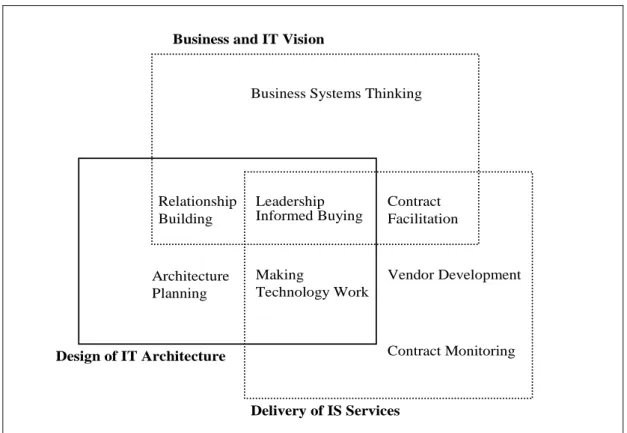
Other researchers have investigated IT capability from alternative viewpoints. For example, Fenny and Willcocks (1998) compiled related studies and identified nine core capabilities for information systems, based on business and IT vision, the design of IT architecture, and the delivery of IT services (shown in Fig. 1): (1) leadership; (2) business systems thinking; (3) relationship building; (4) architectural planning; (5) making technology
Chi-Hung Yeh, Gwo-Guang Lee and Chen-Hui Lin
International Conference on Innovation and Management, Republic of Palau, July 15-18, 2012.
work; (6) informed buying; (7) contract facilitation; (8) contract monitoring, and (9) vendor development.
Business and IT Vision
Design of IT Architecture
Delivery of IS Services Business Systems Thinking
Relationship Building
Leadership Informed Buying
Contract Facilitation
Vendor Development
Contract Monitoring Making
Technology Work Architecture
Planning
Fig. 1: Nine core IS capabilities
Source: Fenny and Willcocks, 1998
Marchand et al. (2000) indicated that an information-oriented organization must be equipped with three types of IT capabilities:
(1) Information technology practices (ITP): The ability of an organization to manage appropriate IT applications and infrastructures effectively in support of operational decision-making and communication processes.
(2) Information management practices (IMP): The ability of an organization to effectively collect, process, and maintain information.
(3) Information behaviors and values (IBV): The ability of an organization to promote behaviors and values in its staff that facilitate effective the sharing and utilization of information.
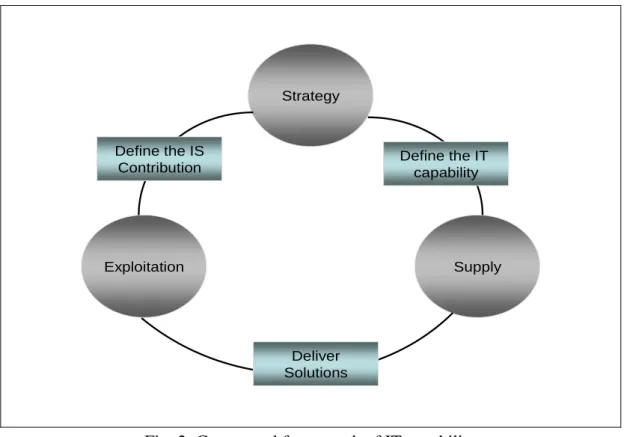
Peppard et al. (2000) identified six domains of IT competence (the framework underpinning this research is shown in Fig. 2):
Strategy: the ability to define the role of IS/IT in the organization and see these elements as an integral part of business strategy;
Defining the IS contribution: the ability to translate business strategy into processes, information, systems investments, and planned changes;
Chi-Hung Yeh, Gwo-Guang Lee and Chen-Hui Lin
International Conference on Innovation and Management, Republic of Palau, July 15-18, 2012.
Defining the IT capability: the ability to translate business strategy into information architecture, technology infrastructure and resourcing plans that enable implementation of the strategy;
Exploitation: the ability to achieve maximum benefit from the implementation of IS/IT investments;
Deliver solutions: the ability to deploy resources to develop, implement and operate IS/IT business solutions;
Supply: the ability to create and maintain appropriate and adaptable information, technology, and supply chain and resource capacity.
Strategy
Exploitation Supply
Define the IS
Contribution Define the IT
capability
Deliver Solutions
Fig. 2: Conceptual framework of IT capability
Source: Peppard et al., 2000
Shoal and Moss (2001) indicated that incorporating and developing an information system contributes to integrating the IT capability of a firm. An organization that seeks to use IT to strengthen its competitive capacity must effectively develop its IT capability (Ross et al., 1996; Bharadwaj, 2000; King, 2002; Kumar, 2004; Kim & Mahoney, 2006; Li et al., 2009).
The research results described above allow us to understand the influence that IT capability has on the core capabilities, competitive advantage, and business performance of a firm. However, few studies have employed the TOE framework to explore the factors that affect the IT capability of e-businesses. Thus, the conceptual framework proposed by this study compensates for the shortcomings of previous research, and provides both researchers and business owners with valuable reference data.
Chi-Hung Yeh, Gwo-Guang Lee and Chen-Hui Lin
International Conference on Innovation and Management, Republic of Palau, July 15-18, 2012.
4. Conceptual framework of factors that influence the IT capability of e-businesses
Barney (1991) indicated that every firm has certain unique assets and capabilities, from which its competitive advantage can be derived. Effectively utilizing these assets and abilities promotes organizational growth and assists the firm in developing a strong market position.
Ciborra (1994) stated that in a dynamic environment, establishing IT capability and IT infrastructure may be more important than selecting IS applications. The main purpose of employing IS/IT is to support organizational operations and enhance competitive capacity.
Organizational structure, technological competence, and business strategy all influence the utilization and incorporation of IS/IT (Orlikowski, 2000).
Peppard and Ward (2004) indicated that IT capability affects business strategy, IS/IT strategy, business operations and IT services. It would thus be safe to say that IT capability influences the overall performance of an organization. Because the scope of the TOE framework is very broad, it is well suited to the study of e-business (Zhu et al., 2003; Zhu &
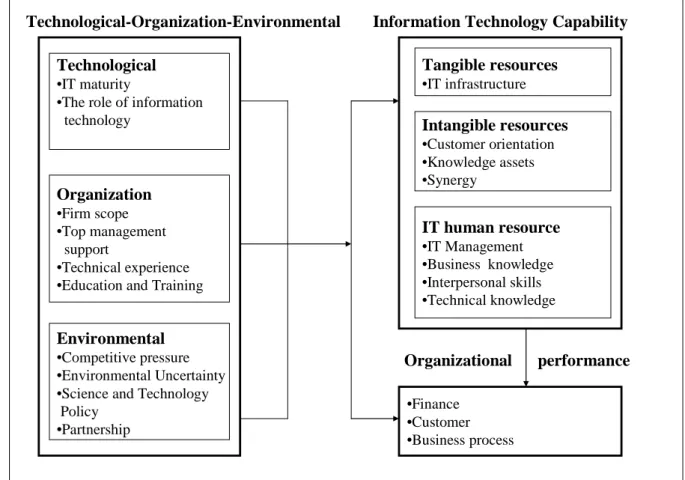
Kraemer, 2005). The theoretical basis of our research framework was derived from the TOE framework developed by Tornatzky and Fleischer (1990), the IT capability-related constructs proposed by Bharadwaj (2000) and Jean et al. (2008), and the relational model of IT capability and organizational performance (produced by Peppard and Ward (2004)). We researched the main TOE factors that influence the development of IT capabilities in e-businesses, and then deduced the factors that influence organizational performance.
For the technological dimension, we investigated how IT maturity and the role of information technology influence the development of IT capability; the theoretical basis for this research was derived mainly from the work of Premkumar & King (1994) and King &
Teo(1996). The organizational factors we explored included firm scope, support from upper level management, technical experience, and education and training (Grover, 1993; Swanson, 1994; Wolfe, 1994; Fichman & Kemerer, 1997). We also studied the influence of environmental factors, including competitive pressure, environmental uncertainty, science and technology policy, and partnerships (Farhoomand et al., 2000; Zhu & Kraemer, 2005;
Zhu et al., 2006).
We categorized IT capability into tangible resources, intangible resources, and IT human resources. Tangible resources refer to the IT infrastructure; intangible resources include customer orientation, knowledge assets, and synergy. IT human resources comprise IT management, business knowledge, interpersonal skills, and technical knowledge.
Organizational performance can be divided into the areas of finance, customers, and business processes. As summarized above, this study employed reasonable measures to maintain the rigor of the conceptual framework and related elements (see Fig. 3).
Chi-Hung Yeh, Gwo-Guang Lee and Chen-Hui Lin
International Conference on Innovation and Management, Republic of Palau, July 15-18, 2012.
Technological
•IT maturity
•The role of information technology
Organization
•Firm scope
•Top management support
•Technical experience
•Education and Training
Environmental
•Competitive pressure
•Environmental Uncertainty
•Science and Technology Policy
•Partnership
Technological-Organization-Environmental Information Technology Capability
Tangible resources
•IT infrastructure
Intangible resources
•Customer orientation
•Knowledge assets
•Synergy
IT human resource
•IT Management
•Business knowledge
•Interpersonal skills
•Technical knowledge
•Finance
•Customer
•Business process
Organizational performance
Fig. 3: Conceptual framework of the relationship between TOE factors and the IT capability of e-businesses
The research hypotheses relating to the TOE factors, IT capability factors (tangible resources, intangible resources, IT human resources) and organizational performance factors are explained below:
(1) Research hypothesis relating to tangible resources: The main purpose of this hypothesis was to test the possibility that TOE factors influence IT infrastructure. Should test results indicate that TOE factors significantly affect IT infrastructure, we intended to further explore this result and propose relevant solutions.
(2) Research hypothesis relating to intangible resources: This hypothesis was developed to test the possibility that TOE factors influence customer orientation, knowledge assets, and synergy. Should test results indicate that TOE factors significantly influence the three elements described above, we intend to further explore this result and propose relevant solutions.
(3) Research hypothesis relating to IT human resources: The purpose of this hypothesis was to find out whether TOE factors influence IT management, business knowledge, interpersonal skills, and technical knowledge. Should test results indicate that TOE factors significantly influence the four elements described above, we intend to explore this result and propose relevant solutions
Chi-Hung Yeh, Gwo-Guang Lee and Chen-Hui Lin
International Conference on Innovation and Management, Republic of Palau, July 15-18, 2012.
(4) Research hypothesis relating to organizational performance: The aim of this hypothesis was to test the possibility that TOE factors influence organizational performance in terms of finance, customers, and business processes. We also tested whether tangible resources, intangible resources, and IT human resources influence organizational performance (in terms of finances, customers and business processes). Should the test results confirm that these elements significantly affect organizational performance, we intend to further explore this result and propose relevant solutions.
5. Conclusions and future research development
Due to the rapid development of IT and e-business strategy, the influence of IT capability on organizational IS management has become a significant issue of concern to both researchers and business owners. A point of even greater interest to businesses is how to effectively develop their IT capability and chart the development of future IT strategies. After reviewing previous literature, this study plans to develop future research along the lines described below:
1. Employing an empirical research approach, use the TOE framework and the IT capability-related constructs described by Bharadwaj (2000) and Jean et al. (2008) to explore the factors that influence IT capability in e-businesses. The results could be used to plan future development of IT capability and help businesses to more effectively incorporate e-business systems and practices.
2. Based on the relational model of IS capability and organizational performance proposed by Peppard and Ward (2004), conduct an empirical study on the extent to which different factors of IT capability influence organizational performance. The results could serve as the basis of reference for planning e-business information strategies.
3. Using the results of empirical analysis, establish a set of guiding principles for businesses in developing IT capability and incorporating e-business systems. Develop a suitable IT framework which, when applied, can contribute to the successful integration of electronic application systems.
References
Abu-Musa, A. A. (2004). Auditing e-business: new challenges for external auditors. Journal of American Academy of Business, 4(1), 28-41.
Amit, R., & Schoemaker, P. J. H. (1993). Strategic assets and organizational rent. Strategic Management Journal, 14(1), 33-46.
Barney, J. (1991). Firm resources and sustained competitive advantage. Journal of Management, 17(1), 99-120.
Bharadwaj, A. (2000). A resource-based perspective on information technology and firm performance: an empirical investigation. MIS Quarterly, 24(1), 169-196.
Chi-Hung Yeh, Gwo-Guang Lee and Chen-Hui Lin
International Conference on Innovation and Management, Republic of Palau, July 15-18, 2012.
Davenport,T.H. & Prusak, L. (1999). Working Knowledge. Boston, MA: Harvard Business School Press.
Earl, M. J. (1994).The New and the Old of Business Process Redesign. Journal of Strategic Information Systems, 3(1), 5–22.
Eze, U. C. (2008). E-Business Deployment in Nigerian Financial Firms: An Empirical Analysis of Key Factors. International Journal of E-Business Research, 4(2), 29-47.
Fenny, D. F. & Willcocks, L. P. (1998). Core IS capabilities for exploiting information technology. Sloan Management Review, 39(3), 9-21.
Fichman, R, G (2000). The Diffusion and Assimilation of Information Technology Innovations.
in Framing the Domains of IT Management: Projecting the Future Through the Past, Pinnaflex Educational Resources, Inc., Cincinnati, OH.
Gibbs, J., Kraemer, K. L., & Dedrick, J. (2003). Environment and policy factors shaping global e-commerce diffusion: A cross-country comparison. The Information Society, 19(1), 5-18.
Gottschalk, P. (1999). Strategic information systems planning: IT strategy implementation matrix. European Journal of Information Systems, 8(2), 108-118.
Grant, R.M. (1991). The resource-based theory of competitive advantage: Implications for strategy formulation. California Management Review, 33(3), 114-135.
Henderson, J. C. & Venkatraman, N. (1993). Strategic Alignment: Leveraging Information Technology for Transforming Organizations. IBM Systems Journal, 32(1), 4-16.
Huber, G. (1990).A Theory of the Effects of Advanced Information Technologies on Organizational Design, Intelligence, and Decision Making. Academy of Management Review, 15(1), 7-71.
Hwang, H. G., Ku, C. Y., Yen, D. C., & Cheng, C. C. (2004). Critical Factors Influencing the Adoption of Data Warehouse Technology: A Study of the Banking industry in Taiwan.
Decision Support Systems, 37(1), 1-21.
Ifinedo, P. (2011). Internet/e-business technologies acceptance in Canada’s SMEs: An exploratory investigation. Internet Research, 21(3), 255-281.
Jean, R. J., Sinkovics, R., & Kim, D. (2008). Information Technology and Organizational Performance within International Business to Business Relationships: A review and An Integrated Conceptual Framework. International Marketing Review, 25(5), 563-583.
Kalakota, R., & Robinson, M. (1999). E-business: roadmap for success. Reading, MA:
Addison-Wesley.
Khazanchi, D. (2005). Information technology (IT) appropriateness: the contingency theory of fit and IT implementation in small and medium enterprises. Journal of Computer Information Systems, 45(3), 88-95.
King, W. R. (2002). IT capabilities, business processes, and impact on the bottom line.
Information Systems Management, 19(2), 85-87.