DOH hospitals information systems development and strategic alliances to promote the study
The study of strategic alliance information system development and expansion for hospitals of DOH
Huang Chin-hsing a Chen Tsai-chin b Liu Zhongfeng c
ac Chung Cheng University, Institute of Information Management b Department of Health
Summary
Since the implementation of National Health Insurance, rapidly changing health care environment, increasing competition among hospitals, the hospital divergent towards large-scale, enterprise and strategic alliance and other business
methods. Import information technology would be effective to enhance business efficiency and effectiveness of the strategy. DOH hospitals to share the
development and promotion of information systems -strategic alliance
information systems (SAIS), after years of operation, its effectiveness has been all positive, and set a world alliance of medical information system model.
Therefore, the purpose of this study is to investigate the alliance strategy of the Department of Municipal Hospital Information System with decision-making process of the development and promotion considerations. In this study, the Department of Health owned 35 hospitals as a subject, to explore its strategic alliance development and promotion of information systems and promotion of the case measures key factors to success. This study was Seoul illegal, the actual participation of selected strategic information systems development 12 8-bit CIO president and group composition may Metcalfe collects information to describe the statistical summary of the findings and conclusions and recommendations have been addressed. The results showed that affect system development and promotion of the key factors that have cost advantages, economies of scale, control of budgets, cost allocation, with competition, interaction between top management support, a clear government policy, public budget, decreasing year by year, flexible working hours. Through strategic alliances and promotion of
information systems development, strategic alliance members for significantly lower costs and enhance competitive advantage, this information system with the traditional concept of the role of the enterprise are very different. Results of this study do not only practical information for the development of the domestic hospital strategic alliances reference, may be used as follow-up medical information systems strategic alliance based on academic research.
Keywords: strategic alliances, strategic alliances and information systems, DOH hospitals, hospital information system may Metcalfe law
Abstract
After the National Health Insurance (NHI) provides universal coverage to all Taiwan citizens, the medical environment is changed dramatically and the competition between hospitals becomes more and more violent. This research used the 35 Department of Healthcare (DOH) hospitals as cases to study the critical success factors of developing and spreading the strategic alliance information system (SAIS). Using modified Delphi method, a structured questionnaire with five-point Likert scale is adopted to collect expert's opinions. The experts included twelve superintendents and eight CIO of DOH hospitals. The Delphi results summarized many factors influencing the decision making of system development. These factors are Cost advantage, economic scale, budget controlling, cost sharing, competition in same business, interaction relationship, top management support, government policy, decreasing government budgeting support, and flexible work time. The critical success factors of SAIS are difference from those of general information systems. General information systems are influenced by system technology greatly. The SAIS is influenced mainly by cost advantage. Through developing the SAIS, members can lower down their cost and enhance their competitiveness.
Keywords: Strategic alliance, Strategic alliance information systems, hospital of department of healthcare, hospital information system, Delphi method
I. Introduction
Recent years, with economic growth, social openness and consumer
consciousness, the public demands for increasingly higher quality of hospital services, to have the rise of private corporate hospitals, national health insurance program, so that the medical markets an unprecedented impact on the
competition between hospitals heating up, the hospital divergent towards large- scale, diversification, enterprise management direction, the Department of Health-owned hospitals is no different. National Health Insurance in 1995 after the medical treatment greatly reduced the economic barriers to the public, and
public and private hospital services and medical benefits the same as in the classification of medical referral system is not implemented, the circumstances of people fascinated by big hospitals, to health care early mining the amount of medical expenses paid capitation model, the relative pulling private hospitals operating between the Grand Duke, according to study in public hospitals after the implementation of universal health insurance universal health insurance productivity is lower than before the implementation of [1], the then provincial hospitals have been non-past well known local "big Byoin", face the challenge of many operation.
To Tisheng Provincial Hospital of Yiliaopinzhi and operating performance, the former health Chu Yu Qi i.e. the 1995 hospital Zuzhi gradually expand recycling Gongzuo, towards the personnel cuts, Jiang Di subsidy of public budgets and personnel targets Nu Li, Zai since 1997,made four recycling Celue , respectively, operational management and recycling, Accounting and Financial Reconstruction, reconstruction and human resources information system reengineering, will own the hospital as an operating system. The "Information Systems Reengineering" is to information technology through the introduction, implementation of medical operations and medical management of fully computerized in order to promote hospital efficiency and effectiveness of the operation, thereby to reduce costs and enhance quality of care and improve the competitiveness purposes and still be able to fulfill the social responsibility of public hospitals. Therefore, the DOH hospitals attached great importance to the development of hospital information technology, from 1986 on a trial basis before Provincial Hsinchu Hospital, hospital computerization, started in 1990,the overall planning of provincial hospital computerization and gradually integrate the needs of other DOH hospitals, enhancements, and development of DOH hospitals shared hospital information system, also known as the Department established a strategic alliance hospital information system called SAIS (Strategy Alliance Information Sysem),to be
completed in December 2002municipal hospital-wide deployment of integrated applications.
As the Department of Health Central Office (hereinafter referred to in the office room) the development of strategic alliances of DOH hospitals information system, promotion of inter-hospital successful experience of integration between the practice of the public hospital system by the national attention, and then follow the practice in 2000, the Taipei County the requirements of the Municipal Health Bureau, Taipei Municipal Women and Children free license, Chung Hsiao,
Yang-Ming Hospital, sexual Bosho, slow anti-Yuan and the Taipei County triple, Itabashi hospital use, and according to the proportion of health care revenue shared between the hospital and the DOH upgrading maintenance costs. In 2003, authorize the use of other hospitals in Taipei. From this, the Department
established a strategic alliance development and promotion of the hospital information system is a very successful experience, therefore, the purpose of this study is to understand and review the DOH Information System Strategic Alliance hospital development and promotion of the case, and to explore the DOH Hospital information systems development and strategic alliances to promote the key factor, as domestic and foreign-related institutions and academic institutions in Taiwan.
Two, the literature A strategic alliance
"Strategic alliance" refers to the organization based on mutual need and willingness to share risks through cooperation to achieve common goals [12].
Broad "strategic alliance" refers to a business or organization is defined between the types of cooperation, mainly through the spirit of mutual cooperation between organizations to enhance the competitiveness of enterprises [9]. Kao Koong-lian [8] that a combination of partners set up a "strategic alliance" has generally become an important mode of business growth, and strategic alliances are built on the alliance to bring the interests of both, in addition to complementary resources between enterprises and cooperation, the more enhanced competitive advantage of firms.
Rongtai Sheng [9] that the Union more popular reasons for merging the league tend to spend less, and involve less investment in benefits, including: availability of economy of scale, access to new technology, close to new markets can be mitigate risk; and potential drawbacks, including: the difficulties of coordination, difficulty in establishing the structure, resulting in competition with the business complex. Hill & Jones [11] believes that the advantages of strategic alliance is committed to cooperation between enterprises, and they may also be each other competitors. The disadvantages of strategic alliances, basically, strategic alliance is the path to a low-cost competitors, to acquire new technologies and markets.
Second, the Department established a strategic alliance hospital
In 1995, the then provincial government health To elevate the quality of medical care and hospital performance, which started the hospital reorganization work, in 1997 a further four recycling strategy, their hospitals classified as a hospital system be operated. Since 1997, the National DOH hospitals from the former Provincial Health Department, Department of Health central office by
administrative relations, shaping a common vision and operational strategies to the operation and strategic alliances.
DOH hospitals shared vision is: easy caring, quality health care, community care.
Compared with its business strategy - resource sharing, technology exchange, joint marketing, control of job openings. Without increasing staff numbers and annual reduction of personnel costs of public subsidy principle to organize
degenerate and regional alliances, reasonable subsidies and adjusting the number of posts in hospitals, so hospitals can reach economies of scale; and in the spirit of enterprise management, improve the human and financial resources of the
structure, with the implementation of health and medical care policy, 『improve operational efficiency, strengthen the level of hospital services, reducing
management costs, change the image of the hospital to improve service quality』
reach the goal of sustainable development.
Regional Union of the current plan is divided into four areas, followed by Taipei, North, Central and Southern Districts, each district choose a blue-chip and more hospital-scale general hospital, the rest of the hospital for the hospital association hospital, its Strategy practices are as follows:
(A) set up to promote the group or the management center, and elected convener contact the business.
(B) the kinds of statements of accounting and unity, so that each communication tool in agreement and cost sharing.
(C) set reasonable posts, and the surplus of manpower attrition.
(D) medical services and support handling patient referrals.
(E) to deal with marketing, teaching, training and research.
(F) integrated logistics management (including the tender offer, called Cargo, written off) and called the goods, including pharmaceuticals, medical supplies, equipment and other procurement activities.
(Vii) cooperation in handling supplementary medical services, including pharmacy, testing, social workers, among others.
(8) co-processing or outsourcing logistics operations: laundry room, supply center, catering, cleaning services, waste disposal, parking, security security, information systems, insurance claims processing or outsourcing of common.
(9) of the total hospital operation and management center for the integration of medical resources, medical services, human resources, financial management, utilization, specialist training, health care declaration, information, administrative operations and management.
(10) if their hospital administration will not fill the vacancy, the first to submit a regional alliance to promote the group meetings, coordinated by a convenor to support each approach. [2, 3, 4, 5]
Triple, DOH hospitals Strategic Information Systems I. Introduction
DOH hospitals strategic alliance development and promotion of information systems, from1991 to 2002, after 10years, can be distinguished by functional level information systems and strategies to share hospital information system in two parts, are as follows:
(A) of the common hospital information system
Shared hospital information system has been developed including outpatient, hospital, medical services, medical administration, general administration, support services and the hospital director of information systems in seven major systems and 51 subsystems, distributed build at all hospitals. In addition, another building information services, administer the site, as the central offices, hospitals and outsourcing provider among the three, information needs and problems reflect, respond, deal tracking, monitoring control, based on acceptance of the bridge. Detailed system functions shown in Figure 1.
(B) Strategic Information Systems
Sharing hospital information system is a set of co-ordinating the development, deployment in 35 hospitals scattered individual independence, and through network connectivity, and strategic information systems is shared by a set of 35 hospitals, and build on the Department of Health Central Office, including performance indicators, Taiwan e Institute - Medical advisory services,
pharmaceuticals and electronic materials ordering and network libraries are as follows:
1. Performance indicators
Use objects to the central office of the Department of Health, hospital managers and staff personnel. Features include: the establishment of service volume, balance costs and a total of 28 categories of medical quality indicators, according to key indicators of the basic information required for the monthly collection of 35 hospitals through a network of information, create the database, monthly produce 35 hospitals in 28 indicators and to compile analysis and comparison, identify
anomalies, problems and causes, and recommendations for improvement.
2. Taiwan eInstitute (website) - Medical Advisory Services
Services as the general public, functions: to provide the public access proposed health care related health problems, by professional medical personnel to answer or path from the Q &A database query wants and hopes of understanding the problem. Website include: medical consultation, a rare disease consultation, SARS consultation, drug counseling, smoking cessation counseling, physical fitness and nutrition consultation classrooms, hire domestic major medical centers and more than 400 hospitals DOH attending specialist level and above physicians, pharmacists, dietitians to network doctors (medicine, nutrition) division, free of charge.
Figure 1: Shared hospital information system functions chart 3. Pharmaceutical materials ordering and network
The target of DOH hospitals, and non-tendering contract tendering
pharmaceuticals, health and material suppliers, the Department of Health Central Office (JPS center) and Bank of Taiwan . Functional content can be divided into:
orders work, job acceptance, please models such as operations and payment operations.
4. Electronic Library
Use object to the room and do all my colleagues in the Department of Municipal Hospital, says: to provide "medical clinical research" and "hospital management"
related to electronic journals, books and databases.
Second, the scope of outsourcing
Feeny & Willcocks [10] by the IS department's core competencies to think about outsourcing options. The so-called IS core competence refers to an enterprise
should have the IS capability to support enterprise scale needed for future expansion. In addition to the scope of the Department of Municipal Hospital outsourcing core competencies, including planning, monitoring air, security, management and administration, the remaining are outsourcing, accounting for more than 90 percent, covering hardware, software, and Internet. About two
million a year funding.
Third, systems development practices (A) provide for the development principles
First, the Department of Health Central Office (hereinafter referred to in the office room) to provide development principles, including application software practices: adopting master-slave (CLIENT / SERVER) architecture practices; device environment: software and hardware and application software, independent of label restrictions, software and hardware for an open system architecture.
Division ofresponsibilities: the common issues on the various hospitals who need to Central Office Room unified planning process, belonging to different hospitals were individual issues can be dealt with individually, then handled by the hospital itself.
(B) Information Integration
Here's 35 DOH hospitals integrative process information needs:
1, needs integration
Demand for integration is the most difficult part of the SAIS developed, involving characteristics of the hospital culture, the environment, people and management systems, so the Department of Municipal Hospital shared system integration, and Department of Mining-step approach, first a few (3 ~ 5 ) representation of the hospital seminars, such as identifying requirements specification, namely, prototype design, such as uniform requirements specification can not be
determined, from the office room came forward and invited the relevant powers and responsibilities of each hospital department to discuss. Through this course, deciding whether to allow two kinds of needs of different specifications to cater to the local environment or hospital characteristics, such as can not discuss the specific conclusions, the review unit is returned to the original mention.
35 DOH hospitals throughout Taiwan, there are urban, rural and more remote islands type, so the demand SAIS specifications, is allowed a second, third specification exists, but up to no more than three, while software development is still only developing and maintaining a set of the same needs, 2-3 kinds of functional specifications, adopting modular design, SAIS build and to set the parameters form select the most appropriate hospital, this flexible approach is to DOH hospitals to promote the key factor in SAIS .
2, build integration
SAIS development, using prototype (PROTOTYPING) design method to fully focus on effective communication, so when the demand function is confirmed, namely, prototype design, to demonstrate some of the hospitals, through the discussions to determine the functional specifications and user requirements referred surface, after the design-entity, some hospital training, by training real machine operation, then Yi Ci discussion to Quedingjitong function Guige, Zhihouxuanding a first on- line Zuoye, after reviewing and amending the stable, then select the second hospital on-line operation to review the revised stability only after a
comprehensive on-line arrangements for other hospital jobs.
Fourth, the system Promotion Strategy
Central Office Department of Health Promotion 35 DOH hospitals build integrated SAIS, adopt the following strategies:
1. Cost Strategy
Porter [13] that the cost advantage is the company to acquire one of two
competitive advantages; the value of the costs of activities are usually subject to the impact of economies of scale. Economy of scale comes from the ability to differentiate and more efficient way to conduct large-scale activities; or the ability to huge sales, to share advertising, R & D and other intangible costs of capacity.
Economies of scale may also be derived from the operating efficiency of large- scale activities, it may be because of the growing scale of infrastructure development or manufacturing costs decreased the proportion of the results.
The value of certain activities, the need for national-scale, regional scale (regional scale), project size indicators to construct the cost characteristics. No matter
what kind of industry, procurement is a very important strategic work.
Integration of the Central Office Room 35 DOH hospitals shared hospital
information system, using cost strategy, in addition to reducing hospital operating costs, improve performance, and to promote to promote the integration of SAIS.
2. Control of the budget
For the effective use of limited resources, the formation of the purchasing economies of scale, co-ordination of budgetary resources, carry out joint
procurement, unity and development to reduce costs and enhance performance.
Transfer shared hospital information system and establishment of strategic information systems, required the purchase of additional equipment, software modification, file conversion, training, counseling and other expenses on the line, rests in the Office Room cope. Later, the information operations, also co-ordinate the Central Office Room planning, design, procurement, build maintenance and management, the burden of requirements, development of individual hospitals, the burden of financing on their own requirements.
3. Voluntarily joined
Do not follow the administrative system, top-down enforcement practices by the hospital voluntarily or voluntary transfer. Viswanath Venkatesh & Fred D. Davis [15] of TAM2 study that voluntary (Voluntariness) will affect their willingness to use information systems and the subjective meaning. Therefore, the promotion of SAIS, homes on the administrative system under the command of the methods adopted by the hospital voluntarily request to join form, to avoid rebound.
4. Project Management
Convene ad hoc meetings on a regular basis, the establishment of IT service management site, supervision and management outsourcing company, hospital, communication and conflict as a problem solution to bridge the coordination. In
the system integration phase, the integration of the division of labor between firms need government agency commissioned by the arbitration and intermediary communication and coordination requirements to ensure that project objectives will be achieved. [2, 3, 4, 5]
Wantonly, data analysis
This study was Metcalfe Modified survey technology development and promotion of the critical success factors of SAIS, was Metcalfe first questionnaire survey,
semi-structured questionnaire, interview a president, one expert, an information officer, amendment to establish the research framework. Metcalfe survey was the second, third and fourth questionnaires were designed in accordance with the established research structure, taken five decile Likert scale (5 - strongly agree, 4- agree, 3- normal, 2- disagree, 1 - is not consent), a survey Metcalfe Group 20 members, including 12 Premier (MB, BS, and HA are master, with an average 9.5 years), the8-bit CIO (Master 1, University of 6, Specialist 1, the average length of 11.4 years).
First, statistics
Statistical methods of each variable before calculating the average person, and then calculate the total average of each variable to the total mean (average weight) size of the degree of consensus that was Metcalfe Group, and calculated the standard deviation of each variable (first calculated for each question item of the sample standard deviation, then the variables Every item of standard
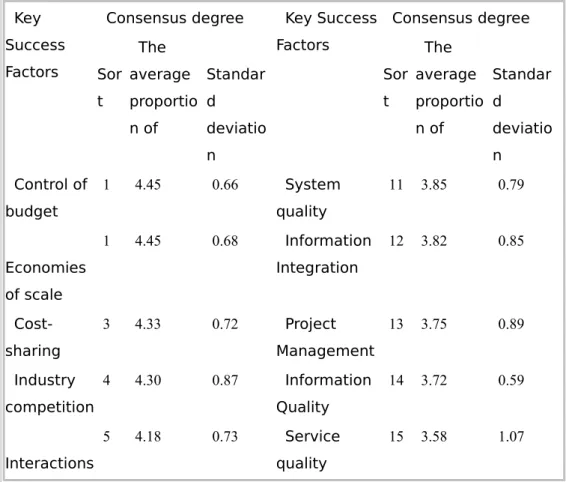
deviation plus average), the critical success factors results in Table 1.
Table 1: Key Success Factors sort table
Key Success Factors
Consensus degree Key Success Factors
Consensus degree
Sor t
The average proportio n of
Standar d deviatio n
Sor t
The average proportio n of
Standar d deviatio n
Control of budget
1 4.45 0.66 System
quality
11 3.85 0.79
Economies of scale
1 4.45 0.68 Information Integration
12 3.82 0.85
Cost- sharing
3 4.33 0.72 Project
Management
13 3.75 0.89
Industry competition
4 4.30 0.87 Information Quality
14 3.72 0.59
Interactions
5 4.18 0.73 Service
quality
15 3.58 1.07
Top manageme nt support
6 4.16 0.74 Mature
technology environment
16 3.57 0.87
A clear governmen t policy
6 4.16 0.72
Organization al resources with
17 3.53 0.68
Gradually decreasing public budget
8 4.12 0.74
Customizatio n features
18 3.50 0.50
Flexible working hours
9 4.05 0.57 Partnerships 19 3.49 0.75
Opt 10 3.94 0.80
Second, strategic alliance development and promotion of the key success factors of information systems
Can see by the above statistics, the cost advantages of strategic alliance information system affect the most important factor in the success, the average weight is greater than 3.5of a total of 17 critical success factors, including the average ratio of 4.0or more, are: economies of scale (4.45), control budget (4.45), cost sharing (4.33), with the competition (4.30), interactions (4.18), senior
management support and (4.16), with a clear government policy (4.16), gradually decreasing public budget (4.12), flexible working hours (4.05). Second, the average weightof 3.5 (or more), less than 4.0, are: voluntary accession (3.94), system quality (3.85), information integration (3.82), project management (3.75), information quality (3.72), mature technology environment (3.57), organizational resources to cope with (3.53), custom functions (3.5). One form of service quality samples to be removed more than 1standard deviation and partnerships of less than 3.5degree of consensus on the key factors which are not included.
Wu, the results discussed
Department of Health to improve the quality of their hospital care and operating performance, but also expand the hospital reorganization, transfer of their
hospitals to operate as a system, and proposed reorganization strategy, including information systems and recycling, mining overall planning, and gradually
integrate their own development individual hospital information system for the unified development of strategic alliances to share information systems, was very well received. This study is in this background environment for the research questions and objectives, through literature review and interviews to understand the strategic alliance Hospital, Department of Health information system
development and promotion situations, and Department of Health Central Office co-ordinate the development and promotion of strategic alliances the practice IT system strategy, the following findings of attainable:
1, the Department established a strategic alliance hospital information system development and promotion situations
Procurement Law specification according to [6, 7], Department of Health-owned hospital information system development of strategic alliances, initially owned 15 hospitals in three phases by the joint development outsourcing, including an integrated hospital-based outpatient services, hospitalization, medical business, medical administration and general administration of 39 sub-systems five systems in the Republic of China 80 years, 80 years build 15 hospitals on the line in
operation, and from 87 onwards gradually integrated to other general hospitals, and further functional requirements will be integrated hospital information
systems into strategic alliances, and their deployment in the nursing home, to the Republic of 91 by the end of their 35 hospitals to complete integration
implementations. This period has been constantly upgrading information
systems strategic alliance of five subsystems for the seven systems, the strategic alliance information systems, processing by the operating system upgrade
management information systems, decision support system and then upgrade;
add Internet capabilities, build " Taiwan e School "- Medical Advice Services website, first public hospital pharmaceutical Eisai Order e-business operations, and import of medical image transfer filmless operation, the implementation of the Ministry Division costs (profit) center cost accounting practices ... and so on.
90 years, this set the system in Taipei City, County Hospital, favor, Department of Health is authorized to 4 Taipei City Hospital, two hospitals in Taipei County to Taipei 93 9 build hospitals all use. In 92years, the Control Yuan, "Hospital
Performance Indicators Management and integration of regional health care resources," the case investigation to monitor the members of the public hospital visits, hospital strategic alliances for the Department of Legislative Information System approach high degree of recognition, especially for drugs Order adopting e-business operations, reduce inventory and costs, to be sure and asked all public hospitals should refer to such a successful model of development to improve.
Second, development and strategic alliances to promote the practice of information systems strategy
Hospital, Department of Health information system development of strategic alliances, be sure, summed up the central office practice using the strategy, a total of six; first; information operations development principles set by the Central Office of the overall planning and development of the 35 DOH hospitals
information operations, which is distributed to individual hospital operator, handled by the hospitals themselves; second, functional design of flexible information integration, business process integration of 35 hospitals, forms, system requirements, then follow the hospital business characteristics,
geographical differences to be appropriate elasticity designed to meet the needs of each hospital; Third, the cost of strategies adopted, 35 hospitals in joint
procurement and development of economies of scale, and the transaction in response to national health care system, the hospital needs urgent business, will demand of the prior purchaser in day hours, response to contingencies, more timely and cost control; Fourth, control of budgets, limited IT resources to co- ordinate the hospital and do the full and effective use of the development of information systems for individual hospitals with the burden on their own requirements, therefore, promote the deployment strategy coalition formation incentive information systems; the fifth, on a voluntary basis to join, do not follow the administrative system, top-down coercive approach, voluntarily requested by the hospital information system transfer build strategic alliances; sixth, project management, development and promotion in the process of , the implementation of project management, master schedule, effective communication and
coordination to resolve the conflict, to ensure that project objectives will be achieved.
Third, strategic alliances affect DOH hospitals information system development and promotion of key factors to success
This study used Likert scales to measure the five other members of the group may Metcalfe key factor in the consensus on the degree of success, taking the average weight of 3.5or more, in order: economies of scale, control of budgets, cost allocation, with competition, interactions , top management support, a clear government policy, public budget, decreasing year by year, flexible working hours, voluntary to join, system quality, information integration, project
management, information quality, mature technology environment, organizational resources to cope with, and customized functions total 17 items.
According to Metcalfe team was the consensus degree of critical success factors to be aggregated with the cost advantage of dimensions that affect the
development of information systems and promotion of strategic alliances is a critical factor of the dimension, followed by the resource perspective, the
environment dimension of the third, final the organization, information technology dimension.
Lu, conclusions and recommendations
Of the Health Department, the Central Office of the Republic of China 82 years to start planning for the development of their hospital information system, used in 86 years began to build to 91 to 35 years to promote integration of hospitals, to achieve good results, but overall build time has been used six years, so the system architecture has become more complicated and lack of flexibility, the study also found that system quality and information quality are becoming unable to meet the diverse needs of users. Moreover, the health policy of the health care system to provide holistic care, the core concept, the development of preventive health care, health care, community health, family physician system, the establishment of personal health records household records, electronic medical records and exchange, the importance of information security, personal privacy etc.; summary, in response to environmental trends, policy direction, planning and development should the next generation of strategic alliances in information systems or health care information system security architecture for medical information environment.
Plan to promote strategic alliances for the development of information systems agency statement, the union organization process, forms and other operating system must first be standardized and unified, also referred to information needs to be integrated, but the coalition authority of various sizes , located in different
geographical environments, different operational characteristics, the so-called unity through diversity, with the requesting different, except through interviews, meetings, administrative procedures, advanced means of communication and head as far as unity, the difference for the case to retain appropriate flexibility is necessary, and software design approach can be adopted design parameters, degree of flexibility varies depending on the situation. Information systems planning, should meet the trend, so that information systems both stability and innovation, and meet the union demand. On the other hand, Alliance members have information technology business operations, strategic alliance to integrate information systems, heads should explain the benefits of full communication, patience, and use strategies that, or roundabout way, to impose incentives, such as control of resources and for policy measures such as distribution or
scholarships, as best as possible to join its voluntary, non-resort to force and then adopt top-down approach build.
References
1. Mu-Van (1999), National Health Insurance on the productivity impact of various types of hospitals, National Chung Cheng University in Accounting, Vol.
2. Taiwan Provincial Health Department, Provincial Hospital affiliated operating principles of computerized planning book, 1991.
3. Taiwan Provincial Health Department, Provincial Hospital affiliated IT operations review report, 1997.
4. Department of Health website: http://www.doh.gov.tw
5. Department of Health -Hospital Management Committee Web site:
http://www.cto.doh.gov.tw
6. Government Procurement Law, the Republic of China 87years on May 27 announced a presidential decree.
7. Government Procurement Act, the Republic of China 88 May 21 Public Construction Commission Executive Yuan promulgated.
8. Kao Koong-lian(2003), "The international strategies is the short cut,"
Economic Journal.
9. Rongtai Sheng (1997), Strategic Management, Prentice Hall.
10. Feeny, DF & Willcocks, LP (1998 Spring), "Core IS capabilities for exploiting information technology," Sloan Management Review, pp.9-21.
11. Hill, Charles WL, Jones, Gareth R. (1992), Strategic Management Theory, An Integrated Approach; Houghton Mifflin Company.
12. Lewis, Jordan D. (1990), Partnerships for Profit: Structuring and Managing Strategic Alliances, The Free Press, USA ..
13. Porter, ME (1980 Jul / Aug), "Industry Structure and Competitive Strategy: Keys to Profitability," Financial Analysts Journal: Charlottesville, 36 (4), p.30.
14. Porter, ME (1985), Competitive Advantage-Creating and Sustaining Superior Performance, Edition, Mori Agency, Inc.
15. Venkatesh, Viswanath, Davis, Fred D. (2000 Feb.), "A theoretical extension of the technology acceptance model: Four longitudinal field studies," Management Science.
Linthicum:, 46 (2), pp.186-204.