Chapter 3
Verbs of Communication in Taiwanese Southern Min:
KONG and THECHHUT
In this chapter, we start with the analysis of KONG ‘to speak, say’ 講 and THECHHUT ‘to propose; to raise (a question)’ 提出. In section 3.1 we analyze the syntactic representation of KONG and THECHHUT along with their frequency of occurrences. In section 3.2, based on the findings in the analysis of syntactic representation, we turn to discuss their semantic representation, in particular their participant roles. Basing on the notion of conduit metaphor, we observe the three participant roles: the role of the Sender, the Message and the Recipient respectively.
We furthermore observe how the participant roles behave in the Communication Frame (Fillmore 1992, 2002) and how KONG and THECHHUT can be categorized into the Communication Frame. In section 3.3 we explore the event structure of these two verbs via Thompson and Hopper’s transitivity parameters (1980) and the transitivity of a verb in different situation types (Vendler 1967; Dowty 1979; Smith 1991). Section 3.4 summarizes the findings.
3.1. The Syntactic Representation of KONG and THECHHUT
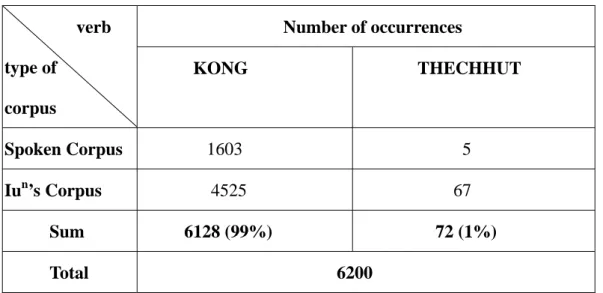
Before analyzing the syntactic patterning of KONG and THECHHUT, it is necessary to discuss their frequency of occurrence. The distribution of KONG and THECHHUT in the TSM corpora shows an extreme skewing in terms of this frequency of occurrences (see Table 4). In the spoken data, KONG has 1603 occurrences while THECHHUT has merely five tokens. In Iun’s Corpus, KONG enjoys a high frequency, 4525; while THECHHUT has lower frequency, 67. In other words, KONG accounts for the majority of occurrences (99%, 6128/6200) in verbs of
speaking in TSM compared to THECHHUT (1%, 72/6200). Such an extreme skewing in frequency signifies that KONG is extremely pragmatically unmarked and is a preferred verb of communication, whereas THECHHUT is pragmatically marked and thus a non-preferred use.
Table 4 Frequency of KONG and THECHHUT in the Corpora Number of occurrences verb
type of corpus
KONG THECHHUT
Spoken Corpus
1603 5Iu
n’s Corpus
4525 67Sum 6128 (99%) 72 (1%)
Total
6200Table 5 shows the syntactic patterns of KONG and THECHHUT.
Table 5 Syntactic Patterns of KONG and THECHHUT in TSM
KONG THECHHUT
Transitive Use
Intransitive Use
Transitive Use
Intransitive Use
NP Clause NP Clause
Object
Position
234 (19%)1006 (81%)
3 (60%)
2 (40%)
Spoken
Data
Sum
1240363
5
0
NP Clause NP Clause Object
Position
731 (18%)3237 (82%)
46 (69%)
As shown in Table 5, KONG has both transitive and intransitive uses whereas THECHHUT only has transitive use. In the intransitive use of KONG, 72% are pure intransitive use, where there is no object occupying in the object position. Example (1a) shows no object which can be traced in the previous text and is thus an intransitive use. Example (1b) ,on the other hand, demonstrates the recoverable object which can be traced back from the prior discourse: a-chi de chiah ai khongche a 姊在吃愛控制 ‘Sister has to control with her eating’. (Prince, 1982)
(1) a. V + Ø (no object)
hit e lang ittit kong/*thechhut bye soah1 hit 個 人 一直 講 /*提出Ø 沒 煞
that man continuously talk no stop
‘That man kept talking.’
b. V + Ø (recoverable object in the intransitive use of KONG)
A:
a -chi de chiah ai khongche m-ho hap-ia姊 在 吃 愛 控制 m好 合意 sister ASP2 eat have to control not love
chiah do tittit chiah 吃 就 直直 吃
eat to keep on eat
1 The romanization follows the system proposed by Cheng & Cheng (1977) with some modification.
2 The list of abbreviation used in the interlinear glosses is to be found on page viii.
21 (31%)
Iu
n’s
Corpus
Sum
3968557
67
0
Sum 5208 (85%) 920 (15%) 72 (100%) 0 (0%)
Total 6128 72
‘Sister has to control her eating. It’s not good to keep on eating what she loves to eat only.’
B: goa wu kah kong Ø 我 有 給 講 implicit object 1SG ASP to say
‘I have said that to her.’
Regarding the transitive use, both KONG and THECHHUT may take an NP or clause as their object. The difference lies in the fact that KONG prefers to take a clause as its object (81.5%) whereas THECHHUT prefers an NP at the object position (68.1%). This may be attributed to the fact that the object of KONG is of lower transitivity; whereas the object in THECHHUT is of higher transitivity (Hopper and Thompson 1980:287) (see section 2.5.1 in chapter 2 for detailed explanation).
(2) NP in the Object Position
a. li ai kong tiongtiam la 2SG 愛 講 重點 la you have to say key point UFP ‘You have to say the key point.’
b. ebin iu gigian keue e kakhto 下面 由 語言 計劃 的 角度 the following from language planning ASSC point of view
thechhut laktiam khuthe kiangi 提出 6 點 具體 建議
propose six concrete suggestions
‘From the view of language planning, (we) proposed six concrete suggestions.’
(3) Clause in the Object Position
a. goa kong kin-a e Taiwan-lang chiushi
我 講 今仔 e 台灣人 就是 1SG say today ASSC Taiwanese is
chu cho chu shiu la 自 做 自 受 la self do self suffer UFP
‘I say that Taiwanese today suffer from their own doing.’
b. wu chitkwua gigian hakka thechhut iong han-lo lam-sia 有 一些 語言 學家 提出 用 漢羅 混寫
there are some linguist propose use sino-roman mix
e hongshik lai kaikoat chit-e buntue 的 方式 來 解決 這個 問題。
ASSC way to solve this problem
‘There are some linguists who proposed sino-roman mix characters to solve this problem.’
To summarize, KONG has both transitive (85%) and intransitive use (15%) while THECHHUT has only transitive use (100%). When KONG and THECHHUT are in the transitive use, an NP or a clause would fill out the object position. While KONG and THECHHUT both appear in transitive use, the main difference lies in the preferred use of NP or clause. KONG prefers to take a clause in the object position (81 % spoken data and 82% in Iun’s Corpus) while THECHHUT prefers to take an NP to occupy the object position (60% in spoken data and 69% in Iun’s Corpus). The preferred use of clause in the object position suggests that object of KONG is of lower transitivity; whereas the object in THECHHUT is of higher transitivity (Thompson and Hopper 1980:287) (see section 2.5.1 in chapter 2 for detailed explanation). We will discuss the issue of transitivity in more detail in section 3.2.1.1.2.
The syntactic representation of KONG and THECHHUT is correlated with their semantic representation, as will be discussed in the next section.
3.2 Semantic Representation of KONG and THECHHUT
In this section we set out to observe the semantic representation of KONG and THECHHUT. In section 3.2.1, the argument types are first explored through the notion of conduit metaphor (Reddy 1979; Lakoff 1987). The transitive use and intransitive use of these two verbs are discussed respectively. Then, in section 3.2.2, we analyze the verbs of speaking in the Communication Frame (Fillmore 1992, 2002) in that we observe how the participant roles of KONG and THECHHUT behave. A comparison will be made between KONG and THECHHUT in the Communication Frame.
3.2.1. Conduit Metaphor
The notion of conduit metaphor is essential in our analysis of distribution of argument types in verbs of communication in TSM since its metaphorical concept has direct association with sending out communication. According to the notion of conduit metaphor, verbs of communication involve three major participant roles: 1) The Sender or Encoder of Message, 2) the Message itself, and 3) the Recipient or the Decoder of the message. In the following sections, we attempt to analyze the three participant roles under two syntactic constructs discussed in the above section:
transitive use and intransitive use. The various interactions between the three participant roles under these two syntactic constructs display semantic contrasts between KONG and THECHHUT.
3.2.1.1 Transitive Use
In the transitive use of KONG and THECHHUT, the most distinctive character is that the role of the Message is essential and cannot be omitted. The Sender is usually present. As for the Recipient, when the Recipient appears, it is always marked by the prepositions such as kah ‘to, toward’ 給, ho ‘to toward’ 互, ham ‘to, toward’ 和 or hiong ‘to, toward’ 向. (4) shows how the three participant roles
behave in the transitive use:
(4) Sender +V + Message (e.g. 我講/提出一件代誌)
Sender + prep. + Recipient + V+ Message (e.g.我給你講/提出一件代誌)
In section 3.2.1.2.1 throughout 3.2.1.2.3, we will discuss the role of Sender, the role of Message and the role of Recipient respectively.3.2.1.1.1 The Role of the Sender
There are two features relevant to the Sender of KONG and THECHHUT: 1)
[+animate] vs. [-animate] and 2) [+specified] vs. [-specified]. In terms of animacy, the Sender (Agent) of both KONG (77%, 4743/6159) and THECHHUT (89%, 68/72) is usually animate as shown in (5). The high percentage of animate Sender in both KONG and THECHHUT is reasonable since communication is mainly carried out by people, which possess the feature of [+animate]. When the Sender is inanimate, the inanimate Sender of KONG may include the medium such as tiansi 電視 ‘television’, an institution such as long-hue 農會 ‘farmers’ association’ or chitku siokgi 一句俗語‘a saying,’ as shown in examples (6a,b,c) whereas the inanimate Sender of THECHHUT includes only an institution such as chhuli uiwuan-hue 處理委員`the committees,'as shown in (6d). The inanimate Sender in KONG and THECHHUT demonstrate metonymization of the Sender. For example, the medium such as dianshi 電視 ‘television’ itself cannot really ‘say things’ but rather the speakers on the television carry out the action of saying something. Therefore the medium such as dianshi 電視 ‘television’ actually represents the speakers on the television and thus is a metonymic use. Similarly, institutions such as long-hue 農 會 ‘farmers’
association’ or chhulii uiguan-hue 處理委員會`the executive committee'actually represents the speakers in the institution.
Regarding the quality of specificity, the Sender is either specified, pointing to a specific person such as a-bu 阿母 ‘the mother’ in (7a) or general, pointing to the
non-referential person such as Taiwan-lang 臺灣人 ‘Taiwanese’, kotza-lang 古早人
‘the people in ancient time’ in (8a,b). Most of the Senders in both KONG (82%) and THECHHUT (99%) take a specific person. This is understandable since the communication is making sense only when we can refer to the speaker to a specific person, especially in a bi-directional communication. However, note that more Senders in KONG are coded as unspecified (18%), while only one token of THECHHUT out of the 72 occurrences (1%) carries an unspecified Sender as in (8c).
It is noticeable that when the Sender is unspecified, the communication is more like a one-way-direction statement (as shown in (8a,b)) rather than in a bi-directional conversation. In example 8a-b, the one-way-direction statement is uttered by an unspecified Sender and no other speakers are involved to respond to the statement or participate in the conversation.
(5) Sender [+animate] +V (KONG)
a.khu i ing kong 邱 憶 瑩 講,…Chuo Yi Yin say
‘Chuo Yi Yin says…’
Sender [+ animate] +V (THECHHUT)
b. chong-thong ma wu thechhut kwe 總統 麼 有 提出 過
the president also have propose ASP ‘The president has said …’
(6) Sender [- animate] +V (KONG)
a. tianshi ma de kong shian3 電視 麼 在 講 什麼,…
the television also ASP say what ‘The television is also saying that …’
3 Raised ‘n’ represents nasalization of a vowel.
b. binkan hiong longhwe kong me be kaumuea-ke 民間 鄉 農會 講 欲 買 狗尾仔 雞…
binkan town farmers’ association say want buy kau-mue chicken ‘The Farmers’ Association of Bin-kan town says that if you want to buy
kau-mue chicken….’
c. Taiwan wu chit-ku shok-gi kong u iun kuwan iun 台 灣 有 一 句 俗 語 講 :「有 樣 看 樣」。
Taiwanese
have an saying say there way look way ‘There is a saying in Taiwanese, saying: “When someone’s doing something,another follows.”’
Sender [- animate] +V (THECHHUT)
228 hitchun chhuli uiwuanhwe thechhut 42 tiao 228 那時 處理 委員會 提出 42 條 228 that time the executive committee propose 42 piece
iaukiu chitma long sithen 要求 現在 都 實現 request now all carry out
`The 42 pieces of requests proposed by the 228 Executive Committee have all been carried out.'
(7) Sender [+ specified] +V (KONG)
a. a-bu kong i anne phahpian longsi uitioh 阿母 講 伊 按呢 扑拼 攏是 為著 mother say 3SG this way hardwork all for
chit-ke tua-se e pingan 一家 大細 的 平安 all family the young and the old ASSC safety ‘Mother said that all the hard work was for the safety of the family.’
Sender [+ specified] +V (KONG)
b.Fishman thechhut bankiu gugen liutsit lilun
Fishman 提出 挽救 語言 流失 理論
Fishman propose Reversing Language Shift theory
‘Fishman proposes the theory of Reversing Language Shift.’
(8) Sender [-specified] +V (KONG)
a. goa siong khilai Taiwanlang tiantian kong/*thechhut e ue 我 想 起來 台 灣 人 定定 講/*提出 的 話 1SG think of Taiwanese often say ASSC words ‘I think of the words often said by the Taiwanese.’
b. kochalang kong pebu tit chhu thiangho mai chhut
古早人 講:
「 父母 在 厝 聽好 不 出ancient
people say parents at home listen well not out ‘Ancient people say that while parents are at home, do not leave the home.’Sender [-specified] +V (THECHHUT)
c. chuekun kuitanglai ma it-tit u lang thechhut 最近 幾冬來 麼 一直 有 人 提出 recent years also always there are people propose
sin e lo-ma-ji hongan 新 的 羅馬字 方案
new ASSC Romanization proposal
‘In recent years, there have always been people proposing new idea of Romanization.’
In short, KONG as the unmarked verb of communication displays greater varieties in terms of its Sender and its argument structure. In the transitive use the Sender in both KONG (77%) and THECHHUT (89%) show high tendency of animate Sender. When the Sender is inanimate, the inanimate Sender of KONG may include the medium, an institution or a saying whereas the inanimate Sender in THECHHUT includes only an institution. The inanimate Sender in KONG and THECHHUT are metonymic uses. Furthermore, the Sender in both KONG (82%) and THECHHUT (99%) show very high percentage of specific Senders. This is understandable since
the communication is making sense only when we can refer to the speaker to a specific person, especially in a bi-directional communication.
3.2.1.1.2 The Role of the Message
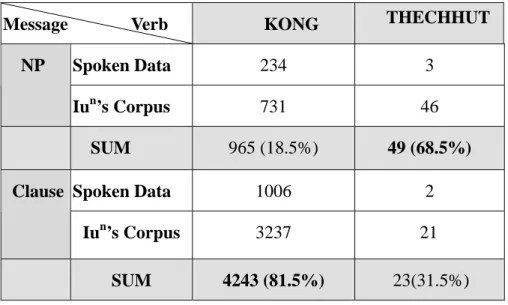
In terms of the role of the Message, KONG and THECHHUT take either a clause or an NP as the Message as shown in Table 6. KONG tends to take a clause (81.5%
in the corpora) as its Message while THECHHUT tends to take an NP as its Message (68.5% in the corpora). The preferred use of clause in the object position suggests that object of KONG is less [affective] and [individuated] and thus KONG is of lower transitivity; whereas the object in THECHHUT is more [+affective] and [+individuated] and thus THECHHUT is of higher transitivity (Thompson and Hopper 1980:287)
Table 6 The Message Role of KONG and THECHHUT in the Corpora
KONG THECHHUT
Message Verb
Spoken Data
234 3NP
Iu
n’s Corpus
731 46965 (18.5%)
49 (68.5%) SUM
Spoken Data
1006 2Clause
Iu
n’s Corpus
3237 21SUM 4243 (81.5%)
23(31.5%)When taking a clause as the Message, the topic in the clause of THECHHUT is more formal and serious as shown in example (9) while the topic in the clause of KONG is more related to daily-life as shown in example (10).
(9)a. lan i-king thechhut la
n beh long iong han-ji su-shia Taigi 我們 已經 提出 若 都 要 用 漢字 書寫 台語1PLI already propose if all use han characters write Taiwanese
bunjihua kah piau-chun hua e bun-te chin tiong-iau 文字化 和 標準化 的 問題 真 重要.
literalization and standardization ASSC issue very important ‘The issue of literalization and standardization is important if we propose to use han characters to write Taiwanese.’
b. siahue gigian-hakka bat thechhut kohchiong gigian 社會 語言學家 也 提出 各種 語言
social linguist also propose various language
pochun e li-lun 保存 的 理論 preserve ASSC theory
‘Sociologists also propose various theories of language preservation.’
(10) a.i
kong kiang mama e liam 伊 講 驚 媽媽 會 唸.3SG say be afraid Mother ASP nag ‘He says that he is afraid that Mother will nag.’
b.in kong chit-goa a-mi e tai-chi 他們 講 一寡 阿美 的 代誌 3PL say some a-mi ASSC matters
‘They say some of a-mi’s matters.’
Regarding the varieties of the NP Message in KONG and THECHHUT, KONG appears to display more varieties than THECHHUT. The Message-Theme of KONG has distinct senses pertaining to various kinds of speaking activity: speaking a language (kokgi 國語 ‘Mandarin Chinese’, enggi 英語 ‘English’ as in (11)), talking in general (kui-ku wei 幾句話 ‘some words’ as in (12)), and talking about a specific topic (as in (13)). A slightly different facet in (13) is that when the Message is not a language but an entity such as a topic, then the entity denotes the ‘product of speaking’ and is thus viewed as an incremental theme (Dowty 1991, 576-571). The
Message of THECHHUT, on the other hand, does not display as many varieties as KONG does. THECHHUT does not take a language or talking in general. Instead, specific topic is the majority of the Message that is sent out by THECHHUT. For example, in (14) ‘the idea and the plan of preparing to produce a Taiwanese movie’ or
‘the directions and suggestions of future development’ are topics which specify a certain plan, idea or concrete suggestion. Notice also that the Message following THECHHUT takes place in an institutional talk and a formal context.
(11) a.
it-ting shi mo kong/*thechhut kokgi ma mokong/*thechhut
一定 是 沒 講/*提出 國語 麼 沒 講/*提出sure be
verb not speak/*propose Chinese neither not speak/*proposeshami hokkien gi 什麼 福建 語 what Fukahngnese
‘It’s sure that (he) doest not speak either Chinese nor Fukahngnese.’
b.it-ting shi lon kong/*thechhut enggi 一定 是 攏 講/*提出 英語.
sure be verb all speak/*propose English ‘It’s sure that (he) all speaks English.’
(12)a. li kong/*thechhut
kui ku wei 你 講/*提出 幾句 話,2SG
say/*propose CL words ‘You say some words.’b. li ai kong/*thechhut tiongtiam la 你 愛 講/*提出 重點 la.
2SG have to say /*propose key points UFP
‘You have to say the key points.’
(13)
kong Iasu e kosu tezai tongzo leksu講 耶穌 的 故事 題材 當做 歷史
Tell Jesus ASSC story topic as history‘(He) tells the story of Jesus as the topic of history.’
(14)a.tongshi ma thechhut tiupi
chechok Taigi tieniang 同時 麼 提出 籌備 製作 台語 電影 at the same time also propose prepare produce Taiwanese movie「honghun
e ko-hiong」 e kosiong kah keue「黃昏 的 故鄉」 的 構想 和 計畫
sunset ASSC hometown ASSC idea and plan‘At the same time, (he) also proposes the idea and the plan of preparing to produce a Taiwanese movie “The hometown of the sunset”.
b.soahbeh thechhut bilai hoattien honghiong e kiangi 煞尾 提出 未來 發展 方向 的 建議 at the end propose future development direction ASSC suggestion ‘At the end, (he) also proposed the directions and suggestions of future
development.’
c. Thieberger thechhut kuitiam pochun chokkun gigan e li-iu Thieberge 提出 幾點 保存 族群 語言 的 理由 Thieberger propose some preserve tribal language ASSC reason
‘Thieberger proposes some reasons of preserving tribal languages.’
To sum up, in terms of the role of the Message, KONG tends to take a clause (83% in the corpora) as its Message while THECHHUT tends to take NP as its Message (68% in the corpora). When taking a clause as the Message, the topic in the clause of THECHHUT is more formal and serious while the topic in the clause of KONG is more related to daily-life. Regarding the varieties of the NP Message in KONG and THECHHUT, KONG displays more varieties than THECHHUT by taking various kinds of speaking activity as its Message such as speaking a language, talking in general and talking about a specific topic; whereas THECHHUT takes only specific topics as its Message.
3.2.1.1.3 The Role of the Recipient
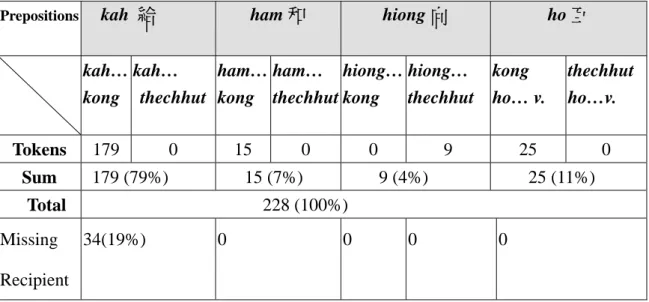
In verbs of speaking in Taiwanese Southern Min, the Recipient goal is always introduced with the following prepositions: kah ‘to, toward’ 給, ho ‘to toward’ 互, ham ‘to, toward’ 和 and hiong ‘to, toward’ 向. The three prepositions kah, ham and hiong are preverbal prepositions and only one preposition, ho is postverbal. In terms of distribution, the Recipient in KONG takes kah, ho, and ham as its preposition while the Recipient in THECHHUT takes only ham as its preposition. The distribution of the prepositions with the Recipient of KONG and THECHHUT is given in Table 7.
Table 7 Interactions of Participant Roles of KONG and THECHHUT with the Four Prepositions in the Transitive Use
Prepositions kah 給 ham 和 hiong 向 ho 互
kah…
kong
kah…
thechhut
ham…
kong
ham…
thechhut
hiong…
kong
hiong…
thechhut
kong ho… v.
thechhut ho…v.
Tokens
179 0 15 0 0 9 25 0Sum
179 (79%) 15 (7%) 9 (4%) 25 (11%)Total
228 (100%) MissingRecipient
34(19%) 0 0 0 0
As Table 8 shows, kah is the most frequently used preposition when the Recipient is highlighted. (15) shows the structure of kah and the participant roles of KONG and THECHHUT with a sample sentence:
(15)Sender + [kah] + Recipient + kong/*thechhut + Message (Ø) +kong/*thechhut
我 給 伊 講/提出 這件代誌In terms of the Recipient, it is noteworthy that in the case of KONG, the Recipient can be omitted (19%, 34/179) (see Table 8) when it is a mutually-known third-person as in
example (16).
(16) a. i
i do m goa ya m kan kah Øi biankiong 伊 就 不要, 我 也 不 敢 給 勉強3SG ASP not want 1SG either not dare to push
dingtitpai goa do kah Øi kong zedaichi 頂一擺 我 就 給(Missing Recipient ) 講 這代誌 last time 1SG ASP to say this matter
‘He does not want to. I do not dare to push him. I have said this matter to him last time.’
When the Recipient goal is introduced with the preposition ho, the relation between the Recipient and the Sender appears to be closer compared with the complement of the other three prepositions. This also explains why THECHHUT does not occur with ho since the two parties of the conversation in THECHHUT have more distant relationship (further explanation will be given in the discussion of the preposition ham). (17) is an example showing the relation between ho and the participant roles:
(17)Sender + kong/?thechhut+ Message + ho+ Recipient + verb of understanding
我 講/?提出4這件代誌 互 伊 了解
When KONG occurs with the preposition ho, we observe a pivotal construction, where the object is followed by another verb with the object as its subject (Li and Thompson 1981:419-34; Chao 1968:327). The second verb position in this pivotal construction is always filled by verbs of hearing thian ‘to hear ’ 聽 or verbs of understanding such as liaukai ‘to understand, to realize’ 了解, chai ‘to know’ 知道, and bingpek ‘to understand, to realize’ 明白as in (18).
(18)a. li kong /*thechhut ho gun
ba thian 你 講/*提出 互 阮 爸 聽.
4 In this sample sentence, THECHHUT is intuitively acceptable. Nevertheless, we do not observe such an example in our corpus.
2PG say to 1PLE dad listen ‘You say to your dad.’
b.goa kong/*thechhut ho li liaukai 我 講/*提出 互 你 了解
1SG say to you understand ‘I say to you for you to understand.’
When the Recipient goal is introduced with the preposition ham, the speaking activity involved is more like a two-party discussion than a one-way message sent out from the first speaker By contrast, when kah is used, only one party of the conversation makes the move to talk to the other speaker about a certain matter. (19) illustrates the relation of ham and the participant roles:
(19) Sender + [ ham] + Recipient + kong/*thechhut + Message
我 和5 伊 講/*提出 這件代誌
In addition, ham indicates certain intimacy between the speakers, who are of closer relationship. For example, the interlocutors are usually family members, relatives or friends. The Sender and the Recipient communicate on an equal basis.
In other words, ham…kong is a pattern found in everyday conversations in which speakers are close to each other. By contrast, THECHHUT is used between speakers of greater social distance in that it occurs in a more formal context and suggests a sense of talk from the inferior to the superior. This property will become more revealing in the following discussion of hiong. Such property also explains that the conflicting concurrence of THECHHUT and the preposition ham, as in examples (20a-c). In this case, KONG and THECHHUT are again in complimentary distribution.
5 HAM 和 has a phonetic variant TSAM (參). For consistency, we will use HAM throughout this thesis.
(20)a goa mo ai ham
likong/*thechhut
chitchiong daichi 我 無 愛 和 你 講/*提出 這種 代誌 1SG not like to 2SG say/*propose this matter ‘I don’t like to say this matter to you.’b. goa ham lin a-tiun-a de kong/*thechhut 我 和 恁 阿丈仔 在 講/*提出 1SG to your uncle ASP say/*propose ‘I am saying to your uncle.’
c. i ma it-ti ham goa kong/*thechhut 伊 麼 一直 和 我 講/*提出
3SG also always to me say
‘He has been always saying to me’
The preposition hiong differs from the above three prepositions in that it only cooccurs with THECHHUT. (21) sketches the structure of THECHHUT with hiong marking the Recipient.
(21)Sender + [hiong] + Recipient + *kong / thechhut + Message
我 向 伊 *講/提出 這件代誌There are two characteristics of THECHHUT when the Recipient is introduced with hiong : 1) a sense of inferiority and superiority, 2) the formality of the context.
When the Recipient goal is introduced with the preposition hiong, the Recipient goal tends to be superior to the Sender (7 occurrences out of 9) or of equal status (2 occurrences out of 9), as in (22a,b). The context where THECHHUT occurs is in more formal contexts such as political talk show or context where serious issues are under discussion. Besides, the Recipient usually has control over the resultant state of the proposal made. For example, in (22b), the President and the premier are the authorities to grant the request.
(22) a.i li
Kohiong chhittiung e sinhun de tiongshiong-hwe 依 你 高雄 市長 的 身分 在 中常會,as 2SG Kahohsiung mayor ASSC identification at Chunchang Committee
hiong abian chongthong kah iu-shit-khun wan-tiung kah thechhut chile iau-kiu 向 阿扁 總統 及 游錫昆 院長 給 提出 這個 要求 to abian president and Iu -shit -khun premier to propose this asking
‘As the major of Kahohsiung City, you propose this asking to President a-bin and premier iu-shik-khun.’
b. Tai-kahi-su
hiong ISO hwegi thechhut singchhing chiong pehweji
戴凱序 向 IS 會議 提出 申請 將 白話字Tai-kahi-su to ISO meeting propose apply take pehweji
iah mo tit Unicod benma laide e huho kahlip Unicode 還 麼 在 Unicode 編碼 內底 的 符號 加入 Unicode still no in Unicode spelling in ASSC sign add Unicode
‘Tai-kahi-su proposed to the ISO meeting to add those peh-we-ji that are not in Unicode into the spelling system.’
In sum, in the transitive use of KONG and THECHHUT, the Recipient is always marked by the preposition kah 給, ham 和, ho 互 and hiong 向. kah is the most preferred preposition (79 %) to mark the presence of the Recipient. The Recipient in KONG can be marked by more variety of prepositions while the Recipient in THECHHUT can only be marked by one preposition. The Recipients in KONG are always introduced by kah 給, ham 和 or ho 互 while the Recipient in THECHHUT is always introduced by hiong 向 . KONG, as an unmarked use of verb of communication prefers to occur in the daily conversation, where various prepositions showing closer relation between speakers are allowed to mark the Recipient; whereas THECHHUT allows only hiong 向 which denotes a distant relation between speakers to mark its Recipient. The reasons for the limitation of THCHHUT may lie in two: 1) the formal context of THECHHUT and 2) a sense of inferior to a superior recipient. While in a formal context, THECHHUT is preferred rather than KONG,
and vice versa. In other words, KONG and THECHHUT demonstrate a complementary distribution with regard to the marking of prepositions. They also demonstrate a division of labor concerning the message conveyed. This echoes back to what we have discussed in section 3.2.1.1.2 regarding their Message role. Since KONG prefers to occur in the daily conversation, the Message of KONG is less formal, including talking in general or speaking a language. The Message in THECHHUT on the other hand is more formal, such as specific policy making, taking place in an institutional talk and a formal context.
3.2.1.2 Intransitive Use
Of the two verbs of communication, only KONG has intransitive use. The essential characteristic of intransitive use is that the Message is absent in that the Message can be either recovered from the preceding discourse or that the talking marked by KONG is a general activity without specific message-theme addressed.
Examples of these two uses are shown respectively in (23a) and (23b). In example (23a), the Message is an implicit object which can be recovered from the prior discourse he peht-hun ba do ho m ho chiah kah chap-hun ba 彼八分飽就好,不好吃 及十分飽 (also see Section 3.1) That is, in (23a), KONG has a syntactic valence of one although it has a semantic valence of two (Payne 169-170; Croft 207-208).
(23) a.A:
he peh-hun ba do ho m ho chiah kah chap-hun ba 彼 八分 飽 就 好 不 好 吃 及 十分飽 Eighty percent full is good not eat till hundred percent full ‘Eat till you feel eighty percent full, not hundred percent full.’B: gao ma wu kah i kong
Ø (Missing Message)
我 麼 有 給 伊 講 Ø1SG also ASP to 3SG say ‘I have also said to him.’
b.gun itti kongi itti kong kao chhim ya
阮 一直 講 Ø 一直 講 到 深 夜 1PLE keep on say Ø keep on say till late night
‘I keep on saying till late in the night’
When the Recipient is shown, it is marked by a preposition as in the case of the transitive use. (24) illustrates the characteristic of the two participant roles in the intransitive use:
(24)
Sender + V (e.g. 我講)
Sender + prep. + (Recipient) + V (e.g. 我給(伊)講)
Most of the Senders in the intransitive use of KONG are present (96%, 883/920).
When the Sender in the intransitive use of KONG is present, it can refer to a specific person ([+specified] (88%)), as lim sensin 林先生 ‘Mr.Lim’ in example (25a) or it can also point to a group of people that are a non-referential ([-specified]), as gin-a lang 囡仔人 ‘children’ in example (25b). Regarding the feature of animacy, KONG unanimously takes an animate Sender (100%). Examples of animate Senders such as sienshin 老師 ‘teacher’or guatha-lolin月下老人 ‘the God of Marriage’ are given in (26a,b).
(25) a lim siensi
n kong liao u toli 林 先生 講 了 有 道理Lim Mr. say ASP have reason
‘What Mr. Kim said has reason.’
b. gin-a lang m-thang o-be kong 囡仔人 m通 黑白 講
children cannot randomly say
‘Children cannot say things randomly.’
(26) a.lawsu
khi kah a- mi e laubu kong biengpek 老師 去 給 阿美 的 老母 講 明白Teacher go to a-mi ASSC mother say clearly
lon kong kah busasa 都 講 kah 霧煞煞 but say till unclearly
‘The teacher wants to say clearly to a-mi’s mother, but end up saying unclearly.’
b.goatha- lojin kong soah duo suishi siaushit khi 月下老人 講 煞 就 隨時 消失 去!
The God of Marriage say finish then right away disappear
‘Right after the God of Marriage finish speaking, he disappeared.’
The other participant, the Recipient, can be either present or absent in the intransitive use. The absence of the Recipient (31%) results either from an absence of an intended Recipient (62%), i.e. the public, as in (27a) or from omission of a referent appearing in the preceding discourse as in (27b). The high percentage of an intended Recipient is making sense since KONG prefers to take place in daily conversation, where speakers in the discourse tend to omit the old information, which in this case is a Recipient that speakers are able to refer back from the prior discourse.
(27)a.
goa mo kongkai kong 我 沒 公開 講1SG not publicly say
‘I don’t say publicly.’
b. a-mi sin-the ma mo ho li m tan kah kong 阿美 身體 亦 沒 好 你 m通 給6 (Missing Recipient) 講 a-mi health also not good you not to say ‘A-mi’s health is not very good. Don’t say to her.’
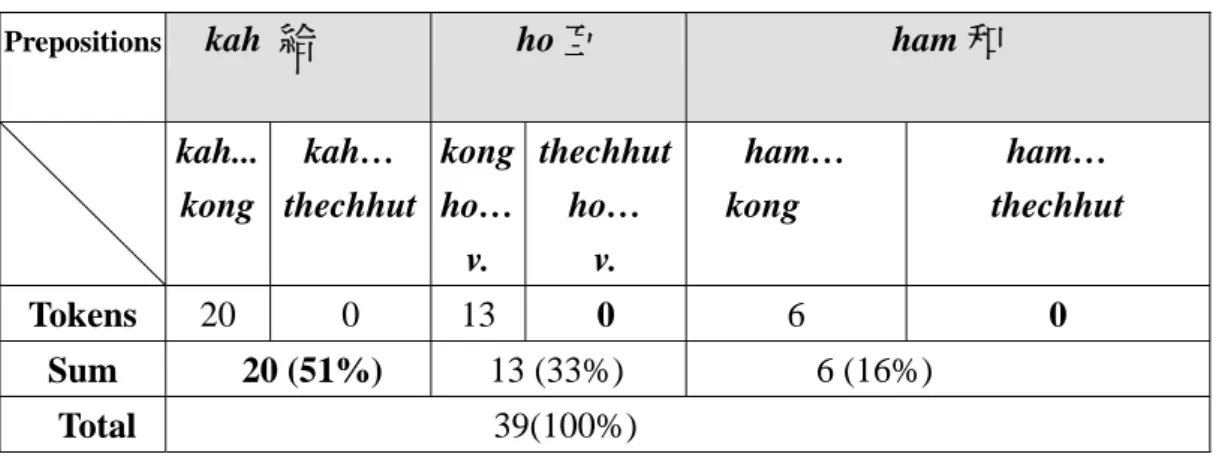
When the Recipient is present, as in the transitive use, the Recipient goal of the intransitive KONG can only be marked with three prepositions kah ‘to, toward’ 給, ho ‘to toward’ 互 and ham ‘to, toward’ 和. Table 8 shows how the participant roles interact with the three prepositions in the intransitive use of KONG:
6 There will be a tone change when the missing Recipient is incorporated into the preposition kah.
Table 8 Interactions of Participant Roles of KONG with the Three Prepositions in the Intransitive Use
Prepositions kah 給 ho 互 ham 和
kah...
kong
kah…
thechhut kong ho…
v.
thechhut ho…
v.
ham…
kong
ham…
thechhut
Tokens
20 0 130
60
Sum 20 (51%)
13 (33%) 6 (16%)Total 39(100%)
Table 8 shows that as in the transitive use, the preposition kah, enjoys the highest frequency (51%) to mark the Recipient of KONG, ho the second high, and ham the lowest frequency. The semantic representations of the Recipient with these prepositions resemble those in the transitive use of KONG and will thus not be repeated here.
To summarize, in the intransitive use of KONG, the Sender is mostly overt.
The unmarked semantic features are [+specific] and [+animate]. Compared to the two semantic features the Sender [+specific] (77%) and [+animate] (82%) in the transitive use, the Sender in the intransitive use possess stronger tendency of [+specified] (88%) and [+animate] (100%). The exclusive animacy of the Sender may be due to the fact that in the transitive use, the Message refers to not only talking but also proposals and suggestion with concrete ideas that can be made by either animate speakers or inanimate institutions; whereas in the intransitive use, the Message only denotes a piece of information taking place in a conversation that can only be carried out by animate speakers. On the other hand, the Message is absent in that the Message can be either recovered from the preceding discourse or the talking marked by KONG is a general activity without specific topic-theme addressed. The other participant role, the Recipient, can be either present or absent in the intransitive
use. The absence of the Recipient results either from an absence of an intended Recipient from omission of a referent appearing in the preceding discourse. When the Recipient is present, the semantic representations of the Recipient with prepositions resemble those in the transitive use of KONG
After examining the participant roles of KONG and THECHHUT in both transitive and intransitive use, in the next section we are going to observe how the participant roles behave in the Communication Frames (Fillmore 1992) and how KONG and THECHHUT can be categorized into the Communication Frame.
3.2.2 Communication Verbs in Verb Frame
A research program based on Frame Semantics has successfully constructed a
lexical database for English, called FrameNet (http://www.icsi.berkeley.edu./~framenet/). In FrameNet, there are fourteen frames
(For details, see Table 2 in chapter 2) pertaining to the Communication Frame.
These frames are repeated below for convenience of reference:
No. Frame Name Lemma
1 Candidness (be) candid, frank, honest, etc.
2 Commitment promise, swear, threaten, etc.
3 Conversation talk, discuss, argue, etc.
4 Encoding express, voice, put, etc.
5 Gesture gesture, nod, beckon, etc.
6 Manner babble, shout, whisper, etc.
7 Noise groan, scream, bark, etc.
8 Questioning inquire, ask, question, etc.
9 Request ask, beg, command, etc.
10 Response answer, reply, respond, etc.
11 Statement address, claim, comment, etc.
12 Volubility (be) talkative, chatty, silent, etc.
13 Hear hear, overhear, read, etc.
telephone, email, fax, etc.
14 Means
Each sub-frame can be viewed as a subset of a cognitive system based on the Conduit Metaphor. The verbs of communication KONG and THECHHUT demonstrate different distributions in FrameNet. KONG pertains not only to the Statement Frame but also to the Conversation Frame. However, THECHHUT pertains only to the Statement Frame. The most distinct difference between the Conversation Frame and the Statement Frame is that the process of communication in Conversation Frame is reciprocal and bi-directional, referring to two or more people talking to one another, whereas Statement Frame is a one-way direction communication. Example (28a) and (28b) illustrate the use of KONG and THECHHUT that operate in the Statement Frame respectively. In example (35a), the Sender of KONG a-pa a 爸 ‘Dad’ sends out a Message chhitma kingkhi chia ni bai 質 馬 景 氣 這 呢 歹 ‘The economy is so bad now.’. The sending of the information is one-way and does not involve any bilateral verbal activity. Similarly, in example (28b), the Message ong hwuekui dzo 用貨櫃做 ‘do with container system’
implies no reciprocal relationship involved in the Statement Frame.
(28)a.
a-pa wu te kong chhitma kingkhi chiani bai la 爸 有 在 講 質馬 景氣 這呢 歹 laFather ASP speaking of now economy this bad UFP
‘Father is speaking of such a bad economy nowadays.’
b . soit goa chitma wu thechhut kong ong hwuekui dzo
所以 我 質馬 有 提出 講 用 貨櫃 做
So 1SG
now ASP propose COM use container system do ‘So, now I am proposing to do with container system.’The use of KONG demonstrates a different picture. In other words, it pertains both to the Statement Frame and the Conversation Frame. The characteristic of reciprocality is demonstrated by the two parties indicated specifically by the preposition ham 和 ‘to, toward’ in the conversation goa 我 ‘I’ and i 伊 ‘he’ in example (29a). Both participants are involved in a discussion about the price of the pipe. By contrast, although ham may co-occur with THECHHUT, as in example (29b), it does not encode a bi-directional verbal behavior.
(29) a.goa ham
i kong hitle hongkong kui gin 我 和 伊 講 彼 le 風管 幾 元 1SG and 3SG talk that pipe what dollar ‘I talk to him about the price of the pipe.’b.
goa ham i thechhut hitle tehan 我 和 伊 提出 彼 le 提案 1SG and 3SG propose that plan ‘He and I propose that plan.’In comparison with verbs of communication in Mandarin Chinese, JIAN講7, verbs of communication like KONG in TSM belongs to both the Conversation Frame and the Statement. JIAN in Mandarin Chinese pertains only to the Statement Frame (Liu and Wu 2003).
In the last two sections, section 3.1 and 3.2, we have explored the syntactic and semantic representation of KONG and THECHHUT respectively. In the next section, we are going to explore the event structure of verbs of speaking in TSM.
7 In Mandarin Chinese, studies on TICHU 提出 have not yet been conducted.
3.3 Transitivity of KONG and THECHHUT
Over the last few decades, aspectual notions have been applied to in structuring
verbal lexical semantic representation. Levin (2000) proposes that aspectual classification is efficient in recognizing the transitivity of a verb and in grounding lexical semantic representation. Early studies such as Thompson and Hopper’s transitivity parameters (1980) have indicated that ‘telicity’ and ‘punctuality’ play prominent roles in recognizing aspectual properties of verbs. Vendler (1967) and Saeed (1997) suggest that aspect system allows speakers to form different situation types, e.g. whether the event is complete, or incomplete, so short as to involve almost no time, something stretched over a perceptible period, or as something repeated over a period. Transitivity involves a number of components and these components would co-vary with one another in different languages (see chapter 2 for a detailed review). We will examine how KONG and THECHHUT rank in the scale of ten parameters. Among the ten parameters, two parameters, Aspect and Punctuality, will receive particular attention for they have direct relevance to the temporal contour of a verb (Levin 2000).First, we look at the parameter of Aspect. Aspect signifies the telicity of a verb.
A telic verb encodes a result or an ending state. The concept of the semantic distinction: telic/atelic in situation types (Vendler 1967; Smith 1991) are identical to the parameters of Aspect in Thompson and Hopper’s transitivity parameters.
According to Vendler (1967), telic verbs refer to verbs that have processes which are seen as having a natural completion.
In terms of Thompson and Hopper’s parameters, THECHHUT scales higher than KONG in the parameter of Aspect. THECHHUT is a very typical telic verb which encodes a result or an ending state, as in (30a). KONG is found to be in either telic
cases such as stating a piece of information or in atelic cases such as repeating the intended saying. Example (30a) illustrates the telicity of THECHHUT, in which once hwantui i-ken 反對意見 ‘cons’ are proposed, the event of proposing is completed right after the proposed was made. (30b,c) illustrate the telicity of KONG in which the action of speaking is carried out right after pieces of information such as i sensing gin chip-it 伊 先生很執一 ‘Her husband is being stubborn.’ or iauo be chhu goa mo ai be ku chhu 以後買厝我沒愛買舊厝 ‘I do not want to buy old houses afterwards.’ are stated. Example (30d,e) on the other hand illustrate the quality of being atelic by repeating the intended saying. Ittit 一直 ‘always’ in (30d) and tangtang 定定 ‘often’ in (30e) further strengthens the imcomplete process that is the characteristic of being atelic.
(30) a.i
ti hwegi duon due TLPA thechhut hwantui i-ken 伊 在 會議 中 對 TLPA 提出 反對 意見 3SG in meeting in toward TLPA propose cons ideas ‘He proposes cons toward TLPA in the meeting.’b.i kong i sensin chin chip-it 伊 講 伊 先生 很 執一 3SG say her husband very stubborn
‘She says that her husband is very stubborn.’
c. goa kong goa iauo be chhu goa mo ai be ku chhu 我 講 我 以後 買 厝 我 沒 愛 買 舊 厝 1SG say 1SG afterwards buy house 1SG not want buy old house ‘I say that I do not want to buy old houses afterwards.’
d. i ma ittit ham goa kong … 伊 麼 一直 和 我 講…
3SG
ASP always to 1SG say…‘He has been always saying to me that ….’
e. goa ma tangtang kong goa hoekau chiok ai chiah gubah 我 麼 定定 講 我 回教 足 愛 吃 牛肉
1SG also always say 1SG Islam very much love eat beef ‘I have always said that I am Islamic and I love to eat beef very much.’
Secondly, we look at the parameter of Punctuality. Punctuality involves when a verb has an obvious transitional phase between inception and completion. It describes an event that seems so instantaneous that it involves virtually no time (Smith 1991). Therefore, the action involved has a clear-cut boundary (cf.
Thompson and Hopper 1980:252). A contrastive notion is durativity, proposed by Vendler (1967) in situation types of verbs. Durative verbs refer to verbs that describe a situation or process which lasts for a period of time. The notion of
‘Process’ is identified as a temporal duration by Huang et al. (2000:26).
In terms of Thompson and Hopper’s parameters, THECHHUT scales higher than KONG in the parameter of Punctuality. That is to say, KONG is more ‘durative’
while THECHHUT is more ‘punctual’. KONG has the quality of being on-going or durative in different contexts; however, TECHHUT pertains only to the quality of a clear-cut action. In example (31a), KONG takes the phrase kui poan kan 歸半天
‘several days’ to demonstrate a durative time without clear inception and completion.
We do not observe any continuation of time involved in the action encoded by THECHHUT. In (31b), on the other hand, KONG marks a punctual event. As for THECHHUT, in example (32a,b), thechhut chite iaukiu提出這個要求 ‘to make this proposal’ or thechhut pingko kah kiangi提出評估和建議 ‘propose an evaluation and suggestion’ has a clear-cut and instantaneous action, demonstrating punctuality in that the action of the proposal takes place within a short time and does not involve process.
(31)a. i iking kong/*thechhut kui-poa
n-kan 伊 已經 講/*提出 歸半天了 3SG already say/*propose days ‘He has been saying for days/for three hours.’(32) a. i thechhut chitle iaukiu
伊 提出 這 le 要求 3SG propose this asking ‘He proposes this asking.’b.sienshin kah gigan gaoyotka thechhut phinggu kah kiangi 老師 和 語言 教育者 提出 評估 和 建議
teacher and language educator propose evaluation and suggestion
‘The teachers and language educators propose evaluation and suggestion.’
c. goa kong goa wu kah i kiam shin 我 講
我 有 給 伊 減 薪 1SG say 1SG ASP to 3SG cut salary ‘I said that I have cut his salary.’
To summarize, KONG and THECHHUT demonstrate different degrees of transitivity. KONG is more atelic and durative while THECHHUT is more telic and punctual. This may have to do with the frequent use of KONG as a verb of communication which gives rise to a variety of uses. KONG is use to mark a piece of information or a statement. The action of KONG can either be completed once the speaker send out a statement (telic/punctual) or it can be lasted by repeating in a certain period of time (atelic/durative). THECHHUT, given its low frequency, is especially enlisted as a verb bearing the quality of telicity and punctuality.
THECHHUT is used to mark an event of proposing or suggesting. Once the proposal or suggestion is made, the action of speaking is accomplished.
3.4 Summary
In this chapter, we have examined closely one of the sub-groups of TSM verbs of communicationKONG and THECHHUT. Sharing the same semantic frame, KONG and THECHHUT appear to be indistinguishable at first sight. However, a closer
investigation of their semantic and syntactic constructs reveals several similarities and differences between the two verbs.
First, KONG and THECHHUT are similar to each other only in the quality of the Sender in their semantic representation. That is, the Sender of KONG and THECHHUT in both transitive use and intransitive use shows high tendency of being animate and being specified. This is understandable since the communication is mainly carried out by people and is making sense only when we can refer to the speaker to a specific person. When the Sender is inanimate, both the Sender of KONG and THECHHUT refers to the animate speakers speaking in an inanimate institution.
Nevertheless, it is observed that KONG and THECHHUT differ from each other in four ways. First, the frequency demonstrates that KONG is extremely pragmatically unmarked and is a preferred verb of communication, whereas THECHHUT is pragmatically marked and thus a non-preferred use. This correlates with their syntactic patterning and grammatical functions. KONG has wider use in terms of its argument structure. That is, the object position in the case of KONG can either be covert or be filled with an NP or a clause. In the case of THECHHUT, however, the object position must be overt and to be filled by an NP or a clause. The differing argument structures of KONG and THECHHUT imply that they differ in terms of their transitivity. KONG has both transitive (85%) and intransitive use (15%) while THECHHUT has only transitive use (100%). KONG prefers to take clause in the object position (83%) while THECHHUT prefers to take an NP as its object complement (68%).
Second, taking a clause as the Message, the topic in the clause of THECHHUT is more formal and serious while the topic in the clause of KONG is more related to daily-life, such as family affairs or friends’ chatting. When taking an NP as the
Message, the Message of KONG has distinct senses pertaining to various kinds of speaking activity: speaking a language, talking in general, and talking about a specific topic. On the other hand, specific topic is the majority of the Message that is communicated by THECHHUT. As for the Participant role, in the transitive use when the Recipient is to be highlighted, the preposition kah is the most preferred use.
The Recipient of KONG can be marked by more variety of prepositions such as kah, ham or ho while the Recipient in THECHHUT can only be marked by the preposition hiong. In the intransitive use, the semantic representations of the Recipient with prepositions resemble those in the transitive use of KONG.
Third, KONG and THECHHUT behave differently in the Communication Frame.
Specifically KONG pertains not only to the Conversation Frame but also to the Statement Frame; whereas THECHHUT pertains only to the Statement Frame.
Fourth, concerning their event structure, KONG is more atelic and durative while THECHHUT is more telic and punctual. This may have to do with the frequent use KONG as a verb of speaking, which gives rise to a variety of uses. THECHHUT, given its low frequency, is especially enlisted as a verb bearing the quality of telicity and punctuality.
Overall, KONG and THECHHUT in TSM bear more differences than similarities. KONG enjoys an extreme high frequency and thus an unmarked use whereas THECHHUT on the contrary is a marked use. Due to the extreme high frequency, KONG displays more varieties in syntactic constructions, semantic representation and its transitivity. The preferred use in the formal context and the pragmatic implication of inferiority to superiority reduce the varieties in semantic representation of THECHHUT. Both the syntactic representation and event structure demonstrate that KONG is of lower transitivity while THECHHUT is a higher transitive verb. Furthermore, KONG is more atelic and durative while THECHHUT
is more telic and punctual in their event structures.
In this chapter, we have analyzed KONG and THECHHUT in TSM. As a continuing study, in the next chapter, we compare THECHHUT and KIANGI since these two verbs share the semantic property of making a suggestion or proposal.