行政院國家科學委員會專題研究計畫 成果報告
高導氧離子之磷灰石結構矽酸鑭系固態電解質之開發 研究成果報告(精簡版)
計 畫 類 別 : 個別型
計 畫 編 號 : NSC 99-2221-E-011-044-
執 行 期 間 : 99 年 08 月 01 日至 100 年 07 月 31 日 執 行 單 位 : 國立臺灣科技大學機械工程系
計 畫 主 持 人 : 郭俞麟
計畫參與人員: 碩士班研究生-兼任助理人員:何享穎 碩士班研究生-兼任助理人員:梁雲淵 博士班研究生-兼任助理人員:蘇昱銘
報 告 附 件 : 出席國際會議研究心得報告及發表論文
處 理 方 式 : 本計畫可公開查詢
中 華 民 國 100 年 09 月 20 日
1
行政院國家科學委員會補助專題研究計畫 ■成果報告
□期中進度報告 高導氧離子之磷灰石結構矽酸鑭系固態電解質之開發
計畫類別:■個別型計畫 □整合型計畫 計畫編號:NSC 99-2221-E- 011-044-
執行期間: 99 年 8 月 1 日至 100 年 7 月 31 日
執行機構及系所:國立台灣科技大學機械工程系
計畫主持人:郭俞麟
計畫參與人員:博士班研究生-兼任助理:蘇昱銘
碩士班研究生-兼任助理:何享穎、梁雲淵
成果報告類型(依經費核定清單規定繳交):■精簡報告 □完整報告
本計畫除繳交成果報告外,另須繳交以下出國心得報告:
□赴國外出差或研習心得報告
□赴大陸地區出差或研習心得報告
■出席國際學術會議心得報告
□國際合作研究計畫國外研究報告
處理方式:本計畫可公開查詢
中 華 民 國 100 年 9 月 20 日
2
國科會補助專題研究計畫成果報告自評表
請就研究內容與原計畫相符程度、達成預期目標情況、研究成果之學術或應用價 值(簡要敘述成果所代表之意義、價值、影響或進一步發展之可能性)、是否適 合在學術期刊發表或申請專利、主要發現或其他有關價值等,作一綜合評估。
1. 請就研究內容與原計畫相符程度、達成預期目標情況作一綜合評估
■ 達成目標
□ 未達成目標(請說明,以 100 字為限)
2. 研究成果在學術期刊發表或申請專利等情形:
論文:□已發表 ■未發表之文稿 □撰寫中 □無 專利:□已獲得 □申請中 ■無
技轉:□已技轉 □洽談中 ■無 其他:(以 100 字為限)
3. 請依學術成就、技術創新、社會影響等方面,評估研究成果之學術或應用價 值(簡要敘述成果所代表之意義、價值、影響或進一步發展之可能性)(以 500 字為限)
(1)學術理論方面:
本研究除了符合目前國家重點項目研究(能源科技)之外,也已投入得到初步結 果。未來將持續進行合成製備法合成具有高導氧率之 La10-xSi6O26+y 固態氧化 物電解質,並進行其物性與電性能探討,以求深入了解矽酸鑭系磷灰石結構 固態電解質之導氧性質與單氣室性能評估結果,期將藉由實驗所得成果,發 展工程設計與實際應用。
(2)國家發展及經濟建設方面預期之貢獻:由此計畫所得之結果,可確定合成製 備技術應用於製備矽酸鑭系磷灰石結構固態氧化物燃料電池電解質,提高設 計能力,增加控制能力,以增加生產,使成本降低。
(3)參與工作人員,預期可獲得之訓練:
本實驗之方法及製程技術的參與之工作人員皆可獲得化學合成方法以及電子 陶瓷實務上的寶貴經驗,同時熟悉各項儀器之量測與分析技術,將學術理論 及工程實務合而為一。
3
高導氧離子之磷灰石結構矽酸鑭系固態電解質之開發 Development of High Oxygen-Ion-Conducting Apatite-Type Lanthanum Silicates Electrolytes 計畫編號:NSC 99-2221-E-011 -044
執行期限:99 年 8 月 1 日至 100 年 7 月 31 日 主持人:郭俞麟
參與人員:蘇昱銘、何享穎、梁雲淵
一、中文摘要
磷灰石結構矽酸鑭 La10-x(SiO4)6O2+δ具有高氧離子導電率及低活化能,被認為具有作為中 低溫固態氧化物燃料電池電解質的潛力,不同於高對稱性的螢石結構電解質或是鈣鈦礦結構,
低對稱性的磷灰石結構材料屬六方晶系,存在著可讓氧離子輕易擴散遷移的路徑。但磷灰石結 構矽酸鑭固態電解質之製備仍存在許多挑戰,若以固態反應法混合製備,由於其不易燒結之特 性,因此需要在高於 1600 ℃以上的高溫燒結才具有高緻密度;且由 La2O3/SiO2之相圖可知,
La9.33(SiO4)6O2為一中間相,合成時易形成第二相 La2SiO5及 La2Si2O7;此外起始粉末 La2O3的 不穩定性,故難以控制矽酸鑭的劑量比。
本研究以 La2O3和 SiO2作為起始粉末,利用固態反應法在 1200 ℃鍛燒後成功合成矽酸鑭
La10(SiO4)6O3,但 XRD 結果指出在 1550 和 1600 ℃燒結後有 La2Si2O7的繞射峰存在。此外以 通入還原氣氛 H2之 TGA 測試其熱化學穩定性,顯示矽酸鑭為一抗具有良好抗還原性質的固態 電解質材料。時效測試可知雖然燒結後之矽酸鑭有第二相 La2Si2O7的產生,但仍維持穩定的導 電率,不隨時效時間的增長而下降。
4
關鍵字:矽酸鑭、磷灰石結構、固態氧化物燃料電池、固態反應法 二、英文摘要
Lanthanum silicate structural with formula La10-x(SiO4)6O2+δ (LSO) are potential candidates for IT-SOFC and LT-SOFC because of its high ionic conductivity and low activation energy. Rather than fluorite and perovskite structure with high symmetric structure, lanthanum silicate with apatite-type structure is belong to hexagonal structure and believed to migrate via an interstitial conduction mechanism. Studies have indicated that LSO synthesized via solid state reactions have to
be sintered at high temperature (>1600 ℃) to achieve the desired densities. According to phase equilibrium diagram of La2O3/SiO2, the composition of La9.33(SiO4)6O2 is a intermediate phase , and La2SiO5 or La2Si2O7 are easily formed as secondary phases. In addition, it’s difficult to control the stoichiometry of LSO due to the hygroscopicity of its staring materials La2O3.
In this study, apatite-type lanthanum silicates La10(SiO4)6O3 were prepared by solid state reaction using powders of La(OH)3 and SiO2 as starting materials. The calcined samples are characterized by XRD and the results indicate that LSO have been obtained after calcination at 1200
℃, but the La2Si2O7 impurity is formed after sintered at 1550 and 1600 ℃. TGA of the LSO
powders were performed under hydrogen atmosphere, and the results indicates that LSO is a stable SOFC electrolyte materials. The effect of microstructure on the conductivity was also investigated, and the results show that the sintered ceramic with coarse grain size exhibits higher conductivity than fine one at low temperature. In addition, the aging test of LSO indicates that the sintered ceramic
5
with La2Si2O7 impurity maintains a conductive stability.
Key words: Lanthanum silicate, Apatite, Solid oxide fuel cells (SOFC), Solid state reaction 三、計畫緣由及目的
近五十年來,許多氧離子導體被發現且廣泛研究。其中以螢石結構(氧化物摻雜氧化鋯基、
氧化鈰基等)及鈣鈦礦結構(鑭鎵氧化物基等),都具有相對較高之導氧率以及應用上之限制。傳 統 SOFC 主 要 是 以 8 mol% 氧 化 釔 (Y2O3) 摻 雜 氧 化 鋯 (ZrO2) 之 氧 化 釔 穩 定 氧 化 鋯
(Yttria-stabilized zirconia, YSZ)作為電解質材料,但此系統需在 800-1000 ℃的高溫下運轉,以 維持其離子導電性。
降低操作溫度的方法有二:一為降低傳統 SOFC 電解質材料 YSZ 的厚度,二為開發在較 低溫仍具有高導電率的電解質材料。在開發較低溫時仍具高導電率的電解質材料方面,磷灰石
(Apatite)結構的固態電解質首先由 Nakayama 等人在 1995 年提出[1],文獻中比較不同的三價稀 土離子 La、Nd、Sm、Gd 及 Dy 對於磷灰石結構的電性影響,其中以摻雜 La3+的 La10(SiO4)6O3
組成具有最佳的離子導電性能。Higuchi 等人在 2006 年以固態反應法製備 La10(SiO4)6O3固態電 解質,並申請美國專利[2]。
Nakayama 等人的研究中指出[1],如圖 1 所示,在操作溫度 600 ℃及 350 ℃時,以固態反 應法製備 La10(SiO4)6O3 的導電率分別高於(ZrO2)0.92(Y2O3)0.08及(Bi2O3)0.75(Y2O3)0.25,值得注意 的 是 當 操 作 溫 度 為 200 ℃ 時 , La10(SiO4)6O3 導 電 率 (1.32×10⁻⁵ S/cm) 為 (Bi2O3)0.75(Y2O3)0.25(8.82×10⁻⁷ S/cm)的 15 倍,因此 La10(SiO4)6O3具有可在低溫下操作的 SOFC 電解質之發展潛力。
6
圖 1 Temperature dependence of conductivity[1]
本研究以固態反應法合成磷灰石結構矽酸鑭 La10(SiO4)6O3,並評估矽酸鑭在 中溫型 SOFC 操作環境下之熱化學穩定性,此外將探討矽酸鑭固態電解質微結構 與導電率之關係,最後將進行長時間於高溫持溫後導電率是否會有衰退現象之時 效測試。
三、實驗方法
利用 La2O3粉體(99.99 %, Alfa Asear, USA)及 SiO2粉體(99.9%, Alfa Aesar,
USA)以固態反應法製備磷灰石結構 La10(SiO4)6O3。實驗流程如圖 2 所示。首先 將 La2O3粉末以 1100 ℃持溫 5 小時,去除其水分及有機物,再加入適量 SiO2和
99.5 %酒精,以 2 mm 氧化鋯珠作為磨球,利用行星式球磨機在 380 rpm 之轉速 下球磨 1 小時,充分將粉末混和並且使粉末粒徑細化。再將混和後之白色漿料以 超音波震盪 30 分鐘,利用減壓濃縮裝置並使用水浴法加熱至 40 ℃使酒精揮發,
使固態電解質漿料在均勻混合的條件下快速去除溶劑,獲得混合均勻的乾燥粉
7
末。乾燥之粉末以研缽和研杵研磨,研磨後之粉末在 1200 ℃下煆燒 10 小時,以 合成出具磷灰石結構之矽酸鑭粉末。
製備後之電解質其材料性質則以 X 光繞射儀分析其結晶結構、利用掃瞄式 穿透式電子顯微鏡觀察其表面型態、比表面積分析儀分析粉體尺寸,電解質塊材 密度與導氧率則利用阿基米德法及交流阻抗分析儀進行量測,以單氣室測試系統 量測其單電池電功率密度。最後,本研究製備之具有高導氧性質、高緻密程度之 電解質塊材將進行長效期高溫熱化學穩定性測試,並與常用之電解質 8YSZ、
Bi2O3及 GDC10 作比較,以確定其未來應用於中低溫固態氧化物燃料電池操作 環境下之熱穩定性。
四、結果與討論
根據許多學者的研究,磷灰石結構矽酸鑭 La10-x(SiO4)6O2+δ固態電解質之製 備仍存在許多挑戰,若以固態反應法混合製備,由於其不易燒結之特性,因此需 要在高於 1600 ℃以上的高溫燒結才具有高緻密度;且由 Bondar[3]等人的研究結 果顯示,在 1900 ℃以下時起始粉末 La2O3/SiO2莫耳比例為 7:9 之 La9.33(SiO4)6O2
為 一 中 間 相 , 因 此 合 成 時 可 能 因 粉 末 混 和 不 均 及 不 正 確 的 劑 量 比 而 形 成
La2O3/SiO2比分別為 1:1 與 1:2 之第二相 La2SiO5及 La2Si2O7,而欲合成δ>0 之矽酸鑭則易有 La2SiO5的生成,在上述情況下 La2SiO5及 La2Si2O7為穩定相,
形成後便很難移除。此外以固態反應法混合製備之起始粉末若為 La2O3,由於其 易與空氣中之水分以及 CO2反應形成 La(OH)3及 La2(OH)6-2x(CO3)x,因此難以控
8
制矽酸鑭的劑量比,此皆為有待克服的難題。因此藉由 1100℃、5 小時熱前處理 後的 La2O3粉體(t-La2O3)可移除 La(OH)3)及 La2(OH)6-2x(CO3)x。本研究將未經過 熱處理的 La2O3粉體標記為 p-La2O3。
為探討混和之 La2O3/SiO2於升溫過程中可能發生的相變化,將粉末置於通入
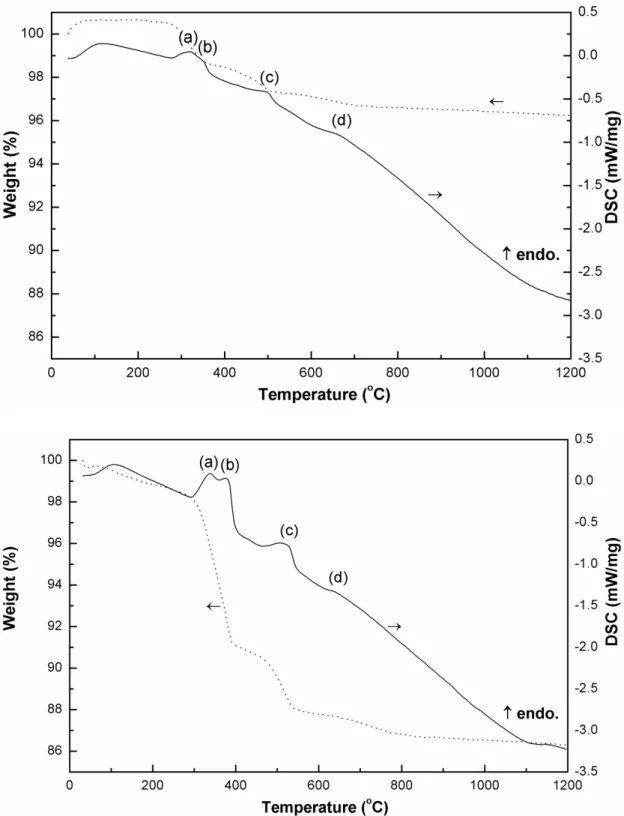
N2之 TG/DSC,以 10 ℃/min 的升溫速率由室溫升溫至 1200 ℃量測其熱重損失 及吸放熱狀態。圖 3 為 p-La2O3/SiO2 and t-La2O3/SiO2混合物的 TGA/DSC 分析圖 譜。結果顯示分別在 370、510 及 650 ℃左右有明顯之三階段熱重損失,對應之
DSC 曲線為 4 個吸熱峰(a)、(b)、(c)及(d),文獻[4~6]指出 La(OH)3的表面易與空 氣中的 CO2進行式(4-1)之反應
O xH CO
OH La xCO
OH
La( )3 2 2( )6 2x( 3)x 2
2 + ↔ − ⋅ (4-1)
其中 x 值,即與 CO2反應的量隨 La(OH)3暴露在空氣中的時間增長而增多,當溫 度升至約 300 ℃則將發生式(4-2)之反應,為造成吸熱峰(a)之原因
O H x CO O La O xH CO OH
La2( )4 3⋅ 2 → 2 2 3+( +2) 2 (4-2)
吸熱峰(b)為 La(OH)3脫水產生羥基氧化鑭 LaO(OH),如式(4-3)所示
O H OH LaO OH
La( )3 370.5C 2 ( ) 2 2
2 ← →° + (4-3)
第一階段熱重損失是由(4-2)及(4-3)反應所致,共造成約 1.8 %的熱重損失,吸熱 峰(c)是因 LaO(OH)的脫水反應,如式(4-4)所示,有 1.2 %的熱重損失
9
O H O La OH
LaO( ) 508.9c 2 3 2
2 ← →° + (4-4)
吸熱峰(d)則是由式(4-2)產生的 La2O2CO3在約 650 ℃進行脫碳酸反應,反應式如 下,有 0.5%的熱重損失
2 3 2 650
3 2
2O CO La O CO
La ← →°C + (4-5)
由式(4-4)及(4-5)可知,在升溫過程中雖有中間產物 LaO(OH)及 La2O2CO3的 產生,但兩者最終皆反應生成 La2O3。但從圖 3(b)結果得知,雖然 La2O3經由熱 處理過,La(OH)3 及 La2(OH)6-2x(CO3)x 還是無法避免會在室溫下生成。再將
p-La2O3/SiO2及 t-La2O3/SiO2混合物以 1200 ℃、持溫 10 小時去做煆燒處理。XRD 結果顯示經由煆燒製程 1200 ℃、持溫 10 小時的 La10(SiO4)6O3 粉體,只有
p-La2O3/SiO2 混合物會有第二相的存在。因此根據 Béchade 等人的文獻提出之反 應式,以及本研究提出之 TGA/DSC 圖 3(b)及 XRD 圖 4(b),可證實 La2O3粉體在 熱 前 處 理 1100 ℃ 、 持 溫 5 小 時 以 上 時 , 可 有 效 移 除 La(OH)3 及
La2(OH)6-2x(CO3)x,進一步製備精確的化學計量之 La10(SiO4)6O3粉體。
煆燒製程過後的 La10(SiO4)6O3粉體,經由壓錠燒結在 1550 ℃及 1600 ℃,其
XRD 結果顯示在圖 5。所有試片結果顯示只有磷灰石結構 La10(SiO4)6O3的單一 相存在(JCPDs # 53-0291)。燒結後的 La10(SiO4)6O3的晶格常數(a=b=9.707 Å and
c=7.174 Å)符合先前的學者研究結果[1, 4, 7]以及其 JCPDS 卡號。
試片密度利用阿基米德法去量測。在不同燒結溫度下的試片密度分別為
10
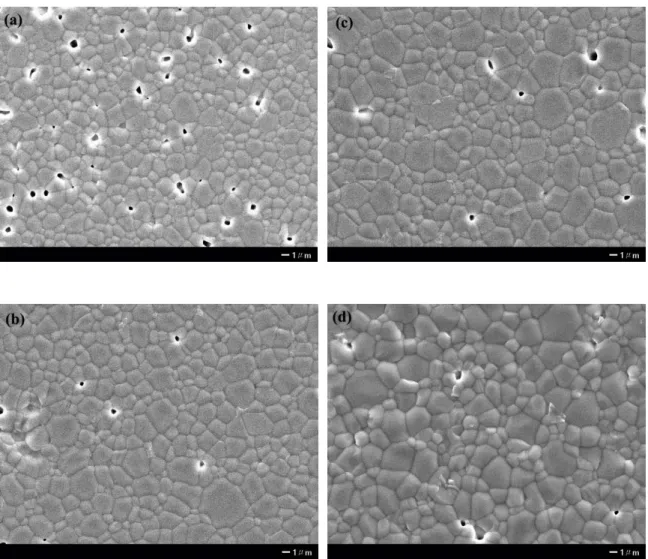
89.12% (3 小時、1550℃),94.37% (6 小時、1550℃),95.50% (12 小時、1550℃) 及 96.91% (2.5 小時、1600℃)。其結果可發現較高的燒結溫度可得到相對較高之 相對密度,對於 La10(SiO4)6O3電解質的緻密性來說,足夠的燒結溫度對於固態反 應法是必需的。圖 6 為燒結壓錠的 SEM 圖。結果顯示當燒結溫度從 1550 ℃提高 至 1600 ℃,平均粒徑則從 1.0 μm 增加至 4.0 μm,也顯示在 1600 oC 燒結之樣品 其空隙率為 2.1%及體密度為 5.441 g.cm-3。
探討經由熱前處理過程的 La2O3 粉體的壓錠燒結製程之效益,煆燒過後的
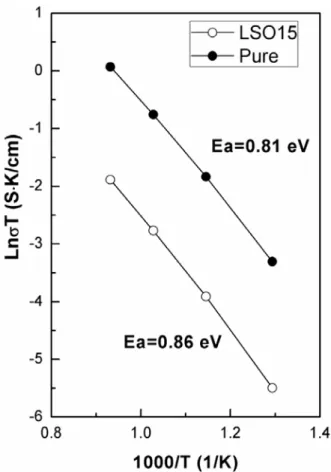
p-La2O3/SiO2 及 t-La2O3/SiO2 混合物將形成 La10(SiO4)6O3粉體,再將粉體壓錠燒 結在 1600 ℃、持溫 2.5 小時。圖 7 為兩種類型的 La10(SiO4)6O3電解質以兩點 DC 法量測其導電性知阿瑞尼士圖。結果顯示有第二相生成的 La10(SiO4)6O3電解質其 導電性低於純的 La10(SiO4)6O3電解質。兩種類型的 La10(SiO4)6O3電解質其活化 能(Ea)如圖 7 所示。純的 La10(SiO4)6O3電解質之活化能 0.81 eV 大於先前的文獻
結果[1, 4, 7~8],但明顯小於有第二相生成的 La10(SiO4)6O3電解質之活化能 0.86 eV。
從材料特性與導電性量測之結果,經由熱前處理製程的 La2O3粉體,在煆燒或燒 結製程可有效移除其第二相之生成。對於應用於固態氧化物燃料電池之電解質來 說,電解質的導電性期望在 700 ℃有 10-2 S/cm[9~11]。以圖 7 來說,純的 La10(SiO4)6O3
電解質其導電度在 700 ℃有 1.1×10⁻³ S/cm,低於常用的 8YSZ 電解質。但有文獻 指出摻雜額外的離子可置換 Si 的格隙或 La 的格隙,並有效改善 La10(SiO4)6O3
電解質應用於固態氧化物燃料電池之導電性能[12~16]。
11
固態電解質的開發除了須考慮離子導電率外,另一重點為是否具良好的抗還 原性,在 SOFC 的相對高的操作溫度以及還原氣氛(氫氣與甲烷)下,電解質材料 必須保持良好的熱穩定性,不能夠發生相變化等造成結構改變的因素。將鍛燒後 的 LSO 粉末置於通入 20% H2之 TGA,以 500 ℃、600 °C、700 °C 和 800 °C 持 溫 8 小時,測試其於中溫型 SOFC 操作環境下之抗還原性質。試驗結果如圖 8 所示,LSO 在不同溫度下測試之熱重損失皆少於 0.05 wt%,證明磷灰石結構之 矽酸鑭為具有良好抗還原性質之 SOFC 電解質材料。經 TGA 測試後之 LSO 粉末 再以 XRD 分析其晶體結構(圖 9),在不同測試溫度之粉末仍維持純磷灰石結構,
無其他繞射峰產生,證明磷灰石結構之 LSO 為一具穩定熱化學性質之 SOFC 電 解質材料。
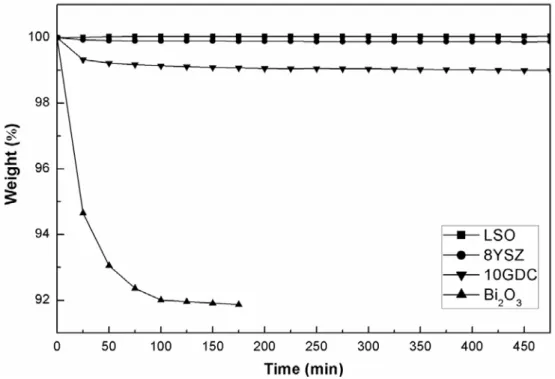
若與其他常見固態電解質 8YSZ、GDC-10 和 Bi2O3作比較,以 TGA 系統測 試在 H2還原氣氛下之熱穩定性,如圖 10 所示。Bi2O3以δ 相具有非常好的離子 導電性,但由於會與還原性氣氛反應造成金屬鉍的產生,使得電子導電性上升而 離子導電性下降,失去固態電解質之特性,使得氧化鉍固態電解質難以應用於 SOFC 操作條件下。根據理論計算,Bi2O3在完全還原後其最大重量損失約為 10.3
%。圖 9 結果指出 Bi2O3在 H2環境下還原 3 小時之後,其重量損失為 8.2 %,顯 示 Bi2O3因 H2的通入被還原成金屬 Bi 而導致熱重上的差異。但可藉由摻雜異價 元素獲得不同結構來改善其還原特性及離子導電性能[17~19]。根據我們先前的研 究[20]也發現摻雜 14.3 mole% TiO2到 Bi2O3 (Bi12TiO20),經由 TGA 系統測試其還
12
原性質,結果顯示在 700 °C、甲烷環境下,Bi12TiO20的抗還原性能優於純 Bi2O3
之結構。
LSO 與 8YSZ 同樣具有良好的熱化學穩定性,熱重近幾乎無變化;GDC-10 (Ce0.9Gd0.1O1.95)在低氧分壓(N2 flow)之升溫段即因 Ce4+還原成 Ce3+,因而部分 O 離子脫離晶格造成大量之熱重損失; Bi2O3則因 H2的通入被還原成金屬 Bi,O 離子脫離晶格導致熱重上的差異,另 Bi2O3之熱重損失在約 175 分鐘即接近其載 氧量(10.3%)且曲線已趨平緩,故未再繼續持溫測試。
純 CeO2 離子導電率低,經適當濃度摻雜三價的稀土金屬陽離子(Trivalent
rare earth ions)或二價的鹼土金屬陽離子(Divalent alkaline earth ions)取代 CeO2中 鈰離子的位置,引入氧離子空缺後,離子導電率明顯提高,適合作為 SOFC 電解 質材料[21]。根據 Steele 的研究指出,當操作溫度在 500 °C 時,以 Ce0.9Gd0.1O1.95
(GDC10)為最適當之組成[22~23]。從 GDC-10 的還原性質來看,結果顯示約有 1.1 % 之熱重損失,因 O 離子與 H2產生化學反應,造成部分 Ce4+還原成 Ce3+。文獻指 出 Ce3+的導電子能力佳,因而造成燃料電池內部之電路部份導通(部分短路),降 低了燃料電池的效率。由於 Bi2O3及 GDC10 在還原氣氛下皆有明顯之熱重損失,
因此可藉由鍍上一額外的 YSZ 層來避免電子傳輸[24]。
8YSZ 為現今 SOFC 系統常用之電解質,由於其具有純氧離子導電性及還原 氣氛下之化學穩定性。本研究之還原性測試結果顯示 8YSZ 在 H2氣氛下具有優 越的熱化學穩定性且不具任何重量損失。然而 8YSZ 須在較高的操作溫度
13
(800-1000 °C)下才能維持其離子導電性能。對於要應用在中溫型(500-700°C)的 SOFC 來說,文獻指出可降低其電解質厚度(<10 μm)以達到較高之發電效率[25-26]。
本研究製備單一相磷灰石結構之 La10(SiO4)6O3具有相當於 8YSZ 的熱化學穩 定性。根據 Nakayama 及 Sakamoto 等人[8]的研究指出,純矽酸鑭系電解質在廣泛 的 氧 分 壓 範 圍 其 離 子 遷 移 數 (Ionic Transport Number) 約 為 1.0 。 然 而 純 的
La10(SiO4)6O3其離子導電性(如圖 7 所示,La10(SiO4)6O3@700 °C ≒ 1.1×10⁻³ S/cm) 不足以應用在 SOFC 上,然而有兩種陽離子摻雜方式可改善其離子導電性能。例 如摻雜離子半徑相對大於 La3+ (r = 1.10 Å)的二價(Sr2+, r = 1.20Å)或三價(Nd3+, r =
1.09 Å)離子去占據 La 位置,其結果顯示離子導電性能增加[12-13]。或是摻雜較小 的陽離子,例如 Al3+或 Ga3+去取代 Si 晶格的位置也可改善離子導電性能。所以 摻雜適當的陽離子於磷灰石結構之 La10(SiO4)6O3是目前較佳的改善方式,因為可 獲得較佳的離子導電性及優越的熱化學穩定性[14-16]。
五、結論
合成純的 La10(SiO4)6O3粉體首先將 La2O3可經由適當之熱前處理 1100 oC、5 小時,再與 SiO2進行球磨混合,混合後煆燒在 1200 oC、10 小時。實驗分析結果 顯示燒結於 1600 oC、2.5 小時可得到最大相對密度 96.91 %。純 La10(SiO4)6O3電 解質具有最高的導電性,其活化能為 0.81 eV,也顯示 La10(SiO4)6O3電解質含有 第二相存在時,會造成離子傳導的阻礙效應。此外,純 La10(SiO4)6O3在 20% H2
的還原氣氛下進行 8 小時的熱化學穩定性評估,以 500 oC~800 oC 測試,結果顯
14
示具有良好的熱化學穩定性,且不具有任何相分離或相還原之性質。
六、參考文獻
1. S. Nakayama, T. Kageyama, H. Aono, Y. Sadaoka, “Ionic conductivity of lanthanoid silicates, Ln10(SiO4)6O3 (Ln=La, Nd, Sm, Gd, Dy, Y, Ho, Er and Yb),”
Journal of Materials Chemistry, 5 (1995) 1801-1805.
2. United States Patent No. 7128995.
3. I. A. Bondar, “Rare-Earth Silicates,” Ceramics International, 8 (1982) 83-89.
4. E. Béchade, I. Julien, T. Iwata, O. Masson, P. Thomas, E. Champion, K. Fukuda,
“Synthesis of lanthanum silicate oxyapatite materials as a solid oxide fuel cell electrolyte,” Journal of the European Ceramic Society, 28 (2008) 2717-2724.
5. P. J. Panteix, I. Julien, D. Bernache-Assollant, P. Abélard, “Synthesis and characterization of oxide ions conductors with the apatite structure for intermediate temperature SOFC,” Materials Chemistry and Physics, 95 (2006) 313-320.
6. A. Neumann, D. Walter, “The thermal transformation from lanthanum hydroxide to lanthanum hydroxide oxide,” Thermochimica Acta, 445 (2006) 200-204.
7. S. Nakayama and M. Sakamoto, “Electrical Properties of New Type High Oxide Ionic Conductor RE10Si6O27 (RE = La, Pr, Nd, Sm, Gd, Dy),” J. Eur. Ceram. Soc., 18, 1413–8 (1998).
15
8. H. Yoshioka, Y. Nojiri, and S. Tanase, “Ionic Conductivity and Fuel Cell Properties of Apatite–Type Lanthanum Silicates Doped with Mg and Containing Excess Oxide Ions,” Solid State Ionics, 179, 2165–9 (2008).
9. N. Oishi, A. Atkinson, N. P. Brandon, J. A. Kilner, and B. C. H. Steele,
“Fabrication of an Anode–Supported Gadolinium–Doped Ceria Solid Oxide Fuel Cell and its Operation at 550°C,” J. Am. Ceram. Soc., 88, 1394–6 (2005).
10. B. C. H. Steele and A. Heinzel, “Materials for Fuel–Cell Technologies,” Nature, 414, 345–52 (2001).
11. D. J. L. Brett, A. Atkinson, D. Cumming, E. Ramírez–Cabrera, R. Rudkin, and N.
P. Brandon, “Methanol as a Direct Fuel in Intermediate Temperature (500–600°C) Solid Oxide Fuel Cells with Copper Based Anodes,“ Chem. Eng. Sci., 60, 5649–62 (2005).
12. H. Arikawa, H. Nishiguchi, T. Ishihara, and Y. Takita, “Oxide Ion Conductivity in Sr–doped La10Ge6O27 Apatite Oxide,” Solid State Ionics, 136–137, 31–7 (2000).
13. R. D. Shannon and C. T. Prewitt, “Effective Ionic Radii in Oxides and Fluorides,”
Acta. Cryst., B25, 925–46 (1969).
14. J. E. H. Sansom, J. R. Tolchard, P. R. Slater, and M. S. Islam, “Synthesis and Structural Characterisation of the Apatite-Type Phases La10–xSi6O26+z Doped with Ga,” Solid State Ionics, 167,17–22 (2004).
16
15. A. Najib, J. E. H. Sansom, J. R. Tolchard, P. R. Slater, and M. S. Islam, “Doping Strategies to Optimise the Oxide Ion Conductivity in Apatite–type Ionic Conductors,” Dalton. Trans., 19, 3106–9 (2004).
16. I. Santacruz, J. M. Porras–Vázquez, E. R. Losilla, M. I. Nieto, and M. A. G.
Aranda, “Colloidal Processing and Characterization of Aluminum-Doped Lanthanum Oxyapatite, La10AlSi5O26.5,” J. Am. Ceram. Soc., 94, 117–23 (2011).
17. C. H. Weng and W. C. J. Wei, “Synthesis and Properties of Homogeneous Nb-Doped Bismuth Oxide,” J. Am. Ceram. Soc., 93, 3124–9 (2010).
18. H. Iwahara, T. Esaka, T. Sato, and T. Takahashi, “Formation of High Oxide Ion Conductive Phases in the Sintered Oxides of the System Bi2O3–Ln2O3 (Ln = La-Yb),” J. Solid. State. Chem., 39, 173–80 (1981).
19. N. Jiang and E. D. Wachsman, ‘‘Structural Stability and Conductivity of Phase-Stabilized Cubic Bismuth Oxides,’’ J. Am. Ceram. Soc., 82, 3057–64 (1999).
20. Y. L. Kuo, L. D. Liu, S. E. Lin, C. H. Chou, and W. C. J. Wei, “Assessment of Structurally Stable Cubic Bi12TiO20 as Intermediate Temperature Solid Oxide Fuels Electrolyte,” J. Eur. Ceram. Soc. (article in press).
21. M. Mogensen, N. M. Sammes, and G. A. Tompsett, “Physical, Chemical and Electrochemical Properties of Pure and Doped Ceria,” Solid State Ionics, 129,
17
63–94 (2000).
22. J. M. Porras–Vázquez, E. R. Losilla, L. León–Reina, D. Marrero–López, and M.
A. G. Aranda, “Microstructure and Oxide Ion Conductivity in a Dense La9.33(SiO4)6O2 Oxy-Apatite,” J. Am. Ceram. Soc., 92, 1062–8 (2009).
23. B. C. H. Steele and A. Heinzel, “Materials for Fuel–Cell Technologies,” Nature, 414, 345–52 (2001).
24. K. Z. Fung, H. D. Baek, and A. V. Virkar, “Thermodynamic and Kinetic Considerations for Bi2O3–Based Electrolytes,” Solid State Ionics, 52,199–211 (1992).
25. P. Briois and A. A. Billard, “A Comparison of Electrical Properties of Sputter–Deposited Electrolyte Coatings Dedicated to Intermediate Temperature Solid Oxide Fuel Cells, Surf. Coat. Technol., 201, 1328–34 (2006).
26. P. Coddet, M. C. Pera, and A. Billard, “Reactive Co–Sputterdeposition of YSZ Coatings Using Plasma Emission Monitoring,” Surf. Coat. Technol., 205, 3987–91 (2011).
18
圖 2 Experimental flowchart of apatite-type La10(SiO4)6O3 prepared in this study.
19
圖 3 TGA/DSC plots of (a) p-La2O3/SiO2 and (b) t-La2O3/SiO2 mixtures
20
圖 4 XRD spectra of calcined La10(SiO4)6O3 powder prepared with the mixtures of (a) p-La2O3/SiO2 and (b) t-La2O3/SiO2.
圖 5 XRD spectra of pure La10(SiO4)6O3 pellets sintered at different temperatures and time.(a) 1550 oC for 3 hrs, (b) 1550 oC for 6 hrs, (c) 1550 oC for 12 hrs, and (d) 1600 oC for 2.5 hrs.
21
圖 6 SEM surface morphology of La10(SiO4)6O3 pellets sintered at (a) 1550 oC for 3 hrs, (b) 1550 oC for 6 hrs, (c) 1550 oC for 12 hrs, and (d) 1600 oC for 2.5 hrs.
22
圖 7 Arrhenius plot of the conductivity as a function of temperatures for
1600°C-sintered pellets (a) pure La10(SiO4)6O3 and (b) La10(SiO4)6O3 with secondary phases
圖 8 Eight-hour reduction-resistant stability tests of pure La10(SiO4)6O3 pellets under various reaction temperatures (a) 500oC, (b) 600oC, (c) 700 oC, and (d) 800oC.
23
圖 9 XRD spectra of pure La10(SiO4)6O3 pellets after eight-hour reduction-resistant stability tests under various reaction temperatures(a) 500oC, (b) 600oC, (c) 700oC, and (d) 800oC.
圖 10 Comparison of 8YSZ, Bi2O3 and GDC10 and La10(SiO4)6O3 pellets after reduction-resistant stability tests.
For Peer Review
Assessment of Thermochemically Stable Apatite La10(SiO4)6O3
as Electrolyte for Solid Oxide Fuel Cells
Journal: Journal of the American Ceramic Society Manuscript ID: Draft
Manuscript Type: Article Date Submitted by the
Author: n/a
Complete List of Authors: Kuo, Yu-Lin; National Taiwan University of Science and Technology, Mechanical Engineering
Liang, Yun-Yuan; National Taiwan University of Science and Technology, Mechanical Engineering
Keywords: apatite, solid oxide fuel cell, conductivity, powders, thermal analysis
Journal of the American Ceramic Society Journal of the American Ceramic Society
For Peer Review
1
Assessment of Thermochemically Stable Apatite La
10(SiO
4)
6O
3as Electrolyte for Solid Oxide Fuel Cells
Yu-Lin Kuo*, Yun-Yuan Liang
Department of Mechanical Engineering, National Taiwan University of Science and Technology, 43, Keelung Road, Section 4, Taipei 106, Taiwan.
Abstract
Apatite-type lanthanum silicate with a formula of La10(SiO4)6O3 is a potential candidate electrolyte for SOFC system because of its high ionic conductivity and low activation energy. Pure La10(SiO4)6O3 powder was prepared by solid state reaction and using a suitable thermal pretreatment (1200°C/10 hrs) of the as-purchased La2O3 powder. Materials characterization, thermal behaviors, and electrical properties of La10(SiO4)6O3 samples were investigated by X-ray Diffraction (XRD), scanning electron microscopy (SEM), thermogravimetric analysis (TGA) and two-point probe DC conductivity. A pure La10(SiO4)6O3 pellet was prepared at the sintering process of 1600°C and 2.5 hrs with a high relative sintered density of 96.91%. The existence of secondary phases in La10(SiO4)6O3 pellet resulted in a lower conductivity than that of pure La10(SiO4)6O3 pellet. Eight-hour reduction-resistant stability tests under reducing atmosphere at the elevated temperature of pure La10(SiO4)6O3 prepared in this study
Page 1 of 36
Journal of the American Ceramic Society Journal of the American Ceramic Society
1 2 3 4 5 6 7 8 9 10 11 12 13 14 15 16 17 18 19 20 21 22 23 24 25 26 27 28 29 30 31 32 33 34 35 36 37 38 39 40 41 42 43 44 45 46 47 48 49 50 51 52 53 54 55 56 57 58 59 60
For Peer Review
2
shows a good thermochemical stability as compared to the well-developed 8 mol%
Y2O3 stabilized ZrO2 (8YSZ).
Keywords: Apatite; Lanthanum Silicate; La10(SiO4)6O3; Solid Oxide Fuel Cells (SOFCs); Thermochemical Stability.
* Correspondent author: Yu-Lin Kuo
Address: No.43, Section 4, Keelung Road, Taipei 10607, Taiwan.
Tel: +886-2-27376784; Fax: +886-2-27376460 E-mail address: [email protected]
Page 2 of 36
Journal of the American Ceramic Society Journal of the American Ceramic Society
1 2 3 4 5 6 7 8 9 10 11 12 13 14 15 16 17 18 19 20 21 22 23 24 25 26 27 28 29 30 31 32 33 34 35 36 37 38 39 40 41 42 43 44 45 46 47 48 49 50 51 52 53 54 55 56 57 58 59 60
表 Y04
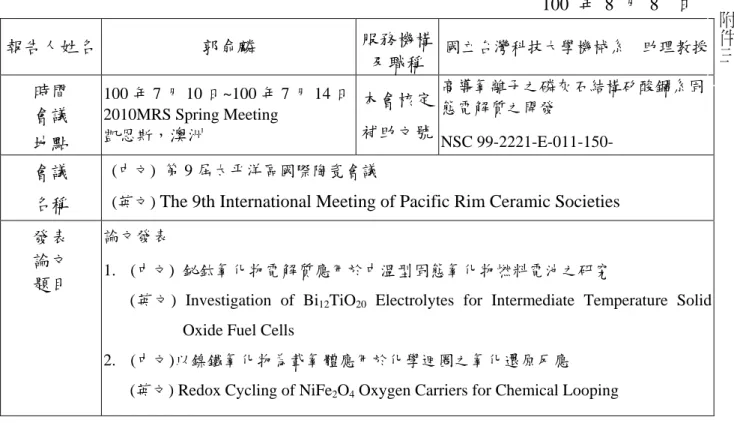
行政院國家科學委員會補助國內專家學者出席國際學術會議報告
100 年 8 月 8 日
報告人姓名 郭俞麟 服務機構
及職稱 國立台灣科技大學機械系 助理教授 時間
會議 地點
100 年 7 月 10 日~100 年 7 月 14 日 2010MRS Spring Meeting
凱恩斯,澳洲
本會核定 補助文號
高導氧離子之磷灰石結構矽酸鑭系固 態電解質之開發
NSC 99-2221-E-011-150- 會議
名稱
(中文) 第 9 屆太平洋區國際陶瓷會議
(英文) The 9th International Meeting of Pacific Rim Ceramic Societies 發表
論文 題目
論文發表
1. (中文) 鉍鈦氧化物電解質應用於中溫型固態氧化物燃料電池之研究
(英文) Investigation of Bi12TiO20 Electrolytes for Intermediate Temperature Solid Oxide Fuel Cells
2. (中文)以鎳鐵氧化物為載氧體應用於化學迴圈之氧化還原反應 (英文) Redox Cycling of NiFe2O4 Oxygen Carriers for Chemical Looping
報告內容應包括下列各項:
一、參加會議經過
2011 年太平洋區國際陶瓷會議於今年七月十日至七月十四日於澳洲/昆士蘭/凱恩斯市中心 舉行。大會時程從共計 4 天,後學於九日下午 4:20 pm.搭乘國泰航空 CX-405 班機自中正機場 起飛經香港機場轉機於澳洲雪梨,隨即入關檢查後再搭乘國內航線班機轉機至澳洲凱恩斯,
在十日約下午 5 點左右進入下塌飯店,飛行時數與等機時間共計約 23 小時,並於隔日(十一 日)即至會議會場註冊報到。
此 次 會 議 是 由 澳 洲 材 料 學 會 及 澳 洲 陶 瓷 學 會 (Materials Australia and the Australian Ceramics Society)主辦,美國陶瓷學會(American Ceramic Society)、阿根廷陶瓷學會(Asociacion Tecnica Argentina de Ceramica)、巴西陶瓷學會(Brazilian Ceramic Society)、日本陶瓷學會 (Ceramic Society of Japan)、中國陶瓷學會(Chinese Ceramic Society)、韓國陶瓷學會(Korean Ceramic Society)、墨西哥陶瓷學會(Mexican Materials Society)及泰國陶瓷學會(Thai Ceramic Society)協辦,與會人員包含有台 灣、美國、中國、日本、加拿大、英國、韓國、德國、蘇聯、
丹麥、烏克蘭、巴西、墨西哥、菲律賓、印度、土耳其、伊朗、瑞典、馬來西亞、挪威、新 加坡、澳洲、法國、波蘭、等數十個國家之材料及陶瓷領域的專家學者。本屆會議主席為 Dr.
Philip Walls,開幕式及大會在澳洲昆士蘭凱恩斯的 Cairns Convention Center 舉行,與旅館距
附件三
表 Y04
離步行約 15 分鐘即可到達。
此會議中心共二樓,而舉辦場地集中在 1、2 樓,其場地廣大且採光良好,路線規劃相當清 楚。其中第一天是報到日並在大會主席 Philip Walls 的致詞中正式開幕。整個議程共分為 23 個 Symposia 及 1 個會議,分別為(1) Biomaterials、(2) Nanostructured Materials for Energy Applications、(3) Advanced Ceramics for Energy-based Applications、(4) The World Wide Increasing Demand in Energy、(5) Functional Materials and Piezoelectrics、(6) Film Processing Science and Technology、(7) Ferroelectrics, Relaxors and Multiferroics、(8) Microwave Ceramics and Wireless Technologies、(9) Solid State Lighting、(10) Photocatalytic Materials、(11) Functional Nanoporous Materials、(12) Materials and Powder Processings、(13) Spark Plasma Sintering、(14) Surface Engineering 、(15) Structure, Properties and Photonic Applications of Glasses、(16) Ceramic Matrix Composites: Design, Development, Properties and Applications、(17) Geopolymers and other Inorganic Polymers、(18) Computer Design and Modelling、(19) Non-oxide based ceramics、(20) Oxide-based ceramics、(21) Traditional/Ancient ceramics、(22) Materials for Aerospace and Military Applications、(23) Hazardous and Nuclear Materials 等 23 個主題,以及 AFPG9: The Ninth International Conference on Advances in the Fusion and Processing of Glass為 主要在玻璃領域的 1 個會議。
會議第一天,在 Symposium 4: The Worldwide Increase in Demand for Energy 的討論會議 中,聽取了德國 Institute of Energy and Climate Research (IEK)的 Hans P. Buchkremer 研究報 告,其研究中提出藉由理論計算與材料合成技術在常溫環境下仍具有高度氧離子導電性之電 解質材料,預期將可降低高溫型固態氧化物燃料電池的操作溫度應用。之後在同地點 10 點半 的會議中,聽取了日本 National Institute of Advanced Industrial Science and Technology (AIST) 的 Toshio Suzuki 的研究報告,其研究中提出許多製備微型管狀的固態氧化物燃料電池之製 程,初期實驗成果已可量測其氧離子導電性能,未來對於改善固態氧化物燃料電池之效能有 很大的助益。
後學於此次之國際研討會中共計二篇之研究成果發表,其中一篇為有關固態氧化物燃料 電池的電解質之製備及材料特性,並提出一新式固態電解質熱化學穩定性之測試方法,此研 究成果在此會議為 Poster Symposium 4 之 The World Wide Increasing Demand in Energy 發表,
時間為七月十日。會議期間,亦有幾位從事固態氧化物燃料電池對於本研究利用熱重分析儀 (TGA)在甲烷或氫氣環境下進行固態電解質熱化學穩定之研究方法深感興趣,亦建議候學能 將其撰寫為期刊論文,以提供其他研究學者進行類似之研究。後學在此會議所提出之研究報
表 Y04
告論文為:
(中文) 鉍鈦氧化物電解質應用於中溫型固態氧化物燃料電池之研究
(英文) Investigation of Bi12TiO20 Electrolytes for Intermediate Temperature Solid Oxide Fuel Cells
另外一篇發表之論文為有關化學迴圈之載氧體材料製備,其主題在此會議為 Symposium 3 之 Advanced Ceramics for Energy-based Applications,時間為七月十四日,Symposium 主持人 為 Oak Ridge National Laboratory 的 Dr. Hua-Tay Lin。本研究利用氧化鎳及氧化鐵製備單一相 之鎳鐵氧化物,會議期間並獲得其他幾個國家的參加者對於本研究提出之建議,例如載氧體 之有效使用圈數等。其諸位所提出之建議與方法皆能提供後學未來在化學迴圈載氧體的製備 與材料分析能獲得更進一步之研究,鑑於有如此會議所提供的平台討論,後學亦開始與其他 國家研究學者建立聯絡方式,其中會議主持人 Dr. Hua-Tay Lin 以及瑞典 Linnaeus University Sweden 的學者 Sharafat Ali 提出許多看法並期望與後學能在未來有合作機會的可能。而後學 在此會議所提出之研究報告論文為:
(中文)以鎳鐵氧化物為載氧體應用於化學迴圈之氧化還原反應
(英文) Redox Cycling of NiFe2O4 Oxygen Carriers for Chemical Looping
在整個會議進行中,論文發表過程與會人員彼此之間討論非常熱絡,互相分享彼此研究 心得,因此對後學而言收穫極為豐盛,相信對日後之研究受益很大。此次會議亦提供業界廠 商展覽,計數十家廠商進駐,無論是關於分析儀器、燒結設備、製程設備及耗材採購等等,在現 場都可以獲得非常充分的資訊。
後學則在七月十五日晚上 5 點 15 分搭乘澳洲航空 QF-927 班機於台灣七月十六日時間 10 點 15 分返抵國門。
二、與會心得
此次研討會議是在澳洲昆士蘭凱恩斯舉辦的年度會議,整個會議所研討之內容甚為廣 泛,為國際陶瓷年會的大型會議。本次年會的口頭發表論文數有 636 篇,海報發表論文數有 383 篇。主辦單位在邀請演講者之主題選擇方面甚是用心,綜合此次會議來看,會議過程除 了專業研究經驗的交流互動外,更提供各國的專業研究人員在未來國際合作的最佳平台,另 外舉辦的廠商展覽部份更是提供未來研究路線相當寶貴的重要資訊。此次大會期間除了學術 界成果分享外,業界代表亦在此次會議提出許多實際業界需求的訊息,如此的互動會議可提 供學校學術路線與業界相交軌,這樣的會議可算是一項成功的國際會議。
三、考察參觀活動(無事項活動者省略)
表 Y04
四、建議
後學目前研究方向為化學迴圈載氧體的合成製備,並與校內外有關研究能源議題的同好 教授門共同研究開發,其研究成果將積極參與國際會議發表,期望在未來的國際舞台上創造 非凡的研究成果。
五、攜回資料名稱及內容
參加本次會議攜帶回參加會議之各宣讀論文輯。
六、其他
附錄 1:PacRim9 會議議程 附錄 2:論文發表之兩篇摘要 附錄 3:與會過程照片
表 Y04
附錄 1
表 Y04
表 Y04
附錄 2
Investigation of Bi
12TiO
20Electrolytes for
Intermediate Temperature Solid Oxide Fuel Cells
Yu-Lin Kuo*, Yu-Ming Su
Department of Mechanical Engineering, National Taiwan University of Science and Technology, Taipei 10672, Taiwan
Abstract
Bi2O3-based materials with various oxide dopants have the potential being used as electrolytic layer for intermediate temperature solid oxide fuel cells (IT-SOFCs). The 14.3 mol% TiO2 doped Bi2O3
(Bi12TiO20, 14BTO) was prepared by colloid processing and subsequent pressure filtration as solid oxide fuel cell electrolyte. Materials characteristics of the electrolytes are characterized by X-ray diffraction (XRD), scanning electron microscopy (SEM). Electrical behaviors were measured by two-point probe DC conductivity in the range of 450~700°C in air. Redox reaction of 14BTO was carried by thermogravimetric (TGA) measurement under pure CH4 atmospheres. A pure 14BTO with a cubic sillenite single phase was prepared at the sintering process of 850 °C with a high relative sintered density of 96.82%. In-situ and batch-type long-term conductivity measurements at 600 °C were carried out to verify the possible reason of degradation. Reduction-oxidation tests under CH4 atmosphere revealed possible application temperature of 14BTO electrolytes below 700
°C.
Keywords: TiO2; Bi2O3; Pressure Filtration; Solid Oxide Fuel Cells
*Corresponding author. TEL: +886-2-27376784; Fax: +886-2-27376460 E-mail address: [email protected]
表 Y04
附錄 2
Redox Cycling of NiFe
2O
4Oxygen Carriers for Chemical Looping Process
Yu-Lin Kuo1*, Yu-Ming Su1, Ping-Chin Chiu2,
Yao-Hsuan Tseng
2, Young Ku21 Department of Mechanical Engineering, National Taiwan University of Science and Technology, Taipei 106, Taiwan
2 Department of Chemical Engineering, National Taiwan University of Science and Technology, Taipei 106, Taiwan
Abstract
This study deals with the investigation of nickel ferrite (NiFe2O4) oxygen carriers suitable for chemical looping process. NiFe2O4 powder has been prepared by ball milling of equimolar NiO and Fe2O3 under high temperature solid state reaction. Materials characterization of NiFe2O4 samples were investigated by X-ray Diffraction (XRD), Brunauer-Emmett-Teller (BET) surface area measurements and scanning electron microscopy (SEM). Redox cycling of NiFe2O4 oxygen carriers was carried by thermogravimetric (TGA) measurement under pure CH4 gas and O2/Air atmospheres, respectively. After 5 successive cycles, NiFe2O4 powder with a single phase of spinel structure represented a higher redox cycling behavior and stability compared to the standard of NiO and Fe2O3. The mechanism of redox cycling by NiFe2O4 spinel powder was also discussed in this study.
Keywords: Redox Cycling, Nickel ferrite, Chemical Looping Process
*Corresponding author. TEL: +886-2-27376784; Fax: +886-2-27376460 E-mail address: [email protected]
表 Y04
附錄 3
圖 1 參加 PACRIM9 的學者(左 1:台灣科技大學 施劭儒教授,左三:大同大學 林永仁教授,
左六:美國田納西州 Oak Ridge 國家實驗室 林華泰博士,左七:清華大學 胡啟章教授)
圖 2 後學與本屆研討會櫃台 圖 3 後學與本屆投稿海報論文
國科會補助計畫衍生研發成果推廣資料表
日期:2011/09/14
國科會補助計畫
計畫名稱: 高導氧離子之磷灰石結構矽酸鑭系固態電解質之開發 計畫主持人: 郭俞麟
計畫編號: 99-2221-E-011-044- 學門領域: 陶瓷
無研發成果推廣資料
![圖 1 Temperature dependence of conductivity [1]](https://thumb-ap.123doks.com/thumbv2/9libinfo/9122671.407308/7.892.340.551.121.418/圖-temperature-dependence-of-conductivity.webp)