• 沒有找到結果。

4.1 The Analysis of Findings of the Evaluation and Discussions

N/A
N/A
Protected

Academic year: 2021

Share "4.1 The Analysis of Findings of the Evaluation and Discussions "

Copied!
39
0
0

加載中.... (立即查看全文)

全文

(1)

Chapter Four Findings and Discussion

In order to meet the fierce competition of the new textbook market, publishers offer the latest-developed CD-ROMs for teachers’ use in class or for students’

self-learning at home. But teachers seldom use them in class regardless of their advantage in terms of multimedia presentation, various activities, and games for classroom interaction. This raises the question of why teachers and students hardly include them in language teaching and learning. The major factors may be that teachers are unfamiliar with the computer or the software, uncertain of the evaluation process and implications involved.

This chapter presents the findings of the evaluation of three Junior High School CD-ROM titles on the basis of Ioannou-Georgiou’s Selecting Software for Language Classes. Findings on the application of these programs in English classrooms from a teacher’s point of view will also be presented. Furthermore, research question 2 will be answered in 4.1 and research question 3 in 4.2.

4.1 The Analysis of Findings of the Evaluation and Discussions

Generally speaking, the key features of instructional Junior High School CD-ROMs may be inferred as the multimedia presentation of texts, practices, and games, as well as instant feedback. The concept attracts many teachers’ interest;

therefore, these programs are regarded as ‘A teacher’s helping hand in class’, as a

slogan printed on Kang Hsuan CD-ROM states. As the discussion in Chapter Three,

Ioannou-Georgiou’s Selecting Software for Language Classes is selected as the

evaluation tool in which three aspects, namely, Technical Criteria, Methodological

Criteria and Pedagogical Criteria, are included. The findings of the evaluation will

(2)

be analyzed and discussed accordingly. Furthermore, their strengths and limits will be identified; suggestions for further improvement will be discussed.

4.1.1 Technical Criteria

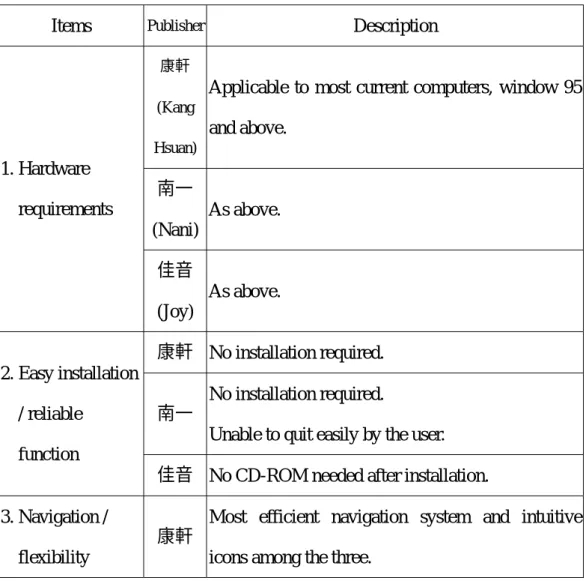
In Ioannou-Georgiou’s evaluation form, there are fourteen items concerning Technical Criteria. Some of them are closely connected to each other; therefore, the following discussion will be categorized into five parts, namely, Installation and Navigation, Interface, Content and Structure Activities, Help Options and Teacher Support as well as Tracking Option (see Table 4-1).

4.1.1.1 Installation and Navigation

The software that does not need installation is considered the most beneficial one.

Kang Hsuan and Nani CD-ROMs do not need installation. Although Joy’s has to be installed first, taking about three minutes, the removal only takes a few seconds.

After installation, no disc is needed. Other than some time, effort, and hardware space occupied, the relative ease in using Joy’s without needing a disk each time is especially attractive to laptop users.

All these three CD-ROMs have intuitive icons and can easily go backwards and forwards. Users only have to click on the icon to easily navigate from lesson to lesson. Nevertheless, there are two technical problems. One is Nani CD-ROM.

The user cannot quit it, but it will stop after the end of presenting its company name and other information. It lasts about one minute. The other is Joy CD-ROM.

While licking on the lesson number, users get no response unless they click on the

language section (dialogue or reading) first. It might confuse the user at first, but

after a few tries, he or she will get used it. Except for these two factors, all three

CD-ROMs run smoothly.

(3)

Furthermore, each program has its own special designs and weakness. Nani software is unique for its simplicity and sound effect, but there are only two kinds of games throughout the program. Users may soon feel bored. It should be added more different games and activities to it. As for Joy CD-ROM, the navigation system is welcomed by users because they are able to practice a certain language section (e.g. dialogue, reading, pronunciation) easily from the first lesson to the last, or read the adventure of ‘Tom N Huck’ in every lesson without going through many layers. Among these three programs, the most significant navigation system is Kang Hsuan CD-ROM. Lesson numbers are listed vertically on the left side of the screen and language sections listed horizontally at the bottom. It leads users to navigate to different lessons or language sections on the same page.

4.1.1.2 Interface

The interfaces of target CD-ROMs are aesthetically appealing to the users for their bright colors, animated characters similar to their textbooks, clear lesson numbers, cute carton animation, help icons, and legible texts. The programs with such designs may motivate students to use them and spend more time working with the programs. For example, in Kang Hsuan CD-ROM, texts are presented in an easy to read style, and language elements, such as vocabulary and sentences, are well integrated with a variety of activities and games. Above all, the design of user interface is user-friendly and intuitive in terms of efficient navigation system, interesting games suitable for classroom activities, and clear text presentation including icons for minimizing and magnifying the screen and role-playing.

After viewing dialogues and reading, the user can practice the newly learned

vocabulary and sentences by means of related activities or games. They are useful

and practical for self-learning at home or in groups in classrooms.

(4)

4.1.1.3 Structure activities

Without misspelled words or misuse of words, the program content is accurate and valid in the entire target CD-ROMs. Moreover, they are structured with activities through a certain topic, such as greetings, school, sports, and more.

Activities include dialogues, reading, spelling practice, filling in the blank, sentence construction, listening practice and role-playing. The reading activities of Joy CD-ROM are especially arranged with a natural transition. There is a series of reading on ‘Tom N Huck’, which focuses on the familiar story ‘The Adventures of Tom Sawyer’. On the other hand, Kang Hsuan CD-ROM is famous for the variety of games designed particularly for classroom activities.

4.1.1.4 Help options and Teacher support

With respect to the instruction for users, Kang Hsuan and Joy CD-ROM titles have clear Chinese explanations in each item presented in ‘help’ options, which are offered in a way and at a language level appropriate to that of the learners. By clicking on the ‘Help’ icon, the instruction in Chinese will pop out. But in Nani CD-ROM, Chinese explanations only appear in games. Nevertheless, all of these three software companies offer little written information about the programs, not to mention the orientation or suggestions on how to use them in class. It would be practical for users if the program can offer a booklet explanation including technical information, content, and operation instructions.

Both Nani and Joy CD-ROMs can connect to their own websites. While

connected to the Internet, users simply click on the website icon and the website will

be presented. It is a pity that Kang Hsuan does not provide such linkage because its

website is designed best among the three in terms of the variety of useful information

(5)

for teachers, parents, and students. In its teacher corner, for example, it includes educational news, downloadable lesson plans and discussion board; for students, there are instructional materials, games and students’ writings, and many others. The website is worth visiting.

Since these CD-ROMs are important teaching aids, it would benefit teachers greatly if the program could include detailed information in its teachers’ guide concerning which activities can be employed in class and how to use it. If the CD-ROM can present a certain group activity, there should be a clear icon on the screen or in the teachers’ guide. For example, in the games of Kang Hsuan CD-ROM, the teacher may use various games for group activities, which are designed to practice pronunciation, word spelling, and sentence patterns. If the program could provide such information in the teacher’s guide, it will certainly increase the opportunity to use them. Furthermore, in order to make the most use of CD-ROM in class, the textbook should be added a unit called ‘Computer Activity’ with a salient icon to remind teachers of its use.

4.1.1.5 Authoring ability

All the CD-ROMs in discussion do not provide the function for teachers to include their own data in the program, or the choice to use a higher or lower level of the text and the hyperlink to related resources or background information. For example, the activities on the program cannot be changed according to learners’

language level. However, in Kang Hsuan CD-ROM, the user has the choice to use a higher or lower level of words and worksheets for practice.

Although these programs have no designs of authoring ability, they offer limited

choice of tailorability. All three CD-ROMs offer the option of switching scripts and

Chinese translation on and off. Another example is Kang Hsuan CD-ROM. It

(6)

allows the user to change the background color. Although it is only a slight change, the power to make a choice may influence the user’s willingness to use the program.

One of the weaknesses of these CD-ROMs is the lack of tracking option. There is no saving device in Kang Hsuan and Nani CD-ROM titles. Joy CD-ROM has a system that can record and print user’s performance. These programs should provide a more powerful saving or tracking system for users to see their performance, and also provide previous records to identify their strengths and weaknesses for further improvement. In addition, the programs should provide the functions of downloading selected texts or graphics, or the ability to change sound and characters.

Table 4-1 Data of Evaluation of three Junior High School CD-ROM Titles in Technical Criteria

Items Publisher Description

康軒 (Kang Hsuan)

Applicable to most current computers, window 95 and above.

南一 (Nani)

As above.

1. Hardware requirements

佳音 (Joy)

As above.

康軒 No installation required.

南一

No installation required.

Unable to quit easily by the user.

2. Easy installation / reliable

function

佳音 No CD-ROM needed after installation.

3. Navigation / flexibility

康軒

Most efficient navigation system and intuitive

icons among the three.

(7)

南一 Easy navigation and intuitive icons.

佳音 Same as Nani.

康軒

1. No printed manuals.

2. Chinese operation description in Games only.

3. Brief description of instructional aims .

南一

1. No printed manuals.

2. Chinese operation description only in Games.

4. Instructions

佳音 Same as Nani.

康軒

Clear Chinese explanation in each item, but no printed manuals.

南一 Non-applicable.

5. Help options

佳音 Same as Kang Hsuan.

康軒

Intuitive interface and more functional icons, e.g.

to enlarge or diminish the screen presentation.

Special role-playing design.

南一 Intuitive interface.

6. Interface / on-screen presentation

佳音 As above.

康軒 Texts presented with sound and animation.

南一 As above.

7. Media integration

佳音 As above.

康軒 Correct spelling and word usage.

南一 As above.

8. Language accuracy

佳音 As above.

康軒 Display with sound, animation, and colors.

9. Aesthetic appeal

南一 As above

(8)

佳音 As above

康軒

Unable to include teachers’ own data in the program. No choice of activities of different language levels, except for word practice.

南一 No such function.

10. Authoring ability

佳音 As above.

康軒

Script, Chinese translation and sound on/off.

Changeable background color.

南一

Script and Chinese translation on/off.

Unchangeable colors and text fonts.

11. Tailorability / control options

佳音 Same as Nani.

康軒 2-page description in teachers’ guide.

南一 No instructions. Connection to its own website.

12. Teacher support

佳音 Same as Nani.

康軒

Activities of pronunciation, word spelling, sentence patterns and games.

南一 As above.

13. Structure activities

佳音 As above.

康軒 No record system.

南一 As above.

14. Tracking option

佳音 A Record and printable system of user’s data.

4.1.2 Methodological Criteria

Ioannou-Georgiou (2002) suggests that the guidelines of Technical and

Pedagogical aspects can be applied to software of all the school subjects; however, the

(9)

methodological criteria are primarily language-based.

The theory adopted in Ioannou-Georgiou’s evaluation criteria is based on the communicative teaching method. The following guidelines are also based on the method. Since the most popular teaching approach in junior high school English classes is also the Communicative Approach, it is appropriate to adopt her guidelines as the evaluation criteria.

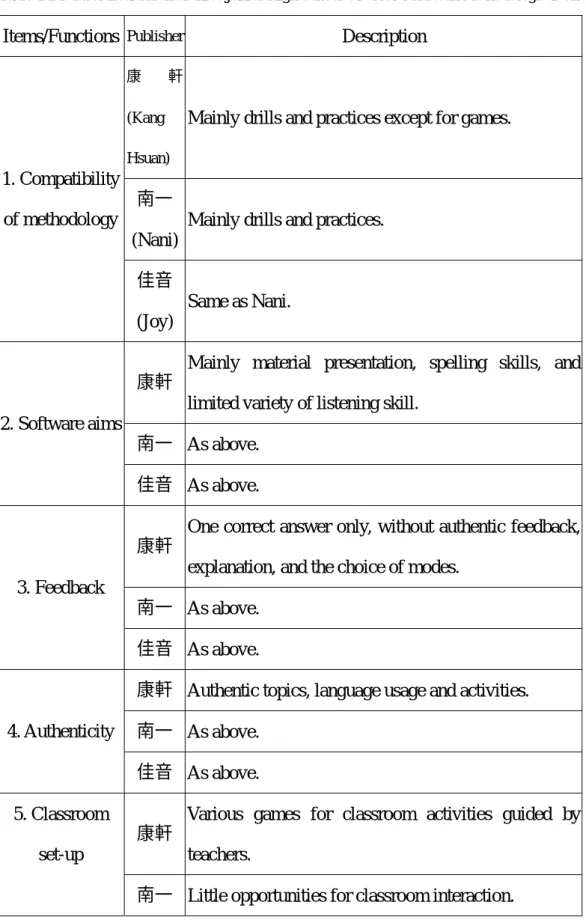
The discussion below will follow the items of her criteria and identify the characteristics of the target CD-ROMs as well as their limits (see Table 4-2).

4.1.2.1 Compatibility of Methodology

Adopting a certain methodology means that the methodology’s specific aims are important in language learning within the framework of that methodology (Ioannou-Georgiou, 2002). As discussions in 1.3, the Ministry of Education had adopted communicative language teaching (CLT) as the main teaching approach for twenty years. But for most teachers, it is more a philosophy than a method or practical teaching activity. Many teachers consider their teaching approach eclectic and do not use only one method or approach. They use a variety of teaching methods in correspondence to their curricula. For example, Grammar Translation may be the major teaching method in reading, or TPR in sentence patterns.

As above, teachers who incorporate CALL activities into their language classroom also adopt a certain theory explicitly or implicitly in their course design.

It depends much on teachers’ own interpretations as to how to implement it to their

language classrooms. To practice spelling by means of games, as an example of

Penguin’s crossing the river in Lesson 8 of Nani CD-ROM, is certainly more

welcomed than simple writing or learning by rote. Except for games, most activities

are mainly drill practice.

(10)

The CD-ROM titles discussed in this study have great similarity with their

textbooks, and some are even the same except for the addition of animation and sound.

It brings the issues of motivation and cognitive load. It is a judgmental call of whether the titles are similar to the textbook is beneficial or not. For students at a more basic level, they can gain the most from the similarity because of their

proficiency limitation. As for higher-level students, it will interest them more if the CD-ROM offers more useful intensive and interesting extensive materials.

4.1.2.2 Software Aim

Communicative Approach emphasizes not only the language knowledge or sentence structures but also the use of language. It focuses on the practical exercises and communication in the process of language learning. For example, a software program focuses on various authentic listening activities is much better than one on spelling or typing. It does not mean that drill and practice cannot be used in

language classrooms; they can be used for a specific section, instead of for the entire program.

Similar to the textbook, some of the functions of these CD-ROM titles are to increase the understanding of the texts, fluency in reading, as well as for practice role-playing the dialogues and the sentence patterns. Although the target CD-ROMs do not state what methodology they adopt, it still can be inferred from their

correspondent textbooks. The textbooks all claim that they adopt the

Communicative Approach and their programs are full of various meaningful activities.

However, most activities in those programs are not communicative and interactive

enough. For example, in the exercises of word spelling and sentence patterns, the

programs offer only fixed and standard answers for users to choose. Students cannot

deliver their own answers and receive a variety of feedback. These activities are not

(11)

consistent with the Communicative Approach. It would be better if the program could provide students with instant and nature feedback imitating what teachers do in class. In short, if the program can offer opportunities for students to make their own sentences and express their ideas meaningfully, then it is communicative.

In addition, all these programs fail to provide opportunities to practice speaking and writing skills, and keep the record of the user’s performance for further improvement.

4.1.2.3 Feedback

Levy (1997) suggests that the evaluation of students’ performance by the computer is one of the main functions of tutorial type. The effectiveness of evaluation needs to be weighed carefully as not to decrease learners’ motivation and interest in using the software again. Also, both computer generated and instructor generated feedback should be examined. The main focus in this study is the feedback prompted by the computer.

Helping the user to realize the problems he or she has and to solve them is the central role of feedback. When the user produces output or makes mistakes, the program should prompt the correct answers as well as the necessary explanation immediately. In the target CD-ROMs, the majority of feedback is given to the wrong answers. This kind of answer is useless for the learners since they can try two or more times to get the correct answers. As a result, students will soon feel bored with the exercise since it cannot give them satisfactory answers. On the other hand, right answers should be included with an explanation of why they are correct, even the delayed answers should provide hints or the related sentence structures. In addition, it will meet the user’s need if the program could offer the choice of feedback modes:

explanations, diagrams or text explanations on or off.

(12)

The programmer should design responses simulating what teachers’ responses in answering their students’ questions or answers to tests. For the same reason,

feedback provided by the software should not merely comprise of attractive devices.

It should include authentic and nature feedback, or an answering voice. When the user is practicing telephone conversation, the answer “This is he speaking” is better than presenting the numbers he or she just typed in.

Apart from the current commercial titles, these CD-ROM titles offer no

suggestions for errors, only answers. One of the reasons may be the user’s language level. Since the programs are designed especially for beginners, clear and concise instruction simulating teacher’s tutoring should be included. The other reason might be that the publication is too hasty to design a set of appropriate feedback. It is understood that there is limited time before the software company could compile the textbook, send it for approval, then publish the CD-ROM.

However, communicative CALL should not evaluate what students perform in every activity because it might decrease the enthusiastic participation in learning (Underwood, 1984). Nor should the program merely offer feedback like “Wrong, try again” or “Yes, you are right” because it doesn’t tell them why they are wrong or which parts they should pay more attention to.

4.1.2.4 Authenticity

Ioannou-Georgiou (2002) points out that communicative language teaching (CLT)

should focus on authentic tasks and situations. The activities should generate

real-life functions and the context in which the language is presented should be

realistic. Being exposed to a large amount of authentic materials, students may

become more active and independent in language learning, although all these

programs provide only the content of the textbooks with little extended reading

(13)

materials or background information. For higher-level students, a variety of texts and activities will be beneficial, and for lower-level students, a more detailed explanation of sentence structures and multimedia presentation of texts would certainly attract their attention.

In Chapelle’s (2002) point of view, authenticity indicates learners’ willingness to communicate and use them outside of class. Since the texts are constructed with familiar topics such as family, numbers, weather, computers, and others, it is likely that students may use them outside the classroom if needed. In addition, the texts of these CD-ROMs are derived from their corresponding textbooks; therefore, there is a great similarity between them and the students will be more confident in using the two together.

4.1.2.5 Classroom Set-up

One aspect of software selection is the consideration of the setting. Is the software used for independent study at home, in a computer lab, as the ones in The Hong Kong Polytechnic University (1996) and Self-Assess Center of National Taiwan Normal University (2001), or for a classroom activity?

Maximizing interaction in the classroom is a great benefit to learning. Kang Hsuan CD-ROM is appreciated in terms of integrating exercises into a variety of games designed mainly for classroom activities. With the aids of the program, students will be able to enjoy the games in the classroom, and at the same time, language elements will be perceived. On the contrary, Nani and Joy CD-ROMs offer little opportunities for interaction in the classroom.

Students do not have to be bored in language learning. It could be fun,

enjoyable at the same time. Multimedia activities in class catch students’ attention

and promote learning atmosphere.

(14)

4.1.2.6 Comprehensible Input

A key feature of the computer programs is that the programs allow the user to make the input comprehensible through hyperlinking or branching. The target CD-ROMs are mainly comprised of animated dialogue and reading, highlighted vocabulary with audio clips and examples. The user can click on a word to view a sample sentence, or to hear an audio input as many times as the user needs.

However, they still lack the hyperlingking to background information and a dictionary.

The reading sections of some programs even offer no explanations of sentence structures.

4.1.2.7 Comprehensible Output

As mentioned in 2.1.2.2, comprehensible output refers to learners’ attempt to create precise and appropriate desired meanings. The software should provide learners the opportunity to make their output comprehensible. If their output is not well recognized or comprehensible enough, then they should be asked to repeat, clarify, or rephrase. This will lead the users to meaningful negotiations in which they realize the need to revise their output. However, these CD-ROMs offer only the exercises in typing, spelling, and rearranging sentences. It is difficult to judge whether it is comprehensible output or not since the programs cannot accept the user’s possible authentic answers or the chance to clarify or rephrase. On the other hand, these CD-ROMs provide neither other possible answers, nor any explanations

concerning why the user’s feedback is wrong. Moreover, there should be a tracking

system to record users’ production for further analysis.

(15)

4.1.2.8 Data Input: Accepting a Variety of Responses

All the target programs’ computer feedback response to learner’s output is limited. The software should accept a variety of responses that simulate human communication. For example, in answering to the question “Where is your mom now?” it should accept responses like “kitchen, in the kitchen, they are in the kitchen, or who knows?” But the three CD-ROM titles only offer fixed answers and exclude all other possible answers. Demanding an exact answer will confuse learners.

This rule also applies to oral interaction between the user and the computer. As the recognition technology has improved, some programs are able to accept a variety of responses. For instance, Traci-Talk (2004) offers the designs of modification of input, which allows the learner to ask the machine to restate what the speaker said, or the simplified sentences, and it also offers slower speed, reference, and change of input mode.

4.1.2.9 Meaningful Use

The main concern for language learning not only focuses on language components or syntax but also on communication. In order to make language learning motivating and useful to the user, the program should create opportunities to use the language meaningfully. In all these programs, there are exercises to practice vocabulary, sentence structure, and pronunciation, but the modes are mainly drill and practice. By means of modern technology, boring drill practice may be transformed into interesting games. A variety of games and activities will motivate learners to use the language in reality.

Nevertheless, teachers should observe all the time whether the program includes

authenticity and various interaction choices in the language classroom. In addition,

at the end of games or activities, there should be an analysis of the weak and strong

(16)

points the user has for further improvement.

Table 4-2 Data of Evaluation of three Junior High School CD-ROM Titles in Methodological Criteria

Items/Functions Publisher Description

康 軒

(Kang Hsuan)

Mainly drills and practices except for games.

南一 (Nani)

Mainly drills and practices.

1. Compatibility of methodology

佳音 (Joy)

Same as Nani.

康軒

Mainly material presentation, spelling skills, and limited variety of listening skill.

南一 As above.

2. Software aims

佳音 As above.

康軒

One correct answer only, without authentic feedback, explanation, and the choice of modes.

南一 As above.

3. Feedback

佳音 As above.

康軒 Authentic topics, language usage and activities.

南一 As above.

4. Authenticity

佳音 As above.

康軒

Various games for classroom activities guided by teachers.

5. Classroom set-up

南一 Little opportunities for classroom interaction.

(17)

佳音 As above.

康軒

Animated dialogue and reading.

Highlighted words with illustrations, an example and audio clip.

Basic and advanced choice in words and worksheets.

南一

Animated dialogues and reading.

Highlighted word with an example and audio clip.

6. Interactionist theory – comprehensible

input – negotiation of

meaning

佳音 Same as Nani.

康軒

The exercises of typing, spelling and rearranging sentences.

Only the correct answers without any explanation.

南一 As above.

7.

Interactionist theory – comprehensible

output 佳音 As above.

康軒

Exclusion from a variety of responses and no speech recognition design.

南一 As above.

8. Data input (accepts variety of

responses) 佳音 As above.

康軒

Games and exercises to practice vocabulary, sentence patterns, and pronunciation.

南一 As above.

9. Meaningful use of language

佳音 As above.

4.1.3 Pedagogical Criteria

The effectiveness of technology depends on how well the activities cope with the

students’ needs and interests, the kind of technology, and the suitability of program

(18)

design to specific situations (Oxford & et al. 1998). Furthermore, simulating the role of the teacher, pedagogical goals of the target CD-ROMs must be carefully considered, in which the following contexts need to be assessed: curriculum

compatibility, effectiveness, learner’s motivation and suitability, variety of activities, learning modes as well as branching (see Table 4-3).

4.1.3.1 Curriculum Compatibility

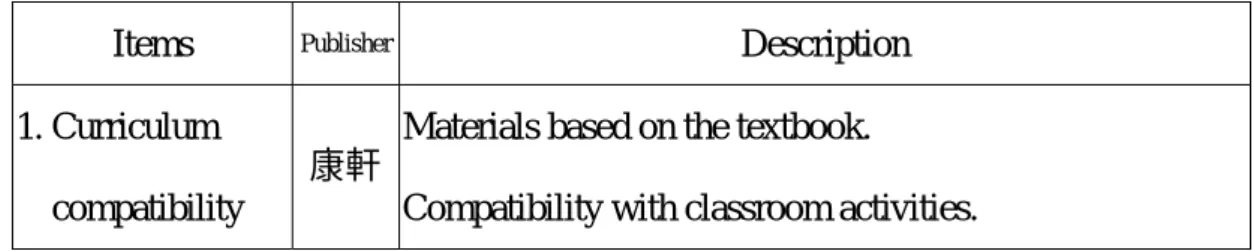
The three CD-ROM titles are all constructed based on their textbooks and compatibility with classroom activities. It depends on teachers to use them in their curricula and make the best use of them. For example, in the “chant and song”

section, they are presented with sound and animation; it will interest students more than the sound on the CD only. Another example is the games in Kang Hsuan CD-ROM designed for classroom interaction; students can try to answer the questions on the screen, and the teacher will decide which team wins.

4.1.3.2 Effectiveness

Due to the lack of documentation, information about the program aims is

unavailable. The CD-ROMs under study are based on their textbooks, which are

complied according to the guidelines set up by Taiwan’s Ministry of Education. I

thus infer that they all adopted the Communicative Approach. In fact, most activities

used in the programs, such as sentence arrangement and the multiple-choice section,

are mainly drill and practice. However, the dialogue and reading are presented with

audio clips and animation. Games are designed for classroom activities in practicing

language elements. They add interest and motivation to the drill and practice mode

and can better attract students’ attention.

(19)

4.1.3.3 Motivation Enhancing

Among the elements that arouse students’ interests are challenges and curiosity.

To make the programs more challenging, learners should be able to choose different activities, control the level of difficulty, and change color, sound or animation.

Generally speaking, the level of difficulty in these CD-ROM titles is considered appropriate. For most students, they might find some activities interesting and challenging since the software provides opportunities to practice their listening skills, to be familiar with sentence structures, and to practice in games.

Problem solving is an efficient method to arouse students’ curiosity. It

motivates students in the effort to find the answer to the question, in which leads to a large amount of linguistic activities. Nonetheless, there is hardly such design of activities in these CD-ROMs.

4.1.3.4 Learner Suitability

As mentioned in section 1.3.2, some students have learned English for a few years in elementary school or cram school before they entered junior high school; but some barely learned anything. As a result, students have a variety of entry levels.

Due to the various students’ levels, it is difficult to find a suitable textbook appropriate for every student. But a wide variety of commercial CALL materials or CD-ROMs emphasizing individual and self-autonomy learning to meet different needs can be used as supplements to meet individual needs.

For most students, the language level of the target programs is suitable to them

and their contexts are well organized with the necessary language elements. With

respect to individual differences, Kang Hsuan CD-ROM provides two levels of

vocabulary for users: basic and advanced. It also provides worksheets for teachers

and students, lesson plans, and course plans. Both types of worksheets contain two

(20)

language levels, basic and advanced. Students or teachers can choose the

appropriate level. Nani also claims that users can choose from its CD-ROM two levels of words in the Penguin Game, but in fact the words are similar but different only in the games’ time span. It would be beneficial for learning if the programs could provide simplified or paraphrased versions of texts, clearer sentence instruction and practice with more interesting games. All three CD-ROM titles lack the designs of linkage to a variety of texts and activities for students at higher levels.

4.1.3.5 Variety of Activities

In order to allow students to practice pronunciation, spelling, and sentence building, the three CD-ROMs provide activities as well as games. Nani CD-ROM offers two games in practicing spelling and pronunciation. Joy software offers three kinds of games with no choice of sound, animation changes, or level, whereas Kang Hshuan CD-ROM provides a variety of games for classroom activity, and there are also choices of two levels of vocabulary, basic and advanced.

Different varieties will interest students to use the program repeatedly.

However, the three CD-ROMs possess only limited activities and games.

Furthermore, in the practice of sentence patterns, or other activities, the feedback prompted by the software delivers only correct answers without authentic way of response and provide no explanation about users’ mistakes.

4.1.3.6 Non-threatening

The use of computer programs for self-learning provides a friendly learning

environment, in which the user always has the chance to read the content numerous

times thereafter, and is not afraid to fail. The way of feedback provided by three

programs is considered proper, with no excessive praises or pointing out mistakes in

(21)

an unfriendly way.

4.1.3.7 Variety of Learning Modes

The three programs do not offer the user many opportunities to work in a variety of learning modes, nor provide chances of oral practice and the designs of recording the user’s oral performance for further improvement. Nani and Joy CD-ROMs are mainly for individual use on the computer, while in Kang Hsuan’s program, some activities and games are designed especially for group work in class.

4.1.3.8 Branching

A very important attraction of the software is the effect of branching. It means hyperlinking from one activity to another or one section to different sections,

allowing learners to navigate intuitively. An example would be a reading text that provides the links to background knowledge, cultural information, or lexical details by means of program-constructed or on-line dictionaries, glossaries, or a corpus. It would be beneficial if branching could be included in the different modes for users of different levels.

The three CD-ROMs do not possess such capabilities. Many newly

developed interface technology, which include voice recognition, speech synthesis, and virtual reality, should all be included.

Table 4-3 Data of Evaluation of three Junior High School CD-ROM Titles in Pedagogical Criteria

Items

Publisher

Description

1. Curriculum compatibility

康軒

Materials based on the textbook.

Compatibility with classroom activities.

(22)

南一 As above.

佳音 As above.

康軒

Mainly material presentation and drill practice.

Games for group interaction in class.

The most effective program among the three.

南一

Mainly material presentation and drill practice.

The least activities among the three.

2. Effectiveness

佳音

Mainly material presentation and drill practice.

A well-designed program.

康軒

Fun and aesthetically pleasing display.

Practice presented with activities and games.

Novel experience for students.

南一 As above.

3. Motivation enhancing

佳音 As above.

康軒

Suitable for learners’ age, interests, and language level.

Two levels of vocabulary and worksheets: basic and advanced.

南一 Suitable for learners’ age, interests, and language level.

4. Learner suitability

佳音 Same as Nani.

康軒 Practice and more than 10 games.

南一 Practice and 2 games in every lesson.

5. Variety of activities

佳音 Practice and 3 games in every lesson.

康軒 Unlimited chances of practice.

南一 As above.

6. Non-threatening

佳音 As above.

(23)

康軒 Visual and aural presentation, no chances of oral practice.

南一 As above.

7. Variety of learning modes

佳音 As above.

康軒

Unable to hyperlink to different activities of the same text, to dictionaries or glossaries, to an explanation of the structure or to different levels of modes of learning.

南一 As above.

8. Branching

佳音 As above.

4.1.4 Summary

From the findings in 4.1, the strengths and weaknesses of instructional Junior High School CD-ROMs are summarized as the following:

Technical Aspect Strength

The three target programs are applicable for most recent computers and two of them do not need installation. Moreover, they are easy to navigate by means of intuitive interface and icons. The integration of color, sound, and animation are

displayed aesthetically, attracting the user to practice various activities on the program.

Clear Chinese explanations on the Help option is offered in a way suitable to the learner’s level. In addition, spelling and language usage are correct.

With respect to individual characteristics, Nani and Kang Hsuan CD-ROMs do not have to be installed, but Joy’s does. After installation, it is easy to use without having to use a disc each time. Kang Hsuan’s program is the most sophisticated and well designed among the three for the following reasons:

1. It provides more activities and special games for classroom interaction.

2. It offers more functions and screen icons than the others.

(24)

3. It has the most efficient navigation system, with the ability in branching to different lessons and language sections on the same page.

Weakness

In general, all three programs apply little recent technology in them. One of the evidence is the lack of authoring ability, being unable to include teachers’ own data in the program to meet their student needs. Even the tailorability or the control options for users are limited. Kang Hsuan’s CD-ROMs can change background color. In addition, only Joy’s program offers the designs of keeping the user’s performance, and the ability to print the records. Nani and Kang Hsuan CD-ROMs do not possess such designs, not to mention the tracking system. Nani program cannot quit easily.

In the diversity of games, Nani program provides two kinds in every lesson, Joy three kinds in every lesson, and Kang Hsuan around 10 different games.

These programs offer no printed manuals, nor explanation booklets and

suggestions for application in class, except Kang Hsuan’s two-page description in its teacher’s guide.

Methodological Aspect Strength

All three CD-ROMs are constructed with authentic topics, language usage, and activities. The texts and dialogues are presented with audio clips and animation.

Vocabulary is highlighted with examples as well as prerecorded sound, and Kang Hsuan’s program provides vocabulary with illustration.

With respect to individual differences, the content of Nani’s program is the

simplest one and offers the least activities. The reading section of ‘Tom N Huck’ in

Joy software is attractive to students. Kang Hsuan CD-ROM provides diverse

games for classroom activities, and in vocabulary and dialogue, two difficulty levels

to choose: basic and advanced.

(25)

Weakness

The three programs all claim that they adopt Communicative Approach, but they are mainly drill and practice in terms of activities of typing, spelling, and rearranging sentences, as well as the fixed feedback without explanation and the choice of modes.

In general, if the software offers the users comprehensible input, increases its output, identifies the users’ error and makes correction, it might be argued that it is beneficial for language learning. But the three CD-ROMs do not offer any function of hyperlinking or branching to simplified or paraphrased version of audio input, or background information, nor provide opportunities to have the users make their output comprehensible in terms of repeating, clarifying, or revising. Above all, these programs only accept fixed answers without other possible answers and offer no explanations, or corrections for the users’ errors.

Pedagogical Aspect Strength

The three target CD-ROMs are constructed based on their textbooks; therefore, their educational value is without any doubt. They also provide a variety of

activities and games for users to practice in a friendly mode. Moreover, the multimedia presentation certainly attracts students’ attention and enhances their motivation in language learning.

Weakness

The target software does not have such designs of hyperlinking to different activities of the same text, dictionaries or glossaries, explanation of the structures or different levels of learning modes.

4.2 Discussions of the Application of Junior High School CD-ROM titles

Recently, many instructional English magazines in Taiwan, such as Studio

(26)

Classroom, My ET and Live ABC, are sold with a piece of multimedia CD-ROM.

The newly developed software is popular with language learners because it presents texts with multimedia designs, which attract the users to practice English in the classroom or in a self-study setting at home or at a language lab.

Similar to these commercial programs, the target CD-ROMs also present textbook materials with sound and animation, and offer opportunities to practice words and sentences with activities and games. The integration of texts, practice, and games make language learning interesting and impressive to the user. Some teachers use them as a part of their curricula, or as a stimulant to arouse students’

interests. But most teachers seldom use them in class.

Warschauer (1996) contends that the best way to efficient use of technology is to integrate it into teaching. Most teachers agree that learners would be highly

motivated and possess positive and active attitudes if teachers utilize software activities as an integral part of their courses instead of as occasional activities or something irrelevant.

Therefore, the purpose of this study is to help teachers become familiar with the content of these programs by identifying the programs’ strengths and limitations as well as discussing their application in language classes. The characteristics and weaknesses of these programs have been examined in section 4.1. The following discussion will focus on the implementation of the target CD-ROM titles in language classrooms to help teacher make the best use and to diversify language teaching.

Overall structure

In general, the overall structure of the CD-ROMs under study is well constructed with an easy navigation system. Joy CD-ROM, for example, is composed of

language sections for beginners, such as reading, grammar, and games, and it has

intuitive connection to other sections, which is different from the common perception

(27)

of lesson-to-lesson arrangement. Users might find it efficient to practice a certain section without changing to many different pages. The navigation system of Kang Hsuan’s CD-ROM is the most efficient one, by which the user can change to other lessons or language sections on the same page.

Because these CD-ROMs are Book One, the beginning book in junior high school, they provide many opportunities for users to practice what they have learned in elementary schools and to prepare for junior high school English courses.

Therefore, in activating prerequisite language knowledge, these programs have their own special designs presented on the main page. First, Nani’s CD-ROM has the design of introducing previous words learned in elementary schools and the characters appearing in the program. There is also an additional part before moving on to the main course, vocabulary review is divided into two levels, low and high, and

presented with an interesting game. Second, Joy’s program is a more sophisticated one. In its “Starter” section, greetings and sentences are reviewed with sound clips and animation. In addition, there is a “Word Bank” section, students can practice from a list of alphabetically arranged words and review the words they have already learned. Finally, in Kang Hsuan CD-ROM, at the beginning of each lesson, lesson objectives and a table of content are listed for the users to gain a clear idea of what they will learn and the main focus of the lesson. For example, in Lesson 8, the user will learn the questions containing ‘where’ or the adverbial phrases. In addition, instructional curricula, lesson plans as well as worksheets are included in the main page for teachers’ reference. The instructional curricula elaborate the prospective language abilities students should have, as well as teaching aims, activities, resources, crucial issues, and ten basic abilities. The program also provides two levels of printable worksheets for teachers and students: basic and advanced.

The following discussion will be categorized into eight parts according to the

(28)

language sections teachers usually adopt in class. At the end of this section, the application of the target CD-ROM titles will be summarized.

4.2.1 Dialogue

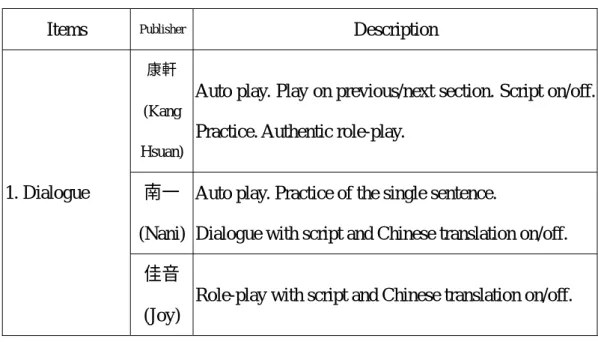
Basically, these target CD-ROM titles are annotated dialogues and readings with vocabulary activities and sentence structure acquisition. They are designed for beginners to learn vocabulary and improve their reading and listening skills. Like their junior high school textbooks, reading and dialogue are two main focuses of each lesson in their CD-ROMs. The dialogue is presented with animation and sound clips.

Users only have to click on the icon and the interface will change smoothly to the section the users want to practice. In dialogue and reading, users also have the choice of scripts in English or Chinese, or without script.

In Kang Hsuan CD-ROM, there is an icon called ‘key sentences” with an illustration of a big key; it reminds the user that the sentence is considered important and needs to be practiced more. In post-dialogue activity, the user has the chance to practice the sentences just learned. There are blanks that can be typed in the user’s answers, or let the program demonstrate the examples of dialogue sentences. It would be beneficial for the students if the program offers the explanation or correction to their input. It is difficult for beginners to detect their own error and make

self-corrections.

In Joy’s “Talk it out” section, motion pictures with colorful designs and sound

are very attractive to students. There are three additional activities: Role-playing,

Listening practice, and Fill-in the blanks. In Role-playing, the student can choose

the role he or she wants to practice. He or she reads the lines of the chosen

character and the computer will read the others out automatically. In Listening

practice and ‘Fill-in the blanks’, the student can check with the answers right after

(29)

finishing the exercise and the wrong answers will be highlighted.

4.2.2 Reading

The texts are presented with animation and audio clips. Students have the choice of scripts in Chinese or English, or without scripts. For example, Kang Hsuan’s CD-ROM provides recorded reading with the choice of reading the whole dialogue or any sentence on the screen. Click on the sentence and it will be read; the color of the sentence will go from black to red. Chinese translations are optional for the users. Joy’s ‘Tom ‘N’ Huck’ is a story in series adapted from the characters of the famous story by Mark Twin. This time the two young men live in modern society with the same passion for adventure.

Recent reading research has focused on the cognitive processes, that is, the interaction of low-level, bottom-up processes, such as vocabulary acquisition with higher-level, top-down processes, such as activating prior knowledge (Chun, 1997).

In addition, reading on the screen is different from reading on paper. Readers have the opportunity to hyperlink to other texts, unfamiliar vocabulary, or related

information. They can interpret the articles from other sources, search for more detailed information, and analyze data by means of computer technology. They have more control over the reading process than ever before.

In the target software, embedding vocabulary and sentence structures in texts

lead learners to pay close attention to language itself. The programs provide

opportunities to question meanings of words or sentences, repeat sentences, answer

questions and make correction. However, the CALL reading program should

provide multiple exposures in varies contexts, in which learners should have the

opportunity to guess, induce, and experiment with the meaning of difficult or

unfamiliar words. Students need to be encouraged to speak about the topic or the

(30)

picture, which will make their thoughts explicit, offer the opportunities to convey what they think, build the connection with previous knowledge, and thus gain a clearer understanding of what they have learned.

The design of these CD-ROM titles, however, is mainly concerned with basic language skills: vocabulary acquisition, “bottom-up” intensive reading, and decoding.

All three programs emphasize on words and sentence structures, but less on inference.

They provide little chance for higher-level “top-down” reading strategies, such as predicting, skimming and scanning, and inferring. Even for first graders, interesting reading or short stories, such as Joy’s reading section, would be necessary because they have already learned some English in elementary school for a period of time.

4.2.3 Vocabulary

When using Nani’s CD-ROM, the user can only check the word listed on the screen. In Joy’s CD-ROM, for instance, there is a box with a list of vocabulary.

Click on the word, and then its pronunciation and examples with Chinese translation will be shown in another box. It would be much better if the user can click on the new word and another related object or words, which belong in the same category (for example, click on the word robin, then the picture of robin or a picture of a sparrow is shown) would be present. Sometimes it is hard for students to figure out what exactly the word means, for example the difference between a mouse and rat.

Gass (1997) contends that a lot of input goes over learners’ head but only the salient to be perceived and noticed. In enhancing the sensitivity to vocabulary, highlighted words prompt learners to notice the important features of different words.

Therefore, instruction designs should prompt learners to notice the important features

by highlighting them. The vocabulary in these CD-ROM titles is highlighted. In

vocabulary rearrangement section of Nani CD-ROM, students can practice the new

(31)

word by typing the correct sequence of the word and check with answers by clicking on the “OK” button. The answers would then be presented with the wrong answers highlighted.

In these three CD-ROMs, some words provide no definition or examples. The programs should add more practical designs to the category of “dictionary”. In addition to the examples and optional sound clips, the program should prompt the pictures or illustrations along with the definition. Difficult vocabulary should give the learners more opportunity to practice by games or in an attractive way, such as graphics or mind mapping for users to associate with and recall new vocabulary.

Furthermore, it would be challenging if the program could provide a variety of ways to approach the unknown item, for example, by guessing the meaning, examples of the word in context, the related background notes and information, or the on-line help for solving puzzles.

To help language learners efficiently learn new words, Groot (2000) suggests two efficient ways to present new words in bilingual word lists for short-term results and for long-term retention in a contextual presentation. Also, an experiment of computer assisted vocabulary acquisition program (CAVOCA) demonstrates that it is most desirable to combine these two methods while learning new words (Groot, 2000).

It is worth concerning how the software presents new words and lexical items, whether they are presented in non-text-based modes or in context and with a variety of examples provided.

In the function of “Help” option, software should offer easy to difficult

presentations: 1.illustrate with picture, sound or animation; 2. Present the first letter of

an unidentified word; 3. Present the entire word; 4. Present the whole text. Thus the

learner can choose the most helpful option and decide how much help is needed.

(32)

4.2.4 Pronunciation

In Kang Hsuan’s CD-ROM, a table of phonetic symbols is arranged in different lessons. Move the mouse to the letter or the phonetic symbol and it will be read automatically. In Joy’s CD-ROM, a practice of choosing the phonetic symbols is arranged according to its spelling after an introduction of pronunciation. The student can check the answers by himself or herself, and wrong answers would be

highlighted.

In Nani’s CD-ROM, the pronunciation of all the lessons is presented by a game.

The student can choose what he or she wants to practice. After hearing a vowel within a short time, the student has to choose the word with the same stressed vowel;

otherwise a cartoon figure will be hit by a rock. It is not easy for beginners to be able to identify the five stressed vowels in seven seconds, and the time span for responding to each question is not adequate. Kang Hsuan’s program provides the chances to practice every phonetic symbol listed in a chart with an additional activity,

“Tongue Twister”, in every lesson.

4.2.5 Grammar

As mentioned earlier, Communicative Language Teaching focuses on language use. It is not to say that grammar is not important because students often produce ungrammatical or inappropriate sentences. The purpose of grammar learning is to help students understand sentences and write comprehensible ones, instead of solely knowing the language.

The principles of grammar teaching in junior high school include clear structures,

practical practice, and easy-to-difficult learning steps (Chou, 2004). The three

CD-ROMs provide one to three sentence patterns in every lesson, followed by

different practice, such as “make sentences”, multiple choice, and games. For

(33)

example, in Nani’s CD-ROM, the sentence pattern is demonstrated at the upper section of the screen, followed by multiple choices and the answer. In Joy’s CD-ROM, sentences along with prerecorded sound are presented at the clicking of key words or pictures for practicing target sentence patterns. While in practicing the structure, students can do the test of multiple grammar choices, then just click on the

“OK” button, and the answers will be prompted; wrong answers will be highlighted.

In Kang Hsuan’s CD-ROM, there are two sentence patterns in every lesson and each structure is demonstrated with examples, but the program does not provide answers to the practice of making sentences, nor is there further explanations to correct students’

mistakes.

4.2.6 Chant and song

Student’s interests will be aroused if they are to sing songs with animations. In Joy’s “Chant it out”, there are only tree songs in lessons 1, 4, and 6, which are

presented with animations and highlighted lyrics follow the melody of the songs. In Nani’s CD-ROM, there are six songs with an additional choice of background music only, by which the user can sing along with it. But there is only the same

background without much change. As Nani’s CD-ROM, Kang Hsuan’s CD-ROM provides karaoke versions in five lessons. It has a clever design of a small ball bobbing up and down according to the melody. In addition, Kang Hsuan’s program offers “Let’s chant” to improve speaking in every lesson.

4.2.7 Games

In Nani’s ‘Having fun’ of lesson 7, there is a memory challenge game with cards of unseen words; after matching them correctly, the user can gain one point. In

“Spelling”, the vocabulary reviewed is presented by the same game if you spell the

(34)

word correctly; a penguin character will also pass safely. Although the user can choose the language level, whether basic or advanced, the words are similar and the time span in the advanced level is only half of that in basic level. Another aspect is that the program cannot accept other possible answers, for example, if ‘hobby’ is the correct answer, ‘interest’ cannot be accepted as an equally valid answer. Joy’s program provides three games in each lesson to practice spelling, sentence structure, and pronunciation.

The three programs mainly comprise of drill activities, such as filling in the blanks, matching, and multiple choice, all contradictory to the concern of the communicative approach. However, Stokes (1997) proposes the idea of

“edutainment”, where the emphasis is not only on entertainment but also on education.

That the software offers a variety of activities and games certainly will make students more willing to use it. By means of computer technology, a drill program may be turned into an interesting activity or a game, which can be used as group work. Each group has to discuss and agree on its answer before typing it in. At the end, groups may compare the number of correct answers (Ioannou-Georgiou, 2002).

Generally speaking, all the games in these CD-ROMs are attractive to young

learners whether in color, text layout, cartoon characters, animation, or sound. But

the choice of games is limited. Nani’s and Joy’s CD-ROMs use two to three games

throughout the whole program, while Kang Hsuan’s CD-ROM has more than ten

games. It should include more games in a CD-ROM; otherwise, the user will soon

be bored with it. Kang Hsuan’s software integrates games into classroom activities,

which offers students the chances to review the content they have learned by means of

group discussion.

(35)

4.2.8 Test

A well-designed program can produce tests, ranging from multiple choices, question and answer, cloze tests, and others. The users can take the test, with their marks calculated, the validity checked, and the result documented for teacher’s reference or further improvement. However, according to the philosophy of the Communicative Approach, computer activities should not evaluate everything students do (Underwood, 1984). Therefore, there is hardly a section called “test”.

But the programs produce various chances for the user to practice language.

In the reading section of Nani’s CD-ROM, there is a test related to the text and the answers can be checked right away. In its sentence pattern section, the test is presented without explanation or examples. It might confuse the user. There is no icon of “test” in Joy’s or Kang Hsuan’s CD-ROMs; in fact the tests are included in different categories. Kang Hsuan’s program offers more practice opportunities for the user, including “match”, “read and fill in” in reading, post-dialogue activity, and many others.

Table 4-4 Data of Evaluation of three Junior High School CD-ROM Titles in instructional sections

Items

Publisher

Description

康軒 (Kang Hsuan)

Auto play. Play on previous/next section. Script on/off.

Practice. Authentic role-play.

南一 (Nani)

Auto play. Practice of the single sentence.

Dialogue with script and Chinese translation on/off.

1. Dialogue

佳音 (Joy)

Role-play with script and Chinese translation on/off.

(36)

康軒 Auto play and fill-in practice.

南一

Auto play the text with sound clips and the choice of Chinese translation on/off.

2. Reading

佳音

A series of modern ‘Tom & Huck’ stories with animated video.

康軒

Options of highlighted basic or advanced words with graphics, phonetic symbols, and examples.

Function of auto play.

南一 Options of low or high level words presented in games.

3. Vocabulary

佳音

Words presented with graphics, examples, and sound clips.

康軒

Practice pronunciation by clicking on the word listed alphabetically as well as intonation practice.

南一

Games in practicing word spelling and pronunciation.

No demonstration of pronunciation.

4. Pronunciation

佳音 Prerecorded highlighted words.

康軒

Introduction of sentence patterns and then practice of

“make sentence”.

南一 No rule or structure introduction, only practice.

5. Grammar

佳音 Same as Nani.

康軒

Two versions of songs, karaoke and chorus, as well as tongue twister. Total 6 chants and 6 songs.

南一 Two versions of songs, karaoke and chorus. 8 songs.

6. Chant and song

佳音 Presented with cute carton figures only in L1, 4 and 6.

7. Games 康軒 10 kinds of games led by the teacher.

(37)

南一 2-3 games. Exclusion from other possible answers.

佳音

3 games in each lesson focused on spelling, rearranging words, and phonetic practice.

康軒

Post-dialogue, “Match” and “read & fill in” in reading, as well as listening, reading, and writing practice.

南一 Tests after sentence patterns.

8. Test (Practice)

佳音

Various practice included in dialogue and vocabulary.

No test items.

4.2.9 Summary

The key for students to acquire language skills is for them to be attracted to learning programs. Students would find it easier to understand or memorize vocabulary and texts associated with sound, graphics, animation, and video. The main purpose of these CD-ROMs is to offer students opportunities to review what they have learned at school and practice the language elements they are unfamiliar with; for teachers, the advantage of the multimedia presentation of language materials and games for group activities in class may arouse students’ interests and motivation to enhance English learning.

Applying the CD-ROMs in class, teachers may play the dialogue in class first, and then role-play the lines with another character on the program as in Kang Hsuan’s CD-ROM. In the reading instruction, texts could be presented with audio clips, animation, as well as scripts and Chinese translation on and off. Students could practice the exercise, such as “listening practice” and “fill in the blank” afterwards.

In Kang Hsuan’s CD-ROM, the designs of illustration, examples, and sound clips

would help students in recognizing new words. Moreover, in order to suit individual

(38)

needs, words are divided into two levels, basic and advanced. The basic words are productive words for memorizing, and the advanced are receptive words for

recognition. In introducing phonetic symbols and practicing pronunciation, the three CD-ROMs present them in practice or games. In Kuang Hsuan’s program, click on the word, which is listed alphabetically on a chart, then the user can practice

pronunciation as well as intonation. In Nani’s, the game is to choose the same stressed vowel from the other four words in seven seconds. The fishing game in Joy’s is considered appropriate and helpful because the single sound is pronounced clearly.

In the grammar section, activities and games are provided. However, due to the lack of structure introduction, authentic practice, and further explanation of user’s mistake responses, students may lose the interest in using the correct grammar.

In a more relaxed way for language learning, Nani offers eight songs with additional karaoke version as Kang Hsuan, but the animation and background video lack variation. Joy only has three songs, but the animation is related to the songs and highlighted lyrics are followed the melody of the songs, which is easy for the user to sing along. Kang Hsuan’ program is the most attractive and diverse one, providing twelve chants and songs as well as tongue twisters to practice pronunciation. Two versions of songs, karaoke and chorus, and the design of a small ball bobbing up and down according to the melody might arouse students’ interests.

On the other hand, the choice of games is limited. Nani’s and Joy’s CD-ROMs have two to three games throughout the whole program, while Kang Hsuan’s

CD-ROM has ten games. Also, in Kang Hsuan’s program, special designs in games offer many opportunities for classroom discussions. More games should be included in a CD-ROM; otherwise the user will soon find it tedious.

These three programs do not include a test section, but they offer activities to

(39)

practice spelling, pronunciation, sentence patterns, dialogue, and reading.

In general, the strengths of the three CD-ROMs are multimedia presentation of texts, a variety of practicing activities, friendly learning environments, and instant feedback.

The limitations of them include the lack of a variety of activities and games,

authentic or explanatory feedback, recording or tracking system, and downloadable

texts, graphics or worksheets. Hyperlink to a power dictionary, extensive reading

materials or background knowledge are also excluded in the program. Furthermore,

these programs only offer activities to practice reading and listening, while writing

and speaking seem to be neglected. The programs provide the user to choose or type

answers only, and the user has no chance to write down the answer in response to a

question or a paragraph about a certain topic. Since there is no Speech Recognition

Technology (SRT), the user has little chance to practice speaking and their voices

cannot be recorded and analyzed for further improvement.

數據

Table 4-1 Data of Evaluation of three Junior High School CD-ROM Titles in Technical Criteria
Table 4-2 Data of Evaluation of three Junior High School CD-ROM Titles in Methodological Criteria
Table 4-3 Data of Evaluation of three Junior High School CD-ROM Titles in Pedagogical Criteria
Table 4-4 Data of Evaluation of three Junior High School CD-ROM Titles in instructional sections

參考文獻

相關文件

Understanding and inferring information, ideas, feelings and opinions in a range of texts with some degree of complexity, using and integrating a small range of reading

Graduate Masters/mistresses will be eligible for consideration for promotion to Senior Graduate Master/Mistress provided they have obtained a Post-Graduate

Students are asked to collect information (including materials from books, pamphlet from Environmental Protection Department...etc.) of the possible effects of pollution on our

The ECA Co-ordinator should design an evaluation and appraisal system for the proper assessment of various activities, school clubs, staff and student performance.. This

Wang, Solving pseudomonotone variational inequalities and pseudocon- vex optimization problems using the projection neural network, IEEE Transactions on Neural Networks 17

Hope theory: A member of the positive psychology family. Lopez (Eds.), Handbook of positive

volume suppressed mass: (TeV) 2 /M P ∼ 10 −4 eV → mm range can be experimentally tested for any number of extra dimensions - Light U(1) gauge bosons: no derivative couplings. =>

We explicitly saw the dimensional reason for the occurrence of the magnetic catalysis on the basis of the scaling argument. However, the precise form of gap depends