行政院國家科學委員會專題研究計畫 成果報告
隨意網路行動模型之機率分析 研究成果報告(精簡版)
計 畫 類 別 : 個別型
計 畫 編 號 : NSC 96-2221-E-011-037-
執 行 期 間 : 96 年 08 月 01 日至 97 年 10 月 31 日 執 行 單 位 : 國立臺灣科技大學電子工程系
計 畫 主 持 人 : 陳維美
計畫參與人員: 碩士班研究生-兼任助理人員:吳培源 碩士班研究生-兼任助理人員:李圭章 博士班研究生-兼任助理人員:黃慕凱
報 告 附 件 : 出席國際會議研究心得報告及發表論文
公 開 資 訊 : 本計畫涉及專利或其他智慧財產權,2 年後可公開查詢
中 華 民 國 98 年 01 月 31 日
行政院國家科學委員會補助專題研究計畫成果報告 隨意網路行動模型之機率分析
計畫編號:96-2221-E-011-037-
執行期限:96 年 08 月 01 日至 97 年 10 月 31 日 主持人:陳維美 台灣科技大學電子工程系
計畫參與人員:吳培源 黃慕凱 李圭章 台灣科技大學電子工程系
摘要
在行動隨意網路(Mobile Ad Hoc Network, MANET) 的環境中,資料的傳遞必需藉由多跳式(multi-hop)的機制 來運作,不過在眾多 MANET 網路環境中的路由協定 中,皆是以最少跳躍(hop)數為選擇路由路徑的選擇依 據,但是這樣的做法卻可能遭遇路由路徑容易斷裂的問 題,導致行動節點必需重新找尋路由路徑,不僅浪費無 線網路頻寬,也降低了網路產能(throughput)。為加強路 由路徑的可靠度,我們提出了分環式(ring-based)路由路 徑選擇機制,主要是依據相鄰兩行動節點間連線的存活 機率選擇路由路徑,並將此機制實際合併於需求式路由 路 協 定 DSR(Dynamic Source Routing) 上 , 在 NS2 (Network Simulator ver.2) 網路模擬器進行模擬實驗。由 模擬實驗結果顯示,加上分環式路由路徑選擇機制,路 由可靠性可有效的提升,並增加網路產能。
一、MANET 網路環境簡介
對於 MANET 網路環境而言,通常具有幾項特 性:
行動節點需擔任路由器的角色:在一個大規模 的MANET網路環境中,接收端的行動節點通 常不在發送端的傳輸範圍之內,因此在發送端 與接收端這兩個行動節點之間,會有一到多個 行動節點來擔任轉送的工作,即路由器的角 色,所以在MANET裡的每一個行動節點,都 要具備所謂的路由(routing)功能。
行動節點的移動模式無法預測:在MANET中 的所有行動節點皆能在任意時間點往任意方 向進行移動,因此在MANET網路中,網路拓
樸(topology)會因為行動節點的任意移動而隨 時改變的,也因如此,MANET的網路拓樸也 變成不可預測的。
有限的能源(power):在MANET網路中的行動 節點,必需仰賴可攜式的能源裝置提供電源才 能正常運作,運作的時間長短,就受限於供電 裝置的續航力,不如一般有線網路中的PC,
直接由市電供應能源,無需擔心續航力不足的 問題。
網路頻寬的限制:在MANET網路之中,所以 的行動節點間的資料傳輸皆是採用無線傳輸 的方式來完成,而在無線網路所使用的頻寬於 現今的IEEE 802.11無線技術下,較風行的是 IEEE 802.11b與IEEE 802.11g兩種,其頻寬分 別為11Mbps與54Mbps兩種頻寬,但是相較於 有線網路的100Mbps或是1Gbps的頻寬之下,
無線網路的頻寬還是較為有限,除此之外,無 線網路的環境中,還存在有頻道、頻率等問 題,延伸出碰撞(collision)、衰減(fading)及干 擾(interference)等等會影響資料傳送的潛在性 問題。
除了以上的特點外,MANET網路中,路由協 定一般分成兩大類,一為主動式路由協定(proactive routing protocol),此類的路由協定下,主要的特性 是必需週期性地更新每一個行動節點的路由表 (routing table),所以又稱為表格驅動式路由協定 (table driven routing protocol),此種作法雖然可以得 到較新的路由資訊,但卻相對地浪費網路頻寬;另 一種為被動式路由協定(reactive routing protocol),此 類的路由協定相較之下不必週期性地更新路由資
訊,只有在行動節點有需要,卻沒有路由資訊的情 況下才會發動路由路徑的找尋動作,所以又稱為需 求式路由協定(on-demand routing protocol),與主動 式路由協定相較之下,比較不會浪費網路頻寬,不 過卻有著路由資訊太舊的問題。
二、路由可靠度
在MANET的路由協定中,大部分都是以最短 路徑為選擇路由路徑的主要依據,以節省並提高無 線網路頻寬的利用。然而,這種路由路徑卻承受著 較高的路徑斷裂機率,因此我們將著重於MANET 網路環境中路由路由可靠度(或路徑存活時間)的研 究。
如圖1所示,圖中的圓圈範圍代表著行動節點 的無線傳輸範圍,假設我們需要從S行動節點到D行 動節點間建立一條路由路徑,在MANET網路環境 中,我們有兩條路由路徑可以選擇,路徑1從跳躍數 目(hop count)觀點來看,是屬於最短路徑,不過卻 缺乏可靠度,因為行動節點A非常容易就會漫遊出S 行動節點和D行動節點的無線傳輸範圍,而造成路 由路徑斷裂;路徑2可能就會有比較高的可靠度,因 為其中間的行動節點B與C在路徑斷裂前,具有較大 的漫遊區域可供移動。
圖1 MANET網路環境中路由路徑的可靠度
路由可靠度定義可以在許多相關研究中得到 不同的解釋。在ABR[6]路由協定中,每一個行動節 點不需擁有路由資訊,而路徑的選擇是建立在所謂 的關聯穩定度(association stability)狀態,而此關聯穩 定狀態常常會暗示行動節點是否正處於一個穩定的 狀態下,因此路徑不需要時常被要求重新更新。在 SSA(Signal Stability-based Adaptive) [2]協定中,在選 擇路由路徑時,考慮訊號的穩定度。方向預測的方
法在[5]中被提出,其中也基於兩相鄰行動節點的現 在位置、漫遊方向及漫遊速度來定義了路由路徑存 活時間,亦被應用在多點傳送(multicast)的環境中 [3]。其它對於路由路徑選擇相關研究有[7][8]等等。
事實上就可靠度而言,選擇路由路徑時所可能參考 到的因子有很多,例如路由路徑的長度、路由品質、
訊號強度、路徑頻寬及路徑存活時間等等。
三、分環式路由機制設計
分環式概念是以行動節點為圓心,將無線傳輸 範圍以同心圓方式分成若干個環,如圖 2 是以 5 層 的環為範例。如有其它行動節點移動到此行動節點 的 無 線 傳 輸 範 圍 內 , 此 行 動 節 點 可 依 RSS(Received-Signal-Strength)公式預估與其之間的 距離,進而得知其位於那一個環之中。
由於單純只考慮路由路徑長度或是路徑跳躍個數是 無法判別路由可靠度的,所以[9]將蜂巢式結構 (cellular structure)化簡後,再進行路徑存活時間的預 測,以改進路由可靠度,不過這樣的作法確太過於 複雜與不自然。[1]中提出一個環狀蜂巢結構,可應 用於預測路徑存活機制,但蜂巢結構與實際應用仍 有差距。事實上,在一般簡化的狀況下,任兩行動 節點間的距離狀態只會有三種變化,靠近、維持不 變以及更遠三種,都是三分之一的機率,若以此來 做考量,任兩行動節點間再也不會有方向性的問 題,只有相對距離狀態的改變。
圖 2 同心狀分環式結構
我們做法是依據分環式結構建出連結存在與 否的機率模型。如圖 3 所示,任兩個行動節點間距 離狀態變化機率之狀態圖,由於行動節點本身有移 動的特性,所以相對於自己無線傳輸範圍內的其它 行動節點而言,是具有靠近、保持不變及更遠的距 離狀態特性,再加上其它行動節點也是具有此特 性,所以對於任兩行動節點間的距離狀態共有九種 變化,我們是利用此路徑存活機率大小做為路由路 徑可靠度選擇的依據。圖 3 是以五環為例,其中的 六種狀態為兩行動節點間相距幾個環的狀態,狀態 5和狀態 6 為吸收(absorbing)狀態,如果有某一連結 的狀態進入到狀態 5 和狀態 6,我們即把此連結視 為斷裂。
圖 3 兩行動節點間距離狀態變化機率之狀態圖
四、分環式路由路徑選擇機制之整合
我們將所提之分環式路由路徑選擇機制整合 到MANET網路裡的DSR路由協定中,其主要原因有 下列幾點:
屬於需求式路由協定:需求式路由協定不需定 時更新路由表,不會浪費MANET無線網路環 境中有限的頻寬,DSR即是典型的需求式路由 協定,非常地適合應用在MANET網路環境中。
可同時維護多條路徑:DSR路由協定具有路由 快取(routing cache)機制,可以儲存經由路由探 索程序或當資料中繼點時所得知的路由路 徑,對於同一個目的地行動節點,可以同時存 在一條或多條路由路徑,我們可藉此選擇多條 路由路徑中,可靠度最高的路徑。
具分組轉送機制:不像其它MANET網路中的 路由協定是採用逐跳式路由(hop-by-hop),
DSR是由來源行動節點進行主動尋路的一種 無線網路路由技巧,來源行動節點決定了所有 封包在傳遞時所需經過的中間行動節點順 序,此路由資訊將會被放在封包的頭端(header)
部份,而此封包將會依此順序來傳遞至目的地 行動節點。
在機制整合後,路由協定的運作流程圖即如圖 4 所示,來源端行動節點會先行檢查自己的路由快 取是否有到目的地行動節點的路由路徑存在,若找 不到,則進入路由路徑探索程序;若有找到,則用 分環式機制求出所有可到達目的地行動節點之路徑 的機率值,並以機率值最大者之路由路徑為封包傳 送的路徑。在路由路徑探索程序中,所有在 MANET 網路環境中的行動節點也會以圖 5 之流程圖來進行 運作,當任意行動節點收到一個路由請求(Route Request,RREQ)封包時,會先確認自己是否為目的 地行動節點,如是,就立即發送路由回應(Route Reply,RREP)封包回來源行動節點;如不是,則檢 查自己的路由快取內是否有到目的地行動節點的路 由路徑,若沒有則將收到的路由請求封包再往下廣 播出去;若是路由快取內有路徑到達目的地行動節 點,則依分環式機制求出所有可到達目的地行動節 點之路徑的機率值,將機率值最大者之路由路徑放 到路由回應封包並發送回來源行動節點。
圖 4 分環式路由機制之流程圖
圖 5 分環式路由路徑探索程序之流程圖
五、模擬結果
針對我們所提出的無線隨意行動網路之分環 式路由機制設計研究中,所提出的分環式路由路徑 選擇機制,我們將透過模擬的方式來討論這樣的機 制表現結果。在換算實際距離方面,我們使用常被 利用來求得距離的有效方法,即是利用無線電訊號 隨著距離長度而衰減的特性來求得距離,可依 RSS (Received-Signal-Strength) 得到,只需利用一些已知 的訊號衰減公式,即可根據接收到的訊號強度來推 估訊號傳遞的距離長度;模擬時包含整體網路環境 的產能,進而討論三種封包傳輸間隔時間、五種網 路環境密度(density)與四種行動節點移動速度的影 響。我們的模擬軟體是採用 NS-2[4]網路模擬器,版 本為 2.29 版。
我們所使用的模擬環境範圍是設定於一個 1000平方公尺的平面中,模擬時間設定為200秒,模 擬的行動節點個數分別設定為10、20、30、40與50,
行動節點的移動速度分別為5、10、15與20公尺/每 秒,每一個行動節點的傳輸半徑為250公尺,傳輸方 式則是設定為CBR(Constant Bit Rate),封包的大小 為1024位元組(bytes),行動節點移動的方向則是採 取隨機決定(random way point),每一進行移動的節 點停留時間(pause time)則是設定為10秒,無線網路
的頻寬設定為2Mbps。
每一次模擬會依不同的網路密度而調整行動節點間 的通訊連線個數,每一條通訊連線的兩個行動節點 是由隨機產生,通訊連線起始時間亦是隨機產生,
並且持續一百秒,以 50 個行動節點的網路模擬為 例,會有 25 條隨機配對的通訊傳輸連線,通訊傳輸 時間點隨機產生,持續一百秒,並且必需在實驗模 擬時間結束前,完成所有通訊傳輸連線;針對通訊 連線時,來源行動節點傳送封包的速率,我們也分 成每秒 2 個、5 個與 10 個封包的速度,並分別模擬 與討論。以上所陳述的數值設定整理於表 1 之中。
模擬環境區域範圍 1000平方公尺
模擬時間 200秒
無線網路頻寬 2Mbps
行動節點個數 10、20、30、40、50
傳送資料的行動節點個數 5、10、15、20、25
傳輸方式 CBR/UDP
行動節點移動模型 Random way point model
行動節點移動速度 5、10、15、20 m/s
停止時間 10秒
封包大小 1024位元組
表1 模擬環境數值設定
我們將所提出之分環式機制,整合到行動節點的無 線傳輸範圍,依距離長短將行動節點的無線傳輸範 圍等距分成 5、10 與 15 等不同密度的環,並各個別 做實驗模擬,並與標準 DSR 路由協定做比較,以了 解分環式機制對路由協定的效能之提升。
在行動節點移動速度較慢時,例如移動速度每 秒 5 公尺時,如圖 6 所示,分環式機制的路由選擇 在效能上比較靠近標準 DSR 協定,主要是因為行動 節點移動速度較慢,連結較不易斷裂,相對路由路 徑的變化也較少。不過,當行動節點的移動速度再 往上調升時,模擬結果也出現較大的轉變,如圖 7、
8 與 9 所示,我們所提之分環式路由機制,確實能 增強路由協定的可靠度,進而提升整體網路的產 能,如圖 9(a)所示,最高還比標準 DSR 協定高出 19.64%之多的產能,在其它條件下,分環式機制也 都有高出 10%以上的表現。圖 6 到圖 9 亦說明加了 分環式路由機制的協定,比標準 DSR 協定更適合於
高移動速度與高資料傳輸流量的網路環境。
20 40 60 80 100 120 140 160
10 20 30 40 50
Number of Nodes
Throughput(Kbits/sec)
5R 10R 15R DSR
(a) 封包傳輸間隔時間0.5s
40 60 80 100 120 140 160 180
10 20 30 40 50
Number of Nodes
Throughput(Kbits/sec)
5R 10R 15R DSR
(b) 封包傳輸間隔時間0.2s
60 80 100 120 140 160 180
10 20 30 40 50
Number of Nodes
Throughput(Kbits/sec)
5R 10R 15R DSR
(c) 封包傳輸間隔時間0.1s
圖6 行動節點移動速度每秒5公尺之Throughput比較
20 40 60 80 100 120 140
10 20 30 40 50
Number of Nodes
Throughput(Kbits/sec)
5Ring 10Ring 15Ring DSR
(a) 封包傳輸間隔時間0.5s
60 70 80 90 100 110 120 130 140
10 20 30 40 50
Number of Nodes
Throughput(Kbits/sec)
5Ring 10Ring 15Ring DSR
(b) 封包傳輸間隔時間0.2s
100 110 120 130 140 150 160 170
10 20 30 40 50
Number of Nodes
Throughput(Kbits/sec)
5Ring 10Ring 15Ring DSR
(c) 封包傳輸間隔時間0.1s
圖7 行動節點移動速度每秒10公尺之Throughput比較
20 30 40 50 60 70 80 90 100
10 20 30 40 50
Number of Nodes
Throughput(Kbit/sec)
5R 10R 15R DSR
(a) 封包傳輸間隔時間0.5s
40 50 60 70 80 90 100 110 120
10 20 30 40 50
Number of Nodes
Throughput(Kbits/sec)
5R 10R 15R DSR
(b) 封包傳輸間隔時間0.2s
0 20 40 60 80 100 120 140 160
10 20 30 40 50
Number of Nodes
Throughput(Kbits/sec)
5R 10R 15R DSR
(c) 封包傳輸間隔時間0.1s
圖8 行動節點移動速度每秒15公尺之Throughput比較
20 30 40 50 60 70 80 90
10 20 30 40 50
Number of Node
Throughput(Kbits/sec)
5R 10R 15R DSR
(a) 封包傳輸間隔時間0.5s
40 50 60 70 80 90 100 110
10 20 30 40 50
Number of Nodes
Throughput(Kbits/sec)
5R 10R 15R DSR
(b) 封包傳輸間隔時間0.2s
60 70 80 90 100 110 120 130 140
10 20 30 40 50
Number of Nodes
Throughput(Kbits/sec)
5R 10R 15R DSR
(c) 封包傳輸間隔時間0.1s
圖9 行動節點移動速度每秒20公尺之Throughput比較
六、結論
在 MANET 網路環境中,路由路徑的長度與路 由可靠度一直是個兩難的問題,而在眾多 MANET 網路標準路由協定裡,都是以最短路由路徑為優 先,在某些網路條件下,例如在行動節點移動速度 較快的情況下,這種做法反而沒有效率,而降低網 路的產能;我們針對 MANET 網路中路由協定的可 靠度問題,提出了一個改良可靠度的路由機制,此 機制是藉由將行動節點的資料傳輸範圍分成若干個 環狀結構,在路由路徑的選擇時,可依此結構來挑 選可靠度較高的連結,如此一來整條路由路徑的可 靠度即可提高,模擬實驗結果顯示,加了分環式路 由機制的 MANET 路由協定,比原來未加分環式機 制的 DSR,最高提升了 19.64%之多的平均網路產 能,分環式路徑選擇機制的確可提高路由可靠度。
參考文獻
[1] I. F. Akyildiz, S. M. Ho, and Y.-B. Lin, Movement-Based Location Update and Selective Paging for PCS Networks,
IEEE/ACM Transactions on Networking, vol. 4, no. 4, Aug.
1996.
[2] R. Dube, C. Rais, K. Wang, and S. Tripathi, Signal Stability Based Adaptive Routing (SSA) for Ad-Hoc Mobile Networks, IEEE Personal
Communications, Feb. 1997, pp. 36-45.
[3] S.-J. Lee, W. Su, and M. Gerla, Ad Hoc Wireless Multicast with Mobility prediction, Proceedings
International Conference Computer Communications and Networks, 1999, pp. 4-9.
[4] The network simulator–ns-2,
http://www.isi.edu/nsnam/ns/
[5] W. Su, S.-J. Lee, and M. Gerla, Mobility Prediction in Wireless Networks, Proceedings
IEEE Military Communications Conference, vol.
1, 2000, pp. 491-495.
[6] C.-K. Toh, Associativity-Based Routing for Ad Hoc Mobile Networks,
Springer Wireless Personal Communications, vol. 4, no. 2, Mar.
1997, pp. 103-139.
[7] Z. Wu, H. Song, S. Jiang, and X. Xu, A
Grid-based Stable Backup Routing Algorithm in MANETs, IEEE Multimedia and Ubiquitous
Engineering, Apr. 2007, pp. 680-685.
[8] J. Wang, and S. Medidi, Density-first Ad-hoc Routing Protocol for MANET,
IEEE Communication Systems Software and Middleware and Workshops, Jan. 2008, pp.
528-535.
[9] Y.-C. Tseng, Y.-F. Li, and Y.-C. Chang, On Route Lifetime in Multihop Mobile Ad Hoc Networks,
IEEE Transactions on Mobile Computing, vol. 2,
no. 4, Dec. 2003.這次前往澳洲荷巴特參加 The 2008 International Symposium on Ubiquitous Multimedia Computing (UMC 2008) 國際研討會。會議期間為 2008 年 10 月 13 日 至 2008 年 10 月 15 日,並同時包含 UMC 2008 與 CSA 2008 此二研討會,三日 會議議題包含下列項目:.
1. Ubiquitous and Pervasive Computing
2. Dependable, Reliable and Autonomic Computing 3. Security and Trust
4. Multimedia
5. Networking and Communications 6. Database and Data Mining
7. Software Engineering
CSA 會議主要探討計算機科學與應用之相關議題,UMC 會議則探討計算機科學 於隨處可見的多媒體之應用,諸如無線廣播多媒體、網路搜尋引擎、多媒體影音 傳輸及家庭安全系統皆為此會議的探討範圍。
研討會共包含了 18 個 Session。其中對 Session 7、12 及 15 尤感興趣,以下 將對各 Session 做進一步地報告。
Session 7 由 Dr. Naveen Chilamkurti 主持,會議中除了探討計算機科學應用 於醫療系統,如監測心跳規律性以探知心律等問題外,更有不少論文針對 P2P 網路傳輸提出有效率的資料結構以增加傳輸效率與可靠度。
於 Dr. Nishat Ahmad 主持的 Session 12 中,Mr. Dong-Min Seo 提出了一更有 效率的方法動態地更新移動物件之狀況;Mr. Dong-Young Lee 與我們分享了新的 Heterogeneous 安全系統之管理模型;Mr. Foon Chi Francts Chul 則分享了圖像辨 識的新技術。
延續 Session12,Dr. Byeong Ho Kang 主持的 Session 15 中進一步地包含了 靜態與動態多媒體技術的改善,不僅在圖像辨識領域上,更深入地探討多媒體傳 輸效率的改善。此外更探討了 Google 搜尋引擎於中國市場中無法勝過百度搜尋 引擎。除了傳統計算機理論,Mr. Surtya Kaewarsa 提出了以類神經網路架構取代 傳統計算機架構之電源品質偵測方法。
會議中我們報告所發表的論文「Efficient Perfectly Periodic Scheduling for Data Broadcasting」,與與會者分享了我們在週期性無線廣播傳輸效率改善的技術 與成果。
在這三日的研討會中,主要參與了探討計算機科學應用於日常科技之 UMC 2008 研討會,於會議中獲得了許多影像辨識、網路傳輸效能改善以及計算機科 學應用於家庭生活與安全等相關新知。參與此會議,感到受益良多,感謝國科會 計畫的資助參與這內容豐富的研討會。
Efficient Perfectly Periodic Scheduling for Data Broadcasting
Wei-Mei Chen and Mu-Kai Huang
Dept. of Electronic Engineering, National Taiwan University of Science and Technology [email protected], [email protected]
Abstract
The perfectly periodic scheduling problem is to schedule a set of jobs such that each job is served occasionally, at fairly regular time intervals. For wireless broadcast systems, when a server periodically broadcasts data to different mobile clients, a perfectly periodic schedule provides no-jitter broadcasting and useful information to reduce power consumption for mobile devices. In this paper, we propose an efficient algorithm to determine a perfectly periodic schedule with low average delay.
Our simulation results show that the new algorithm performs still well when the total requested bandwidth is high and the variance of requested period is large.
1. Introduction
Recently, data broadcasting [10, 12] is an important technology to design mobile computing systems with low power consumption and high bandwidth utilization. When a server broadcasts data to different mobile clients successively and periodically, the mobile clients have to wait for the required data and receive it via broadcast channels [1, 8, 10, 11].
Generally mobile devices are power-limited.
Power consumption is one of the major problems in mobile computing systems. To improve power conservation and broadcast performance for data broadcasting, an effective approach is bandwidth scheduling instead of bandwidth competition.
Schedules can significantly reduce the power
requirement of a mobile client by keeping its radio to
“sleep” for most of idle time. For example, in Bluetooth standard [4], the “Park Mode” and “Sniff Mode” allow mobile clients to sleep in their idle time slots.
In a perfectly periodic schedule, each job is scheduled exactly every some fixed number of time slots [2, 5, 6]. In the perfectly periodic scheduling problem, Bar-Noy [2] first suggested a binary tree-based algorithm to schedule requests with unit length. Dhanakoti et al. [7] proposed a scheme for fault avoidance in 802.11 WLANs by binary-tree-based perfectly periodic scheduling. Later in [5, 6], Brakerski et. al. considered a more general problem for scheduling a set of requests with different lengths and periods. Recently, for the same problem in [5, 6], Patil and Garg [9] proposed an algorithm that schedules n job requests in O(nlogn) time.
For any job requirement, it is not always feasible to determine a perfect schedule which satisfies all requested period. In fact, it is NP-hard even to decide whether a given set of requests admits a perfectly periodic schedule [3]. Thus, one objective of perfect scheduling is to reduce the average delay of jobs.
In this paper we study the perfectly periodic scheduling problem for the client requests with different requested periods and various requested lengths. The rest of this paper is organized as follows.
Preliminaries and related work are introduced in Section 2. In Section 3, we propose an algorithm called GAS for perfectly periodic scheduling.
Performance evaluation is presented in Section 4 and the conclusion is given in Section 5.
2. Preliminaries
This work is supported by National Science Council under the Grant NSC96-2221-E-011-037
2008 International Symposium on Ubiquitous Multimedia Computing
978-0-7695-3427-5/08 $25.00 © 2008 IEEE DOI 10.1109/UMC.2008.15
29
2.1 Problem Statement and Notation
Given a set of n jobs, each job i associated with a requirement (bi, τi), where bi is the length (or execution time) of job i and τi is the requested period of job i. A set of n jobs J = {(bi, τi) | i=1,2, …, n} is called an instance. The maximum and minimum required period of J is denoted by TJ=max{τi | i=1,2, …, n} and tJ=min{τi | i=1,2, …, n}
respectively. The required bandwidth of i is defined by βi = bi / τi and the requested bandwidth of an instance J is denoted asβJ=∑in=1βi.
A schedule S for an instance J is an infinite sequence s0, s1, s2, …, where sj={1, 2, …, n} for all j.
A schedule is feasible if no two jobs are scheduled at the same time. A schedule is perfectly periodic if each job is scheduled exactly every τiS time slots, where τiS is the scheduled period for job i in S.
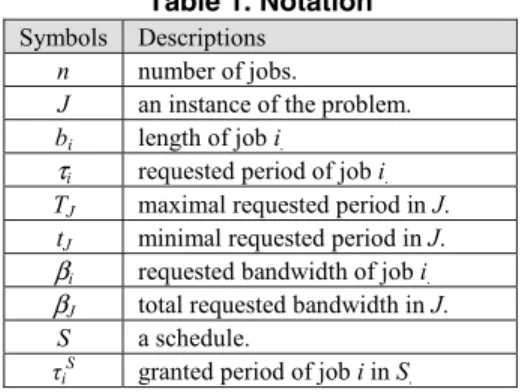
Essentially, a perfectly periodic schedule can be viewed as an infinite concatenation of a cycle. The related symbols and the corresponding descriptions are summarized in Table 1. In this paper, we assume that the granted period is greater than or equal to the required period for all jobs.
Table 1. Notation Symbols Descriptions
n number of jobs.
J an instance of the problem.
bi length of job i.
τi requested period of job i.
TJ maximal requested period in J.
tJ minimal requested period in J.
βi requested bandwidth of job i.
βJ total requested bandwidth in J.
S a schedule.
τiS granted period of job i in S.
To study the performance of perfectly periodic schedule, we evaluate the weighted average distortion, a popular measure first proposed in [2].
The weighted average distortion defined as
i S i n i
i J
S J
C β ττ
β
∑
=
=
1 AVE
) 1 , (
where the ratio of τiS / τi represents the distortion of job i and the weight of job i, βi, is the requested bandwidth. Obviously, the best case of distortion occurs when the granted period equals to the requested period.
2.2 Related Works
In the perfectly periodic scheduling problem, Bar-Noy [2] first suggested a binary tree-based algorithm to schedule requests with unit length. Later in [5, 6], Brakerski et. al. considered a more general problem for scheduling a set of requests with different lengths and periods. Recently, for the same problem in [5, 6], Patil and Garg [9] proposed a more efficient algorithm Adaptmin that schedules n jobs requests in O(nlogn) time.
In general, the requested period of each job may not be formed a power of two, algorithm Adaptmin rounds up all periods to the nearest power of two, i.e.,
⎡ i⎤
i τ
τ '=2log2 , and schedules the scaled jobs. Let the maximum period be T and the minimum period be t respectively. First, algorithm Adaptmin sorts the jobs in the nondecreasing order of requested periods and creates T/t intervals, each interval of length t slots, for a cycle. Next it processes the jobs in the nondecreasing order of requested periods. For job i, it scans the first
τ
i'/t
intervals and choose the first interval with most free slots. If the number of free slots is less thanτ
i', the length of the interval is enlarged for job i. Since all intervals have the same length, all intervals are enlarged. Finally, the job is scheduled in all intervals that are at a multiple ofi'/
t τ
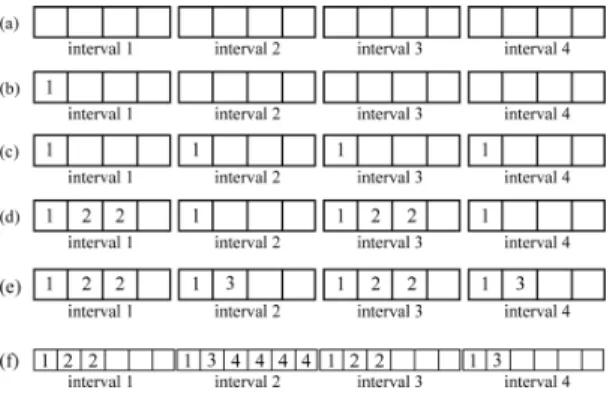
.Figure 1 shows an instance of algorithm Adaptmin for J={(1, 8), (1, 4), (2, 7), (4, 13)}.
After rounding up all periods to the nearest power of two and sorting the requested periods, we have the scaled jobs J’={(1, 4), (2, 8), (1, 8), (4, 16)}, T = 16, and t = 4, as shown in Figure 1(a). Next find interval 1 with most free space and set the first job in interval 1, as shown in Figure 1(b). Then insert the first job into all intervals at a multiple of 1 interval away, as shown in Figure 1(c). Repeat the same procedure, Adaptmin schedules two slots for the second job in intervals 1 and 3 and one slot for the third job in intervals 2 and 4, as shown in Figure 1(d) and Figure 1(e). For the last job, since the free space of all intervals is less than the requested length of the fourth job, all intervals will be expanded so that the fourth job can be scheduled perfectly. In this case, the least number of slots to be expanded is two, so each interval will consist of six slots. Finally the ,
30
fourth job can be scheduled in interval 2, as shown in Figure 1(f).
Figure 1. An Example of Adpatmin.
Examining the last step in Figure 1, if we can schedule the second and third jobs both in intervals 1 and 3, the fourth job can be inserted into interval 2 just with one-slot expansion. On the other hand, since Adaptmin adjusts each period to its nearest power of two, the jobs with longer request period get higher distortion. Moreover, Adaptmin schedules jobs according to the nondecreasing order of periods and using the best-fit strategy to allocate the slots, then the jobs with long requested period and long requested length may result in interval expansion and bring more idle slots.
3. Algorithm GAS
In this section, we introduce a new algorithm called GAS for estimating more economic sizes of intervals instead of enlarging all periods to the nearest power of two. The algorithm is composed of three stages: the first stage is “Grouping” that divides jobs into lists according to requested periods;
the second stage is
“
Adjusting” that determines the interval length to schedule all jobs tightly; and the third stage is “Scheduling” which schedules the jobs into intervals.3.1 Procedure Group
For improving the average performance, the short-period jobs need to be served more often, thus we assign them with higher priority of scheduling.
But if two jobs have the same priority, the job with greater length is scheduled first. The aim of procedure Group is to classify the jobs into lists
according their periods and arrange the lists in the nonincreasing order of lengths. The detailed steps of procedure Group are shown in Figure 2. And Figure 3 gives an example for J = {(1,7), (8,39), (1,62), (1,64), (32,96), (2,122), (12,128)} processed by Procedure Group.
Procedure Group Input: Instance J Output: Lists L0,L1,…Lm-1
1. Sort J in nondecreasing order of periods and let B be the total length of all requested jobs.
2. Let the maximum period be T and the minimum period be t.
3. Create lists, says L0,L1,…Lm-1.
4. For all i, insert job i into list Lk where k = in nondecreasing order of periods and keep the list in nonincreasing order of length.
Figure 2. Procedure Group
Figure 3. An Example of Procedure Group
3.2 Procedure Adjust
The aim of procedure Adjust is to determine the length of schedule intervals, i.e., the minimum τiS of J.
For all jobs in list Lj, procedure Adjust tries to make an interval reservation to list Lj-1 by joining jobs in list Lj into a pseudo job and inserting it to list Lj-1 . The description of the procedure is given in Figure 4.
Procedure Adjust Input: Lists L0,L1,…Lm-1
Output: Lists L0,L1,…Lm-1 and length of interval l 1. For j = m-1 to 1
1.1 Distribute all jobs in list Lj into 2j sets in noninecreasing order of lengths as evenly as possible.
1.2 For k = 1 to j
Join the (2k-1)th and (2k)th sets into a pseudo job and set the length of the
⎡ ⎤
⎡log2τi/B⎤−⎡log2⎡t/B⎤⎤
⎡ ⎤
⎡log2 / ⎤−⎡log2⎡ ⎤/ ⎤+1
= T B t B
m
31
pseudo job is the greater total length of two merged sets.
1.3 Record the scheduling order of jobs in pseudo jobs.
1.4 Insert 2j-1 pseudo jobs into list Lj-1 in noninecreasing order of lengths.
2. Let l be the sum the length of jobs in list L0 3. If ∃ job i (τi < 2j× l), expand interval length to
l=l + max{⎡(τi – (2j× l)) / 2j⎤}.
Figure 4. Procedure Adjust
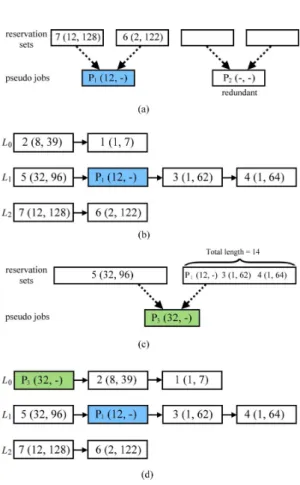
Figure 5. An Example of Procedure Adjust For any list Lj, we distribute all jobs in list Lj into 2j sets in noninecreasing order of lengths as evenly as possible. Next join two consecutive sets into a pseudo job and set the length of the pseudo job is the greater total length of two merged jobs. Then insert the 2j-1 pseudo jobs into list Lj-1 in noninecreasing order of lengths. We do this process for lists in the order of Lm-1, Lm-2, …,L1. Let l be the total length of jobs in list L0. Finally, procedure Adjust scans all jobs and adjusts the maximum interval. The size of the maximum interval is extended to l = l + max{⎡(τi – (2j× l)) / 2j⎤ } for all job i with period
longer than 2j× l slots where job i is in Lj.
An example of procedure Adjust is shown in Figure 5. Note that the interval length l = 41 obtained by the total length of jobs in L0. But, since the request period of job 5 is longer than l and job 5 is in L1, we extend interval to l = 41 + ⎡(96-21×41) / 2⎤ = 48, i.e.
each interval is extended four slots.
3.3 Procedure Schedule
The aim of procedure Schedule is to schedule all jobs according to the lists produced by procedure Adjust. The description of the procedure is given in Figure 6. The procedure first round all periods by τiS = 2j × l, where job i is in the list Lj. Let the maximum scheduled period TS = max{τiS} and minimum scheduled period tS = min{τiS}. Next we create TS / tS intervals with equal length l. To schedule all jobs into intervals, the algorithm schedule jobs from L0 to Lm-1 and in decreasing order of length. At the begining of scheduling, all of the space of interval can be scheduled for list L0. But for list Lj(j≠0), the intervals to be scheduled is constrained to the reservation by pseudo jobs in list Lj-1. Then schedule jobs of list Lj into constrained intervals in nonincreasing order of length. For each job, find an interval with the position that belongs for current examined job in first τiS / tS constrained intervals. Insert the job in the interval and in the intervals at a multiple of τiS / tS away.
Procedure Schedule
Input: Lists L0,L1,…Lm-1 and length of interval l Output: A schedule S.
1. For all jobs (including pseudo jobs), round all job periods to τiS = 2j× l, if job i is in the list Lj. 2. Let TS = max{τiS} and tS = min{τiS}.
3. Produce TS / tS intervals with equal length l.
4. Insert all jobs in L0 into all intervals directly.
5. Let j = 1 and set the intervals for pseudo job in L0 as constrained interval.
6. Schedule jobs of list Lj into constrained intervals in nonincreasing order of length. Search first τiS / tS constrained intervals and insert jobs into appropriate positions according to the related scheduling record.
32
7. Insert the job into all intervals at a multiple of
S iS/t
τ intervals away.
8. Set j = j+1 and let the constrained intervals in the next iteration be the scheduled intervals for pseudo jobs. Repeat step 6 to 8 until j = m.
Figure 6. Procedure Schedule
Figure 7. An Example of Schedule
Continuing the example in Figure 5, the scheduling for the instance is shown in Figure 7.
From procedure Adjust, we have l=48. Procedure Schedule first rounds all periods, then define TS = 192 and tS = 48 and create four (192 / 48 = 4) intervals with length 48, as shown in Figure 7(a). The jobs in L0 is scheduled first. Consider the pseudo job P3 of L0. The pseudo job P3 in L0 is inserted into all intervals directly, as shown in Figure 7(b). The other jobs in L0 are scheduled similarly, shown in Figure 7(c). For the next list L1, the procedure scans the first two constrained intervals, and schedules jobs into appropriate positions according to the related scheduling record. Then the job is allocated into all intervals at a multiple of two intervals away, as shown as Figure 7(d). Process the other lists in the same way. Finally the schedule S is given in Figure 7(e).
4. Simulations
In this section, we compare the performances of algorithm Adaptmin and algorithm GAS based on the average efficiency of the schedule and time complexity. The simulations are performed using C language with IBM PC and the simulation data is generated by the approach proposed in [9].
To compare the efficiency of algorithms, an
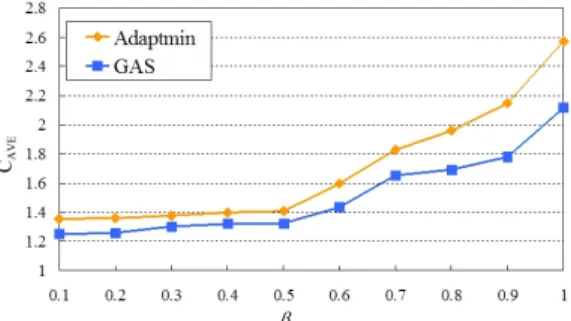
approach for producing simulation data is proposed in [9]. The simulation results are shown in Figures 8-10. The comparison of performance CAVE of two algorithms with the maximum period τmax= 128 is shown in Figure 8. As expected, when the requested bandwidth β(0 ≤ β≤ 1) is high, algorithm GAS can arrange the jobs into more compact intervals to reduce the number of idle slots. More specifically, for the cases of β > 0.5, our approach can improve efficiency from 10% to 20%. Even in the case of β = 1, from Figure 9, the average efficiency CAVE of GAS is better than that of Adaptmin. The comparison of time complexity is given in Figure 10. The result shows that algorithm GAS performs better than algorithm Adaptmin.
Figure 8. Performances of Adaptmin and GAS with τmax = 128.
Figure 9. Performances of Adaptmin and GAS with β = 1.
Figure 10. Complexity Comparison of Adaptmin and GAS.
33
5. Conclusions
In this paper, we considered the perfectly periodic scheduling problem for the client requests with different requested periods and various requested lengths. Algorithm GAS we proposed is based on the strategy which balances the effects of the request periods and the request lengths. Our simulation results show that algorithm GAS performs well when the total requested bandwidth is high and the range variance of requested period is large.
6. References
[1] S. Acharya, R. Alonso, M. Franklin and S. Zdonik, Broadcast disks: data management for asymmetric communication environments, Proceeding of ACM SIGMOD, Mar. 1995, pp. 199-210.
[2] A. Bar-Noy, V. Dreizin and B. Patt-Shamir, Efficient periodic scheduling by trees, Proc. 21st Annual Joint Conf.
of the IEEE Computer and Communications Societies, Vol.
2, June 2002, pp.791-800.
[3] A. Bar-Noy, B. Randeep, J. Naor and B. Schieber, Minimizing service and operation cost of periodic scheduling, Proceeding of the 9th Annual ACM-SIAN Symposium on Discrete Algorithms, 1998, pp. 11-20.
[4] Bluetooth technical specifications, version 1.1. from http://www.bluetooth.com/, Feb. 2001.
[5] Z. Brakerski, A. Nisgav and B. Patt-Shamir, General perfectly periodic scheduling, 21st Annual Symp. on Principles of Distributed Computing, 2002, pp. 163-172.
[6] Z. Brakerski, A. Nisgav and B. Patt-Shamir, General perfectly periodic scheduling, Algorithmica, 45(2), 2006, pp. 183-208.
[7] N. Dhanakoti, S. Gopalan and V. Sridhar, Perfectly periodic scheduling for fault avoidance in IEEE 802.11e in the context of home networks, 14th Annual IEEE Internat.
Symp. on Software Reliability Engineering, November 17-20, 2003.
[8] T. Imielinski, S. Viswanathan and B. Badrinath, Data on air: organization and access, IEEE Transactions on Knowledge and Data Engineering, 9(3), Jun. 1997, pp.
353-372.
[9] S. Patil and V. K. Garg, Adaptive general perfectly periodic scheduling, Information Processing Letters, 98(3), 2006, pp. 107-114.
[10] W. C. Peng, J. L. Huang and M. S. Chen, Dynamic leveling: adaptive data broadcasting in a mobile computing
environment, Mobile Networks and Applications, 8(4), 2003, pp 355-364.
[11] C. J. Su and L. Tassiulas, Joint broadcast scheduling and user’s cache management for efficient information delivery, Proceedings of the 4th ACM/IEEE International Conference of Mobile Computing and Networking, Oct.
1998, pp. 33-42.
[12] J. Xu, X. Tang and W.-C. Lee, Time-critical on-demand data broadcast: algorithms, analysis, and performance evaluation, IEEE Transactions on parallel and distributed systems, 17(1), 2006, pp. 3-14.
34