Bridging English Teaching and the Workplace Experiences:
An ESP Program for Vocational High School Students 融合職場經驗的英語教學:以一個高職專業英語課程為例
National Taiwan University of Science and Technology 國立台灣科技大學
Department of Applied Foreign Languages 應用外語系
學生: 沈玳玫 Day-Mei Demi Shen 柯承佑 Cheng-Yu Lucas Ko
洪韻涵 Yun-Han Gloria Hung 徐念筠 Nien-Yun Rainy Hsu 蔡宜庭 Yi-Ting Jessica Tsai
指導教授:駱藝瑄 博士
Advisor: Dr. Yi-Hsuan Gloria Lo
中華民國一百零二年五月
May 2013
ACKNOWLEDGEMENTS
“When you want something, all the universe conspires in helping you to achieve it.” This is a quote by Paulo Coelho from The Alchemist: A Fable About Following Your Dream. Our journey in accomplishing this research project has been a rough ride, but with the help of the people around us, we survived!
The most respectable and knowledgeable leader of our pack, Dr. Gloria Yi-Hsuan Lo (駱藝瑄) has truly led us well with her patience. We express our greatest gratitude to her, our advisor, our instructor, our dear mentor, for her continuous support and dedication to this project and to us. We are very grateful to her for devoting her time to this project, especially during the 10-day-program; she was there from morning till night. Dr. Lo has continued to give us advice and encouragement to this day, and we are deeply indebted to her. We cannot show
enough gratitude to her. We owe our achievements to Dr. Lo. “Thank you, Professor.”
This project couldn’t have been possible without the willingness of Shilin High School of Commerce (SLHS) to cooperate with us. They were generous in lending us their space, classrooms, equipment, and much more. Much support and organizing of the program came from the former dean of the Department of International Trade in SLHS, Ms. Ling-Mei Chen (陳玲美). She was very welcoming and offered her aid whenever we needed it. During the 10 days at SLHS, we were also supported and supervised by teachers of the Department of International Trade, Ms. Yu-Lian Chou (周玉連) and Ms. Yu-Hua Wei (魏玉華). Ms. Lisa Hung (洪儷倩), our initial connection to SLHS, was very accommodating even before our first meeting and rendered assistance to us before, during and even after the program.
Special thanks go to our teammates, especially Alexandra Shen (沈宥伶) and Amy Chuang (莊子誼), who offered their helping hand before and during the ESP program when we were in need.
The participants in the program were very cooperative and they were the biggest motivation for us during the 10 days when we were under extreme pressure. Thanks to them, we could persist joyfully throughout the ESP program.
In the early stages of our project, we were shown kindness by strangers who guided us to step out of our comfort zone of the language field. Dr. Seng-Su Tseng (曾盛恕) from the Department of Business Administration in NTUST was our first door to the business world and we are indebted to him for assisting us. We were honored to have been able to invite speakers, Dr. Hsing-chin Lee (李幸瑾), Dr.
Shu-Chiao Tsai (蔡叔翹), and Mr. Harry Liu (劉浩秋), to share their experience with us. Moreover, we can’t express enough gratitude to Creation Ltd. (諾耶廣告股份有 限公司), Studio Classroom, Herdsman Enterprises, and the Visitor Information
the time and providing the participants an opportunity to walk into the workplace.
Without their kindness to enlighten us with their resources, we would not have been able to see the workplace and the specialist fields. Thanks to them, we were able to take this research project to another level.
We wish to thank the Department of Applied Foreign Languages (AFL) at NTUST for giving us this opportunity to apply what we’ve learned in college to practice. Resources we have used from the department allowed us to complete this project without struggling. Blessings from our professors have touched us and encouraged us to move on. We are truly grateful to the AFL department.
We are bound by ties of gratitude, and cannot stop here but to mark this journey as a new beginning in our lives. We will remember the people we have met and carry the invaluable experience into our future. We shall grow big and strong, and lend our hands to those in need when we are capable. Thank you.
Demi, Gloria, Jessica, Lucas and Rainy May 05, 2013
TABLE OF CONTENTS
Page
ACKNOWLEDGEMENTS...i
TABLE OF CONTENTS...iii
LIST OF TABLES...vi
LIST OF FIGURES...vi
ABSTRACT...1
INTRODUCTION...4
Background of the Study...4
Purpose of the Study...5
Research Questions...6
LITERATURE REVIEW...7
Problems with VHS English Education...7
ESP and Workplace English...8
School-University Partnership Program ...10
METHODOLOGY...16
Overview ...16
Participants...17
Instruments...20
The Intensive ESP Program...24
Procedures for Data Collection and Analysis ...29
FINDINGS...37
DISCUSSION...61
CONCLUSION & SUGGESTIONS...69
FINAL REFLECTION………..…74
APPENDICES...84
EGP Speaking Test (Self-Introduction)...84
EGP Writing Test...85
ESP Speaking Test (English Sales Presentation 1)... 86
ESP Speaking Test (English Sales Presentation 2)... 88
ESP Writing Test (Business Letter Writing)…………...89
Needs Analysis Questionnaire...94
Motivation Questionnaire... ...100
EGP vs. ESP Questionnaire...102
Daily After-class Questionnaire...107
Interview Questions for Motivation...110
Lesson Plans for International Trade...111
Self-developed Teaching Materials for International Trade (I) Basic Elements in Business Letters (貿易英文書信格式)...113
Self-developed Teaching Materials for International Trade (II) Proposal Letter (開發信) ...119
Self-developed Teaching Materials for International Trade (III) Inquiry Letter (詢價信) ...129
Self-developed Teaching Materials for International Trade (IV) Quotation Letter (報價信) ...139
Self-developed Teaching Materials for International Trade (V) Payment Request Letter (催款信) ...148
Self-developed Teaching Materials for International Trade (VI) Review of Business Letter (國貿總複習) ...156
Appendix M: Lesson 1 – Introduction to Presentations Lesson Plan for June 3, Tuesday – Day 2………..160 Appendix A:
Appendix B:
Appendix C:
Appendix D:
Appendix E:
Appendix F:
Appendix G:
Appendix H:
Appendix I:
Appendix J:
Appendix K:
Appendix L:
Self-developed PowerPoint Slides for Sales Presentation (I)…161
Self-developed Handouts for Sales Presentation (I)…………...164
Lesson 2 – Preparing for Your Presentation Lesson Plan for June 4, Wednesday – Day 3……….167
Self-developed PowerPoint Slides for Sales Presentation (II)...168
Self-developed Handouts for Sales Presentation (II)……….…172
Lesson 3 – How to Make a Powerful Introduction Lesson Plan for June 5, Thursday – Day 4……….……175
Self-developed PowerPoint Slides for Sales Presentation (III)..176
Self-developed Handouts for Sales Presentation (III)…………178
Lesson 4 – How to Make the Content Logical (Part I) Lesson Plan for June 6, Friday – Day 5……….181
Self-developed PowerPoint Slides for Sales Presentation (IV)..182
Self-developed Handouts for Sales Presentation (IV)……...….185
Lesson 5 – How to Make the Content Logical (Part II) Lesson Plan for June 9, Monday – Day 6…………...…………187
Self-developed PowerPoint Slides for Sales Presentation (V)...188
Self-developed Handouts for Sales Presentation (V) ………....190
Lesson 6 – Finish Powerfully Self-developed PowerPoint Slides for Sales Presentation (VI)..193
Self-developed Handouts for Sales Presentation (VI)…………197
Lesson 7 – Check List Self-developed PowerPoint Slides for Sales Presentation (VII)199 Self-developed Handouts for Sales Presentation (VII)….…….203
Appendix N: Criteria for EGP Writing Test (pre and post)...205
Appendix O: Criteria for EGP Speaking Test (pre and post)...206
Appendix P: Criteria for International Trade (pre and post)...208
Appendix Q: Criteria for Sales Presentation (pre and post)...210
Appendix R: Photos throughout the Program...212
Table 1:
Table 2:
Table 3:
Table 4:
Table 5:
Table 6:
Table 7:
Table 8:
Table 9:
Table 10:
Table 11:
Table 12:
Table 13:
Table 14:
LIST OF TABLES
Problems with VHS English Education from domestic scholars...8
Result of English Learning Experiences in Needs Analysis Questionnaire...19
Five Types of Instruments...20
The Curriculum of the Intensive ESP Program...26
A Typical Three-hour Session of English for International Trade...27
A Typical Three-hour Session for English Sales Presentation...29
Details for Data Collection during the ESP Program...31
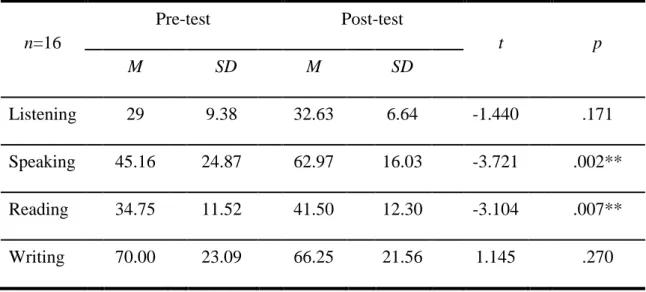
Paired t-Test of Mean Scores on General English Proficiency in the Pre-test and Post-test...38
Paired t-Test of Mean Scores on Understanding of PowerPoint Slides’ Organization in the Pre-test and Post-test...39
Paired t-Test of Mean Scores on English for International Trade in the Pre-test and Post-test ...41
Perceptions of General English in School and the ESP Program ………...42
Difficulties Encountered by Participants and Strategies Used by Student-teachers in the ESP Program... ...53
Paired T-test on Pre- & Post- Questionnaire of Integrative Motivation………54
Top Three Reasons Why Students Registered for ESP Program………55
LIST OF FIGURES
An Overview of the Study………16Procedures for Data Analysis………...………....33
Timelines for the Major Events of the Study……….36 Figure 1:
Figure 2:
Figure 3:
ABSTRACT
Globalization has created an increasing demand for English in the workplace.
Companies look for employees who not only are experts but also are fluent in English.
For this reason, English for Specific Purposes (ESP) has become an important issue.
Despite the integration of theory and practice in vocational high schools (VHS), VHSs do not provide students with a learning environment to attain fluency in English.
However, a school-university partnership has been effectively proved to increase students’ motivation for learning English.
With this notion in mind, an intensive ESP program that linked English teaching to workplace experience was implemented for VHS students of International Trade by the researcher and her work-team as student-teachers majoring in Applied Foreign Languages. In this study, the researchers investigated how an ESP program via a school-university partnership influenced the VHS participants in four aspects: (1) general and professional English ability, (2) perception of school classes and the ESP program, (3) difficulties encountered during the ESP program, and (4) English learning motivation.
During the ESP program, both qualitative and quantitative measurements were employed for data collection and analysis. The quantitative data were analyzed through paired t-tests, and the qualitative data were transcribed, translated, and analyzed through to conduct content analysis. The results show that after being intensively immersed in the ESP program, not only did the VHS participants improve their general English proficiencies, they were also capable of giving a sales
presentation in English to supervisors in the workplace. Moreover, their motivation for English learning was enhanced due to the positive rapport built between
participants and student-teachers through collaborative learning (CL). In conclusion,
this research supports the idea that an ESP program via a school-university
partnership can be an alternative avenue for VHS English education in Taiwan and that bridging English learning to the workplace experience is meaningful for VHS learners. Suggestions for school-university partnerships, EFL teacher education, cooperation with workplaces, and ESP research are provided.
Key-words: Collaborative Learning (CL), English for General Purposes (EGP), English for Specific Purposes (ESP), School-university Partnership, Vocational High School (VHS)
摘 要
隨著全球發展迅速及「地球村」的觀念影響,企業界招募人才時不僅衡量其專業 能力,也將求職者的英語能力納入資格考量。因此,與特定領域相關的專業英語 (ESP, English for Specific Purposes)便成為極需重視的議題。談及未來職涯人才的 相關教育,台灣的技職體系鼓勵學生培養專業知能,並期望能培育務實致用的專 業人才。然而,在英語教育方面,因缺乏適當的課程標準及教學規劃,技職體系 學生的英語程度遠遠落後高等教育的學生;學習動機低落、表現不甚理想。有鑒 於大學與中小學夥伴關係(School-university Partnership)之相關研究指出,大學與 中小學的夥伴關係建立於師生間互信與合作學習之基礎,有助於提升學生學習動 機,因此,研究者組成五人教學團隊,旨在探討以大學生擔任課程教師與設計者,
及執行專業英語密集課程對於高職學生英語學習之影響。本研究採量化與質化並 重的資料收集與分析。所得量化資料以 T 考驗分析;質化資料以敘述統計及內容 分析之方式分析成果。研究結果發現,透過此課程,學生不僅提升一般英語及專 業英語能力,也提升英語學習動機,此外,透過合作學習的方式,師生間建立正 向、良好的互動關係,亦使學生更願意主動學習。總結而言,根據本研究的主要 發現,研究者認為以大學與中小學夥伴關係發展專業英語課程之教學方式能作為 台灣高職英語教學上的另一種選擇,未來研究也應持續探討以專業英語至職場呈 現學習成果對於高職生英語能力的影響。最後,本研究就大學與學校的教育夥伴 關係,應外系職前老師,如何將職場經驗融入高職英語教學以及專業英語研究提 出建言。
關鍵字:專業英語,一般英語,高職英語,大學與中小學的夥伴關係,課程發展
INTRODUCTION
Background of the Study
The educational system of Vocational High Schools (VHSs) in Taiwan aims to provide an environment in which students learn to apply their professional knowledge to a relevant career or the workplace after graduation. However, VHS students are currently learning English for General Purposes (EGP) instead of English for Specific Purposes (ESP). Studies have emphasized the importance of ESP in encouraging students to combine their professional content knowledge with English learning (Huttner, Smit, & Mehlmauer-Larcher, 2009) and that ESP should not be limited to college level; rather, it should be expanded to secondary schools (Cruickshank, 2009).
These studies suggest that it would be an advantage for Taiwanese VHS students to have ESP courses because they could link English learning to the specialist content knowledge of their field, for example, offering Hotel and Restaurant English to VHS students of Hospitality and Hotel Management (Chen, 2008).
According to Nie and Su (2006), the following five major reasons have been identified as contributing to VHS students’ overall low English proficiency: (1) insufficient hours of English class, (2) inappropriate design of teaching materials, (3) low learning motivation from students, (4) ineffective teaching approaches and methods, and (5) inconsistent expectations between teaching evaluation and desired outcomes. More essentially, the majority of the VHS students aim to continue further studies in technological universities after graduation and EGP is still emphasized as important for the entrance examination. Hence, it is important to ask what
approach(es) could be employed if ESP courses were offered to VHS students in Taiwan.
School-university partnership has been widely advocated by both international scholars (e.g., Tsui & Law, 2007; Tsui, et al., 2009) and domestic scholars (e.g., Chang & Yen, 2005) for building collaboration between schools and universities because of the positive learning outcomes a partnership brings to students. In this study, a school-university partnership was established between a national university of technology and a public high school of commerce in the northern area of Taiwan, in which pre-service secondary teachers1 designed and implemented an intensive ESP program using collaborative learning (CL) and task-based learning (TBL) approaches, during which they observed and evaluated the effects of the program on the VHS students.
In order to bridge the ESP program to the workplace, the program introduced two courses, namely English for International Trade and English Sales Presentation, to 16 VHS students. Kim (2008) indicates that ESP includes a clear objective. For students majoring in International Trade, it is important that they learn English
business letter writing. In addition, presentations are frequently used in the workplace;
thus, to bridge to the workplace, an English Sales Presentation class was chosen. Both courses have clear objectives and purposes. What is worth mentioning is that at the end of the ESP program, the VHS participants needed to complete a task in which they gave a PowerPoint presentation to a supervisor in a workplace.
Purpose of the Study
In this study, the purpose is to examine the effects of an intensive ESP program through a school-university partnership on VHS students’ EGP and ESP English
1 The terms “student-teachers” and “pre-service secondary teachers” refer to undergraduate college students who are English majors and who are concurrently taking education courses to become certified secondary English teachers.
proficiency. They also interviewed the VHS participants to learn their perceptions of this ESP program taught by college students. The difficulties and challenges
encountered during the program and how the problems were tackled were recorded. In addition, the researchers investigated how the program influenced the participants’
motivation to learn English.
Research Questions
1. Does the ESP program enhance the VHS participants’ general and professional English ability?
2. How do the VHS participants perceive the general English classes taught in school and the ESP taught by student-teachers in the program?
3. What difficulties do the VHS participants encounter in the ESP program? How do the student-teachers help them overcome the difficulties?
4. Are the VHS participants more motivated to learn English after taking the ESP program? If yes, in what ways? If not, why not?
LITERATURE REVIEW
Relevant concepts and studies including (1) problems with VHS English education, (2) ESP and workplace English, and (3) school-university partnership are reviewed in this section.
Problems with VHS English Education
According to the handbook published by the Ministry of Education (MOE) introducing Technological and Vocational Education (TVE) in Taiwan (Lee et al., 2011), VHS is the intermediate level in this educational system. Considering the development of students in the three-year program, VHSs aim to provide a diverse and appropriate learning environment which focuses mainly on the practical skills and applicable knowledge for students who are interested in subsequently seeking jobs in which these skills can be applied (Lee et al., 2011).
However, in terms of VHS English education, the TVE system does not seem to provide students with a solid and complete learning environment where practical skills and applicable knowledge can be combined. The problems of VHS students’
low English proficiency are brought up by domestic scholars. Nie and Su (2006) reported that approximately 86% of VHS students did not pass the English test in the TVE joint college entrance examinations. After probing into the fundamental causes of this problem, according to Nie and Su (2006), several Taiwanese scholars found the following five main reasons for VHS students’ immature English ability, which can be seen in Table 1 below:
Table 1
Problems with VHS English Education from Domestic Scholars
Factors Scholars
1.
Few hours of English class
(Tseng & Kuo, 1987; Huang, 1990; Hung, 1994; Lin, M. S., 1995, 1996; Shih, Lin, Chou, & Hung, 1999)
2.
Lack of appropriate design of teaching materials
(Tseng & Kuo, 1987; Huang, 1990; Hung,1994, 1997; Chou, 1995; Chuang & Chou, 1996; Shih & Lin, 1996; Chen, 1997; Shih, Lin, Chou, & Hung, 1999)
3.
Low learning motivation from students
(Chuang, 1997; Hung, 1997, 1998; Chen, 1999; Wu, W., 2004; Cheng & Williams, 2005; Wu, M., 2005)
4.
Mistakes in English teachers’
teaching method
(Chou, 1993; Yang, 1994; Chou, 1995; Chuang & Chou, 1996; Shih, Lin, Chou, & Hung, 1999; Luo, 2000; Ho, 2001;
Chen & Lee, 2002) 5.
Inconsistency between teaching evaluation and goals
(Shih, Lin, Chou, & Hung, 1999)
Adapted from Nie and Su, 2006, page 1 To improve VHS students’ performance in English, Chang (2006) suggests that in addition to adding teaching hours and strengthening English teachers’
professionalism, instructors should adjust their teaching methods according to the students’ English proficiency. However, Chen (2007) states that the motivation of VHS students with a better performance in English is obviously stronger than the motivation of those with a poorer performance. Therefore, VHS students’ motivation can be the most important factor in students’ learning, because students can perform better if they are strongly motivated.
ESP and Workplace English
ESP and workplace English might be a partial solution to the problems of VHS English education pointed out in the studies above. The study by Chen (2008) showed
that after taking the ESP program he developed, students generally considered ESP materials beneficial for learning English. In addition, since ESP is related to students’
specialized areas, it can increase students’ motivation to learn English (Hutchinson &
Waters, 1987).
As has been mentioned, ESP is related to students’ professional fields and the goal is to apply what they learn in future jobs. Different from EGP, ESP focuses on teaching the student what is relevant to his/her specialist area (Hutchinson & Waters, 1987; Belcher, 2006). After learning ESP, students can put their knowledge of English into practice in their relevant fields (Huttner, Smit, & Mehlmauer-Larcher, 2009); for example, after learning Business English, a student should be able to make business presentations in English (Edwards, 2000). Learning ESP can motivate students by raising their awareness of where they can actually use the language (Hutchinson &
Waters, 1987).
As defined by some scholars (Carter, 1983; Hutchinson & Waters, 1987), ESP includes several branches, such as English for Academic Purposes (EAP), English for Occupational Purposes (EOP), English for Science and Technology (EST) and
English for Business and Economics (EBE). Among the divisions, EOP is the most related to the goal of VHS education, for students to apply the practical skills they learned at school in future jobs. Hutchinson and Waters (1987) noted that in EOP, “In many cases the language learnt for immediate use in a study environment will be used later when the student takes up, or returns to a job” (p. 16), similar to the concept of workplace English and consistent with the goal of VHS education in Taiwan.
Much research over the decades (e.g., Belcher, 2006; Berry, 1995; Lockwood, 2012; Martin, 1985) has shown that instructors do not teach the specific texts or genres required by learners in the workplace, and therefore the instruction does not meet the workplace needs in the specific field. However, EOP emphasizes the general
basic skills learners need in the workplace (Minodora, 2012), and its objective is to apply English to practical purposes in the workplace (Kim, 2008). Hence, in this ESP program, researchers examined whether using workplace English to fill in the gap between learners and the workplace affected the students’ motivation to learn English.
School-university Partnership Programs
The study also draws on the idea of a school-university partnership in the ESP program, as some studies suggest that school-university partnerships also improve students’ learning motivation (Abdal-Haqq, 1998; Darling-Hammond, 1994; Tsui &
Law, 2007; Tsui, et al., 2009). When schools and universities cooperate, students improve their achievement, and teachers improve their development as well. Even though the two institutions are distinctly different, collaboration makes each more effective in learning and teaching because of their overlapping interests, which benefits both sides (Goodlad, 1994).
In addition, some Taiwanese educators (Chang & Yen, 2005; Ou, 2004) have also advocated “school-university partnerships.” According to Ou (2004), a
school-university partnership occurs when schools and universities work with each other in order to achieve their own interests and deal with their own challenges. The process is flexible, with everyone bringing their advantages into full play to reach their goals. However, although many educators recommend relationships between schools and universities, few domestic studies of school-university partnerships, particularly in secondary schools, have been done (Tsai, 2005). For this reason, the researchers applied the essence of a school-university partnership to examine the effectiveness and outcomes of the ESP program for VHS students. This research approaches the concept of a school-university partnership through three facets: (1)
intensive English programs, (2) collaborative/cooperative learning (CL) and (3) task-based learning (TBL).
Intensive English programs. Intensive English programs are accelerated or condensed programs that immerse the learners in the courses for more hours but for a shorter duration than conventional programs (Scott & Conrad, 1992; Wodkowski, 2003). Intensive English programs have been the subject of controversy for several years. Some researchers (Nagano, 1995; Spade & Lightbown, 1994) have suggested that the intensive learning format results in a positive impact on learners, while other researchers (Gallow & Odu, 2009; Nasiri & Shokrpour, 2012) have criticized the effectiveness of accelerated programs and pointed out the disadvantages.
According to Mukundan, Mahvelati and Nimehchisalem (2012), thirty Malaysian secondary school students effectively improved their English language proficiencies and enhanced their previous language competencies while participating in a
four-week intensive English program. In addition to positive results in improvement of language proficiencies, some studies (Burton & Nesbit, 2002; Daniel, 2000;
Jacques-Bilodeau, 2010; Nagano, 1995) also show that with intensive English
programs, the learners increased their English learning motivation, positively changed their attitude toward English learning, and concentrated more on learning.
However, other studies show opposite findings. Nasiri and Shokrpour (2012) found that learners in the non-intensive programs performed significantly better than those in the accelerated courses, suggesting the ineffectiveness of the intensive instructional format. Furthermore, Scott and Conrad (1992) indicated that learners in the intensive courses might feel exhausted and have difficulty digesting too many new lessons, which would lead to a negative impact on students.
In summary, from the results of the literature reviewed above, the researchers conclude that the effectiveness of intensive programs may be inconsistent. The issue is still being debated, and further research in this field is needed.
Collaborative learning. Collaborative learning (CL) is an effective way of teaching that has been commonly used since 1970 (Yu, 2001). Although there is no single complete and precise definition for this term (Chang, 2010), the various
definitions have some common points. Lin (2010) organizes the common ideas among several definitions offered by international and domestic scholars. Firstly, CL is a systematic teaching strategy; secondly, CL is composed of more than two participants;
thirdly, there must be a common learning goal in CL; fourthly, CL includes negotiation and discussion; and lastly, collaborative learning can increase the cognitive, social, and affective development of students to enhance their ability to learn from one another. These five common points above show that the main focus in classrooms conducted with CL is students themselves instead of teachers. When students are learning, they not only learn from teachers, but also from their classmates.
In addition, to make successful CL happen, students need to actively team up and cooperate with one another, so that they not only obtain knowledge but also learn how to interact and get along with people.
Furthermore, referring to Johnson and Johnson (1987) and Chiu and Shao (2003) state that CL includes six essential elements: (1) heterogeneous groups, (2) positive interdependence, (3) face to face promotion, (4) individual accountability, (5) social skills, and (6) group processing. Accordingly, the researchers understand that what CL values is not having only one genius, but instead not leaving anyone in the group behind. This learning method encourages members to work together to make one another better and replaces competitive relationships with mutual cooperation.
CL has been one of the methods adapted to developing students’ motivation and achievement. Many studies have demonstrated the positive effect of CL on student’
motivation and learning achievement (Huang & Lin, 2002); Chiu’s(2002), for example, found that students’ learning achievement increased and their motivation also improved after she implemented CL in a regular English class at a junior high school for five months . Lee (1999) claims that, with CL, students can gain an interactive relationship either with their teachers or classmates through group work, and students will actively rely on one another to achieve their common goal. In such a model, students are inspired to learn.
There are also some case studies which have used CL in VHS students’ English learning. For example, Chang’s (2003) study explored the effect of CL on VHS students’ learning achievement, learning motivation, and social skills. Additionally, she also wanted to know how these students evaluated CL. Two classes of first-year VHS students participated in Chang’s (2003) research. The experimental group was taught using CL activities, such as Jigsaw and Inside-Outside Circles. The control group was taught by the traditional teacher-centered method, in which the teacher stands on a stage and gives a lecture, while students just listen. The results show that learners in the experimental group performed better in speaking and listening than learners in the control group. Furthermore, students in the experimental group were more interested in English courses compared to those in the control group and commonly had stronger learning motivation. Although Chang’s (2003) results show that students in the experimental group didn’t have a higher performance in reading and writing skills, students claimed that they were more used to giving compliments and caring about the people around them. They had learned better interpersonal skills, and their self-esteem was enhanced. Moreover, the students in the experimental group indicated that the system of CL was beneficial to developing a good learning
atmosphere and that dividing them into several groups gave them opportunities to practice English in daily life.
Based on the literature review and case study, the benefits of CL match the needs of current VHS students, who are commonly recognized as having insufficient
English proficiency and low motivation to learn English. CL seems to be a potential solution to these problems, since it has been proven helpful for improving both learning achievement and learning motivation. For this reason, the researchers
adopted CL in this research. In addition, Chang’s (2003) study has shown a beneficial relationship between foreign language learning and CL. However, since there are still not enough studies in this field, the researchers would like to provide more research data for VHS English teachers and future researchers.
Task-based learning (TBL). Willis (1996) defines “task” as “[an activity] where the target language is used by the learner for a communicative purpose (goal) in order to achieve an outcome” (p. 23). It focuses on a form of output. As for task-based language learning, Breen (1987) defines it as “any structured language learning endeavor which has a particular objective, appropriate content, a specific working procedure, and a range of outcomes for those who undertake the task” (p. 23). In general, TBL is a learning method in which an achieved goal is the outcome. TBL is applied to language learning by creating opportunities for learners to develop skills through collaborative knowledge building (Ellis, 2003). The results of an experiment conducted to study the effectiveness of text-based tasks in terms of task-based language learning. The results show that the students were more motivated to learn through this method (Thanh & Huan, 2012). In English-learning classes, the results of TBL show a positive impact. For example, in a study comparing two intact
low-intermediate adult English-as-a-second-language (ESL) classrooms, the results showed that learners had positive responses to the TBL learning, and they improved
their language performance through this new learning approach (Nassaji & Tian, 2010).
Task-based language learning focuses on a form of output and has been implemented in classrooms, gaining learners’ positive response and performance.
Input-based communication, whether comprehensible or not, cannot develop learners’
full language skills. Studies have suggested that language learning cannot be complete without output, and that knowledge should be put into practice for the learning to be whole (Swain, 1985). In a case study by Zheng and Xie (2011) some stage drills were added to the teaching process, with the goal of making students adapt from the input process to the output. Zheng and Xie concluded that when students received concrete input instruction from the teacher for output, they felt more at ease during the learning process, enabling them to participate more actively, and leading them to enhance both their reception and production of language.
In summary, TBL enables learners to achieve the final outcomes through the goals set. Moreover, students can practice through output activities to accomplish their goals, making the experience of language learning whole.
METHODOLOGY
Overview of the Study
Participants were recruited from international trade-related fields in a VHS in Taipei to attend an intensive ESP program. During the program, the 16 participants were divided into four groups, with one of the student-teachers as the group leader. As part of an evaluation after the program, the participants were asked to present their final outcome to an authentic audience in the workplace (Figure 1).
Figure 1.
An Overview of the Study
Recruit participants from VHS
VHS students give a presentation at the workplace
Conduct data analysis and answer research questions
Make conclusion and suggestion
The ESP Program (for details please refer to “Ten-day Program” in Table 4)
EGP
•Listening Pre-test
•Speaking Pre-test
•Reading Pre-test
•Writing Pre-test
ESP
•English for International Trade (Business letter writing)
•English Sales Presentation
Instruments
•Needs Analysis
•Motivation Questionnaire
•Interview EGP
•Listening Pre-test
•Speaking Pre-test
•Reading Pre-test
•Writing Pre-test
ESP
•English for International Trade (Business letter writing)
•English Sales Presentation
Instruments
•Needs Analysis
•Motivation Questionnaire
•Interview
Participants
The participants in this study were a class of 16 students, aged 16-18 from one VHS in Taipei. Among them, 7 were first-year students (1 male and 6 females) and 9 were second-year students (1 male and 8 females). The reason the researchers chose a VHS rather than a normal high school was that the VHS education system emphasizes practical skills in certain professional areas. The researchers chose students majoring in international trade because this field plays an important role in Taiwan and because globalization requires good English ability. All the participants in this research were assigned a pseudonym, and their identity is confidential. The participants were randomly divided into 4 groups.
From the students’ learning backgrounds reported in the needs analysis
questionnaire (see Appendix F) and the situation in the EGP classroom reported in the EGP vs. ESP questionnaire (see Appendix H), the researchers understood the
participants’ English abilities and English learning conditions. The findings showed that most participants (13 of 16) attend 3 to 4 periods (50 minutes each) of English classes per week at school. When asked how much time they spend studying English after English classes at school every day, 6 participants reported spending half an hour to one hour, 4 spend under half an hour, 4 spend no time, 1 spends one to two hours and 1 spends two to three hours. In short, based on the results, most participants do not spend more than 10 hours per week learning English, which contrasted very much with the ESP program (25 hours per week for English learning). As for the
participants’ English abilities, more than half of the participants (9 of 16) did not have an English proficiency certification and some had passed only the preliminary GEPT test, which indicated that the participants had only fundamental English proficiencies.
From the EGP vs. ESP questionnaire (Questions 1 to 4), the researchers understood the participants’ English learning conditions at school. First, 13 of 16
participants answered that currently the teachers at school taught English mostly in Chinese and very seldom in English. In addition, most of them (14 of 16) indicated that the teachers at school taught English through lectures, and all replied that the teachers use mostly textbooks, magazines, and written notes on the blackboard to present teaching materials. Finally, most of the participants reported that the teachers employed paper exams and pop quizzes to evaluate the students’ learning results.
Table 2 below shows the participants’ levels of satisfaction with their English proficiencies, as reported in the English learning experiences section in the needs analysis questionnaire. Less than 15 percent of the participants were satisfied with their English listening ability. Only 6.3 percent were satisfied with their English speaking proficiency, and over 80 percent were not satisfied with their English
speaking proficiency. Only 25 percent were satisfied with their English reading ability, and over 50 percent had no comments. Fifty percent were not satisfied with their English writing proficiency, and 50 percent had no idea. These findings correspond with the results in the needs analysis questionnaire; when asked what kind of English ability they always used in class at school, 88 percent of the participants (14 of 16) said they used reading skills in English class at school but did not have a chance to use speaking and writing skills. In summary, the results indicated that the participants felt unsure about, or lacked confidence in, especially their English listening, speaking, and writing proficiency, for they had few experiences using these skills in the English learning conditions provided in the current EGP classrooms. With this needs analysis of the participants, the researchers were able to understand the participants’ English learning experiences and design a course fit for the students.
Table 2
Result of English Learning Experiences in Needs Analysis Questionnaire
n= 16
5 Strongly Agree % (No)
4 Agree %
(No)
3 Neutral %
(No)
2 Disagree %
(No)
1 Strongly disagree %
(No)
Mean SD
7.
Currently, I am satisfied with my English listening proficiency.
0 (0)
12.5 (2)
31.3 (5)
50.0 (8)
6.3
(1) 2.50 0.82
8.
Currently, I am satisfied with my English speaking proficiency.
0 (0)
6.3 (1)
18.8 (3)
56.3 (9)
18.8
(3) 2.13 0.81
9.
Currently, I am satisfied with my English reading proficiency.
0 (0)
25.0 (4)
56.3 (9)
18.8 (3)
0
(0) 3.06 0.68
10.
Currently, I am satisfied with my English writing proficiency.
0 (0)
0 (0)
50.0 (3)
37.5 (6)
12.5
(2) 2.38 0.72
In addition to the 16 students, 7 college students and 1 instructor from an Applied Foreign Languages Department took part in the ESP program. Five of the college students were the researchers in this study, while all of them played the roles of teachers, collaborators, materials and course designers, and program evaluators (Hutchinson & Waters, 1987). During the ESP program, 4 of them acted as group
leaders: Demi, Gloria, Jessica, and Lucas, who were in charge of groups 1, 2, 3, and 4 respectively. The other researcher, Rainy, served as a recorder during the program.
The other 2 college students, Amy and Alexandra, were called upon for extra help during the program.
Instruments
Five major types of instruments were employed to collect data in the research:
EGP tests, ESP tests, questionnaires, interviews, and observations. Table 3 lists the five types of instruments and the data collection materials that correspond to each type.
Table 3
Five Types of Instruments
Types of Instruments Correspondences to Every Type Appendix
EGP tests
1. EGP Listening (TOEIC Test)
2. EGP Speaking (Self-Introduction) Appendix A 3. EGP Reading (TOEIC Test)
4. EGP Writing GEPT Test Appendix B
ESP tests
1. English Sales Presentation Appendices C & D
2. English for International Trade Appendix E
Questionnaires
1. Needs Analysis Questionnaire Appendix F 2. Motivation Questionnaire Appendix G
3. EGP vs. ESP Questionnaire Appendix H
4. Daily After-class Questionnaire Appendix I
Interviews Interview Questions Appendix J
Observation
1. Daily Meeting Minutes 2. Daily Reflection Journal
EGP tests. EGP tests were used to compare the participants’ 4 skills— listening, speaking, reading and writing—before and after the ESP program.
In terms of EGP listening, participants were required to take pre- and
post-program TOEIC tests. This test was used to evaluate how well English learners can communicate in English with others in the global workplace. The TOEIC tests were adapted from the mini-tests in Achieve TOEIC by Renald (2008). There are 50 questions in the listening part. The pre- and post-course TOEIC listening tests were mainly used to evaluate the participants’ EGP listening proficiencies.
To help researchers understand whether the participants improved in EGP speaking ability during the ESP program, the pre- and post-program EGP speaking tests (see Appendix A), designed by the researchers, were administered to the participants, who were asked to make a 1-minute-and-30-second self-introduction in English.
As for EGP reading, the participants were also asked to take pre- and
post-program tests, retrieved from the mini-test for the reading section in Achieve TOEIC published by Marshall Cavendish Education. There are 50 questions in the reading section. The pre- and post-program TOEIC reading tests were mainly used to evaluate the participants’ EGP reading proficiencies.
Pre- and post-program EGP writing tests (see Appendix B), were retrieved from
the participants to write a 100-word paragraph based on instructions and three pictures.
The goal was to compare the participants’ improvement in EGP writing proficiencies.
ESP tests. The ESP tests were intended to observe the participants’ changes in 2 areas during the ESP program, ESP speaking test (English Sales Presentation) and ESP writing test (English for International Trade).
Two major aspects were covered in the test of English Sales Presentation: the concepts for (1) organizing PowerPoint slides and (2) giving an English
presentation. The first part of the English Sales Presentation test (see Appendix C) asked the participants to arrange 10 PowerPoint slides in the correct order, helping the researchers understand the participants’ concept of how to organize PowerPoint slides.
Secondly, the participants gave a trial presentation (see Appendix D): they were asked to sell a mock product to the other VHS participants in a 5-minute English
presentation on stage in class. This presentation helped the researchers see the
participants’ English Sales Presentation skills at the beginning of the ESP program. At the end of the ESP program, the participants were required to make a 12- to 15-minute English presentation on stage with specific objectives at the end of the ESP program.
In order to understand changes in the participants’ skills in business letter writing, the researchers asked them to complete pre- and post-program tests of English for International Trade (see Appendix E) retrieved from Level C Technician for International Trade Management: Practice by the Research Team for
International Trade (2007). The tests were divided into three aspects. The first part asked the participants to differentiate different types of letters. The second part, a cloze exercise, evaluated the participants’ understanding of ESP vocabulary. Finally, the participants were asked to write a business letter in English according to the guidelines provided. The purpose of this part was to examine the students’
organization, content, and ESP vocabulary use in writing.
Questionnaires. Four kinds of questionnaires were used in the study: (1) needs analysis, (2) motivation (3) EGP vs. ESP and (4) daily after-class questionnaire. The responses to the questions were marked on a 5-point Likert scale (Strongly agree = 5, Agree = 4, Neutral = 3, Disagree = 2, Strongly disagree = 1).
To help the researchers design appropriate courses in the ESP program,
participants filled out a needs analysis questionnaire (see Appendix F) before the ESP program. Their responses helped the researchers understand the participants’
educational background, expectations of the ESP program, English learning experiences, and understanding of ESP.
The participants also filled out a pre- and a post-program motivation
questionnaire (see Appendix G), aiming to find out whether their English learning motivation had changed after taking the ESP program. The questionnaire used a modified survey questionnaire by Vaezi (2008), adapted from Gardner (1985)’s Attitude/Motivation Test Battery (AMTB) and Clement et al.’s (1994) questionnaire in study of second language learning.
In addition, an EGP vs. ESP questionnaire (refer to Appendix H) was
administered to the participants after the ESP program implementation, helping the researchers compare the participants’ perspectives on EGP classrooms at school and attitudes toward the ESP program implemented by student-teachers. The
questionnaire consisted of two aspects: the current situation in participants’ EGP classrooms at school and their viewpoints of EGP classrooms at school compared to the ESP program.
Daily after-class questionnaire (see Appendix I) were filled out by every
participant and collected at the end of the class in order to help researchers understand the participants’ learning situation and trace their changes in motivation to learn English. Participants also noted difficulties in learning in the after-class questionnaire,
which helped the researchers understand their learning problems and assist them in overcoming the difficulties. The three main aspects in the questionnaire were
feedback on the teaching and learning of English for International Trade, feedback on the teaching and learning of Sales Presentation and the students’ self overall
reflection.
Interviews. To get to know more about participants’ feelings about their motivation to learn English and their attitudes toward the ESP program, researchers interviewed participants one-on-one after the participants had finished the
questionnaires.As Turner (2010) states, “Interviews provide in-depth information pertaining to participants’ experiences and viewpoints of a particular topic” (p. 754).
The participants were free to answer questions (see Appendix J) with limited guidance.
The interviews were tape-recorded.
Observation. Observational notes were based on daily meeting minutes and the researchers’ daily reflection journals, which were used to record the process of the student-teachers’ teaching and the participants’ learning. The researchers held a daily after-class meeting, discussing issues such as what went well or what didn’t go so well in that day’s classes. In addition, every student-teacher shared personal
observations, such as what difficulties the participants encountered in class or how the participants performed in class. This discussion was tape recorded and meeting
minutes were taken. After each daily after-class meeting, every researcher wrote in a daily reflection journal to keep track of the teaching and learning situation that day or the participants’ English learning process.
The Intensive ESP Program
The ESP program lasted from July 2, 2012 to July 13, 2012 (5 days a week from 9:00 am to 4:00 pm) and consisted of two courses: (1) English for International Trade
and (2) English Sales Presentation. Since participants came from the department of International Trade, the purpose of the program was to help them put what they learned into practice, hoping to connect English skills with real experiences in
business. In order to equip participants with skills that would be needed in the field of business, the complete program was composed of two main lessons: English for International Trade and English Sales Presentation.
The Overall ESP Program Curriculum
In general, the ESP program can be divided into two parts as has been mentioned. In the morning, the lessons in English for International Trade included four kinds of English business letters: proposal, inquiry, quotation, and payment request letters. In the afternoon, the English Sales Presentation class encompassed lessons such as introduction to presentations, skills for making presentations, and the structure of presentations, including opening, content, and conclusion. The complete program is shown in Table 4. (For photos with descriptions throughout the ESP Program, refer to Appendix R.)
Table 4
The Curriculum of the Intensive ESP Program
July 2, 2012 Monday
July 3, 2012 Tuesday
July 4, 2012 Wednesday
July 5, 2012 Thursday
July 6, 2012 Friday
Morning *
Trade Introduction to
Business Letters
Trade
Proposal Letter
Trade
Inquiry Letter
Trade
Quotation Letter Break
Afternoon *
Sales Introduction to
Presentations
Sales Preparing for
Your Presentation
Sales Presenting the
Introduction
Sales How to Make Content Logical
(I) July 9, 2012
Monday
July 10, 2012 Tuesday
July 11, 2012 Wednesday
July 12, 2012 Thursday
July 13, 2012 Friday
Morning
Trade Payment Request Letter
Final Review of Trade
* *
Competition for Sales Presentation Break
Afternoon
Sales How to Make Content Logical
(II)
Sales Finish Powerfully
Sales Check List for
Your Presentation
* *
*Time slots for pre-& post-course tests (see Table 7)
The Lessons in English for International Trade
Instructional objectives. Business letters play a crucial communication role in the commercial world and are used frequently in business. Even though most of the participants had learned about writing business letters in school, they had only learned about letters in Chinese rather than in English. Based on the lesson plans (see
Appendix K), the participants were expected to have basic concepts about business
letters, know professional terms, and be able to write the letters on their own after the lesson.
Teaching materials. The teaching materials (see Appendix L) included handouts and activity sheets designed by the student-teachers. Handouts based on Level C Technician for International Trade Management: Practice by the Research Team for International Trade (2007), introduced the structure, vocabulary, and sentence patterns for four kinds of letters: proposal, inquiry, quotation, and payment request. Activity sheets were also designed to require participants to interact with each other when learning the concepts of the lesson.
Organization of the lesson. The time period for each lesson was three hours. At the beginning, the lesson was introduced and questions were raised by
student-teachers to lead participants to learn the basic elements in the letters. After the introduction, the structure and professional terms were taught, and activities were held in the end for review and evaluation. Table 5 presents a typical three-hour session of English for International Trade.
Table 5
A Typical Three-hour Session of English for International Trade
Time Instructional activity Instructional Focus 1 hour Warm-up activity and
introduction
A short clip related to the topic is played to give a basic understanding, and the elements required in the letters are introduced.
1 hour Structure and professional terms (group discussion)
Questions designed in the materials lead
participants to learn the structure and vocabulary.
1 hour Evaluation Participants write a letter on their own in groups.
The Lessons in English Sales Presentation
Instructional objectives. The lessons in sales were designed to teach skills to make English presentations since this ability is also necessary and common in the workplace; however, participants had little chance to give English presentations in school. The goal of the lesson was to develop the participants’ ability to give English sales presentations, and the students’ ultimate goal was to go to the workplace after the program ended and sell a product in English.
Teaching materials. The teaching materials (see Appendix M) were designed by the student-teachers and included handouts and presentations for every topic. The information was adapted from How to Make English Presentations by Deane and Reynolds (2006). The teaching materials covered 7 topics: (1) Introduction to
Presentations, (2) Preparing for Your Presentation, (3) Presenting the Introduction, (4) How to Make the Content Logical (I), (5) How to Make the Content Logical (II), (6) Finish Powerfully, and (7) Check List for Your Presentation. Every topic was covered in several sections, such as pre-questions for the day’s lesson, the structure of
presentations, model presentations, sentence patterns used in presentations, and self practice.
Organization of the lesson. The time period for the lesson was three hours. In the first hour, concepts including basic structure, presentation skills, and sentence patterns were taught. For the second hour, participants had team work to prepare for their presentation. In the last hour, they went on stage by turns to present their day’s work as an evaluation of their learning. Table 6 shows a typical three-hour session for English Sales Presentation.
Table 6
A Typical Three-hour Session for English Sales Presentation
Time Instructional activity Instructional Focus 1 hour Lecture on skills to make
presentations
To learn about the structure of presentations.
1 hour Preparation Discuss in groups to work on the English presentation.
1 hour Evaluation Participants go on stage and present their work to the class.
Procedures for Data Collection
The data collected during the ESP program (July 2, 2012 to July13, 2012) are discussed chronologically as follows.
On July 2, 2012, quantitative data from four pre-program tests and a
pre-questionnaire were collected: EGP speaking (see Appendix A), EGP writing (see Appendix B), ESP speaking (see Appendices C, D), ESP writing (see Appendix E), and the pre-questionnaire on participants’ needs analysis and motivation (see
Appendices F, G). As for time duration, the EGP speaking pre-test took 5 minutes for each participant to finish, the EGP writing pre-test took 50 minutes, the ESP speaking pre-test took 100 minutes, and the ESP writing pre-test took 50 minutes. The
pre-questionnaire on participants’ needs analysis and motivation took 20 minutes.
On the same day, after the quantitative data were collected, qualitative data from pre-course interview questions (see Appendix J) was gathered. The interviews lasted for 20-25 minutes in each group.
On July 3, 2012, the quantitative data from pre-course tests of EGP listening and reading was collected; the tests lasted for 120 minutes.
On July 11, 2012, the post-course tests of ESP writing (see Appendix E) and EGP writing (see Appendix B) were gathered. The two tests together took 50 minutes to finish.
On July 12, 2012, the post-program questionnaire on participants’ needs analysis and motivation (see Appendix F, G), the questionnaire on participants’ perceptions of EGP in school and the ESP program (see Appendix H), the post-program EGP
speaking test (see Appendix A), and the post-program reading and listening tests were recorded. The post-questionnaire on participants’ needs analysis and motivation took 20 minutes, the questionnaire on participants’ perceptions on EGP in school and ESP program brought by student-teachers took 20 minutes, the EGP speaking test took 5 minutes for each participant to finish, the EGP reading and listening tests took 120 minutes, and the ESP speaking test took 100 minutes.
On July 13, 2012, post-program interview questions (see Appendix J) were given to the participants. The interviews lasted for 20-25 minutes in each group.
From the first day to the day before the end of the program, qualitative data from the open-ended questions from participants’ daily after-class questionnaires and the student-teachers’ daily reflection journals were transcribed, translated into English, and analyzed.
Table 7 presents the details for the data collection during the ESP program including date, instruments, and the duration of each instrument.
Table 7
Details for Data Collection during the ESP Program
Date Instruments Duration
07/02/2012
Quantitative Data EGP speaking test
(see Appendix A)
5 minutes for each participant EGP writing test
(see Appendix B) 50 minutes
ESP speaking test
(English Sales Presentation) (see Appendix C, D)
100 minutes
The ESP writing test
(English for International Trade) (see Appendix E)
50 minutes
The pre-questionnaire on participants’ needs analysis and motivation
(see Appendices F, G)
20 minutes
Qualitative Data The pre-program interview questions
(see Appendix I)
20-25 minutes for each group
07/03/2012
Quantitative Data
The EGP listening and reading test 120 minutes
07/11/2012
Quantitative Data The ESP writing test
(English for International Trade) (see Appendix E)
50 minutes
The EGP writing test
(see Appendix B) 50 minutes
07/12/2012
Quantitative Data The post-course questionnaire on participants’ needs analysis and motivation
(see Appendices F, G)
20 minutes
The questionnaire on participants’ perceptions on EGP in school and the ESP program brought by student-teachers
(see Appendix H)
20 minutes
The EGP speaking test (see Appendix A)
5 minutes for each participant The EGP listening and reading tests 120 minutes The ESP speaking test (English Sales Presentation)
(see Appendices C, D) 100 minutes
07/13/2012
Qualitative Data The post-course interview questions
(see Appendix J)
20-25 minutes for each group
07/02/2012~
07/13/2012
Qualitative Data The results of participants’ daily after-class questionnaires and the student-teachers’ daily
reflection journals were recorded as parts of the data.
N/A
Procedures for Data Analysis
Quantitative data (such as closed-ended questions in pre- and post-questionnaires, and participants’ pre- and post-test score results), and the qualitative data (such as interviews, parts of open-ended questions in questionnaires, participants’ daily after-class questionnaire, and student-teachers’ daily reflection journals) were collected during and after the ESP program. The quantitative data were analyzed through paired t-tests, and the qualitative data were analyzed through transcribing and translating the interviews to conduct content analysis (Figure 2).
Figure 2.
Procedures for Data Analysis
An overview of the process for grading the EGP and ESP tests is presented first, followed by the analyses of the quantitative and the qualitative data.
Overview of process for grading EGP and ESP pre- and post-program tests.
The performances of the participants on the pre- and the post-course tests were evaluated by different criteria (see Appendices N-Q). Each test was reviewed by two evaluators. If they agreed or if the scores were within 1, the final score was the average from the two evaluators. If the two did not agree, the test was reviewed by a third evaluator, who assigned the final average score. Different sections of the test were evaluated differently, so to unify the grading systems, all the original total scores were converted to a 100-point system, which makes the test results easier for the researchers to analyze and for readers to understand.
Grading EGP listening and reading ability (TOEIC test). The mini-test of Achieve TOEIC by Renald (2008) has 50 questions for the listening section and 50
Data Analysis
Quantitative analysis Qualitative analysis
Paired T-test Content analysis
Integrated data analysis
questions for the reading section. Each question was worth 2 points and both tests had the same total score of 100 points.
Grading EGP writing ability. The performance of the participants on the pre-
and the post- course EGP writing tests was evaluated using one section to examine their ability in short-paragraph writing. The details for grading each section are in Appendix N. The highest number of points in the section was 5, and the lowest was 0.
The original total score for the section is 5; however, to conform to the scores from other tests in this program, the total score was set to be 100. Consequently, after each student’s test was scored, the evaluators multiplied the original score by twenty to match the scores of the other tests.
Grading EGP speaking ability. The performance of the participants on the pre-
and the post-program EGP speaking test was evaluated by dividing the test into four sections: content, pronunciation, fluency, and grammar. The details of grading for each section are in Appendix O. Each section was ranked from 0 to 5, where 0 shows the most unsatisfactory and 5 shows the most satisfactory performance. The original total score of the four sections combined was 20; however, to conform to the scores from other tests in this program, the total score was set to be 100. Consequently, after each student’s score was assigned, the evaluators multiplied the score by five to be able to compare it to the other tests.
Grading ESP writing ability (English for International Trade). The
performance of the participants in the pre- and the post-program ESP writing tests was evaluated by dividing the scores into five sections: content, ESP vocabulary, grammar, paragraphing, and order. The details for grading each section are in Appendix P. The sections, except for ESP Vocabulary and Paragraphing, were ranked from 0 to 4. For the ESP Vocabulary section, 11 specific words were valued at one point. If any of these words were missing in the text, points were deducted from the scores. The