Optically switchable biphotonic gratings based on dye-doped cholesteric liquid crystal films
H.-C. Yeh, G.-H. Chen, and C.-R. Leea兲
Institute of Electro-Optical Science and Engineering, National Cheng Kung University, Tainan, Taiwan 701, Republic of China
T.-S. Mo
Department of Electronic Engineering, Kun Shan University of Technology, Tainan, Taiwan 710, Republic of China
共Received 2 March 2007; accepted 3 June 2007; published online 25 June 2007兲
This study elucidates optically switchable gratings共BGs兲 based on biphotonic effect in dye-doped cholesteric liquid crystal films. When one circularly polarized green beam is switched on共off兲, the gratings can be turned on共off兲 by illumination with an interference field generated by two linearly polarized red beams. The biphotonic gratings are formed by two mechanisms—green-beam-induced dye reorientation through trans-cis isomerization and red-beam-induced suppression of dye reorientation by cis-trans back isomerization. These mechanisms result in a spatially periodic distribution with homeotropiclike and planarlike structures, respectively, in dark and bright regions of the interference field, generating the BGs. © 2007 American Institute of Physics.
关DOI:10.1063/1.2752110兴
Dye material–doped liquid crystals共LCs兲 have received considerable interest in the development of all optically con- trollable devices due to their large birefringence and ability to be flexibly controlled through interaction with photoex- cited dyes.1–4 In particular, biphotonic holographic gratings based on LCs combined with azo dyes have recently at- tracted increasing attention because their controllable ele- ments have potential applications in integrated optics.5,6 However, no investigation based on cholesteric liquid crystal 共CLC兲 systems has been conducted. This work addresses the development of optically switchable biphotonic gratings 共BGs兲 based on dye-doped CLC 共DDCLC兲 films. The grat- ings can be switched on共off兲 by turning on 共off兲 one green beam under irradiation with a red interference pattern. The mechanisms by which BGs are produced are green-beam- induced dye reorientation in the direction of the wave vector by trans-cis isomerization and red-beam-induced suppres- sion of dye reorientation by cis-trans back isomerization.
These mechanisms yield a spatially periodic distribution of homeotropiclike and planarlike textures, respectively, in the dark and bright regions of the red interference field, which creates the BGs. The diffraction efficiency of BGs depends markedly on the relative intensity of the green and red beams.
The nematic LC, chiral dopant, and azo dye employed herein are BL009共n0= 1.5266,⌬n=0.2915兲, CB15, and D2 共all purchased from Aldrich兲, respectively. The mixing ratio of BL009:CB15:D2 is 90.5: 9.0: 0.5 wt %. Two indium tin oxide glass slides separated by two 38-m-thick plastic spacers are used to fabricate an empty cell. Both glass slides are coated with polyvinyl alcohol alignment film and rubbed in the same direction. The homogeneously mixed compound is then injected into the empty cell to form a DDCLC cell;
cell pitch is confirmed to be 1.5m using a Fourier- transform infrared ray spectrometer.
Figure1 displays the experimental setup for developing and investigating optically switchable BGs based on DDCLC cells. Two s-polarized共along x axis兲 red beams, ER1and ER2, from a He–Ne pump laser共R: 633 nm,艋35 mW兲, are fo- cused and intersect at the DDCLC cell at a small angle of
= 2.8°. The beams have an equal intensity of IR1= IR2
= IR1,2= 340– 909 mW/ cm2. Since the red beams are coher- ent, an intensity-modulated interference field共ER兲 is gener- ated in the crossing region, where the sample is placed. One right-circularly polarized green beam共EG兲 with an intensity of IG= 14– 306 mW/ cm2, derived from an Ar+ laser 共G: 514.5 nm兲 and passed through a quarter-wave plate, im- pinges simultaneously on the interference region. One s-polarized probe beam共Epro,pro: 633 nm兲 with a weak in- tensity of 1 mW/ cm2, derived from another He–Ne laser and passed through polarizer P2with a transmission axis in the x direction, is almost normally incident on the sample. A de- tection system, consisting of a photodiode and an oscillo- scope, is placed behind the DDCLC samples to detect and record first-order diffraction intensity of the probe beam when BGs form.
Figure2共a兲presents the optical switching process of the BG-ER with IR1,2= 909 mW/ cm2 is turned on at t = 14 s and EGwith IG= 204 mW/ cm2is turned on and off at t = 19 and
a兲Author to whom correspondence should be addressed; electronic mail:
FIG. 1. Schematic of the experimental setup for investigating optically swit- chable biphotonic gratings共BGs兲 in dye-doped cholesteric liquid crystal 共DDCLC兲 films; EG: green beam; ER1,2: red pump beams; Epro: probe beam;
P1, P2: polarizers;/4: quarter waveplate for 514.5 nm.
APPLIED PHYSICS LETTERS 90, 261103共2007兲
0003-6951/2007/90共26兲/261103/3/$23.00 90, 261103-1 © 2007 American Institute of Physics
Downloaded 22 Oct 2009 to 140.116.208.44. Redistribution subject to AIP license or copyright; see http://apl.aip.org/apl/copyright.jsp
78.5 s, respectively. No diffraction occurs when the red pump beams interfere with each other at the sample during t = 14– 19 s. Once EGis turned on at t = 19 s, the BG is rap- idly generated and diffraction intensity of the probe beam increases markedly, reaching a constant after t = 20 s. There- after, the BG is switched off and probe beam diffraction rapidly declines to zero when EGis turned off at t = 78.5 s.
Response times required to optically switch on and off the BG are 1 and 0.2 s, respectively. Figure 2共b兲 depicts the stable diffraction pattern of the probe beam during BG formation—the zeroth order is too strong and must be shielded.
A separate experiment is performed to clarify the mecha- nism of formation of the BG based on the DDCLC cell. One of the pumped red beams ER2 共Fig. 1兲 is blocked, and an analyzer A is placed behind the sample. Polarization of the incident s-polarized probe beam through the DDCLC sample is almost linear at␦= −75° with respect to the x axis共0° in the x-y plane in Fig.1兲 before EGand ER1are turned on. The DDCLC cell can exhibit optical activity, which causes the polarization of the outgoing probe beam to rotate 75° coun- terclockwise共observed in the wave vector direction兲. As is widely known, the CLC medium with a planar structure can be optically active in the regime⬎⌬nP with normal inci- dence 共excluding the case of exact Bragg reflection = P兲, where is incident beam wavelength in a vacuum, P is CLC cell pitch, and ⌬n is the difference between ordinary and extraordinary refractive indices of the LC material.7As inci- dent, linearly polarized beam passes through the CLC cell, it can be decomposed into orthogonal right- and left-circularly polarized eigenmodes of waves propagating along the z axis with indices of nR and nL, respectively. The corresponding outgoing wave is also linear but rotated through an angle, such that
兩␦兩 =d兩nR− nL兩/. 共1兲
The CLC cell used in this work can be simply confirmed in the regime of optical activity, by substituting=0.633m, P = 1.5m, and⌬n=0.2915 into the inequality of ⬎⌬nP.
Accordingly, the value of 兩nR− nL兩 in the present unillumi- nated DDCLC cell can be estimated at⬃6.9⫻10−3 by sub- stituting兩␦兩=75°, =0.633m, and d = 38m into Eq.共1兲.
Figure3shows the dynamics of probe beam transmitted intensity in the separate experiment when analyzer A is crossed with polarizer P2 during the excitation of EG with IG= 62, 162, 255, and 270 mW/ cm2 and ER1 with IR1
= 909 mW/ cm2. During the first stage 共t=19–99 s兲, trans-
mitted intensity of the probe beam through crossed A abruptly declines when EGis turned on at t = 19 s, and the stronger the green beambecomes, the deeper the transmitted intensity drops. This experimental result suggests that the circularly polarized green beam stimulates the azo dyes by trans-cis isomerization5,8,9 to reorient parallel to the wave vector 共kG兲 to minimize the probability of being photoex- cited again. The homeotropically aligned dyes then induce the LC molecules to tilt toward the z axis, in turn forming a distorted planar structure.9As IG increases, more and more LC molecules tilt toward the z axis, producing a homeotro- piclike structure, in which capacity for optical activity of the CLC cell decreases. The variation of␦ with IG共inset in Fig.
3兲 confirms this inference, in which the angle␦of rotation of the linear polarization of the probe beam caused by the cell declines as IGincreases, such that the transmitted intensity of the probe beam via A decreases in Fig.3. The experimental result for the first stage共Fig.3兲 is therefore reasonable. The reduction in optical activity of the CLC cell corresponds to the probe beam experiencing a drop in the difference be- tween indices 兩nR− nL兩. During the second stage 共t
= 99– 118 s兲, the pumped red beam ER1 is also turned on at t = 99 s, and then the transmitted intensity of the probe beam increases immediately but only to specific extent because of the inherent limitation on He–Ne pump laser power. Addi- tionally, the increase in transmitted intensity increases as IG
decreases. This experimental result is explained as follows.
The absorption spectrum共Fig.4兲 indicates that an absorptive peak of trans-D2 doping in the CLC cell is in the green- yellow band, and no absorption can occur when the wave- length exceeds 620 nm in dark 共black line兲. Once the
FIG. 2.共a兲 Optical switching feature of the first-order diffraction beam from the BG and共b兲 the diffraction pattern of the probed red beam from a stable BG based on a DDCLC cell.
FIG. 3. Dynamics of transmitted intensity of a probe beam when an ana- lyzer A共crossed with P2兲 is inserted behind the cell during excitation of green beam with four intensities and a pumped red beam with an intensity of 909 mW/ cm2. The inset figure plots the variation of angle of rotation of the polarization of the probe beam due to the optical activity of the DDCLC cell with the green-beam intensity.
FIG. 4. Absorption spectrum of a D2-doped CLC cell in the dark共black line兲 and in the irradiation of EGwith intensity of 300 mW/ cm2 for 1 s 共gray line兲.
261103-2 Yeh et al. Appl. Phys. Lett. 90, 261103共2007兲
Downloaded 22 Oct 2009 to 140.116.208.44. Redistribution subject to AIP license or copyright; see http://apl.aip.org/apl/copyright.jsp
DDCLC has been irradiated by EG with an intensity of 300 mW/ cm2 for 1 s, the trans isomers conform to the cis isomers, and their absorption in the green-yellow and red bands drops and rises, respectively共gray line兲.5Experimental results during the second stage共Fig.3兲 reveal that restimu- lation by strong red beam can suppress additional dyes to reorient the LCs toward kGvia cis-trans back isomerization, causing the cell to recover its planarlike structure to some extent. The capacity of the cell for optical activity then in- creases and transmitted intensity through the crossed A thus increases. During the third stage共t艌118 s兲, transmitted in- tensity increases when the green beam is shut off at t
= 118 s, and then recovers to its initial value. This experi- mental finding demonstrates that the isomers in the cis state all conform to the trans state due to the red-beam-induced and thermal cis-trans back isomerization, which restores a perfect planar structure.
As explained, BGs are formed via two mechanisms that operate separately in the dark and bright fringes of ER. One is green-beam-induced reorientation of LCs parallel to kG, generated by the interaction of LCs with rotated dyes via trans-cis isomerization; the other mechanism is red-beam- induced suppression of dye rotation by cis-trans back isomerization. These two mechanisms are responsible for, respectively, a spatially periodic distribution of the homeo- tropiclike and planarlike structures, yielding the BGs.
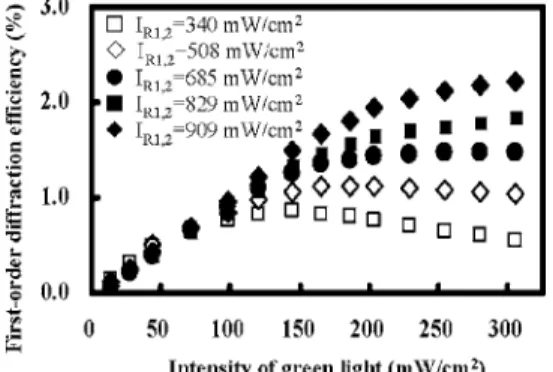
Figure5 plots the variation of the first-order diffraction efficiency1of the probe beam with the relative intensity of the green and red beams. Typically,1increases as IR1,2in- creases for a fixed IG. This experimental result is reasonable because, based on a previous discussion, as IG 共IR1,2兲 in-
creases, the texture in the dark 共bright兲 regions of ER typi- cally becomes homeotropiclike 共planarlike兲. Therefore, no matter IGor IR1,1 increases, the difference between textures and, thus, the effective refractive indices⌬neff“seen” by the probe beam in these two regions increases, thereby increas- ing 1. However, 1 falls rather than increasing as IG in- creases above 144 mW/ cm2 when IR1,2 equals the weakest intensity of 340 mW/ cm2; the red beams are too weak to suppress the strong green-beam-induced reorientation of the dyes and the LCs in the bright regions of ER, such that⌬neff
and, therefore,1 weaken.
In summary, this investigation develops optically switch- able BGs and analyzes the mechanisms through which grat- ings form on DDCLC cells. The gratings can be switched on 共off兲 by turning on 共off兲 the circularly polarized green beam, illuminated in a red interfering field created from two coher- ent linearly polarized red beams. The mechanisms of BG formation are green-beam-induced dye reorientation in the direction of the wave vector via trans-cis isomerization and the red-beam-induced suppression of dye reorientation via cis-trans back isomerization in the dark and bright fringes of the red interfering field. These mechanisms result in a spa- tially periodic distribution with homeotropiclike and planar- like textures, which in turn cause the BGs. The diffracted performance of BGs depends significantly on the relative intensity of the green and red beams.
The authors would like to thank the National Science Council of the Republic of China, Taiwan, for financially supporting this research under Contract No. NSC 95-2112- M-006-020-MY2.
1W. M. Gibbons, P. J. Shannon, S. Sun, and B. J. Swetlin, Nature共London兲 351, 49共1991兲.
2H.-K. Lee, A. Kanazawa, T. Shiono, T. Ikeda, T. Fujisawa, M. Aizawa, and B. Lee, Chem. Mater. 10, 1402共1998兲.
3M. Pei, Y.-J. Wang, and G. O. Carlisle, Opt. Eng.共Bellingham兲 40, 1481 共2001兲.
4U. Gubler, D. Wright, W. E. Moerner, and M. B. Klein, Opt. Lett. 27, 354 共2002兲.
5C.-R. Lee, T.-S. Mo, K.-T. Cheng, T.-L. Fu, and A. Y.-G. Fuh, Appl. Phys.
Lett. 83, 4285共2003兲, and references therein.
6M.-R. Lee, J.-R. Wang, C.-R. Lee, and A. Y.-G. Fuh, Appl. Phys. Lett. 85, 5822共2004兲.
7P. G. de Gennes and J. Prost, The Physics of Liquid Crystals共Oxford Science, New York, 1993兲, Chap. 6, p. 270.
8F. Simoni and O. Francescangeli, J. Phys.: Condens. Matter 11, R439 共1999兲.
9Y.-J. Wang, M. Pei, and G. O. Carlisle, Opt. Lett. 28, 840共2003兲.
FIG. 5. Variation of the first-order diffraction efficiency of a probe beam with relative intensity of green and red beams.
261103-3 Yeh et al. Appl. Phys. Lett. 90, 261103共2007兲
Downloaded 22 Oct 2009 to 140.116.208.44. Redistribution subject to AIP license or copyright; see http://apl.aip.org/apl/copyright.jsp