Research Express@NCKU - Articles Digest
Research Express@NCKU Volume 4 Issue 5 - May 16, 2008 [ http://research.ncku.edu.tw/re/articles/e/20080516/5.html ]
ZnO Nanowire Array/Nanoparticle Composite Dye-Sensitized Solar Cells
Jih-Jen Wu
*, Chen-Hao Ku, Guan-Ren Chen and Hung-Hsien Yang
Department of Chemical Engineering, National Cheng Kung University, Tainan, 701, Taiwan Email:[email protected]
Appl. Phys. Lett. 2007, 91, 093117.
Nanotechnology 2007, 18, 505706.
Crystal Growth & Design, 2008, 8, 283.
D
ye-sensitized solar cell (DSSC) is one of the most promising low- cost and high-efficiency solar cells. The DSSC is composed of a dye- sensitized and high-surface-area TiO2 nanoparticle (NP) electrode (with a typical thickness of ~10 μm) on a transparent conducting oxide (TCO) and a platinized counter electrode sandwiched together with an I-/I3- redox electrolyte solution, as shown in Figure 1. A light-to-current conversion efficiency of the DSSC more than 10% is achieved so far. It has been recognized that diffusion is the major mechanism for electron transport through the NP film. Multipletrapping/detrapping events occurring within grain boundaries result in a slow electron transport rate in the NP film. Electron diffusion through the NP film should be much faster than the electron
recombination with oxidized dyes on TiO2 surface or I3- in the electrolyte for achieving an efficient DSSC. The diffusion coefficient of an electron in the anatase TiO2 NP film is several orders of magnitude lower than that of single crystal anatase TiO2. A superior DSSC efficiency is thus anticipated by
replacing the NP film on TCO with a vertical single-crystalline-nanowire (NW) array for enhancing the electron transport rate. Owing to the unsuccessful development of the vertical TiO2 NW array on TCO, only ZnO-NW-array DSSCs have been demonstrated up to now. Transient photovoltage and
photocurrent response measurements have revealed that electron transport in the ZnO NW DSSC was about 2 orders of magnitude faster than that in the NP DSSC. However, the efficiencies (η ~1.5 %) of the ZnO-NW cells with a NW length as long as 18-24 μm are still inferior to those of TiO2-NP DSSCs. It is suggested that an increase in surface area of the NW cell for achieving higher dye adsorption may raise the efficiency to a competitive level. Therefore, a NW/NP composite photoanode, as shown in Figure 2, composed of a single-crystalline NW array directly formed on the TCO electrode and NPs grown within the interstices of the NW array for affording fast electron transport channels and enlarging dye
adsorption area, respectively, is anticipated to possess the potential of significantly enhancing the overall efficiency of the DSSC.
Figure 1 Schematic of a Dye-sensitized solar cell.
Figure 2 Schematic of a nanowire array/nanoparticel composite photoanode.
Instead of the deficient filling the interstices of the NW array with NPs by using physical mixing method, in this work, composite films composed of single-crystalline ZnO NW arrays and ZnO/Zn5
Research Express@NCKU - Articles Digest
(OH) 8 (CH3COO) 2•2H2O (layered basic zinc acetate, LBZA) NPs have been successfully synthesized for use in DSSCs, i.e., formation of the aligned ZnO NW array on TCO by aqueous chemical bath deposition (CBD) and then heterogeneous nucleation and growth of the ZnO/LBZA NPs among the ZnO NWs by another base-free CBD using 0.15 M methanolic solution of zinc acetate dihydrate at 60 ˚C for 18h.
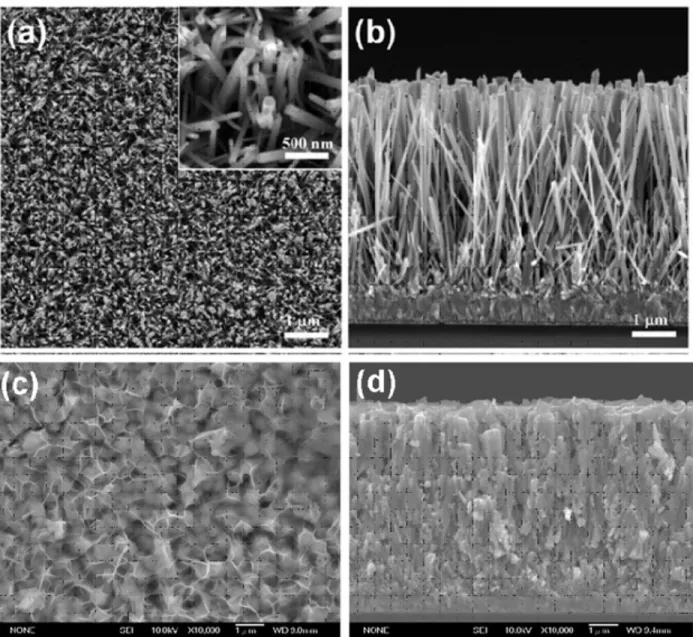
Figure 3 shows the top-view and cross-sectional SEM images of the aligned ZnO NWs and the NW-array/
NP composite film grown on the FTO substrates. As shown in Figures 3 (c) and (d), the interstices of the NWs were entirely occupied with NPs. Such configuration is not available for TiO2 materials up to now.
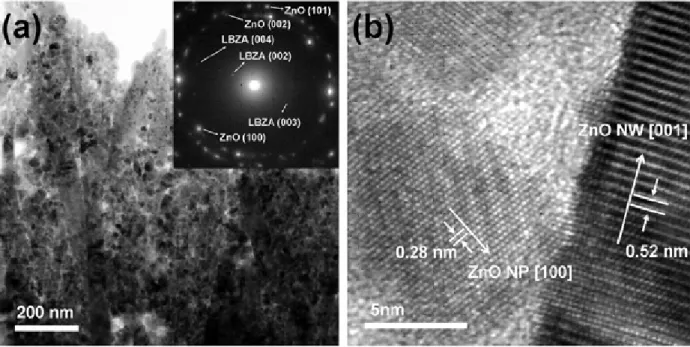
Figure 4 shows the TEM analyses of the NW-array/NP composite film. In Figure 4(a), a low-
magnification TEM image reveals that the interstices of the NWs were occupied by NPs with diameters in the range of 5-30 nm. The corresponding selective area electron diffraction (SAED) pattern indicates the formation of ZnO and LBZA NPs as shown in the inset. A high-resolution (HR) TEM image of the composite film at the interfacial region of the NW and NPs, shown in Figure 4(b), reveals there is no epitaxial relationship between NW and NPs.
Figure 3 The top-view and cross-sectional SEM images of the aligned ZnO NWs (a), b) and the NW- array/NP composite film (c), (d) grown on the FTO substrates.
Figure 4 (a) Typical low-magnification TEM image and the corresponding SAED pattern (inset) of NW array/NP composite. (b) Typical HR-TEM image at the interfacial regions of the NW and NPs.
It has been demonstrated that the performance of the ZnO-NP DSSCs decreases with increasing concentration of Ru complex dye on the surface of the photoandes since protons releasing from the dye molecules dissolve ZnO to generate aggregates and more abundant electron interfacial recombination occurs in the Ru complex dye-sensitized ZnO DSSC due to the higher surface trap density in the ZnO photoanode after such dye adsorption. On the other hand, mercurochrome (C20H8Br2HgNa2O) is one of the best photosensitizer for ZnO photoanode to date and is much cheaper than the Ru complex dyes.
Therefore, mercurochrome dyes were employed to be the sensitizer for the ZnO-based DSSCs here instead of using the Ru complex dyes which were designed for TiO2 DSSCs. The photocurrent density (J)-voltage (V) characteristics of the mercurochrome-sensitized ZnO NW array-LBZA/ZnO NP
composite DSSC (which is referred to as NW-array/NP composite in the following) in comparison with the ZnO NW cell are shown in Figure 5(a). With an anode thickness of 5.5±0.2 μm, the performances of both ZnO-based DSSCs under the AM-1.5 illumination at 100 mW/cm2 are summarized in Table I.
Obviously, the considerable enrichment of the short-circuit current density (Jsc) is attributed to the superior light harvesting characteristic of the ZnO-NW array/NP composite DSSC in which the larger surface areas of the composite anodes are provided for dye adsorption. In addition, the open-circuit voltage (Voc) and fill factor (F.F.) of the ZnO NW DSSC are also improved by growing NPs within the interstices of the ZnO NW array. Nevertheless, as shown in Figure 5(a) and listed in Table I, the performance of the mercurochrome-sensitized ZnO NW-array/NP composite DSSC is still inferior to that of the N719 (Ru complex dye)-sensitized TiO2-NP DSSC. We suggest that specially designed dye molecules with wider absorptive wavelength range, higher uptake on the ZnO surface and higher
quantum yields for electron injection to ZnO conduction band are needed to be developed for enhancing the performance of the ZnO NW-array/NP composite DSSCs further. The J-V characteristics of NW- array/NP composite DSSCs with different anode thicknesses and the effects of the anode thickness on the η, Jsc, Voc and FF of the NW-array/NP composite DSSCs are shown in Figure 5(b) and Figure 5(c), respectively. Figure 5(c) shows that η and Jsc possess a similar trend increasing with the anode
Research Express@NCKU - Articles Digest
thickness (η=2.38 %, Jsc=6.13 mAcm-2 for 4.6 μm anode and η=3.20 %, Jsc=9.06 mAcm-2 for 6.2 μm anode). A significant increase in Jsc of the cell with thicker anode is mainly ascribed to the enlargement of the surface area for dye adsorption. On the other hand, an increase in anode thickness would lead to increase series resistance of the cell and enrich the loss of injected photoelectrons due to increasing electron recombination, resulting in the decreases in both Voc and FF, as shown in Figure 5(c). Voc and FF decrease from 0.61 V and 0.64 to 0.58 V and 0.60 with increasing anode thickness from 4.6 to 6.2 μm, respectively.
Figure 5 (a) J–V curves of the mercurochrome-sensitized ZnO NW (I), mercurochrome-sensitized ZnO NW-array/NP composite (II) and N719-sensitized TiO2-NP (III) DSSCs. (b), (c) Performances of NW- array/NP composite DSSCs with different anode thicknesses.
Table I. Performances of the mercurochrome-sensitized ZnO NW (I), mercurochrome-sensitized ZnO NW-array/NP composite (II) and N719-sensitized TiO2-NP (III) DSSCs and the electron transport properties in their 5.5±0.2 μm thick photoanodes determined by impedance analysis.
To examine the contribution of the vertical NW array to the electron transport in the photoanode of the ZnO NW-array/NP composite DSSCs, charge-transport properties in the three types of the DSSCs shown in Table I are investigated using electrochemical impedance spectroscopy (EIS). EIS measurements were carried out under the illumination of AM-1.5 100 mW/cm2 by applying a 10 mV ac signal over the frequency range of 10-2 ~ 105 Hz on the top of Voc of the DSSC using a potentiostat with a frequency response analyzer. An equivalent circuit representing the DSSCs, as illustrated in Figure 6 (a), based on the diffusion-recombination model is employed for analyzing the electron transport properties in the DSSCs. The Nyquist plots of the impedance data of the three DSSCs obtained under the open-circuit condition are shown in Figure 6(b). The electron density (n) in the conduction band of the anode and the effective diffusion coefficient (Deff) of an electron in the photoanode of the three DSSCs determined by impedance analysis are listed in Table I as well. It reveals that electron density in the TiO2-NP anode is fivefold larger than that in the ZnO-NW array/NP composite anode, which results from the wider absorptive range of N719 for light harvesting and the higher quantum yield of electron injection to TiO2
in the N719-sensitized TiO2-NP DSSC. Table I also shows that the Deff of an electron in the ZnO-NW array/NP composite anode is lower than that in the ZnO NW anode while the overall efficiency of the NW/NP composite DSSC is superior to that of the ZnO-NW one. It indicates that multiple trapping/
detrapping events indeed occur within the grain boundaries during electron transport in the ZnO-NW array/NP composite anode. The efficiency enhancement of the ZnO-NW array/NP DSSC is ascribed to the enrichment of the light harvesting and the reduction of the electron back reaction on the TCO surface without significant sacrificing electron transport efficiency at the same time by synthesizing dense NPs among the ZnO NW array. Moreover, a threefold enhancement of the Deff of an electron in the ZnO-NW array/NP composite photoanode is achieved in comparison with the TiO2-NP one, as listed in Table I. It has been demonstrated that Deff increases as more electrons are present since the deep traps are filled and electron trapping/detrapping involves shallower levels. A lower electron density appearing in the mercurochrome-sensitized ZnO-NW array/NP composite compared to that of the N719-sensitized TiO2- NP photoanode, as listed in Table I, suggests that an even higher Deff of an electron in the ZnO-NW array/NP composite anode should be observed when the electron density is as high as that in the TiO2- NP anode. The superior Deff of an electron in the NW array/NP composite photoanode indicates that the ZnO NW array in the composite anode plays an important role in electron transport. The inferior
efficiency of the ZnO-NW array/NP composite cell in comparison with the TiO2-NP one is mainly limited to the issue of dye.
Figure 6 (a) The equivalent circuit model of the DSSCs. (b) Nyquist plots of the impedance data of the mercurochrome-sensitized ZnO NW (I), mercurochrome-sensitized ZnO NW-array/NP composite (II) and N719-sensitized TiO2-NP (III) DSSCs. The solid lines in (b) are the fitting results based on the model in (a).
In summary, synthesis of the ZnO NW array-LBZA/ZnO NP composite films with various extent of NP occupying for use in DSSCs has been achieved using a simple wet-chemical route. A considerable enhancement of the efficiency of the ZnO-NW array/NP composite DSSC in comparison with the ZnO- NW one is observed. Impedance analyses of the electron transport in the anodes reveal that the Deff of an electron in the ZnO-NW array/NP anode falls between those in the ZnO-NW and TiO2-NP anodes.
The superior performance of the ZnO-NW array/NP composite DSSC compared to that of the ZnO-NW cell is ascribed to the enrichment of the light harvesting and the reduction of the electron back reaction on the TCO surface without significant sacrificing electron transport efficiency at the same time by synthesizing dense NPs among the ZnO NW array.
Research Express@NCKU - Articles Digest