• 沒有找到結果。

Laser Machining for SOI Wafer

N/A
N/A
Protected

Academic year: 2021

Share "Laser Machining for SOI Wafer "

Copied!
32
0
0

加載中.... (立即查看全文)

全文

(1)

Chapter 4

Laser Machining for SOI Wafer

In this chapter, we present the fabrication and characterization of the rib waveguide by the use of continuous-wave (CW) Diode-Pumped Neodymium-doped Yttrium Aluminum Garnet (Nd:YAG) and diode-pumped solid-state (DPSS) Neodymium-doped yttrium orthovanadate (Nd:YVO

4

). As a result of the excellent guided-wave characteristics of UNIBOND SOI substrates have been exhibited in waveguide devices, we focus our fabrication of direct-writing technique on the SOI waveguide devices based on UNIBOND SOI wafers. This Chapter is organized as follows: Section 4-1 introduction of laser micromachining are described. In Section 4-2, fabrications of laser direct-writing technique are discussed. The experimental results of laser micromachining waveguides are presented in Section 4-3. Finally, we also give the summary and discussion in section 4-4.

58

(2)

4-1 Introduction of Laser Micromachining

Laser micromachining has become increasingly important in recent years.

It is a business sector with double digit annual growth rates. Laser application engineers are striving to improve quality, resolution, and reliability. Laser micromachining can be used for many fields, including micro-optics, micro-electronics, micro-biology, and micro-chemistry [71].

For the benefits of it allows the micromachining, non-contact nature and the surface patterning of materials with minimal mechanical and thermal deformation. Although the physical mechanisms of the modifications are still under investigation, this technique has been applied to fabricate for many applications. One of the more important requirements for micromachining is the high-precision controllability. The continuing improvement of laser parameters have significantly extended the capability of laser microtechnology, with such parameters as the machining speed, output power, wavelength, beam uniformity and stability, etc [72].They have to reduce process cost and cycle time and extend the range of materials. These advantages lie in its ability to deposit energy into a material in a very short time period. As a result, the heat-affected zone, where melting and solidification can occur, is

59

(3)

significantly reduced.

The most important laser parameters for industrial micromachining applications are pulse energy, spot size, laser wavelength, and pulse on demand operation [73]. Energy density is controlled by pulse energy and spot size. The focal spot size is the result of the chosen optical set up.

Micron-size diameters and small work distances are possible with high NA lens and short focal length. This approach is mostly combined with x-y- gantry systems or x-y-tables to move the parts with up to about several meters in a second. The pulse energy for example of short pulse laser, has to correspond to the spot size and match the 1 J/cm

2

threshold criterion; 10 μm diameters require about 1 μJ for micro-machining.

Such pulse energies, with some reserve for losses in the optical set up, and for harmonics generation should be produced by an industrial Pico-second laser with good beam quality, high pointing stability, high repetition rates and pulse-to-pulse stability over time and at environmental temperature.

With all the advantages of laser micromachining mentioned above, we will try to fabricate the rib Waveguide device through laser direct-writing.

60

(4)

Fabrication process and results will be discussed in the next section.

61

(5)

4-2 Fabrication Process of Direct-Writing Rib Waveguide Based on SOI

In this section, we present the fabrication of rib waveguide by using both of Nd:YAG laser and Nd:YVO

4

laser. Our Direct-writing rib Waveguide device is experimented in Metals Industry Research and Development Center (MIRDC) and Laser Micromachining and Optical Fiber Sensor Laboratory (LMM&OFS). As mentioned above, there are two different laser sources used to write waveguide. One type of laser sources used is Nd:YVO

4

laser which had been used in chapter 3. The other laser source is a CW Diode-Pumped Nd:YAG, with the following characteristics:

¾ Wavelength : 1064 nm

¾ CW output power : 35W

¾ Pulse frequency : 1-10kHz

¾ Minimum pulse duration<150ns

¾ Beam quality ( M²)<10

In this Chapter, we write the rib/ridge waveguide on SOI wafer by

62

(6)

percussion drill. The structure of SOI is silicon on a thin silica glass substrate. With this characteristic, we write two direct lines and etching ditches by a higher laser energy. After writing two lines several micrometers apart from each other, we will have a rectangular rib waveguide. As Fig. 4.2 shows, we can design rectangular waveguide with different drill depths. We can design three surfaces in the air and the bottom layer is thin silica glass substrate, or various rib high waveguide.

When comparing the laser direct-writing technique with the waveguide device to the semiconductor process, the waveguide device doesn't need too many run cards but rather requires a couple of simple steps and a couple of minutes to be able to get it completed

Besides, both Nd:YVO

4

laser and Nd:YAG laser are used in the fabrication. As Fig. 4.3 shows, 4 cases had been tested in this experiment.

In the first case, we write nine waveguides on SOI by Nd:YVO

4

laser. We fabricated straight waveguides by laser direct-writing. We varied the distances of ditches near the waveguides to get different widths. Second, we wrote ten waveguides with different widths on SOI by Nd:YVO

4

laser, each of those ditches near the waveguides had been written five times. In these two cases, the average power of Nd:YVO

4

laser we used is 10W.

63

(7)

The laser writing speed is 5 mm/s with shoot density of 1000 Pulses/mm.

The material we used is SOI wafer with a thickness of 0.7 mm. In the third and fourth cases, we tested different writing powers to write several waveguides on SOI by using the Nd:YAG laser. We also try to write bending waveguides. All different kinds of long-pulse lasers and short-pulse lasers micromachining result will be analyzed in section 4-4.

64

(8)

4-3 Results of Direct-Writing Rib Waveguide Based on SOI

In this experiment, we write the rib/ridge waveguide on SOI wafer by using a percussion drill. Both Nd:YVO

4

laser and Nd:YAG laser are used in the fabrication. The results of the different kinds of the long pulse laser (Nd:YAG, >1-nanosecond) and short pulse laser (Nd:YVO

4

, <1- nanosecond) micromachining will be analyzed and discussed in this section respectively.

4-3-1 Analysis of the Writing Waveguides on SOI by Nd:YVO 4 Laser

As shown in Fig. 4.2, we write waveguides on SOI by Nd:YVO

4

laser and Nd:YAG laser. Here we discuss the waveguides fabricated by Nd:YVO

4

laser. In the first case of the experiment, we write nine waveguides on SOI. Second, we write ten waveguides on SOI, each of those ditches near waveguides have been written five times. The laser writing speed is 5 mm/s with a shoot density of 1000 Pulses/mm.

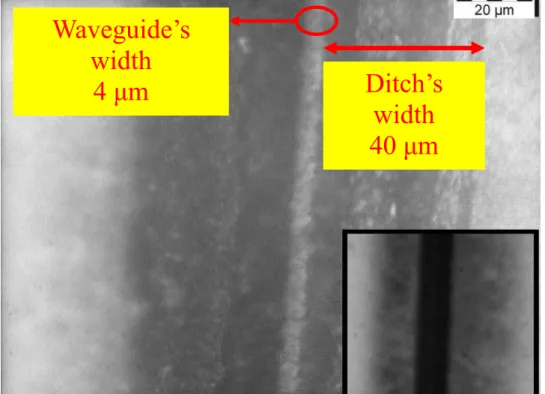
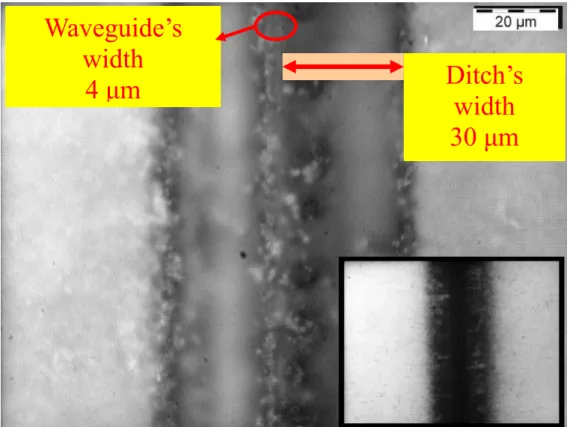
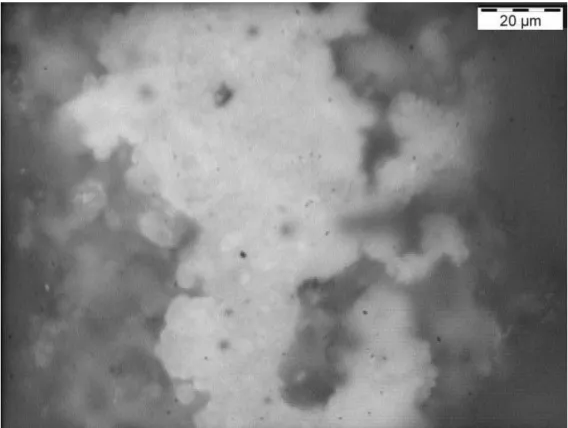
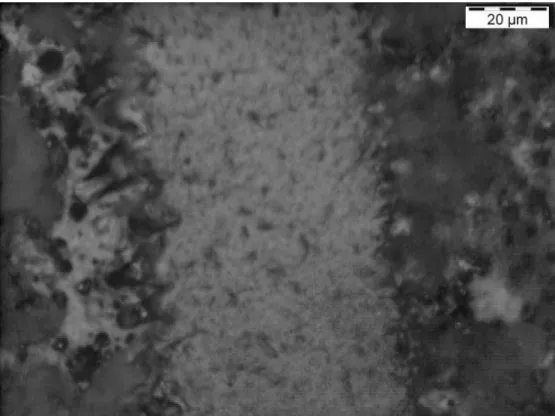
In the first case of the experiment as Fig. 4.4 to Fig. 4.5 shows, we can see the width of the ditches that have been drilled by laser pulses which is about 40 μm. We have written serial waveguides with different widths

65

(9)

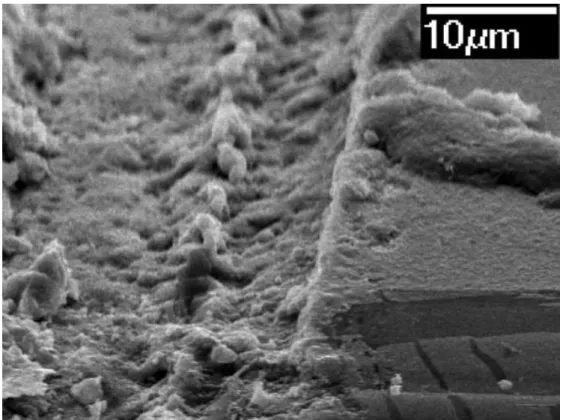
and depths. From the OM pictures, we can find the sidewall of waveguides have similar roughness. And from Fig. 4.6 to Fig. 4.8, we can see that minimum value of sidewall’s roughness width which is less than 1μm and the maximum is about 2μm. These laser pulses shoot result from thermal cooling after ablation has taken place, as the material cools and contracts, it concentrates the strains around the hole. Laser ablation refers to removing material through the use of a continuous wave laser beam if the laser intensity is high enough. Surface debris and recast layer can be seen clearly in those pictures. But the curve lines of the sidewall’s roughness looks like regular patterns in this case of the experiment. Fig.

4.8 shows two ditches with widths of 15 μm and deepens with the writing depth. While Fig. 4.7 shows a shallow ditch.

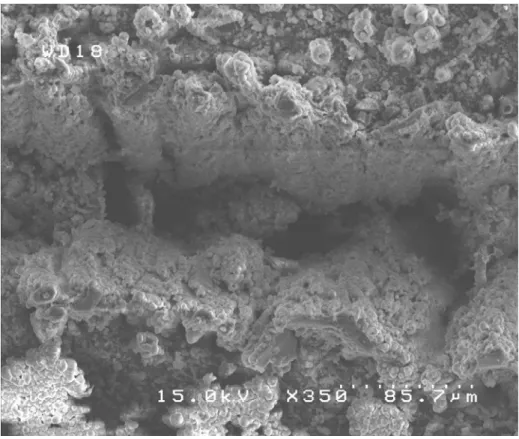
In the second case of the experiment, we can see the pictures which go out of focus as seen in Fig. 4.9 to Fig. 4.10. The reason why the pictures go out of focus is that the surface piled with large debris. Repeat the machining five times which resulted in serious laser ablation, which also caused large debris to pile up on the wafer surface. We can see the fabrication results more clearly in the SEM pictures in Fig. 4.11 and Fig.

4.12. To compare the performance of the waveguide sidewall’s roughness,

66

(10)

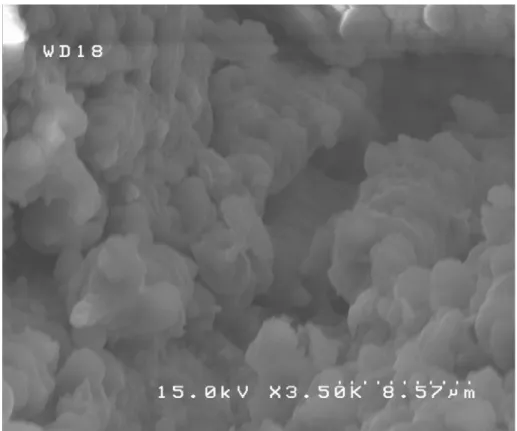
waveguide which written five times is not as good as the waveguide written once. From Fig. 4.12, we can see the top view of a ditch. The sidewall of the waveguide is recast to the strain of the thermal contraction after being processed. We can see the bottom of the ditch in Fig. 4.13.

High power laser melted down the debris and the thermal contraction joined them into a granular structure.

4-3-2 Analysis of the Writing Waveguides on SOI by Nd:YAG Laser

After the study of writing waveguides on SOI by Nd:YVO

4

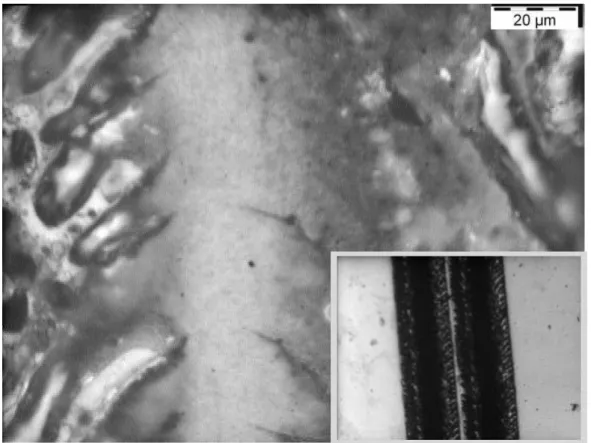
laser, Waveguides which are fabricated based on SOI by Nd:YAG laser will be discussed here. At first, we test different writing powers from 60% to 90% of 35W with 5 kHz and the writing speed is 2 mm/s. As Fig. 4.3 shows, we wrote five straight waveguides by Nd:YAG laser, with the power of 70%, 80% and 90%. Fig. 4.14, Fig. 4.16 and Fig. 4.17 shows the top view of waveguides which are at writing speed 2 mm/s and with the power of 70%, 80% and 90% respectively. From these three pictures, we may infer that the writing using power at 70% is better than 80% and 90%. Fig. 4.15 shows the top view of a ditch which is drilled by Nd:YAG

67

(11)

laser. Large sized granular debris fills the bottom of the ditch.

Second, we wrote another five straight waveguides, with 60%, 63%, 66%, 69% and 72% of power 35W, shown in Fig. 4.18 to Fig. 4.22. As the writing power decreased, we change the frequency to 8 kHz and fabricate it two times. Those pictures show that the laser machining waveguide boundary is not as good as shown in Fig. 4.14. The waveguide that was fabricated with powers of 60% and 63% are smoother than others on this chip. With this result, we try to write bending waveguides with the power of 60% and 63%.

As Fig. 4.23 shows, we magnify the waveguide through a microscope with different object lens (5X, 20X and 40X); there are two straight ditches that go vertically up to down and make a 15 degree angle to the left. Therefore, there is one waveguide with 15 degree reflection. Fig.

4.23 to Fig. 4.27 shows that waveguide with 15, 30, 45, 60 and 75 degree angle respectively. The optical microscope figure shows that the laser machining surface is quite good. The waveguide has a well defined boundary. However, there are some defects in the turning angle because of the X-Y working table and laser scanning limitations.

We have also checked two ports of the waveguide within the 60 degree

68

(12)

reflection as Fig. 4.28 shows. It is important to compare the sidewall’s roughness with the result of the laser machining with the straight waveguide and the waveguide has 60 degree angle to the left. We find that in those two parts of waveguide sidewall’s roughness are quite different. The different lattice structure is the important factor that causes this result.

From Fig. 4.29 to Fig. 4.34, we try again the triangular waveguide with a power of 63%. There is some defect in the turning angle on the left side of the waveguide as shown in Fig. 4.29. The X-Y working table and laser scanning limitations made the left side of the waveguide corner to be written twice. The sidewall of the waveguide had been recast and the roughness became rougher as seen clearly in the pictures. The last two pictures show the different parts of two waveguides. The optical microscope figure shows that the sidewall’s roughness of the waveguide is quite good after turning it to a 75 degree angle.

69

(13)

4-4 Discussion and Summary

In this chapter, we present the fabrication of rib waveguide based on SOI by the laser direct-writing technique. Both the Nd:YAG laser and Nd:YVO

4

laser have been tried in the experiment. Besides, different writing powers and different writing times have been tested. We have also written waveguides with different degrees of reflections.

From the results of the first experiment, we can find the waveguide’s sidewall is smooth and the surface is clear. The waveguide’s sidewall roughness is less then 2 μm. If we put the regular roughness (r) which we had mentioned in Chapter 2 into calculation. The radius of pulse is 7.5 μm and the laser writing speed is 5 mm/s. We can get the regular roughness r=1.9 μm. The result of the experiment roughness and the ideal roughness quite match.

When comparing the short-pulses laser direct-writing technique with the waveguide device to the long-pulse laser, the short-pulses laser doesn't need too much power but rather requires a 10W to be able to get a complete ditch. The sidewall of the waveguide has a well defined boundary and the width of the ditch can be shorten to less then ten

70

(14)

micrometers. Not like a long-pulse laser which caused a serious consequence to the debris, the short-pulses laser machining have a clear waveguide surface.

By comparing the sidewall’s roughness of the laser machining with the straight waveguide where the waveguide has a 75 degree angle to the left.

We find that the sidewall’s roughness is quite different in those two parts of the waveguide. From the straight waveguide before turning, the sidewall’s roughness is about 4μm. After a 60 degree angle to the left, the sidewall’s roughness is reduced to less then 1μm. If we turn 75 degree angle to the left, we will find that the sidewall’s roughness will reduce to hundredths of a nanometer. The different lattice structure is the important factor to cause this result.

71

(15)

Fig. 4.1 Schematic of the Nd:YAG laser equipment.

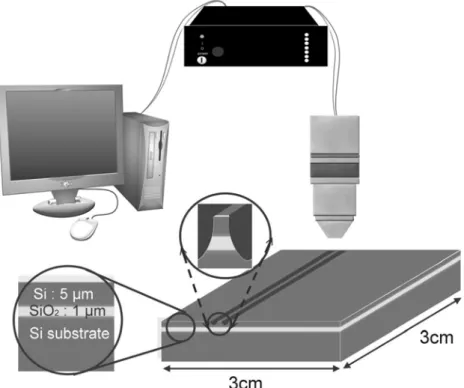
Fig. 4.2 Experimental set-up to perform “laser writing” onto SOI wafers.

72

(16)

(a) (b)

(c) (d)

Fig. 4.3 Top view of the waveguide fabricated by using Nd:YVO

4

laser (a,b) and Nd:YAG laser (c,d) writing on SOI.

Ditch’s width 40 μm Waveguide’s

width 4 μm

Fig. 4.4 Optical microscope photograph of waveguide fabricated by using Nd:YVO

4

laser writing on SOI. The waveguide’s width of 4 μm.

73

(17)

Waveguide’s width 18 μm

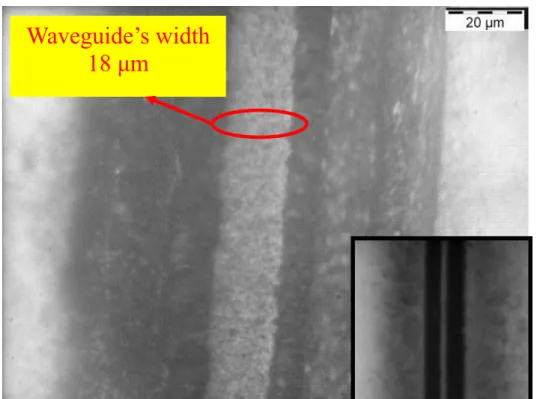
Fig. 4.5 Optical microscope photograph of waveguide fabricated by using Nd:YVO

4

laser writing on SOI. The waveguide has a width of 18 μm.

Fig. 4.6 Scanning electron microscope (SEM) image of the damaged structures created by Nd:YVO

4

laser writing on SOI wafer.

74

(18)

Fig. 4.7 SEM image of the waveguide fabricated by using Nd:YVO

4

laser writing shallow ditch on SOI.

Fig. 4.8 SEM image of the waveguide with 15 μm width and deepens with the writing depth.

75

(19)

Ditch’s width 30 μm Waveguide’s

width 4 μm

Fig. 4.9 Image of waveguide fabricated by using Nd:YVO

4

laser writing 5 times on SOI. The waveguide is width of 4 μm.

Waveguide’s width 15 μm

Fig. 4.10 Image of the waveguide fabricated by using Nd:YVO

4

laser writing 5 times on SOI. The waveguide’s width of 15 μm.

76

(20)

Fig. 4.11 SEM images of the damage structures of two waveguides created on SOI wafer.

Fig. 4.12. Top view of ditch which was drilled by using Nd:YVO

4

laser.

77

(21)

Fig. 4.13 Bottom of ditch which was drilled by using Nd:YVO

4

laser.

Fig. 4.14 Optical microscope photograph of waveguide fabricated by using Nd:YAG laser writing on SOI, with writing power of 70% to 35W.

78

(22)

Fig. 4.15 Top view of ditch which was drilled by using Nd:YAG laser.

Fig. 4.16 Optical microscope photograph of waveguide fabricated by using Nd:YAG laser writing in SOI, with writing power of 80% to 35W.

79

(23)

Fig. 4.17 Optical microscope photograph of waveguide fabricated by using Nd:YAG laser writing in SOI, with writing power of 90% to 35W.

Fig. 4.18 Optical microscope photograph of waveguide fabricated by using Nd:YAG laser writing in SOI, with writing power of 60% to 35W.

80

(24)

Fig. 4.19 Optical microscope photograph of waveguide fabricated by using Nd:YAG laser writing in SOI, with writing power of 63% to 35W.

Fig. 4.20 Optical microscope photograph of waveguide fabricated by using Nd:YAG laser writing in SOI, with writing power of 66% to 35W.

81

(25)

Fig. 4.21 Optical microscope photograph of waveguide fabricated by using Nd:YAG laser writing in SOI, with writing power of 69% to 35W.

Fig. 4.22 Optical microscope photograph of waveguide fabricated by using Nd:YAG laser writing in SOI, with writing power of 72% to 35W.

82

(26)

Fig. 4.23 Images of waveguide fabricated by using Nd:YAG laser writing in SOI, with writing power of 60% to 35W. We magnify the waveguide by using a microscope with different object lens (5X, 20X and 40X);

there are two straight ditches vertically up to down and make a 15 degree angle to the left.

Fig. 4.24 Images of waveguide fabricated by using Nd:YAG laser writing in SOI, with writing power of 60% to 35W. The waveguide make a 30 degree angle to the left.

83

(27)

Fig. 4.25 Images of waveguide fabricated by using Nd:YAG laser writing in SOI, with writing power of 60% to 35W. The waveguide make a 45 degree angle to the left.

Fig. 4.26 Images of waveguide fabricated by using Nd:YAG laser writing in SOI, with writing power of 60% to 35W. The waveguide make a 60 degree angle to the left.

84

(28)

Fig. 4.27 Images of waveguide fabricated by using Nd:YAG laser writing in SOI, with writing power of 60% to 35W. The waveguide make a 75 degree angle to the left.

Fig. 4.28 Images of waveguide make a 60 degree angle to the left; we magnify the waveguide by microscope with different object lens (5X and 40X). Two parts of the waveguide sidewall’s roughness are quite different.

85

(29)

Fig. 4.29 Images of waveguide fabricated by using Nd:YAG laser writing in SOI, with writing power of 63% to 35W. The waveguide make a 15 degree angle to the left.

Fig. 4.30 Images of waveguide fabricated by using Nd:YAG laser writing in SOI, with writing power of 63% to 35W. The waveguide make a 30 degree angle to the left.

86

(30)

Fig. 4.31 Images of waveguide fabricated by using Nd:YAG laser writing in SOI, with writing power of 63% to 35W. The waveguide make a 45

degree angle to the left.

Fig. 4.32 Images of waveguide fabricated by using Nd:YAG laser writing in SOI, with writing power of 63% to 35W. The waveguide make a 60 degree angle to the left.

87

(31)

Fig. 4.33 Images of waveguide fabricated by using Nd:YAG laser writing in SOI, with writing power of 63% to 35W. The waveguide make a 75 degree angle to the left.

Fig. 4.34 Images of waveguide make a 60 degree angle to the left; we magnify the waveguide by microscope with different object lens (5X and 40X). Two parts of waveguide sidewall’s roughness are still quite different.

88

(32)

Fig. 4.35 Images of waveguide make a 75 degree angle to the left. We magnify the waveguide by microscope with different object lens (5X and 40X).

89

數據

Fig. 4.2 Experimental set-up to perform “laser writing” onto SOI wafers.
Fig. 4.4 Optical microscope photograph of waveguide fabricated by using  Nd:YVO 4  laser writing on SOI
Fig. 4.5 Optical microscope photograph of waveguide fabricated by using  Nd:YVO 4  laser writing on SOI
Fig. 4.7 SEM image of the waveguide fabricated by using Nd:YVO 4  laser  writing shallow ditch on SOI
+7

參考文獻

相關文件

In x 2 we describe a top-down construction approach for which prototype charge- qubit devices have been successfully fabricated (Dzurak et al. Array sites are de­ ned by

For ASTROD-GW arm length of 260 Gm (1.73 AU) the weak-light phase locking requirement is for 100 fW laser light to lock with an onboard laser oscillator. • Weak-light phase

Please liaise with the officer in your school who are responsible for the Class and Subject Details Survey for using of the same class names in both the Class and Subject

● tracking students' progress in the use of thinking routines and in the development of their writing ability using a variety.. of formative assessment tools

 Create and present information and ideas for the purpose of sharing and exchanging by using information from different sources, in view of the needs of the audience. 

 Create and present information and ideas for the purpose of sharing and exchanging by using information from different sources, in view of the needs of the audience. 

n Receiver Report: used to send reception statistics from those participants that receive but do not send them... The RTP Control

In accordance with the analysis of relevant experimental results carried in this research, it proves that the writing mechanism and its functions may improve the learning