Correlation between outward diffusion of additives and oxidation
of Cu
„3.9 at. % Ti… and Cu„2.3 at. % Ta… thin films
C. J. Liu and J. S. Chena兲
Department of Materials Science and Engineering, National Cheng Kung University Tainan 701, Taiwan 共Received 7 June 2005; accepted 6 January 2006; published online 8 February 2006兲
Thin films of pure Cu and Cu alloys 共with 3.9 at. % Ti or 2.3 at. % Ta兲 are deposited on SiO2/ Si substrates by magnetron sputtering. Upon annealing at 700 ° C in vacuum for 30 min, Ti in the Cu共3.9 at. % Ti兲 films will mostly diffuse to the free surface, but the majority of Ta in the Cu共2.3 at. % Ta兲 film remains within the Cu layer. The outward diffusion of Ti or Ta strongly influences the oxidation of Cu in air. The degree of Cu oxidation was determined by glancing incident angle x-ray diffraction and the normalized sheet resistance. Oxidation test shows that the Cu共3.9 at. % Ti兲 films exhibit a superior oxidation resistance when oxidized at 200 °C in air, especially for the Cu共3.9 at. % Ti兲 film which has been preannealed at 700 °C in vacuum. But the Cu共2.3 at. % Ta兲 film with the same preannealing treatment only slightly improves the oxidation resistance, in comparison with the pure Cu film. The correlation between outward diffusion of additives and oxidation of Cu in the Cu共3.9 at. % Ti兲 and Cu共2.3 at. % Ta兲 thin films is discussed. © 2006 American Institute of Physics.关DOI:10.1063/1.2170410兴
The development of the modern integrated circuit needs to follow the current trend of improving speed and power consumptions. Therefore, reduction of both resistance-capacitance共RC兲 delay and current density is becoming in-creasingly important as there is a continuous downscaling in device dimensions. The high electromigration and low resis-tivity of copper共⬃1.7⍀ cm for bulk兲 make it an attractive candidate.1,2
However, there are some drawbacks to use Cu as the material of interconnect. One of these is the fact that oxida-tion of Cu is not self-passivating. This deficiency makes Cu susceptible to oxidation during deposition and annealing,3 and the formation of oxide would degrade the electrical property of Cu.4Therefore, oxidation of Cu must be inhib-ited during processing and use. To avoid this problem, a capping layer is used to prevent the Cu from oxidizing. Nev-ertheless, this additional layer may complicate the processes. Thus, a scheme to circumvent this problem is to alloy Cu with additives.5–8
It is well known that the additives in Cu will spontane-ously dissociate as it has limited solid solubility in Cu. In view of material science, the additives may precipitate and diffuse to the free surface.9 As a result, the degree of Cu oxidation should be strongly related to the degree of outward diffusion of additives. However, most of works investigating the oxidation resistance of Cu alloy films do not compare the outward diffusion of additives with the oxidation of Cu. In this study, we explore the outward diffusion of Ti and Ta from Cu共Ti兲 and Cu共Ta兲 films, and find out its correlation with oxidation resistance of Cu.
Two alloying elements with limited solid solubility of Cu investigated here are Ti and Ta. Besides, pure Cu films were used as controls. Phosphorus-doped n-type silicon 共100兲 wafers and oxidized silicon 共270 nm, thermally grown
in dry oxygen at 1050 ° C兲 were used as substrates. Pure Cu and dilute Cu共Ti兲 and Cu共Ta兲 alloy films were deposited onto the substrates by magnetron sputtering. The Cu alloy films were prepared by cosputtering in Ar gas and at a negative substrate bias of 150 V. The base pressure and working pres-sure of the deposition system were 2.5⫻10−6Torr and 4 mTorr with a turbomolecular pump. In order to improve their uniformity, the Cu alloy films were deposited with ro-tation. The contents of additives in Cu alloy films investi-gated in this work were determined by an electron probe microanalyzer共EPMA兲 共JEOL 8900R兲. The compositions of these Cu alloy films were 3.9 at.% Ti for Cu共Ti兲 关referred to as Cu共3.9 at. % Ti兲兴 and 2.3 at. % Ta for Cu共Ta兲 关referred to as Cu共2.3 at. % Ta兲兴, respectively. The thicknesses of pure Cu and Cu alloy films were measured by profilometer 共TEN-COR␣step兲. These were 180 and 150 nm, respectively. Fol-lowing deposition, all samples were annealed in vacuum at a pressure of 2⫻10−5Torr. The annealing temperature was 700 ° C for the duration of 30 min. To investigate the oxida-tion property of Cu, samples were also annealed at 200 ° C in air for a duration ranging from 5 to 15 min.
After deposition and annealing, the dissociation of Cu alloy films was examined using Auger electron spectroscopy 共AES兲 共VG AES-310D兲. For the oxidation test, characteristic phases in the samples were identified by glancing incident angle X-ray diffraction 共GIAXRD兲 共Rigaku DMAX 2500兲 with Cu K␣radiation at an incident angle of 2°. Besides, the normalized sheet resistance of the oxidized samples was cal-culated from the sheet resistance measured with a four-point probe.
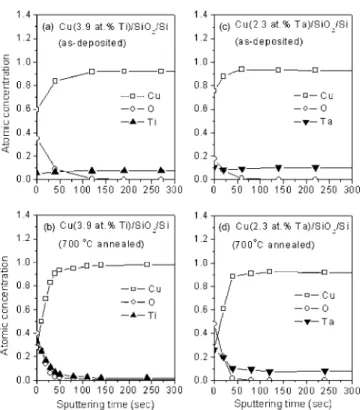
Figure 1 presents the AES compositional depth profiles of Cu共3.9 at. % Ti兲/SiO2/具Si典 and Cu共2.3 at. % Ta兲/SiO2/ 具Si典 samples, as deposited and after annealing at 700 °C in vacuum. Without using any standard sample, the atomic con-centration presented here is only semiquantitative but not absolute. From Fig. 1, one can see that both Ti and Ta in Cu a兲Electronic mail: [email protected]
JOURNAL OF APPLIED PHYSICS 99, 036104共2006兲
0021-8979/2006/99共3兲/036104/3/$23.00 99, 036104-1 © 2006 American Institute of Physics
would be uniformly distributed over the Cu layer in the as-deposited state. However, accumulation of Ti and Ta on the free surface 共sputtering time=0–50 s兲 is observed in the spectra of both Cu共3.9 at. % Ti兲/SiO2/具Si典 and Cu共2.3 at. % Ta兲/SiO2/具Si典 samples after annealing at 700 ° C. This result indicates that the Ti and Ta in Cu would diffuse outwardly to the free surface upon annealing at 700 ° C.
In view of thermodynamics, Ti and Ta have low solid solubility in Cu共Ref. 10兲 and are more reactive with O2than Cu at 700 ° C.11Therefore, during annealing at 700 ° C, su-persaturated Ti and Ta would leave the Cu lattices and dif-fuse to the free surface to react with residual O2 in the vacuum furnace. Meanwhile, this phenomenon of segrega-tion would reduce the overall free energy. Nevertheless, compared to the 700 ° C annealed Cu共3.9 at. % Ti兲 sample 关Fig. 1共b兲兴, a considerable amount of Ta atoms of 700 °C annealed Cu共2.3 at. % Ta兲 sample still remain within the Cu layer关Fig. 1共d兲兴. This result indicates that the degree of out-ward diffusion of Ta to the free surface is much less than that of Ti ones. It can be understood from kinetic standpoints. Kinetically, Ta atoms cannot move easily to the surface as compared to Ti atoms, because the atomic mass of Ta is significantly larger than that of Ti.12 As a consequence, Ta will not migrate to the free surface as much as Ti does.
To understand if the accumulated Ti and Ta on the free surface will have an effect on the suppression of Cu oxida-tion, the oxidation resistance of Cu alloy samples after oxi-dizing was examined using sheet resistance and GIAXRD. Both Cu共3.9 at. % Ti兲 and Cu共2.3 at. % Ta兲 samples were divided into two groups: 共i兲 one of them was directly
an-nealed at 200 ° C for 5 – 15 min in air;共ii兲 another was pre-annealed at 700 ° C for 30 min in a vacuum furnace prior to annealing at 200 ° C for 5 – 15 min in air. The purpose of preannealing in vacuum is to have Ti and Ta segregate to the free surface. And after this treatment, we investigate whether these accumulated additives could prevent Cu from oxidizing under the oxidation test. Samples with preannealing at 700 ° C in vacuum before oxidation are referred to as prean-nealed samples hereafter, while those received oxidation di-rectly are named as-deposited samples. For the purpose of comparison, pure Cu samples also underwent the oxidation test. Figure 2 shows the normalized sheet resistance of all as-deposited and preannealed films before and after oxidiz-ing at 200 ° C in air for 5 – 15 min. The normalized sheet resistance of the film is given by
⌬RS/RS0=共RSf− RS0兲/RS0, 共1兲
where RS0and Rsf are the initial共before oxidation test兲 and final共after oxidation test兲 values of sheet resistance, respec-tively. On examining Fig. 2, it is clear that the normalized sheet resistance of all films increases significantly after the oxidation test except for the preannealed Cu共3.9 at. % Ti兲 films. In addition, all “preannealed” films exhibit a less in-crease of normalized sheet resistance as compared to their corresponding “as-deposited” ones upon oxidizing, and the normalized sheet resistance of all Cu alloy films, either as-deposited or preannealed, is lower than that of pure Cu films, especially for the as-deposited and preannealed Cu共3.9 at. % Ti兲 films.
It is clear that the oxidation resistance should be related to the degree of outward diffusion of additives on the free surface. As a result, Cu alloy films perform a better resis-tance to oxidation than pure Cu. For the as-deposited Cu alloy films, the oxidation temperature共200 °C in air兲 and the duration共5–15 min兲 are not high/long enough to induce suf-ficient segregation of additives on the surface, resulting in lower degree of oxidation resistance, compared to that of the preannealed Cu alloy films. The accumulated additives on
FIG. 1. AES compositional depth profiles of 共a兲 as-deposited
Cu共3.9 at. % Ti兲/SiO2/具Si典, 共b兲 700 °C annealed Cu共3.9 at. % Ti兲/SiO2/ 具Si典, 共c兲 as-deposited Cu共2.3 at. % Ta兲/SiO2/具Si典, and 共d兲 700 °C annealed Cu共2.3 at. % Ta兲/SiO2/具Si典 samples.
FIG. 2. Normalized sheet resistance values as a function of oxidation time at 200 ° C in air for the as-deposited and preannealed films.
036104-2 C. J. Liu and J. S. Chen J. Appl. Phys. 99, 036104共2006兲
the free surface should be in form of metal oxides共TiOxor TaOx兲, as examined by x-ray photoelectron spectroscopy re-ported in our previous study.13,14This oxide layer passivates the film surface and consequently retards the oxidation of Cu. Finally, the superior oxidation resistance of the prean-nealed Cu共3.9 at. % Ti兲 film should be attributed to the sig-nificant segregation of additives, which can act as a capping layer to suppress the oxidation of Cu.
In addition, whether the metal oxides form a continuous layer on the surface is critical to the oxidation of Cu. From our previous Rutherford backscattering spectrometry result,13,14 we realize that the Cu signal in the spectra of 700 ° C annealed Cu共3.9 at. % Ti兲 sample is shifted slightly to lower energies, but that of 700 ° C annealed Cu共2.3 at. % Ta兲 sample is not. Hence, the oxidation resis-tance of preannealed Cu共3.9 at. % Ti兲 film is superior be-cause it has formed a continuous layer on the surface, while the Cu共Ta兲 film with preannealing treatment has not.
Figure 3 shows the GIAXRD patterns of as-deposited and preannealed samples, after oxidizing at 200 ° C in air for 15 min. Before the oxidation test, XRD patterns of all samples show Cu diffraction peaks only 共not shown兲. After the oxidation test, additional Cu2O diffraction peaks are ob-served in all patterns expect for the that of the preannealed Cu共3.9 at. % Ti兲 sample 共Fig. 3兲. In addition, the intensity of Cu2O peaks for preannealed Cu共2.3 at. % Ta兲 alloy samples is still lower than that for pure Cu samples. The result of the GIAXRD agrees perfectly with that of the normalized sheet resistance 共Fig. 2兲 and should be related to the degree of outward diffusion of additives to the free surface.
In conclusion, outward diffusion of Ti and Ta to the free surface of Cu共Ti兲 and Cu共Ta兲 films, respectively, will affect their oxidation resistance upon annealing in air. The Cu共3.9 at. % Ti兲 sample after preannealing at 700 °C in vacuum shows the best oxidation resistance. This result can be attributed to its substantial out diffusion and accumulation of Ti on the free surface. By contrast, the same preannealing treatment only slightly improves the oxidation resistance of Cu共2.3 at. % Ta兲 film due to the lower degree of accumu-lated Ta on the surface. However, both Cu共3.9 at. % Ti兲 and Cu共2.3 at. % Ta兲 alloy films, with or without preannealing, perform a better resistance to oxidation than the pure Cu film does. Therefore, alloying Cu with elements which are kineti-cally mobile and thermodynamikineti-cally reactive with oxygen, such as Ti, will improve the oxidation resistance of Cu ap-preciably.
The authors gratefully acknowledge the financial support from the National Science Council of Taiwan, R.O.C.共Grant No. NSC-94-2623-7-006-020-AT兲.
1M. T. Bohr and Y. A. El-Mansy, IEEE Trans. Electron Devices ED-45, 620共1998兲.
2S. P. Murarka, Mater. Sci. Eng., R. 19, 87共1997兲.
3J. Li, G. Vizkelethy, P. Revesz, J. W. Mayer, and K. N. Tu, J. Appl. Phys. 69, 1020共1991兲.
4H. K. Liou, J. S. Huang, and K. N. Tu, J. Appl. Phys. 77, 5443共1995兲. 5W. Lee et al., J. Electrochem. Soc. 147, 3066共2000兲.
6P. I. Wang, S. P. Murarka, D. A. Kaminski, S. Bedell, and W. A. Lanford, J. Electrochem. Soc. 148, G481共2001兲.
7P. J. Ding, W. A. Lanford, S. Hymes, and S. P. Murarka, J. Appl. Phys. 75, 3627共1994兲.
8D. Adams, T. L. Alford, N. D. Theodore, S. W. Russell, R. L. Spreitzer, and J. W. Mayer, Thin Solid Films 262, 199共1995兲.
9K. Barmak, A. Gungor, C. Cabral, Jr., and J. M. E. Harper, J. Appl. Phys. 94, 1605共2003兲.
10Binary Phase Diagrams, 2nd ed., edited by T. B. Massalski, J. L. Murray, L. H. Bennett, and H. Baker共ASM International, Ohio, 1990兲, pp. 1485 and 1494.
11I. Barin, Thermochemical Data of Pure Substances, 3rd ed.共VCH, New York, 1995兲, pp. 620, 1606, and 1692.
12C. Kittel, Introduction to Solid State Physics, 7th ed.共Wiley, New York, 1996兲, p. 78.
13C. J. Liu, J. S. Jeng, and J. S. Chen, J. Vac. Sci. Technol. B 20, 2361 共2002兲.
14C. J. Liu, J. S. Chen, and Y. K. Lin, J. Electrochem. Soc. 151, G18共2004兲. FIG. 3. GIAXRD patterns of Cu/ SiO2/具Si典, Cu共3.9 at. % Ti兲/SiO2/具Si典
and Cu共2.3 at. % Ta兲/SiO2/具Si典 samples after oxidizing in air at 200 °C for 15 min.共a兲 as-deposited and 共b兲 pre-annealed films.
036104-3 C. J. Liu and J. S. Chen J. Appl. Phys. 99, 036104共2006兲