Development of A Small-ScaleOfficeGridComputing System For Electromagnetic Optimization Designs
Ming-Iu Lai (1) and Shyh-Kang Jeng (2) (1) Graduate Institute of CommunicationEngineering,
NationalTaiwanUniversity,Taiwan,R.O.C. milai 1
102(,yahoo.com.tw
(2)GraduateInstituteof CommunicationEngineering and Departmentof ElectronicEngineering, NationalTaiwanUniversity,Taiwan,R.O.C.
skiengF(aew.ee.ntu.edu.tw
A Small-Scale Office Grid Computing System forelectromagnetic optimization designs is presented in this paper. This system is to collect the unused computational powertogether andtoutilize upto 90%of computerresources in the office. The scale of the proposed system is set to connect up to 100 computational resources which istypical in an officeenvironment. TCP/IP and winsock programmingtechniques are usedtoconstructthenetworking between the job control manager and computational workers. Based on the proposed computing system, a multi-band printed monopole antenna designisdemonstrated inthis paper. The numericalelectromagnetic technique usedtosolve theexample istheFDTDmethod and the optimizationisbasedonthe genetic algorithms.
Introduction
In practical electromagnetic design, it is common to simulate the electrical performance using various numerical electromagnetic techniques such as the FiniteElementMethod (FEM) and theFinite-Difference Time-Domain (FDTD) method.Inordertoobtainabetterdesign, itisusualtoapplyvariousoptimization techniques to search for the potential solution. However, with a considerable number ofdesign parameterstobeoptimized, it'sfrequently necessarytosolve EM problem hundreds of times until the solution converges [1]. Because numericalEM solutions areoften computationally intensive, the use ofnumerical solutions during the optimization process on a single computer is almost impossible. Onewaytoperform these intensive tasksis tobuildasupercomputer. Nevertheless, this approach is very expensive. Amuchcheaperalternative isto usedistributed computing.
In atypical office andlaboratory environment, more and more computers appear, butthe vastmajority of the machines are usedmostlyforwordprocessing, web browsing, files downloading, etc. TheCPU time is oftenwasteddoing nothing. Thisimplies thatmorethan90%ofcomputing resourcesareunused.Distributed computing technique istoutilize thesparecomputing power of every available computer,and to workby splitting up thelarger task into smaller chunks, which canbeperformedat thesametimeindependently of each other.Inthis way, the
0-7803-8883-6/05/$20.00©2005IEEE
computing power of thousands of computers can be salvaged and combined together to solve a singleproblem. Distributed computing roughly falls into two categories,Cluster and Grid Computing. Cluster Computing, or so called PC. Clusters, is alocal computing system comprisingasetofindependent computers usually residingin a single room andadedicated networkinterconnecting tightly the computers. Grid Computing focuses on ensembles of geographically distributed heterogeneous resources used as a platform for high performance computing. The computers need not be in the same room. Clusters and Grids [2] have beensuccessfully applied inlife sciences, aerospace, CAD/CAM, military applications, and so on. Tosolvelarge electromagneticoptimization problems,we need a computing systemenabling us to easily access the computational resources in an office environment and is seamlessly compatible with various in-house numerical electromagnetic programs andoptimization schemes.
Inthis paper, the concept is to develop a Small-Scale Office Grid Computing System for electromagnetic optimization designs using C++ Object-Oriented Programming, TCP/IP and winsock programmingtechniques. Differing from the well-known distributedcomputing systems, the scale of the proposed system is set to connect up to 100 computational resources which is typical in an office environment. As an example, amulti-band printed monopoleantenna design is demonstrated. TheGeneticAlgorithms (GAs)and the FDTD method are used for the design.
Small-ScaleOffice Grid Computing System
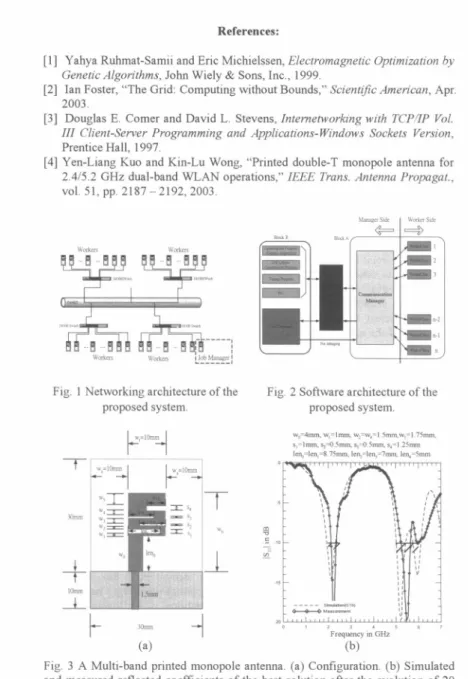
Figure 1 illustratesabasicnetworking architectureinofficesorlaboratories. The two main entities in the computing system are one manager and many computational workers. The manager generates job packages, which are passed onto computational workers. From the view of optimization, a job is an independent electromagnetic problem, and the job package defines which numerical programtobe usedtosolve this EMproblem, which filestobepassed to aworker andreturned to manager side, and so on. The workers will perform the task in the job package, and when it is finished, the calculated results will be passed back to the manager. The networktopology is a star one. Because the amountof data exchange between the manager andaworkerisjustseveraltensof kilobytes, the communication time doesnotdominate thecomputing time in this systemwhen the number of workers increases. Figure 2 displays the software architecture, where each box is implemented byaclass. Block Aconsisting of two classes, CommunicationAManager and WorkerClass, is a client-server communication program constructed by TCP/IP and winsock programming techniques [3].Thelogin information ofaworkercontains thename,IPaddress, memory space,computing capability,etc.Accordingto theinformation, it is easy for the managerto know the computing limitation ofeach worker. The class JobManager manages the submittedjob packages. BlockBiscomposed of many classes designed according to different optimization schemes and various
applications. The jobpackages aregenerated by these classes in this block and thensubmitted to the class JobManager for computing.
Whenreceiving ajob package from the managerside, the worker will create a thread with priority lower than normalto executethejob. Theuseof the lower priority isfor the sake of makingsurethat thejob doesnotinterrupt localuser's works. While the job isrunning,the class WorkerClass will periodically respond to the class CommunicationManager the series number of the governing job package. By means of this simple message, the manager iscapable of identifying thejob status. The job-synchronization problem depends on the optimization algorithm used, and isnotdiscussed here for the limitation of spaces.
Design Example
Basedontheproposed computing system,amulti-band printed monopoleantenna design is demonstrated here. Printed monopoleantennas areeasytobeintegrated ontheprinted circuit board (PCB), offering many features such as the small size and the lowfabrication cost [4]. To satisfy the IEEE 802.11 a/b/g standards, multi-band antennas are highly desired. The proposed system associated with FDTD andGAistoautomatically designa multi-bandmonopoleantennawith reflected coefficient lower than -10 dB within 2.0-2.5 and 5.0-6.0GHz. The configuration of the antenna is shown in Fig. 3(a), and the design parameters are
leno,
len1, len2,len3, len4,wawI,
W2,W3, W4, W5,SI,
S2, S3, and S4. The antenna is designedon an FR4 substrate with thicknessh=0.8mm and relative dielectric constant r= 4.2. The FDTD solution is solved inacubic regionof dimension(N.,
N,,
N, )=(151,151,34) grid points. The grids chosen are Ax=Ay=Az=0.25mm and the total number of time steps is3000. OneFDTD solution takes about40minutesatthe bestcomputational worker(withaPentium 4CPU) and about2hoursattheworst one (witha Pentium3 CPU). After the evolutionof20generations, the simulated and measured reflected coefficients of the best solution are shown in Fig 3(b). The number of population for each generation is 20, and the evaluation count is about 280. The number of computational workers is between 5 and 11, and the computing time is about 38hours.Conclusions
Based on C++, TCP/IP, and winsock programming techniques, a Small-Scale Office Grid Computing System forelectromagnetic optimization designs has been proposed. This systemcancollecttheunusedcomputational power togetherand utilize upto 90%of computer resources in the office. Based onthe proposed computing system,amulti-bandmonopoleantennadesign has been demonstrated in thispaper. Thisexample reveals that this system is efficient. The extension of this system to deal with general electromagnetic optimization is also under development.
References:
[1] Yahya Ruhmat-Samii and EricMichielssen, Electromagnetic Optimization by GeneticAlgorithms,JohnWiely&Sons, Inc., 1999.
[2] IanFoster, "The Grid:Computing without Bounds," Scientific American, Apr. 2003.
[3] DouglasE. Comerand David L. Stevens,Internetworking with TCP/IP Vol. I11 Client-Server Programming andApplications-Windows Sockets Version, PrenticeHall,1997.
[4]Yen-LiangKuoandKin-Lu Wong,"Printed double-T monopole antenna for 2.4/5.2GHzdual-bandWLANoperations," IEEETrans.Antenna Propagat., vol.51, pp.2187-2192, 2003.
Wokr
"1
W(ki W
Cr!i
CB-~~~---'-Fig. INetworking architectureof the proposed system.
F-
(a)Fig.2Softwarearchitecture of the proposed system.
-I-,ms=-O5mm s= 5 4-,l25mm len=len,=8 75mm, len,=n7mm len,=m
O5
FrequencymGHz
(b)
Fig. 3AMulti-band printed monopole antenna. (a) Configuration. (b) Simulated and measuredreflectedcoefficientsofthe best solutionafter the evolution of 20 generations. 294 W.,k-U__11 li"