
任務型導向教學對於台灣大專院校學生英語口語表現之效益
147
0
0
全文
(2) The Effects of Task-based Instruction on English Speaking of EFL College Students in Taiwan. Advisor: Dr. Shwu-Mei Hwang By Chien-Lin Liu. A Thesis Submitted to the Graduate Program of Applied English In Partial Fulfillment of the Requirements For the Degree of Master of Arts National Pingtung Institute of Commerce. Pingting, Taiwan, R.O.C. July, 2014.
(3) 摘要 台灣大專院校學生普遍對於英語口說表達感到困難,因他們對於英文口說沒有抱 持正面的動機且沒有足夠的能力表達出來。為了要改善大專院校學生的口說學習動機 及表現,本研究採取任務型導向教學,旨在探討其對於英語口說的成效。四十八位參 與者來自台灣南部一所大學參與此研究,其中一班為實驗組 ( 24 人),以任務型導向 教學方式進行,另一組為對照組 ( 24 人),以傳統教學法 (PPP) 進行口語訓練。本研 究為期四個月,實驗工具包括英文口說測驗、問卷及訪談,資料分析方式分為量化及 質化。研究結果分別呈現如下: 首先,問卷結果發現,實驗組所有題目的平均分數都比對照組高。因此任務型導 向教學對於大專院校學生在英語口說學習的動機有正面效果。第二,本研究比較實驗 組及對照組對於英文口說表現,研究發現雖然兩組之間在英文口說測驗的口語正確 度、流暢度、複雜度及句子表達長度表現之間未呈現顯著性不同,但是實驗組的成績 在口語測驗表現上大多比起對照組來的高,對照組的成績只有在朗讀句子與短文部分 的口語正確度上比實驗組還高。第三,訪談中學生就任務型導向教學及傳統教學課 程,表達其對於英語口語學習之優缺點。根據本研究的結果,提供教學及研究建議給 國內英文教學老師及專家作為參考。. 關鍵字: 任務型導向教學、口語表現、語言焦慮、動機. i.
(4) Abstract In Taiwan, EFL college students generally have difficulties in speaking English. They generally did not have motivation and competence in English speaking. To improve their speaking motivation and performance, task-based instruction was adopted in this study. The current research was attempted to explore the effects of task-based instruction on English speaking of college students in Taiwan. Participants were 48 students from a college in southern Taiwan. All of them were divided into an experimental group (n = 24) which practiced English speaking under task-based instruction and a control group (n = 24) which practiced English speaking under traditional instruction (PPP). The study lasted four months. The instruments included English speaking performance tests, questionnaires and semi-structured interviews. Both qualitative and quantitative data were analyzed. Results were presented as follows: First, the results of questionnaires found that all items in the experimental group were higher than the control group, which revealed task-based instruction strongly improved college students‟ motivation in speaking English than traditional instruction. Second, although there were no significant differences in terms of English speaking accuracy, fluency, complexity and sentence length performance between the two groups in repeating, reading aloud and answering questions, results showed the mean scores of most three parts of post-speaking test in the experimental group were higher than those in the control group.. ii.
(5) By contrast, the mean scores of reading aloud in regard to accuracy performance in the control group were slightly higher than those in the experimental group. Thirdly, from interviews, students revealed their opinions about strengths and weaknesses in the two kinds of instruction. Based on the present results, pedagogical implications and suggestions are provided.. Keywords: task-based instruction, English speaking performance, language anxiety, motivation. iii.
(6) Acknowledgements “Yes, I can!” I did it! I am very grateful to many people who have helped and contributed to this thesis. Without their support, inspiration, encouragement, my thesis would have never been possible. Firstly, I would like to express my sincere gratitude to my advisor, Dr. Shwu-Mei Hwang. She serves not only as a great consultant to assist me but also a good companion to inspire me. Without her persistent guidance, patience, assistance, this thesis would be impossible. Next, I would like to express deepest appreciation to my committee members, Dr. Hsiu-Hsiu Yang and Dr. Yi-Chun Pan for their professional comments, suggestions, and careful reviewing to improve my thesis. Further, I would like to thank my research participants in this study. Without their participation, I would not have completed my study. I also would like to express gratitude to instructors: Dr. Chun-Mei Shieh, Dr. Shu-Fen Liao, Dr. Mei-Chen Chen, Dr. Shih-Chung Lin, and Dr. Feng-Hung Tsai for their guidance in graduate school. Besides, thanks as well to the National Pingtung Institute of Commerce and the Department of Applied English, for offering the best location and equipment. Further, I would like to thank the department assistant, Iris Lee for, for her assistant and encouragement. In addition, I am also grateful to my classmates and friends who always company. iv.
(7) with me. Especially, I express my deepest gratitude to people who helped my check me thesis: Jonathan Charbonneau, Kevin Huang, Laura Liu and Vivienne. I am very thankful for my schoolmates: Kevin Huang, Shelby, Lin, and Vivienne Chien for their kind assistance and encouragement. I would like to thank my classmates: Carolyn Huang, Jessica Lee, Josie Chin, Kiwi Kuo, and Penny Lin for accompanying and encouraging me. I also express my gratitude to college friends: Amber Wu, Anita Wang, Fiona Lin, Gavin Huang, Java Huang, Laura Liu, Mei-Hung Shiu, Ricky Chen, Robert Chuang, Yuan-Ru Huang and so on and college instructors: Chris Hung, Gloria Lo, Kevin Wu, Larry Chen, and so on for their inspiration, encouragement and assistance during the processes. Special thanks also go to many people from the Bliss and Wisdom Foundation. With their kind assistance and spiritual support, I would have completed my thesis. Especially, I am indebted to Dr. Chio-Fang Chio who is a professor from Department of Real Estate Management, National Pingtung Institute of Commerce for giving me great assistance, encouragement and inspiration. Hence, many thanks are also due to Master Jih-Chang (Tibetan name: Tanzen Jamchen) who is the founder of bliss and wisdom foundation. With your inspiration, I would have great confidence to complete my thesis. Finally, heartfelt appreciation also goes out to my beloved family: dad, mom, younger brothers, grandmothers, uncles, and aunts for their infinite support and endless love. With their encouragement and support, I would have completed my thesis.. v.
(8) Table of Contents Abstract (Chinese)……………………………………………..…………………………….i Abstract (English)……..…………..………………………..………………………...….....ii Acknowledgements...……..…………………………………..…………………………....iv Table of Contents…………………………………………...………………………….......vi Tables.……………………………………………………..…………………………….....xi Figures.…………...………………………………………..……………………………....xii CHAPTER 1………………………………………………………………….……………..1 Introduction……………………………………………………………………………1 Background of the Study……………………………………....…………………1 Statement of the Problem…………………………………..……..……..…….....6 Purpose of the Study……………………………………………………………...7 Research Questions …………………………………………..………..………...7 Significance of the Study ……………………………………..………………....8 Definition of Terms ……………………….……………..….…...………………8 CHAPTER 2……………………………………………………………………………….10 Literature Review……………………………………………………………..…….10 Motivation and Anxiety in Relation to English Speaking…………….…………10 Anxiety in Relation to English Speaking…………….………….…………11. vi.
(9) Motivation in Relation to English Speaking………………..…..…………13 Task-based Instruction in Relation to Language Learning…………...……….18 The Relationship between Task-based Instruction and English Speaking.20 The Effects of Task-based Instruction on English Speaking Performance...21 Accuracy………...…………………………………………………....21 Fluency……......……...………………………...………………….…23 Complexity…………..………………………....………………….….24 Sentence Length………….……………………….…………………...25 Strengths and Weaknesses of Task-based Instruction in English Speaking….27 Advantages of Task-based Instruction in English Speaking………....27 Disadvantages of Task-based Instruction in English Speaking…..…28 Summary………………...………………………………….……..…….……..30 CHAPTER 3……………………………………………………………..……………….33 Methodology………………………………………………………………….……33 Research Design………………………………………….……………………..33 Participants……………………………………………….……………..…..35 Instruments……………………………………………….…………………35 English Speaking Performance Tests…………….……………..............35 Questionnaires………………………………..……….....……………...36. vii.
(10) Validity………………….……………………………....................37 Reliability………………….……………………...….....................38 Semi-Structured interviews……………….………………...................38 Sitting Arrangement and Role Allocation in the Experimental Group..…..39 Procedures...……………………...……………………..………….......….39 Before the Experiment……………………………..…………............40 During the Experiment………………………………..………..…….41 After the Experiment……………………………..…………..............45 Data Analyses……………………………..………….....……..…………..46 CHAPTER 4..………………………………………...……………………………………48 Results and Discussions…………………………...…………………………………48 Results of Research Question One……………….………………………..……48 Discussions...………………...……………………………...……………..55 Results of Research Question Two……..…….…………...…………………….57 Discussions……...…………...……………………………...……………..61 Results of Research Question Three...……...…………………………………..65 Discussions…...……………………………………………...….................71 CHAPTER 5………………………………………………………………..……………...75 Conclusions ………..…………….……………………………………………………75. viii.
(11) Summary of the Findings……………………………………………….……75 Pedagogical Implications…………………………………………………….77 Limitations of the Study…..……………………………...............…..............79 Suggestions for Future Studies….…………………...……………………….80 English References...………………………….………………………….………………..81 Chinese References…..……………………….………………………….……………..…90 Appendix A: The Rating Scale of the English Speaking Fluency Performance….....….....92 Appendix B: The Rating Scale of the English Speaking Accuracy Performance..………..93 Appendix C: The Rating Scale of the English Speaking Complexity Performance………94 Appendix D: Results of Pre-English Speaking Test in the Experimental Group……..……....95 Appendix E: Results of Pre-English Speaking Test in the Control Group…………….…..96 Appendix F: Results of Post-English Speaking Test in the Experimental Group………..…...97 Appendix G: Results of Post-English Speaking Test in the Control Group…………….....98 Appendix H: Pre-Questionnaire (Chinese) …………….……………………..……….......99 Appendix I: Post-Questionnaire (Chinese) ……………...…………………………….....103 Appendix J: Pre-Questionnaire (English) ………….….…………………………............107 Appendix K: Post-Questionnaire (English) …………….…………………………..........111 Appendix L: Interview Questions (Chinese and English) …………….…………………115 Appendix M: The Task Types Used in the Experimental Group………………………....116 Appendix N: Task in Unit One: Introduce Yourself……………………………………...118 Appendix O: Task in Unit Two: My Ideal Husband or Wife……………………………..119 ix.
(12) Appendix P: Task in Unit Three: Fashion Survey……………………………………….120 Appendix Q: Task in Unit Four: Asking for Directions………………………………….121 Appendix R: Task in Unit Five: What is Your Idea Job? ………………………………..122 Appendix S: Task in Unit Six Food and Drink Survey…………………………………..123 Appendix T: Task in Unit Seven: Introduce Weather…………………………………….124 Appendix U: Task in Unit Eight: Find the Differences…………………………………..125 Appendix V: Task in Unit Nine: Let‟s Make A Date! ……………………………………126 Appendix W: Task in Unit Ten: Market Taiwanese Snack……………………………….127 Appendix X: Task in Unit Eleven: Fruits and Vegetable…………………………………128 Appendix Y: Task in Unit Twelve: Plans for Chinese New Year ………..………………129 Appendix Z: The Overall Results of Questionnaires in both Instructions……………….130. x.
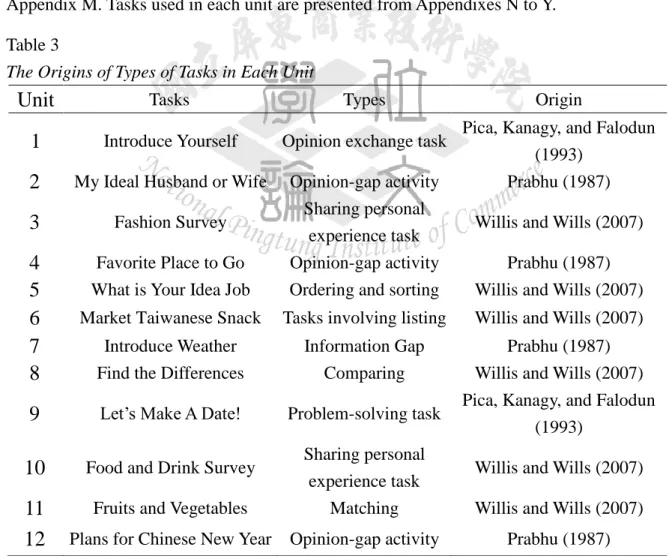
(13) Tables Table 1 Results of Levene‟s Test in the Experimental and Control Groups…...……..........40 Table 2 The Origins of Materials of Twelve Units in Both Instructions……………………..41 Table 3 The Origins of Types of Tasks in Each Unit…..............................................……..43 Table 4 The Allocations of English Speaking Teaching Time between the Two Groups…44 Table 5 Major Data Collection Events……………………..….…………………....……..45 Table 6 Comparison of Post-Questionnaire between the Two Groups………………….…49 Table 7 Significant Differences on Pre- and Post-Questionnaires in the Experimental Group........................................................................................................................52 Table 8 Significant Differences on Pre- and Post-Questionnaires in the Control Group….54 Table 9 Comparisons of English Speaking Performance between the Two Groups…...….58 Table 10 Comparisons of Pre- and Post-English Speaking Performance in the Experimental Group…………………...…………………………………………………………....59 Table 11 Comparisons of Pre- and Post-English Speaking Performance in the Control Group……………..………………………………………………………………....60. xi.
(14) Figures Figure 1 The Flowchart of the Research Design…………………….…………………...34. xii.
(15) CHAPTER 1 Introduction Background of the Study English is an international language which is applied to communication in all major fields around the world today (Chang, 2007; Nunan, 2003), and there is no exception in Taiwan. There are four main skills in English including listening, speaking, reading and writing. Specially, speaking skill is regarded as the essential one for language learners to communicate in the education, economics, tourism, and business fields. More specifically, interlocutors express their ideas, opinions, or consult with others to communicate by speaking (Dwan, 2003). Furthermore, based on a survey released by the Educational Testing Service in 2012, 95.9 percent of Taiwan‟s top 1,000 companies indicated English communication ability is the first priority skill for employees (Chang, 2012; Hsieh, 2013). This research further indicated English communication ability is the extent that people use language to speak English. Obviously, people should be equipped with English communication ability in the working place and know how to use English well in Taiwan. Since speaking ability is one of the essential elements of communication (Tseng, 2006), and English speaking performance is a critical ability to assure good competition in the future, how to promote learners in oral communication well is one of the essential tasks for English teachers (Lin, Lin, & Fu, 2011). Nevertheless, due to the washback effect. 1.
(16) (Bailey, 1996; Hughes, 2003), English teachers do not spend sufficient time improving students‟ speaking performance in class. When it comes to entrance examinations such as the Basic Academic Competence Test or Matriculation Academic Administration in Taiwan, speaking performance is apparently neglected. Hence, Taiwanese students generally lack speaking practice in the target language in English classroom. Since they do not have enough time to practice English speaking, they tend to be afraid of speaking English. Horwitz, Horwittz, and Cope (1986) indicated anxiety is a major obstacle which needs to be overcome in learning to speak another language. It is especially true to Taiwanese college students. In this study, most of them graduated from vocational high school. Nevertheless, vocational high school students are considered low achievers in English compared to high school students in Taiwan (Chang, 2006). Chang (2007) indicated that these students lacked motivation in learning English due to poor English academic performance since junior high school. Furthermore, there are only two or three English classes in vocational high school; by contrast, in normal high school, there are seven to nine classes in a week (Yu, 2006; Wu, 2003). With insufficient English class, vocational high school EFL teachers just focus on catching up with the schedule, so they do not have enough time to train students‟ English speaking skills. In Taiwan, the Technological and Vocational Education Joint College Entrance Examination is the major test for these students studying at college. Yet, the format of the English test merely constructs on the. 2.
(17) reading skill. In addition, to improve students‟ English ability, more and more colleges set English graduation requirements (Huang, 2010). The majority of English proficiency tests (such as GEPT) required test-takers to speak. When they take English proficiency tests, most of them can pass the first stage in listening and reading but not the second stage in speaking and writing (Chow, 2007). Since students have insufficient English courses to train the English speaking skill when studying at vocational high school, it is not surprising that they do not have satisfactory performance in language output (writing and speaking). According to the 2009 score data summary for GEPT elementary level of the six educational levels (junior high school, general high school, vocational high school, junior college, university of technology and university or above), college students have worse English speaking performance than junior high school students (the language training and testing center, 2009). Because of poor English speaking ability, most of them feel anxious when pressured to speak English in class or test (Chuang, 2010a). Since English speaking has been regarded as an essential professional skill, it is important to equip students with adequate language skills (Chiu et al., 2010). Task-based instruction is generally advocated to improve students‟ English speaking performance. The research of the instruction in the field of language learning and teaching has been explored over the past three decades (Ellis, 2003; Long, 1985; Nunan, 2004; Prabu, 1987; Willis, 1996). It is one of the suitable approaches to create a natural learning. 3.
(18) context to achieve the three essential conditions for learners to learn to exposure to the target language, to use the target language for real communication, and to motivate learners to engage in the learning process (Willis, 1996). In addition, task-based instruction is one of the mainly efficient approaches to teach a language by engaging learners in real situation (Willis & Willis, 2007). In practice, tasks are the essential elements in task-based instruction. They are types of communicative activities that are employed in the classroom to develop learners‟ communicative language ability (Bygate, 2012). Generally speaking, English teachers adopted a traditional teaching style at traditional instruction like PPP (presentation, practice, production). Learners seldom have enough opportunities to work with their peers to use meaningful language in traditional instruction. Willis (1996) mentioned the PPP lesson is to teach learners the specific language forms, grammatical structures or realizations of a particular function or notion. The main feature of the lesson is a teacher-centered instruction. Teachers control learners‟ language during the course; therefore, learners are asked to produce the language that teachers teach without using meaning language in instruction (Wills & Willis, 2007). Besides, learners often are asked to memorize new vocabulary words and grammatical rules of the new language in this instruction (Buyukkarci, 2009). Thus, learners spend most time doing drills. Even when students have opportunity in practicing speaking skills, they often do unnatural conversation rather than genuine communication (Willis, 1996). Different from traditional. 4.
(19) instruction, task-based instruction involved many groups or pair work which provides learners with opportunities to use the language, particularly the spoken language (Willis & Willis, 2007). Learners not only can cultivate their communicational ability but also know how to deliver language relating to the real world. Therefore, learners can develop their ability to utilize the language they learned from school to do effective communication with other people outside the classroom (Willis & Wills, 2009). Recently, several literature has been published on task-based instruction and these studies demonstrated that task-based instruction have positive effects on learners‟ English speaking performance (Chen, 2009; Chen & Yang, 2009; Chuang, 2010b; Kuo, 2006; Wang, 2010). In the process of completing tasks, learners usually engage in pair or group work, so they have many chances to practice English with their peers. The peer interaction in the classroom is a common and significant component of the learning process that influences the permanent learning habit of learners (Chen, 2011). When learners work to complete tasks, they have more opportunities to interact with peers (Larsen-Freeman, 2000). The processes of language use from doing task-based activities reflect situations that occur in the real-world communications (Ellis, 2003). Quite a number of studies indicated task-based instruction benefited on promoting learners‟ learning motivation (Chen, 2009; Chen & Yang, 2009; Chuang, 2010b; Wang, 2010). Hence, in order to provide a solution to enhance students‟ English speaking performance, task-based. 5.
(20) instruction can be an alternative. Moreover, it is hoped that students‟ English speaking motivation can be enhanced. Statement of the Problem Task-based instruction is an essential teaching approach to improve learners‟ English speaking performance. This instruction not only could decrease language anxiety but also increase learning motivation in English speaking. However, English teachers tend to adopt traditional teaching methods to teach student, especially college students. In such methods, the teachers‟ duty is to assure students learn the new vocabulary and language forms; the focus is on the language itself rather than the information or the process used by language learners (Chuang, 2010b). Furthermore, the format of the English test in Taiwanese entrance examination constructs on reading performance, speaking performance is apparently neglected. With insufficient ability in English speaking performance, college students tend to be afraid of and lack self-confidence in speaking English, and they do not have motivation or competence in English speaking when studying at college. Besides, since students will get into the working field once they graduate, the demand of communication ability is important. The training of speaking skills to students is especially important.. 6.
(21) Purpose of the Study In order to enhance college students‟ English speaking performance, task-based instruction was adopted. The main purpose of the study was to explore the effects of task-based instruction on English speaking performance among college students. This study first explored the extent that task-based instruction improved English speaking anxiety and motivation among college students. Second, the present study examined the extent task-based instruction has on English speaking performance among college students. Third, this study further explored students‟ opinions toward the strengths and weaknesses of task-based instruction and traditional instruction in terms of English speaking. Research Questions To address the issues already outlined and to provide another insight to the previous research, the present study is designed to examine the following research questions: 1. To what extent does task-based instruction make a difference in English speaking anxiety and motivation among college students? 2. To what extent does task-based instruction make a difference in English speaking performance among college students? 3. What are the strengths and weaknesses of task-based instruction and traditional instruction in terms of English speaking?. 7.
(22) Significance of the Study First, it is hoped that this study will contribute to English teachers to understand the effects of task-based instruction on English speaking performance. Second, this study is done with the hope to decrease anxiety and enhance college students‟ motivation in English speaking through task-based instruction. Third, due to unsatisfactory English speaking performance, college students lack confidence and feel anxious in speaking English. Results of this study could be useful to students in improving their English speaking performance. It may provide an alternative solution to the problem of students‟ poor performance to enhance their English speaking performance. Definition of Terms The English Speaking Performance Test The English speaking proficiency test is based on the speaking performance on the Elementary level of General English Proficiency Test (GEPT) which is a commonly used standardize test in Taiwan. The Elementary level of GEPT test consists of three parts, including repeating, reading aloud and answering questions. Language Anxiety Horwitz, Horwitz, and Cope (1986) defined language anxiety as “a distinct complex of self-perceptions, beliefs, feelings, and behaviors related to classroom language learning arising from the uniqueness of the language learning process” (p. 128).. 8.
(23) Motivation According to the definition from Longman Dictionary of Language Teaching and Applied Linguistics, motivation is regarded as “The factors that determine a person desire to do something” (p. 298). Dornyei (1994) stated motivation can be divided into intrinsic and extrinsic motivation. According to the definition from Dornyei, extrinsically motivated behaviors are learners‟ individual performance to receive some extrinsic reward (such as good grades) or avoid punishment and intrinsically motivated behaviors‟ rewards are internal (such as the enjoyment of participating particular activity or satisfying one‟s curiosity).. 9.
(24) CHAPTER 2 Literature Review The purpose of study was to explore the effects of task-based instruction on English speaking of college students in Taiwan. This chapter presents literature related to task-based instruction in terms of English speaking learning. The first section begins with presenting anxiety and motivation in relation to English speaking including the roles of anxiety and motivation they play in English speaking. The second section explores literature of task-based instruction in relation to language learning, including the relationship between task-based instruction and English speaking and its effects on English speaking performance. The third section reviews the strengths and weaknesses of task-based instruction in English speaking learning including the advantages and disadvantages of adopting task-based instruction in English speaking learning. Finally, the summary of literature review is presented. Anxiety and Motivation in Relation to English Speaking The main barrier that learners need to overcome in English speaking is their anxiety which is an important factor in the process of English oral communication (Brown, 2007a; Lin, 2012). In addition, to increase the interest and to stimulate learners‟ motivation in English speaking learning also challenge for language teachers (Oura, 2003). In this section, anxiety and motivation in relation to English speaking learning are explored.. 10.
(25) Anxiety in Relation to English Speaking Foreign language anxiety is an essential factor that affects learners‟ language performance which seems more evidently revealed in output (speaking and writing) than input language abilities (Chiu, et al., 2010). Horwitz, Horwittz, and Cope (1986) defined anxiety as a major obstacle which needs to be overcome in learning to speak another language which is a distinct complex of self-perceptions, beliefs, feelings, and behaviors related to classroom language learning arising from the uniqueness of the language learning process. Speaking anxiety would lead language learners to feel nervous of expressing erroneous, stupid and incomprehensible information to others (Brown, 2007a). Therefore, once people feel anxious about communicating with others, they have difficulty speaking in public and listening to spoken messages (Liu & Zheng, 2013). Language learners need to overcome psychological constraints before speaking English (Malihah, 2010). Taiwanese college students also encountered such English speaking anxiety. Chuang (2010a) conducted a study to explore college student‟s affective reactions to English speaking anxiety in the EFL classroom. Results from questionnaires and interviews revealed that students‟ English speaking anxiety came from four situations: first, teachers demanded students to use English to answer questions that they did not prepare in advance; second, students conducted English speaking presentation in front of class; third, students. 11.
(26) were demanded to discuss unfamiliar topics in English and fourth, students lacked self-confidence in speaking performance. In addition, Tsai (2012) indicated the majority of college students felt nervous and confused when speaking English in class. Especially, majority of them were afraid of be laughed by other classmates when speaking English. Lin (2013) further pointed out they were easily feel nervous when speaking English, and intentionally avoid any English speaking occasions for making mistakes. Hence, they tended to be were passive speakers who were not passionate about doing English communication activities in the classroom. As mentioned previously, Chuang (2010a), Tsai (2012) and Lin (2013) pointed out that learners felt nervous in speaking English, especially in English class. Therefore, EFL teachers play an essential role to reduce learners‟ anxiety in the classroom. For foreign language anxiety perhaps could be alleviated when teachers understand students‟ feelings of isolation and helplessness and enhance their self-confidence in speaking English (Horwitz, Horwittz & Cope, 1986). In generally, English speaking anxiety could result in positive and negative influences on learners‟ English speaking learning (Chiu et al., 2010; Horwitz, Horwittz & Cope, 1986; Jhang, 2012; Tseng, 2010). In terms of positive influence, speaking anxiety would lead to learners to promote their motivation to speak English more; on the contrary, when experiencing negative language anxiety, learners would behave abnormally to lead to their poor performance in English speaking because of stress or nervousness (Chiu et al., 2010).. 12.
(27) Jhang (2012) explored the relationships between English speaking anxiety and motivation among college students in Taiwan. Results revealed that anxiety shows a negative correlation with the motivation. When language learners had higher English speaking anxiety, their motivation in English speaking learning would decrease. Chuang (1995) conducted a survey to examine Taiwanese college students‟ anxiety in learning English. The instrument was questionnaires adopted from Horwitz, Horwittz, and Cope‟s (1986) Foreign Language Classroom Anxiety Scale (FLCAS). Results revealed that most students did not have confidence in English learning. When it comes to speaking, learners were afraid of speaking English in front of their peers and English native speakers. Tseng (2010) claimed learners with higher anxiety in English speaking leaded to poorer speaking performance than less anxious classmates. Moreover, language learners easily experienced more anxious feelings when speaking English in front of others, especially peers. Language teachers‟ duty is to provide friendly contexts to encourage students to speak (Brown, 2007b). Motivation in Relation to English Speaking Motivation is the critical element for success in improving of students‟ engagement in the classroom (Wachob, 2006). According to the definition from Longman Dictionary of Language Teaching and Applied Linguistics (2007), motivation is regarded as “The factors that determine a person desire to do something” (p. 298). For Brown (2007a), motivation. 13.
(28) means “goals to pursue and the effort you will devote to that pursuit (p. 85). Gardner (1985) referred motivation as “the extent to which the individual works or strives to learn the language because of a desire to do so and the satisfaction experienced in this activity” (p. 10). Willis (1996) claimed success and satisfaction are the essential elements in sustaining motivation. She further stated “if students feel they have achieved something worthwhile, through their own individual effort, they are more likely to participate the next time (p. 14)”. Therefore, when EFL teachers design courses, they need to consider setting achievable aims and emphasizing learners‟ successes to promote their motivation in learning English in the classroom. Language learning is likely affected by different types of motivation. Motivation is generally divided into instrumental/integrative motivation or extrinsic/intrinsic motivation (Brown, 2007a; Dornyei, 1994; Gardner, 1985; Longman Dictionary of Language Teaching & Applied Linguistics, 2007; Parrott, 2004; Willis, 1996). Instrumental motivation refers to learners intend to learn a language because it will be useful for certain instrumental goals, for instance, getting a job, reading a foreign newspaper, passing an examination etc.; integrative motivation means learners intend to learn a language in order to communicate with people of another culture who speak it (Longman Dictionary of Language Teaching & Applied Linguistics, 2007). On another classification, motivation can be divided into extrinsic and intrinsic motivation. Base on the Dornyei (1994), extrinsic motivation is learners intend to receive some extrinsic reward. 14.
(29) (such as good grades) or avoid punishment. On the other hand, intrinsic motivation is learners receive rewards which are internal (such as the enjoyment of participating particular activity or satisfying one‟s curiosity). Deci (as cited in Brown, 2007a, p. 88) defined intrinsic motivation as follows: Intrinsically motivated activities are ones for which there is no apparent reward except the activity itself. People seem to engage in the activities for their own sake and not because they lead to an extrinsic reward…. Intrinsically motivated behaviors are aimed at bringing about certain internally rewarding consequences, namely, feelings of competence and self-determination. On the contrary, “extrinsic motivation is fueled by the anticipation of a reward from outside and beyond the self” (Brown, 2007b, p. 172). Soureshjani (2011) mentioned extrinsic motivation was associated with the aim of obtaining something in the outside world like receiving a prize; by contrast, intrinsic motivation was directly related to inner factors and learning the language just for itself. Simply stated, instrumental motivation is the need to learn due to educational or occupational purposes such as further study or find a good job; on the other hand, integrative motivation refers to the learners wish to identify and admire with the target language and culture (Parrott, 2004; Willis, 1996). Brown (2007b) mentioned integrative/ instrumental motivation is a dichotomy which related to the context of learning. Moreover, he further claimed extrinsic/intrinsic motivation is “a continuum of possibilities of intensity of feeling or drive, ranging from deeply internal, self-generated rewards to strong, externally administered rewards from beyond oneself” (p. 88). 15.
(30) To promote learners‟ motivation in English speaking is an important issue for EFL teachers. Several empirical studies have been done in promoting learners‟ learning motivation in speaking learning (Chen, 2009; Chuang, 2010b; Sae-Ong, 2010; Wang, 2010; Wang, 2006b). Chen (2009) explored whether task-based instruction motivated college students in learning English. The participants were 62 students from the department of educational technology at a private university in northern Taiwan. The data were collected from interviews, classroom observations, and teaching logs. Results indicated that task-based activities enhanced the students‟ motivation in learning English because these activities were interesting and relevant to their daily life. Most learners responded their English speaking performance was improved due to more opportunities to practice speaking English with classmates. Chuang (2010b) adopted task-based instruction to instruct college students‟ English speaking performance. Through the instruction, the researcher as a teacher created a real-life communicative environment to learners in English class. By classroom observation, interviews, and questionnaires, students thought that they had more opportunities working in pairs or group with their peers for English speaking practice without anxiety. Besides, learners had more opportunities to learn language usage to utilize language in real-life situations, so their motivation in English speaking learning enhanced after the instruction. Furthermore, most learners thought they felt self-fulfillment and satisfactory with their performance when completing tasks due to. 16.
(31) clear goals in each task. Sae-Ong (2010) conducted task-based instruction to develop English speaking communication ability for college students in Thailand. The researcher found using interesting topics in the classroom increased learners‟ motivation in English speaking. The topics of activities were advertisement and social accidents which connected to real life, so learners thought they were interesting. Most students felt satisfactory with their performance when completing tasks. Wang (2010) explored the effects of implementing different cooperative task types of task-based instruction on speaking performance in college students. They thought that activities were practical and related to real-world situations, so they could have more opportunities to do meaningful communications with their peers. Their motivation in English speaking enhanced due to peer interaction. Wang (2006b) examined the effects of task-based instruction on English speaking performance in Chinese vocational high school students. She found that task-based instruction promoted learners‟ motivation in English speaking learning. Students did not feel nervous of speaking English with peers, and did not worry about making mistakes or other classmates laughed at them when speaking English. Therefore, it promoted learners‟ desire to use English to communicate with others. Previous studies revealed that task-based instruction offered learners with real life contexts to practice speaking English with their classmates in English class. Learners could learn meaning language to communicate with other classmates. Moreover, the language. 17.
(32) goal of task-based activities was explicit, so learners could feel self-fulfillment when completing activities in task-based instruction. As a result, their motivation in English speaking was enhanced after the instruction. Task-based Instruction in Relation to Language Learning In order to promote motivation in English speaking, task-based instruction is generally advocated. Recently, quite a number of literature demonstrated that task-based instruction had positive effects on improving learners‟ English speaking performance (Chen, 2009; Chuang, 2010b; Guo, 2006; Kasap, 2005; Liu, 2008; Sae-Ong, 2010; Tan & Tai, 2011; Torky, 2006; Wang, 2010b). The aim of language teaching is to enable learners to use the language from school to do effective communication outside the classroom (Willis & Willis, 2009). Task-based instruction is an efficient approach to develop learners‟ meaningful communication by target language for real-world situations in the classroom. The purpose of task-based instruction is to offer learners work in pairs or groups with their peers to do tasks with a natural context for practicing language (Larsen-Freeman, 2000) which is based on using tasks as the core unit of planning and course in language teaching (Brown, 2007a; Richards & Rodger, 2006). Various definitions of task are proposed by educators and researchers in the field of language teaching (Ellis, 2003; Nunan, 2004; Prabhu, 1987; Skehan, 1998; Willis, 1996). Prabhu (1987) defined that “task is an activity required learners to arrive at an outcome. 18.
(33) from given information through some process of thought and which allowed teachers to control and regulate that process” (p. 24). Willis (1996) pointed out tasks were activities that learners use target language for communicative goal which learners need to concentrate on meaning priority and use efficient way to deliver that meaning linguistically to meet an outcome. Ellis (2003) stated “tasks are activities that call for primarily meaning-focused language” (p. 3). He further set the criteria for task - it is a work plan; it involves a primary focus on meaning; it involves real-world processes of language use; it can involve any of the four language skills; it engages cognitive processes and it has a clearly defined communicative outcome. Nunan (2004) referred task as “a piece of classroom work that involves learners in comprehending, manipulating, producing or interacting in the target language… to express meaning, and … the intention is to convey meaning rather than to manipulate form” (p. 4). Skehan (1998) defined task as an activity which has five characteristics with “meaning is the primary, there is some communication problems to solve, there is some sort of relationship to comparable real-world activities, task completion has some priority and the assessment of the task is in terms of outcome” (p. 95). Put together, task-based instruction offers learner with opportunities to engage in the language activity to develop their communicative ability. Learners have more opportunities to practice speaking English with peers by doing tasks which involves real-world activities to convey meaning outside the classroom. All in all, task-based. 19.
(34) instruction provides learners with more opportunities to practice speaking English with peers which requires with learners work in pairs or groups with their peers to learn meaningful communication to use language that they usually encounter in daily life. The Relationship between Task-based Instruction and English Speaking The general aim of language learning is to fluently, accurately and practically use the target language, so learners are encouraged to express without undue hesitation and fragmentation without producing linguistic errors (Ellis, 2003). Learners speak language not only understand why, when, and in what ways to produce language but know how to produce specific points of language usage such as grammar, pronunciation, or vocabulary (Tseng, 2006). To promote students‟ speaking performance, teachers need to enable students to have more opportunities to get involved, express opinions, and interact with other classmates in the classroom (Tseng & Tai, 2010; Wang, 2006a). Thereby, EFL class should prepare learners to develop their English speaking competence by using the target language dealing with basic interactive skills and presenting their needs related to the real-world situations such as showing directions, making request etc.(Chuang, 2009). Task-based instruction can improve learners‟ English speaking performance due to the more chances for oral communication and negotiation of meaning through peer interactions in English class (Chen, 2009). Therefore, learners could practice speaking English in a natural context.. 20.
(35) The Effects of Task-based Instruction on English Speaking Performance When it comes to speaking, Skehan (1996, 1998) proposed complexity, accuracy and fluency are three main dimensions in speaking for task-based instruction. He further indicated successful speaking performance in task-based instruction contexts had three characteristics; “more advanced language, leading to complexity; a concern to avoid error, leading to higher accuracy if this is achieved; and the capacity to produce speech at normal rate and without interruption, resulting in greater fluency” (2009, p. 1). In addition to accuracy, fluency, and complexity, some studies pointed out that learners‟ sentence length would increase after the task-based instruction (Chuang, 2010b; Guo, 2006; Tseng & Tai, 2011). The effects of task-based instruction on language learners‟ English speaking performance in regard to accuracy, fluency, complexity and sentence length are discussed. Accuracy. Accuracy is achieved to some extent by asking learners to pay attention to language structure, grammar, vocabulary words and pronunciation in their speaking (Sae-Ong, 2010; Torky, 2006). Simple stated, accuracy implies learners can understand how to use target language to speak English in a rule-governed way (Kasap, 2005; Thurman, 2013). In addition, accuracy is the learners‟ ability to avoid provoking errors in speaking performance, reflecting their extent of control language and orientation to avoid using advanced language structures to lead to more errors (Thurman, 2008). Previous studies showed learners‟ English speaking performance improved in terms of accuracy. 21.
(36) after the task-based instruction. Chen and Yang (2009) examined the effects of the task-based instruction on EFL Chinese college students‟ English speaking performance. All students were allocated into task-based and traditional instructions. The instruments in this study were pre-and post-questionnaires and pre- and post- speaking performance tests. Results from pre-questionnaire indicated learners regarded lack vocabulary sizes as the greatest difficulty in speaking English. However, results revealed that learners in task-based instruction learnt to use more appropriated vocabulary words after the instruction. During the processes of doing task-based activities, learners acquired considerable vocabulary words which relevant to daily life. Torky (2006) explored the effects of task-based instruction in developing Egyptian junior high school students‟ English speaking performance. This study adopted experimental and control group design. Results revealed that learners‟ English speaking performance was significantly improved in the experimental group. After the instruction, they used more appropriate and sufficient vocabulary words, articulate grammatical rules, and demonstrate intelligible pronunciation accurately. He further indicated that the task-based activities were practical and related to real life situation so learners could learn how to use and identify more vocabulary words to apply in appropriate speaking genres and topics well. Besides, task-based instruction gave learners more opportunities to perform publicly in front if their peers. Teacher helped learners correct their pronunciation errors before oral presentation. Moreover, learners. 22.
(37) were allowed to discuss and identify their own and group members‟ pronunciation errors after completing tasks. Therefore, they paid more attention to accuracy because they intended to present well in front of their peers. Fluency. According to the definition from Longman Dictionary of Language Teaching & Applied Linguistics (2007), fluency means “the features which give speech the qualities of being natural and normal, including native-like use of pausing, rhythm, intonation, stress, rate of speaking and use of interjections and interruptions” (p. 108). Poor fluency may lead to dissatisfactory communication between speakers and interlocutors (Kasap, 2005). Sae-Ong (2010) explored the use of task-based instruction and group work incorporating to develop English speaking performance for Thai college students. She asked students to self-monitor during the processes of doing tasks to explore the comparison of their self-assessment in English speaking performance. The assessment form was three aspects, including communication, fluency, as well as vocabulary and grammar structure. Results pointed out that students‟ fluency speaking performance significantly improved than other aspects. They communicated with fewer hesitations and repetitions after the instruction. Results also revealed students had more opportunities to work in groups to discuss with real-world topics by speaking English without emphasizing forms and losing face in front of people. Hence, learners were willing to speak English more to lead to greater fluency in English speaking.. 23.
(38) Complexity. Complexity concerns speaking performance which was “measured in terms of multi-propositional utterances, lexical density, and percentage of lexical words per utterance; fluency in pauses per utterances and words per utterance” (Torky, 2006, p. 124). It involves learners‟ commitment to expand fundamental ability to utilize more challenging words, sentences or phrases (Kasap, 2005; Skehan, 2009). Studies demonstrated learners‟ English speaking performance improved in terms of complexity after the task-based instruction. Kasap (2005) explored the effects of task-based instruction in improving college students‟ English speaking performance in Turkey. Results from preand post of speaking performance test and classroom observations and interview revealed their speaking performance improved after the instruction. In terms of complexity, teacher encouraged learners to use more complex phrases, words or sentences to complete tasks. Task-based instruction facilitated learners to use more advanced language which related to daily life during the process of doing task-based activities. Liu (2008) examined the effect of task-based instruction on Chinese elementary students. The research design of the study included an experimental group (task-based instruction) and a control group (traditional instruction). Narrative and role play tasks were done to explore learners‟ speaking performance. The measure of learners speaking performance in terms of complexity based on As Unit (the Analysis of speech Unit). He further indicated researcher needed to exclude one word minor utterances such as “Right, Umm, Okay, Uh” when learners spoke. 24.
(39) English with no meaningful repetition or reformulation. After the study, participants in task-based instruction produced more complex language performance than the traditional group did. Moreover, learners used variety of sentence patterns to express orally instead of producing no meaningful repetition or reformulation when speaking English. Sentence Length. Sentence length means language learners use the number of vocabulary words in one sentence (Chuang, 2010b; Guo, 2006). When learners had advanced speaking performance in terms of sentence length, they not only have competence to speak longer sentences but use more meaningful vocabulary words to achieve complete sentences (Tseng & Tai, 2011). Several studies showed learners‟ speaking performance improved in terms of sentence length after the task-based instruction. Guo (2006) examined the effects of task-based approach on senior high school students‟ English speaking performance in Taiwan. Forty students from a senior high school in northern Taiwan engaged in this study. During the study, participants were demanded to engage in eight task-based activities. Student work in groups to complete tasks and the process were recorded by audio-taped. In terms of the analysis of recorded data revealed that students spoke longer sentences after the treatment. Chuang‟s (2010b) revealed Taiwanese college students‟ produced more words and spoke longer sentences after the task-based instruction. The result was consistent with that of Guo (2006). It revealed that learners sentence lengths was significantly increased after the task-based instruction. Tan. 25.
(40) and Tai (2011) explored the effects of task-based instruction on English speaking performance in Taiwanese fourth grade elementary students. The instruments were English speaking performance test and video-tape in this study. As to sentence length, results found learners produced more meaningful vocabulary words in per minute than before the instruction. To sum up, quite a number of previous studies presented different effects on learners‟ English speaking performance in regard to accuracy, fluency, complexity and sentence length in task-based instruction. In terms of accuracy, some studies indicated learners learnt to use appropriated vocabulary words and grammatical structures, pronunciation to speak English accurately (Chen & Yang, 2009; Torky, 2006). In regard to fluency, study found those learners spoke English fluently after the instruction (Sae-Ong, 2010). In terms of complexity, some studies revealed that learners learnt to use more complex language to complete tasks (Kasap, 2005; Liu, 2008). As to sentence length, some studies found that learners could produce longer sentence length after the instruction (Chuang, 2010b; Guo, 2006; Tan & Tai, 2011). It is essential to have measures of complexity, accuracy, fluency and sentence length because they capture the different aspects of performance to be evaluated (Chen & Yang, 2009; Chuang, 2010b; Guo, 2006; Kasap, 2005; Liu, 2008; Sae-Ong, 2010; Tan & Tai, 2011; Torky, 2006).. 26.
(41) Strengths and Weaknesses of Task-based Instruction in English Speaking Learning Quite a number of studies revealed task-based instruction benefited for improving learners‟ English speaking learning (Kasap, 2005; Sae-Ong, 2010; Torky, 2006; Wang, 2010b), some weaknesses were also detected in this instruction. In this part, strengths and weaknesses of task-based instruction in English speaking learning would be explored. Advantages of Task-based Instruction in English Speaking Task-based instruction offers learners with an active role in participating and creating the activities; particularly, increasing learners‟ motivation for learning language (Buyukkarci, 2009). Ellis (2009, p. 242) listed seven advantages of task-based instruction; to provides the opportunity for „natural‟ learning inside the classroom; to focus on meaning over form but it can also stress learning form; to afford learners an abounding input of target language; to promote intrinsically motivating; to connect with a learner-centered educational philosophy but also permits teacher input and direction; to suitable for the development of communicative fluency but not ignoring accuracy; to be utilized more traditional approach. In terms of English speaking performance, learners have more opportunities to use language in task-based instruction. They do not excessively pay attention to the forms. Learners can employ language they learn before to do meaningful communication. In other words, they are free to utilize what grammar constructs and vocabulary they intend to further motivate them in English speaking learning (Malihan,. 27.
(42) 2010; Willis, 1996). Several studies indicated learners‟ English speaking performance was improved after task-based instruction (Chuang, 2010b; Kasap, 2005; Sa-Ong, 2010; Wang, 2006b; Wang, 2010). These studies further revealed learners thought work in pairs or groups was advantageous because they could have more opportunities to practice speaking English with peers at relaxed contexts. Jacobs (as cited in Ellis, 2003, p. 267) argued the advantages of working in pairs or groups were reducing anxiety, increasing motivation and enjoyment. He further commented that learners felt less nervous in speaking English in front of their classmates than in the whole class. Furthermore, learners were less competitiveness when working in pairs or groups so they were more likely to encourage each other. As a result, their anxiety decreased and confidence speaking English increased. In addition, some studies indicated learners revealed that task-based activities were related to real-world situations which were familiar with students and it motivated their interest in learning English (Chuang, 2010b; Sa-Ong, 2010; Wang, 2006b; Willis & Willis, 2007). These studies further stated that one of the features in task-based instruction is each task has their language goal. Hence, learners could promote their self-confidence in English speaking when completing tasks. Disadvantages of Task-based Instruction in English Speaking Learning Although much research demonstrated task-based instruction benefits for improving learners‟ English speaking performance, each learner has different characteristics, learning. 28.
(43) style and motivation; it is not overwhelming by adopted task-based instruction in teaching speaking. Ellis (2003) indicated “students may contribute very unequally to the completion of the task, which some learners trying to dominate and others freeloading by getting their peers to do the work for them” (p.268). Quite a number of studies indicated that some drawbacks occurred when learned English speaking in task-based instruction (Kasap, 2005; Sa-Ong, 2010; Sanguanngarm, 2011; Wang, 2010). Several studies also revealed some learners did not intend to do tasks that they did not like, so it also affected other learners‟ motivation in English speaking learning (Kasap, 2005; Wang, 2010). Sanguanngarm (2011) found that participants interacted with their peers constantly when working in groups in task-based instruction. However, not “every member in the group actively spoke English all the time as the participants had low English proficiency and different learning styles which may have influenced their learning behavior” (p. 18). Thus, learners were unwilling to use target language rather than speak mother tongue language in instruction (Kasap, 2005; Wang, 2010). Dailey (2009) indicated low achievers do not have sufficient vocabulary or knowledge of the English language, so it is hard and frustrate for them to complete tasks. Thus, it causes learners intend to use mother tongue to complete tasks. In addition, several researchers found that individual learners prefer to work by herself or himself than word pairs or groups and it is not easy for them to perform well in task-based instruction (Sae-Ong, 2010; Kasap, 2005). Furthermore, teachers teach forms and. 29.
(44) vocabulary words in the pre-task stage, learners are free to use target language they want (Harmer, 2001). Learners do not have sufficient competence to practice language because most teaching time is taken up by doing task-based activities in the classroom. As a result, learners easily focus on completing tasks quickly rather than using forms and vocabulary words correctly (Wang, 2006a). To sum up, compared with the traditional instruction, learners under task-based instruction have more opportunities to employ natural language to do real-world activities in the classroom. In addition, learners have more opportunities to use target language to achieve learning goal effectively in task-based instruction. Concerned with the weaknesses, several learners spoke mother tongue language instead of the target language. Besides, some of them were individual learners who did not prefer working with other classmates. Some students did not willing to complete tasks with others. Hence, teachers should take these factors into consideration when adopting task-based instruction. Summary Improving English speaking is extremely essential, especially in the global village today. Nevertheless, Taiwanese college students generally did not have strong motivation in English speaking due to poor English performance. They were not active in engaging classroom activities in English class (Lin, 2013). Success and satisfaction are the essential elements in promoting learners‟ motivation in English speaking (Willis, 1996). EFL. 30.
(45) teachers could take consideration to design appropriated activities to enhance their achievement and sense of participation in the classroom. In order to enhance students‟ motivation and decrease their anxiety in speaking English, task-based instruction is adopted in this research. In this instruction, learners can work in pairs or groups with their peers to use more meaningful language to complete activities with a natural context for practicing language in the classroom (Larsen-Freeman, 2000; Willis, 1996). Skehan (1996, 1998) proposed complexity, accuracy and fluency are three main dimensions in English speaking learning for task-based instruction. Previous studies showed this instruction benefited for improving learners‟ English speaking fluency (Sae-Ong, 2010), accuracy (Chen & Yang, 2009; Torky, 2006) and complexity (Kasap, 2005; Liu, 2008) performance. Furthermore, several studies revealed this instruction improved learners‟ English speaking sentence length performance (Chuang, 2010b; Guo, 2006; Tseng & Tai, 2011). Put together, based on the previous studies revealed that task-based instruction had different influence on learners‟ English speaking performance in regard to complexity, accuracy, fluency and sentence length. Moreover, several studies revealed that task-based instruction contained some strengths in decreasing anxiety and increase motivation in English speaking learning (Kasap, 2005; Malihah, 2010; Wang, 2010). During the instruction, learners need to work in pair or group to use meaningful language to complete tasks, so learners usually less feel. 31.
(46) anxious in speaking English with their fellow classmates (Kasap, 2005; Malihah, 2010; Wang, 2010). In addition, learners were more likely to encourage their peers when working in pairs or groups instead of competitiveness (Ellis, 2003). Furthermore, each task has their language goal, students promote their confidence in English speaking once they complete task (Kasap, 2005; Malihah, 2010; Wang, 2010; Willis, 1996). Besides, some studies concluded that tasks are related to real-world situations which familiar with learners so they think learning English is practical, interesting and useful in task-based instruction (Kasap, 2005; Malihah, 2010; Wang, 2010). Nevertheless, no approach is perfect. The students‟ responses from questionnaire and interview revealed that task-based instruction presents some weaknesses (Kasap, 2005; Sa-Ong, 2010; Wang, 2010). Some studies revealed that students were individual learners who do not like to interact with their peers (Kasap, 2005; Sa-Ong, 2010; Wang, 2010). These learners only intended to work individually rather than work in pairs or groups in task-based instruction. Some studies indicated that some students even prefer speaking mother tongue rather than target language when doing tasks (Kasap, 2005; Sa-Ong, 2010; Wang, 2010). Most studies, however, indicated most students held positive opinions about task-based instruction.. 32.
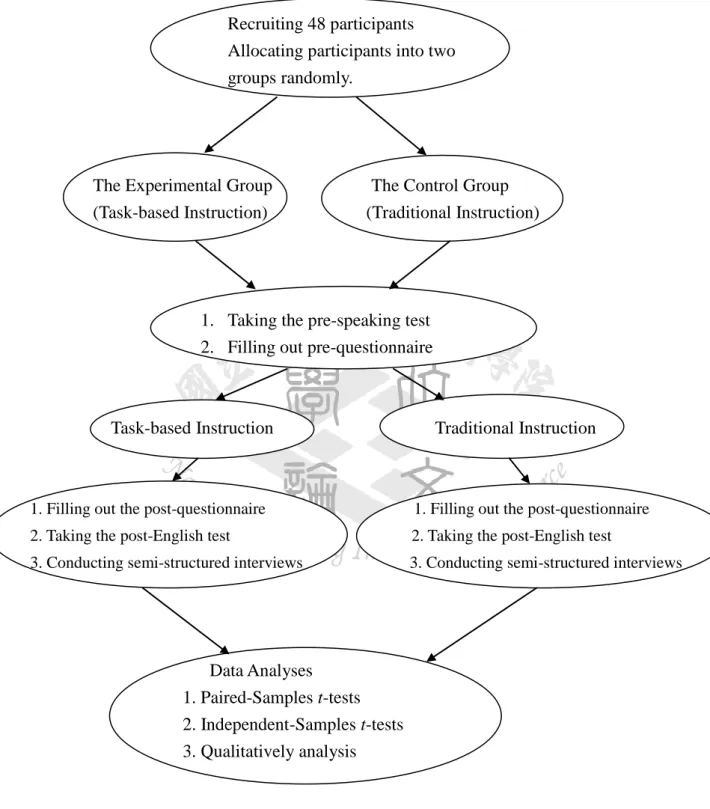
(47) CHAPTER 3 Methodology This chapter presents the research design, participants, instruments, procedures, and data analyses in the present study. Research Design The current research was an experimental study to explore the effects of task-based instruction on English speaking of college students in Taiwan. Qualitative and quantitative approaches were adopted in this study. The research design of the study included an experimental group and a control group. The independent variable was the English speaking teaching methods, and the dependent variable was the students‟ English speaking performance. The study lasted four months. Before the research, the researcher recruited 48 students to participate the instruction. Then, participants were allocated into the experimental group (task-based instruction) and the control group (traditional instruction) randomly. After that, all participants took a pre-speaking test and then they were asked to fill out the pre-questionnaire. Next, the experiment was conducted. After the experiment, all participants filled out the post-questionnaire and took a post-speaking test. Ten participants were randomly chosen for semi-structured interviews. Finally, the researcher did data analyses. The flowchart of the research was presented in Figure 1.. 33.
(48) Recruiting 48 participants Allocating participants into two groups randomly.. The Experimental Group. The Control Group. (Task-based Instruction). (Traditional Instruction). 1. Taking the pre-speaking test 2. Filling out pre-questionnaire. Task-based Instruction. Traditional Instruction. 1. Filling out the post-questionnaire. 1. Filling out the post-questionnaire. 2. Taking the post-English test. 2. Taking the post-English test. 3. Conducting semi-structured interviews. 3. Conducting semi-structured interviews. Data Analyses 1. Paired-Samples t-tests 2. Independent-Samples t-tests 3. Qualitatively analysis. Figure 1. The Flowchart of the Research Design. 34.
數據


相關文件
候用校長、候用主任、教師 甄選業務、考卷業務及試 務、教師介聘、外籍英語教 師及協同教學人員招募、推
Engaging Students in Task-based Learning Activities to Practise the Target Vocabulary Items and Language Forms. KS1 learners may not have enough experience in buying/ordering
Reading Task 6: Genre Structure and Language Features. • Now let’s look at how language features (e.g. sentence patterns) are connected to the structure
• Information on learners’ performance in the learning task is collected throughout the learning and teaching process so as to help teachers design post-task activities
Tying in with the modules and topics in the school-based English Language curriculum, schools are encouraged to make use of the lesson plans in the resource
• Oral interactions are often indivisible from the learning and teaching activities of an English task, and as such, speaking activities can be well integrated into any
• Tying in with the modules and topics in the school-based English language curriculum, schools are encouraged to make use of the lesson plans in the resource
• School-based curriculum is enriched to allow for value addedness in the reading and writing performance of the students. • Students have a positive attitude and are interested and
