Research Express@NCKU - Articles Digest
Research Express@NCKU Volume 6 Issue 4 - October 31, 2008 [ http://research.ncku.edu.tw/re/articles/e/20081031/3.html ]
A Five-Stage Approach to Fostering
Knowledge Management Deployment in R&D
Workspaces
Sheng-Tun Li
1,2,*and Won-Chen Chang
11Department of Industrial and Information Management, National Cheng Kung University
2Institute of Information Management, National Cheng Kung University
Chang, W.-C., Li, S.-T., “Fostering knowledge management deployment in R&D workspaces: a five-stage approach,” R&D Management, Vol. 37, No. 5, Nov. 2007, pp. 479-493.
T
he active and effective management of valuable knowledge is widely believed to be a core competency for solidifying the competitiveadvantage of an organization. Whether knowledge management (KM) is a new idea or just a recycled concept per se, both managerial and academic campuses have paid increasing attention in seeking a vast array of solutions for KM strategies, frameworks, processes, barriers and enablers, IT tools and measurements over the past decade.
Although there are many KM studies for both public and private sectors, most of them focus on the practice of international companies and western experiences, relatively few cases are reported on KM implementation in the Chinese community, especially for knowledge intensive R&D institutes whose missions are to serve traditional industries. To reveal some of the accomplishments gained in the Asia-Pacific region, this study presents and discusses the lessons learned from a particular case study in fostering the KM initiative and system in a research-oriented institute serving the metal industry. We discuss the complete concept and practice for developing the KM deployment framework and associated KM portal at the Metal Industries Research and Development Centre (MIRDC), the third largest
industry-oriented R&D institute in Taiwan. We conduct a study, how MIRDC has adopted a five-stage approach to develop a deliberate framework of KM deployment in order to manipulate the KM operations in the context of a Chinese R&D institute.
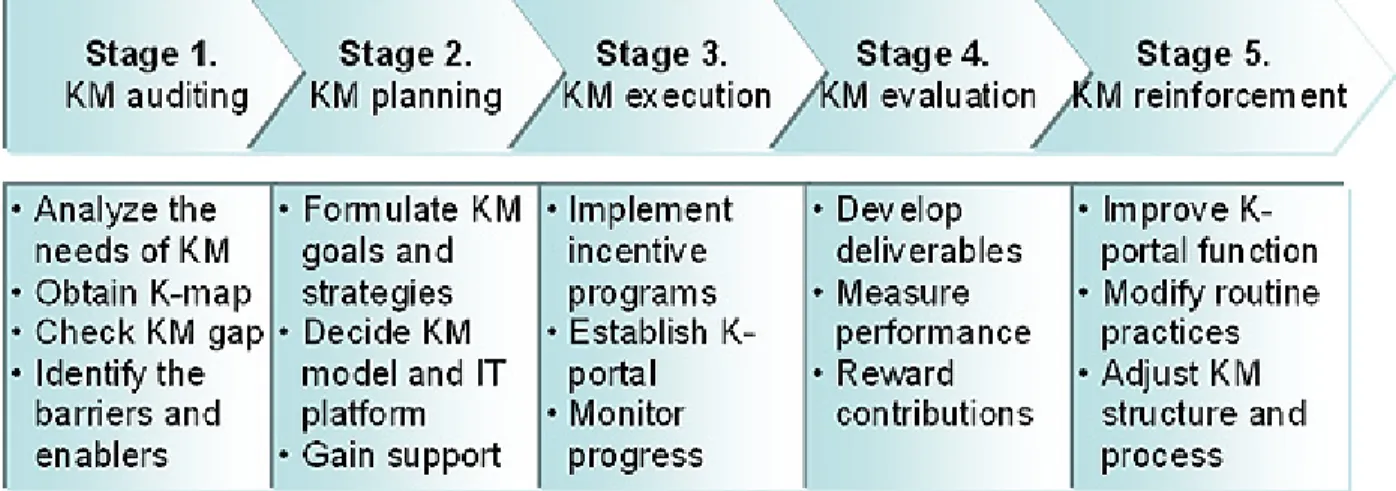
The five-stage KM approach including auditing, planning, execution, evaluation and reinforcement as illustrated in Figure 1 is in an attempt to answer the questions of what, why, where, when and how of the KM initiatives and was later developed into a more sophisticated KM deployment framework. The rationale of this five-stage approach was to identify and explore the potential value of an organization’s knowledge resources, as well as finding the proper alignment between the KM model and IT solutions in conjunction with the overall organizational strategy.
Research Express@NCKU - Articles Digest
Figure 1. Five-stage KM approach and critical tasks involved
KM auditing. The major work of the KM auditing stage is to conduct a status quo survey across various workspaces in the centre. The survey conducted in 2003 primarily focused on the identification of needed knowledge assets, the current KM practices in each department, what gaps existed in knowledge management, and consensus of KM vision and mission throughout the organization. Once these
knowledge assets were identified and represented in the form of an organizational knowledge map (K-map), managers were provided with a whole picture of knowledge resources and knowledge gaps. As a result, MIRDC was able to recognize the organization’s KM needs, strengths, weaknesses, opportunities and threats, consequently capable of guiding MIRDC directly towards the KM efforts that could fill those knowledge gaps, and thus determine the strategic focus of KM.
KM planning. This activity defines the objectives, scope, strategies and approaches of the KM plan. Prior to implementing KM, one elementary issue is how to integrate it with the organization’s vision and missions. Through a synthesis of opinions collected in knowledge auditing, an initial descriptive KM vision of MIRDC was formulated to achieve the goals of “enriched knowledge, diversified learning, interesting work, concrete impartation, faster processing, and quality output.” This was expected to support MIRDC in becoming the navigator of technology innovation and application for the local metal industry. Consequently, for the sake of attaining KM goals and closing the KM gaps, two simple and straightforward strategies were formulated - bridging people with systems and bridging people with people.
KM execution. This activity represents an effort to realize the goals of KM in routine practice. For this, MIRDC established a sophisticated KM deployment framework which covers the assignments, steps and control points for systematically managing KM progress by developing a series of “small steps” within the five stages to deliberately manage the KM plan. The major tasks in the KM execution stage can be divided into two groups. For the KM task force, their job mainly focused on developing the KM portal, facilitating organizational change and managing the KM progress. Parallel to the task force actions, the knowledge workers in R&D teams and administrative units were obliged to submit KOs in response to the rules and regulations. This was particularly effective since most R&D projects were sponsored by the government and all R&D outputs had to be in explicit format and accountable as requested in the contracts. All the R&D outputs and related reports were recorded as part of the employee’s evaluation system.
KM evaluation. This stage refers to the activity of examining the impact of KM implementation on the organization and the performance of the KM system. MIRDC assessed the success of KM through a user 2 of 3
Research Express@NCKU - Articles Digest
satisfaction survey for the KM portal system. First of all, the IT engineers tried to enhance the system stability based on user feedback. Later the IT managers interviewed heavy users in the first quarter of 2004 after introducing the KM portal and collected comments about how the portal could be further improved to fulfill their needs. Accordingly, in the second quarter of 2004, IT engineers added new functionalities to make it as robust as possible, which included on-line administration approval, personal workflow alerts and on-line booking. A user opinion survey was then conducted by asking several open questions about user perceptions of the KM portal, which 72 users responded. The results showed that most users were satisfied with the improved system offered. In addition, two distinctive knowledge capturing and diffusion outcomes for collaborative knowledge innovation are discovered by an ontology-enhanced presentational KOs management sub-system and by a patent filing sub-system. The former one could effectively assist in learning others’ cognitive style and skills of presentation whereas the latter one was designated for managing the process of R&D and associated patent submission also enhanced the productivity and creativity of engineers.
KM reinforcement. This activity concerns the continuous improvement, monitoring progress and making adjustments accordingly on an ongoing basis. These reinforcements consist of the linkage with daily workflow as work proceeds (e.g. providing on-line administration approval, project report alerts, meeting rooms and facilities on-line booking), customer directory and personal messages (e.g. unknown work leaves, unused overtime, unchecked travel expenses), automatic email publishing on the KM portal, Web file transfer protocol (FTP) system and governmental request for proposal (RFP) news. They echoed user feedback and encouraged users to interact with the system and other people, significantly increasing the average daily usage of the portal as new functions were added.
The five-stage approach offers a holistic view of KM manipulation activities and serves as a clear and reliable guideline to assure that every step of KM implementation is properly undertaken. Moreover, MIRDC’s KM deployment framework is designed to be generally applicable in R&D workspaces by integrating previous frameworks found in the literature. On the other hand, considering the specific nature of the project operation in the MIRDC context, the common communication protocols existing in MIRDC such as specifying assignments of KM task forces, control points and resource allocation are embedded in the deployment framework which allows managers to closely watch over the progress of KM and make adjustments when necessary.