結構用自攻螺絲接合之集成材雙剪抵抗性能評估
葉民權1,2) 林玉麗1) 宋雲煒1)
摘 要
本研究採用直徑6~10 mm,長度267~302 mm之三種結構用自攻螺絲為扣件,柳杉、南方松、花 旗松、冰片木四種樹種製成之異等級結構用集成材為構材,探討以扣件組合三構材在載重下雙剪接合 強度性質。結果顯示冰片木集成材接合之最大剪斷容量分別優於花旗松、南方松及柳杉等集成材之接 合條件19.8、54.7及48.5%。垂直木理方向之雙剪接合最大剪斷容量高於平行木理方向條件16.0%。以 鋁合金連結件接合集成材條件方面,冰片木集成之雙剪最大剪斷容量分別優於花旗松、南方松及柳杉 等集成材之接合條件20.1、31.8及34.3%。垂直木理方向之接合最大剪斷容量高於平行木理方向條件 19.5%。以8 mm結構用自攻螺絲配合鋁合金連結件之雙剪接合最大剪斷容量則高於木—木接合條件 45.5%。在不同直徑條件下以直徑8及10 mm結構用自攻螺絲接合之雙剪最大剪斷容量分別高於6 mm直 徑條件46.8及92.3%。接合部位在剪斷載重下之能量散逸趨勢亦與最大剪斷容量相近。依現行木構造建 築物及施工技術設計規範中有關木螺絲釘或大木螺釘的容許剪力計算,應用於結構用自攻螺絲之接合 強度估算,均會有低估之趨勢。
關鍵詞:接合、剪斷容量、自攻螺絲、柳杉。
葉民權、林玉麗、宋雲煒。2018。結構用自攻螺絲接合之集成材雙剪抵抗性能評估。台灣林業科學 33(2):141-61。
1)國 立 屏 東 科 技 大 學 木 材 科 學 與 設 計 系 ,91201屏東縣內埔鄉學府路1號 Department of Wood Science and Design, National Pingtung Univ. of Science and Technology, 1 Shuehfu Rd., Neipu Township, Pingtung 91201, Taiwan.
2)通訊作者 Corresponding author, e-mail:[email protected]
2017年11月送審 2018年1月通過 Received November 2017, Accepted January 2018.
Research paper
Evaluation of the Performance
of the Double-Shear Resistance of Glulam Connections Using Structural Self-tapping Screws
Min-Chyuan Yeh,1,2) Yu-Li Lin,1) Yun-Wei Sung1)
【Summary】
Three structural self-tapping screws with diameters of 6~10 mm and lengths of 267~302 mm were used as fasteners. Four wood species of Japanese cedar, Douglas fir, southern pine, and Kapur were used for making heterogeneous-grade structural glulam members in the study. Three glulam members were assembled with structural self-tapping screws as a joint to investigate the double-shear properties of a connection subjected to a load. Results indicated that the maximum shear capacity of a connection assembled with Kapur glulam members was 19.9, 54.7, and 48.5%, respectively, higher than those of Douglas fir, southern pine, and Japanese cedar glulam connections. The maximum shear capacity of a double-shear connection loaded perpendicular to wood grain was 16.0% higher than that loaded parallel to the wood grain. In the case of a glulam joint assembled with an aluminum connector, the maximum shear capacity of a double-shear connection assembled with Kapur glulam members was 20.1, 31.8, and 34.3%, respectively, higher than those of Douglas fir, southern pine, and Japanese cedar glulam connections. The maximum shear capacity of a double-shear connection loaded perpendicular to the wood grain was 19.5% higher than that loaded parallel to the wood grain.
Further, the maximum shear capacity of a double-shear connection assembled with 8-mm structural self-tapping screws and an aluminum connector was 45.5% higher than that of a wood-wood connec- tion. The maximum shear capacity of a double-shear connection assembled with 8- and 10-mm diam- eters of structural self-tapping screws were 46.8 and 92.3%, respectively, higher than those with 6-mm diameter screws. The tendency for energy dissipation of the connection subjected to a shear load was similar to that of the maximum shear capacity. The calculated results of the allowable joint strength for self-tapping screws showed a tendency of underestimation when the allowable shear calculations for both wood screws and lag screws in the wood-frame structure design code were applied.
Key words: connection, shear capacity, self-tapping screw, Japanese cedar.
Yeh MC, Lin YL, Sung YW. 2018. Evaluation of the performance of the double-shear resistance of glulam connections using structural self-tapping screws. Taiwan J For Sci 33(2):141-61.
緒 言
木 質 構 造 的 建 築 物 在 考 量 設 計 載 重 需 求 時,必須確認各部位所使用之構材強度性能夠 符合安全考量,而對結構的整體性及剛性需求
上 , 扣 件 的 使 用 則 成 為 設 計 上 重 要 的 考 量 因 素。目前在木結構施工最常用的扣件為螺栓、
釘、木螺絲、大木螺釘,相對於其他扣件,主
要是具有成本低及安裝容易的特性。在現今有 新型木質建材及新工法不斷被開發,另外,針 對地震、風力抵抗的設計也更為重視之際,對 木結構接合性能則有更高的需求。Prat-Vincet et al. (2010)認為釘及木螺絲是適用於低載重容 量接合的框組壁結構建築之工法,而大斷面木 構材所採用螺栓及大木螺釘等扣件,則必須有 導引孔的前置作業,除了會減少構材淨斷面,
增加結構組合作業時間,也有接合安裝容許差 的困難度,甚至造成木構材劈裂之脆性破壞。
直 交 集 成 板( c r o s s - l a m i n a t e d t i m b e r, C L T ) 是 近 來 開 發 之 重 要 工 程 木 材 , 廣 泛 用 於 中 高 層 木 構 造 建 築( K a r a c a b e y l i a n d Lum 2014, The Japan Housing and Wood Technology Centre 2016)。在新型的工法中,
直交集成板構材為高剛性高強度元件,必須透 過 連 結 件 或 扣 件 的 設 計 , 運 用 在 接 合 部 位 為 木 構 造 提 供 適 當 的 延 展 性 或 塑 性 抵 抗 行 為 , 用以抵抗如地震、風等側向力(Hossain et al.
2016, Mahdavifar et al. 2016)。其中結構用自 攻螺絲扣件廣泛的引用在CLT接合的場合,藉 以提供高強度且具足夠延展性,能在承載外力 時有適當的能量散逸容量(Polastri and Angeli 2014, Mahlknecht et al. 2016)。結構用自攻 螺絲直徑及長度較木螺絲釘大,應用於木構件 之接合時其承載容量較大,另外相較於大木螺 釘扣件,結構用自攻螺絲在施工組合時,不須 有導引孔前置作業,其效率可大幅提高,也較 能展現接合之塑性部分(plastic zone)。針對此 種結構用自攻螺絲應用在國內木結構之接合設 計及施作,實有必要進一步了解該扣件對不同 樹種木材的接合承載特性。
在CLT木結構物在承載如地震和風力等側 向力過程中,CLT木構材作為牆體、樓板或屋 頂元件是以剪力抵抗或傳遞其水平外力。各構 材之間則是透過接合扣件的剪斷承載容量緊固 並維持木結構之整體安全。Gavric et al. (2012, 2015)針對CLT木構材以結構用自攻螺絲接合,
在該接合方向施予側向力,探討對構材接合界 面之剪斷抵抗特性。結構用自攻螺絲亦可應用 於大斷面木構材如集成材之梁梁接合或主梁托
梁 之 接 合 , 透 過 該 扣 件 在 兩 構 材 間 之 剪 斷 抵 抗,可具有良好之接合強度特性(Bjtka and Blaβ 2002, Yeh et al. 2014)。
前述所探討的結構用自攻螺絲之接合強度 特性,均著重在兩木構材接合所形成的單剪載 重條件,對於三支木構材組成之接合場合,亦 即具有兩個剪斷界面的雙剪載重設計條件之探 討則不多見。此種多支木構材接合的木結構設 計或施作常可見於螺栓及大木螺釘的運用,由 於結構用自攻螺絲之尺寸長,適合應用此種多 支木構材接合的場合,而相關之接合強度特性 則有待探討。
在 現 行 之 營 建 署 木 構 造 建 築 物 設 計 及 施 工技術規範(Ministry of the Interior 2011)在木 構材有關接合部設計中,有針對木螺絲釘及大 木螺釘分別訂定該扣件在接合處之容許剪力計 算,而尚未有結構用自攻螺絲的相關接合設計 規定。故本研究擬針對國內木構造常用之木材 材種以及主要的結構用自攻螺絲種類,利用各 樹種組成結構用集成材,再以結構用自攻螺絲 組合三支集成材,探討接合部分位在扣件承載 雙剪抵抗下之接合強度,作為國內運用新型扣 件於木結構接合設計及施工之參考。
材 料 與 方 法
一、樹種
剪斷試驗使用4種木材,柳杉(Cryptomeria japonica)造林木伐採自新竹林區管理處竹東 林 班 ,38年生,經製材窯乾後平均含水率為 (13.0±1.5)%;花旗松(Pseudotsuga menziesii)及 南方松(Pinus spp.)為北美進口之框組壁結構用 製材等級為結構級(select structural),平均含水 率為12.5±0.5%及12.0±0.5%。闊葉樹冰片木 (Dryobalanops spp.)為東南亞進口原木,經製材窯 乾後平均含水率為17.5±1.0%。本試驗依框組壁 結構用製材2×4規格,再經刨光成37×89×1800 mm 作為集成元並進行結構用集成材之製造。
二、金屬扣件與連結件
所採用之結構用自攻螺絲依直徑規格可區
分為6、8、10 mm等3種,其中直徑8 mm扣件 又依釘尖切削刃型式區分成2種,一種是金屬板 及木材兩用型,一種是木材切削刃。材質為硼 鋼,由舜倡發股份有限公司製造,各型號細部 如Table 1,金屬連結件材質為鋁合金(Al-Mg-Si 合金),型號為A6061-T6主要之建築結構材料,
尺寸為5×90×100 mm。
三、試驗方法
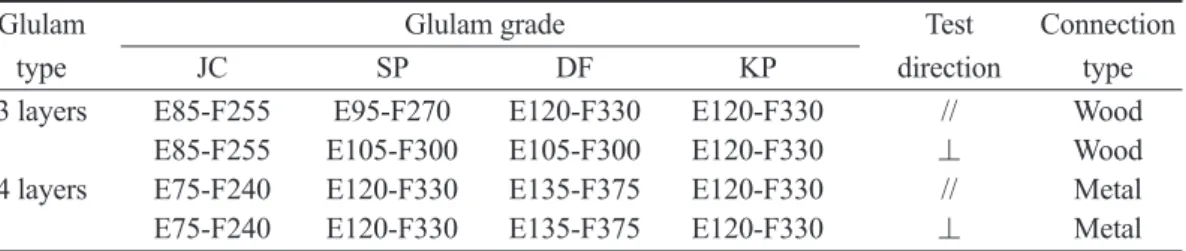
各樹種集成元首先進行打音分等,每支木 材經密度測定後,以打音頻譜分析法測定集成 元之縱向共振頻率,並計算其動彈性模數,再 依CNS 11031 (Bureau of Standard, Metrology, and Inspection 2014)標準進行異等級結構用集 成材之各層集成元等級配置,並分別製作三層 及四層之集成材,各樹種木材所組合之集成材 等 級 如Table 2所示,柳杉集成材等級為E75- F240~E85-F255,E75-F240集成材之配置最外 層為L90集成元,內層為L80集成元,E85-F255 集成材之配置是最外層為L100集成元,內層為 L80集成元;南方松為E95-F270~E120-F330,
E95-F270集成材之配置是最外層L110集成元,
內層為L100集成元,E120-F330集成材之配置 是最外層為L140集成元,內層為L125集成元;
花旗松為E105-F300~E135-F375,E105-F300 集 成 材 之 配 置 是 最 外 層 為L125集成元,內層 為L110集成元,E135-F375集成材之配置最外 層 為L160集成元,內層為L140集成元;冰片 木為E120-F330,其配置是最外層為L140集成 元 , 內 層 為L125集成元。集成元層積膠合時 採用間苯二酚-酚甲醛樹脂(resorcinol-phenol formaldehyde resin adhesive, RPF)為主劑,與 粉 末 狀 聚 甲 醛 為 硬 化 劑 以1:0.15比例混合佈 膠 , 佈 膠 量 為250 g m-2, 針 葉 樹 種 之 加 壓 壓 力為0.98 MPa,闊葉樹種以1.47 MPa進行,
在 集 成 台 層 積 加 壓 時 間 為4小時。集成材尺寸 為89×111×1800 mm(三層)及89×148×1800 mm(四層)兩種。
結構用自攻螺絲在不同樹種異等級結構用 集成材之接合剪斷抵抗試驗,區分木材-木材及 木材-金屬連結件接合,兩種型式如下:
Table 1. Descriptions of structural self-tapping screw details
Length Outside Root Thread Shank Head Pitch Code (mm) diameter diameter length diameter diameter (mm) (mm) (mm) (mm) (mm) (mm)
M6×300 302 6.04 3.72 78 4.14 11.72 4.86
M8×300 301 8.11 5.35 109 5.71 14.82 6.07
HW8×270 267 8.05 5.27 86 5.70 14.70 5.63
M10×300 302 9.95 6.11 101 6.94 17.87 5.78
Table 2. Heterogeneous-grade glulam manufactured from 4 wood species and outline of the test schedule
Glulam Glulam grade Test Connection
type JC SP DF KP direction type
3 layers E85-F255 E95-F270 E120-F330 E120-F330 // Wood
E85-F255 E105-F300 E105-F300 E120-F330 ⊥ Wood
4 layers E75-F240 E120-F330 E135-F375 E120-F330 // Metal
E75-F240 E120-F330 E135-F375 E120-F330 ⊥ Metal
1) JC, Japanese cedar; DF, Douglas fir; SP, southern pine; KP, Kapur; // or ⊥, load respectively ap- plied parallel or perpendicular to the grain; Wood, wood-wood connection; Metal, joined with metal connector.
(一)木材-木材接合剪斷試驗
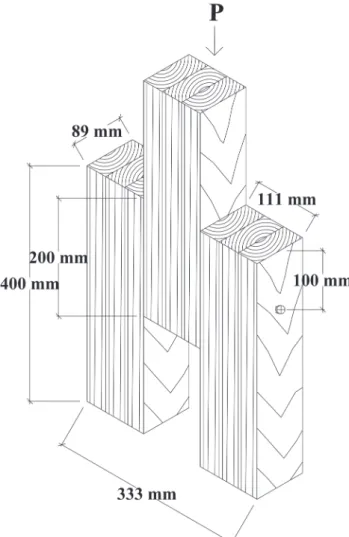
以三支結構用集成材透過結構用自攻螺絲 進行組合如Figs. 1及2,在中間之主構材施予載 重,形成兩個木材接合介面的雙剪受力。單支 三層集成材試材尺寸為89×111×400 mm,用 釘位置依據木構造建築物設計及施工技術規範 (Ministry of Interior 2011)之螺栓配置規定,在 載重承擔側之端距分別為扣件直徑之7倍(平行木 理方向受力)及4倍(垂直木理方向受力)以上。接 合剪斷試驗分別採用直徑6、8、10 mm三種結構 用自攻螺絲,進行柳杉、南方松、花旗松、冰 片木等四種樹種集成材條件之接合,並考慮木 理走向受力(平行與垂直木理)之影響。以萬能試
驗機進行剪斷施力,加壓速度7 mm min-1,每種 條件各重複試驗12次。
(二)木材-金屬連結件接合剪斷試驗
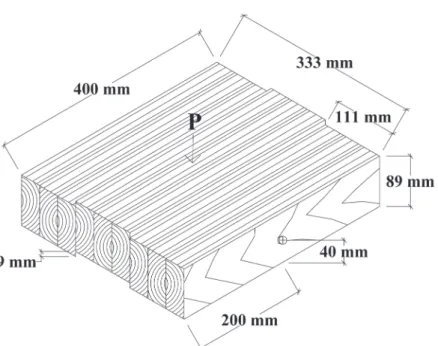
以2支4層之結構用集成材透過結構用自攻 螺絲將木材及金屬連結件組合如Figs. 3及4。
接合處中央之連結件材質為5 mm厚鋁合金,直 接施予載重於連結件上,形成金屬連結件與木 材 介 面 間 之 剪 斷 作 用 。 單 支4層集成材試材尺 寸為89×148×400 mm,金屬連結件與集成材 接合之雙剪抵抗試驗採用具金屬切削刃之8 mm 結構用自攻螺絲(HW8×270),考慮四種樹種 集成材之接合條件,同時考慮載重方向分別為
Fig. 1. Shearing test of a glulam connection with pressure (P) applied parallel to the grain.
Fig. 2. Shearing test of a glulam connection with pressure (P) applied perpendicular to the grain.
Fig. 3. Shearing test of a glulam member assembly with an aluminum connector with pressure (P) applied parallel to the grain.
平行及垂直木理之受力條件,每種條件各重複 試驗12次。
結 果
一、木材-木材接合剪斷試驗
(ㄧ)平行木理之接合剪斷力
三支集成材構材以結構用自攻螺絲組合,
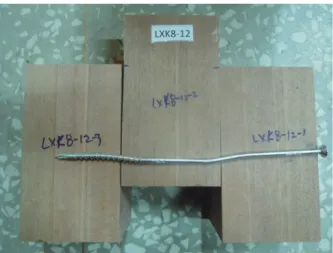
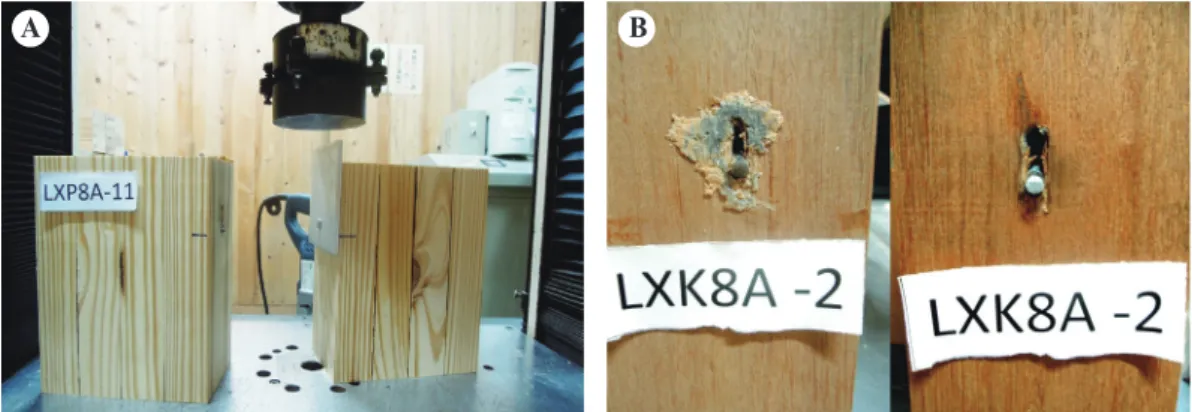
在中間主構材承受載重過程中,與兩邊的側構 材間所形成的兩個剪斷面,都分別造成結構用 自攻螺絲形成兩個塑性鉸(plastic hinge)之彎曲 變形(Fig. 5),在外層集成元的螺絲孔周圍之木 材亦明顯呈局部壓潰破壞(crushing failure),此 種扣件彎曲降伏型式屬於模式IV (NDS 1997)。
顯示木材材質之承壓特性與扣件之剛性相近,
使接合效果完全發揮,直徑為6 mm之自攻螺絲 的破壞變形最為明顯,直徑8及10 mm之自攻 螺絲在承載剪斷力下,亦呈相同之破壞變形。
Hoyle and Woeste (1989)指出當螺栓在木構材平 行木理方向之埋入長度在直徑的4倍以上,即會 因承壓而開始呈現非彈性之行為,在6倍以上之
長度即達最大值而呈現塑性行為。如依本試驗 各結構用自攻螺絲之胴徑與三層厚度之集成材 比較,其長徑比在16.0~26.8之間,其扣件容易 達到降伏變形呈現塑性行為。
試驗結果亦顯示結構用自攻螺絲在受剪斷 過程中,在外層集成元因釘頭部分沉陷而埋入 木材,在各樹種及各扣件型式條件均發生,由 於本研究所採用之結構用自攻螺絲屬於半螺紋 型式,近釘頭側的胴身不具螺紋,當需承載扣 件軸向之力時,釘頭的型式對木材的承壓抵抗 有很大影響。Hossain et al. (2016)在探討直交 集成板牆體以結構用自攻螺絲進行之剪斷接合 時,其主要的牆體降伏變形過程中,也多因釘 頭之受拉埋入板內所致。Gavric et al. (2012)在 直交集成板牆體之組合進行評估結構用自攻螺 絲的垂直引拔抵抗性能過程中,亦顯示接合的 破壞原因是扣件頭的木材穿透破壞較螺絲部位 自木材引拔破壞更為關鍵。
試 驗 結 果 亦 顯 示 直 徑6 mm之結構用自攻 螺 絲 在 抵 抗 剪 力 過 程 中 亦 發 生 斷 裂(Fig. 6),
其 位 置 在 靠 近 胴 身 中 段 的 加 速 區 前 第2螺紋位 置 , 顯 示 該 位 置 之 應 力 已 超 過 降 伏 點 。 相 對 Fig. 4. Shearing test of a glulam member assembly with an aluminum connector with pressure (P) applied perpendicular to the grain.
於直徑8及10 mm之結構用自攻螺絲在該位置 的螺紋谷徑,6 mm扣件之斷面積僅為其48及 37%,因此扣件之斷裂亦成接合破壞之主要原 因。Table 3表示該種自攻螺絲產生剪斷斷裂的 結果,其中以冰片木集成材組合之6 mm結構用 自攻螺絲全部斷裂破壞,在柳杉集成材組合者 最少亦佔25%。
以不同結構用自攻螺絲直徑進行不同樹種 結構用集成材之接合,於平行木理方向進行剪 斷 試 驗 所 得 之 結 果 採 用 日 本 住 宅·木材技術中 心(The Japan Housing and Wood Technology Centre 2001)之分析軟體分析接合剪斷載重- 位 移 關 係 , 求 得 降 伏 剪 斷 力 及 極 限 剪 斷 力 如 Table 4。
(二)垂直木理之接合剪斷力
在木材-木材之三構材接合依垂直木理方向 施予載重下,結構用自攻螺絲扣件所產生的降 伏變形與前述平行木理方向之受力條件相近,
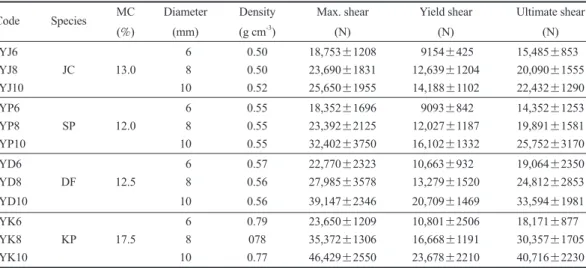
皆屬於模式IV,且因軸向受拉產生釘頭沉陷於 集成材外層集成元之材面,惟在剪斷界面於螺 絲孔周圍的外層集成元之木材纖維,因壓潰變 形進而斷裂。以直徑6 mm自攻螺絲接合的條件 中,因承受雙剪而斷裂者佔54% (Table 3)。垂 直木理方向之接合最大剪斷力、降伏剪斷力以 及極限剪斷力結果如Table 5所示。
二、金屬連結件接合木材剪斷試驗
在雙支木材之間透過金屬連結件接合,並 Fig. 5. An 8-mm self-tapping screw yielded in bending at 2 plastic hinge points per shear plane of a Kapur glulam connection.
Fig. 6. Structural self-tapping screw fracture at the plastic hinge location and at a point 2 threads away from the speeding threads.
A B
Table 3. Shear failure of 6-mm structural self-tapping screws in glulam member connections Wood species Parallel to the grain Perpendicular to the grain
No. of failures % No. of failures %
JC 3 25 4 33
SP 6 50 5 42
DF 7 58 5 42
KP 12 100 12 100
Total 28 58 26 54
1) JC, Japanese cedar; DF, Douglas fir; SP, southern pine; KP, Kapur.
Table 4. Shear resistance of glulam connections assembled with different self-tapping screws and various wood species (parallel to the wood grain)
Code Species MC Diameter Density Max. shear Yield shear Ultimate shear
(%) (mm) (g cm-3) (N) (N) (N)
LXJ6 6 0.52 12,676±1280 6692±513 10,442±798
LXJ8 JC 13.0 8 0.50 21,293±1846 11,109±937 18,430±1176
LXJ10 10 0.51 29,976±3402 16,358±2275 26,348±3047
LXP6 6 0.56 11,527±1119 6364±518 9269±806
LXP8 SP 12.0 8 0.53 19,492±1602 9943±956 16,653±1045
LXP10 10 0.54 25,078±2418 14,115±1241 22,031±1930
LXD6 6 0.57 13,625±1688 7241±686 11,018±1248
LXD8 DF 12.5 8 0.59 24,275±2651 12,399±1587 21,309±2927
LXD10 10 0.58 35,042±2979 18,262±2095 30,817±1576
LXK6 6 0.79 22,922±2377 10304±902 17,425±1529
LXK8 KP 17.5 8 0.77 32,005±2154 15,282±1413 27,822±1765
LXK10 10 0.78 40,093±3385 19,801±2081 34,635±2206
1) JC, Japanese cedar; DF, Douglas fir; SP, Southern pine; KP, Kapur; MC, moisture content.
Table 5. Shear resistance of glulam connections assembled with different self-tapping screws and various wood species (perpendicular to the wood grain)
Code Species MC Diameter Density Max. shear Yield shear Ultimate shear
(%) (mm) (g cm-3) (N) (N) (N)
LYJ6 6 0.50 18,753±1208 9154±4250 15,485±853
LYJ8 JC 13.0 8 0.50 23,690±1831 12,639±1204 20,090±1555
LYJ10 10 0.52 25,650±1955 14,188±1102 22,432±1290
LYP6 6 0.55 18,352±1696 9093±8420 14,352±1253
LYP8 SP 12.0 8 0.55 23,392±2125 12,027±1187 19,891±1581
LYP10 10 0.55 32,402±3750 16,102±1332 25,752±3170
LYD6 6 0.57 22,770±2323 10,663±932 19,064±2350
LYD8 DF 12.5 8 0.56 27,985±3578 13,279±1520 24,812±2853
LYD10 10 0.56 39,147±2346 20,709±1469 33,594±1981
LYK6 6 0.79 23,650±1209 10,801±2506 18,171±877
LYK8 KP 17.5 8 078 35,372±1306 16,668±1191 30,357±1705
LYK10 10 0.77 46,429±2550 23,678±2210 40,716±2230
1) JC, Japanese cedar; DF, Douglas fir; SP, southern pine; KP, Kapur; MC, moisture content.
於中央界面施予剪斷載重,結果顯示直徑8 mm 結構用自攻螺絲在鋁合金連結件兩側剪斷界面,
同樣產生模式IV之降伏破壞,除了螺絲孔周圍 外層集成元木材產生壓潰破壞,鋁合金之螺絲孔 亦呈明顯變形。各樹種集成材之接合在剪斷載重 下,均造成8 mm結構用自攻螺絲在剪斷界面產 生斷裂(Fig. 7)。各樹種結構用集成材接合之平行 木理及垂直木理方向的最大剪斷力、降伏剪斷力 及極限剪斷力結果如Table 6所示。
討 論
一、樹種之影響
(一)木材-木材接合
1. 平行木理方向之接合剪斷抵抗
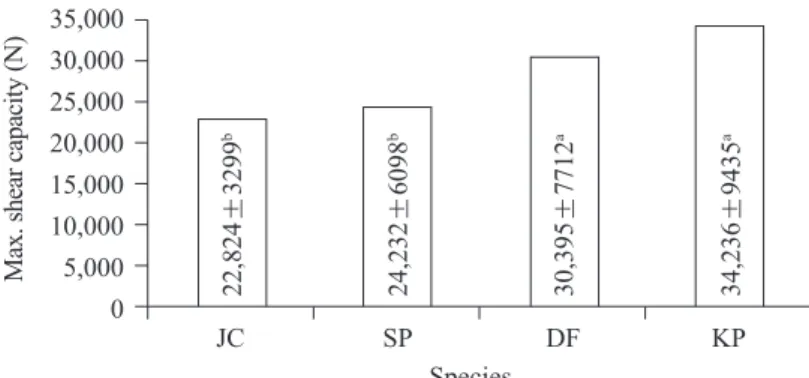
三 支 結 構 用 集 成 材 透 過 結 構 用 自 攻 螺 絲 接 合 , 當 載 重 方 向 是 平 行 木 理 走 向 施 加 時 , 集 成 材 的 平 行 木 理 抗 壓 強 度 會 影 響 接 合 部 位 的承載性能。各樹種集成材之間的接合最大剪 斷容量比較如Fig. 8。根據統計Turkey法分析 顯示,冰片木集成材以結構用自攻螺絲進行接 合條件的最大剪斷容量明顯高於其他樹種,分 別高於花旗松27.1%及柳杉46.9%。南方松集 成 材 之 接 合 最 大 剪 斷 容 量 為 最 低 , 僅 為 冰 片 木條件之59.5%。所採用之南方松集成材等級 E95-F270,較之柳杉集成材等級E85-F255,並
未顯示有較高之接合承載效果。花旗松集成材 等級與冰片木集成材等級同為E120-F330,但 其接合承載力又明顯低於冰片木。另外,本試 驗所取之冰片木含水率為17.5%,但在其破壞 過程中並未見及木材在膠合層破壞或剝離之現 象,顯示其膠合良好。根據Table 4中冰片木的 平均密度為0.78 g cm-3,花旗松為0.58 g cm-3, 柳杉材為0.51 g cm-3,南方松材為0.54 g cm-3, 木材密度變化與平行木理抗壓強度之間呈線性 關係,Wang (1986)指出無論在國產材、南洋 材及北美材所推導的線性方程式均有相近的關 係,因此可推斷冰片木構材對扣件有較佳之承 載抵抗力。在木構造設計規範中有關木螺絲釘 在木構材接合的容許剪力估算式,即是考慮到 該值與木材氣乾比重呈1.8次方關係(Ministry of Interior 2011)。同時,有關大木螺釘在木構材 接合的容許剪力估算式亦是以該值與木材比重 的線性關係計算。由此顯示不同樹種對結構用 自攻螺絲的接合剪斷抵抗的影響與該樹種的密 度有關。在本試驗中南方松之密度略高於柳杉 材6%,而在接合承載力則有略低於柳杉材之趨 勢,雖然統計上兩樹種之接合承載力並無明顯 差別,但南方松試材顯示有較高比例的春材,
可能是造成強度不如預期的原因。
2. 垂直木理方向之接合剪斷抵抗
在 接 合 部 位 之 結 構 用 自 攻 螺 絲 在 剪 斷 載 重下,會對螺絲孔周圍木材纖維之垂直方向施
Fig. 7. Structural self-tapping screw fracture at the interface between a glulam member and the aluminum connector.
A B
Table 6. Shear resistance of glulam connections assembled with an aluminum connector using 8-mm self-tapping screws and subjected to different loading directions
MC Diameter Density Max. shear Yield shear Ultimate shear Code Species
(%) (mm) (g cm-3) (N) (N) (N)
Loaded parallel to the wood grain
LXJ8 JC 13.0 0.53 31,720±1904 15,458±1471 25,661±1915 LXP8 SP 12.0
8 0.55 30,512±2711 14,687±1151 24,049±1986 LXD8 DF 12.5 0.58 34,125±2445 14,064±4496 27,085±1540 LXK8 KP 17.5 0.80 41,400±2054 18,150±1133 31,935±1953
Loaded perpendicular to wood grain
LYJ8 JC 13.0 0.50 35,615±3121 15,734±1939 28,683±3077 LYP8 SP 12.0
8 0.56 38,473±2772 18,870±1086 30,521±2051 LYD8 DF 12.5 0.56 41,366±3736 19,569±1288 32,783±3264 LYK8 KP 17.5 0.80 49,170±2579 23,300±1934 39,569±2889
1) JC, Japanese cedar; DF, Douglas fir; SP, southern pine; KP, Kapur; MC, moisture content.
Fig. 8. Comparison of maximum shear capacities loaded parallel to the wood grain for a double-shear connection among wood species. (JC, Japanese cedar; DF, Douglas fir; SP, southern pine; KP, Kapur) (n = 36).
力,而各樹種木材的垂直木理壓縮比例限度應 力會影響接合部位的承載性能。各樹種集成材 之間的接合最大剪斷容量之比較如Fig. 9。結構 用自攻螺絲在各樹種集成材垂直木理方向之接 合剪斷抵抗雖有所不同,但在統計上冰片木與 花旗松之間差異不顯著,同時柳杉與南方松之 間的差異亦不顯著。就個別樹種而言,結構用 自攻螺絲在冰片木集成材垂直木理方向之接合 最大剪斷容量分別較柳杉及南方松高出50.0及 41.3%,而有較佳的接合效果。其中,南方松 集成材等級為E105-F300,柳杉集成材等級為 E85-F255,但南方松集成材之接合承載力並未 明顯高於柳杉集成材條件。另外花旗松集成材
等級與南方松集成材相同,卻有較佳之接合承 載效果。
綜合上述平行及垂直木理方向的接合剪斷 抵抗性能,顯示垂直木理方向有較佳的剪斷承 載能力,相差16%,應是扣件順木理方向施力 於接合部位時,較容易產生木材劈裂形成早期 破壞所致。另外也顯示柳杉集成材之接合剪斷 抵抗性能與南方松相近。
(二)木材-金屬連結件接合之剪斷抵抗 1. 平行木理方向之接合剪斷抵抗
各樹種集成材構材之間透過鋁合金連結件
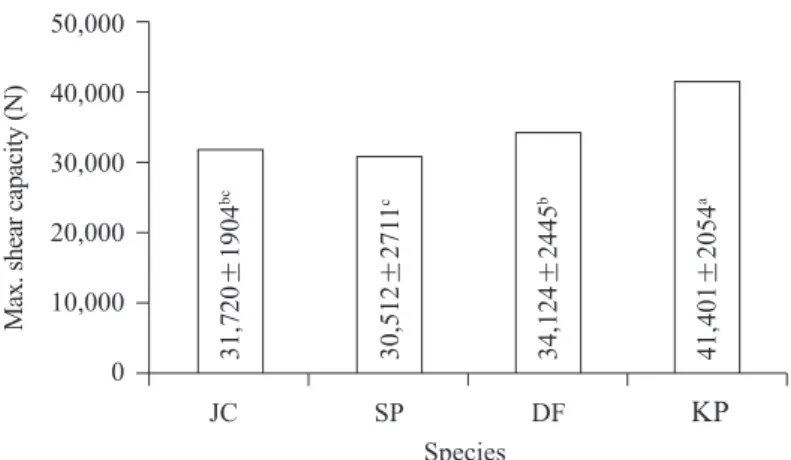
以 直 徑8 mm結構用自攻螺絲進行接合,接合 部位之雙剪抵抗性能以Tukey’s統計分析結果如 Fig. 10,其各樹種間的趨勢與木材-木材接合結 果相同,冰片木之接合剪斷容量分別高於柳杉 及南方松條件30.5及35.7%,而後兩者之接合剪 斷容量之間則無顯著差異。同時,冰片木也較 花旗松條件高21.3%。當與前述之8 mm結構用 自攻螺絲的木材-木材接合比較,則以鋁合金連 結件接合者其剪斷容量高出41.9%,顯見金屬連 結件有提高接合之剪斷承載抵抗的作用。
2. 垂直木理方向之接合剪斷抵抗
各樹種集成材構材在垂直木理方向條件之 接合剪斷容量比較如Fig. 11。各樹種間之差異趨 勢與木材-木材接合條件之結果相近,且統計上 較為明顯。冰片木集成材之接合剪斷容量分別 較柳杉、南方松、花旗松等條件高38.1、27.8、
及18.9%。與上述平行木理方向的接合剪斷抵抗 性能比較,亦顯示在垂直木理方向有較高的承 載能力,相差19.5%,應是自攻螺絲之胴徑在受 剪過程中施予壓力於孔周圍之木纖維超過比例限 界而使木材局部緻密化,進而限制孔周圍之破壞 發展。當與前述之8 mm結構用自攻螺絲的木材- 木材接合比較,以鋁合金連結件接合者之剪斷容 量則較高49.1%。另外,由於以薄金屬連結件接 合,結構用自攻螺絲在其兩側木構材有較長的扣 件埋入深度,相較以三支構材接合雙剪條件,扣 件可以有更高的承壓面積支承;同時依前述破壞
模式顯示,結構用自攻螺絲均在穿過鋁合金連結 件之位置剪斷,已達扣件本身材質之強度所致。
在美國木材手冊(FPS 2011)對扣件型式與自攻螺 絲相近的大木螺釘配合金屬連結件接合時,亦建 議在平行木理方向的側向抵抗載重亦即剪斷抵抗 力可提高25%。
二、扣件直徑之影響
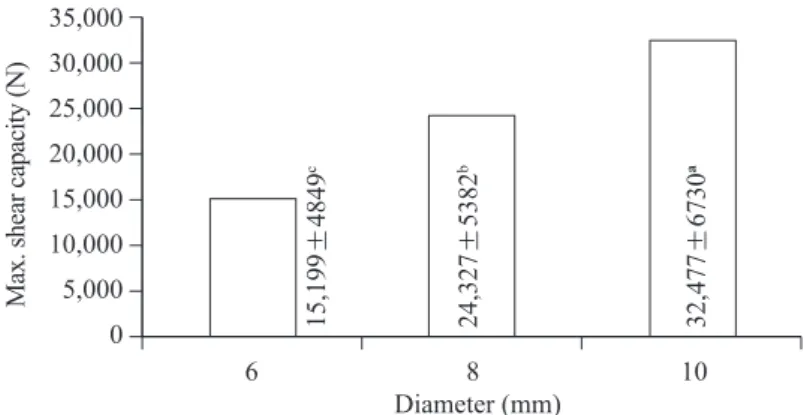
本研究採用直徑6、8、10 mm三種結構用 自攻螺絲,進行三支木構材之接合,在中央主 構材施予載重,在雙剪斷界面所得之剪斷抵抗 經統計分析如Fig. 12及13。在平行木理方面施 力時,隨扣件直徑加大其最大剪斷容量顯著提 高,以直徑8及10 mm扣件接合者分別高於直 徑6 mm條件60.1及113.7%。由於8及10 mm結 構用自攻螺絲在螺紋部位的谷徑較大,所形成 的剪斷面積分別高出直徑6 mm結構用自攻螺絲 107及170%,也有較高之剛性能夠承載接合部 之外力及減少變位,實驗結果亦顯示直徑6 mm 者本身多因剪力而斷裂,故直徑8及10 mm條件 能有較高之剪斷容量,可以有效提高木構材的 接合強度性能,亦可以減少接合部位的用釘數 量,此直徑因子也成為扣件接合性能估算的重 要考量。在木構造建築物設計及施工技術規範 (Ministry of Interior 2011)中,有關以木螺絲釘 或大木螺釘的接合容許剪力估算,其關係式均 建議以扣件直徑的平方進行考量,顯示直徑因 子對接合剪斷抵抗效果有密切關係。
Fig. 9. Comparison of maximum shear capacities loaded perpendicular to the wood grain for a double-shear connection among wood species. (JC, Japanese cedar; DF, Douglas fir;
SP, southern pine; KP, Kapur) (n = 36).
Fig. 10. Comparison of maximum shear capacities loaded parallel to the wood grain among different wood species for a joint assembled with an aluminum connector using a structural self- tapping screw. (JC, Japanese cedar; DF, Douglas fir; SP, southern pine; KP, Kapur) (n = 12).
Fig. 11. Comparison of maximum shear capacities loaded perpendicular to the wood grain among different wood species for a joint assembled with an aluminum connector using a structural self-tapping screw. (JC, Japanese cedar; DF, Douglas fir; SP, southern pine; KP, Kapur) (n = 12).
在垂直木理方向的接合最大剪斷容量亦顯 示隨扣件直徑加大而提高(Fig. 13)。以直徑8及 10 mm扣件接合者分別高於直徑6 mm條件33.5 及70.8%,其增加的幅度不若平行木理方向受 力條件者大。同時垂直木理方向受力之接合最 大剪斷容量亦較平行木理方向者高,又因不同 扣件直徑其差異也不同,兩者差異在6、8、10 mm扣件條件下分別為36.9、14.2、及9.4%,隨 著直徑加大,兩者之最大剪斷容量差異漸小。
三、結構用自攻螺絲雙剪接合特性
木 構 件 之 接 合 在 承 載 外 力 過 程 的 力 學 行
為 , 多 以 線 性 彈 - 塑 性 理 論 解 釋 該 接 合 的 初 始 剛 性 以 及 超 越 降 伏 點 之 後 的 延 展 變 形 程 度 。 Fig. 14顯示柳杉集成材以不同直徑之結構用自 攻螺絲,進行木材-木材接合及木材-鋁合金連 結 件 接 合 的 載 重 - 位 移 關 係 , 說 明 了 不 同 的 組 合條件會有不同的接合效果。透過軟體分析,
不同樹種集成材以結構用自攻螺絲接合,在雙 剪抵抗下之初始剛性(initial stiffness)、能量散 逸(energy dissipation)以及塑性率(ductility),
結 果 如Table 7所示,其中初始剛性為將接合 部位之載重-位移曲線轉成彈-塑性關係後,在 極限降伏點(ultimate yield point)之前的線性
Fig. 12. Comparison of maximum shear capacities parallel to the wood grain for a double- shear connection assembled with different sizes of structural self-tapping screws.
Fig. 13. Comparison of maximum shear capacities perpendicular to the wood grain for a double-shear connection assembled with different sizes of structural self-tapping screws.
彈性斜率,能量散逸則為彈塑性雙線性的位移 範圍內面積和,塑性率則是極限位移(ultimate displacement)與極限降伏位移之比值。
(一)集成材接合初始剛性
在Fig. 15顯示以三支結構用集成材組合 之結構用自攻螺絲接合,並在平行木理方向之 剪斷承載條件下,各樹種的雙剪接合初始剛性 比較,其中柳杉與南方松相近,而冰片木與花 旗松則分別高出柳杉集成材之接合剛性73.0及 26.4%。以鋁合金連結件接合之雙剪初始剛性,
在各樹種間之趨勢亦與木-木接合者相近,惟均 較8 mm自攻螺絲組合之木-木接合條件為高,平 均可高出36.5%。在垂直木理方向之剪斷承載條 件下,各樹種集成材雙剪接合初始剛性也有相
近的趨勢,其中冰片木與花旗松也分別高於柳 杉集成材之接合剛性80.9及36.0% (Fig. 16)。而 在平行木理及垂直木理方向的接合初始剛性之 間則無明顯差別。以8 mm自攻螺絲配合鋁合金 連結件組合集成材者,其雙剪初始剛性亦較木- 木接合條件高出46.5%。
以不同直徑之結構用自攻螺絲所組成之雙 剪接合方面,在Fig. 17顯示隨著結構用自攻螺 絲之直徑提高,集成材接合之平行木理方向初 始剛性明顯提高,其中直徑8及10 mm條件分別 較直徑6 mm條件高40.2及79.0%。在垂直木理 方向之剪斷承載條件下,各直徑結構用自攻螺 絲接合之初始剛性也有相近的趨勢,直徑8及10 mm條件分別較6 mm結構用自攻螺絲接合者高 37.6極70.7% (Fig. 18)。接合處之載重分別施予
Table 7. Structural performance of glulam double-shear connections assembled with structural self-tapping screws
Parallel to the grain Perpendicular to the grain
Initial Energy Initial Energy
Code stiffness dissipation Ductility Code stiffness dissipation Ductility
(N mm-1) (N-mm) (N mm-1) (N-mm)
LXJ6 959±112 26,124±1767 2.56±0.24 LXJ6 1288±152 37,149±1851 2.42±0.29 LXJ8 1752±265 46,159±3247 2.86±0.47 LXJ8 1559±224 48,088±4310 2.34±0.25 LXJ8A 2282±311 57,228±7009 2.48±0.25 LXJ8A 2287±189 54,496±7098 2.03±0.21 LXJ10 1970±242 62,169±7032 2.21±0.13 LXJ10 1802±180 52,855±2588 2.41±0.33 LXP6 820±113 20,853±3960 2.22±0.22 LXP6 1166±134 43,931±4665 2.06±0.29 LXP8 1299±106 39,959±2331 2.35±0.21 LXP8 1554±102 60,215±5615 2.35±0.13 LXP8A 2123±187 52,668±6502 2.29±0.27 LXP8A 2847±309 50,945±5995 2.02±0.14 LXP10 2032±230 54,819±3781 2.71±0.33 LXP10 1805±145 83,511±4232 2.12±0.18 LXD6 1194±204 20,795±7901 2.42±0.42 LXD6 1434±126 43,931±4665 1.93±0.28 LXD8 2003±271 51,283±4599 2.87±0.37 LXD8 2026±154 60,215±5615 2.44±0.25 LXD8A 2541±204 48,740±4173 2.11±0.17 LXD8A 3012±380 50,945±5995 1.93±0.19 LXD10 2716±365 76,799±5327 2.54±0.20 LXD10 2838±280 83,511±4232 2.46±0.24 LXK6 2470±416 25,761±4316 2.43±0.14 LXK6 2137±225 19,295±3803 2.00±0.45 LXK8 2602±461 69,650±5360 2.80±0.39 LXK8 2835±340 73,900±4834 2.61±0.24 LXK8A 3262±398 53,231±3514 2.14±0.18 LXK8A 3046±451 60,309±5408 1.70±0.17 LXK10 3159±535 88,437±5650 2.73±0.35 LXK10 3497±490 10,0730±7253 2.56±0.27
Fig. 14. Load-displacement relationship of Japanese cedar glulam connections assembled with structural self-tapping screws subjected to double-shear loads (perpendicular to the wood grain).
平行或垂直木理方向,對各直徑結構用自攻螺 絲條件並無明顯差別。
(二)集成材接合能量散逸
在平行木理方向之剪斷承載條件下,不同
樹種集成材在雙剪接合部位的能量散逸比較如 Fig. 19。冰片木明顯高於柳杉及南方松,分別為 31.1及58.3%。柳杉以結構用自攻螺絲組合之雙 剪接合能量散逸則介於南方松及花旗松之間,但 差異並不明顯。以鋁合金連結件接合者,其剪斷
Fig. 15. Comparison of initial stiffness loaded parallel to the wood grain for a double-shear connection among wood species. (JC, Japanese cedar; DF, Douglas fir; SP, southern pine;
KP, Kapur) (n = 36).
Fig. 16. Comparison of initial stiffness loaded perpendicular to the wood grain for a double- shear connection among wood species. (JC, Japanese cedar; DF, Douglas fir; SP, southern pine; KP, Kapur) (n = 36).
Fig. 17. Comparison of initial stiffness parallel to the wood grain for a double-shear connection assembled with different sizes of structural self-tapping screws. (n = 48).
能量散逸在柳杉及南方松優於木-木接合條件,
但在冰片木方面則低於木-木接合。在垂直木理 方向之剪斷承載條件下,冰片木及花旗松之雙剪 接合部位之能量散逸相近,且分別高於柳杉之接 合剪斷能量散逸32.3及39.6% (Fig. 20)。綜合而 言,在垂直木理方向之接合剪斷能量散逸則略高 於在平行木理方向條件13.9%。以鋁合金連結件 接合者,在冰片木、花旗松及南方松均以木-木 接合者有較佳之剪斷能量散逸。
集成材以不同直徑結構用自攻螺絲所組成 的接合,在雙剪抵抗時之能量散逸結果比較如 Fig. 21所示,隨著扣件直徑之提高,在平行木 理方向受力的能量散逸明顯提高,其中直徑8及 10 mm條件分別較直徑6 mm條件的2.34及3.12
倍。在垂直木理方向之剪斷承載條件下,以各 直徑結構用自攻螺絲接合之能量散逸也有相同 之趨勢,直徑8及10 mm條件分別為6 mm結構 用自攻螺絲接合者1.82及2.39倍(Fig. 22)。一 般言,各直徑之結構用自攻螺絲對集成材接合 時,於接合處之載重施加在垂直木理方向之能 量散逸較施加在平行木理方向者高12.4%。
四、雙剪接合容許剪斷力
在現行之木構造建築物設計及施工技術規 範中,以木螺絲釘接合之單剪接合容許剪力(P) 可以依公式Pw=870ρ1.8·d2計算,其中ρ為木構 材之特徵密度,d為扣件之標稱直徑。另外,以 大木螺釘接合之單剪接合容許剪力可以依公式 Fig. 18. Comparison of initial stiffness perpendicular to the wood grain for a double-shear connection assembled with different sizes of structural self-tapping screws. (n = 48).
Fig. 19. Comparison of energy dissipation loaded parallel to the wood grain for a double- shear connection among wood species. (JC, Japanese cedar; DF, Douglas fir; SP, southern pine; KP, Kapur) (n = 36).
Fig. 20. Comparison of energy dissipation loaded perpendicular to the wood grain for a double-shear connection among wood species. (JC, Japanese cedar; DF, Douglas fir; SP, southern pine; KP, Kapur) (n = 36).
Fig. 21. Comparison of energy dissipation parallel to the wood grain for a double-shear connection assembled with different sizes of structural self-tapping screws. (n = 48).
Fig. 22. Comparison of energy dissipation perpendicular to the wood grain for a double- shear connection assembled with different sizes of structural self-tapping screws. (n = 48).
PL = 625ρ·d2計算。依本研究所使用的四種木 材樹種製作集成材之特徵密度以及三種結構用
自攻螺絲直徑條件,可以進行單剪接合之容許 剪力計算如Table 8所示。
Table 8. Allowable shear of connections calculated based on code equations and characteristic shear derived from experimental results
Characteristic Allowable Allowable Characteristic
density Diameter shear for wood shear for lag shear using Code (g cm-3) (mm) screws PW (N) screws PL (N) self-tapping
screws PK (N)
Loaded parallel to wood grain
LXJ6 0.48 6 808 1051 10,054
LXJ8 0.44 8 1258 1736 17,513
LXJ8A 0.47 8 1426 1861 27,820
LXJ10 0.45 10 2015 2749 23,008
LXP6 0.47 6 803 1047 9280
LXP8 0.46 8 1326 1787 16,212
LXP8A 0.52 8 1663 2027 24,961
LXP10 0.42 10 1769 2557 20,124
LXD6 0.48 6 830 1067 10,168
LXD8 0.52 8 1672 2033 18,845
LXD8A 0.53 8 1741 2079 29,116
LXD10 0.49 10 2391 3023 28,941
LXK6 0.76 6 1896 1688 18,053
LXK8 0.73 8 3128 2879 27,593
LXK8A 0.70 8 2884 2752 37,193
LXK10 0.75 10 5135 4624 33,160
Loaded perpendicular to the wood grain
LXJ6 0.44 6 701 971 16,180
LXJ8 0.46 8 1369 1819 19,940
LXJ8A 0.46 8 1338 1796 29,224
LXJ10 0.47 10 2230 2909 21,646
LXP6 0.50 6 879 1102 14,878
LXP8 0.47 8 1406 1846 18,985
LXP8A 0.49 8 1521 1929 32,797
LXP10 0.49 10 2331 2982 24,723
LXD6 0.50 6 892 1110 18,012
LXD8 0.50 8 1593 1979 20,568
LXD8A 0.51 8 1597 1982 33,715
LXD10 0.51 10 2527 3118 34,342
LXK6 0.76 6 1872 1676 21,173
LXK8 0.73 8 3088 2858 32,698
LXK8A 0.68 8 2749 2680 43,887
LXK10 0.72 10 4725 4414 41,206
各接合條件經推導所得之特徵剪斷值PK, 在考慮接合之安全係數2以及木結構長期載重換 算係數(2),即可獲得相對應之設計容許剪力值 (Architectural Institute of Japan 1995)。由於試 材採用雙剪接合,所得之值可以取1/2,再與規 範公式有關木螺絲釘及大木螺釘接合之單剪條 件比較。結果顯示結構用自攻螺絲以木-木接合 在平行木理方向的推導容許剪力值平均高出木 螺絲釘規範容許值38.8%,在垂直木理方向則高 出72.7%,綜合各樹種木材兩種受力方向其平均 可高出55.8%。如與大木螺釘規範容許值比較,
則所推導之容許剪力在平行及垂直木理方向條 件分別高出14.3及44.3%,平均為29.3%。顯 示結構用自攻螺絲之接合強度,若依現行木結 構規範,以相近之木螺絲釘或大木螺釘公式計 算,均有低估其接合性能之趨勢。
在鋁合金連結件配合結構用自攻螺絲之接 合方面,在平行及垂直木理方向所推導之容許 剪力,分別為木螺絲釘規範容許值的2.01及2.52 倍,平均為其2.27倍,其差距更大。亦分別高出 大木螺釘規範容許值的71.3及108.5%,平均高 出89.9%,在規範中允許以金屬連結件接合的容 許剪力提高25%,相較之下,結構用自攻螺絲所 推導之容許剪力,以相近之木螺絲釘或大木螺 釘公式計算,仍有低估其接合性能之趨勢。
結 論
本研究採用四種樹種之異等級結構用集成 材 構 材 以 結 構 用 自 攻 螺 絲 組 合 成 木-木之接合 及配合鋁合金連結件之接合,用以探討接合之 雙剪斷抵抗性能。結果顯示結構用自攻螺絲在 接合部位雙剪載重下,主要是產生模式IV之降 伏變形以致破壞。冰片木結構用集成材之接合 具有高最大剪斷容量、初始剛性及能量散逸,
花旗松結構用集成材次之,柳杉與南方松兩者 相近。接合部位在受力方向而言,以垂直木理 方向之接合最大剪斷容量及能量散逸高於平行 木理方向之承載力,而初始剛性均相近。在結 構用自攻螺絲採用之直徑方面,隨著直徑之增 加,可以有效提高木構材的接合強度性能,其
接合之最大剪斷容量、初始剛性及能量散逸可 提高,且在最大剪斷容量及能量散逸在木理平 行方向承載時,其差異更為明顯,接合之初始 剛性則在平行及垂直木理兩條件間則無明顯差 別。依現行規範中有關木螺絲或大木螺釘的容 許剪力計算方法,應用於結構用自攻螺絲之接 合強度估算,均會有低估之趨勢。
致 謝
本 研 究 承 科 技 部 計 畫(MOST 103-2313- B-020-002-MY3)經費補助,特此致謝。
引 用 文 獻
NDS. 1997. National design specification (NDS) for wood construction. Washington, DC: American Forest & Paper Association, American Wood Council. p 75-101
Architectural Institute of Japan. 1995. Stan- dard for structural design of timber structures.
Tokyo, Japan. p 210-321
Bjtka I, Blaβ HJ. 2002. Joints with inclined screws. Kyoto, Japan: International Council for Research and Innovation in Building and Con- struction - Working Commission W18 - Timber Structures. 12 p.
CNS 11031. 2014. Structural glulam. Taipei, Taiwan: Bureau of Standard, Metrology, and Inspection. 45 p.
Gavric I, Fragiacomo M, Ceccotti A. 2012.
Strength and deformation characteristics of typical X-Lam connections. 2012 World Con- ference on Timber Engineering, Auckland, New Zealand. 10 p.
Gavric I, Fragiacomo M, Ceccotti A. 2015.
Cyclic behavior of typical screwed connec- tions for cross-laminated (CLT) structures. Eur J Wood Prod 73 179-91.
Hossain A, Danzig I, Tannert T. 2016. Cross- laminated timber shear connections with double-angled self-tapping screw assemblies. J
Struct Engin 142(11) 04016099.
Hoyle RJ, Woeste FE. 1989. Wood technol- ogy in the design of structures. Ames, IA: Iowa State University Press. p 227-33.
Karacabeyli E, Lum C. 2014. Technical guide for the design and construction of tall wood buildings in Canada. Quebac, Canada:
FPInnovations. Chapter 2:1-46.
Mahdavifar V, Barbosa AR, Sinha A, Muszynski L, Gupta R. 2016. Hysteretic behavior of metal connectors for hybrid (high- and low-grade mixed species) cross-laminated timber. 2016 World Conference on Timber En- gineering, Vienna, Austria. 8 p.
Mahlknecht U, Brandner R, Augustin M.
2016. Block shear failure mode of axially load- ed groups of screws. 2016 World Conference on Timber Engineering, Vienna, Austria. 10 p.
Ministry of the Interior. 2011. Specification of wood-framed structure design and construc- tion techniques. Taipei, Taiwan: Construction Magazine. p 5-1~24.
Polastri A, Angeli A. 2014. An innovative connection system for CLT structures: ex- perimental-numerical analysis. 2014 World Conference on Timber Engineering, Quebac,
Canada. 8 p.
Prat-Vincent F, Rogers C, Salenikovich A.
2010. Evaluation of the performance of joint- to-header self-tapping screw connections. 2010 World Conference on Timber Engineering, Riva del Garda, Trento, Italy. ID256, 9 p.
The Japan Housing and Wood Technology Centre. 2001. Allowable stress design for post and beam housing construction. Tokyo, Japan:
The Japan Housing and Wood Technology Centre. p 145-52.
The Japan Housing and Wood Technology Centre. 2016. Design and construction man- nual of CLT buildings. Tokyo, Japan: The Ja- pan Housing and Wood Technology Centre. p 145-52.
Wang SY. 1986. Wood physics. Taipei, Tai- wan: National Translation and Compilation Center. 816 p.
FPS. 2011. Wood handbook-Wood as an en- gineering material. Madison, WI: Forest Prod- ucts Society (FSP).USA. p 8-1~28.
Yeh MC, Lin YL, Huang GP. 2014. Investi- gation of the structural performance of glulam beam connections using self-tapping screws. J Wood Sci 60(1) 39-48.