行政院國家科學委員會專題研究計畫 成果報告
創新超級橢圓組成各種截面之垂直鰭片之膜狀凝結熱傳
計畫類別: 個別型計畫 計畫編號: NSC94-2212-E-151-020- 執行期間: 94 年 08 月 01 日至 95 年 07 月 31 日 執行單位: 國立高雄應用科技大學模具工程系 計畫主持人: 楊勝安 計畫參與人員: 李冠羣;、曾士洪、董士欽 報告類型: 精簡報告 處理方式: 本計畫可公開查詢中 華 民 國 95 年 8 月 2 日
□期中進度報告
(計畫名稱)
創新超級橢圓組成各種截面之垂直鳍片之膜狀凝結熱傳
計畫類別:■ 個別型計畫 □ 整合型計畫
計畫編號:NSC94-2212-E-151-020
執行期間:
94 年 8 月 1 日至 95 年 7 月 31 日
計畫主持人:楊勝安 教授
共同主持人:
計畫參與人員: 曾士洪
成果報告類型(依經費核定清單規定繳交):□精簡報告 ■完整報告
本成果報告包括以下應繳交之附件:
□赴國外出差或研習心得報告一份
□赴大陸地區出差或研習心得報告一份
□出席國際學術會議心得報告及發表之論文各一份
□國際合作研究計畫國外研究報告書一份
處理方式:除產學合作研究計畫、提升產業技術及人才培育研究計畫、
列管計畫及下列情形者外,得立即公開查詢
□涉及專利或其他智慧財產權,□一年□二年後可公開查詢
執行單位:
國立高雄應用科技大學模具工程研究所
中 華 民 國 95 年 7 月 27 日
目錄
目錄 ---
I
一、
中文摘要
--- IV
二、
英文摘要
--- V
三、
計畫內容
--- 1
(一) 前言
--- 1
(二)
研究目的 ---
1
(三) 文獻回顧
--- 2
(四) 研究方法
--- 4
(五) 結果與討論
--- 4
(六)
未來研究方向與建議
--- 6
(七)
參考文獻
--- 6
(八)
計畫成果自評部分
--- 8
四、
附錄(與本計畫相關之著作)
--- 13
(一)
主要著作
(本計畫投稿至國外期刊稿件) --- 13
(a)
“Role of Superellipse Geometric Parameter in Laminar Film
Condensation on the Extend Surface”, submitted to Applied
Math Modeling (Under reviewing) --- 14
(二)
相關著作 --- 39
(a) “Thermodynamic Optimization of Free Convection Film
Condensation on a Horizontal Elliptical Tube with Variable
Wall Temperature”, submitted to Int. J. Heat and Mass
Condensation on an Elliptical Cylinder”, Int. J. Thermal
Sciences, accepted (in press 2006) ---
58
(c) “Thermodynamic Analysis of Free Convection Film
Condensation on an Elliptical Cylinder”, J. of the Chinese
Institute of Engineers, accepted, (in press 2006) ---
77
(d)
“Second Law Analysis and Optimization for Film-wise
Condensation from Downward Flowing Vapors onto a Sphere”,
Heat and Mass Transfer, accepted, (in press 2006) ---
95
(e)
“Second Law Based Optimization of Free Condensation
Film-Wise Condensation on Horizontal Tube”,
Int. Comm. in
Heat and Mass Transfer, accepted, (in press 2006) ---
100
(f)
“Entropy Generation of Free Convection Film Condensation
from Downward Flowing Vapors onto a Cylinder or
Sphere”, Journal of Mechanics, accepted (to appear in 2006)
---
109
(g)
“Entropy Generation of Free Convection Film Condensation
from Downward Flowing Vapors onto a Sphere”, The 29th
National Conference on Theoretical and Applied Mechanics,
A027, December 16-17, 2005, NTHU, Hsinchu, Taiwan
---
125
(h) “ENTROPY GENERATION OF LAMINAR FILM
CONDENSATION ON A HORIZONTAL TUBE”, The 29th
National Conference on Theoretical and Applied Mechanics,
A028, December 16-17, 2005, NTHU, Hsinchu, Taiwan
---
131
(i) “Second Law Based Optimization of Laminar Film
Condensation on a Non-isothermal Horizontal Tube”, 17th
International Symposium on Transport Phenomena accepted,
本計畫係採用辛普森積分理論解析飽和蒸汽流經一等溫壁的超級
橢圓鰭片與壁上的層流膜狀凝結熱傳。主要研究壓力梯度,汽體界面剪
應力,以及各種鰭片幾何外型等效應對局部凝結液流動分析,並探討凝
結液脫離表面的臨界角度,進而探討對局部熱傳以及平均熱傳的影響。
本研究將針對不同的超級橢圓次方參數,採用數值積分法並搭配相
關研究參數加以分析。同時採用Taghavi壓力梯度理論探討散熱鰭片各種
外型的表面張力對於凝結液厚度之影響,以及發生凝結液脫離表面的臨
界角度;由於目前尚無對針對散熱鰭片做各種幾何外型的凝結熱傳研
究,因此最後將研究成果與前人的圓管(特例)實驗數據相比較。最後本
計畫將與前人所做的特例圓管等溫壁情況的結果以及申請人先前自然
對流模型結果比較。本計畫亦將使膜狀凝結熱傳理論,應用於各種散熱
鰭片的幾何外型,從原始設計的方形到各種超級橢圓外型,達到一個完
整的凝結熱傳分析,提供散熱鰭片等相關設計業者參考。
關鍵詞:層流,膜狀凝結,壓力梯度,超級橢圓,鰭片。
二、英文摘要:
A first analytical model is developed for the study of laminar film
condensation from very slow saturated vapor onto an isothermal
super-elliptical fin. The effects of the pressure gradient, the interfacial vapor
shear stress, and the various super-elliptical geometrical parameters on the
local condensate film flow are investigated in the project. Further, the above
effects on the local and mean heat transfer coefficients are then studied.
The Simpson numerical integration analysis in the condensation heat
transfer under the related experimental parameters is performed for the
various super-elliptical geometrical parameters in the present study.
Meanwhile, the Taghavi pressure gradient theory is to study the surface
tension effect on the condensate liquid thickness for different shape of
super-elliptical fins, and to investigate the critical angle for the condensate
film separated from the fin wall. The present project will make the film
condensation theory form a complete heat transfer analysis during
application in different shape of super-elliptical fins from the classical-shape
“square” to various super-elliptical shapes. Besides, it will offer the fin
designer a reference data in the future.
Key words:Laminar flow, Film Condensation, pressure gradient,
Superellipse, Fin.
(主要計畫內容請詳閱附錄之主要著作 pp. 13-38)
(一) 前言
近年來3C產業發展迅速且已走向國際化趨勢,所以在產品設計上皆
朝向輕、薄、短、小的設計目標前進,由於競爭激烈,加上
3C產品生命
週期短且淘汰率高,所以在產品設計上必須在最短的時間內設計出具有
高競爭力的模組,以達到最高經濟效益,而由於功能不斷的提升,最後
終究須面臨系統的散熱問題。
散熱的方式與途徑,不外乎下列幾種,輻射與自然對流、強制氣冷、
強制液冷、相的變化及冷凍系統;以常溫下熱傳的物理模式中,對於散
的速率可知道以下的相關比較:凝結≧沸騰
>>傳導>強制對流>>自然對
流>>輻射。因此運用相變化作為熱量的傳遞是目前散熱效率最高的方
法。
(二) 研究目的
如果無法將廢熱帶到外界,這些熱量最後還是傳回整個系統,而使
系統整體溫度上升,導致系統不穩定,甚至使系統損壞。目前大多數解
決途徑為採用將廢熱帶至散熱片處(Heat Sink),再經由風扇強制對流方
式將散熱片的熱量帶出電子裝置外,以降低系統溫度。然而強制對流的
散熱風扇造系統的環境噪音,也增加耗電率,尤其近年來在全球一片節
約能源的聲浪中,先進國家積極投入開發更省能源、更高效率及材料最
少的熱交換器中,以達到節省資源與提高效率的主要目標,因此一個高
效率的熱交換器不但可以節約能源,亦可節約成本及操作費用,同時也
可以有效地減少熱污染。
超級橢圓方程式為一高階的數學方程,特色為可以依其超級橢圓參
數描繪任意取線特性,隨著X、Y及Z三軸作幾何的變化,從收縮菱型
(Pinched diamond)到菱型(Diamond)到圓型(Circular)到方型(Rectangle),
皆可用同一方程式表示。所以本研究搭配超級橢圓方程式對於各種的幾
何外型作一系列相變化凝結熱傳研究,探討各種橢圓幾何外型對於散熱
的優缺點,因應各種不同的工作環境,改善熱傳效率,並增加研究的實
用性。
(三) 文獻探討
(a) 均勻溫度分佈表面之凝結情況:
Dhir 與Lienhard[1]、[2]所歸納軸對稱表面,如圓管、圓球、圓錐等。
他們延續Nusselt-Roshsenow 膜狀凝結理論,將表面上重力之有效分力
表示成流線位置函數,而獲得類似垂直平板之Nusselt型態所表示之簡單
解,不但未曾考慮表面張力效應,且在其特例一圓球之平均熱傳係數值
計算,由於採用不當角度平均,因而結果失誤。Souza-Santes[3]亦針對
各種形式之連續表面,在含凝結液之加速度與對流能量等效應下,作凝
結熱傳分析,但仍不針表面曲率變化所引起之表面張力作用影響。
Semenov[4]等人則著手研究水平非圓形剖面管外膜狀凝結熱傳遞之促
進,考慮在自然重力與表面張力雙重作用下,發展出一種最佳超幾何曲
線之曲面,可產生最佳平均凝結傳係數。其促進熱傳遞之關鍵,在於該
曲面所造成之表面張力較有利於凝結液流動,因此能促進凝結熱傳遞效
果。然而此曲線所圍成特殊剖面形狀之管,在加工製造時,量產或經濟
果將高過於水平圓管,此點在Ali 與McDonald[5]以及Karimi[6]之研究結
果獲得證實後者同時也證實直立構圓球體之凝結熱傳效果大於球體之
凝結熱傳效果;不過Karimi只研究等溫度表面,且未曾考慮表面張力效
應,同時採有差分法求解。
近年來,大陸學者Chen 與Tao[7]以及Wang[8]等人亦研究過等溫壁
的水平構圓管外的層流凝結熱傳,然而仍未加入表面張力作用之影響,
同時,他們均採用不當的角度平均熱傳係數,而非周圍流線長平均之熱
傳係數。由於橢圓半徑,並不像圓半徑為定值,故以上兩個平均熱傳係
數並不相等。換句話說,橢圓周長之平均熱傳係數並無法將曲率半徑抵
消而形成角度平均之熱傳係數。
(b) 均勻溫度分佈表面之凝結情況
公元1961 年,Nusselt [9] 首先研究均勻溫度分佈之垂直平板與水
平圓管外的層流膜狀凝結熱傳問題。其主要假設為:(一)壁面為等溫;
(二)液膜內溫度分佈為線性;(三)不考慮液體和蒸汽交界面之剪應
力;(四)忽略液膜內慣性力與對流能之作用。其結果獲得以凝結過程
相關之參數,所直接表示的熱傳係數,雖然其理論預測值與實驗量測值
相比較,理論值稍微低。此乃因實驗量測之膜狀液面具有波動效應,在
其理論分析未予考慮所致。之後,許多學者開始針對Nusselt 假設的缺
失,著手改善此理論預測值。其中,Bromley[10]與Rohsenow[11]大約同
時分別提出對凝結液的線性溫度分佈之修正,改以非線性分佈,但仍忽
略液膜內慣性力作用一項,均獲得一較佳(較高)之平均熱傳係數值。
後者,更建立了聞名的Nusselt-Rohsenow 凝結熱傳理論。公元1959年
Sparrow 與Gregg[12]提出了加入慣性力項與能量方程式中熱對流項的
修正,但仍忽略液汽界面之黏阻力,並以數值方法求解凝結液之邊界層
方程式。其結果證實,只有當Pr 值很低的流體,如液態金屬,慣性力
的作用才顯得重要,並且忽略慣性力作用之誤差將不超過2%,故不失
為一相當可靠的方法。
公元1961 年,Koh 等人[13],再加入考慮液-汽介面剪應力。其計
算結果顯示,在Pr 值大於1 時,交界面剪應力的影響相當小,幾乎可
忽略,只有Pr值很小時,介面剪應力才會對凝結熱傳產生影響,此影響
造成較低的凝結熱傳係數。另外,Koh[14]亦針對介面剪應力作修正,
同時擴充至液相與汽相均考慮雙相邊界層之數值積分解析。當
Pr 減小
時,汽態黏阻力將逐漸顯得重要,而且比凝結液的慣性力項對熱傳特性
更具影響力。其他尚有Chen[15]、[16],亦以數值方法,作此方面修正
之研究,亦均獲得較接近實驗量測之理論預測值。
除此之外,尚有針對圓管加入凝結液厚度之曲率半徑與否對凝結熱
傳特性影響之修正、此點係由Churchill[17]與Taghavi[18]分別提出。
Churchill 發現當
NuD參數小於
27 時,液膜表面之曲率效率已可明顯提
高垂直圓管外凝結熱傳效率,但對垂直圓管內凝結熱傳效率卻減少。
Taghavi 僅針對水平圓管外忽略液膜厚度之曲率半徑變化,所產生壓力
度項對熱傳特性影響。其結果顯示,在一般範圍之
Nu參數下,考慮加入
凝結液膜厚度之曲率半徑所獲得平均熱傳係數值較高於
Nusselt理論
解,兩者誤差僅在1%以內,亦即Nusselt理論之平均熱傳係數值,仍相當
正確且可靠。其他尚有Krupiczka[19],亦考慮加入表面張力效應。他以
Nusselt 理論,加入因凝結液度對角度變化所產生之表面張力,建立一
效應明顯時,其平均熱傳係數不超過30%的Nusselt 解。在此特別注意一
點,實際上若加入液厚於管半徑上,圓管上流線即變成近乎橢圓流線,
故平均熱傳係數提高。
綜合以上對Nusselt 理論假定缺失所作的改善修正,大致可歸納以
下二點:
第一,凝結液的慣性力與汽態黏阻力兩項傾向於阻攔凝結液的流
動,故若忽略此二項效應,得造成Nusselt 理論高估平均熱傳係數之原
因;第二,加入凝結液所含的對流能量與熱含量之次冷效應,此具正面
效應可提高熱傳遞性能,故若不計此二能量效應,將造成
Nusselt 理論
所預測之平均熱傳係數過於低估。總結以上兩點,對凝結熱傳遞分別具
有消長的效應,意即具有互補性。故平均而言,Nusselt理論解,仍想當
準確可靠。此點,另由Stepanek等人[20]實驗實,其實驗量測值與Nusselt
理論預測值之誤差僅在10%以內。
(c)有關運用超級橢圓相關之研究:
超級橢圓最早是由法國的數學家Gabriel Lam於1818年提出平面的
超級橢圓幾何方程式的原型,運用不同次方階數可改變橢圓幾何外型,
外型幾何,但因為當時尚未有適當的運用。到了
1965年Gardiner[21]將超
級橢圓幾何方程式推廣到三維的應用,由此超級橢圓幾何開始愛到注
目,由於超級橢圓的高階性,可以提供一相當簡單方程式,且還保有一
相當寬廣的外型變化。
因此Barr[22]將超級橢圓幾何應用於曲線的擬合(curve fitting),應用於
電腦的繪圖上,Pentland[23]也將超級橢圓應用於電腦的顯示應用上。
由於超級橢圓的高階性,目前尚無人將此方程式應用於工程的領域,所
以本研究創新將超級橢圓幾何方程式針對散熱鰭片做一完整的熱傳研
究。
(d) 有關鳍片散熱相關的研究
在流場中加裝鳍片對整個熱流場之影響一直是學者所關注的,例如
Bunditkul和Yang [24] Tropea和Gackstatter [25]所提出單一鳍片對流場分
佈的研究,及Webb和Ramadhyani [26]所提出鳍片放置位置對流場的影響
等。此外,鳍片在製造時所形成的彎曲型、鋸齒型和使用一段時間後附
著在鳍片上之堆積物與雜物均會增加鳍片厚度而影響熱傳效率,所以實
際應用上不考慮鳍片厚度是無法完全應用在熱交換器上。因此Patankar
和Prakash [27]首先考慮了鳍片厚度對熱流場之分析,而Cur和Sparrow
[28]也針對直線排列的八片鳍片其厚度對熱流場之影響作分析。
(四) 研究方法
首先第一步係建立分析座標與物理模型,運用解析解法導入超級橢
圓管管形離心率,藉由此方程式來推導鰭片物理模型,並以離心率來控
制鰭片之外型,同時嘗試將產生的凝結液利用幾何形狀對重力場的特性
將凝結液厚度下降及鰭片表面的乾濕特性,使相變化散熱效果達到最
高,並降低凝結液厚度造成的反效果。
第二步建立統制方程式,分成質量、動量與能量守恆等三部分方程
式
;從研究層流流動的特性分析,且由層流理論的解析探討層流的流動厚
度,在Nusselt之假設條件來推論二維向量的流動狀況,在分析其理論的
第三步求解凝結液厚度分佈的微分方程式,並解出凝結液在不同形
狀鰭片表面發生的凝結液厚度;並模擬流過一鰭片之熱交換器所造成的
溫度層分佈現象後,最後考慮潛熱值造成的相變化凝結現象,此現象使
得飽和蒸氣被帶走大量的熱,而使大量的凝結現象在發生在鰭片壁上,
並在一重力下,凝結液向下滴落。
第四步求得凝結液流動特性後將凝結液厚度分佈結果帶入平均熱
傳係數,作數值積分以獲得平均凝結熱傳特性。
(五) 結果與討論
◎共同類似結論
(1) 證實具直立長軸支超級橢圓表面凝結熱傳性能優於一般圓型表
面。
(2) 水平橢圓壁上,包括三角型、一般橢圓及矩形等各種幾何外型,
對於膜狀凝結的平均熱傳係數均隨離心率增加而遞增。
(3) 均鑒於Nusselt-Rohsenow凝結模式係以重力為主要有效作用造
成流動力之缺失,必須輔以另一表面曲率半徑變化所引起流動
之表面張力,方可避免些微高估平均熱傳係數。
(4) 表面張力效應對局部凝結液厚度分佈和局部熱傳係數影響,尤
其在曲率半徑變化較大處影響更為顯著。
(5) 表面張力效應對於各種超級橢圓幾何參數的平均熱傳係數影
響,會隨著離心率增加而降低。
(6) 超級橢圓幾何參數(n值)對於平均熱傳係數有重大影響,幾何參
數越小,對整體熱傳效果越好。
◎各種情形下之特性結論
(1) 水平超級橢圓壁面,具重力方向為直立長軸者,其離心率越高,
則凝結液膜分離位置越往重力方向移動並使得凝結液更薄。
(2) 離心率越高之超級橢圓其平均層流凝結熱傳係數高於一般圓
管,且隨著離心率愈趨於1.0,則提升效果愈加明顯。
(3) 超級橢圓幾何參數(n值)的改變,對於凝結液的分佈有不同的結
果,當n<2時,厚度從最小開始,隨著角度值增加厚度也隨著增
加;而當n>2後,厚度是從最厚處,隨著角度增加而減少,而到
達一峰值後,隨著角度增加而增加。
(4) 表面張力的作用在每一種幾何外型的影響不盡相同,由於曲率
半徑的變化直接影響到表面張力的大小,因此本研究發現在一
般橢圓(n=2)時,表面張力對於熱傳效果最明顯。
(六) 未來研究方向與建議
(1) 加入凝結液膜之對流項、慣性力、表面張力及流動之壓力梯度
影響,更進一步討論對紊流膜狀凝結熱傳係數的影響。
(2) 主動式熱傳外力影響,如電磁力及機械力等;或是討論各類管
壁材質,如多孔隙材質。
(3) 反向操作並加入輻射效應探討蒸發沸騰等相關議題。
(4) 對於分母為零、根號內部為負值等問數值問題,尋找一套數值
轉換的方法。
(5) 由於使用超級橢圓極座標來表示各點位置的熱傳效果,因此在
圖形的表示上,無法使角度與弧長作均勻的等分,因此期望發
(6) 改變成散熱鳍片相關理論的邊界條件,探討將超級橢圓應用於
散熱鳍片上的熱傳效果研究,以改善目前傳統散熱技術的瓶
頸。
(七) 參考文獻
[1] Dhir, V. K., and Lienhard, J. H., "Laminar film condensation on
plane and axisymmetric bodies in non-uniform gravity," J. Heat
Transfer 93C. pp.97-100 (1971).
[2] Dhir, V. K., and Lienhard, J. H., "Laminar film condensation on
submergedisothermal bodies", J. Heat Transfer, pp.555-557 (1974).
[3] Souza-Santos, Marcio L. de. "Explicit forms for the calculation of
heat and momentum transfer coefficients for vapour condensation on
surfaces of-various forms," Canadian J. of Chem. Engng. 68,
pp.29-37 (1990).
[4] Semenov, V. P.; Shkiover, G. G.; Usachev, A. M. and Semenova, T.
P., "Enhancement of heat transfer in condensation of steam on a
horizontal non-circular pipe," Heat Transfer-Soviet Research 22,
no.l, pp.15-20 (1990).
[5] Ali, A. P.M., and McDonald, T. W., "Laminar film condensation on
horizontal elliptical cylinders: A first approximation for condensation
on inclined tubes," ASHRAE Trans. 83 (2), pp.242-249 (1977).
[6] Karimi, A. "Laminar film condensation on helical reflux condensers
and related configurations," Int. J. Heat and Mass Transfer 20,
pp.1137-1144- (1977).
[7] Cheng, S. and Tao, J. "Study of condensation heat transfer for
elliptical pipes in stationary saturated vapor", ASME, Proceedings
ofthe 1988 National Heat Transfer Conference 2, pp.405-408 (1988).
[8] Wang, C. Y. Joseph; Jiang, Z. and Yi, Feng , "Laminar film
condensation of pure saturated vapors on horizontal elliptical tubes",
Proceedings of International Symposium on Phase Change Heat
Transfer, pp.307-311, May 20-23 (1988).
[9] Nusselt, W., “Die oberflachen kondensation des wasserdampers,”
Zeitsehriftdesvereines eutsher ingenieure, Vol.60, pp.541–546
(1916).
[10] Bromley, L. A., “Effect of heat capacity of condensate,” Int. Engng.
Chem. 44, pp.2966-2969 (1952).
[11] Rohsenow, W. M., “Heat transfer and temperature distribution
inlaminar filmcondensation,” Trans ASME 78, pp.1645-1648(1956).
[12] Sparrow, E. M. and Gregg, J. L., "Laminar condensation heat
transfer on a horizontal cyclinder," J. Heat Transfer, pp.291-296
(1959).
[13] Koh, J. C. Y., Sparrow, E. M. and Hartnett, J. P., "The two phase
boundary layer in laminar film condensation," Int. J. Heat Mass
Transfer, pp. 69-82 (1961).
[14] Koh, J. C. Y., "On integral treatment of two phase boundary layer in
film condensation," J. Heat Transfer 83, pp. 359-362 (1961).
[15] Chen, M. M., "An analytical study of laminar film condensation: part
1-flat plates," J Heat Transfer 83, pp.48-54 (1961).
[16] Chen, M. M., "An analytical study of laminar film condensation: part
2-single and multiple horizontal tubes," J Heat Transfers, pp.55-60
[17] Churchill, S. W., "Laminar film condensation," Int. J. Heat Mass
Transfer 29, pp.1219-1226 (1986).
[18] Taghavi, K., "Effect of surface curvature on laminar film
condensation," J Heat Transfer, pp.268-270 (1988).
[19] Krupiczka, R., "Effect of surface tension on laminar film
condensation on a horizontal cyclinder," Chem. Engng. Process. 19,
pp.199-203, (1985).
[20] Stepanek, J. Heyberger, A.. and Vesely, V., "Warme-ubergang am
WagrechtenRohrbei Kondensationgesattiger und Uberhitzer
Dampfe," Int. J. Heat Mass 12, 137~146(1969).
[21] Gardiner M., The superelliipse: a curve that lies between the ellipse
and the rectangle, Sci. Am 21, pp. 222-234 (1965).
[22] Barr A., Superquadrics and angle-preserving transformations, IEEE
Comput. Graphics App1. 1, pp.11-23 (1981).
[23] Pentalnd A., Automatic extraction of deformable part models, Int. J.
Comput., Vision 4 (2), pp.107-126 (1990).
[24] Bunditkul S. and Yang W.J., Laminar Transport Phenomena in
Parallel Channels with a Short Flow Construction, J. Heat Transfer,
Vol. 101, pp.217-221 (1979).
[25] Tropea C. D. and Gackstatter R., The Flow Over Two-Dimensional
Surface-Moubted Obstacles at Low Reynolds Numbers, J. Fluid
Engng., Vol. 107, pp.489-494 (1985)
[26] Webb B. W. and Ramadhyani S., Conjugate Heat Transfer in a
Channel with Staggered Ribs, Int. J. Heat Mass Transfer, Vol. 28,
pp.1679-1687 (1985).
[27] Patankar S. V. and Prakash C., An analysis of the Effect of Plate
Thickness on Laminar Flow and Heat Transfer in Interrupted-Plate
Passages, Numerical Heat Transfer, Vol. 24, pp. 1801-1810 (1981).
[28] Cur N. and Sparrow E. M., Measurement of Developing and Fully
Developed Heat Transfer Coefficients along a Periodically
Interrupted Surface, J. Heat Transfer, Vol. 101, pp. 211-216 (1979).
(八) 計畫成果自評部份
研究成果與原計畫所預期之目標相符程度大致上相同,但還缺乏實
際加工出實際成品來驗證實際狀況,因此這一點在未來還需要繼續加
強,並且能投入實作來與數值結果作比較,建立一套更詳細完善的規
範。在預期目標方面,本研究結果均有達成,將其各種效應等關係圖作
逐一討論,請詳閱附錄之主要著作(pp. 13-38)。
在學術價值上,本研究極具學術價值,原因為截至目前為止,相關
文獻依然相當少,也由於相關文獻有限,因此相當適合在國際期刊上或
是國際熱傳相關研討會中發表,目前也已投至SCI國際期刊審查中。
本研究計畫主要價值在於提供了擴展超級橢圓幾何原理對鰭片散
熱之理論,如此一來,未來如果有電子散熱業者或學者要進行製造或是
實驗時,此研究結果將可提供給予參考。
(一) 主要著作(本計畫投稿至國外期刊稿件)
Role of Superellipse Geometric Parameter in Laminar Film
Condensation on the Extend Surface
Sheng-An Yang1* , Cha’o-Kung Chen2 , Yan-Ting Lin3
1. Professor , Department of Mold and Die Engineering, National Kaohsiung University of Applied Sciences, Kaohsiung 807, TAIWAN
2. Professor , Department of Mechanical Engineering, National Cheng Kung University, Tainan 701, TAIWAN
3. Graduate student, Department of Mechanical Engineering, National Cheng Kung University, Tainan 701, TAIWAN
* Corresponding author, Tel: 1-886-7-3814526 ext. 5412, * Fax: 1-886-7-3835015 * E-mail: [email protected]
ABSTRACT—
An analytical study is made into the process of heat transfer with the vapor condensation on a novel Superelliptical extend surface under the simultaneous effects of the forces of surface tension and gravity on the condensate film. Analytical expressions for both local condensation film thickness and heat transfer coefficient around the superelliptical extend surface periphery have been derived under the effects of gravity and surface tension for various values of ellipticity and superellipse geometric parameter, respectively. The dimensionless mean heat transfer coefficient – Nu for anyellipticity e, superellipse geometric parameter n and various Bond numbers Bo has been obtained; however, it is almost unaffected by surface tension force due to surface curvature changing. For special objects (circular tube e = 0 and n = 2) the results are identical to some classical Nusselt-type solutions and Yang and Chen’s elliptical tube solutions.
Keyword:Laminar, Film condensation, Superellipse geometric parameter, Free convection, Surface tension.
b
semi-minor axis of ellipse
Bo Bond number,
(
ρ ρ)
ga2/σ vl −
C
pspecific heat of condensate at constant
D
eequivalent diameter of superelliptical, defined in equation (21)
e
ellipticity of ellipse
F
dimensionless function, defined in equation (20)
g
acceleration due to gravity
h
condensing heat transfer coefficient at angle
h
mean value of condensing heat transfer coefficient
h
’fglatent heat of condensation corrected for condensate subcooling
Ja Jakob number, C
p( T
sat-T
w) / h
’fgk
thermal conductivity of condensate
m&
condensate mass flow rate per unit length of superelliptical extend
body
Nu local Nusselt number, hD
e/ k
Nu
mean Nusselt number,
hD
e/ k
n
superellipse geometric parameter
P
static pressure of condensate
Pr Prandtl number
r
radial distance from centroid of superellipse to the surface
R
radius of superelliptical surface curvature
Ra Rayleigh number,
(
ρ ρ)
ρ Pr 3/μ2e v
l − g D
S
fdimensionless integral function, defined in equation (28)
T
satsaturation temperature of vapor
T
wwall temperature
u
velocity component in x direction
v
velocity component in y direction
x
coordinate measuring distance along circumference from top of
surface
y
coordinate normal to the superelliptical surface
Greek symbols
δ
thickness of condensate film
*
δ
dimensionless thickness of condensate film, defined in equation (22)
θ
angle measured from top of superelliptical surface
μ
absolute viscosity of condensate
l
ρ
density of condensate
v
ρ
density of vapor
σ
surface tension coefficient in the film
φ
angle between the tangent to superelliptical surface
Subscripts
l
condensation
sat saturation
v
vapor
w
wall
Superscripts
*
indicates dimensionless
-
indicates average
1. INTRODUCTION
In view of the practical importance in the design of the condensers for power plants and various thermal engineering processes, numerous analyses of steady laminar
since Nusselt [1916]. Many investigators have directed their effort at studying the impact of Nusselt’s assumptions and made significant improvements on the Nusselt condensation theory.
Among those investigators, Bromley [1952] considered the effects of subcooling within the liquid film and Rohsenow [1956] also accounted for a non-linear distribution of temperature through the film due to energy convection. Sparrow and Gregg [1959] relaxed the restriction on not only the energy convection but also the inertia force in the condensate film by using a boundary layer treatment for the condensate film. Next, Koh et al. [1961] and Chen [1961] included the influence of the drag exerted by the vapor on the liquid film. Both results indicate that the interfacial shear stress can reduce heat transfer owing to the effect of “hold up” of the condensate film for low values of Prandtl number, but this effect is negligible and steadily decreases with increasing Pr for Pr greater than unity. Lately, Dhir and Lienhard [1971] proposed a general integral method for solving laminar film condensation problems of axi-symmetric bodies and based largely on Nusselt’s work as adapted by Rohsenow. Their analysis can not be applied when Pr « 1, as it is for liquid metals. Karimi [1977] also used the Nusselt-Rohsenow model to study laminar film condensation on isothermal helical cylinder and related configurations, including ellipsoids and spheres. As for condensation on different geometric configurations and extend surfaces, Cur and Sparrow [1979] investigated the heat conduction in the fin as a two-dimensional phenomenon coupled with the process of condensation. Churchill [1986] provided a closed form solution to account for the secondary effect, such as, the sensible heat, the condensate inertia, the vapor shear drag, and the curvature of the surface, and demonstrated that these solutions were very accurate for large Pr, but for small Pr are restricted to small values of Jacob number. However, above studies did not take the effect of surface tension into account on the condensate film layer.
In general, the condensate surface curvature generally varies during film condensation. This is true even for condensation on a circular tube due to growing of the film in the flow along the surface direction. Because of the surface tension at the vapor-liquid interface, a pressure gradient is set up in the condensate film owing to the
curvature of the condensate-vapor interface varying along the condensing surface. Krupiczka [1985] first accounted for a pressure gradient term due to surface tension effect in film condensation on circular tubes, and concluded that this effect is actually negligible the mean heat transfer. Next, Semenov et al. [1990] also included the effect of surface tension upon laminar film condensation on a horizontal non-circular pipe. More recently, Yang and Chen [1993a] and [1993b] investigated effect of surface tension upon filmwise condensation on vertical ellipsoids and horizontal elliptical tube, respectively. The results also indicated that the surface tension has an appreciable influence on the local film thickness and heat transfer characteristics, but the effect on the mean heat transfer coefficient is nearly insignificant. In the above two studies, they employed a mathematical treatment to extend the axi-symmetric body from circular to flat plate by varying the ellipticity. However, the rectangle andtriangle are excluded.
Gardiner [1965] first presented a mathematical model, a superellipse system of coordinates and used it fitting various ellipses, cylinders, diamonds, and rectangles, etc. These two representations have been brought into the computer vision and graphics community by Barr [1981] and, in particular, Pentland [1986] who used superquadrics (superellipses 3D extension) to model parts of objects in a coarse but very compact way. This is the major motivation to attract as to investigate the filmwise condensation outside a superelliptical body. The purpose of this study is to unify and simplify the filmwise condensation analysis for all kinds of axi-symmetric bodies via the proposed superellipse geometric parameter n and ellipticity e.
2. Mathematical Modeling and Thermal Analysis
Consider a superelliptical wall, with major axis “a” in the direction of gravity, situated in a quiescent, pure vapor that is at its saturation temperature Tsat. The wall
temperature Tw is uniform and below the saturation temperature. Thus, condensation
occurs on the wall and a very thin continuous film of the liquid runs downward over the superelliptical wall under the actions of the component of gravity, which is parallel to the tangent of the wall surface, and of the surface tension forces.
condensate film with constant fluid properties, the boundary layer equations governed by the basic conservation principles: mass, momentum, and energy are
0 = ∂ ∂ + ∂ ∂ y x u υ (1) x P Sin g y u y u x u u l v ∂ ∂ − − + ∂ ∂ = ⎟⎟ ⎠ ⎞ ⎜⎜ ⎝ ⎛ ∂ ∂ + ∂ ∂ υ μ ρ ρ φ ρ 2 ( ) 2 (2) 2 2 y T k y T x T u Cp ∂ ∂ = ⎟⎟ ⎠ ⎞ ⎜⎜ ⎝ ⎛ ∂ ∂ + ∂ ∂ υ ρ (3)
Where φ=φ(x) is the angle between the horizontal direction and the tangent to the surface at the position (r,θ). Here, θ is the angle measured from the surface upper generatrix; r is the radial distance from the centroid of the superellipse and can be expressed as ( )n n n e a r 1 2 1 sin cos − ⎥ ⎥ ⎦ ⎤ ⎢ ⎢ ⎣ ⎡ ⎟⎟ ⎠ ⎞ ⎜⎜ ⎝ ⎛ − + = θ θ (4)
Where e≡ a2−b2 a is the ellipticity.
Owing to the very thin film thickness, compared with the radius of surface curvature, one may approximately express the pressure gradient as
x R R x P ∂ ∂ = ∂ ∂ − σ2 (5)
where R, the radius of curvature of the superellipse at the position (r,θ) can be derived as
(
)
(
(
)
)
(
)
(
)
⎟⎟ ⎠ ⎞ ⎜⎜ ⎝ ⎛ − + + − − + − = −+ − − n n n n n n e n e e r R θ θ θ θ tan 1 1 tan 1 1 tan cos 1 2 2 2 3 2 2 2 2 (6)In free convection, inertia and convective terms are neglected, as is usual in Nusselt-type condensation theory. The momentum and energy equations reduce to
( )
[
φ θ]
ρ ρ μ ρ gSin Bo y u v l− + − = ⎟⎟ ⎠ ⎞ ⎜⎜ ⎝ ⎛ ∂ ∂ ) ( 2 2 (7) and, 0 2 2 = ∂ ∂ y T k (8)It is further assumed that at the interface no vapor shear is considered to exert upon the condensate. Thus, the boundary conditions are
δ = y ; =0 ∂ ∂ y u , sat T T = (9) 0 = y ; u=υ=0,T =Tw(θ) (10)
Consequently, the momentum and energy equations can be solved as follows: ( ) [ ] ] 2 1 [ ) ( 2 2 ⎟ ⎠ ⎞ ⎜ ⎝ ⎛ − + − = δ δ θ φ δ μ ρ ρ g Sin Bo y y u l v (11) w T y T T=Δ • + δ (12) where, ( ) x R R a Bo Bo ∂ ∂ ⎟ ⎠ ⎞ ⎜ ⎝ ⎛ = 2 1 θ ( ) σ ρ ρ ga2 Bond Bo= ≡ l − v
With the help of equation (12), the heat flux at the liquid-vapor interface is related to the rate of condensation by
δ
w sat fg T T k dy dT k dx m d h′ & = = − (13)where m& is the rate of the condensate mass flow over an superelliptical perimeter per unit length, and h′fg=hfg
(
1+0.68CpΔT/hfg)
, latent heat of condensation corrected forμ 3
In order to derive the local film thickness δ at the circumferential are length x (or angleθ) in terms of ψ, one can substitute equation (14) into equation (13) and obtain
(
)
(
)
[
( )
]
k T Bo r d d h g fg l l = Δ ⎭ ⎬ ⎫ ⎩ ⎨ ⎧ − + ′ − δ θ φ δ θ φ θ μ ρ ρ ρ υ cos sin 3 3 (15)It is more convenient at this point to express dx in polar coordinates. With reference to Fig. 1, the differential superelliptical is length may be written as
(φ θ) θ − = cos rd dx (16)
By using the geometric relationship of a superellipse, it may be shown that the tangent at any point is given as
(
1 2)
2(
tan)
( )1 tan − − − = n n eθ
φ
(17)Furthermore, with the help of equations (17) in equation (16) and in the pressure gradient term, one may obtain the following expressions in terms of e and θ:
( )(
)
(
)
(
)
θ θ θ θ d e e r dx n n n n tan 1 1 tan 1 1 sec 2 2 2 2 2 − + − − − + − + = (18) and(19)
Substituting equations (18) and (19) into equation (15), and introducing the transformation of the variable from x to θ, one can obtain the local film thickness at θ as follows:
(
)
(
ρ
ρ
)
( )
θ
ρ
μ
δ
υ F h g T T k l l fg w sat ]14 [ − ′ − = (20) where( )
( )
(
)
(
( )
)
14 0 3 1 3 1]
sin
cos
4
[
]
[sin
∫
+
−
+
=
− θφ
θ
θ
θ
φ
θ
φ
θ
Bo
r
Bo
d
F
(
1 2)
tan 2 2 ]0.5 1 [ sinφ
= + −e nθ
− n(
)
(
)
(
)
(
)
n n n n e eθ
θ
θ
θ
φ
1 1 tan tan 1 1 sec cos 1 2 2 2 2 2 − + − − − + ⎟ ⎠ ⎞ ⎜ ⎝ ⎛ + − = −It is to be note that the above relation applies to the angle from θ = 0 to θc (≦π).
The critical angle, θc is the root of sinθ+ Bo(θ) = 0. For θ≧θc, since the condensate
film layer is dripping off the tube, F(θ) and δ are considered as infinity. In order to compare with circular tube, based on the same condensing area, or the same perimeter per unit length of tube, one may express the film thickness in terms of equivalent diameter De
(
)
∫
− − + =θ
θ
π
0 2 2 tan 1 1 d e De n n (21)and obtain the local dimensionless film thickness
(
)
4( )
14 1 *[
]
−=
−−
′
Δ
=
e l l fg eF
D
h
g
T
k
D
θ
ρ
ρ
ρ
μ
δ
δ
υ (22)Similar to equation (20), the about relation also applies to the angle from 0 to θ. Hence, the local heat transfer coefficient at a particular angle 0 ~θ may be expressed as
(
)
(
)
( )
θ
μ
ρ
ρ
ρ
υF
T
T
k
h
g
h
w sat fg l l/
]
[
14 3−
′
−
=
(23)Consequently, the local dimensionless heat transfer coefficient may be obtained as
( )
4 1 * 1 ⎟ ⎠ ⎞ ⎜ ⎝ ⎛ = Ja Ra Nu δ (24) where,(
)
2 3 Pr μ ρ ρ ρ g De Ra = l l − v(
)
fg w sat ph
T
T
C
Ja
'
−
=
Next, in the procedure to obtain the expression of the mean heat transfer coefficient, firstly, insertion of equation (14) and (15) gives
(
)
(
)
(
( )
)
3 3 1 3 1 3 1sin
cos
3
⎥
⎦
⎤
⎢
⎣
⎡
+
−
⎥
⎦
⎤
⎢
⎣
⎡
−
′
Δ
=
φ
θ
θ
θ
φ
μ
ρ
ρ
ρ
υd
Bo
r
g
h
T
k
m
d
m
l l fg&
&
(25)Integration of the above equation form θ= 0 to θ=π gives the condensate production from one side as
(
)
(
)
(
( )
)
4 3 0 3 1 4 1 3 3 sin cos 81 64 ⎥ ⎦ ⎤ ⎢ ⎣ ⎡ + − ⎥ ⎥ ⎦ ⎤ ⎢ ⎢ ⎣ ⎡ ′ Δ − =∫
φ
θ
θ
θ
φ
μ
ρ
ρ
ρ
υ θ d Bo r h T gk m c fg l l & (26)Noting that the above relation gives only half of the condensate mass flow from the surface, one finds that an energy balance within the condensate film over an entire superelliptical perimeter per unit length yields
( )(
e sat w)
fg
h
D
T
T
h
m
&
′
=
π
−
2
(27)Secondly, inserting equation (26) into (27), one may obtain the mean heat transfer coefficient as
(
)
(
)
(
( )
)
4 3 0 3 1 4 1 3 4 1 4 [ cos sin ] 81 1024 φ θ θ θ φ μ ρ ρ ρ π θ υ d Bo r T gk h D h e fg l l∫
c − + ⎥ ⎥ ⎦ ⎤ ⎢ ⎢ ⎣ ⎡ Δ − ′ ⎟ ⎠ ⎞ ⎜ ⎝ ⎛ = (28)Finally, the overall Nusselt number can then be presented as follows:
f e S Ja Ra k D h Nu 4 1 4 1 4 81 1024 ⎟ ⎠ ⎞ ⎜ ⎝ ⎛ ⎟ ⎠ ⎞ ⎜ ⎝ ⎛ = =
π
(29) where,(
)
(
( )
)
( )(
)
(
(
)
)
4 3 0 2 2 2 2 2 4 3 0 3 1 ] tan 1 1 tan 1 1 sec 2 [ ] sin cos [∫
∫
− + − − − + − + + − = c d e e r d Bo r S n n n n c f θ θ θ θ θ θ π θ θ φ θ φFor the case of regular ellipse, n = 2, e = 0, it is noted that an ellipse becomes a circular. Hence, its equivalent diameter becomes De= 2πr. Here, r is a radius of a
circular. Therefore, one should use 2r instead of De for Ra and Nu in equation (29) and
may obtain the same form as Nusselt’s [1916] solution, i.e.
4 1 728 . 0 ⎟ ⎠ ⎞ ⎜ ⎝ ⎛ = Ja Ra Nu (30)
overflow problem in numerical evaluation, we only consider half range of superellipse, i.e., 0≦θ ≦0.5π. For this reason, one finds that an energy balance within the
condensate film over an extend surface perimeter per unit length yields
T
D
h
h
m
fg e⎟
Δ
⎠
⎞
⎜
⎝
⎛
=
′
2
2
&
π
(31)Inserting Eq. (26) into (31), one may obtain the mean heat transfer coefficient as
(
)
(
)
(
( )
)
4 3 5 . 0 0 3 1 4 1 3 4 1 4 [ cos sin ] 81 1024 φ θ θ θ φ μ ρ ρ ρ π π υ d Bo r T gk h D h e fg l l∫
− + ⎥ ⎥ ⎦ ⎤ ⎢ ⎢ ⎣ ⎡ Δ − ′ ⎟ ⎠ ⎞ ⎜ ⎝ ⎛ = (32)Thus, the mean Nusselt number over half range of superellipse, i.e., 0≦θ ≦0.5π reads as follows: g e S Ja Ra k D h Nu 4 1 4 1 81 128 ⎟ ⎠ ⎞ ⎜ ⎝ ⎛ ⎟ ⎠ ⎞ ⎜ ⎝ ⎛ = =
π
(33) where(
)
(
( )
)
( )(
)
(
(
)
)
4 3 5 . 0 0 2 2 2 2 2 4 3 5 . 0 0 3 1 ] tan 1 1 tan 1 1 sec 2 [ ] sin cos [∫
∫
− + − − − + − + + − = π π θ θ θ θ π θ θ φ θ φ d e e r d Bo r S n n n n g3. RESULTS AND DISCUSSION
A. Characteristics of Condensate Film Flow Dynamics
(I). Role of geometric configuration parameters: n and e
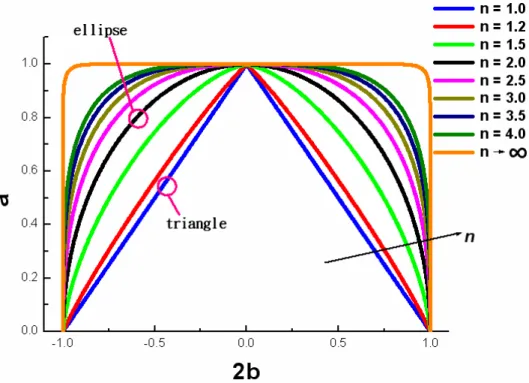
The novel superellipse has been developed to fit any body of various shape as shown in Fig. 2. It is obvious that geometric profile is approaching to a rectangle as a superellipse geometric parameter, n is increasing up to four.
Figs. 3. When e = 0 (circular cylinder) and e = 1 (flat plate), the condensate film profiles show a fairly good agreement between the Nusselt’s [1916] and Yang and Chen [1993b] theoretical prediction results. Note that on the top of vertical flat plate (e→ 1), one may find the film thickness approaching to zero.
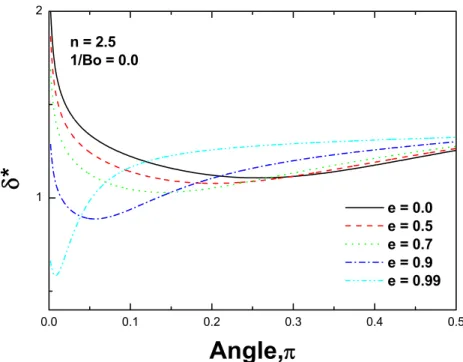
Secondly, for the case of the superellipse geometry parameter, n = 2.5, the surface wall approaches to a square. It is seen from Fig. 2 that the superellipse geometry becomes a straight contour for both near the up-stagnation point and the down-stagnation point. Note that the film thickness is accumulated significantly at θ = 0. Fig. 4 demonstrates that the local film thickness is decreasing greatly within the very closed to the up-stagnation point and then slowly up to the minimum value. Next, local heat transfer coefficient begins to increase because the condensate film accumulates thicker enough and drips off. In general, the higher ellipticity is, the more significantly appreciable variation of surface curvature is. In other words, for the cases of higher values of e, the smaller θ value is, the greater of arc length contained is.
Finally, for the case of n = 4, superellipse geometry is quite close to a rectangle as shown in Fig. 2. Since the geometric surface tends to flatness for n = 4.0, the condensate film accumulates favorably and thickly.
Consequently, the local film thickness is quite large in the beginning and then decreases as the condensate film is drawn down as shown in Figs 5. As the film flows behind the corner, the local heat transfer coefficient diminishes.
(II). Effect of surface tension
For the case of the superellipse geometry parameter, n = 2, the effect of the surface tension on the film profile is caused by the variation of radius of surface curvature, as illustrated in Figs. 6. Owing to the positive surface tension, the condensate film becomes thinner, above all near θ = 0 stagnation point. Besides, it is also found that the condensate film profile is independent of surface tension effect for different values of e because radius of surface curvature remains unchanged.
Moreover, note that for n = 1.5, the superellipse geometry slightly tends towards a straight line. Thus, the influence of the surface tension on the condensate film profiles is
B. Characteristics of condensation heat transfer
(I). Role of geometric configuration parameters: n and e
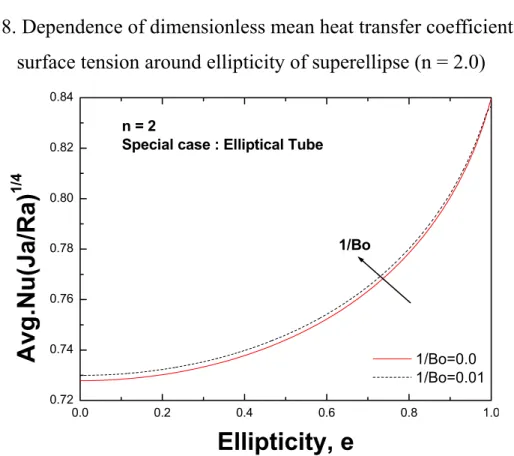
Firstly, for the case of the superellipse geometry parameter, n = 2, the effect of surface tension increases with ellipticity, e. Consequently, the mean heat transfer coefficient,Nu , is enhanced with increasing e as shown in Fig.8. It is verified in Fig. 9 that the numerical evaluation from the integral of Eq. (28) for e = 0 (circular tube) and 1/Bo = 0 is identical to the result of Yang and Chen[1993b].
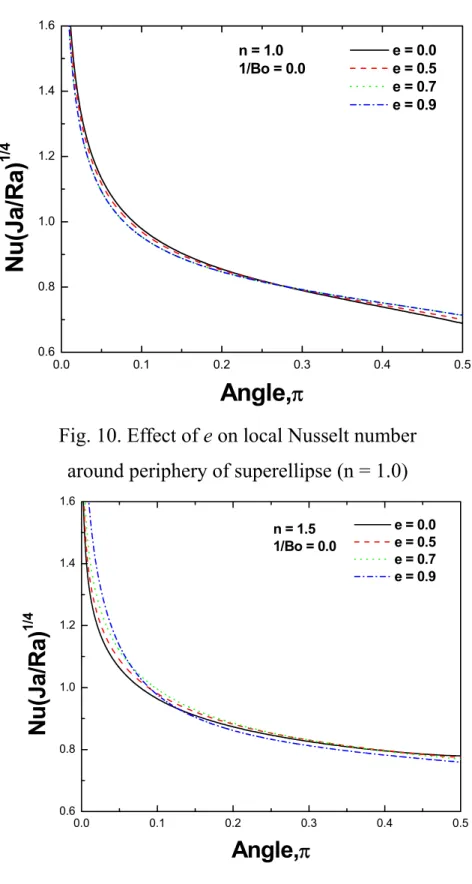
Furthermore, for n = 1(triangle), the condensate film profile is demonstrated in Fig. 2. It is interesting to note that the local heat transfer coefficient is just inversely proportional to film thickness of condensate as shown in Figs 10.
Thirdly, for n = 1.5, the radius of curvature varies with every local angle, the dependence of local heat transfer coefficient on the ellipticity is illustrated in Fig. 11. It is obvious from this figure that local heat transfer coefficient is augmented with an increase in e, for some angles such as θ<0.1π. While, for θ>0.4π, the local heat transfer coefficient is reduced with increasing e. This trend can be explained by the influence of different surface tension at different position. The mean heat transfer coefficient is enhanced with increasing e.
(II). Effect of surface tension
When the superellipse parameter, n, equals to unity, the radius of curvature remains a constant. Consequently, it is evident, from Fig. 12, that both local and mean heat transfer coefficients are independent of surface tension effect.
Fig. 13 indicates that the mean heat transfer coefficient is enhanced with ellipticity e. It is also obvious that the effect of surface tension for n = 2.5 is quite appreciable and the mean heat transfer coefficient increases with an increase in 1/Bo.
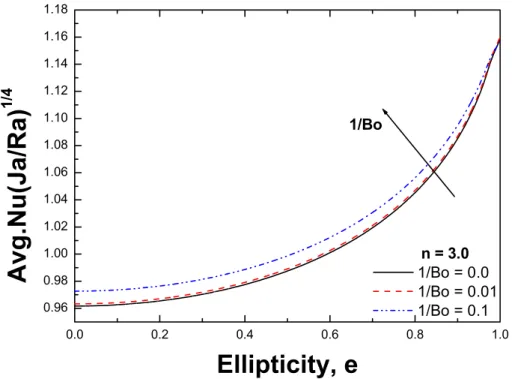
As for n =3, Fig. 14 shows that mean heat transfer coefficients are augmented with an increase in e and the effect of the surface tension becomes more significant for the
smaller e. The effects of e and surface tension on the heat transfer coefficient for n = 3.5 are similar to those for n = 3. For the case of n = 4, from Fig. 15, it is found that the greater the effect of the surface tension, the better the mean heat transfer coefficient.
4. CONCLUDING REMARKS
This paper describes various kinds of axial symmetry geometry forms by the relationship of superellipse geometry parameter n and ellipticity e, superellipses provide an interesting form for representing a spectrum of objects whose shape varies among rectangles, ellipses, diamonds, and pinched diamonds, etc. It should be noted that the numerical results use Nusselt numbers based on an equal condensing area diameter rather than a hydraulic diameter. The result obtained only applies to the very slow or quiescent vapor condensing outside horizontal superelliptical surface, with negligible interfacial vapor shear drag. Taghavi [1988] confirmed the good significance concerning the effect of neglected film thickness on the mean heat transfer coefficient. Three major conclusions are warranted in the present study.
(1) Unlike the Nusselt model, considering the gravity drain alone, the present analysis considers both the gravity and surface tension forces. The results indicate the surface tension has an influence on the local heat transfer rate and hydrodynamics characteristics, but the effect of surface tension force on the mean heat transfer coefficient is nearly insignificant especially for larger ellipticity.
(2) For all values of n, the mean heat transfer coefficient is enhanced with increasing ellipticity, e.
(3) The superellipse geometric parameter (n value) exerts a significant effect on the mean heat transfer coefficient. The less n is, the higher the mean heat transfer coefficient is.
5. ACKNOWLEDGMENT
Funding for this investigation was provided partially by National Science Foundation, Taiwan, R. O. C. under the grant number NSC94-2212-E-151-020.
Gravity dx y a b b
Super-Elliptical Fin Wall
Enlarge View of dx Condensate Film Condensate Element
(
ρ
−ρ
v)
gSinφ
θ
rd(
π
/2)
+φ
−θ
dxθ
dθ
φ
xFig.2. n denotes the various geometric profile parameter
0.0 0.1 0.2 0.3 0.4 0.5 0.0 0.2 0.4 0.6 0.8 1.0 1.2 1.4 1.6 1.8 2.0 n = 2.0 1/Bo = 0.0δ*
Angle,
π
e = 0.0 e = 0.5 e = 0.7 e = 0.9 e = 0.99Fig. 3. Effects of e on dimensionless local film thickness around periphery of
superellipse (n = 2.0)
0.0 0.1 0.2 0.3 0.4 0.5 1 n = 2.5 1/Bo = 0.0
δ*
Angle,
π
e = 0.0 e = 0.5 e = 0.7 e = 0.9 e = 0.99Fig. 4. Effects of e on dimensionless local film thickness
around periphery of superellipse (n = 2.5)
0.0 0.1 0.2 0.3 0.4 0.5 1 2 3 n = 4.0 1/Bo = 0.0
δ*
Angle,
π
e = 0.0 e = 0.5 e = 0.7 e = 0.9 e = 0.99Fig. 5. Effects of e on dimensionless local film thickness
around periphery of superellipse (n = 4.0)
0.0 0.1 0.2 0.3 0.4 0.5 0.6 0.8 1.0 1.2 1.4 n = 2.0 e = 0.0 ; 1/Bo=0.0 e = 0.0 ; 1/Bo=0.1 e = 0.5 ; 1/Bo=0.0 e = 0.5 ; 1/Bo=0.1 e = 0.9 ; 1/Bo=0.0 e = 0.9 ; 1/Bo=0.1
δ*
Angle,
π
Fig. 6. Dependence of dimensionless local film thickness on surface tension
around periphery of superellipse (n = 2.0)
0.0 0.1 0.2 0.3 0.4 0.5 0.6 0.8 1.0 1.2 1.4 n = 1.5 e = 0.0 ; 1/Bo=0.0 e = 0.0 ; 1/Bo=0.1 e = 0.5 ; 1/Bo=0.0 e = 0.5 ; 1/Bo=0.1 e = 0.9 ; 1/Bo=0.0 e = 0.9 ; 1/Bo=0.1
δ*
Angle,
π
Fig. 7. Dependence of dimensionless local film thickness on surface tension
around periphery of superellipse (n = 1.5)
0.0 0.2 0.4 0.6 0.8 1.0 1.00 1.02 1.04 1.06 1.08 1.10 1.12 1.14 1.16 1/Bo
Avg.Nu(Ja/Ra)
1/4Ellipticity, e
n = 2.0 1/Bo = 0.0 1/Bo = 0.001 1/Bo = 0.1Fig. 8. Dependence of dimensionless mean heat transfer coefficient on
surface tension around ellipticity of superellipse (n = 2.0)
0.0 0.2 0.4 0.6 0.8 1.0 0.72 0.74 0.76 0.78 0.80 0.82 0.84 1/Bo n = 2
Special case : Elliptical Tube
Avg.Nu
(Ja/Ra
)
1/ 4Ellipticity, e
1/Bo=0.0 1/Bo=0.01Fig. 9. Dependence of dimensionless mean heat transfer coefficient on
surface tension around ellipticity of superellipse (n = 2.0, special case)
0.0 0.1 0.2 0.3 0.4 0.5 0.6 0.8 1.0 1.2 1.4 1.6 n = 1.0 1/Bo = 0.0 e = 0.0 e = 0.5 e = 0.7 e = 0.9
Nu
(J
a/
Ra)
1/ 4Angle,
π
Fig. 10. Effect of e on local Nusselt number
around periphery of superellipse (n = 1.0)
0.0 0.1 0.2 0.3 0.4 0.5 0.6 0.8 1.0 1.2 1.4 1.6 n = 1.5 1/Bo = 0.0 e = 0.0 e = 0.5 e = 0.7 e = 0.9
N
u
(Ja/
Ra)
1/ 4Angle,
π
0.0 0.2 0.4 0.6 0.8 1.0 1.06 1.08 1.10 1.12 1.14 1.16 1.18
Avg.Nu(Ja/Ra)
1/ 4Ellipticity, e
n = 1.0 1/Bo = 0.0 1/Bo = 0.001 1/Bo = 0.1Fig. 12. Dependence of dimensionless mean heat transfer coefficient
on surface tension around ellipticity of superellipse (n = 1.0)
0.0 0.2 0.4 0.6 0.8 1.0 0.98 1.00 1.02 1.04 1.06 1.08 1.10 1.12 1.14 1.16 1.18 1/Bo
Avg.Nu(Ja/Ra)
1/ 4Ellipticity, e
n = 2.5 1/Bo = 0.0 1/Bo = 0.01 1/Bo = 0.1Fig. 13. Dependence of dimensionless mean heat transfer coefficient
on surface tension around ellipticity of superellipse (n = 2.5)
0.0 0.2 0.4 0.6 0.8 1.0 0.96 0.98 1.00 1.02 1.04 1.06 1.08 1.10 1.12 1.14 1.16 1.18 1/Bo
Avg.Nu(Ja/Ra)
1/ 4Ellipticity, e
n = 3.0 1/Bo = 0.0 1/Bo = 0.01 1/Bo = 0.1Fig. 14. Dependence of dimensionless mean heat transfer coefficient
on surface tension around ellipticity of superellipse (n = 3.0)
0.0 0.2 0.4 0.6 0.8 1.0 0.92 0.94 0.96 0.98 1.00 1.02 1.04 1.06 1.08 1.10 1.12 1.14 1.16 1.18 1.20 1/Bo
Avg.Nu(Ja/Ra)
1/ 4Ellipticity, e
n = 4.0 1/Bo = 0.0 1/Bo = 0.01 1/Bo = 0.11.
Barr, A., 1981, Superquadrics and angle-preserving trans- formations,
IEEE Computer. Graphics App1, pp. 11-23.
2.
Bromley, L. A., 1952, Effect of heat capacity of condensate, Int. Engng.
Chem. 44, pp. 2966-2969.
3.
Chen, M. M., 1961, An analytical study of laminar film condensation:
part 2- single and multiple horizontal tubes, J Heat Transfers, pp. 55-60.
4.
Churchill, S. W., 1986, Laminar film condensation, Int. J. Heat Mass
Transfer 29, pp. 1219-1226.
5.
Cur, N., & Sparrow, E. M., 1979, Measurement of Developing and Fully
Developed Heat Transfer Coefficients along a Periodically Interrupted
Surface, J. Heat transfer, Vol.101, pp.211-216.
6.
Dhir, V. K., & Lienhard, J. H., 1971, Laminar film condensation on
plane and axisymmetric bodies in non-uniform gravity, J. Heat Transfer,
93C, pp. 97-100.
7.
Gardiner, M., 1965, The superellipse:a curve that lies between the
ellipse and the rectangle, Scientific American, Vol.21, pp.222–234.
8.
Karimi, A. 1977, Laminar film condensation on helical reflux
condensers and related configurations, Int. J. Heat and Mass Transfer 20,
pp.1137-1144.
9.
Koh, J. C. Y., 1961, On integral treatment of two phase boundary layer
in film condensation, J. Heat Transfer 83, pp. 359-362.
10.
Krupiczka, R., 1985, Effect of surface tension on laminar film
condensation on a horizontal cylinder, Chem. Engng. Process. 19,
pp.199-203.
11.
Nusselt, W., 1916, Die oberflachen kondensation des wasserdampers,
12.
Pentalnd, A., 1986, Perceptual organization and the representation of
natural form, Artificial Intelligence vol. 28, pp. 293-331.
13.
Rohsenow, W. M., 1956, Heat transfer and temperature distribution in
laminar film condensation, Trans ASME 78, pp. 1645-1648.
14.
Semenov, V. P. & Shkiover, G. G. & Usachev, A. M. & Semenova, T.
P., 1990, Enhancement of heat transfer in condensation of steam on a
horizontal non-circular pipe, Heat Transfer-Soviet Research 22, no. 1,
pp. 15-20.
15.
Taghavi, K., 1988, Effect of surface curvature on laminar film
condensation, J. Heat Transfer, ASME 110, pp. 268-270.
16.
Yang, S. A. & Chen, C.K., 1993,Effects of Surface Tension and
Nonisothermal Wall Temperature Variation upon Filmwise
Condensation on Vertical Ellipsoids/sphere, Proc. Royal Society Lord, A:
442, pp.301-312.
17.
Yang, S. A. & Chen, C. K., 1993, Role of surface tension and ellipticity
in laminar film condensation on a horizontal elliptical tube, Int. J. Heat
and Mass Transfer Vol.36, pp.3135-3141.
(a) Submitted to Int. J. Heat and Mass Transfer (Under reviewing)
Thermodynamic Optimization of Free Convection Film
Condensation on a Horizontal Elliptical Tube with Variable
Wall Temperature
Sheng-An Yang a, *, Guan-Cyun Li a, Wen-Jei Yang b
a Department of Mold and Die Engineering, National Kaohsiung University of Applied Sciences, 415
Chien-Kung Road, Kaohsiung 80778, Taiwan, R.O.C.
b Department of Mechanical Engineering, University of Michigan, Ann Arbor, Michigan 48109-2125 , U.S.A.
*E-mail: [email protected]
*Tel.: +886-7-3814526 ext. 5412 *Fax: +886-7-3835015
Abstract
This study focuses on the thermodynamic analysis of saturated vapor flowing slowly onto and condensing on an elliptical tube with variable wall temperature. An entropy generation minimization, EGM, technique is applied as a unique measure to study the thermodynamic losses caused by heat transfer and film flow friction for the laminar film condensation on a non-isothermal horizontal elliptical tube. The results provide us how the geometric parameter-ellipticity and the amplitude of non-isothermal wall temperature variation affect entropy generation during film-wise condensation heat transfer process. The optimal design can be achieved by analyzing entropy generation in film condensation on a horizontal elliptical tube with further account for the amplitude of non-isothermal wall temperature variation.
Keywords: free convection; variable wall temperature; condensation; thermodynamic
second law; elliptical tube