Research Express@NCKU - Articles Digest
Research Express@NCKU Volume 19 Issue 1 - June 24, 2011 [ http://research.ncku.edu.tw/re/articles/e/20110624/3.html ]
Preparation and properties of crosslinked sulphonated
poly(arylene ether sulphone) blend membranes for
direct methanol fuel cell applications
Jie-Cheng Tsai
1, Chien-Kung Lin
2,*, Jen-Feng Kuo
2, Chuh-Yung Chen
21Advanced Propulsion and Power System Research Center, National Cheng-Kung University, Tainan, 70148, Taiwan
2Department of Chemical Engineering, National Cheng-Kung University, Tainan, 70148, Taiwan [email protected]
Journal of Power Sources 195, 4072-4079 (2010) 1.
I
ntroductionThe direct methanol fuel cell (DMFC) is an attractive candidate for a mobile energy source because of its advantageous properties such as its highly efficient energy conversion, low operating temperature, simple design and no requirement of a fuel reforming process [1,2]. The proton exchange membrane (PEM) is one of the most important components in a DMFC.
In recent years, several efforts have been made to replace the Nafion® membranes. Among the PEMs being developed, hydrocarbon-based aromatic polymers have been suggested as new PEM materials such as sulphonated poly(ether sulphone) (SPES) [3], sulphonated poly (ether ether ketone) (SPEEK) [4], sulphonated
polybenzimidazole (SPBI) [5], and sulphonated polyimide (SPI) [6]. Unfortunately, such a high loading of acidic groups leads to excessive swelling and methanol crossover, which permeates through the ionic channels and clusters of membranes [7,8].
Crosslinking is a feasible and effective method to suppress water swelling and methanol diffusion of highly sulphonated polymers [9]. In this paper, a crosslinked blend membrane was composed of uncrosslinkable SPES and crosslinkable SPES, which was prepared via the direct polymerisation method suggested by McGrath and co-workers [10,11], to introduce an interesting stilbene core as a crosslinkable group on polymer main chain and then crosslinked by UV irradiation. This novel crosslinking method can avoid the consumption of sulphonic acid groups by UV irradiation and the decrease of sulphonic acid concentration by introduction of a crosslinkable sulphonated polymer, benefit the compatibility with blending crosslinkable SPES into uncrosslinkable SPES matrix due to the similar structure of these two fully aromatic copolymers, and hence form a more compact network structure, which effectively suppresses the swelling and methanol permeability.
2. Experimental
2.1. Membrane preparation
The crosslinked BPASH/HMSSH blend membrane was prepared by a solution casting method. Benzophenone and triethylamine as the photo-initiator system were added to the solution. The mixture was then cast onto a glass dish and dried under vacuum at 80°C. To obtain the crosslinked blend membrane, the dried membrane was irradiated for 20 min with a 600-W UV light. The crosslinked blend membrane thus prepared was designated as BPASH/
Research Express@NCKU - Articles Digest
HMSSH-X, where X is the HMSSH content in the membrane.
Figure 1 The 1H NMR spectra for (a) HMSSH and (b) BPASH. 3. Results and discussion
3.1. Copolymer characteristics
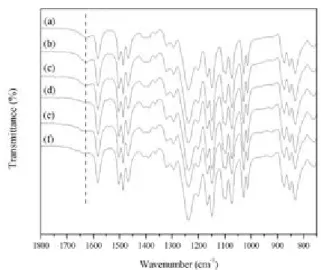
The FT-IR ATR technique was used to analyse the functional groups in the polymer structure. Figure 1 (a) – (f) shows the FT-IR ATR spectra of uncrosslinked and crosslinked BPASH/HMSSH blend membranes. The strong characteristic peaks at 1030 and 1098
cm–1 were assigned to symmetric and
asymmetric stretching of sulphonate groups, respectively, which were observed for BPASH and HMSSH loaded with sulphonate groups. The absorption of the Ar–O–Ar linkage in the
polymer backbone appears at 1008 cm–1. The intensity of the absorption peak at 1626 cm–1 assigned to trans C=C
double bonds of crosslinkable HMSSH obviously decreased by UV irradiation, which indicates the occurrence of crosslinking. Moreover, the crosslinked blend membranes became insoluble in DMAc, DMF, DMSO and NMP solvents after full thermal treatment, which also indicates the formation of crosslinkage among the HMSSH polymer chains.
Figure 2 The proton conductivity for native BPASH and crosslinked BPASH/HMSSH blend membranes.
3.2. Proton conductivity
The performance of a DMFC is mainly determined by proton conductivity and methanol permeability. Figure 2 shows the proton conductivities of native BPASH and crosslinked BPASH/HMSSH blend membranes as functions of temperature. The proton conductivity was slightly reduced. BPASH showed a proton conductivity of 0.087 S cm−1, whereas the crosslinked blend
membranes exhibited proton conductivities of 0.085 S cm−1, 0.080 S cm−1, and 0.076 S cm−1 with an increase of crosslinker from 3% to 9% at 30°C.
Although this led to a slight reduction in proton
conductivity, the proton conductivity of the crosslinked blend membranes was maintained at the level of 10−2 S cm
−1, which is comparable to that of Nafion® 117 (0.098 S cm−1). The decrease in proton conductivity could have resulted from the crosslinkage restricting morphological structure and decreasing the free volume in the
membrane, which may have resulted in fewer and smaller hydrophilic channels and ionic clusters for water uptake, hindering the transfer of hydrated protons in the water phase.
3.3. Single-cell performance
Research Express@NCKU - Articles Digest
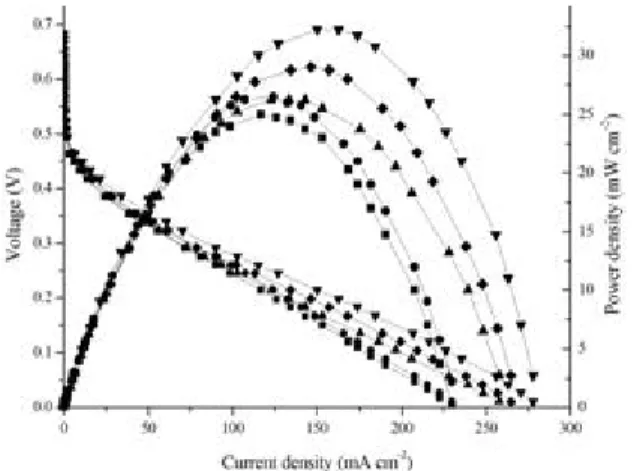
Figure 3 The performance with polarisation (a) and power density (b).
Nafion® 117, BPASH and crosslinked BAPSH/ HMSSH blend membranes were used in DMFC. Figure 3 shows the performance with polarisation (a) and power density (b) as functions of current density with various contents of crosslinker. Single cells with any of the crosslinked blend membranes had a higher open circuit voltage (OCV 0.65–0.68 V) than did Nafion® 117 (OCV 0.59 V). The higher OCV clearly indicates that the introduction of crosslinker significantly decreased the rate of methanol crossover in the DMFC applications due to the relatively low methanol permeability. The crosslinked blend membrane with a content of 6%
crosslinker had the highest power density (32 mW cm–2), which was better than that of the other crosslinked blend
membranes and of Nafion® 117 (25 mW cm–2).
4. Conclusion
Crosslinked blend membranes are obtained by blending the crosslinkable HMSSH with BPASH by UV irradiation of the blend membrane, which can avoid the consumption and dilution of sulphonic acid groups and benefit the compatibility with blending HMSSH into BPASH matrix. The studies showed that compared with the pristine BPASH, the incorporation of crosslinker in BPASH decreased the methanol permeability of the membrane, significantly suppressed methanol-crossover, decreased the water uptake, and retained reasonable thermal properties. Although the conductivity was decreased, the methanol crossover of the crosslinked blend membranes could be decreased as a result of reduced hydrophilic channels and ionic clusters for water uptake. The
experimental results revealed that the crosslinked blend membranes with 6% HMSSH content exhibited the higher OCV and superior single-cell performance compared with that of the other crosslinked blend membranes and of Nafion® 117. The promising observed single-cell performance and durability test suggest that crosslinked blend membranes warrant serious consideration for use in future DMFC applications.
Acknowledgements
The authors are extremely grateful to Ms P.Y. Lin and Professor W.H. Lai for their crucial contribution to the 1H NMR experiments and the single-cell performance test.
References
[1] V. Neburchilov, J. Martin, H. Wang, J. Zhang, J. Power Sources 169 (2007) 221–238.
[2] M.A. Hickner, H. Ghassemi, Y.S. Kim, B.R. Einsla, J.E. McGrath, Chem. Rev. 104 (2004) 4587–4612. [3] W.L. Harrison, M.A. Hickner, Y.S. Kim, J.E. McGrath, Fuel Cells 5 (2005) 201–212.
[4] L. Li, J. Zhang, Y.X. Wang, J. Membr. Sci. 226 (2003) 159–167. [5] M. Rikukawa, K. Sanui, Prog. Polym. Sci. 25 (2000) 1463–1502.
[6] N. Asano, M. Aoki, S. Suzuki, K. Miyatake, H. Uchida, M. Watanabe, J. Am. Chem. Soc., 128 (2006) 1762–1769.
[7] C. Manea, M. Mulder, J. Membr. Sci. 206 (2002) 443–453. [8] K.D. Kreuer, J. Membr. Sci. 185 (2001) 29–39.
[9] J.A. Kerres, Fuel Cells 5 (2005) 230–247.
Research Express@NCKU - Articles Digest
[10] W.L. Harrison, M.A. Hickner, Y.S. Kim, J.E. McGrath, Fuel cell 5 (2005) 201–212.
[11] W.L. Harrison, F. Wang, J.B. Mecham, V.A. Bhanu, M. Hill, Y.S. Kim, J.E. McGrath, J. Polym. Sci. Part A: Polym. Chem. 41 (2003) 2264–2276.