CHAPTER II. LITERATURE REVIEW
Internationalization Theory
When it comes to studying on internationalization of an enterprise, the stage model, which conceptualizes the process of change in terms of sequential stages, has been widely used in relevant literature (Chetty, 1999; Lam & White, 1999). Hereby, two models from the standpoint of internationalization stages are reviewed, namely the Uppsala model proposed by Johanson & Vahlne (1977) and another five-stage model suggested by Briscoe & Schuler (2004).
Uppsala View of the Internationalization Process
Johanson & Vahlne (1977) developed a classic internationalization process (IP) model through the behavioral theory of individual firms. In order to understand how a firm makes decisions to increase its international involvement, the two scholars created a dynamic model that focuses on its gradual acquisition, integration, and use of knowledge of foreign markets and operations, and on its successively increasing commitment to foreign markets.
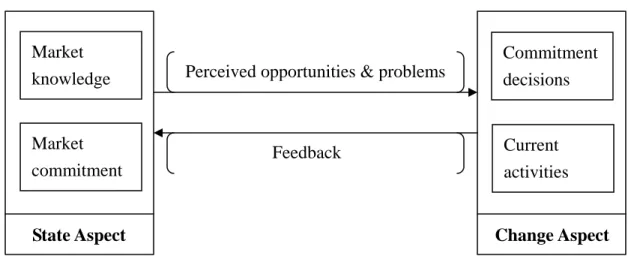
As the schematic illustration in Figure 1 shows, the “state of internationalization” (i.e.
knowledge about foreign markets and resource commitment to foreign markets) will affect how the company perceives existing opportunities and problems in foreign markets, and such perception successively influences both the commitment decisions and the way current activities are performed. These two “change aspects of internationalization” in turn alter market knowledge and commitment.
State Aspect Change Aspect
Figure 2.1 The basic mechanism of internationalization---state and change aspects Source: Adapted from Johanson & Vahlne (1977)
In brief, the outcome of one decision (or more generally one cycle of events) constitutes the input of the next. This classic Uppsala dynamic model is useful for explaining the decision-making behavior of a single company that evolves toward the next step/stage of internationalization. However, such model has not clearly identified what possible stages a company might go through in its internationalization process. Therefore, another internationalization theory which better conforms to the demand of this research is reviewed in the next paragraph.
Briscoe & Schuler’s Stage Model
Briscoe & Schuler (2004, pp.38-46) proposed a five-degree internationalization stage model from the perspective of geographic scope as (1) international; (2) multi-country or multi-domestic; (3) regional; (4) global; or (5) transnational.
At the international stage, a firm makes the initial decision to go international through only exporting to foreign customers or importing from foreign suppliers. Afterwards, as the proportion of foreign sales increases, or global sourcing gets more and more important, the company may choose to form international divisions to take charge of all international
Market knowledge
Market commitment
Current activities Commitment decisions Perceived opportunities & problems
Feedback
operations. Many service-oriented businesses begin their internationalization process with the establishment of offices or service centers abroad.
At the multi-domestic stage, a firm sets up subsidiaries in multiple countries, which operate independently of operations in other countries, and even independent of the home-country headquarters. Cullen & Parboteeah (2005, p.150) mentioned that multi-domestic firms give priority to local responsiveness, that is, their products or services attract customers by satisfying local cultural flavors and needs.
An alternative to the multi-domestic strategy is through running international businesses on a regional basis, with the assumption that countries in a region share some common characteristics like country culture or stage of economic development. Moreover, the rise of trading blocs such as European Union (EU) has led to more uniformity of customer needs and less governmental regulations within member nations, where regional products and regional location advantages are pursued (Cullen & Parboteeah, 2005, p.153).
In recent years, many MNCs have reached the state of internationalization where their operations are becoming blind to national boarders. Even though they may still organize based on regions and adequate adaptation to local customer preferences may still be necessary, these so-called “global” firms incline to look at the whole world as one market and create products or services where costs are the lowest and quality is the highest throughout the world to obtain economies of scale and global efficiency. Although a global firm may disperse its value chain activities worldwide, its strategic decisions, resources, and information are tightly controlled by what Bartlett & Ghoshal (1988) called the “centralized hub” in the home country.
Bartlett & Ghoshal (1988) also suggested firms to evolve beyond the simpler multi-domestic (i.e. decentralized, local responsive) or global (i.e. centralized, efficient) approach, and to develop the “transnational capability” to achieve global integration and national flexibility simultaneously. A transnational firm manages across national boundaries
with dynamic interdependence of resources and responsibilities among organizational units.
In other words, there is interdependent relationship among individual branches and the headquarters. For instance, by “thinking globally and acting locally”, national resources (expertise or experience) are sent back to the headquarters for developing strategy; afterwards, the corporate management is willing to delegate design, development, and manufacturing responsibilities to overseas subsidiaries.
All in all, Briscoe & Schuler’s stage model (2004) classifies the sequential development process of an international firm into five stages based on its growth and maturity, in which the pioneering concept of “transnational company” proposed by Bartlett & Ghoshal (1988) that is extremely influential and probably is the most extensive typology of MNCs so far (Harzing, 2000) is incorporated.
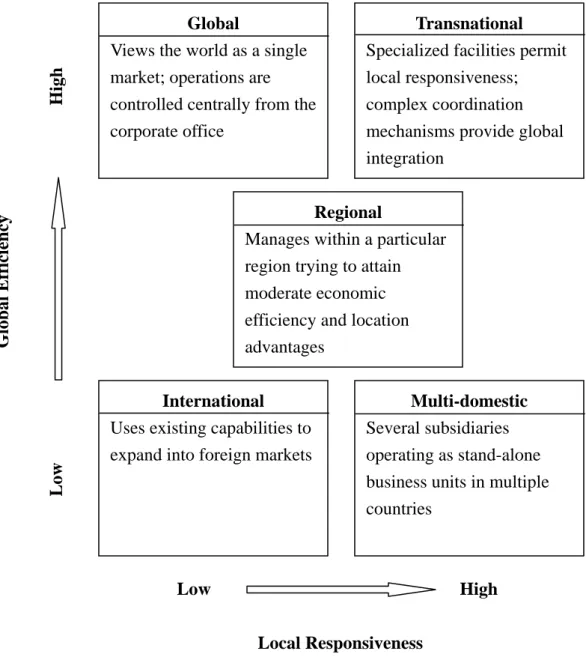
This five-stage internationalization model is demonstrated in Figure 2.2 according to the characteristics of each stage:
Figure 2.2 Characteristics of each stage of the internationalization process Source: Adapted from Bohlander & Snell (2004)
However, contrast to the sequential evolutionary concept, some researchers found out exceptions to such rule. According to their study on 11 Irish companies, Monks, Scullion &
Creaner (2001) discovered that due to the saturation of many international markets, late entrants to the international arena might bypass or leapfrog some of the stages of internationalization in their attempts to catch up with or overtake their more established
Global Efficiency High Low
Global
Views the world as a single market; operations are controlled centrally from the corporate office
Transnational Specialized facilities permit local responsiveness;
complex coordination mechanisms provide global integration
International Uses existing capabilities to expand into foreign markets
Multi-domestic Several subsidiaries operating as stand-alone business units in multiple countries
Regional
Manages within a particular region trying to attain moderate economic efficiency and location advantages
Low High
Local Responsiveness
international competitors.Moreover, many of these firms developed more comprehensive and proactive IHRM policies and procedures in order to assist their quick overseas expansion.
Besides, while utilizing the stage model as the basic concept to conduct a survey of the globalization of human resources, Arthur Andersen, the management consultants acknowledged that it is not always easy to allocate each company to one specific category (Robert, 2000). Because companies are complex organisms keeping evolving on the continuum of internationalization, some may just lie in the transition period or their operations are not perfectly identical to the characteristics of any stage. However, despite the difficulty of categorizing companies into their corresponding stages, the stage typology is still considered valuable in this research for us to better understand organizational characteristics of MNCs.
International Human Resources Strategy
According to the comment of Lam & White (1999), the international process often creates managerial dilemmas for organizations in terms of strategic, structural and human resource changes. In other words, internationalization concerns influence the MNC’s approach to HRM; conversely, HRM is also perceived to assist the MNC to fulfill its internationalization goals and concerns, and as such HRM is a means to an end rather than an end itself (Keating & Thompson, 2004). As Welch & Luostarinen (1988) explained in detail that “the success of internationalization in any company depends heavily on the type of people both initiating and carrying through the various steps in the process, and on overall personnel policies” (Lam & White, 1999, p.123), we know how important the role of international human resources strategy is during such organizational change process.
Thus, related IHRM literatures are reviewed in below two sections. First, an overview of the current trend in study of global staffing is provided. Then, the ideal IHRM orientation corresponding to each internationalization stage is reviewed.
Global Staffing --- Recruitment, Selection, and Training
According to Dowling & Welch (2004, p.83), recruitment is “searching for and obtaining potential job candidates in sufficient numbers and quality so that the organization can select the most appropriate people to fill its job needs”, and selection is “the process of gathering information for the purposes of evaluating and deciding who should be employed in particular jobs”. Furthermore, DeSimone, Werner & Harris (2002, p.10) gave definition to training as following: Training provides employees the knowledge, skills and attitudes needed to do a particular task or job.
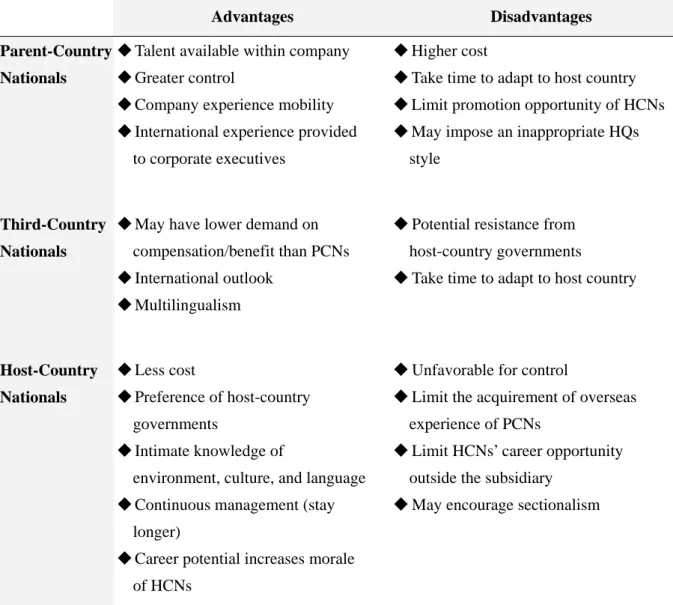
Basically, when a MNC expands its business to a foreign country, there are three sources of employees with whom to staff international operations, namely host-country nationals (HCNs), parent-country nationals (PCNs), and third-country nationals (TCNs). Table 2.1 is a
list of primary advantages and disadvantages of using each of them as overseas managers.
Table 2.1 Advantages and disadvantages in sources of overseas managers
Advantages Disadvantages
Parent-Country Nationals
Talent available within company
Greater control
Company experience mobility
International experience provided to corporate executives
Higher cost
Take time to adapt to host country
Limit promotion opportunity of HCNs
May impose an inappropriate HQs style
Third-Country Nationals
May have lower demand on compensation/benefit than PCNs
International outlook
Multilingualism
Potential resistance from host-country governments
Take time to adapt to host country
Host-Country Nationals
Less cost
Preference of host-country governments
Intimate knowledge of
environment, culture, and language
Continuous management (stay longer)
Career potential increases morale of HCNs
Unfavorable for control
Limit the acquirement of overseas experience of PCNs
Limit HCNs’ career opportunity outside the subsidiary
May encourage sectionalism
Sources: Adapted from Bohlander & Snell (2004) and Dowling & Welch (2004)
Although there are three sources for global staffing, the most common area of investigation in IHRM to date is regarding expatriation issues; especially of PCNs (Lloyd &
Hartel, 2004; Keating & Thompson, 2004). It is because comparing to HCNs who are already familiar with the host-country context, the recruitment, selection and training of expatriates have always been complexities.
First, a company needs to figure out the source of expatriates. Monks et al. (2001) listed two advantages of internal recruitment as opposed to external recruitment. On one hand, the company has better knowledge of the individual and the family. As Dowling, Welch &
Schuler (1999, p.102) proposed, lack of such knowledge while recruiting and selecting external TCNs may cause a danger that more emphasis will be placed on the candidate’s ability to fit into the corporate culture rather than on cross-cultural ability. On the other, internal recruitment accommodates to the growing tendency of using international assignments for career development purposes. Moreover, there are another two choices of expatriate recruitment. International assignees can come from either the regular organization or an international cadre of managers. The latter is to assure a sufficient supply of employees who expect and want to go aboard; however, the trend is gradually away from such system due to the diminishing need to fill positions in the developing world (Edstrom & Galbraith, 1994).
As for selection of expatriates, companies should emphasize on different elements including “the extent of contact that one would have with the local culture and the degree to which the foreign environment differs from the home environment” (Bohlander & Snell, 2004, p.649). According to Monks et al. (2001), companies usually give priority to the domestic track record, general management and technical skills when setting selection criteria.
Actually, more factors need to be taken into consideration to increase the success rate of international assignment, such as cross-cultural adaptability and family factors (Dowling &
Welch, 2004, p.98). Black, Gregersen, Mendenhall & Stroh (1999, p.82) also suggested the selection process with regard to international assignments should involve interviews or briefing sessions with the spouse for providing him/her with realistic expectations about the foreign country, and for determining dual-career and family needs. This way, the chances for success in a global assignment can be significantly enhanced.
Moreover, the training need for expatriates is closely related to selection criteria. As Edstrom & Galbraith (1994) mentioned, when the motive of expatriation is to fill an overseas position, the important consideration is to find someone with necessary qualifications.
Obviously, less training is required for such experienced and capable expatriates. On the other hand, if the transfer is made for developmental reasons, it would be ineffective to appoint someone overqualified for the post and hence has little to learn. Comparatively more supportive training sessions should be offered to these green hands. In addition, Bauer &
Taylor (2001) stressed the importance of providing training and support to an expatriate’s spouse, since poor adjustment by a spouse is a key reason why expatriates return early from their assignments.
Just because of the higher expense and the family relocation issue, there is an increasing use of short-term assignments as a substitute of traditional expatriation (Briscoe & Schuler, 2004, p.216; Monks et al., 2001). However, short-term foreign postings are not appropriate when the building of long-term relationships or critical cultural sensitivities is necessary for business success (Briscoe & Schuler, 2004, p.216).
Although expatriation issues are the main trend of investigation as mentioned earlier, TCNs, who are also expatriates, are treated lightly by practitioners and academics compared with PCNs. To the extent TCNs are covered in research, the focus has usually on compensations and benefits (Reynolds, 1997). Not to mention the more often neglected HCNs (Vance & Paik, 2005). This research doesn’t merely follow the main stream of studying expatriates, yet focuses on whoever assumes the role of middle management in overseas branches of MNCs.
IHRM Orientation at Each Internationalization Stage
Now that Lam & White (1999) mentioned the internationalization process leads to
are in recruitment, selection, and training of PCNs, TCNs and HCNs respectively when a MNC becomes more internationalized.
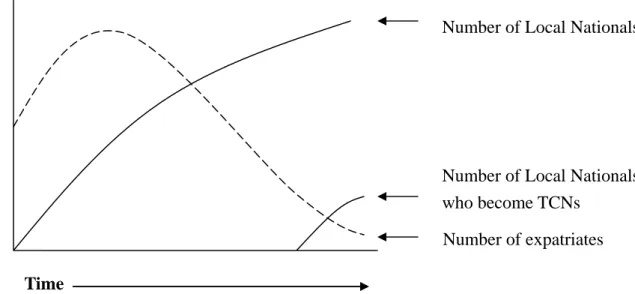
In Reynolds’ (1997) research, he proposed the possible variation of employment among these three sources of workers as a company grows and matures with time. It is obvious that a firm would send expatriates to transfer technology and lead the subsidiary in a planned direction for the first couple of years. Then, as local nationals become qualified, expatriates from the headquarters are less used and HCNs begin to fill senior positions and some even become TCNs themselves to help other subsidiaries operate. Figure 2.3 illustrates this trend graphically as following.
Figure 2.3 Evolution of a foreign subsidiary Source: Reynolds (1997)
In addition, Perlmutter (1969) has introduced an “EPG” typology decades ago to describe the accompanying shifts in attitudes of top management as the international firm evolves. He mentioned the attitudinal changes toward management could be described as a transition from ethnocentrism to polycentrism to geocentrism. Although in reality there are steps forward and steps backward, the desired direction seems to be the development of
NumberofEmployees
Time
Number of Local Nationals
Number of Local Nationals who become TCNs
Number of expatriates
geocentric attitude while managing human resources. Ethnocentrism is a home-country approach usually adopted when the company is relatively new overseas, in which people from the headquarters are used to fill key managerial positions and decision-making is centralized at head office. Nevertheless, polycentrism is a host-country approach, which uses local managers to fill key managerial positions. The geocentric approach is world-oriented where the best men, regardless of nationality, are needed for the key posts.
Similar to Perlmutter’s contention, in their stage model, Briscoe & Schuler (2004, pp.39-46) also noted the possible accompanying international human resources strategy a company might adopt corresponding to its internationalization phase:
At the very initial stage where only a few key managers or technical personnel are involved in export or import, the impact on domestic HR is fairly slight. While the international division or foreign offices are set up, parent-country nationals (PCNs) with specific product and business knowledge are sent on international assignments as expatriates.
Thus, HR takes on the responsibility for development of IHRM policies, practices, and decisions for foreign operations and management of expatriates.
As a firm makes more commitment to international markets by setting foreign subsidiaries, host-country nationals (HCNs) are largely employed to hold low-level jobs or mid-level management jobs by such subsidiaries emphasizing adaptation to cultural and institutional differences among countries; however, key personnel like top management are usually from the headquarters (PCNs) to retain adequate control over key issues. That is, although a multi-domestic firm is a decentralized federation of local businesses where each of its country-level subsidiaries is given considerable autonomy over HR matters, it is linked together through control of expatriates who occupy key positions abroad (Bartlett & Ghoshal, 2003).
Similar to the previous HR approach, a regionalized firm tends to adopt region-wide or
decide on its regional applicable HR policies. Usually host-country nationals (HCNs) or third-country nationals (TCNs) from the region take mid-level management positions or below with a “glass ceiling” for promotion since key people in the regional headquarters are those from the home company who master the cultures and languages of the countries in its regional locations (Cullen & Parboteeah, 2005, pp.408-411).
Unlike above-mentioned two phases, a firm evolving into the global stage concentrates on pursuing global consistency and economies of scale, so centralized HR policies are developed by the parent company and implemented in numerous places around the world. In addition, a global enterprise not only looks at the whole world as one market, but also views the talent pool on a global basis. Employees are hired from wherever the best quality (i.e.
necessary skills, training, and experience) for cost can be found regardless of their countries of origin, which usually means fewer expatriates in local subsidiaries and an increased use of TCNs. Moreover, key employees need to be multilingual, experienced in a number of countries, and culturally sensitive. Management promotions or selection will require international experience and managers will be developed from all major countries or regions of operation.
A transnational firm is similar to a global one in the sense that they both have a global focus and draw upon global expertise, technology, and resources. Capable employees are from worldwide, thus HR faces a huge challenge to manage the complex cultural diversity and managers need continuous training for cultural adaptation. However, when a firm progresses into the transnational stage, it strives to resolve the localization versus centralization dilemma that multi-domestic and global firms confront. According to Bartlett
& Ghoshal (1988), the headquarters may make decisions on﹝HR﹞strategic direction along with subsidiary boards and allow local units to develop their own details for implementation.
Moreover, a transnational firm creates cooperative and collaborative organizational climate among units through constant transfers and joint teams so that local managers regard
themselves as part of the parent company rather than independent autonomous units. When local managers being transferred to the headquarters, they are not only going to learn but also to bring their expertise. Thus, knowledge is developed jointly and shared worldwide (Bartlett
& Ghoshal, 2002, p.75). This is how a transnational firm builds interdependence of human resources among units.
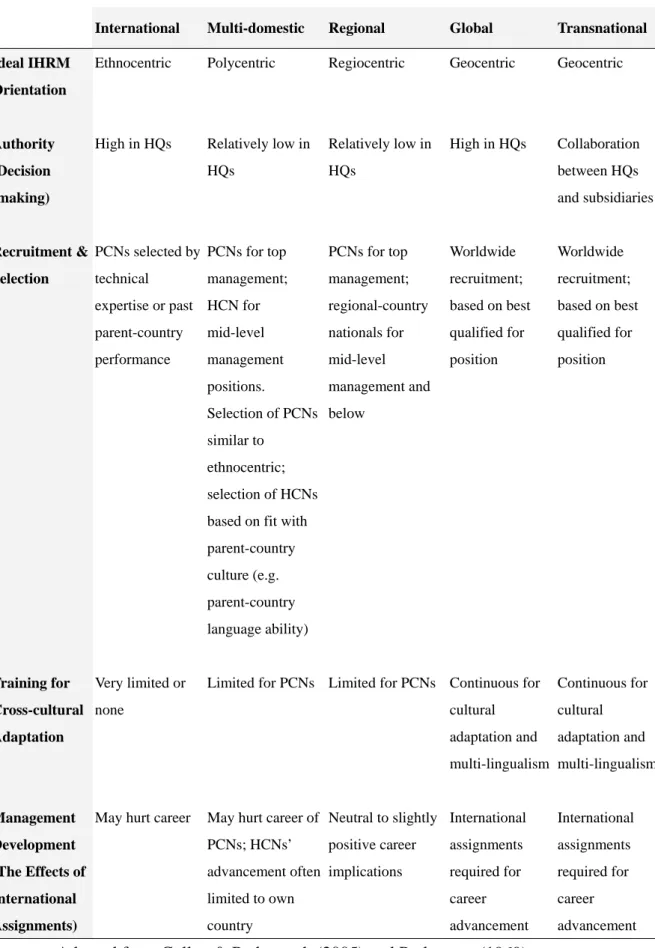
Combining above arguments, the ideal corresponding IHRM strategy at each internationalization stage is shown in Table 2.2.
Table 2.2 IHRM orientation at each internationalization stage
Internationalization Stage
International Multi-domestic Regional Global Transnational Ideal IHRM
Orientation
Ethnocentric Polycentric Regiocentric Geocentric Geocentric
Authority (Decision -making)
High in HQs Relatively low in HQs
Relatively low in HQs
High in HQs Collaboration between HQs and subsidiaries
Recruitment &
Selection
PCNs selected by technical
expertise or past parent-country performance
PCNs for top management;
HCN for mid-level management positions.
Selection of PCNs similar to
ethnocentric;
selection of HCNs based on fit with parent-country culture (e.g.
parent-country language ability)
PCNs for top management;
regional-country nationals for mid-level management and below
Worldwide recruitment;
based on best qualified for position
Worldwide recruitment;
based on best qualified for position
Training for Cross-cultural Adaptation
Very limited or none
Limited for PCNs Limited for PCNs Continuous for cultural adaptation and multi-lingualism
Continuous for cultural adaptation and multi-lingualism
Management Development (The Effects of International Assignments)
May hurt career May hurt career of PCNs; HCNs’
advancement often limited to own country
Neutral to slightly positive career implications
International assignments required for career advancement
International assignments required for career advancement
Sources: Adapted from Cullen & Parboteeah (2005) and Perlmutter (1969)
Briscoe & Schuler (2004, pp.39-46) proposed the ideal IHRM strategy corresponding to the degree of internationalization. Cullen & Parboteeah (2005, p.413) agreed with such point that a successful company selects the ideal IHRM orientation that best supports its internationalization development. However, they said usually no one IHRM orientation perfectly fits a company’s internationalization strategy/stage, and few companies follow any IHRM orientation completely. Rather, each MNC selects an ideal approach as the general IHRM policy combining with specific IHRM procedures from other orientations to meet its individual strategic needs.
Therefore, this research intends to compare practices with these two contentions and to see whether there is a single IHRM orientation ideal to an international company as Briscoe
& Schuler (2004)mentioned, or there is an eclectic or mixed IHRM orientation needed in the real business world as Cullen & Parboteeah (2005) claimed.
Banking Industry in Taiwan
Domestic Banks
For a long time, banking in Taiwan was under tight control of the government, thus financial businesses enjoyed high profitability from the monopoly market formerly. Situation has been changed after 1990, when the Taiwanese government started to loosen the regulations and permitted the establishment of volumes of new private banks. Although liberalization of the financial market was indeed a right direction to go, an excess numbers of banks led to very vicious competition among domestic banks. Problems like over crediting and high ratio of NPL (non-performing loan) emerged and many defective local banks were near the edge of bankruptcy. In order to reform this unsound phenomenon of over banking, new laws such as “The Financial Institutions Merger Act” and “Financial Holding Company Act” were enacted in year 2000 and 2001 respectively as thrust of integration of domestic banks (蘇法 & 林茂陽, 2004, pp. 65-76).
By September of 2006, there are 43 domestic banks and 14 financial holding companies, still far more than the optimal quantity on Taiwanese financial market. The trend of merger among banks, insurance companies and securities houses will keep going on in pursuit of economics of scale and cross-industry synergy (Financial Holding Company Act, 2005). To compete with foreign financial consortiums after Taiwan entered into the World Trade Organization (WTO) since 2002, it is necessary for domestic banks to seek consolidation and diversification.
Therefore, Taiwanese government proclaims the financial vision for the following years as consolidation, privatization and internationalization. In the light of statistics at the year end of 2005, although the government-dominant banks have assets over 50% on the market share, their pretax net profit share is only 8.40%, far less than that of domestic private banks (71.25%). It is planned to gradually sell government-owned stocks through market mechanism to promote efficiency. As for pushing ahead with internationalization of domestic
banks, our government encourages foreign businesses to invest in or to form strategic alliance with domestic banks, letting the latter learn from the former about internationally operational experience. Furthermore, domestic banks with soundness and competitiveness will be given priority over others to set overseas branches with approval (金融市場套案計畫, 2006).
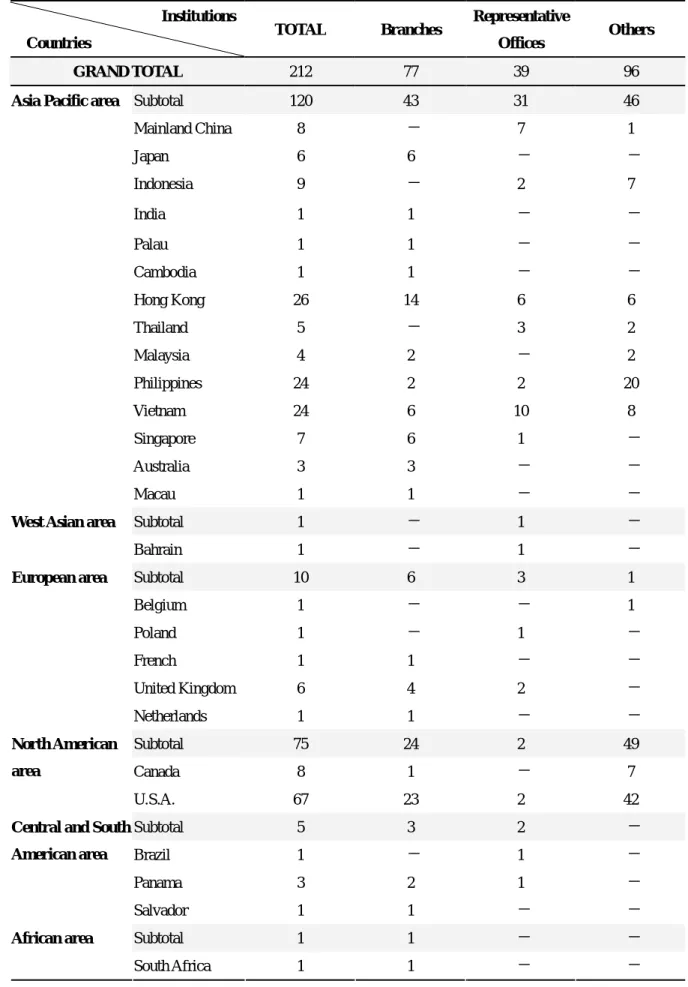
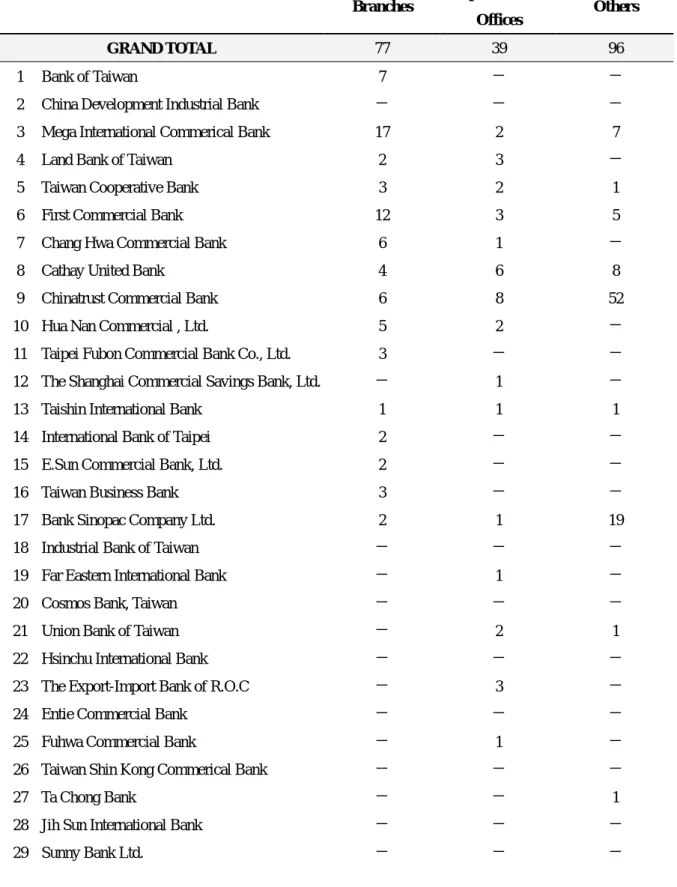
Table 2.3 shows the current internationalization status of domestic banks. The majority of overseas branches locates in Asia Pacific area and the U.S., where Taiwanese manufacturers site plants or branch companies. Table 4 illustrates the respective numbers of overseas branches of 43 domestic banks listed by their ranking of equities. It seems that larger banks are more internationalized than smaller ones. Consequently, it can be asserted that merger and consolidation among banks on Taiwanese financial market is beneficial for the internationalization of domestic banks. It is expected to see more local banks progress along the road of internationalization due to the reforms made by our government and the need for financial services from overseas Taiwanese manufacturers.
Table 2.3 Numbers of overseas branches of domestic banks (End of Sept., 2006)
Institutions
Countries TOTAL Branches Representative
Offices Others
GRAND TOTAL 212 77 39 96
Subtotal 120 43 31 46
Mainland China 8 - 7 1
Japan 6 6 - -
Indonesia 9 - 2 7
India 1 1 - -
Palau 1 1 - -
Cambodia 1 1 - -
Hong Kong 26 14 6 6
Thailand 5 - 3 2
Malaysia 4 2 - 2
Philippines 24 2 2 20
Vietnam 24 6 10 8
Singapore 7 6 1 -
Australia 3 3 - -
Asia Pacific area
Macau 1 1 - -
Subtotal 1 - 1 -
West Asian area
Bahrain 1 - 1 -
Subtotal 10 6 3 1
Belgium 1 - - 1
Poland 1 - 1 -
French 1 1 - -
United Kingdom 6 4 2 -
European area
Netherlands 1 1 - -
Subtotal 75 24 2 49
Canada 8 1 - 7
North American area
U.S.A. 67 23 2 42
Subtotal 5 3 2 -
Brazil 1 - 1 -
Panama 3 2 1 -
Central and South American area
Salvador 1 1 - -
Subtotal 1 1 - -
African area
South Africa 1 1 - -
Source: Financial Supervisionary Commission, Executive Yuan (2006)
Table 2.4 Ranking of domestic banks and respective numbers of overseas branches (End of Sept., 2006)
Branches Representative
Offices Others
GRAND TOTAL 77 39 96
1 Bank of Taiwan 7 - -
2 China Development Industrial Bank - - - 3 Mega International Commerical Bank 17 2 7
4 Land Bank of Taiwan 2 3 -
5 Taiwan Cooperative Bank 3 2 1
6 First Commercial Bank 12 3 5
7 Chang Hwa Commercial Bank 6 1 -
8 Cathay United Bank 4 6 8
9 Chinatrust Commercial Bank 6 8 52
10 Hua Nan Commercial , Ltd. 5 2 -
11 Taipei Fubon Commercial Bank Co., Ltd. 3 - - 12 The Shanghai Commercial Savings Bank, Ltd. - 1 -
13 Taishin International Bank 1 1 1
14 International Bank of Taipei 2 - -
15 E.Sun Commercial Bank, Ltd. 2 - -
16 Taiwan Business Bank 3 - -
17 Bank Sinopac Company Ltd. 2 1 19
18 Industrial Bank of Taiwan - - -
19 Far Eastern International Bank - 1 -
20 Cosmos Bank, Taiwan - - -
21 Union Bank of Taiwan - 2 1
22 Hsinchu International Bank - - -
23 The Export-Import Bank of R.O.C - 3 -
24 Entie Commercial Bank - - -
25 Fuhwa Commercial Bank - 1 -
26 Taiwan Shin Kong Commerical Bank - - -
27 Ta Chong Bank - - 1
28 Jih Sun International Bank - - -
29 Sunny Bank Ltd. - - -
Branches Representative
Offices Others
30 The Chinese Bank - 1 -
31 Kings Town Bank - - -
32 Bank of Overseas Chinese - - 1
33 Bank of Kaohsiung - - -
34 Bank of Panhsin - - -
35 Chinfon Bank 2 - -
36 Central Trust of China - 1 -
37 Taichung Commercial Bank - - -
38 Hwatai Bank - - -
39 Bowa Bank - - -
40 Cota Bank - - -
41 Luckybank - - -
42 Taitung Business Bank - - -
43 Enterise Bank of Hualien - - -
Source: Financial Supervisionary Commission, Executive Yuan (2006)
Foreign Banks
In 1964, Taiwanese government first opened the financial market to foreign investors. At that time, some pioneering foreign banks like Citibank, Bangkok Bank Public Company and American Express Bank entered Taiwan in the 60’s. With various foreign banks coming in and out of Taiwan market, at present, there are 33 foreign banks who have local branches in Taiwan and their ranking by equities are shown in Table 5. In addition, there are another 14 foreign banks set up representative offices instead which are not included in below table.
Table 2.5 Ranking of foreign banks in Taiwan (End of Sept., 2006)
Ranking Institution Nationality
1 Citibank N. A. U.S.
2 Mizuho Corporate Bank Ltd. Japan 3 The Hongkong and Shanghai Banking Corp.Ltd. H.K.
4 The Bank Of Tokyo-Mitsubishi Ltd. Japan 5 Bangkok Bank Public Company Ltd. Thailand
6 UBS AG Switzerland
7 8
ABN AMRO Bank Deutsche Bank AG
Netherlands Germany 9 JPMorgan Chase Bank, N.A. U.S.
10 Bank of America, National Association U.S.
11 The Bank of New York U.S.
12 DBS Bank Ltd. Singapore
13 KBC Bank N.V. Belgium
14 Calyon Corporate and Investment Bank France
15 BNP Paribas France
16 Australia and New Zealand Banking Group Ltd. Australia
17 Barclays Bank PLC U.K.
18 Sumitomo Mitsui Banking Corporation Japan 19 United Overseas Bank Singapore 20 State Street Bank and Trust Company U.S.
21 Standard Chartered Bank U.K.
22 The Standard Bank of South Africa Ltd. South Africa
23 ING Bank, N. V. Netherlands
24 The Bank of East Asia Ltd. H.K.
25 Metropolitan Bank and Trust Company Philippines 26 The Bank of Nova Scotia Canada 27 Wachovia Bank, National Association U.S.
28 American Express Bank Ltd. U.S.
29 Societe Generale France
30 Fortis Bank Belgium
31 Cetelem France
32 Oversea-Chinese Banking Corporation Ltd. Singapore 33 Wells Fargo Bank, National Association U.S.
Source: Financial Supervisionary Commission, Executive Yuan (2006)
As mentioned earlier that Taiwanese government encourages foreign investment in domestic banks or strategic alliance between the two, the first foreign takeover of a local lender just happened recently. In October 2006, Standard Chartered Bank spent U.S.$1.2 billion to acquire Hsinchu International Bank, hoping to combine Hsinchu International’s branch network and strong customer base in northern Taiwan with its global network and strong position in Northeast Asia, the Middle East and South Africa. From this British bank’s point of view, it can utilize Hsinchu International’s 2.4 million consumer deposit accounts and over 115,000 corporate accounts in 83 branches across Taiwan. Also, Hsinchu International’s Mandarin-speaking management is helpful to Standard Chartered’s expansion in China. Conversely, from Hsinchu International’s perspective, the combined entity will become the first Taiwanese bank that could help local firms’ operations overseas through its global infrastructure. For example, Standard Chartered’s 20 outlets in China would be at the disposal of China-based Taiwanese companies (Chung, 2006). From this angle, merger is a fast way for Taiwanese banker to go international, especially the banned yet attractive China market.
According to Financial Supervisionary Commission, since the beginning of 2006, Taiwan has attracted US$2.7 billion of investment in the local financial sector through strategic alliances with six foreign investors including Standard Chartered. More consolidation and cooperation is on the way.