• 沒有找到結果。

2. The Essence of Language Teaching and Learning, Cooperative Learning and Web-based Learning

N/A
N/A
Protected

Academic year: 2021

Share "2. The Essence of Language Teaching and Learning, Cooperative Learning and Web-based Learning "

Copied!
32
0
0

加載中.... (立即查看全文)

全文

(1)

2. The Essence of Language Teaching and Learning, Cooperative Learning and Web-based Learning

In this chapter, the purpose is to review some crucial frameworks in language teaching and learning, cooperative learning, and web-based learning. In language teaching and learning, since Communicative Language Teaching (CLT) is still the current trend in ESL/EFL teaching and learning, I will review some articles related to it.

After the review of CLT, Johnson and Johnson’s framework of cooperative learning will be discussed, including the underlying theory construct, the elements, and the comparison between non-cooperative- learning class and cooperative class.

Then, I will also discuss the roles of teachers and students in the cooperative learning class.

Finally, Michael Levy’s tutor-tool framework of computer in computer assisted language learning would be reviewed. Then, some articles related to web-based learning will be discussed, including the definition of web-based learning, its characteristics, the tools provided on the Internet, and the roles of teachers and students.

2.1. The goal of an ESL/EFL teaching program – to enhance students’

communicative competence

To enhance students’ communicative competence has become the most widely accepted goal of ESL/EFL teaching and learning (Savignon, 1997, Bahruth, 2000, Hwang, 2000, Shr, 2001, Xin, 2001, Wei, 2001). Since it takes up such important position in ESL/EFL teaching, in the beginning, I would like to examine what its essence is.

The definition of “communicative competence” has been widely discussed or

mentioned by many scholars (Marianne Celce-Murcia, 1991, Alice Omaggio Hadley

(2)

1993, H. Douglas Brown, 1994). In their discussion, they clearly depict the derivation of this term “communicative competence” and its components. The following description is a synthesis from their discussion.

2.1.1. The definition of communicative competence

This term was coined by Dell Hymes (1971). Unlike Chomsky’s “competence”

(in fact, linguistic competence), he claims, “there are rules of use, without which the rules of grammar would be useless.” From Dell Hymes’s viewpoint, communicative competence is the aspect of the competence that enables us to convey and interpret messages and to negotiate meanings interpersonally within specific context. However, Dell Hymes’s concept of sole language use as “communicative competence” seems not to satisfy Canale and Swain (1980). They say,

“…Just as Hymes was able to say that there are rules of grammar that would be useless without rules of language use, so we feel that there are rules of language use that would be useless without rules of grammar.”

(Hadley, 1993: 5)

Therefore, their model of “Communicative competence” consists of four major components: grammatical competence, socio- linguistic competence, discourse competence, and strategic competence. Following their viewpoints, Savignon (1983) characterizes communication as:

…dynamic rather than … static …. It depends on the negotiation of meaning between two or more persons…. [It] is context specific. (Hadley, 1993:5)

In 1990, Lyle Bachman (1990) synthesizes all these theories and presents his model of

“Communicative Language Ability”. In his model, there are three major components:

language competence, strategic competence and psycho-physiological mechanisms.

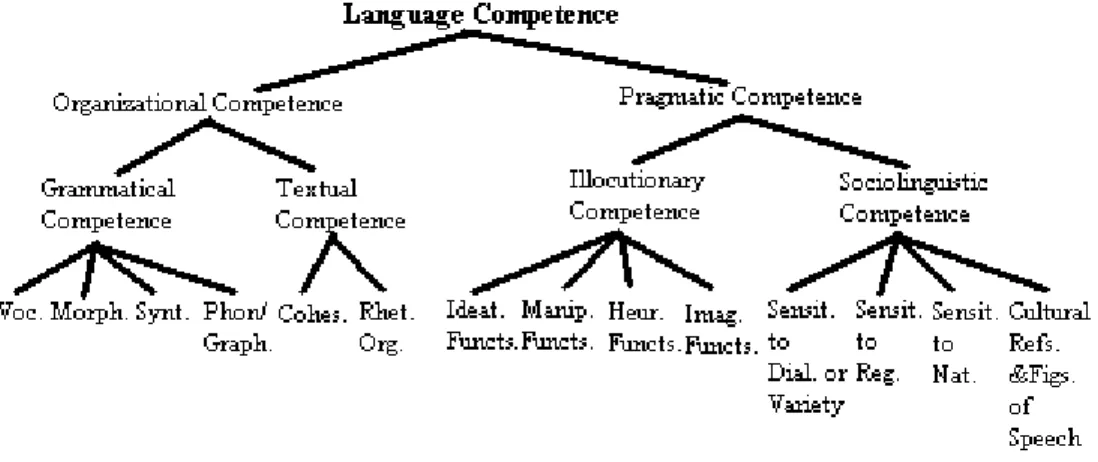
Language competence consists of two types of competence, organizational competence and pragmatic competence. Each consists of two components.

Organizational competence consists of grammatical competence and textual

(3)

socio-linguistic competence.

Grammatical competence includes learners’ knowledge of language usage, such as vocabulary, morphology, syntax, phonology and graphology.

Textual competence includes learners’ knowledge of the conventions for joining utterances together to form a text. It consists of two or more utterances or sentences that are structured according to rules of cohesion and rhetorical organization.

Cohesion comprises ways of explicitly marking semantic relationships such as reference, sub-situation, ellipsis, conjunction, and lexical cohesion. Conventions of rhetorical organization include common methods of development such as narration, description, comparison, classification, and process analysis.

Illocutionary competence deals with language functions, such as ideational, manipulative, heuristic, and imaginative functions. Ideational function means to use language to express proposition or to exchange information about knowledge or feelings. The heuristic function pertains to the use of language to extend our knowledge of the world around us, and occurs commonly in such acts as teaching, learning, problem solving, and conscious memorizing. The imaginative function of language enables us to create or extend our own environment for humorous or esthetic purposes, where the value derives from the way in which the language itself is used.

Social- linguistic competence deals with the sensitivity to differences in dialect or

variety, sensitivity to differences in register, and sensitivity to naturalness.

(4)

Figure 1. Components of language competence (Bachman, 1990)

One characteristic of many communicative competence frameworks recognizes language use as dynamic process, involving the assessment of relevant informa tion in the context and a negotiation of meaning on the part of the language user. Therefore, Bachman considers strategic competence as an important part of all communicative language use. He includes three components in strategic competence: assessment, planning, and execution. In the assessment stage, all the information needed is assessed to produce the most effective way to communicate. In the planning stage, relevant items (grammatical, textual, illocutionary, socio- linguistic) from language competence are retrieved to achieve the communicative goal. In the execution stage, the relevant psycho-physiological mechanisms are processed to express or interpret the utterance. As for the last component in communicative language ability, psycho-physiological mechanisms, it means the neurological and physiological processes that are used in communication. All these components construct Bachman’s framework of “Communicative Language Ability.”

2.1.2. The implication of the essence of “communicative competence” on ESL/EFL teaching and learning

From the discussion of the previous section, we know, to enhance learners’

(5)

communicative competence means to develop learners’ competence to communicate with other language users in real contexts. This competence contains language competence, strategic competence and psycho-physiological mechanism. Therefore, language teachers should develop learners’ knowledge of the world, knowledge of language, psycho-physiological mechanisms and communication strategies. That is, language teachers should use teaching methods under the paramount of communicative approach. To be more specific, H. Douglas Brown’s (Brown, 1994) presentation of four interconnected characteristics could be used as a definition of communicative language teaching (CLT):

u The teaching goals should contain all the components in communicative competence.

u Learners should be engaged in the pragmatic, functional use of language for meaningful purposes. Organizational competence is not the central focus but should be considered as a facilitator to accomplish those purposes.

u Fluency, at times, should take on more importance than accuracy in order to keep learners meaningfully engaged in language use.

u Students should finally use the language, productively and receptively, in unrehearsed contexts. (Brown, 1994:245)

Shr (2001) also presents her viewpoints of communicative language teaching from a more practical aspect. There are five characteristics:

u The goal of language learning is to enhance students’ communicative competence. Students should acquire the ability to use the language in real communication. Therefore, all the components of communicative competence should be developed.

u The development of language ability is through the activities.

u The teaching program should be learner-centered. Students are the active participants of the classroom activities.

u Accuracy and fluency should both be emphasized. However, both accuracy and fluency should not be over-emphasized. Especially in the beginning stage, students should be asked to speak out. They should not be forced to produce native-like, fluent, error-free English.

u The focus of language teaching is to construct suitable language

(6)

environment for students, so that they can contact English naturally and acquire English language. (Shr, 2001:9-12)

Comparing Shr’s and Brown’s viewpoints, we can generate the following concepts: Communicative language teaching intends to develop students’

communicative competence. That is, students should have the ability to use English to communicate with others in real contexts. Such ability should be developed through activities. The teacher’s task is to construct a suitable language environment for students to learn English and to adopt an appropriate syllabus to help students achieve the goal.

There is also a major difference between Brown’s ideas and Shr’s ideas. Brown claims, “Fluency, at times, should take on more importance than accuracy in order to keep learners meaningfully engaged in language use.” However, Shr claims that both accuracy and fluenc y should be emphasized, and they should not be overemphasized.

From their sayings, we can see that Brown puts more emphasis on fluency, while Shr puts the two in an equal status. Why there is such difference might be that the setting of Shr’s saying is in an EFL environment. Unlike in the ESL environment, the students can receive many natural and correct target language inputs. In an EFL environment, it’s not that easy for students to acquire the target language naturally.

The inputs given to students might not be that abundant. Therefore, the accuracy should be emphasized.

2.1.3. The process of second language acquisition – a simplified version of Interactionist theory framework outlined by Gass

In last section, the discussion of CLT is from teaching aspect. Teaching and learning are two sides of one coin. Besides discussion from teaching aspect, I would like to discuss this issue from the learning aspect.

Larsen-Freeman classifies SLA theories into three types: Nativist theory,

(7)

Environmentalist theory, and Interactionist theory. Nativist theories focus on students’

innate factors to acquire the language. Environmentalist theories focus on the effects that the environment gives to students. Interactionist theories focus on both students’

inborn abilities and the effects caused by the environment. From her viewpoints, Interactionist theories seem more powerful than the other two types of learning theories. The following citation is given to describe Interactionist Theory:

Interactionist theories are more powerful, all other things being equal, than either nativist or environmentalist theories, because they invoke both innate and environmental factors to explain language learning

(Larsen-Freeman & Long, 1997:266) Chapelle (1998) proposed seven hypotheses about ideal conditions for SLA, based on a simplified Interactionist Theory Model (Figure 2) outlined by Gass (1997).

Figure2. A simplified Interactionist Theory Model Outlined by Gass(1979), adapted by Chapelle (1998)

“Input” in this model refers to the target language the learner is exposed to. Only the “apperceived” has the potential to be acquired. The language might be understood

“semantically” with or without any comprehension of the “syntax”. However, when comprehension is through the combination of semantic and syntactic processing, the linguistic characteristics of the input can become “intake.” It means the comprehended language that is potential for developing the learners’ linguistic system.

“Integration” contains the processes for using or holding the intake in short-term

memory to influence the development of the linguistic system, which in turn affects

the L2 output that the learner produces. The L2 output is an observable part of the

(8)

process. It is also considered a contributor to linguistic development. This process, referred to as negotiation of meaning, is believed to facilitate L2 learning.

According to this framework, Chapelle (1998) presents seven hypotheses about ideal conditions for SLA.

u The linguistic characteristics of target language input need to be made salient.

u Learners should receive help in comprehending semantic and syntactic aspects of linguistic input.

u Learners need to have opportunities to produce target language output.

u Learners need to notice errors in their own output.

u Learners need to correct their linguistic output.

u Learners need to engage in target language interaction whose structure can be modified for negotiation of meaning.

u Learners should engage in L2 tasks designed to maximize opportunities for good interaction.

Summarizing Chapelle’s ideal conditions, we can find there are seven elements contributive to SLA acquisition: salient linguistic characteristics, help in comprehending semantic and syntactic of linguistic input, opportunity to produce target language output, error-awareness, error correction, negotiation of meaning, tasks designed for good interaction. The seven elements also seem to be parallel with the concepts Brown’s and Shr’s viewpoints – the teacher should provide an appropriate language-learning environment for students to acquire the target language.

Carefully examining Brown’s and Shr’s description of CLT and Chapelle’s ideal

conditions of SLA, we can find that Brown and Shr are discussing from the teaching

aspect, while Chapelle is from SLA aspect. Though the aspects are different, we can

still generate some concepts from their sayings. First, learners should acquire the

language through activities (tasks). Second, learners should have opportunities to

produce target language output. Third, both accuracy and fluency should be

emphasized. Fourthly, interaction is necessary in learners’ language learning. Fifthly,

(9)

the teacher should construct a suitable language- learning environment for students to acquire the target language.

These concepts are really helpful for ESL/EFL teaching and learning. However, they are mainly at the “approach” level. How to merge these ideals into real teaching, that is, teaching methods, is a great challenge to ESL/EFL teachers. Traditional ESL/EFL teaching methods, such as grammar-translation methods, audio- lingual methods, and some cognitive teaching methods, seem only able to cover some of these concepts. Grammar-translation methods seem to cover the accuracy, but they neglect the interaction aspects. Audio- lingual methods give students many opportunities to practice the target language, but they neglect real interaction. In a word, they can’t cover the last two concepts we generate from Brown’s, Shr’s and Chapelle’s ideas, the suitable language learning environment and real interaction.

However, many techniques and ideas in currently prosperous cooperative learning and web-based learning seem to shed some light for ESL/EFL teachers.

2.2. The cooperative learning theory

Recently, the concept of cooperative learning is widely applied to ESL/EFL learning (Roger E. W-B Olsen, 1992, Mary Ellen Quinn and Marilyn Molloy, 1992, Donald Freeman, 1993, Roger Budd and Tony Wright, 1993, Linda Schinke-Llano, 1994) Most of the studies show satisfactory effects of ESL/EFL learning. Roger E.

W-B Olsen and Spencer Kagan (1992:1-2) reviewed some studies related to

cooperative learning. From the review, we can find that nonnative English speakers

show more gains in language acquisition and academic achievement in cooperative

learning classes than in traditional whole-class instruction. Besides, the carefully

structured and abundant interactions in cooperative learning classes between students

also help students clarify their meanings, elaborate explanation, resolve discrepancies,

and finally enhance the comprehension of learning material. Even in the interaction

(10)

process, the students have more opportunities to use the target language, which can’t be easily done in traditional whole-class instruction.

In order to know how cooperative learning makes learning effects of ESL/EFL learning enhanced, the essence of cooperative learning has to be examined first.

2.2.1. Definition of cooperative learning

Roger E. W-B Olsen and Spencer Kagan (1992) once give cooperative learning the following definition:

Cooperative learning is group learning activity organized so that learning is dependent on the socially structured exchange of information between learners in groups and in which each learner is held accountable for his or her own learning and is motivated to increase the learning of others. (Olsen and Kagan, 1992:8)

From this citation, we can find some ge neral characteristics of cooperative learning.

They are dependent learning, information exchange, accountability for individual learning and group learning. In order to deeply see into cooperative learning, Johnson and Johnson’s framework of cooperative learning will be reviewed.

2.2.2. Theoretical roots of cooperative learning

Johnson and Johnson (1999) propose that at least three general theoretical perspectives have guided research on and practice of cooperative learning – social interdependence, cognitive-developmental, and behavioral learning theories.

2.2.2.1. Social interdependence theory

Social interdependence theory posits that the way social interdependence is structured determines how individuals interact which, in turn, determines outcomes.

In a teaching and learning program, there are three choices of organization to achieve

the goals: competitive, individual, and cooperative (Johnson & Johnson, 1999). In

competitive learning, it’s important to rank students one by one in the group. In such a

learning group, since the goal is to identify the better ones out of the whole, only a

(11)

few students can achieve the teaching goal. Every student’s success builds upon others’ failure, that is, negative interdependence. Therefore, members in such a group would not be willing to help others. In individual learning groups, each member in the group fulfills his or her tasks alone without giving or receiving assistance, that is, non-interdependence. Each member in such a group is expected to be an extreme individualist. As for the cooperative learning group, learning becomes the responsibility of each member in the group. Everyone should share the responsibility in the learning process, and each member also has to be responsible for the success or failure of the complete group, that is, positive interdependence. Therefore, students in a group would like to help each other to achieve the common goal of the group.

2.2.2.2. Cognitive-development Theory:

The cognitive developmental perspective is largely based on the theories of Piaget and Vygotsky.

2.2.2.2.1. Jean Piaget’s cognitive theory:

The cognitive definition stresses the role of the mind in processing the information acquired. It states that learning is the perception, acquisition, organization, and storage of knowledge in such a way that it becomes an active part of the individual’s cognitive structure. The new information, if learning is to be meaningful, must be relatable by the students to their past knowledge and experience.

George P. Knight and Elaine Morton Bohlmeyer (1990) also present similar

ideas. They propose that learners’ learning strategies are promoted by the need to give

clear explanations to others, to process explanations received from others, and to

constructively manage the controversy that arises within the group. That means during

the process of cooperation, students have to negotiate meaning to make the

explanations clearer, and during this process, students can construct their cognitive

system.

(12)

Webb (1985) also suggests that students who have to give explanation to peers are required to engage in high- level cognitive restructuring in an attempt to make the material more comprehensible. The discussion shows how learners’ cognitive development is enhanced through the group discussion and cooperation in cooperative learning classrooms.

2.2.2.2.2. “Scaffolding” metaphor:

Scaffolding metaphor here refers to the gradual withdrawing of adult control and support as a function of children’s increasing mastery of a given task. Successful scaffolders focus children’s attention on the task and keep them motivated and working throughout the session. They also divide the task at hand into simpler and more accessible components, directing the child’s attention to the essential and relevant features. Finally, the scaffolding tutor demonstrates and models successful performance while keeping the task at a proper level of difficulty, avoiding unnecessary frustration and encouraging children’s independent functioning (Rafael M. Diaz, etc. 1990, James P. Lantolf and Gabriela Appel, 1994).

The Scaffolding metaphor seems to explain the role of teachers and more able colleagues in cooperative learning programs. The teachers, or more able colleagues, serve as scaffolders to help students develop. When students have enough mastery of a certain skill, the teachers should gradually withdraw the control, so that students could develop the ability of independent functioning.

2.2.2.2.3. Vygotsky’s notion of zone of proximal development (ZPD):

Vygotsky proposes that each child has an “actual developmental level” and a

potential for development within that domain. He terms this difference between the

two levels the “zone of proximal development”. He defines this zone as “the distance

between the actual developmental level as determined by independent problem

(13)

under adult guidance or in collaboration with more capable peers.” Therefore, in Vygotsky’s notion of ZPD, children are not mere passive recipients of the adult’s teachings, nor is the adult simply a model of expert, successful behavior. Instead, the adult-child dyad engages in joint problem-solving activity, where both share knowledge and responsibility for the task. Once the child shares the adult’s goals and definition of the problem situation, the adult must gradually and increasingly transfer task responsibility to the child (Jonathan Tudge, 1990, James P. Lantolf and Gabriela Appel, 1994).

Therefore, with the help of their colleagues or teachers, learners would perform better than they originally do individually in the process of the problem-solving activities, and this shows the value of cooperation in the learning process.

2.2.2.2.4. Controversy theory:

Involved participation in cooperative groups will inevitably produce conflicts among ideas, opinions, conclusions, theories, and information of members. Such controversies are an important aspect of cooperative learning.

(Johnson and Johnson, 1994:201)

From the citation, we find that during the process of debating of different opinions, students can reshape their ideas and then attain a more refined and elaborative conclusion.

2.2.2.3. Behavioral learning theory:

Behavioral learning theory posits that learners would perform better on those tasks for which they could get a reward. Cooperative learning is designed to provide incentives for the group members to participate in group effort. Therefore, to achieve the common goal of the group and win the award, each member in the group will try their best and the learning effect will be enhanced.

From the discussion of the theoretical root of cooperative learning, we can find

that it is based on social interdependence theory, cognitive theory, and behavioral

(14)

learning theory. Due to positive interdependence, the learners might be willing to cooperate with each other and therefore help enhance others’ learning effects. The learning effects are based on the enhancement of learners’ cognitive system. The behavioral learning theory provides an outer incentive for learners to achieve the common goals of the whole group.

2.2.3. Elements of cooperative learning:

Johnson and Johnson (1999) propose five basic components of effective cooperative learning. They are positive interdependence, face-to-face promotive interaction, individual and group accountability, appropriate use of social skills, and group processing.

Positive interdependence is the most essential element in cooperative learning.

Each member in the learning group has to bear in mind “they sink or swim together.”

In the design of cooperative learning, the group performance directly influences every member’s grades. Therefore, each group member’s efforts are required and indispensable for group success and each group member has to make a unique contribution to the joint efforts because of his or her resources or role and task responsibilities. Then, each member of the group would care about himself or herself and would help other members to achieve the teaching or learning goal.

Face-to-face promotive interaction is another element of cooperative learning.

The group members meet face to face to work together to complete assignments and promote each other’s success. The meeting schedule should be fixed so that members of the group could have the chance for positive interdependence to develop and achieve the group’s goals.

Individual accountability means each member’s performance. Group

accountability means the group’s performance. Traditional competitive learning

(15)

success, students tend not to help other learners in the class. Cooperative learning helps students learn together. However, that doesn’t mean that members in one group would just have to perform a task and everybody gets the same score. Each member of the group should achieve the learning goal individually. If one member does not fulfill his or her share and responsibility, other members of the group might feel upset and disappointed.

Social skills are those skills, such as negotiation or discussion, which students use to interact with each other. In cooperative learning, interaction among group members is crucial. Therefore, having good interaction among group members is a premise of success. However, students are not born with these skills, and therefore, teachers have to teach students these social skills so that they can interact with each other effectively.

Group processing means the learning process that the whole group work together to achieve the final goal. The process should be recorded regularly, based on which the teacher or the students could discuss with other group members to (a) describe what member actions were helpful and unhelpful and (b) make decisions about what actions to continue or change. Such discussion could have the following benefits: (1) better relationship between group members, (2) enhancement of cooperative learning skills, (3) feedback of performance, and (4) self-examination of the performance.

2.2.4. Types of cooperative learning activities

Slavin (1985) classifies the cooperative learning activities into four types. They are Student Team Learning, Jigsaw, Learning together, and Group Investigation. Each of these types would be briefly described in the following sections. Then, some derived activities would also be discussed.

2.2.4.1. Student team learning

The most representative activity in this type is Student Teams-Achievement

(16)

Divisions (STAD). In STAD, after the teacher presents a lesson, teams composing of four or five students work together to master a set of worksheets on the lesson. Then each student takes a quiz on the material. The scores that the students contribute to their teams are based on the degree to which the students have improved over their individual past averages. The teams with the highest scores are recognized in a weekly class newsletter. Similar activities in this type are Teams-Games- Tournament (TGT) and Jigsaw II.

2.2.4.2. Jigsaw

In Jigsaw, five to six students form a group and each of them is given unique information on a topic that the whole group is studying. After the students have finished reading their sections, they meet in “expert groups” with their counterparts coming from other groups and then discuss the material. After that, they come back to their original group to teach other students in the group what they have learned.

Finally, the entire class may take a test for individual grades at the end. A derived activity, Jigsaw II, is a combination of Jigsaw and STAD. The major difference between original Jigsaw and Jigsaw II is that Jigsaw II uses the evaluation method of STAD. The quiz scores include individual and team scores.

2.2.4.3. Learning together

In Learning together, students work in small groups to complete a single worksheet. This method emphasizes on (1) training students to be good group members and (2) continuous evaluation of group functioning by the group members.

Positive interdependence is the major element of this type of learning activity.

2.2.4.4. Group-Investigation

The Group-Investigation method is the most complex of all the cooperative

learning methods. Students in small groups have to decide what they will learn, how

(17)

have learned with their classmates. Each group takes on a different task and then allocates subtasks among the members. The tasks often involve open-ended investigations using a variety of resource materials. Ultimately, the groups prepare reports to present to the rest of the class.

Comparing the four major types of cooperative learning methods, we can find the major difference is in the organization method, or the evaluation method. Each has its merits. Therefore, different types of cooperative learning methods should be adopted, or combined, to meet the different requirements in different situations, such as different types of students or different teaching and learning materials.

2.2.5. Roles of teachers in cooperative learning

Wendy McDonell (1992) describes the role of teacher in cooperative learning classroom as an inquirer, a creator, an observer, a facilitator and a change agent. That means the role of the teacher has shifted from a sole authority of knowledge to an organizer of courses, monitor, guide, facilitator, and evaluator. The center of learning has shifted from teachers to learners. However, that doesn’t mean the teacher becomes unimportant. Teachers in cooperative classes take even greater responsibility than those in traditional classrooms. In the beginning, teachers have to assign students into groups homogenously or heterologously to achieve the greatest learning effect. Then, they still have to give some necessary lectures. During the process of group work, they have to monitor the process and give necessary aid in time. Since the process of cooperative learning is very important, process evaluation is adopted in cooperative learning. Teachers can take care of the individual differences of students by observing them when group activities are progressing, and give immediate help when necessary.

2.2.6. Roles of students in cooperative learning

In cooperative learning classrooms, learners have to actively participate in the

teaching program. The teacher is no longer the center of the teaching program. The

(18)

students have to collect necessary data for the group learning. They may have to collect certain pictures, articles or even some realia to share with their group members.

Besides, since teachers’ lectures have been greatly reduced, the students have to discuss with each other and give their own contribution to the whole group and make sure each member in the group has understood the learning materials. As for evaluation, the students have to take some responsibility of evaluating their peers. To be brief, students have become the center of learning.

2.2.7. The comparison of non-cooperative learning classroom & cooperative classroom

In this section, I wo uld like to discuss the difference between non-cooperative learning classrooms and cooperative classrooms. The following table is generated from Johnson and Johnson (1999) and Wei and Chen (1999).

Factor Old Paradigm of Teaching New Paradigm of Teaching Knowledge Transferred from faculty to

students

Jointly constructed by students and faculty

Students Passive vessel to be filled by the faculty’s knowledge

Teacher-centered

Active constructor, discoverer, transformer of own knowledge Learner-centered

Faculty purpose Classify and sort students Develop students’ competencies and talents

Relationships Impersonal relationships among students and between faculty and students

Personal interaction among students and between faculty and students

Context Competitive/individualistic Cooperative learning in classroom and cooperative teams among faculty

Assumption Any expert can teach Teaching is complex and requires considerable training

Evaluation Product evaluation Both process and product

evaluation

(19)

evaluation Creativity Lack of creativity Rich in creativity

Table 1 Comparison of Old and New Paradigms of Teaching (Adapted from Johnson and Johnson, 1999 and Wei and Chen, 1999)

u The acquisition of knowledge: In a non-cooperative learning classroom, knowledge transfers from teacher to students directly. However, the effect of transmission of knowledge is doubted. First, students’ attention in the classroom is not always fixed on the teachers’ lectures. Second, students might not feel interested in the material the teacher prepares for them. The situation in cooperative classrooms is different. Knowledge is not always transferred directly from the teacher, but often discovered by students themselves. In other words, students acquire the knowledge through the discussion with colleagues. They have to process the knowledge but not only memorize what the teacher says to them.

u Roles of students and teachers: In non-cooperative learning classrooms, the

teacher is the spirit of the teaching and learning programs. The common

procedure is that the teacher sets the teaching goal, collects teaching materials,

presents them to students, assigns homework to students, and then assesses

students. Therefore, the teacher alone takes the major responsibility of the

success or failure of the complete teaching and learning programs. In cooperative

classrooms, the situation is quite different. Students have to collect data needed

for the class by themselves. They also have to take certain parts in the decision of

teaching materials. Then, they have to discuss the learning materials with their

colleagues or sometimes with their teachers. Sometimes, they have to evaluate

themselves or their colleagues. During such kind of teaching program, learners

take greater responsibility than in traditional classrooms. The role of the teacher

has been transferred from a “doer” to a “designer”. He or she will no longer just

(20)

read aloud the textbooks and explain the grammar rules, but has to design activities for students to cooperate and discover knowledge.

u Faculty purpose: In a non-cooperative learning class, teachers classify students by deciding who gets which grade and sort students into categories by deciding who does and does not meet the requirements to be graduated. The evaluation type is typically norm-referenced. There is constant inspection to weed out any

“defective” students. It seems that those students with low grades would be sacrificed. In a cooperative learning class, the situation is different. Teachers aim at developing students’ competencies and talents. A “cultivate and develop”

philosophy replace a “select and weed out” philosophy. (Johnson and Johnson, 1994:262)

u Relationship among students and between students and teachers: In a non-cooperative learning classroom, students and teachers are interchangeable and replaceable parts in the education machine. In cooperative learning class, education is regarded as a social process that would occur only through interpersonal interaction. Teacher must build positive interdependence with students, and students also have to build positive interdependence with their classmates or their teacher.

u Context of learning: Most of the time, the learning style in a non-cooperative learning classroom is competition and individualistic. Therefore, only those superior students can have the sense of achievement, but other students suffer from frustration. In cooperative classroom, students do not study individually.

They co-work with other members in the group. The common success of the whole group is valued. Thus, most students in the class can get sense of achievement.

u Quality of teachers: In a non-cooperative learning classroom, any expert can

(21)

teach. That is, if one is graduated from English department, he can teach English.

That is, teaching isn’t regarded as a profession. However, in a cooperative learning class, teaching is an application of theory and research. To be a good teacher, one should not only possess the profession in certain field, such as language or math, and the profession in teaching, but also use the teaching experience to refine the teaching methods.

u Different emphasis of evaluation: In a non-cooperative learning class, teaching and evaluation are separated. That is, when teaching, the teacher focuses on teaching but ignores the evaluation of students. After they finish teaching, they give students a test to assess students’ learning effects. The grades given to students serve only as a rank. In cooperative classroom, process evaluation is emphasized. The evaluation is merged into the learning and teaching process.

That is, teacher evaluates students nearly at any time.

u Creativity: In a non-cooperative learning class, since the teacher controls most of the time, what students have to do is sit there, listen to their teachers, and memorize what have been told to them. Therefore, students’ creativity seems unable to be exploited. However, in cooperative learning, students collect the material by themselves, discuss with their colleagues and attain the goal in their own ways. Therefore, their creativity would be aroused and encouraged.

2.3. The web-based learning

With rapid development of semi-conductor and telecommunication, the incorporation of the Internet into daily life becomes very common. This situation inspires many ESL/EFL teachers, since it provides an authentic environment for language learning and teaching. However, how to take advantage of this new technology and merge it into ESL/EFL teaching challenges ESL/EFL teachers.

Web-based learning can be discussed from two aspects, materials provided on

(22)

websites and web-provided environment for communication. The former means the huge amount of resources provided on the Internet, which can be retrieved by people who connect to the Internet freely or at very low cost, such as on- line libraries or on- line databases. The latter means the environment provided on websites for learning activities to take place, such as chat-room or discussion forum.

2.3.1. Definition of web-based learning

I define Web-based learning as “ all learning tasks occurring in the web-based environment”. Here, a broadest definition is adopted. Any material provided on the Internet, or any activities on the LAN (local area network) or WAN (wide area network) could be categorized into it. Mark Warschauer (2000) gives a definition of network based la nguage teaching (NBLT), which is similar to the definition aforementioned.

Network-based language teaching (NBLT) is language teaching that involves the use of computers connected to one another in either local or global networks (Richard Kern and Mark Warschauer, 2000:1).

From the citation, we know that web-based learning combines telecommunication and computers. This combination constitutes a virtual community. In this community, members are given a new identity. It’s possible for them to hide their real identity, which is quite different from the situation in physical world. However, they can do certain things just like in the physical world. They can buy things, chat or discuss with each other, or mail to others.

Since NBLT involves telecommunication and computers, it possesses advantages on both sides. Telecommunication connects teachers and students to a real context. It breaks the limitation of physical classroom settings in time and in space. The teacher and the students can communicate with each other at any time and at any location.

Besides, telecommunication helps teachers and the students retrieve valuable

(23)

processing and high storage of large quantity of data. All these advantages will be discussed in the following section.

2.3.2. The characteristics of web-based learning

The characteristics of web-based learning have been widely discussed by many scholars (Forsyth Ian 1998, Orlando R. Kelm, 1994, Chou 1995). Their opinions are synthesized as follows:

u Fast: The message communicated through the Internet can be sent in much shorter time than through physical mailing system. For example, the mail from Taipei to America that takes at least seven days in physical mailing system takes only minutes through the Internet.

u Anonymous: Since the community constructed in web-based environment is a virtual one, everybody in the community can hide his or her real identity. Except for the system operator, no one has the authority to know who others are. That is, one can send mail to people or receive mail from people he or she doesn’t know.

Similarly, they can also talk with people unknown to him or her.

u Economical: The cost of using the Internet is low. Everybody with access to a computer connected to the Internet can easily use the tools provided on the Internet. With the rapid development of technology in semi-conductors and electronics, the price of computers has decreased greatly.

u Real context: Although all tasks in web-based environment occur on computers, the back-end of each computer is a human being. The interaction among these computers is real. It’s in essence human-human interaction but not the made-up human-computer interaction. One doesn’t buy things from computer but from other human beings. Similarly, one doesn’t give invitations to computers but give invitations to other human beings.

u Interactive: There are two types of interaction on the Internet: synchronous

(24)

interaction and asynchronous interaction. Examples of the former are chatting in chatting rooms and interaction in MOO. Examples of the latter are E- mail exchange and discussion in BBS. Both types of activities provide abundant real interactions, which are helpful to learning.

u Abundant feedback: In web-based learning environment, a lot of feedbacks can be obtained during the interaction on the Internet, which is crucial to learning.

Most of the time, the learners expect the feedbacks from other people when they encounter difficulties. On the Internet, the feedback is abundant. Take BBS for example. Once you post an article to ask a question on the board, you may get a lot of feedbacks very soon.

u Not border limited: Through the Internet, it’s very easy to get access to websites abroad, which can’t be easily done in physical world. If one would like to get to the virtual community abroad, he only has to click the mouse button several times and type certain words, and then he or she is in the virtual community abroad. Through the Internet, net users can get access to the culture of target language very easily.

u Rich resources: There are many websites on the Internet. The contents of these websites cover nearly all topics. Since “resource sharing” is the essence of the Internet, there are rich resources on the Internet for net users to retrieve. If one can make the best use of the searching engine, he or she can obtain nearly any information he or she needs.

2.3.3. The tools provided in current web-based environment

There are numerous tools provided on the Internet. They are E- mail system, Talk, FTP, Bulletin Board System, Gopher, and WWW.

u E-mail system: E-mail system is the basic function of the Internet. By using it,

(25)

nearly every field, including ESL/EFL teaching and learning. “Tandem” is one representative project using E-mail. Besides Tandem, discussion list is also a derivation widely used in ESL/EFL teaching and learning. The reason why it is so widely used might be that the cost is very low and the speed is very high.

u Talk: Talk is another tool on the Internet. It connects two on-line users to communicate with each other synchronously in text. Chatting room is its derivation. Unlike Talk, chatting room gives multiple users a place to communicate with each othe r synchronously in text. Users log on to a chatting server simultaneously and discuss with each other. The manager can set up some rules for those who enter the chatting room. Anyone who violates the rules will be kicked out of the chatting room. Besides communication in text, the communication can also be in video-form. However, due to the busy network and huge data size of video files, communication through the Internet in video-form seems impractical currently.

u FTP: FTP is another tool on the Internet. It is a protocol that allows users to transfer files on the Internet. The Internet is the place for the sharing of resources.

One only has to put the files on the FTP server, and other users can download the files very easily.

u Bulletin Board System: Bulletin Board System is a system that provides learners with the opportunities to discuss with certain topics. Through discussion and debating on a certain topic, net users can understand that topic better. Most BBS integrate the functions of the E- mail system, talk, and even ftp. If one enters a BBS, he or she can mail, talk and post articles. Most BBS exist in text-form and this guarantees that the server can run smoothly, since text-form is synonym of

“low data transference.” The advantage is that the speed is very high, while the

disadvantage is that it can’t incorporate multimedia into the system, which might

(26)

be more attractive for students.

u Gopher: Gopher is an information system that allows users to retrieve valuable information they need easily. Unlike currently prosperous WWW, it only can provide text-form information. Currently, it seems to have been replaced by WWW.

u WWW(World-Wide-Web): WWW is an integrated system that contains all the functions provided on the BBS. The major difference is that WWW contains multimedia data, but BBS can provide only text- form data. With the advantage of the graphic interface, the tools on WWW are developed quickly, such as on- line test, searching engine, interactive games, and so on. All these conveniences encourage teachers to utilize the computer technology.

2.3.4. Michael Levy’s tutor-tool framework of the computer role

Michael Levy (1997) proposes a tutor-tool framework of the computer role in CALL. Although Michael Levy proposes this framework originally for CALL, it seems applicable to “web-based learning” here, since web-based learning contains computer and telecommunication. The major difference of web-based learning and CALL lies in that web-based learning provides more powerful tools to provide real interactions. However, the two roles can still be used to discuss web-based learning.

As a tutor role, the computer presents material, conducts practice activities and teaches students in a pre-designed way. Students only have to follow the directions provided by the computer. The following citation given by Michael Levy (1997) about computer as tutors reveals its essence.

Yet, although the computer in the role of tutor has evolved and matured, with computer tutors, the notion of the teacher in the machine rather than the teacher working with the student alongside the machine has remained. (Levy, 1997:184)

As a tool role, the computer serves as a tool to enhance the efficiency of the

(27)

work of the teacher or students, but not to replace the teachers. Another citation about computer as tools could describe its essence.

To summarize this view, it is what people do that is the central concern, and then as a corollary, how computers can help them do it better. (Levy, 1997:

185)

From Michael Levy’s framework, we can clearly understand the role of computer in CALL, and teachers’ conceptualization of the role of computer might affect his or her teaching methods.

Both roles have the strengths and weaknesses. As a tutor role, the strength is that students can practice certain drills at a time, place, with paces that suit them. The weakness is that the reliability of the teaching program (software) should be ensured, since students are generally working alone without the teacher. If the wrong feedback is given, then the problem arises. The success of the computer in the tutorial role lies in the perfect reliability of the program.

As a tool role, the strength and weakness are described from the following citation:

The strength of computer lies in its versatility and capacity to augment human capacities; the weaknesses derive from its neutrality and the fact that it offers the user no guidance on its use in context, that is, beyond the mechanics of its actual operation (Levy, 1997: 209).

From Michael Levy’s framework, we can find computer can serve both as a tutor and as a tool. Maybe ESL/EFL teachers should make use of both roles of the computer in their teaching program to enhance the teaching effects.

2.3.5. The roles of teachers and learners in web-based learning environment (Forsyth Ian, 2

nd

, 1998)

With the progress of technology, the role of the teacher has to change. In

web-based learning environment, unlike traditional classrooms, the teacher isn’t the

only source of all knowledge. Some might think that the importance of the teachers is

(28)

decayed or the teacher may be eliminated from the teaching program. However, that’s not the case. There is still a role for the teacher to relate the knowledge, skills and attitudes to the course. Since there isn’t any truly intuitive computer-based intelligent system to guide the learner, students will probably need assistance during the course.

The role of the teacher has been shifted from a sole knowledge provider to a facilitator or a mentor during students’ learning progress. Therefore, the teacher has to develop the following skills:

u The use of electronic mail for messages;

u Participation in chat and bulletin board sessions;

u The use of computer managed learning applications for test generation;

u Scoring and updating learner records; and

u The electronic receipt of free text submissions such as essays and open-ended questions. (Forsyth Ian, 1998:31)

Besides these basic skills, the teacher still has to possess the ability to design carefully structured activities. The tools provided on the Internet are there. However, without carefully structured activities, these powerful tools are only tools and will not really enhance students’ learning effects.

Not only the role of the teacher but that of the students has to change. The students change from primarily being passive recipients to being active participants.

Therefore, the students also have to develop the following skills:

u Search and enquiry design;

u Ability to download material to work offline;

u The use of electronic mail;

u The use of file transfer for test and assessment tasks and for communication with class peers and teacher (Forsyth Ian, 1998:31-32) 2.3.6. The comparison of traditional classroom interaction and web-based

learning environment interaction

There is great difference of the interaction between traditional classroom and

web-based learning environment. Vera Paiva (1999) once compared traditional

(29)

classroom interactions with e- mail interaction. It seems that this can be applied to non-web-based classroom interaction and web-based learning environment.

Traditional classroom interaction Email interaction

Face to face Distance interaction

One student may get more attention Students do not feel ignored Turns are allocated by the teacher Everybody can send a message

Some students ‘steal’ others’ turns All the students have the same opportunities

The teacher often initiates the turns The student initiates the turns The teacher is an authority The teacher is a participant More face threatening Less face threatening Impersonal relationship Personal relationship Does not facilitate dialogue between the

teacher and the students

Facilitates dialogue between the teacher and the students

Artificial interaction Real interaction

Fictional audience Real audience

Participation is coordinated by the teacher Students participate according to their own pace and will

Timed interaction No time constraint

Simultaneous monitoring Message can be corrected before being sent

Absent students cannot participate Students can always participate Interaction in the classroom only Possibility of interaction with the world Natural desire to interact is repressed Natural desire to interact is stimulated Students are afraid of running risks and

experimenting

Students are less afraid of running risks and experimenting

Focus on form Focus on meaning

No problems with equipment Problems with connection and equipment Number of students is limited Number of students may represent

increased work hours for the teacher Access to teacher usually limited to

classroom

The teacher can be contacted before and

after the class which might represent

(30)

overwork

Intruders are not allowed Vulnerable to intruders

Table 2. The comparison of Traditional classroom interaction and Email interaction

In sum, the major difference between non-web-based classroom interaction and interaction in web-based learning environment could be categorized into the following aspects:

u Distance limited / Distance free: In a non-web-based classroom, most interactions happen in the classroom. When class dismisses, the interaction stops. However, in web-based learning environment, the interaction among students or interaction between the teacher and students could happen outside the classrooms.

u Time limited / Time free: Time span is also a big difference between non-web-based classroom interaction and interaction in web-based learning environment. In non-web-based classrooms, the interaction is limited to class hours; however, in web-based learning environment, the time of interaction could be lengthened to after-class hours.

u Unfair turn-taking / Fair turn-taking: Teachers in non-web-based classroom is usually a turn assigner. However, most of the time, it’s very difficult to assign the turn to each student equally. Some more active students might “steal” those passive students’ turns. However, in web-based learning environment, the situation is different. The turn is not assigned by teachers but by every student participating in the interaction. Therefore, every learner can have fairer opportunity to take the turn.

u Teacher as an authority / Teacher as a participant: In non-web-based

classroom interaction, most of the time, the teacher serves as an

(31)

authority, and students as passive receivers. However, in web-based learning environment, the teacher serves as a participant, but not an authority.

u Higher-anxiety / Lower-anxiety: Interaction in non-web-based classroom causes students higher anxiety, since they have to interact with teachers or other students face-to-face and they might be afraid of being laughed at, and the result is that students’ natural desire to interaction is repressed. However, in web-based learning environment, since the interaction can be asynchronous and anonymous, therefore, the anxiety can be lowered.

u Impersonal relationship / Personal relationship: In non-web-based classroom interaction, teachers and students are interchangeable in the education machine. However, in web-based learning, in certain situations, it’s more likely to build personal relationships. Therefore, it is possible to build personal friendship among students or between students and teachers.

u Artificial interaction / Real interaction: Interaction in the non-web-based classroom is artificial. Teachers create the situation to help students achieve the teaching goal. However, in the web-based learning environment, students directly contact the real world and the interaction is real.

u Teacher controlled learning path / learner controlled learning path:

Teachers in non-web-based classroom control the learning path. They

set up the goal, decide which activities to proceed and how long these

activities last. However, in web-based learning, the teacher shares the

right with the students. Students can decide their path of learning,

(32)

according to their willingness and their abilities.

u Form-focused / Meaning-focused: In non-web-based classrooms, most of the tasks are designed for form, since there isn’t an authentic environment. However, in web-based learning environment, the authentic environment is given, and therefore it’s possible for teachers and students to deliver meaningful learning.

u Non-equipment-limited / Equipment-limited: In non-web-based classroom, since the major teaching media is the textbook, blackboard, and chalk, the teaching and learning can proceed in nearly every place.

However, in web-based learning, the school authority should prepare computers connected to the Internet, which might be a problem for those school having financial problems.

After the discussion of the essence of communicative language teaching and

learning, cooperative learning and web-based learning, in next chapter, I would like to

discuss how cooperative learning and web-based learning work together to enhance

communicative language teaching.

數據

Figure 1. Components of language competence (Bachman, 1990)

參考文獻

相關文件

• Assessment Literacy Series: Effective Use of the Learning Progression Framework to Enhance English Language Learning, Teaching and Assessment in Writing at Primary Level. •

• Assessment Literacy Series - Effective Use of the Learning Progression Framework to Enhance English Language Learning, Teaching and Assessment in Writing at Primary Level.

• To enhance teachers’ knowledge and understanding about the learning and teaching of grammar in context through the use of various e-learning resources in the primary

It provides details about promoting Language across the Curriculum at the secondary level, the learning and teaching of language arts and the four language skills, namely

Teachers may encourage students to approach the poem as an unseen text to practise the steps of analysis and annotation, instead of relying on secondary

The short film “My Shoes” has been chosen to illustrate and highlight different areas of cinematography (e.g. the use of music, camera shots, angles and movements, editing

← This allows teachers to adapt the school-based English Language curriculum and devise learning/teaching materials that better suit the diverse abilities, needs

vs Functional grammar (i.e. organising grammar items according to the communicative functions) at the discourse level2. “…a bridge between