K -connectivity of Cognitive Radio Networks
Luoyi Fu, Zhuotao Liu, Ding Nie, Xinbing Wang Dept. of Electronic Engineering
Shanghai Jiao Tong University, China
Email: {fly, zhuotaoliu, nding, zxz, xwang8}@sjtu.edu.cn
Abstract—The k-connectivity of cognitive radio networks is discussed in this paper. By combining asymptotic k-connectivity and percolation, we define that the cognitive radio networks are k-connected if there exists an infinite k-connected component in the secondary network. Utilizing continuum percolation theory, we prove that the secondary network is k-disconnected if secondary users’ density λs < log l+(k−1−θ) log log l
πr2 , where l → ∞ is the side length of a square-shaped network, r is the transmission range of the secondary network, and θ = Ω(1). And the network is k-connected when λs ≥ log l+(k−1+ξ) log log l
πr2 , where ξ = Ω(1).
Finally, we provide the necessary condition and sufficient condition of k-connectivity on primary user density λp.
I. INTRODUCTION
Connectivity in large scale wireless ad hoc networks finds its application in many areas such as sensor networks, and has been widely studied for nodes with homogeneous distribution [1], [2], [4], [5]. Two different approaches are used in these stud- ies: asymptotic connectivity and percolation. The asymptotic connectivity means that all nodes in the network are connected with high probability (whp) when the number of nodes goes to infinity. P. Gupta and P. R. Kumar showed that a transmission range of Θ(
qlog n
n ) ensures the asymptotic connectivity in a unit disc with n → ∞ nodes [6]. On the other hand, percolation of wireless networks is based on percolation theory. It requires an infinite connected component to exist in the network. In [7], O. Dousse et al. showed that despite the global interference dependency, the critical density for percolation in wireless networks is identical to that in continuum percolation λc.
One important theoretical application of connectivity is the analysis of network capacity. The ad hoc network is superior since it can transmit messages without base station or in some crucial environments. P. R. Kumar [8] studied the unicast capacity in static dense networks, and showed the capacity is Θ(q
n
log n), where n is the number of nodes in the network.
Since then, many new findings have been discovered. Among them multicast capacity is worth noting, since multicast is a general case of network traffic. However, the achieved result is based on a multi-hop scheme, so the bottleneck of network capacity is the interference in the network. A. Ozgur et.
al presented a series of work [9], [10] that uses multiple- input multiple-output (MIMO) to reduce the interference. They achieved a nearly information theoretical upper bound of uni- cast capacity Θ(n1−²), for any small ² > 0. With similar methods, multicast capacity achieves Θ((nk)1−²) in [11]. Wang et. al. further study multicast in mobile networks [12].
The connectivity property has been widely used in many real world applications such as wireless sensor networks. In these cases, the nodes and wireless channels can suffer from problems caused by different conditions (nodes failure, attacks, etc.) and therefore become unreliable. The k-connectivity property is important when considering the network reliability. Specifically, a k-connected network remains connected with removal of any k − 1 node from the network. Moreover, k-connectivity is necessary for multi-path routing, since it implies that there exist k disjoint paths between any two nodes in the network.
To ensure the network k-connectivity, numerous papers have investigated the critical conditions from various aspects. One topic is to determine the critical transmission range, as pre- sented in [6], [13], [16]. In this context, all nodes in the networks use uniform transmission power. In [6], by using the theory of continuum percolation, Gupta and Kumar presented the critical transmission range for asymptotic connectivity in a two-dimensional (2-D) dense network with n nodes indepen- dently and identically distributed in a disc of unit area. Consid- ering the network topology, M. D. Penrose [13] stated that the transmission range of a network achieving a minimum vertex degree k is identical to that of an asymptotic k-connectivity network almost surely in a unit area with n → ∞ nodes.
Applying the result in [13], the authors [14], [16] gave the critical transmission range in either a unit square or a unit disc as
qlog n+(2k−1) log log n+ξ
πn , where ξ is a constant. With this range, either asymptotic connectivity or the minimum vertex degree is no less than k + 1.
The minimum number of neighbors is another critical con- dition which is well considered in [15], [16]. In [15], Xue and Kumar presented that each node should be connected to Θ(log n) nearest neighbors to ensure the network connectiv- ity. Then in [16], Wan and Yi studied the critical neighbor number for k-connectivity, on which they gave an asymptotic almost sure upper bound. Besides the two aspects above, [17], [18] treat the critical total power for k-connectivity. In [18], under the assumption that nodes are allowed to choose different levels of transmission power, H. Zhang showed that the critical total power required to maintain k-connectivity is Θ((Γ(c/2 + k)/(k − 1)!)λ1−c/2) with probability approaching one as λ goes to infinity, where c is the path loss exponent.
Based on percolation theory, percolation of wireless networks has been used to analyze the connectivity problem. In the literature, if each node has a unit transmission area, the accurate value of the percolation threshold λchave not been decided yet,
but given in [19] the analytical upper bound for the percolation threshold is 10.526 and the analytical lower bound is 2.195.
And simulation shows that the value is around 4.5. In [20]
noncoherent physical layer cooperation is proposed to improve the performance of network connectivity. Then in [21], this result is analytically obtained for α < 4, where α is the path loss exponent. In [22], for 2-D extended network with α > 2 and transmission radius r = 1, if using λ∗c to denote the percolation threshold in the cooperative system, by utilizing a pair-wise collaboration, the authors showed λ∗c ≤(1+1/2λcα)2/α. All above studies are based on homogeneous networks, while the wireless network in the real world is more likely to be heterogeneous. One example is the cognitive radio (CR) networks [23], which build a hierarchical structure to achieve opportunistic spectrum access. The existence of primary users causes the heterogeneity the network, and therefore complicates the analysis of connectivity. W. Ren et al. [24] studied the connectivity of CR secondary network in percolation sense, and presented a connectivity region with respect of densities of primary and secondary users. In [25], the same authors discussed the connectivity and multihop delay of CR networks and concluded that asymptotic multihop delay between two secondary nodes grow linearly to the distance between them.
In this paper, we focus on k-connectivity of heterogeneous networks. The motivation is to consider connectivity problems in a more realistic perspective: k-connectivity allows node failure and more routing paths, and the heterogeneous network is a generalized network structure. Specifically, we consider the k-connectivity of CR secondary network. Since little work has focused on this, the following questions are still open to us:
1) What is the density of secondary users that ensures k- connectivity of network?
2) Are there any restrictions on primary users that ensure k-connectivity of secondary network?
3) How does the critical density of primary users vary with the density of secondary users?
To answer the above questions, we first introduce the concept of k-connectivity in the CR network. Since the existence of hierarchy, the primary users have higher priority to access the channel, while the activity of secondary network cannot intro- duce destructive interference to the primary network. Observing that secondary users close to the primary node contribute most part of the interference, we set an interference range R to every primary user, which is no less than the transmission range of secondary users r. Under this assumption, not all secondary users can access the channel, which means the asymptotic connectivity is not feasible to our CR network. In this paper, we consider connectivity in percolation sense and investigate how the node densities affect k-connectivity property.
Given a density pair (λs, λp), where λsdenotes the density of secondary network and λp is that of primary network, we also investigate the relation between the densities λs, λp and k-connectivity property of CR network. Notice that the connec- tivity definition is in percolation sense, we employ continuum percolation theory [26] in our analysis. In our work, we model
the CR network as a Poisson Boolean model B(X, ρ, λ), which is used to find a vacuum component of the primary network where secondary users can transmit. Then we focus on the k-connectivity problem in the secondary network. The main contributions of this paper are as follows.
• We prove that the secondary network is k-disconnected if secondary users’ density λs<log l+(k−1−θ) log log l
πr2 and is
k-connected when λs≥ log l+(k−1+ξ) log log l
πr2 , where θ = Ω(1) and ξ = Ω(1).
• We set a necessary and sufficient condition of k- connectivity on the density of primary users λp.
• We find the λs-λpcurve that can ensure the k-connectivity of the CR network.
The rest of the paper is organized as follows. In section II we give our network model. In section III, we present the critical density of secondary network ensuring k-connectivity.
Then the necessary conditions and the sufficient conditions of k-connectivity are given in section IV. Finally, we conclude the paper in Section V.
II. NETWORKMODEL
We consider a CR network, with primary users (PUs) and secondary users (SUs) in a two-dimensional network area l × l square Ω. In particular, we model the CR network as a Poisson Boolean model B(X, ρ, λ). In this model, X is a Poisson point process with density λ, and each point of X is the center of a 2-D disc with a random radius. The radii of different points are independent and identically distributed according to ρ. In this way, the plain is partitioned into the occupied component, which is covered by at least one disc, and the vacuum component, which is the complement of the occupied region. For simplicity, we use B(r, λ) to denote the model with radius r and density λ in the rest of the paper. We describe the PU and SU network respectively.
A. The primary network
The primary network consists of PU nodes, which are distributed in Ω according to Poisson point process (ppp.) with density λp. The PU network has the i.i.d. mobility, so that all the PU nodes are re-distributed according to ppp. with density λp
at every moving chance. Since the PU nodes have the priority to use the spectrum, we assume every PUs will preempt the spectrum opportunities from Sus when PUs are transmitting messages.We assume no SU nodes can be activated in the interference circle with radius R of any PU nodes, i.e., for any PU node xp, no SU nodes is activated in the interference region of D(xp, R), where D(x, r) is a disc centered at x with radii r. In the rest part, we use ΩP U to denote the total interference region of all PU nodes.
B. The secondary network
The secondary network consists of SU nodes, and works as an ad hoc network. The SU nodes are fixed and distributed in Ω according to ppp. with density λs independent with the primary network. As the SU network has less priority to use the spectrum, two SU nodes are considered connected if
• they are within each other’s transmission range r;
• they are outside the interference region ΩP U of all PU nodes.
Note the SU network connection only exists outside the inter- ference region of all PU nodes. In the discussion of SU network connectivity, we use Ω0= Ω\ΩP U to denote the possible region for SU connection.
C. Definition of k-connectivity
Then we turn to the k-connectivity of CR network. K- connectivity in CR network is defined on the secondary net- work, which works on ad hoc method. Unlike the homogeneous ad hoc network, the existence of PU node introduces a “silence”
region that no SU transmissions can happen. If any of the SU nodes is in the interference region ΩP U, all the SU nodes cannot be connected to each other simultaneously. For this reason, the definition of connectivity cannot include all nodes in the secondary network.
To solve this, we employ a definition in the sense of percola- tion. Phase transition is a well-known property in percolation.
For the Poisson Boolean model B(r, λ), a sharp transition oc- curs on the critical density λc. When λ < λc, there is no infinite occupied component and a unique infinite vacuum component almost surely; when λ > λc, there is a unique infinite occupied component and no infinite vacuum component almost surely.
The exact value of λc is not known, but λc∝ r−2. We assume λc= λ0r−2 in this paper.
We define the CR network is k-connected if there exists an infinite k-connected component in the secondary network as l → ∞.1 This definition of k-connectivity applies to all SU nodes, and each of them belongs to the infinite k-connected component with a positive probability. Since the PU nodes have i.i.d. mobility, every node in the SU network is k-connected in the long term.
III. THECRITICALDENSITY FORCR NETWORKS
K-CONNECTIVITY
In this section, we begin to analyze the property of CR network k-connectivity. Since our CR network model has two parameters: the density of PUs λpand SUs λs, we first consider the relationship between λsand SU network k-connectivity. In order to solve the k-connectivity problem of our SU network, we start by considering a much simpler case: k-connectivity in random graphs. Consider a set of nodes Xn randomly distributed in an area A. A random graph G(Xn, rn) is a graph that
1) uses Xn as the vertices of the graph;
2) an edge exists in every two nodes with distance no more than rn.
From the definition and our CR network model, we can simulate our secondary network as a random graph model in the SU network region Ω0. Next we present a theorem that deals with k-connectivity in random graphs.
1In the rest parts, we use k-connectivity of CR network and k-connectivity of SU network interchangeably.
In [13], M. D. Penrose presented the following theorem on k-connectivity of random graphs.
Theorem 3.1: [13] Let k > 0 and λ ∈ R. Then for any sequence (rn)n≥1 satisfying
n k!
Z
A
(n|D(x, rn)\
A|)ke−n|D(x,rn)
TA|dx ∼ λ (1)
the probability of two events
1) G(Xn, rn) is at least (k + 1)-connected;
2) the minimum vertex degree of G(Xn, rn) is at least k +1 both converge to e−λ as n → ∞, where D(x, r) is a disc with radii r and centered at x.
By utilizing Theorem 3.1, we present our results in the following two theorems.
Theorem 3.2: The SU network is not k−connected if λs<log l + (k − 1 − θ) log log l
πr2 , (2)
where θ = Ω(1).
Proof: See our technical report [27] for detailed proof.
Then we present the sufficient condition for k-connectivity of CR networks in the following theorem.
Theorem 3.3: The SU network is k-connected if λs≥log l + (k − 1 + ξ) log log l
πr2 , (3)
where ξ = Ω(1).
Proof: Using the similar scaling technique, the parameters after scale will be:
˜ rc=
rlog n + (k − 1 + ξ) log log n πn
R˜c=R r˜rc =R
r
rlog n + (k − 1 + ξ) log log n πn
λ˜sand ˜λpare the same as the previous scale. These parameters of this scale will also be used in the next section. Then Theorem 3.3 becomes
For any ˜r ≥ ˜rc, there exists a ˜np = Ω(log nn ) such that the SU network is k-connected almost surely.
To show the SU network is k-connected, we need first find an infinite SU network area, and then prove SU network is k- connected in this area. We find the infinite SU network area via discrete bond percolation model. The basic idea of building the model L is to ensure that an infinite SU network area exists as long as L is percolated.
We begin by constructing a square lattice L over the network area ˜Ω, with edge length d. Without lose of generality, we set an origin point O at a vertex of L. Now we consider the SU network area in the plane by using bond percolation in L. To do this, we will decide some edges are open and others are closed according to the distribution of PU and SU nodes in the network. A bond is open when transmission opportunity for SU exists, i.e., no PU interference regions cover the bond.
Specifically, we define an open bond when there are no PU nodes in a rectangle region (d + 2( ˜R + ˜r)) × (2( ˜R + ˜r) + ²),
2( ) d+ R+r
2(R+r)+ ε d ε
˜ ˜
˜ ˜
Fig. 1. The status of a edge.
for any ² = Ω(˜rc), and an closed bond otherwise. We divide the rest of proof into two steps.
Step 1: Proof of percolation. For each edge, the probability that no PU nodes exists in the rectangle region is
p = 1 − exp[−˜λp(d + 2( ˜R + ˜r))(2( ˜R + ˜r) + ²)] (4) Notice that ˜λp= λp n
log n. Obviously, p can be arbitrarily close to 1 when λp is sufficiently small. However, since the model is a dependent percolation model, we cannot conclude the model is percolated as p → 1.
In order to handel the dependence, we build an dual lattice L0 by shifting L a (d2,d2) vector. Notice there exists a one to one relation between the edges in L and L0: every edge in L intersects one in L0. Since the open/closed status of L edges are defined, we let the intersected edges in L0 on the same open/closed status. Under this assumption, the probabilities an edge is open in both L and L0 are both p → 1.
It is straightforward that that the open/closed status of 4dR+˜˜dre2− 2dR+˜˜dre + 1 bonds is dependent, either in L or L0. Use b to denote the constant, and then we have the following lemma.
Lemma 3.1: In lattice L0, the probability for a path with length m to be closed is at most (1 − p)m/b, where p is the probability that an edge is open in either L and L0.
The idea of Lemma 3.1 is to disregard the dependent edges and only consider the independent bonds. Since the maximum number of dependent edges is b, in all m edges of a path, we consider only the independent bonds (at least m/b) and find the closed probability. Obviously m/b edges are all closed with probability (1 − p)m/b.
Using Lemma 3.1, we can calculate the probability that a closed loop in L0 surrounding the origin point O (in L) as
P(closed loop exists) ≤ X∞ m=1
ρ(m)(1 − p)m/b
= 4
3(1 − p)1/b X∞ m=1
m(3(1 − p)1/b)m−1
= 4(1 − p)1/b
3(1 − 3(1 − p)1/b)2 (5) In above calculations, we use ρ(m) to denote the number of circuits surrounding O with length m. From [26], we know
ρ(m) is upper bounded by ρ(m) ≤ 4 · 3m−2m.
In (5), P(closed loop exists) can be smaller than 1 by choosing sufficient large p. Now we observe this result from the relation of L and L0. When an infinite open path starting from O in L exists, there does not exist a closed loop in L0 surrounding O; otherwise, this closed loop exists. Thus, the results in (5) show that if p is large enough, a infinite path starting from O exists with positive probability. According to the basic discrete percolation theory, this means the lattice L is percolated.
To summarize the result of step 1, the discrete model is percolated when the open probability is close to 1. In other words, a sufficiently small λp ensures the lattice L to be percolated.
Step 2: Proof of k-connectivity. The open/closed definition of bond guarantees near an open edge, two PU nodes are at least 2( ˜R + ˜r) + ² apart. This condition yields a “strip”
of SU network area ˜Ω0, and another “strip” that ensures
|D(x, ˜r)T ˜Ω0| = |D(x, ˜r)|. Figure 1 shows this clearly. So when b edges are connected, the connected region area that ensures |D(x, ˜r)T ˜Ω0| = |D(x, ˜r)| is at least ² × b(d − 2²).
When percolated, the area of the referred region becomes a constant of Ω(1) independent of n.
Now we show a k-connected infinite component exists in ˜Ω0. Since an infinite region that ensures |D(x, ˜r)T ˜Ω0| = |D(x, ˜r)|
exists, we are only interested in this region (use ˜Ωk to denote this region). By Theorem 3.1
n (k − 1)!
Z
Ω˜k
(n|D(x, ˜r)\
Ω˜0|)(k−1)e−n|D(x,˜r) T˜
Ω0|dx
= n
(k − 1)!(nπ˜r2)(k−1)e−nπ˜r2| ˜Ωk| = o(1)
IV. THENECESSARY ANDSUFFICIENTCONDITIONS FOR
CR NETWORKK-CONNECTIVITY
Next we will present the necessary and sufficient condi- tion that ensures the k-connectivity of SU network. Recall the Poisson Boolean Model B(r, λ) and the critical density λc ∝ r−2. Without loss of generality, we assume the critical density λc= λ0r−2. Before showing our result, we first define several functions that help in our analysis. Define function S(R, r, d) to be the size of intersected area of two discs with radii R and r and centered d apart. Assume R ≥ r, we define another function d(R, r, a), 0 ≤ a ≤ 1, which satisfies S(R, r, d(R, r, a)) = a · πr2. Intuitively, a is the fraction of the intersected area comparing to the area of a disc with radius r. For simplicity, we use d(a) instead of d(R, r, a) in our proof. Using the notations above, we can get our necessary and sufficient condition for SU network k-connectivity.
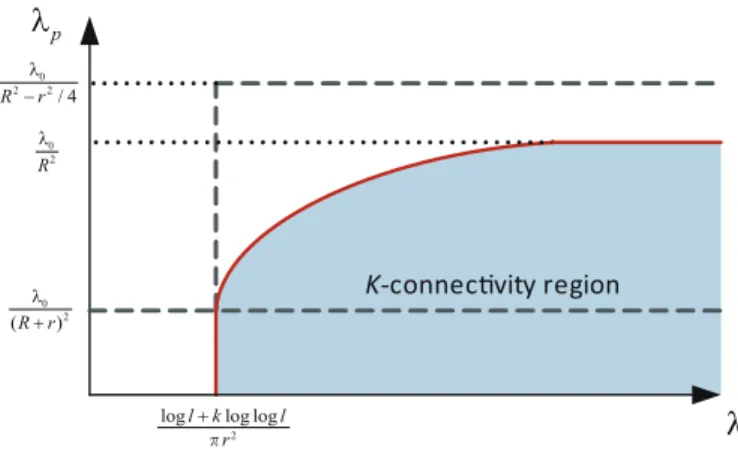
Theorem 4.1: A necessary condition for SU network con- nectivity is
λp< λ0
R2− r2/4
Proof: The idea of this prove is to find out the minimum possible distance between two PU nodes that can still allow
λp
λ
s logl+klog logl0 2 2/ 4
R r
λ
−
0
R2
λ
0
(R r)2
λ +
K-connecvity region
r2
Fig. 2. The k-connectivity region.
two SU nodes transmit “through” . This is also the minimum distance between two PU nodes that ensures SU connectivity.
When two PU nodes are too close to allow any SU node to transmit, the SU network is surely not connected. For detailed proof, please refer to our technical report [25].
Theorem 4.2: A sufficient condition for SU network k- connectivity is
λp< min
( λ0
[d(12−2λλsc
s)]2, λ0
R2 )
(6) Proof: See our technical report [27] for detailed proof.
Figure 2 shows the result of Theorems 4.1 and 4.2.
V. CONCLUSION
In this paper, we discuss the k-connectivity of cognitive radio networks. Combining asymptotic k-connectivity and percola- tion, we define the cognitive radio networks are k-connected if there exists an infinite k-connected component in secondary network, and conclude that when l → ∞, the SU network density λs for k-connectivity is above log l+(k−1+ξ) log log l
πr2 ,
where ξ = Ω(1). Also, we provide the necessary condition and the sufficient condition of k-connectivity on primary network densityλp. The sufficient condition varies as λschanges, while the necessary condition remains unchanged.
VI. ACKNOWLEDGMENT
This work is supported by National Fundamental research grant (2010CB731803), NSF China (No. 60832005, 60934003);
China Ministry of Education New Century Excellent Talent (No. NCET-10-0580); China Ministry of Education Fok Ying Tung Fund (No. 122002); Qualcomm Research Grant; Shanghai Basic Research Key Project (No.11JC1405100); National Key Project of China (2010ZX03003-001-01).
REFERENCES
[1] O. Dousse, F. Baccelli, and P. Thiran, “Impact of interference on connec- tivity in ad hoc networks,” in IEEE/ACM Transactions on Networking, vol. 13, no. 2, pp. 425-436, Apr. 2005.
[2] J. Ni and S. A. G. Chandler, “Connectivity properties of a random radio network,” in IEEE Proc. Communication, vol. 141, no. 4, pp. 289-296, Aug. 1994.
[3] C. Bettstetter, “On the minimum node degree and connectivity of a wireless multihop network,” in Proc. of ACM MobiHoc, pp. 80-91. Jun.
9-11, 2002.
[4] Y. Liu, K. Liu and M. Li, “Passive Diagnosis for Wireless Sensor Networks”, in IEEE/ACM Transactions on Networking (TON), Vol. 18, No. 4, Aug. 2010, pp. 1132-1144.
[5] Z. N. Kong and E. M. Yeh, “Connectivity and latency in large-scale wireless networks with unreliable links,” in IEEE INFOCOM, pp. 11-15, Apr. 2008.
[6] P. Gupta and P. R. Kumar, “Critical power for asymptotic connectivity in wireless networks,” in Stochastic Analysis, Control, Optimization and Applications: A Volume in Honor of W. H. Fleming. Edited by W. M.
McEneany, G. Yin, and Q. Zhang, pp. 547-566, 1998.
[7] O. Dousse, M. Franceschetti, N. Macris, R. Meester, and P. Thiran,
“Percolation in the signal to interference ratio graph,” in Journal of Applied Probability, vol. 43, no. 2, pp. 552-562, 2006.
[8] P. Gupta and P. R. Kumar, “The capacity of wireless networks,” in IEEE Transaction on Information Theory, vol. 46, no. 2, pp. 388-404, Mar.
2000.
[9] A. Ozgur, O. Leveque and D. Tse, “Hierarchical cooperation achieves optimal capacity scaling in ad hoc networks,” in IEEE Transaction on Information Theory, vol. 53, no. 10, pp. 3549-3572, Oct. 2007.
[10] A. Ozgur and O. Leveque, “Throughput-delay trade-off for hierarchical cooperation in ad hoc wireless networks,” in Proc. International Confer- ence on Telecommunication, Jun. 2008.
[11] C. Hu, X. Wang, D. Nie, J. Zhao, “Multicast scaling laws with hierarchical cooperation,” in IEEE INFOCOM, pp. 1-9, Mar. 2010.
[12] X. Wang, W. Huang, S. Wang, J. Zhang, C. Hu, “Delay and Capacity Tradeoff Analysis for MotionCast,” inI EEE/ACM Transactions on Net- working, Vol. 19, no. 5, pp. 1354-1367, Oct. 2011.
[13] M. D. Penrose, “On k-connectivity for a geometric random graph,”
Random Structures and Algorithms, vol. 15, no. 2, pp. 145-164, Sept.
1999.
[14] X.-Y. Li, P.-J. Wan, Y. Wang, and C.-W. Yi, “Fault tolerant deployment and topology control in wireless networks,” in Proc. of ACM MobiHoc Jun. 2003.
[15] F. Xue and P. R. Kumar. “The number of neighbors needed for connec- tivity of wireless networks”, in Wireless Networks, vol. 10, issue 2, pp.
169 - 181, Mar. 2004
[16] P.-J. Wan, and C.-W. Yi, “Asymptotic critical transmission radius and critical neighbor number for k-connectivity in wireless ad hoc networks,”
in Proc. of ACM MobiHoc, May 2004.
[17] J. Gomez and A. Campbell. “A case for variable-range transmission power control in wireless multihop networks”, in Proc. IEEE INFOCOM, Mar.
2004.
[18] H. Zhang, J. C. Hou, “Asymptotic critical total power for k-connectivity of wireless networks”, in IEEE/ACM Transaction on Networking, vol. 16, pp. 347-358, Apr. 2008.
[19] Peter Hall, “On Continuum Percolation”, in The Annals of Probability, vol. 13, No. 4, pp. 1250-1266, Nov. 1985.
[20] S. Song, D. Goeckel, and D. Towsley, “Collaboration improves the connectivity of wireless networks”, in Proc. IEEE INFOCOM, Apr. 2006.
[21] L. Wang, B. Liu, D. Goeckel, D. Towsley, and C. Westphal. “Connectivity in Cooperative Wireless Ad Hoc Networks”, in Proc. of ACM MobiHoc, May 2008.
[22] D. Goeckel, B. Liu, D. Towsley, L. Wang, and C. Westphal. “Asymptotic Connectivity Properties of Cooperative Wireless Ad Hoc Networks”, in IEEE Journal on Selected Areas in Communications, vol. 27, no. 7, pp.
1226 - 1237, Sept. 2009.
[23] J. Mitola, III, and G. Maguire, Jr., “Cognitive radio: making software radios more personal,” in IEEE Personal Communications, vol. 6, pp.
13-18, Aug. 1999.
[24] W. Ren, Q. Zhao, and A. Swami, “Connectivity of heterogeneous wireless networks,” submitted to IEEE Transactions on Information Theory, Aug.
2009.
[25] W. Ren, Q. Zhao, and A. Swami, “On the connectivity and multihop delay of ad hoc cognitive radio networks,” available on arXiv, Dec. 2009.
[26] R. Meester, and R. Roy, Continuum Percolation. Cambridge University Press, 1996.
[27] Luoyi Fu, Zhuotao Liu, Ding Nie, Xinbing Wang, “K-connectivity of Cognitive Radio Networks,” Technical Report, 2011. Available at http://iwct.sjtu.edu.cn/Personal/xwang8/paper/CR-k-connectivity.pdf