Chain Authentication in Mobile Communication Systems
Chern-Tang Lin, Shiuh-Pyng Shieh
Department of Computer Science and Information Engineering National Chiao Tung University
Taiwan, ROC 30050 Tel: +886-35-731876 Fax: +886-35-724176 Email: [email protected] URL: http://dsns.csie.nctu.edu.tw
Abstract
Digital mobile telecommunication systems have become a future trend in personal communications services (PCS) networks. To satisfy the demand for high quality services, security functions, including the authentications of communication parties and the confidentiality of communication channels, must be embedded into mobile communication systems. This work presents an authentication scheme to support the security functions. The proposed protocol significantly improves the performance of authentications and ensures the security of mobile communications in a large-scale communication network with multiple service providers.
1. Introduction
As communication and computer technologies develop, users desire that all communication services, including audio, video, image, and data, be available anytime and everywhere to everybody. The Federal Communications Commission (FCC), U. S. A., defines personal communications services as “a family of mobile or portable radio communication services which could provide services to individuals and businesses and could be integrated with a variety of competing networks. The primary focus of PCS is to meet the communications requirements of people on the move.” Such an expectation implies that PCS must, at least, possess the features of mobility, digitization, and data variability [1]. Therefore, digital mobile telecommunication
Unlike in the conventional computer (or telephone) networks, in a mobile communication system, an end user subscribing in his home domain may request services after or during moving from one domain to another. The service provider of a visited domain, who has no information about the user, should immediately identify the user and provide authorized services, and then inform the service provider of the home domain to accumulate user's accounting data for demanded services. Intuitively, the users' mobility increases the risk of masquerading legal users; the radio channels are also more vulnerable to eavesdroppers. Thus, while a user arrives in a new visited domain, the preparation, called the registration, must, at least, contain the authentication and the generation of the session key to guarantee the security of services against impersonating and eavesdropping by evil intruders. In mobile communication systems, the confidentiality of mobile users' identities is also necessary to protect against tracing users' location by listening to the message exchanges on the radio channel. However, with the restriction of security requirements, the registration scheme must still sustain efficiency to provide excellent services.
Many digital mobile telecommunication systems, e.g. the Global Systems for Mobile Telecommunications (GSM) [2] in several countries, Cellular Digital Packet Data (CDPD) [3] in U.S.A., and the Cellular IS-41 Standard in North American [4], provide simple authentication and ciphering schemes to prevent security threats, e.g. eavesdropping and unauthorized access.
In practice, however, those systems authenticate only the mobile users who request services, not other communication parties, e.g. the service providers of visited/home domains. In addition, they guarantee the confidentiality of messages only between mobile users and the service providers of visited domains to prevent against eavesdropping on the radio channel, but not between the service providers of all domains [5]. Recently, IETF/IAB announced the mobile-IP specification that allows mobile computers to move freely between various domains of the Internet [6]. However, it still encounters the same problem: based on the specification, only the authentication between the mobile computer and his home agent is mandatory. To enhance the security of existing mobile networks, Molva et al. proposed an authentication scheme [7] that not
only certified each communication parties, including users and service providers, but also guaranteed the confidentiality of each communication channel.
Unfortunately, each registration request of all above practical systems and schemes, except GSM, must be transmitted back to the home domain to authenticate the mobile user. When the scope of the network is large, communication between the visited and the home domains is expensive and negatively affects the performance of the mobile communication system. Furthermore, if the user roams between different domains, the service provider is left with insufficient time to authenticate. Recently, attempts have been made to reduce the overheads of the mobile user registration, accelerate call connections and reduce network traffic [8,9]. For example, to enhance performance of the registration procedure in the Mobile-IP, the architecture of domains is hierarchically rearranged [10]. However, the authentication of communication parties remains unexplored.
This paper presents an authentication scheme, called chain authentication , which does not require assistance from the home domain while authenticating a mobile user. Like in GSM, when a mobile user roams to a new visited domain, the service provider of the old visited domain authenticates the user in the new visited domain. Thus, the proposed scheme combining the adaptive registration procedure (such as the methods mentioned in Ref [8,9]) is more efficient and particularly appropriate for large -scale networks since the old visited domain is generally closer to the new one than the home domain. And, unlike in GSM, the scheme proposed herein authenticates all communication parties and guarantees the confidentiality of all data transmissions. In addition, our scheme is suitable for an area with multiple service providers, and can effectively reduce the connection overhead and satisfy the security requirements in an enormous and heterogeneous network.
Section 2 briefly describes the well-known authentication protocols in modern communication
and 4 present the problems to be resolved, the assumptions for our protocol, and the chain authentication scheme. Section 5 discusses the protocol analysis and compares the present model with traditional protocols. Concluding remarks are finally made.
2. Previously Published Authentication Schemes
We first define a generic environment for mobile communication systems to simplify our discussion. This environment is used herein to describe the existing and the present authentication schemes. The environment is based on the architecture of modern cellular mobile telecommunication systems [11], and uses the similar notations as GSM. The environment comprises three important parties:
§ MS --- mobile station. It is a portable communication component with limited computation power to provide the security functions. MS also denotes the user of the mobile station throughout the article.
§ HLR --- home location register. It is a database in a subscriber's home domain that contains the subscriber's/MS's management information, including authorized services and accounting data. Interchangeably, HLR may also denote the service provider of the home domain or the domain itself.
§ VLR --- visitor location register. It is the database of the service provider in the visited domain, where MS is roaming. This database stores personal and temporary information to manage the visiting MSs. Thus, VLR denotes the service provider of the visited domain or the domain itself. Regarding MS, except the HLR subscribed by MS, other domains are VLRs. If MS roams from an old visited domain to a new one, VLRn and VLRo denote the new visited and the old domains, respectively.
Under such an environment, when MS arrives in a new domain VLRn and seeks a service, VLRn must identify MS and justify in real time whether MS is authorized to acquire this service. Since
VLRn lacks this MS's information in advance, it must seek assistance from a third party. There are two candidates of the third party: HLR and VLRo.
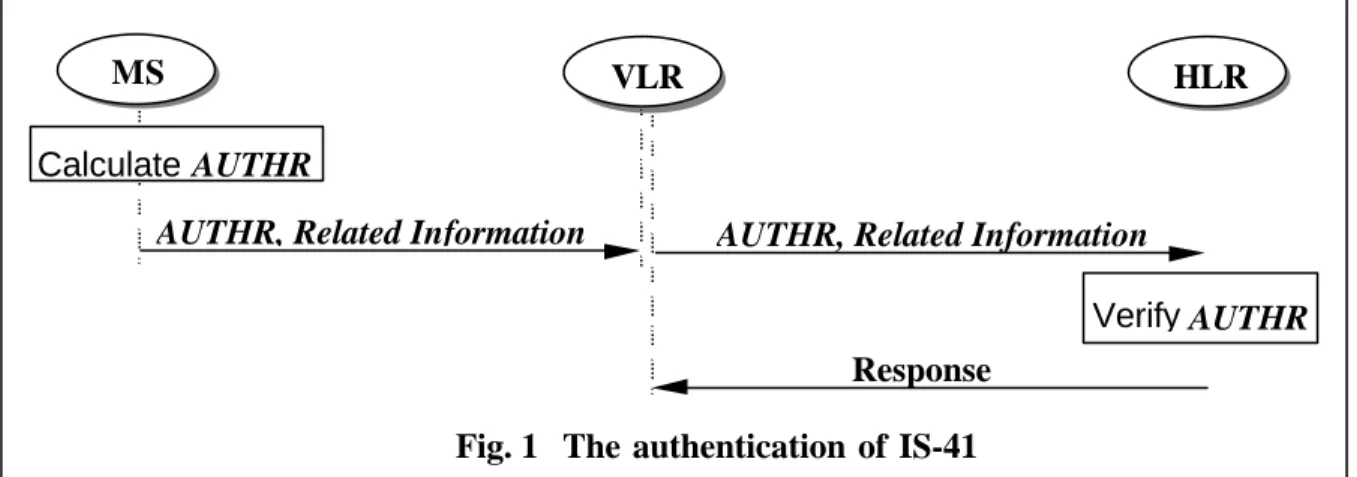
Seeking assistance of HLR is an intuitive solution to authenticate MS because the latter has subscribed in HLR. Many practical systems utilize through this mechanism, including IS-41 [4], CDPD [3], and Mobile-IP [6]. IS-41, Intermin Standard 41, was defined by Electronic Industries Association (EIA) and by Telecommunications Industries Association (TIA) for the mobility management of MSs who roam across cellular telecommunication systems, such as AMPS, IS-95, and so forth [27, 28]. As MS moves from VLRo to VLRn, VLRn forwards the authentication request submitted by MS to MS's HLR (see Fig. 1). The request consists of the authentication result AUTHR and other security related information. The request is directly transmitted to HLR via VLR n. If the verification of AUTHR is successful in HLR, HLR responds to VLRn and provides security related information to VLRn who establishes the private communication channel between MS and VLRn. In IS-41, HLR, VLRn, and the network between them are fully trusted. Thus, this protocol only verifies the validity of MS's request and guarantees the confidentiality between VLRn and MS.
The authentication protocol of CDPD resembles IS-41 except that MS and VLRn must first determine their sharing secret key with the Diffie-Hellman key exchange protocol [12]. HLR,
Fig. 1 The authentication of IS-41
HLR MS VLR
Calculate AUTHR
AUTHR, Related Information AUTHR, Related Information
Verify AUTHR Response
Like IS-41 and CDPD, Mobile-IP adopts the same registration mechanism:
MS-VLRn-HLR-VLRn-MS. MS inserts an authenticator into the registration request, and HLR authenticates the request with the authenticator. (The authenticator is produced with the secret information, called the security association, which is shared between MS and HLR.) MS similarly verifies the registration reply from HLR by the HLR-MS authenticator. The authentications of HLR -VLR and VLR-MS occur if they can share some security associations in advance by other appropriate mechanism(s) [13]. However, establishing this job for each pair of HLR-VLR and VLR-MS is a difficult task. Hence, in the Mobile-IP specification, only the authentication between HLR and MS is mandatory.
The second candidate supporting MS's information to assist VLRn in authenticating MS is VLRo, where MS originates from. The authentication protocol proposed in GSM resembles this mechanism. GSM was developed by European Telecommunications Standard Institute (ETSI) [11]; it is the first digital cellular mobile telecommunication system providing security functions for its subscribers to guarantee the confidentiality of communications and avoid frauds. In GSM, each MS carries a unique and permanent subscriber identity, generated by HLR, and a temporary identity (TID), generated by VLR where MS is roaming in. Besides, MS and HLR share some security-related-information that is used in the authentication. When MS leaves his home domain and arrives in a new visited domain, VLR must query HLR for security-related-information to authenticate MS. If MS roams to another new domain VLR n, the latter will demand security-related-information from VLRo. Fig. 2 depicts the authentication procedure, which is embedded in the registration protocol. Although GSM provides better security functions in modern telecommunication systems, the system still has many weaknesses [5]. For instance, GSM only authenticates MS like IS-41 and CDPD. Furthermore, although VLRn directly obtains security-related-information from VLRo rather than from HLR to reduce the traffic of networks, the exchanged messages are by far numerous. The number of messages is large because the security-related-information transmitted from VLRo to VLRn should suffice to satisfy sequential
authentications. Besides, VLRn should inform HLR to update MS's location; the overhead of MS's registration is still large.
Obviously, modern telecommunication systems, such as IS-41, CDPD, Mobile-IP, and GSM, fail to satisfy the requirements of high security assurance in the PCS. Future communication networks will be heterogeneous and integrate multiple service providers to support demanded communication services [25]. Therefore, providing confidentiality and authentication to each party in the communication networks, including subscribers and service providers, is necessary.
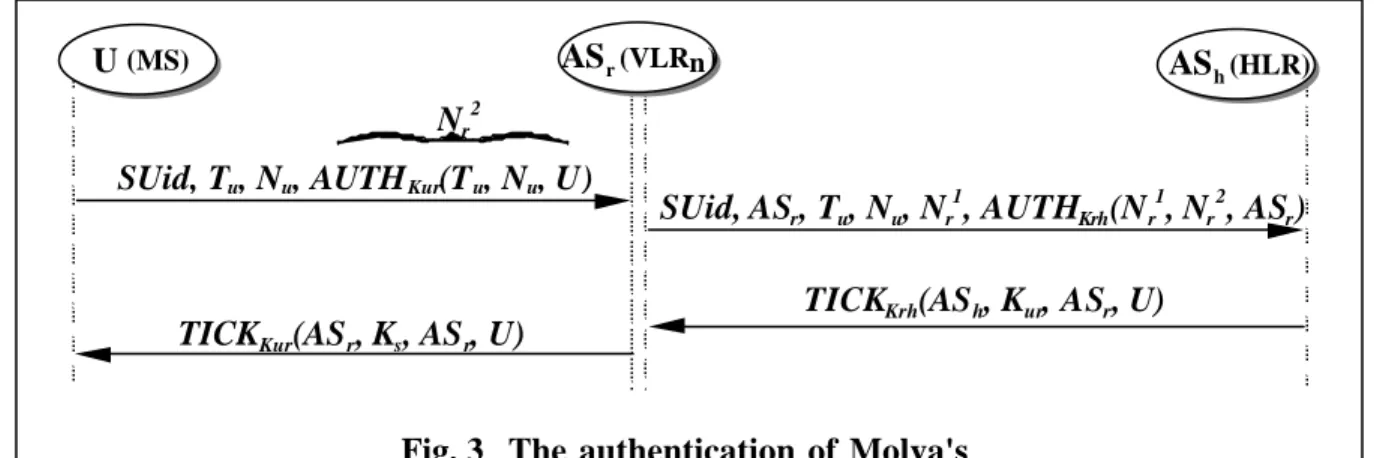
To resolve the security problems of mobile telecommunication systems, Molva et al. proposed an authentication protocol [8]. The protocol authenticates all the individuals, i.e., MS, VLR, and HLR, and protects all exchanged messages between the parties as ciphertext. No intruder can therefore impersonate the legal party in the communication network and gain access to unauthorized services, or eavesdrop on secret information in communication channels. Like IS-41, VLRn in Molva's protocol directly requests HLR to authenticate MS. Fig. 3 presents the details of this procedure. The first message MS sends to VLRn is AUTHKur(..), which is an authentication token and is encrypted by a location-dependent key Kur. The key Kur is generated by MS and is used only in the authentication phase. Since VLRn does not yet know Kur, VLRn
MS VLRn VLRo HLR
Location Updating
Acknowledge Acknowledge
Cancellation
Authentication
Generation of the session
Security-Related-Information
TIDo TIDo
Allocation of TIDn Cipher(TIDn)
just recomputes a new authentication token with the undecrypted token Nr2 and its certificate information and sends to HLR. Molva et al. assumed that HLR and VLR n share a long-term key Krh that is distributed by a secure key distribution procedure involving a mutually trusted third party. With the shared key Krh, HLR authenticates VLRn and MS by the token and, if successful, sends a ticket to VLRn that contains the secret key Kur. VLRn can then verify the authentication token, AUTHKur(… ), received from MS. Upon receiving the correct authentication token, VLRn sends a ticket containing the session key Ks shared by MS and VLRn for the subsequent communication to MS.
Because future PCS will provide services in any city, such extension necessitates long connection between HLR and VLRn. Thus, Molva's protocol, although superior to the previous four schemes in terms of security, suffers from the communication overhead between VLRn and HLR. The overhead not only includes the message transmission for the long connection, but also the added complexity of establishing a secure key distributed system to guarantee the security between HLR and the remote VLR. To guarantee smooth services, the time taken for the registration (including the authentication) should be kept to minimum while MS roams into a new domain during service. Therefore, eliminating the traffic between HLR and VLRn can improve the performance of the registration/authentication.
Fig. 3 The authentication of Molva's ASr (VLRn)
SUid, Tu, Nu, AUTHKur(Tu, Nu, U) Nr2
SUid, ASr, Tu, Nu, Nr1, AUTHKrh(Nr1, Nr2, ASr)
TICKKrh(ASh, Kur, ASr, U) TICKKur(ASr, Ks, ASr, U)
ASh (HLR)
U (MS)
3. Problems and Assumptions
Many advanced schemes have recently been proposed to reduce the overhead by avoiding the assistance of HLR. Jain et al. proposed a caching strategy, incorporating the original location strategy, to improve the performance of finding the called user's location [8]. Perkins proposed an architecture of hierarchical VLRs for reducing the overhead of registrations in Mobile-IP [10].
In this scheme, the registration request does not need to be transmitted back to HLR, but must cross several domains to a targeted VLR that can authenticate MS. Nevertheless, this scheme also suffers from the disadvantage of only authenticating MS and HLR.
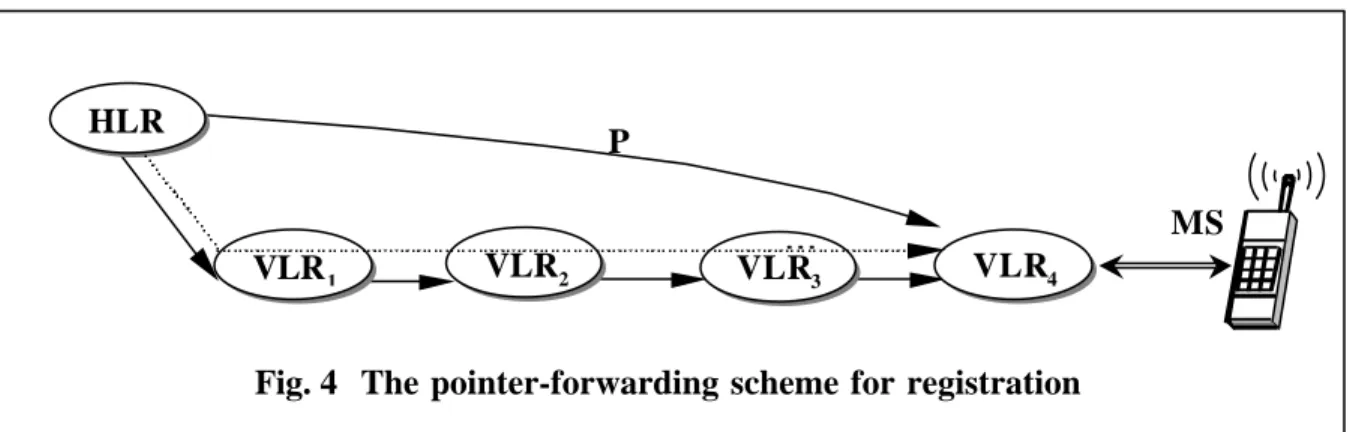
In 1995, Jain et al. proposed a pointer-forwarding scheme to reduce the registration cost [9]. To find the called MS's location and deliver the call to him, the conventional systems resort to record MS's current location at HLR whenever the user moves. However, Jain's registration scheme creates only a pointer from VLRo to VLRn when MS moves from VLR to another, instead of immediately updating his location record in HLR. Updating of MS's location in HLR is unnecessary until a call delivery for MS arrives. As Fig. 4 reveals, when MS is called, the new location pointer P is created by traveling from HLR to VLR4 (dashed lines), and the original pointers are deleted. This scheme significantly benefits the registration when accessing HLR is rather expensive, e.g., for when HLR and VLRn are distant or when the network topology is quite complicated. However, the authentication protocol was not addressed in their work. The authentication procedure must be completed before the location updating during the registration phase. Jain's registration scheme is incompatible with most conventional authentication protocols because they must connect back HLR to authenticate MSs. Herein, we present an authentication scheme that is especially appropriate for Jain's registration scheme. The overhead of the registration, including the authentication, is therefore significantly lower in our scheme.
In fact, the proposed chain authentication is suitable not only for the pointer-forwarding-based registration, but also for the conventional registrations, which record MS’s current location at HLR. In the conventional schemes, the chain authentication will not reduce the network burden for registration but will shorten the response time for authentication. This feature is very useful for communication services, e.g., the voice services, which have to smoothly continue when MSs roam from a domain to another. (That is because the service can be immediately re-started after the interruption for authentication, and then the rest of the registration can be concurrently proceeded with the service.) Because the detail of the registration is out of the scope of this paper, we will not discuss the impact of different location updating schemes combined with the chain authentication.
The following assumptions about the PCS environment are used in this study.
§ PCS network is a distrusted communications environment. Users can travel to anywhere in the PCS network that consists of many service providers. All communications are likely to be eavesdropped through wireless or wired channels. The messages can be destroyed to confuse services or be replayed to access unauthorized services. An intruder may try to impersonate every role, including that of MS, VLR, and HLR, to cheat others.
§ The network topology is extremely large and complicated. Thus, VLR is distant HLR and the path contains many switches (or routers). Therefore, the communication back to HLR is expensive and may significantly degrade the performance of the authentication. In addition,
Fig. 4 The pointer-forwarding scheme for registration HLR
VLR1 VLR2 VLR3 VLR4
P
MS
the covered area of the administrative domain of a service provider may overlap with other domains, and each service provider may not support all the services. That is, a local area may contain multiple service providers who support different services. Each service provider must continuously broadcast a beacon containing VLR-related information, such as the identity of VLR and supported services. By listening to the beacons, MS can detect the domains he arrives in, and select an appropriate VLR to connect with.
§ Inter-domain authentication is available. In a multi-domain environment, all service providers must cooperate to support services for all subscribers under the control of the contract. Thus, authentications of participant service providers and the non-repudiatio n of their operations are deemed necessary. The public key cryptography will be the best candidate; many security standards and applications use the public key cryptography, e.g., CCITT X. 509 [14], ANSI X9.30, and Internet Privacy Enhance Mail [15-17]. This work assumes that VLR can access the public keys of other VLRs. We do not stipulate that the public key infrastructure established for the certificates and key management (Readers interested in this issue can refer to [18] for the details.). Chokhani [18] reported that the cost of obtaining other public keys relies on the distance between them. Since MSs generally travel from a domain to its neighbor, the distance between VLRo and VLRn is typically shorter than the distance between VLRn and HLR. This assumption is therefore reasonable and practical.
§ The administration of HLR/VLR is trusted. That is, the servers of HLR/VLR are protected from malicious intruders or renegade system-operators. This assumption may fail because security-management schemes are still imperfect now. However, schemes, such as access control and auditing, fall beyond the scope of the present paper. Readers interested in those schemes can refer to related articles [19, 20].
§ The pointer-forwarding scheme for subscriber registration is applied. We emphasize the design of the authentication protocol. The next section describes the relation between the present protocol and the pointer-forwarding scheme.
4. Chain Authentication
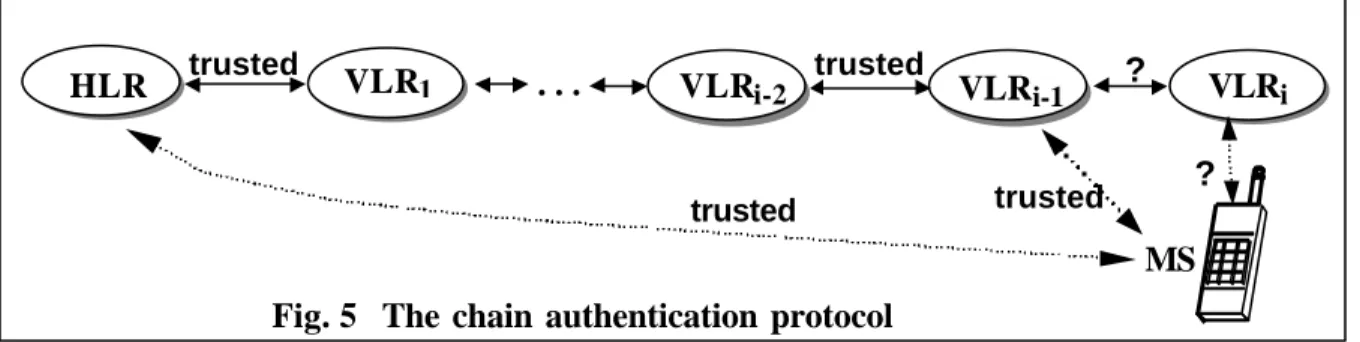
The chain implies that, in the proposed protocol, all domains, visited by MS, constitute a virtual trusted chain, which originates HLR and ends at the VLRn that he is currently visiting. A trusts B only if A can successfully authenticate B by a pre-defined protocol. Therefore, each entity in the trusted chain must aut henticate the neighbors and trust them. Fig. 5 depicts the authentication history for MS. When MS lies in the domain of HLR, the authentication of both MS and HLR is trivial because HLR knows its subscriber MS. If MS roams to VLR 1, some authentication procedure must be applied to establish mutual trust. Since VLR1 is strange to MS before registration of MS, VLR1 must query HLR to authenticate MS. Prior to authentication, however, HLR and VLR1 should authenticate each other. Upon establishing authentication, HLR can authenticate MS for VLR1, and relay MS's security related information to VLR1. VLR1 and MS must then authenticate each other. Afterwards, if they can trust each other, VLR1 can be included in the MS's trusted chain. These steps are repeatedly exec uted as MS travels until MS roams to VLRi, the trusted chain being from HLR to VLRi-1; i.e., they all trust MS, and vice versa.
Since the proposed protocol uses only VLR i-1 to establish authentication between VLRi and MS, we use VLRo and VLRn to denote the old domain VLRi-1 and the new visited domain VLRi,
Fig. 5 The chain authentication protocol
HLR trusted VLR1 . . . VLRi-2 VLRi-1 ? VLRi
MS trusted
? . . . trusted
trusted
respectively (Fig. 5). If some authentication procedures can be applied to guarantee that (1) VLRo trusts the authentication request claimed by MS, (2) VLRn trusts the respons e of VLRo, and (3) MS trusts the authentication result issued from VLRo, who is trusted; then, VLRn and MS can trust each other. Therefore, we define a basic rule for the authentication in VLRn using VLRo when MS moves from the trusted VLRo to the new visited domain VLRn. The rule of the chain authentication protocol is as follows:
given
MS and VLRo trust each other, if
1) VLRo and VLRn trust each other,
2) VLRn proves to VLRo that MS has arrived in the new domain, and 3) VLRn proves to MS that VLRo trusts and authorizes VLRn,
then,
MS and VLRn trust each other.
The notations used in the chain authentication protocol are defined as follows. Notably, we append a subscript o to a notation to denote its relation to VLRo, and a subscript n to show its relation to VLRn.
§ IMSI − international mobile subscriber identity. It is a unique and permanent MS identity, generated by HLR when MS subscribes the services. IMSI is confidential; only MS, HLR, and trusted VLRs are aware of this information.
§ TMSI − temporary mobile subscriber identity, generated by VLR whenever MS arrives and completes the registration. To preserve the confidentiality of MS's identity, MS uses TMSI, rather than IMSI, to identify itself in the local domain. When MS leaves this VLR and registers in another domain, this identity is canceled. It is assumed that TMSI contains the
temporary sequence number to establish its identity. VLRn can then gain the address of VLRo while receiving TMSIo submitted by MS.
§ VID − the unique and permanent identity (or address) of VLR. By listening to the beacon broadcasted from the service provider, MS can detect his current domain and get the domain-related information, including VID. If the local area is covered with the administrative domains of multiple service providers, MS can determine which service provider he wants to connect with by their beacons. VIDn denotes the identity of the new service provider (VLRn) which MS finally chooses to connect.
§ K, K-1 − the public/private key pair of VLR with the asymmetric cryptosystem [21]. The public/private key pair is applied to the digital signature and encryption of messages between VLRs/HLR. VLR generates a signature by encrypting data with the private key K-1.
Other VLRs can then authenticate the validity of data with the sender's public key K. In addition, sensitive data is encrypted with the receiver's K by the sender and transmitted in the fixed network to prevent from eavesdropping by a third party. Only the public keys of VLRs demanding communications are needed in advance to upgrade the authentication's performance. Since the VLRs are usually neighbours, obtaining and caching these keys should be economical.
§ Kc − the session key shared by MS and VLRo. It is based on the symmetric cryptosystem.
However, the algorithm to be chosen relies on system requirements and is ignored in this work. We use Kc to encrypt/decrypt the data transmitted on the radio path to guarantee the confidentiality of communications. To distinguish from Kc, the session key shared by MS and VLRn is denoted as Kc'.
§ AT − the authentication token provided by VLR. It is a random number and is only known to MS and to the VLR who generates it. AT establishes mutual authentication between MS and VLR in the chain authentication protocol (for details, see section 5(A)).
§ N − a nonce generated by VLRn. VLRn uses N to verify the freshness of the response message from VLR o.
§ Seed − a random number generated by MS, and used by MS and VLRn to generate the new session key shared only by them.
§ {Message}K − a message encrypted by an encr yption key K. The key may be the session key or, in the asymmetric cryptosystems, the public key K. If the encryption key is the private key K-1 of the message sender, this notation denotes the digital signature of Message.
§ f(INPUT1, INPUT2) − the result of an irreversible one-way function f with two inputs, INPUT1 and INPUT2. The output of the function can therefore not be forged without knowing the two inputs. Thus, the one -way function can safely authenticate the sender if only the sender and the receiver share the inputs.
The chain authentication protocol consists of three procedures: the subscription procedure, the initial authentication procedure, and the subsequent authentication procedure. The first procedure is initiated as MS subscribes to a new account of communication services in HLR. The roaming MS in a new domain invokes the second procedure to complete the registration in VLRn. The last procedure is finally invoked if MS has registered and the authentications are demanded for subsequent service s within the same domain.
The Subscription Procedure
For each new MS, HLR provides a unique and permanent identity IMSI, a temporary identity TMSI, a session key Kc, and an authentication token AT. The off-line method directly saves the information in the mobile station or subscriber's smart card, used in GSM, and evades security problems in this phase. MS can then directly announce itself by TMSI and communicate with
AT are used only when MS remains in the home domain. If MS moves and registers elsewhere, the three parameters are rendered illegal and useless.
MS must invoke the initial authentication procedure upon arrival in a new domain to register when VLRn will generate three new parameters TMSIn, Kc', and ATn for MS in the newly visited domain. A single domain usually covers a local area and contains only one service provider. Herein, we propose a basic procedure for initial authentications in such environme nts.
However, the future PCS will cover multiple service domains in a local area. That is, two or more service providers concurrently compete for a new MS arriving in their administrative regions (domains). Thus, we propose another enhanced initial authentication procedure for such complicated environments.
The Basic Initial-Authentication-Procedure
Step 0) While detecting a new domain name VIDn in the received beacon, MS should record VIDn and invoke the following procedure.
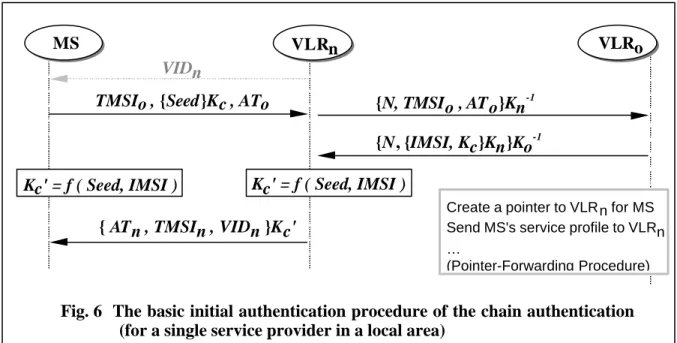
Step 1) First, MS generates a random number Seed and enciphers it with Kc. Then, MS sends its TMSIo, {Seed}Kc, and ATo to VLRn.
{N, {IMSI, Kc}Kn}Ko-1 {N, TMSIo , ATo}Kn-1
Fig. 6 The basic initial authentication procedure of the chain authentication (for a single service provider in a local area)
MS
TMSIo , {Seed}Kc , ATo
{ ATn , TMSIn , VIDn }Kc'
Kc' = f ( Seed, IMSI ) Kc' = f ( Seed, IMSI )
VLRn VLRo
VIDn
Create a pointer to VLRn for MS Send MS's service profile to VLRn
…
(Pointer-Forwarding Procedure)
Step 2) VLRn generates a nonce N and ciphers the message (N, TMSIo, ATo) with its private key Kn-1. Finally, VLRn sends the ciphered message to VLRo. VLRn retains the ciphertext {Seed}Kc.
Step 3) VLRo uses the public key Kn of VLRn to decipher the received message. If the deciphering is successful, VLRo believes that the message was sent by VLRn. VLRo then uses TMSIo to find out the corresponding IMSI, Kc, and ATo in its database. Since ATo is known only to MS and VLRo and is used once, if VLRo receives original ATo, VLRo believes that this message is not replayed and that MS is in the domain of VLRn.
Step 4) VLRo sends {N, {IMSI, Kc}Kn}Ko-1 to VLRn. Because {IMSI, Kc}Kn is ciphered with Kn, VLRn alone can disclose this information.
Step 5) VLRn uses the public key Ko of VLRo to decipher the received ciphertext and verifies the authenticity of returned nonce N, after which, VLRn believes that a fresh message arrived from VLRo. Thus, VLRn believes that MS has been successfully authenticated by VLRo. VLRn can create a new registration record for MS and generate a new temporary identity TMSIn and an authentication token ATn for MS. Another important task in this step is to produce the new session key Kc' shared only by MS and VLRn.
VLRn initially uses the MS-VLRo session key Kc to decipher the ciphertext {Seed}Kc kept at step 2 and obtains the random number Seed. The number and MS's IMSI are then assigned to a one-way function f to produce the new session key Kc', shared by MS and VLRn. That is, Kc' = f( Seed, IMSI ).
Step 6) VLRn sends {ATn, TMSIn, VIDn }Kc' to MS.
Step 7) Before MS receives the message sent at step 6, he uses Seed and his IMSI to generate Kc' using the same one-way function f used by VLRn. MS then deciphers the message using the new session key and, finally, verifies the varible VIDn with the identity
disapproves the request and does not return the previous session key Kc to VLRn.
Without the correct Kc, VLRn fails to compute Kc' and thus cannot generate the fourth message {ATn, TMSIn, VIDn }Kc'. Therefore, MS can use VIDn to verify the correctness of the fourth message in case that the message may be corrupted.
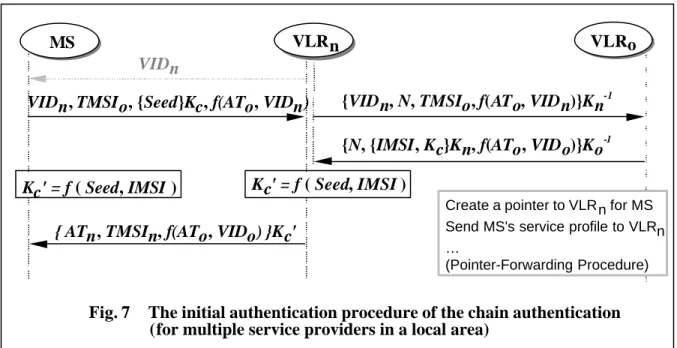
The basic initial authentication procedure is simple, but vulnerable to the complicated environment containing multiple service providers in a local area. Consider, for example, that MS arrives in a new area containing two service providers, VLR1 and VLR2. MS chooses VLR1 to register and sends the first authentication message to VLR1. VLR2 also likely receives (eavesdrops on) this messages and sends the second message to VLRo. Consequently, arrival of two messages from VLR1 and VLR2 confuses VLRo who fails to distinguish the service provider selected by MS. In the worst case, if VLR2 can block VLR1's message, VLR2 masquerades as VLR1 to serve MS. However, we improve the basic procedure to help VLRo distinguish the valid VLRn. Fig. 7 depicts the enhanced initial authentication procedure. The procedure includes the following steps.
The Enhanced Initial-Authentication-Procedure
Step 0) While detecting a new domain name VIDn in the received beacon, MS should record VIDn and invoke the following procedure.
Step 1) MS initially generates a random number Seed and then transmits (VIDn, TMSIo, {Seed}Kc, f(ATo, VIDn) to VLRn, where VIDn is the identity of the service provider chosen by MS. Since ATo is known only to MS and VLRo, nobody, even VLRn, can forge f(ATo, VIDn).
Step 2) By using VIDn, VLRn assures itself that the message is authentic. The following steps resemble the basic procedure: VLRn sends {VIDn, N, TMSIo, f(ATo, VIDn)}Kn-1 to VLRo. The ciphertext {Seed}Kc is retained in VLRn.
Step 3) VLRo deciphers the received message and computes f(ATo, VIDn) using the same one-way function. If the computed result is similar to f(ATo, VIDn) received from VLRn, MS's authentication is successful and VLRo believes that MS chose VLRn to support services.
Step 4) VLRo re-computes f(ATo, VIDo) and sends {N, {IMSI, Kc}Kn, f(ATo, VIDo)}Ko-1 to VLRn.
Fig. 7 The initial authentication procedure of the chain authentication (for multiple service providers in a local area)
MS
VIDn, TMSIo, {Seed}Kc, f(ATo, VIDn)
{ ATn, TMSIn, f(ATo, VIDo) }Kc'
Kc' = f ( Seed, IMSI ) Kc' = f ( Seed, IMSI )
VLRn VLRo
VIDn
{VIDn, N, TMSIo, f(ATo, VIDn)}Kn-1 {N, {IMSI, Kc}Kn, f(ATo, VIDo)}Ko-1
Create a pointer to VLRn for MS Send MS's service profile to VLRn
…
(Pointer-Forwarding Procedure)
Step 6) VLRn sends {ATn, TMSIn, f(ATo, VIDo) }Kc' to MS.
Step 7) MS also generates Kc' and uses the new session key to decipher the message. Finally, MS uses ATo and VIDo of VLRo to compute the result of the one-way function f and verifies whether the result is the same as that received from VLRn. If yes, this fact implies that his authentication request has correctly passed to VLRo via VLRn. VLRo must then trust VLRn. Otherwise, VLRo disapproves the request and does not return the secret value f(ATo, VIDo) to VLRn. Thus, this successfully completes the authentication.
Unlike the basic procedure, ATo is used not only as a nonce to prevent replay attacks, but also to protect f(ATo, VIDn) from forging in the second message in the enhanced procedure. VLRo can thus recognise the service provider selected by MS. Furthermore, since MS can predict f(ATo, VIDo), verification of this value allows MS to detect faults in the last message, like the information VIDn used in the basic procedure. (See section 5 for proof)
Notably, the initial authentication procedure can be combined with the registration process which adopts the pointer-forwarding scheme, as mentioned in section 3, to track MS's current location.
Details of the combination are not within the scope of this paper. The following example is made.
After VLRo has approved the authentication request and returned the response to VLRn, it can create a pointer to VLRn for MS in itself database. At this moment, VLRo can also transmit other MS's personal information, such as the profile of subscribed services, to VLRn. If these messages are confidential, VLRo is entitled to generate a shared secret key and send it to VLRn by inserting the secret key into {IMSI, Kc}Kn mentioned in step 4.
Fault Tolerance for the Initial Authentication Procedure
With our initial authentication procedure, the authentication fails if VLRo is unreachable, such as when VLRo crashes, the link between VLRo and VLRn is broken, or VLRn does not know VLRo. However, the fault probability is low due to the high fault tolerance of telecommunication
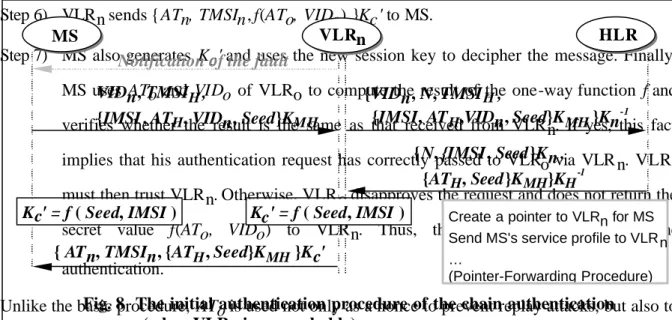
Fig. 8 The initial authentication procedure of the chain authentication (when VLRo is unreachable)
MS
VIDn, TMSIH,
{IMSI , ATH, VIDn, Seed}KMH
{ ATn, TMSIn, {ATH, Seed}KMH }Kc'
Kc' = f ( Seed, IMSI ) Kc' = f ( Seed, IMSI )
VLRn HLR
Notification of the fault
{VIDn, N, TMSIH,
{IMSI, ATH,VIDn, Seed}KMH}Kn-1 {N, {IMSI, Seed}Kn,
{ATH, Seed}KMH}KH-1
Create a pointer to VLRn for MS Send MS's service profile to VLRn
…
(Pointer-Forwarding Procedure)
systems. In the event of this fault, an additional scheme is necessary to authenticate MS and to continue the registration process. Existing schemes can be used. For instance, by signalling by VLRn to MS of the fault, both parties adopt Molva's scheme or other conventional authentication protocols with the assistance of HLR to complete the authentication and registration process.
Alternatively, our initial authentication procedure can be modified to tolerate the fault with additional secret information. Fig. 8 presents a feasible solution. KMH is a long-term key shared only by MS and HLR. ATH and TMSIH denote the old AT and TMSI used, respectively, in the last authentication between MS and HLR. The procedure resembles the previous two authentication procedures, except that MS does not use one -way function to protect data and that Seed is disclosed by HLR, rather than by VLRn itself. Note that Kc, the old session key coresponding to ATH and TMSIH, in this procedure, will not be used in encipher data because it has been known to the first visited VLR after MS leaving HLR (referring to the previous section).
Instead, MS uses ATH to prove the origin and the freshness of the authentication request because only MS and HLR know ATH. Thus, VLRn continues the authentication process with this modified initial authentication procedure while VLRo is unreachable. Moreover, the additional efforts of MS and HLR only retain KMH, ATH, and TMSIH.
In addition to the condition that VLRo is unreachable, this procedure is also suitable to the condition that HLR is nearer than VLRo, e.g., the new domain in which MS arrives is HLR. If VLRn always selects the nearest VLRo/HLR to help authenticate MS, the network burden caused by the authentication will be significantly reduced. However, to achieve this benefit, VLRn must be intelligent enough to determine the communication cost of contacting VLRo and HLR.
The Subsequent Authentication Procedure
Some practical systems require re-authentication by MS, who must decide/establish a new
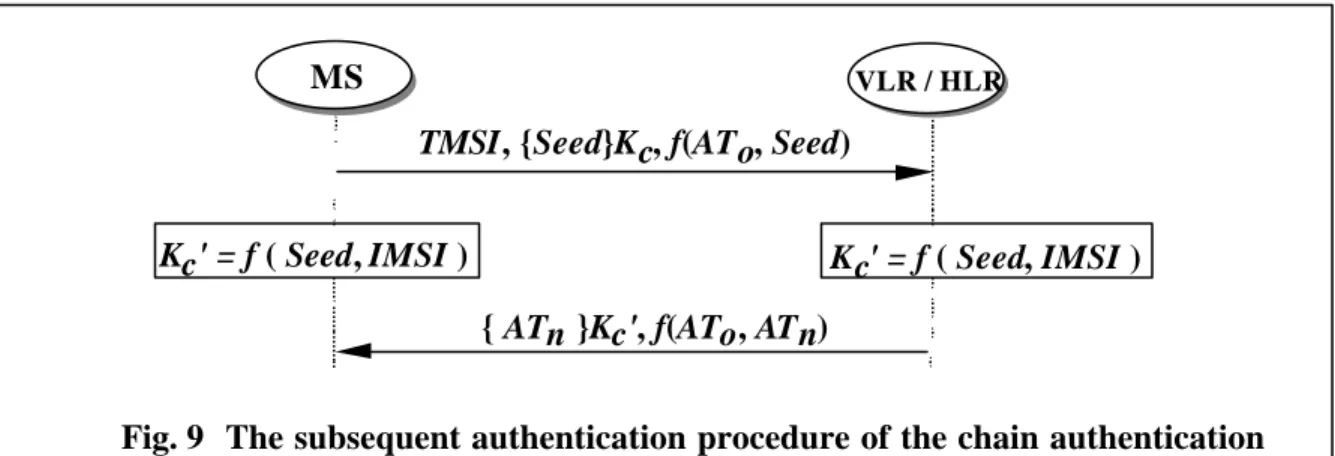
procedure. The procedure consists of only two messages that can be embedded in the service request or isolated from the request. Herein, we merely describe the contents of authentication messages (Fig. 9). Kc and ATo denote the session key and the authentication token generated by the previous initial/subsequent authentication procedure, while Kc' and ATn present the new session key and the authentication token generated presently.
Step 1) MS generates a random number Seed and enciphers it with Kc shared between MS and the current service provider, i.e., VLR or HLR. Then, MS sends his TMSI , the ciphertext {Seed}Kc, and f(ATo, Seed) to his service provider.
Step 2) The service provider uses TMSI to determine the corresponding IMSI , Kc, and ATo in its database. Next, Seed disclosed from the ciphertext with Kc is used to compute f(ATo, Seed). If the computed result is the same as f(ATo, Seed) received from MS, the authentication is successful. Although hostile attacks may replace {Seed}Kc, such a condition is easily detected by verifying the correctness of f(ATo, Seed); the output of the one-way function cannot be masqueraded.
Step 3) MS and the service provider generate the new session key, that is, Kc' = f(Seed, IMSI), by the key-generation method mentioned in the initial authentication procedure.
Step 4) The service provider generates a new authentication token ATn and transmits ({ ATn }Kc', f(ATo, ATn)) to MS. Correct generation of Kc' by the legal service provider
Kc' = f ( Seed, IMSI ) MS
TMSI, {Seed}Kc, f(ATo, Seed)
{ ATn }Kc', f(ATo, ATn) Kc' = f ( Seed, IMSI )
VLR / HLR
Fig. 9 The subsequent authentication procedure of the chain authentication
enables MS to decipher this message and obtain the new token ATn for the subsequent authentication.
If faults occur in the subsequent authentication procedure, MS must only invoke the (basic/
enhanced) initial authentication procedure to restart the services with the present VLR.
5. Protocol Analysis and Comparison
This section analyzes the security and performance of the proposed protocol and compares it with traditional mechanisms. (Only the enhanced initial authentication procedure is considered in this section.)
(A) Security Analysis
Once trust is established between MS and VLRo, whether MS and VLRn can trust each other can be determined using three criteria:
§ VLRo and VLRn trust each other,
§ VLRn proves to VLRo that MS has arrived in the new domain, and
§ VLRn proves to MS that VLRo trusts and authorizes VLRn.
We now explain how our protocol uses four messages to accomplish authentication and will use the BAN -logic to verify why it can correctly authenticate each communication party. (The BAN-logic formally verifies the correctness of authentication protocols. BAN-logic is neither sufficient nor complete; however, it can help verify the correctness of an authentication protocol to some extent. Refer to Ref. [22] for details.)
We first idealize our protocol to the BAN-logic form:
MS → VLRn: {Seed}Kc, <VIDn>ATo (M1)
VLRn → VLRo: {N, TMSIo, <VIDn>ATo }Kn-1 (M2) VLRo → VLRn: {N, {IMSI, MS Kc VLRo}Kn, <VIDo>ATo }Ko-1 (M3)
defined in BAN-logic [22]. <X>Y means that X is combined with the secret formula Y. The shared secret formula Y is ATo in our protocol. Since ATo is shared only by MS and VLRo, and is used only once, it is difficult to forge or replay f(ATo, X), where X is VIDn or VIDo. Thus, f(ATo, X) can prove the origin of the message and guarantee its freshness. That is,
VLRo believes fresh( <VIDn>ATo ) and
MS believes fresh( <VIDo>ATo ). (D1) The following analysis first employs the BAN-logic to describe the deductions obtained upon receipt of each message. The detailed proof is presented in Appendix. We then verify that our protocol meets the three criteria.
After (M1) − VLRn suspects all information received because it cannot verify the message. Thus, no deduction is derived.
After (M2) − The secret key Kn-1 of VLRn encrypts the message, VLRo believes that VLRn is the source of M2. Based on the deduction (D1) mentioned above, we deduce that
VLRo believes VLRn believes ( N, TMSIo, <VIDn>ATo ). (D2)
VLRo believes ( N, TMSIo, <VIDn>ATo ). (D3)
After (M3) − As for (M2), VLRn believes M3 is sent by VLRo, because the nonce N is generated by VLRn itself, and VLRn can verify if N is fresh. Thus, we deduce that
VLRn believes VLRo believes ( N, {IMSI, MS Kc VLRo}Kn, <VIDo>ATo ). (D4) VLRn believes ( N, {IMSI, MS Kc VLRo}Kn, <VIDo>ATo ). (D5) By (D5), it follows that VLRn believes also {IMSI, MS Kc VLRo}Kn. So, we deduce that
VLRn believes IMSI. (D6)
VLRn believes MS Kc VLRo. (D7)
After (M4) − If VLRn obtains the correct Seed in M1, MS and VLRn will share the same session key Kc'. Thus, by (D1), we make the following deductions
MS believes VLRn believes ( ATn, TMSIn, <VIDo>ATo ) (D8)
Since Kc' is generated by MS, Kc' = f(Seed, IMSI), therefore
MS believes ( MS Kc’VLRn ). (D10)
Using these deductions allow us to demonstrate that our protocol fulfills the three criteria to complete the authentication.
Criterion 1 − VLRo and VLRn must trust each other. Deduction (D2) and (D3) prove that message 2 meets the requirement that VLRo trusts VLRn. On the other hand, deductions (D4) and (D5) prove that message 3 satisfies the requirement that VLRn trusts VLRo. Therefore, criterion 1 is satisfied by messages 2 and 3.
Criterion 2 − VLRn must prove to VLRo that MS has arrived in the new domain. This requirement is trivial because our protocol guarantees (D2 and D3) and that only real MS can generate f(ATo, VIDn). VLRo therefore believes MS who announces identity by TMSIo and f(ATo, VIDn). Besides, since f(ATo, VIDn) contains the identity of VLR n and cannot be forged by VLRn, f(ATo, VIDn) suggests the location of MS.
Criterion 3 − VLRn must prove to MS that VLRo trusts and authorizes VLRn. MS can check this condition by decrypting message 4 with the new session key Kc' generated by MS. If MS can decrypt it and correctly verify f(ATo, IMSI), MS accepts the authority of VLRn granted by VLRo. Deductions (D9) and (D10) prove that our protocol satisfies this requirement.
Although the chain authentication protocol can fulfill the above criteria, we cannot infer that
"VLRn believes Kc'" in the above deductions. Our protocol only guarantees that VLRn trusts MS (see (D5)) and is able to get the correct session key Kc (see (D7)), but it does not imply that VLRn obtains the correct Seed (see (d15) in Appendix). This inability is because {Seed}Kc may be replaced by hostile intruders in message 1. VLRn cannot confirm the validity of session key Kc' until the former correctly decrypt the data encrypted using Kc' by MS. Fortunately, even in the worst case, when {Seed}Kc was replaced, only Kc' of VLRn is inconsistent with MS's and the
We guarantee, as explained above, that MS and VLRn can trust each other. That is, our protocol can authenticate the three communication parties, including MS, VLRo, and VLRn.
(B) Performance Evaluation
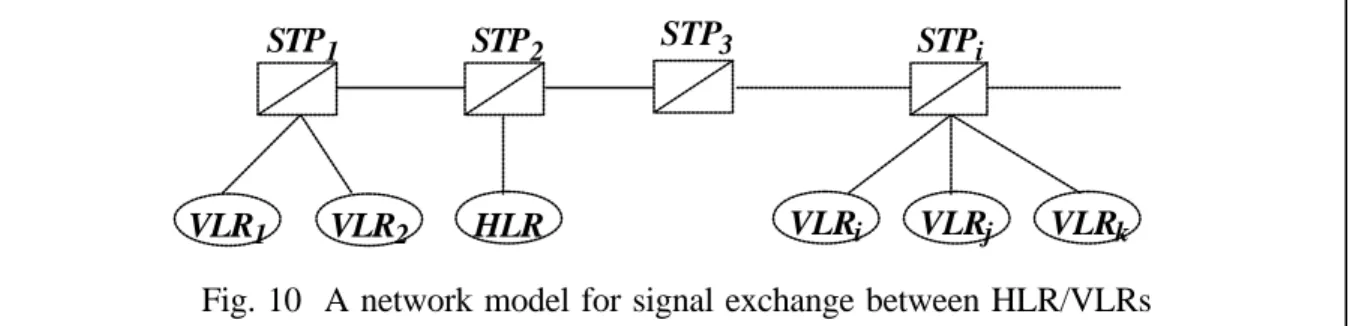
A simple HLR/VLR network model is illustrated in Figure 10 to show the benefit of the proposed authentication protocol. All HLR/VLRs exchange control signals, such as the registration messages, through middle switches. (In telecommunication systems, the switch is commonly called the Signalling Transfer Point (STP) in the Common Channel Signalling network with a Signalling System No. 7 (SS7) protocol [26].) For simplicity, we assume that the cost of signalling between HLR/VLRs is dependent on the number of switches. Therefore, the geographically contiguous domains have the smallest cost, def ined as 1. And we assume that the proposed chain authentication is combined with an intelligent VLR described in the previous section, so that VLRn will require VLRo or HLR to authenticate MS based on their costs. To compare the improvement, the traditional authentication scheme with the assistance of HLR, such as IS-41 or Molva's scheme, is used in the performannce evaluation.
Whenever MS roams from an old domain to a new domain, one of three conditions occurs. The mobile user may roam from his HLR to a VLR, from a VLR to his HLR, or from a VLR to another VLR. The following table summarizes the three conditions and the corresponding costs of the first authentication process with different protocols. For variant behavior of mobile users, we define three pr obabilities, P1, P2 and P3, for these conditions and their sum is equal to 1. And we assume P1 is equal to P2 since a user will finally return to his home after a long travel. With
Fig. 10 A network model for signal exchange between HLR/VLRs VLR1 VLR2
STP1
HLR STP2
VLRi VLRj VLRk STPi
STP3
each condition as shown in the following table.
Condition Old domain
New
Domain Probability Cost with traditional schemes
Cost with our scheme
I HLR VLRJ P1 x = y x
II VLRI HLR P2 0 0
III VLRi VLRJ P3 y Min[x, y]
x: the number of switches between the new and old domain
y: the number of switches between the new domain and HLR
Table.
Consequently, the average costs of both schemes are COSTtraditional = x * P1 + y * P3 and COSTour = x * P1 + Min[x, y] * P3.
Intuitively, the cost of our scheme is smaller than the traditional schemes and the difference is
∆C = COSTtraditional - COSTour = (y – Min[x, y]) * P3. From the equation, we conclude two factors that affect the network burden:
§ The mobile user should frequently roam among VLRs.
§ The cost of message transmission between the new domain and HLR should be larger than that between the new and old visiting domains.
If we assume the user handset is always power-on while traveling, the authentication and registration process should be immediately invoked when MS arrives in a new domain. That is, the new and old domains are geographically contiguous, and x is equal to 1. Thus, the difference can be simplfied as
∆C = (y – 1) * P3.
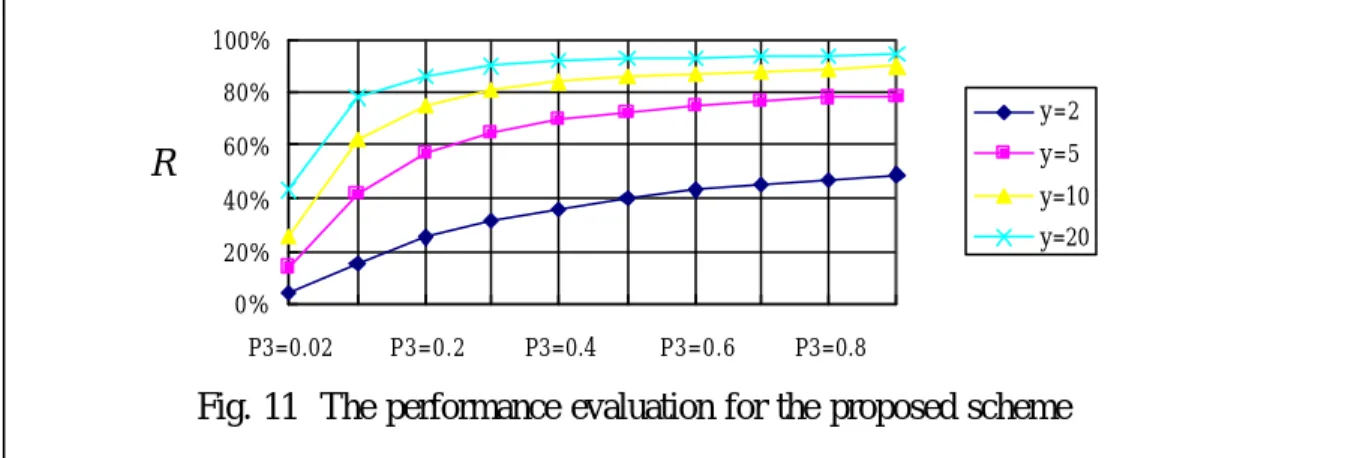
In order to clearly show the reduction of network burden due to the proposed chain authentication protocol, we normalize ∆C as the improvement rate R,
( )
1 . 1
3 1
3
P y P
P y
COST R C
l
traditiona ∗ + ∗
∗
= −
= ∆
real world since user handsets are not always power -on during their trips. Thus, x may be larger than y, and VLR will require HLR to help authenticate MS. Consequently, in the worst case, our scheme has the same network burden as traditional schemes.
(C) The Advantages of the Chain Authentication Protocol The chain authentication protocol has the following merits:
No assistance from HLR − The distance between VLRn and VLRo is generally shorter in a large PCS network than that between VLRn and HLR. A long connection path causes long propagation delay of messages, reduces the reliability of the communication channel, and makes far more traffic in the network. The proposed protocol merely uses VLRo to help VLRn authenticate MS; our scheme authenticates MS rapidly. An efficient authentication scheme is particularly crucial when time is of essence.
Another merit of the mechanism is that the certification between VLRn and VLRo is easier and faster than between VLRn and HLR, because VLRo lies closer to VLRn than does HLR. The certification is established by the public key scheme with a hierarchical architecture [18].
Therefore, the cost of the certification relies on the distance between the two communicating parties in the architecture.
Low overhead − Only four messages need be exchanged in the chain authentication protocol.
Since VLRn must contact with VLRo in the network to query the user information, four R
0%
20%
40%
60%
80%
100%
P3=0.02 P3=0.2 P3=0.4 P3=0.6 P3=0.8
y=2 y=5 y=10 y=20
Fig. 11 The performance evaluation for the proposed scheme
HLR, consequently, the chain authentication can significantly reduce the network burden caused by the authentication process when MS tries to register in a new domain.
Furthermore, computation power required is low. Using a one -way function between MS and VLRn and a symmetric cryptosystem, such as DES [23], guarantees the confidentiality of messages. These two mechanisms demand only simple computation and have been applied in existing mobile telecommunication systems, such as GSM. Although we use the public key cryptosystem between VLRn and VLRo, which is more complex than above two mechanisms, VLRs can easily perform the task because they offer better computation power in practical systems.
Subscriber identity confidentiality − If IMSI is directly used to ide ntify MS's messages, MS's moving from a domain to another can be traced by listening to his identity on the radio path. The relation between the transmitted user data and MS is also available. To prevent the privacy of user location and to improve other security features, e.g., user data confidentiality, assurance the confidentiality of subscriber identities in the communication channels is imperative. We recommend that the user be registered as a temporary identity; this mechanism resembles that used by GSM [24]. A temporary subscriber identity TMSI used in the chain authentication protocol to identify MS's request of services. TMSI is generated by VLR of the domain and submitted to MS in ciphertext when MS arrives in a new domain. Since the temporary ident ity is changed as the user travels between domains, tracing the user location on the radio path is impossible.
Communication confidentiality − To maintain confidentiality of communications between MS and VLR, a session key is needed to encipher/decipher the data transmitted on the channels.
Herein, we only suggest using symmetric cryptosystems because the system demands low computational power of MS. The proposed protocol uses a one-way function with two
addition, within the initial/subsequent authentication procedure, all exchanged secret information, such as IMSI, ATn, and TMSIn, is transmitted as ciphertext to prevent eavesdropping.
Authenticating overall participant communication parties − The modern telecommunication system only authenticates those subscribers seeking services. Furthermore, the system assumes that the network is trustworthy. In contrast, the proposed protocol authenticates all communication parties participating in the protocol, i.e. MS, VLRn, and VLRo. Between VLRo and VLRn, the public key cryptosystem are used to authenticate each other. Between MS and VLRo, the secret information, ATo and IMSI, is used to authenticate each other. Based on the two mutual authentications, MS and VLRn can authenticate each other, as mentioned earlier in this section.
Consideration of multiple service providers in a local area − Future PCS network will include multiple competing service providers in a local area. The proposed enhanced initial authentication procedure enables VLRo to distinguish the service provider chosen by MS.
Domain separation − Both the session key Kc and the temporary identity TMSI are local information. They are only valid within the domain that generated them. Thus, all domains are separated by this local and secret information. (If the administration of HLR/VLR betrays, an evil system-operator armed with MS's secret information, i.e. TMSI, Kc, and AT, can masquerade as MS in a different domain. Before the masquerade, however, if MS moves and is registered elsewhere, the evil operator (although holding these secrets) is powerless).
Session key confidentiality − Our session key generation relies on a random number and a secret information IMSI. MS and VLRn generate the key, that is unknown to anyone, including HLR and VLRo. This scheme ensures confidentiality of the new session key and reduces the probability eavesdropping by a third party. (Many practical systems, including GSM, adopt this scheme.)
Low cost for preventing replay attacks − We use an authentication number AT rather than the timestamp in the exchanged messages to ensure the freshness. Therefor e, the clock synchronization is unnecessary and message replay is difficult.
The following figure shows the comparison between our protocol and other protocols.
Protocol
Assistance of HLR
Messages needed
Authenticated parties
Confidentiality of authentication
messages
Clock synchronization
IS-41 Yes 5** MS Only between MS
and VLRn
No
CDPD Yes 6 MS Only between MS
and VLRn
No
GSM No* 6*** MS Only between MS
and VLRn
No Mobile-IP Yes 4 only MS-HLR is
mandatory
All Yes
Molva's Yes 4 MS, VLRn, HLR All Yes
Chain No 4 MS, VLRn, VLRo All No
* The registration still requires the assistance of HLR.
** It is the S authentication scheme in IS-41.
*** It does not include the messages of the location updating and acknowledges.
Fig. 12 Comparisons of the protocols
6. Conclusions
To enhance the quality of communication services, users and service providers desire a more secure environment to prevent accessing unauthorized services or disclosing confidential information. Numerous modern mobile telecommunication systems contain simple security functions, such as subscribers' authentication and the confidentiality of the communication on
referred to herein as the chain authentication protocol. This protocol contains a series of procedures, including the preparation for subscribing in HLR, the initial authentication for registering in a new domain, and the subsequent authentication for querying a service. In the initial authentication procedure, we exemplify two cases regarding a local area containing a single or multiple service provider(s). Furthermore, we also consider the occurrence of the fault that VLR o is unreachable during the initial authentication procedure, and a possible solution is proposed by modifying the original procedure.
Our protocol guarantees the confidentiality of exchanged messages and of the subscriber's identity; furthermore, the protocol uses minimal messages to authenticate all communicating parties (including MS and all participative service providers), does not require the clock synchronization, and, importantly, operates independently of HLR for MS authentication. The protocol can be applied in large communication networks with multiple service providers, such as the global PCS network.
Acknowledgement
This work is supported in part by FarEasTone Telecommunications Co., Ltd. The authors are grateful to Dr. Herman Rao and Dr. Hung-Fa Sun of FarEasTone Telecommunications Co. for their many suggestions that help improve the paper.
Reference
[1] Bennett Z. Kobb, "Personal Wireless," IEEE SPECTRUM, Jun. 1993.
[2] M. Mouly, M. B. Pautet, "The GSM System for Mobile Communications," ISBN:
2-9507190-0-7, 1992.
[3] CDPD Consortium, "Cellular Digital Packet Data System Specification," Release 1.0, July 1993.
[4] EIA/TIA, "Cellular Intersystem Operations (Rev. C)," Technical Report IS-41, EIA/TIA, 1995.
[5] S. P. Shieh, C. T. Lin, and J. T. Hsueh, "Secure Communication in Global Systems for Mobile Telecommunications," Proceedings of First Workshop on Mobile Computing, pp.
136-142, 1995.
[6] C. Perkins, Editor, "IP Mobility Support," RFC 2002, Oct. 1996.
[7] R. Molva, D. Samfat, and G. Tsudik, "Authentication of Mobile Users," IEEE Network, Mar./Apr. 1994.
[8] R. Jain, Y. B. Lin, C. Lo, and S. Mohan, "A Caching Strategy to Reduce Network Impacts of PCS," IEEE Journal on Selected Areas in Communications, Vol. 12, No. 8, Oct. 1994.
[9] R. Jain, Y. B. Lin, and S. Mohan, "A Forwarding Strategy to Reduce Network Impacts of PCS," IEEE INFOCOM, 1995.
[10] C. Perkins, "Mobile-IP Local Registration with Hierarchical Foreign Agents," IETF Internet-Draft, Feb. 1996.
[11] "GSM 02.09: Security Aspects," European Telecommunications Standards Institute, Jun.
1993.
[12] W. Diffie and M. Hellman, "New Directions in Cryptography," IEEE Trans. Information Theory, Nov. 1976.
[13] R. Atkinson, "Security Architecture for the Internet Protocol," RFC-1825 , Aug. 1995.
[14] "Recommendation X.509 and ISO 9594-8, Information Processing Systems - Open Systems Interconnection - The Directory - Authentication Framework," CCITT Technical report, Mar. 1988.
[15] J. Linn, "Privacy Enhancement for Internet ElectronicMail, Parts I: Message Encryption and Authentication Procedures," RFC-1421 , SRI Network Information Center, Feb. 1993.
[16] S. Kent, "Privacy Enhancement for Internet ElectronicMail, Parts II: Certificate-Based Key Management," RFC-1422, SRI Network Information Center, Feb. 1993.
[18] S. Chokhani, "Toward a National Public Key Infrastructure," IEEE Communications Magazine, Sep. 1994.
[19] Ravi S. Sandhu and Edward J. Coyne, "Role-Based Access Control Models," IEEE Computer, Feb. 1996.
[20] "Trusted Computer System Evaluation Criteria," DoD STD-5200.28, Dec. 1985.
[21] R. L. Rivest, A. Shamir, and L. Adelman, "A Method for Obtaining Digital Signatures and Public-Key Cryptosystems," Commun. of the ACM, Vol. 21, No. 2, pp. 120-126, Feb. 1978.
[22] M. Burrows, M. Abadi, and R. Needham, "A Logic of Authentication," ACM Transaction on Computer Systems, Vol. 8, No. 1, Feb. 1990.
[23] NBS FIPS PUB 46-1, "Data Encryption Standard," National Bureau of Standards, U.S.
Department of Commerce, Jan. 1977.
[24] "GSM 03.20: Security Related Network Functions," European Telecommunications Standards Institute , Jun. 1993.
[25] K. Buchanan, R. Fudge, D. McFarlane, T. Phillips, A. Sasaki, and H. Xia, "IMT-2000:
Service Provider's Perspective," IEEE Personal Communications Magazine, Vol. 4, No. 4, Aug. 1997.
[26] A. R. Modaressi and R. A. Skoog, “Signalling System No. 7,” A tutorial, IEEE Communications Magazine, pp. 19-35, Jul. 1990.
[27] Y. B. Lin, Introduction to Mobile Network Management, Wei-Keg Publishing Co., 1997.
[28] EIA/TIA, “Mobile Station-base Station Compatibility Standard for Dual-Mode Wideband Spread Spectrum Cellular System, ” Technical Report TIA/EIA/IS-95-A, EIA/TIA, 1995.
Appendix
In this proof, we use the same notations and logical postulates as the BAN-logic [15].
§ (P1): for the message using shared key, we postulate:
P believes P Q, P sees {X}KK P believes Q said X
§ (P2): for the message using public key, we postulate:
P believes Q, P sees {X}K-1K P believes Q said X
§ (P3): for the message using secret information, we postulate:
P believes Q P, P sees <X>Y P believes Q said X
Y
§ (P4): the nonce-verification rule:
P believes fresh(X), P believes Q said X P believes Q believes X
§ (P5): the jurisdiction rule:
P believes Q controls X, P believes Q believes X P believes X
§ (P6):
P sees (X, Y) P sees X
§ (P7):
P sees <X>Y P sees X
§ (P8):
P believes P Q, P sees {X}KK P sees X
§ (P9):
P believes P, P sees {X}KK P sees X
§ (P10):
P believes Q, P sees {X}K-1K P sees X
§ (P11):
P believes fresh(X) P believes fresh(X, Y)
As mentioned in section 5, we have the following four idealized messages.
(M1) MS → VLRn: {Seed}Kc, <VIDn>ATo
(M2) VLRn → VLRo: {VIDn, N, TMSIo, <VIDn>ATo}Kn-1
(M3) VLRo → VLRn: {N, {IMSI, MS Kc VLRo}Kn, <VIDo>ATo}Ko-1 (M4) VLRn → MS: {ATn, TMSIn, <VIDo>ATo, MS Kc' VLRn}Kc’
Before the proof, the following assumptions are made.
(A1) VLRo believes Kn VLRn (A2) VLRn believes Ko VLRo (A3) VLRn believes Kn VLRn (A4) VLRo believes VLRo ATo MS (A5) MS believes VLRo ATo MS (A6) MS believes MS Kc’VLRn (A7) VLRo believes fresh(ATo) (A8) MS believes fresh(ATo) (A9) VLRn believes fresh(N)
(A10) VLRo believes VLRn controls (VIDn, N, TMSIo, <VIDn>ATo)
(A11) VLRn believes VLRo controls (N, {IMSI, MS Kc VLRo}Kn, <VIDo>ATo) (A12) VLRn believes VLRo controls {IMSI, MS Kc VLRo}Kn
(A13) MS believes VLRn controls (ATn, TMSIn, <VIDo>ATo, MS Kc’ VLRn)