• 沒有找到結果。

To explore the competencies that a strategic negotiator, particularly strategic

N/A
N/A
Protected

Academic year: 2021

Share "To explore the competencies that a strategic negotiator, particularly strategic "

Copied!
30
0
0

加載中.... (立即查看全文)

全文

(1)

CHAPTER IV. FINDINGS AND DISCUSSIONS

The study tends to explore and figure out the competencies required for strategic negotiator, particularly in sport sector. In this chapter, the research result and findings will be discussed and illustrated on basis of the data collected through interview. In this chapter, the obtained data will be discussed and analyzed in accordance with the framework of strategic negotiation process with open-ended questions, especially from the perspective of the formulated “Olympic Mode”, which consist of four parts, in order to explore and figure out the competencies that may be required for a strategic negotiator in sport and generalized to the strategic negotiators in other sectors.

Given the competencies that may be required for processing the strategic negotiation, the study undertook the interviews with purposive samples having involved in negotiation and documenting for negotiation, where six were interviewed.

Of the six samples, three have been involving in negotiation in sport, particularly the negotiation on the national identity and status in international sport community, while two have been involving in negotiation in accession to international organizations, such as WTO and OECD, and one was involved in staffing and documenting for issues in APEC. As far as the competencies of a strategic negotiation are concerned, the collected data are to be explored and analyzed on basis of the hypotheses that a strategic negotiator shall possess certain competencies to prepare for the negotiation, to attempt to achieve the goal and execute the agreement.

To explore the competencies that a strategic negotiator, particularly strategic

negotiator in sport sector, is required, this study conducted interviews to draw from the

negotiation experiences of the six samples with discussions on the concepts to pinpoint

(2)

the competencies that are used to build the competency model for strategic negotiator.

Basically, the data analyzed based on the framework and strategic negotiation process resulted in several competencies required at different stages for negotiation.

The study is to identify and explore the competencies of a strategic negotiator by examining the data of interviews. Comparing the data of the interviews across different cases, the concepts for preparation of negotiation and strategic negotiation process were primarily clustered and classified in several categories, namely (1) information seeking; (2) concern for order, quality and accuracy; (3) initiative; (4) result orientation;

(5) interpersonal understanding; (6) partnership orientation; (7) organizational awareness; (8) relationship building; (9) analytical ability; (10) conceptual thinking;

(11) technical/professional/managerial expertise; (12) growth and development; (13) directiveness; (14) teamwork and cooperation; (15) team leadership; (16) self-control;

(17) flexibility and adaptability; (18) communication skills, and (19) media operation.

All these categorized concepts are generally applied to the process of strategic negotiation from pre-negotiation to post-negotiation, which illuminate the competencies required for a strategic negotiation. Bearing these categories of concepts in mind, several competencies required for dealing with a strategic negotiation emerged from the descriptive themes extracted from the data of interviews that highlighted the key elements that may contribute to build the competency model for strategic negotiator. Whereas the clusters of concepts were found and formulated, the competencies of a strategic negotiator are developed and further discussed as follows:

Action Orientation

A well-prepared strategic negotiator will have to take initiative and appropriate

actions toward strategizing and framing prior to sitting around the table of negotiation.

(3)

Table 4-1 shows certain key elements for this competency, which provides a framework for preparation of negotiation at pre-negotiation stage.

Table 4-1 Competency with categories of concepts: action orientation

Competency Category Concept

1 Action orientation 1-1 Information seeking 1-1-1 Problem definition 1-1-2 Diagnostic focus 1-1-3 Scanning for potential opportunities

1-2 Concern for order, 1-2-1 Framing

quality and accuracy 1-2-2 Strategizing

1-3 Initiative 1-3-1 Self-motivation

1-3-2 Decisiveness

1-3-3 Time arrangement

1-3-4 Scenario simulation 1-4 Results orientation 1-4-1 Efficiency orientation

1-4-2 Problem solving

1-4-3 Achievement orientation

Several researchers address that the pre-negotiation stage involves certain steps

and measures to undertake, for instances, preparation, relationship building,

information gathering, information analyzing and so forth, forming the major parts of

competency model as all these steps are revolving in each stage. To support and perfect

the aforementioned steps, Watkins (2002) addresses that, strategically, the negotiator

may adopt the measures for negotiation by diagnosing the situation, shaping the

structure, managing the process, assessing the results, overcoming power imbalance,

(4)

building that make the negotiation toward a more agreeable outcomes. The arguments of Watkins reflected the similar ideas addressed by the ancient Chinese wisdom Kuei Ku-tzu who presented the fundamentals of negotiation competencies with the open and close tactics. Table 4-2 reflects the basic competencies with clusters of concepts for the development of competency model.

Researchers also indicate that the attitudes of the parties in conflicts may relate to the outcome of negotiation. Nonetheless, the outcome of negotiation could be determined beforehand through the affluent and extensive information seeking. Adair

& Brett (2004) articulates that the negotiation is primarily a process of building, reconstructing and maintaining relationships or a process of distributing resources.

Before attaining the negotiation goals, the quality of preparations may affect the success of the negotiation. Hence, the interviewees gave massive and extensive experiences on how to prepare for the negotiation.

“In the conference, every issue needed to be discussed, totally and thoroughly discussed. At that time, we could feel the underlying issue.”

(Subject B, reputed athlete)

“In fact, we figured out the factors favorable for us as firstly, China was

bidding for hosting 2000 Olympic Games in 1993. Thus, the factor was a

good point for us to negotiate with China because they could not afford such

negative impact if they made Taiwan a hard time and a big trouble. Secondly,

our last option would be departed for Shanghai separately on different dates

instead of taking chartered flight, while the third choice would be that we

declined to participate in the opening ceremony under which, we would be

(5)

able to announce that the president of (Chinese Taipei) National Olympic Committee (NOC) was not able to participate in the opening ceremony due to the hindrance aroused from the national law of China for chartered flight.”

(Subject D)

The Subject F provided valuable advices addressing that “we cannot relax and be indifference when there is no negotiation. It is suggested that the information collection on the WTO related issues should be carried on by collecting and noting the cases of new rounds of negotiation or the disputes arisen out of the WTO negotiation.

We then need to find out why it happens and how they figure out the solutions, how they work in the process of negotiation. As a negotiator, you have to pay great attention to these data and information.”

The statements of these interviewees reveal that in terms of information seeking, to define problem, to diagnose focus and to scan for potential opportunities would be of great help in negotiation to identify and set the goals for negotiation, thereby achieving the goal.

In consideration of working toward a successful negotiation, either in sport affairs or any business issues, the strategic negotiator may need to define problem, diagnose the focus and discovering the potential opportunities for the success of negotiation.

Through such thorough information seeking and gathering, the strategic negotiator is able to figure out the action plan for strategic negotiation.

“In preparation of data and information for negotiation, the first step is to

find out the nature and characteristics of the counter organization, for

(6)

example, APEC or WTO,…and the ways of its operation, then to define the relevant issues for negotiation.” (Subject A, senior management of Taiwan International Cooperation and Development Fund)

The interview with Subject B indicated that “… since 1970s, Japan initiated to accept China being a member of the International Sport Federation… which is a tendency development that cannot be stopped…” that the negotiator must be aware of the change of the international environment. Similarly, Subject C took the example of negotiation on the national identity and status with United Nations to encourage to firstly learn the historical background and the overall profile, and the change of international community: “till 1960s and 1970s, the world tendency has been changing, even the United States cannot ignore such change by taking into account their benefit…” Here, Subject C confirmed that the negotiation in sport was only a small part of the negotiation on the national identity and status in the international community that cause to affect the identity and status of national sport organizations in international sport community, and to conduct such negotiation in the identity of sport associations in international sport community, the negotiator shall learn “the long story and background of the National Olympic Committee (NOC) under the name of

‘Chinese Olympic Committee’ and being denominated with other names, for example, Taiwan, ROC and so on to protect the privileges of the NOC through negotiation”. In terms of preparation for negotiation, Subject D believed that “without complete and reliable information available on hand, the negotiation cannot be conducted”.

Comparing with the responses of other interviewees, Subject A believed that to

understand the nature and characteristics of the counterpart’s organization will be of

help, especially when the negotiation falls in the international issue across borders. In

(7)

addition, how the counterpart organization operates shall also be taken into account when preparing for negotiation. The negotiator shall be sensitive to the change of external environment, for instance political or economic factors. Based on their experiences in preparation for negotiation, Subject E, as a team staff, indicated that “to collect relevant information and statistical data” will facilitate the negotiation and it is important to be aware of the change of external environment, saying that “with regard to the early voluntary liberalization proposed in APEC meetings, the purpose of this proposition made by the United States tends to achieve the goal of liberalization prior to the conclusion of WTO/ GATT negotiation in order to set example for the WTO”, while Subject F emphasized that “the factors that affect the success of negotiation include information, which is the more the better, for example the regulatory information, the needs and standpoints of the counterparts, backgrounds…” and “to seek for information to the issues for negotiation from time to time”.

Another measures to be taken at pre-negotiation stage include defining the issues or problems for negotiation, identifying the purpose/objective, determining the approaches and principles for negotiation, setting the goal to be achieved in negotiation, seeking for the similarity and commonality of the goals and prioritize the goals, and making blueprint for negotiation, as well as simulating the negotiation process.

In his negotiation for the identity and status of National Olympic Committee

(NOC) in Olympic Games, Subject C was aware of the national status and indicated

that “the negotiation for the membership of our country in the Olympic Movement was

not a large scale formal negotiation, as the negotiation required strong support of

national prestige…” In respect of negotiation in sport affairs, Subject D stressed during

(8)

the interview that “to set the goal for negotiation and set the principles for negotiation instead of bottom line which may cause to become passive in the process of negotiation… and how to conduct the negotiation” Other than the goal and principle setting, Subject D also indicated the importance “to define the issue” with the example of dealing in forming a delegation to participate in the 1993 East Asian Games in Shanghai and to identify the advantages with reliable information on hand. With regard to the sport related negotiation, Subject D described how he achieved the set goal through negotiation by using the obtained information: “before we left for negotiation in Singapore, we identified the information of the key factors that the IOC used to allocate the revenue generated from The Olympic Partners (TOP) programme, firstly, the national economic development with GNP and GDP per capita of the country, secondly, the marketing share and possession rate of the products manufactured by the 10 multinational business in the TOP programme in the country concerned, and thirdly, the sport performance of the country concerned in international sport events, as well as fourthly, the number of international sport events hosted by the country concerned”, with all these information available, the goal of such negotiation was finally achieved.

To enable the negotiation be conducted smoothly, Subject B suggested that “to form and establish a model or example to be followed” would facilitate the negotiation.

Subjects A, E, and F confirmed that defining the issues for negotiation would

facilitate the negotiation process. Subject A even indicated that “in terms of

negotiation, …, [the negotiators] shall be aware of the goal to achieve for such

negotiation” and “to inspire and move toward the negotiation by figuring out the worst

and best results that may happen at the end of negotiation…and explore the key

success elements from the results”. Furthermore, Subject F stated: “the accession to

WTO involved a number of government departments, such as agriculture, industry,

(9)

service industry or treasury department, the issues and purpose for negotiation prepared by these departments shall be clearly identified and divided …It is easier for processing with the negotiation if the issues are identified, for example, the issues on the membership of which organization can be obtained…” and “to set several minimum goals as bottom line for negotiation in accordance with the organizational value by “understanding what challenges you would encounter, and how to work toward … the goal within the framework of the national policy.”

The measures taken for preparing oneself for negotiation basically include the following aspects:

1. To identify and define the issue/problem for negotiation;

2. To identify the purpose/objective for conducting negotiation;

3. To seek for information relating to the identified issue/problem;

4. To set goal or principle or bottom line for negotiation in accordance with the organizational value or national policy;

5. To simulate the negotiation process by bearing the worst and best results in mind;

6. To draw the blueprint for negotiation;

7. To scan for potential opportunities in the process of information gathering and collection.

Concern for order, quality and accuracy, initiative, and result orientation

Basically, the formation and development of negotiation strategies and tactics

interrelates with the information seeking and the goal/principle setting. The

interviewees took initiatives to proactively develop the solutions by diagnosing and

analyzing the obtained information and attempted to obtain the information and

(10)

support by building relationships and established rapport based on interpersonal understanding. From the perspective of the “Olympic Mode”, the negotiation was conducted along with lawsuits to fight against the Olympic Movement and to protect the privileges and interests of the NOC concerned. “After all, the Olympic Movement is officially declared itself as an organization promoting the equality, fair play and no discrimination…To enable our participation in the Winter Olympic Games in February (1980), the NOC filed a lawsuit in New York even though the lawyer informed us of the very least chance to win”, said Subject C. “…The delegation to the Lake Placid Winter Olympic Games that would arrive in the afternoon of February 6 (1980), and it was foreseeable that the delegation would be refused to enter the Athletes Village.

Under such circumstances, we brought all world media and made the news of our

delegation become the headlined breaking new in New York Times”. Another example

that Subject C gave during the interview was the case of hosting softball world

championships in 1982. To prevent the hindrance of hoisting the national flag and

playing the national anthem from the coming softball championships, Subject C

described that “we made a proposition on the use of national flag during the world

championships that was unanimously rectified by the General Assembly of the

International Softball Federation”, showing the strategy to be formed along with

proactive thinking. In accordance with the goal set, Subject B elaborated how the

lobbying was applied by making presentations projecting the issues to seek for the

support from third parties and broadened the existent relationships. Subject D provided

certain concessionary measures for negotiation in the accreditation for dignataries of

Chinese Taipei Olympic Committee (CTOC) during the Osaka East Asian Games in

2001, where “technically as long as the goal that the guests of CTOC were accredited

with the card properly shown their status could be achieved, the strategy and tactic for

negotiation could be adaptable and flexible”, and to disclose the result of negotiation to

(11)

the press and media.

Whenever necessary and appropriate, Subject A suggested that it is important to keep the ball in our court, for example, “we ought to master and get hold of the whole process and make the counterpart to follow our paces, instead of dancing along with their tempo…” Moreover, to take initiative on the major issues during negotiation will maximize the negotiation value, as mentioned in Subject A’s responses, another important step “is to review the previously similar cases and evaluate the strategies adopted in those cases in order to improve the strategies and tactics for negotiation.” In terms of goal achievement, Subject E indicated that to seek support from other countries and third parties for strategic network would facilitate the negotiation process. Subject F indicated that the negotiation should not be restrained of the change or of trivial confrontations or unexpected challenges, as “the negotiation is not competition with muscle but with wisdom and intelligence, make yourself flexible and adaptable to any situation and challenge, rationally or sensationally, would significantly affect the negotiation outcome.”

Furthermore, the interviewees pointed out that the empowerment of authority might also affect the outcome for negotiation, and a well-organized team would enable a successful negotiation and guarantee the long-standing relationships with counterparts.

The negotiation strategies, according to the responses of interviewees, can be formed with principles listed below:

1. To analyze and evaluate the obtained information relating to the issues for

negotiation will facilitate the negotiation;

(12)

2. The strategies and tactics must be framed and formulated in accordance with the purpose/objective of negotiation or goal set for the negotiation;

3. The strategies and tactics ought to be adaptable and flexible to the actual situation in negotiation;

4. The empowerment of authorities will allow the negotiator to maximize his ability and competence in negotiation;

5. To figure out the possible solutions with alternatives in order to facilitate the negotiation and get the desirable and favorable outcome.

Helping Service

In most cases, the success of negotiation involves hard work of teammates and staff on the one hand, and work in partnership with other parties by building interpersonal understanding on the other hand. In terms of negotiation, good skill of listening and respond to the needs of the counterpart negotiator will facilitate and enhance the effect of negotiation. The table 4-2 below indicates the key factors of this competency.

Table 4-2 Competency with categories of concepts: helping service

Competency Category Concept

2 Helping Service 2-1 Interpersonal 2-1-1 Diagnostic understanding understanding 2-1-2 Understanding of others

2-1-3 Listening and responding 2-2 Partnership orientation 2-2-1 Partnership

2-2-2 Service orientation

(13)

As what Sun Tze (506 B.C.?) said “knowing when one can and cannot do battle is victory”. At a table of negotiation, it can be considered an oral battle for all parties with strategies and tactics available in mind. Hence, the negotiation strategy may be varied along with the issues to be negotiated, and the negotiator should possess the knowledge and expertise in the fields and disciplines relating to the issues for negotiation.

In such cases, the interviewees expressed that the expertise and professionalism of the negotiator in the subjects or issues to be negotiated would be required. In sport sector, Subject C emphasized “the value of knowledge, which provide the guidelines for you to strive for exploration of the truth”. Similarly, both Subjects B and D demonstrated their expertise in negotiation, for example, B has the knowledge and expertise in track and field, while D with legal background knows the sport related rules and regulations and the protocol for the multisports games. When negotiating the issue on the accreditation of guests of CTOC in Osaka East Asian Games with his Japanese counterpart, he indicated that “the rules of East Asian Games should apply as there is just a G category for all the guests to this regional Games, unlike the Olympic Games, which categorize the G accreditation into G, Go, Gv or Gt” that enabled him to convince the counterparts and protect the privileges of the CTOC guests participating in the Games.

Same advices were also given in the responses of other interviewees. Subject A

expressed clearly that “the negotiator must be with expertise and professionalism in the

topic or issue to be negotiated.” Subject F advised that “a negotiator should know the

rules and regulations relating to the issues or topics to be negotiated, as well as

understand the industry”, where the expertise may offer to achieve the goal of

(14)

negotiation and figure out the satisfactory outcomes.

“The Olympic Charter of IOC is the legal instrument for us to fight back and struggle for our membership. I may not have the powerful strength, yet I defend on legal basis as the Olympic Charter explicitly stated that no political discrimination is allowed, while on rationale basis, I am a faithful membership loyal to our duties to participate in the Olympic Games. …Thus, the law and the rationale is the base where the underprivileged people can count on...” (Subject C, former secretary general of Chinese Taipei Olympic Committee)

“He (the negotiator) must be able to listen, listen with sincerity for the counterpart where you will learn the implied meanings.” (Subject F)

To be a negotiator, the ability of listening is a necessity for understanding the generic needs and the overtones of your counterpart. Subject F explained that you may be fully aware of the true needs and internal voices of your counterpart if you listen to them faithfully and sincerely that may allow you to take some action that touch him/her.

Impact and influence

In terms of facilitating the negotiation, the strategic negotiator should not only know where he/she is and be aware of the organizational needs and values, but develop contact and establish networking as well with a view of accomplishing the negotiation.

To this extent, the interpersonal relationships and partnership networking should be

taken into account. The interpersonal relationships and networking is of help to obtain

(15)

the information that may not be obtained through formal channel and contacts. Table 4-3 identifies some elements to maximize the impact and influence in negotiation.

Table 4-3 Competency with categories of concepts: impact and influence

Competency Category Concept

3 Impact and influence 3-1 Organizational awareness

3-1-1 Understanding of organization

3-1-2 Positioning of status 3-2 Relationship building 3-2-1 Developing contact

3-2-2 Networking

Cullen & Parboteeah (2005) reveal that the actual negotiation process begins with relationship building getting to know the other party in order to understand the similarities and differences of both parties, building commitment toward achieving a mutual beneficial set of outcomes (Lewcki et al, 2004). In such cases, the Chinese Taipei Olympic Committee obtained the insider’s information before heading for the negotiation in profit sharing of sport marketing; thereafter, the negotiators succeeded in the negotiation and came back with favorable results.

Building the partnership networking and developing interpersonal relationships are of help to get through the barriers and difficulties that come across. Meanwhile, a third party’s involvement may sometimes ease the tension among the negotiators.

Hereunder is how the Subject D obtained the insider’s information through the contact and worked toward the expected outcomes.

“How can we have such information, back to the principles previously

(16)

mentioned, you must have some channels and contacts to collect accurate information. Due to our good international relationships with some sport organizations, like representatives of Thailand and Malaysia, they did offer us very valuable information that we did not know before…” (Subject D, secretary general of Chinese Taipei Olympic Committee)

Subject E confirmed the importance of this competency enabling to establish the strategic alliance for accomplishment of negotiation goals.

“Taking accession to APEC as an example, we did make certain contribution.

In this case, we seek for alliance with friendly country, like Korea at that time, to achieve our goal of obtaining the membership of APEC…When we submit a request for discussion, we will seek for support from other countries, for example, U.S.A., or Korea…and vice versa. When they make proposals, we will give our support if the proposal is not in question…”

Being aware of the organizational needs and values is somehow important to the find a favorable solution for the organization. Subject A points out that “create value and divide the bottom line of negotiation help us to identify the goal with which we expect to achieve…In fact, before negotiation, the scenario of negotiation shall be simulated, that is to simulate the best situation and the worst condition that can be acceptable for us, so that we can develop a viable and practical goal for negotiation in accord with the organizational needs and values…”.

Being aware of where you are and who you are is also important when

undertaking the negotiation, so as to understand the counterpart negotiator is

(17)

indispensable. Subject C articulated that “technically, the negotiation does require some state-of-the-art techniques and skills. From the perspective of the said Olympic Mode, it is the product come out after a long period of struggle and thinking…we must understand where we are, we cannot always do as per our wish. What we ought to focus is how to maximize the national interests. We must find a way that is acceptable for all parties…”.

Cognitive

To become a successful strategic negotiator, it is required to possess a combination of abilities, knowledge and skills, which the table 4-4 below can be referred to:

Table 4-4 Competency with categories of concepts: cognitive

Competency Category Concept

4 Cognitive 4-1 Analytical ability 4-1-1 Reasoning and planning 4-1-2 Negotiation advantage 4-2 Conceptual thinking 4-2-1 Critical thinking

4-2-2 Concept application 4-3 Technical/professional/ 4-3-1 Diagnostic skills managerial expertise 4-3-2 Expert helping image

4-3-3 Legal awareness

Researchers in negotiation argue that the information analyzing will help learning

what need to know about the issues, about the other party and their needs, about the

feasibility of possible settlement, and about what might happen if fail to reach

agreement with the other side (Lewcki et al, 2004). The analytical ability enables a

(18)

strategic negotiator to reason and plan the negotiation by identifying the advantage and disadvantage of negotiation. The interviewees did confirm that it is necessary to analyze the collected information before leaving for negotiation. Subject C suggested that “the advantage and disadvantage of the outcome (Olympic Mode) should be further analyzed objectively and subjectively, and to figure out the applicability.”

Subject D articulated that when obtaining the information and data required, it is a necessity to estimate, assess, evaluate and analyze the strength and weakness, i.e., the advantage and disadvantage of your own. Working toward the goal of negotiation, the expertise of negotiator on the negotiated issue may ensure the preparation of proper documentation and keep the negotiation on track. As a staff of the negotiation team, being aware and sensitive of the environmental change and the policy focus will be of help to prepare the negotiator for and undertake negotiation.

“As we were the first line staff, we must be aware of potential damage when we were attempting to access to WTO at that time, yet the major issues focused on the liberalization not globalization…we had to work under the principle of liberalization, and could not resist to open the gates for trading…” (Subject E, senior specialist of government departments)

“We have to assess and evaluate the possible impact and how big it will be if

we implement and fulfill the commitment and promises. If any, the remedial

measures should be taken. On other words, some impacts are anticipated, the

main question is how to improve and enhance our competitiveness before

accession to WTO” (Subject F, retired senior figure of Council of

Agriculture)

(19)

As a strategic negotiator, it is required to think proactively and to be sensitive to any possible change of the surroundings internally and externally. In such cases, the new concepts will be formed and the preventive measures may be taken prior to the damages occurred.

“In 1981, we participated in the Softball meeting in Hawaii. We did all our best to prevent the use of our national flag from being restricted by the international federation. What we had done was to make a proposition on the case that all international games and competition should hoist the national flag of the hosting country to show the respect to the host country, which was rectified and approved by the members present in the Meeting. The purpose of this proposition was to prevent from banning the use of national flag in the international games, competitions and tournaments” said Subject C. The case showed the sensitivity sensoring the potential crisis.

From the perspective of Olympic Mode, the controversies and confrontations of two National Olympic Committees (NOCs) across Taiwan Strait keep two NOCs wrestling at all times. Therefore, regardless of the issues to be negotiated either with China directly or any third party concerned, the cognitive perceptions help the negotiator diagnose, analyze and think over the possible situations and work out the possible action plan. Taking the example of the issue of Guest card in the 3

rd

East Asian Games in Osaka, the action plan taken by Subject C reflected his competency in this regard, which is confirmed based on the points of view on the competencies as the

“ways of behaving or thinking, generalizing across situations, an enduring for a

reasonably long period time” (Spencer & Spencer, 1993)

(20)

“They (China) never publicly objected the issuance of G category accreditation card by the Organizing Committee to the dignitaries of the Chinese Taipei delegation to the 3

rd

East Asian Games in Osaka,…, nevertheless, China knew that they had been successful with the strategy of suppressing Taiwan through the IOC in Busan in 1997, which should also be applicable to the case in Osaka. We understood that it was not necessary to return the G accreditation card as the main purpose of the Organizing Committee in Osaka was to show China and the IOC that they had done in compliance with their request on the one hand, and we stood firmly and insisted to maintain the dignity and respectful protocol of our Ministers to the East Asian Games but claimed that we would not attempt to prevent them from taking any action”, explained Subject D, to show the intricacy in the process of negotiation by understanding the needs and stance of the counterpart.

To speak the same language with the counterpart negotiator, Subject A emphasized that the professionalism and expertise in the fields relating to the issue of negotiation is necessary. Subject F indicated that to conduct a successful negotiation, the negotiator must prepare oneself well, including the language proficiency, knowledge of relevant laws and regulations, as well as the expertise in the industry.

Managerial Skills

Leadership and managerial skills are also required for a strategic negotiator.

Whether the negotiation can achieve the goal successfully or not depends on proper

team building and the collaborative teamwork. Negotiation in most cases is regarded

as a competency of management. Wu (2000) concluded in her study that the

management level shall cultivate themselves with the competencies of (1) analytical

ability; (2) innovation; (3) planning and organizing; (4) leadership and directiveness;

(21)

(5) supervision and monitoring; (6) oral communication and coordination; (7) written communication and coordination; (8) bilingualism; and (9) computer literacy.

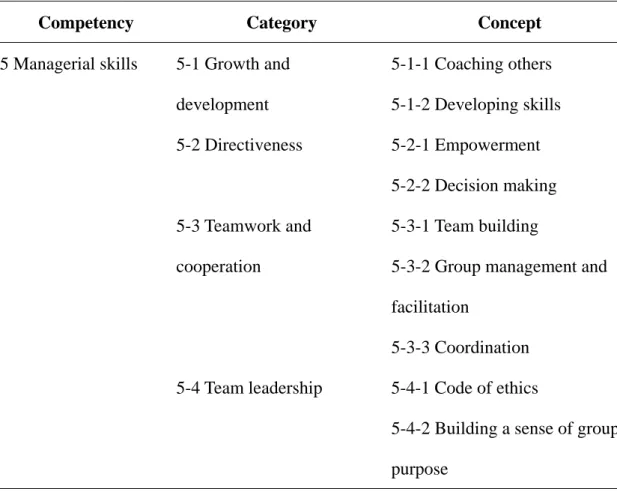
Negotiation is not necessarily conducted only by one individual. Yet, it may be required to build a team for conducting negotiation that needs managerial skills to make the negotiation successful. The managerial skills possibly required were illustrated in Table 4-5.

Table 4-5 Competency with categories of concepts: managerial skills

Competency Category Concept

5 Managerial skills 5-1 Growth and 5-1-1 Coaching others development 5-1-2 Developing skills 5-2 Directiveness 5-2-1 Empowerment

5-2-2 Decision making

5-3 Teamwork and 5-3-1 Team building

cooperation 5-3-2 Group management and facilitation

5-3-3 Coordination

5-4 Team leadership 5-4-1 Code of ethics

5-4-2 Building a sense of group purpose

Green (1999) suggests that in terms of performance skills, they may include the

components with behaviors, such as to participate in teamwork, to display leadership,

to manage conflict and so forth. However, the managerial skills for the strategic

negotiator may encompass both upward and downward management to facilitate the

(22)

negotiation and obtain the authority for making alternative or expedient decision in the process of negotiation whenever appropriate.

“Before conducting negotiation, it is necessary to report to the supervisor on the possible measures and action to be taken, the analysis on the negotiation scenario, the bottom lines for such negotiation…In addition, negotiation may involve several people, taking the accession to WTO as example, the issues on agriculture include agriculture, forestry, fishery and husbandry, thus, to select a right person through coordination will guarantee the success of the negotiation. As none of us had such experience in negotiation for accession to WTO, we were required to develop ourselves immediately, and coaching your companions for rapid growth.” (Subject F, retired senior figure of Council of Agriculture)

“When the news regarding the interference by (Mr. Porter) was published on the media, it outraged the general public that the phone calls reprimanding and threatening to assassinate Mr. Porter flooded to him. He was frightened and intended to flew away. I went to see him and calmed him down and worked with him to find out the solutions”. (Subject C, retired secretary general of Chinese Taipei Olympic Committee)

The above two cases showed the dealing with emergency and preventive action.

As a general rule, the negotiator may involve in the complexity and complications of

the issues during the negotiation, or encounter the challenges. To this extent, the

negotiator shall be fully authorized and know how to develop and coach his teammates,

as well as motivate the team working toward to negotiation goal.

(23)

Personal Effectiveness

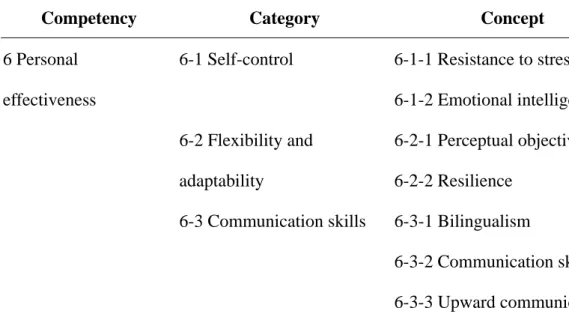
The negotiation may take a longer time than expected to achieve the goal. In the process of negotiation, the negotiator may experience a lot of pressure and stress to accomplish the mission of negotiation. As a result, the personal traits and personal effectiveness will be helpful in facilitating the negotiation.

Table 4-6 Competency with categories of concepts: personal effectiveness

Competency Category Concept

6 Personal 6-1 Self-control 6-1-1 Resistance to stress

effectiveness 6-1-2 Emotional intelligence

6-2 Flexibility and 6-2-1 Perceptual objectivity

adaptability 6-2-2 Resilience

6-3 Communication skills 6-3-1 Bilingualism

6-3-2 Communication skills

6-3-3 Upward communication

In addition to the expertise, the communication and coordination abilities are the key elements to facilitate the negotiation. The interviewees mentioned that internal and external communication and coordination would not only enhance the effectiveness of negotiation, but also realize the win/win principles for negotiation. To ensure the consistency of responding to the counterpart negotiator, Subject A pointed out that

“who should respond the question shall be determined through internal coordination

and communication to avoid any inconsistency of the responses in the process of

negotiation.” Subject F confirmed the importance of internal communication and

coordination, as the accession to WTO “involves a diversity of issues and topics,

especially the agricultural sector, it encompasses the agriculture, forestry, fishery and

(24)

husbandry, as well as the processing industry that require communication and coordination before heading for negotiation”. Apart from the aforementioned internal communication and coordination, Subject F suggested that upper communication was important by “reporting to the supervisor the points of view, submitting the analytical data on the issues to be negotiated, the strategies and the bottom lines for negotiation in details” to obtain the empowered authorities and full support. Same thing happened to Subject C when dealing in the issue of national identity and status in the Olympic Movement as well as the issue of hosting the Softball World Championships. Subject D advocated that “the consensus should be reached along with internal communication and coordination.” To undertake the negotiation in international issues, the interviewees requested the bilingual language proficiency a prerequisite for international negotiation, for example, Subject B proposed that “every potential gold medalist should receive English language proficiency training” in order to advocate in the international sport community.

In terms of flexibility and adaptability, the strategic negotiator shall act flexibly to adapt into any possible situations or challenges while undertaking the negotiation.

Hereof, the negotiator is required to adjust the strategy and tactics of negotiation whenever appropriate and necessary in order to achieve the goal. When discussing the issue of the name of Taiwan under the roof of the Olympic Movement, Subject D showed the flexibility and adaptability on the issue of the national identify of Taiwan under the protocol of Olympic Mode by clearly stating that:

“For instance, we accept the national identity neither as China, nor Province

of China, nor China Taiwan nor China Taipei. Nonetheless, we will have no

objection if the national identity under the roof of the Olympic Movement is

(25)

referred to as Taiwan.”

With regard to personal traits of a negotiator, the sincerity and amiability, tolerance and empathy as well as the resistance to stress and resilience may also be helpful in conducting negotiation, as the negotiator may encounter the unexpected challenge and the stress for achieving the goal in negotiation that the interviewees believed that these personal traits might be of help. Moreover, emotional intelligence can help facilitate the negotiation, too. Dalziel (2004) suggested a set of competencies or characteristics being behaviorally observed, including self-assessment, social awareness, self-management and relationship management, among which, the emotional self-control is one of the competencies that is required for problem solving.

Subject C indicated that the emotions may cause troublesome and derail the issues, but the emotion is not always negative, there are some touching stories with resounding emotions.

As the so-called “Olympic Mode” involved the national identity and status in the

international community, the majority of the interviewees believe that it is very

difficult to deal with the issue. Meanwhile, the issue on the application of “Olympic

Mode” causes a lot of stress. In consequence, the negotiators need to be resilient to the

great pressure. According to Subject A’s experience in negotiation for international

issues, the national identity and status of Taiwan has been officially positioned and

denominated “Chinese Taipei” just like that in the Olympic Movement. Subject D

suggested that it is better to apply the Olympic Mode to avoid any political

confrontation and argument, as “Chinese Taipei is currently exclusive for us. The

question for Taiwan people is to accept it or not… In my opinion, ‘Chinese Taipei’ as

the national identity in the Olympic Movement is significantly important even though

(26)

the public in Taiwan is not satisfied with it and did not recognize its use. However, what denomination can be offered other than the name ‘Taiwan’, which is not accepted as an official name of the country.” Discussing on the issue of adopting the “Olympic Mode”, Subject F indicated that “the use of ‘Chinese Taipei’ under the Olympic Mode is a question of 0 and 1, which can not be detached and involves in the national status and standpoint that cannot be compromised and no concession can be made.” Under such circumstances, Subject F, like Subject D, suggested to just accept and recognize it for the purpose of facilitating the establishment of better and close relationships with other countries and across Taiwan Strait.

Media and Public Relations

Media and public relations can be the major components that affect the outcomes of negotiation. The media sometimes may disclose the immature outcomes of negotiation that could fail the negotiation before reaching consensus and truly acceptable agreement. In the meantime, the well-developed public relations will help expose the focus that the negotiator may want to bring to the attention of relevant parties or the general public.

Table 4-7 Competency with categories of concepts: media and public relations

Competency Category Concept

7 Media and public 7-1 Media operation 7-1-1 Public Relations

relations 7-1-2 Media communications

The proper media operation will help the strategies and tactics implemented

whenever necessary. When Taiwan sport team was rejected to enter into Olympic

Village of Lake Placid Winter Olympic Games, the media in the United States

(27)

headlined the event as breaking news on first page of New York Times that successfully brought the issue to the attention of the American people and the world and won the support within the territory of United States.

“Being rejected, we made a statement that brought us to the spotlight of the world stage. The New York Times reported such event on first page that gave an extraordinary publicity opportunity for us to the world. This could not be done without setting up the scenario in advance.” (Subject C)

To address the significance of media operation and public relations, Subject B believes that the spotlight of media will fall on the athletes if the athletes want to voice for their countries. She said that “I would make an accusation to the world in front of the international press, all the press, that we are unfairly treated” to project the issue of using delegation name, flag, and anthem other than the national name, flag and anthem.

This address the extraordinary power of media that impact and influence the world.

With regard to the worldwide known event of Taiwan team to Lake Placid Winter Olympic Games, the media coverage were full of the news regarding the mistreatment of Taiwan team. “At that time, we had developed public relations by spending few money, the media and news agencies provided me with a huge bundle of coverage on the story of Taiwan team” said Subject C.

The ways of dealing with these hard experiences and challenges that Subject C adopted proved to be successful by bringing Taiwan’s issue to the attention of the world and making Taiwan become the spotlight on the international community stage.

It shows that the operation of media and the development of public relations play a

(28)

significant part toward a successful negotiation with favorable outcomes. However, the precautions and cautious planning should be considered when dealing with media to avoid any damage and prejudice.

In addition, the negotiation is also considered a category level general topic, the competencies based on the categories of the concepts generated from the responses are interrelated, which can be used to develop competencies for any jobs that require negotiation skills. According to Cooper (2000), the derived competencies include:

1. Multi-form tendencies that may help identify the personality tendency of others and know strategies for effectively dealing, as well as mediate personal tendencies to fit style of others;

2. Decision making under risk (framing) that may help know the differences in decision making with gains versus losses, and reframe gains to losses or vice versa;

3. Win/lose decision making that can identify wins for negotiating partners and develop negotiating strategies to leverage potential wins;

4. Negotiating leverage that can recognize the leverage approaches of others and develop strategies utilizing available leverage;

5. Negotiating tactics that can develop strategies utilizing tactics when necessary;

6. Managing concessions that help to understand the concession cycle and rules for making concessions;

7. Planning checklist that can help to manage a negotiating effort.

Apart from the competencies as previously discussed, at the post-negotiation

(29)

phase, two of the interviewees indicated that the negotiation on an issue may revolve after implementation. In such cases, the evaluation and review on the performance shall apply. In consequence, whether the negotiation in formulating the “Olympic Mode” in sport sector or the negotiation in economic and trade issues, such as accession to WTO, APEC and OECD, is conducted, the strategic negotiation process addressed in this study is applicable to the negotiation in various aspects and can be generalized.

In this chapter, the points of view and experience sharing from the interviewees on the negotiation show the commonality and universality of general competencies required for strategic negotiation. Inferred from the data collected, the competencies for strategic negotiation were categorized with different concepts, coming out with the results that the competency model for strategic negotiator may be built.

Since the competencies are considered as underlying characteristics of people and

indicate “ways of behaving or thinking, generalizing across situations, an enduring for

a reasonably long period of time (Spencer & Spencer, 1993), and the competency

scope encompasses core competencies and capabilities, cover values and priorities,

technical knowledge and job skills, and performance skills and competencies

interrelating to the organizational characteristics, knowledge and skills (Green, 1999),

the categories of concepts of Table 4-1 can be further examined and developed into the

competencies that a strategic negotiator need. As a result, the categories of concepts,

which may be interpreted and consolidated into the general competencies illustrated in

Table 4-2. These competencies are identified and clustered into three levels, namely,

competency, category and concepts. For the purpose of this study, the competency,

category and concepts are interchangeable for building the competency model.

(30)

數據

Table 4-5 Competency with categories of concepts: managerial skills
Table 4-6 Competency with categories of concepts: personal effectiveness

參考文獻

相關文件

You need to act now plant it in your heart The simple fact of how we can do our part For future generations. Step up and make

ADtek assumes no responsibility for any inaccuracies that may be contained in this document, and make no commitment to update or to keep current the information contained in

ADtek assumes no responsibility for any inaccuracies that may be contained in this document, and make no commitment to update or to keep current the information contained in

Understanding and inferring information, ideas, feelings and opinions in a range of texts with some degree of complexity, using and integrating a small range of reading

 Promote project learning, mathematical modeling, and problem-based learning to strengthen the ability to integrate and apply knowledge and skills, and make. calculated

To be an effective practitioner, a defined body of formal knowledge and skills is the necessary, but not sufficient, condition to meet workplace requirements. The important

Research has suggested that owning a pet is linked with a reduced risk of heart disease, fewer visits to the doctor, and a lower risk of asthma and allergies in young

Proof. The proof is complete.. Similar to matrix monotone and matrix convex functions, the converse of Proposition 6.1 does not hold. 2.5], we know that a continuous function f