CHAPTER IV. RESULTS AND FINDINGS
An Overview
Data analysis is not off-the-shelf; rather, it is custom-built, revised and
“choreographed” (Huberman & Miles, 1994), as such this chapter seeks to find out answers to the research questions through a thorough analysis of the data collected from various research participants. The research participants consists of members of the Senior Management Team at the Department of State for Education (DoSE) in The Gambia, former Gambian teachers who now reside in the United Kingdom and the United States, former foreign teachers who taught in The Gambia and are now in the United Kingdom, school principals and Local teachers. The composition of the research participants serve as a tool for gathering data from different stake holders in education in the Gambia. It will also help in getting a varied view points on teacher turn over in the Gambia. For the sack of analysis of the data, the research participants are divided into two groups. Group A referred to as “Teachers” and group B as “administrators”. The teachers’ group A, consists of former Gambian Teachers now residing in UK and US, Local teachers, and former foreign teachers now in UK. The administrators group B comprised of the members of the Senior Management Team (SMT) and school Principals.
Role of compensation in teacher turnover Group A- Teachers
1. Local Teachers
Table 4.1 shows that the issue of low salary and allowances play a role in both the satisfaction and motivation level of teachers. This is evident by the responses they gave
in relation to factors that motivates them to stay or leave the teaching field. They all agreed that they are well motivated by the ‘respect that people give us as teachers” but are very unsatisfied with their salaries because the “pay is not very attractive and there is very little incentive”. They even try to make a comparison of their living standard to others who work in different fields. Their salary is not enough to cater for their basic needs and this is reflected in the fact that as a teacher, their low salary makes them to basically “live from hand to mouth” and can not afford the basic luxuries of life such as a nice house and a “flashy car”. Local teachers also claim that, though they are entitled to certain benefits like travel allowance, it is practically impossible to access it. This is attributed to the bureaucratic nature of the education management system.
Apart from their monthly basic salary, some of the teachers are entitled to Head of Department allowances, and provincial allowances. Despite the general point of agreement that the teacher salary is small, one of the local teachers agreed that “when compared to other civil servants, the teachers’ salary is quite good”. He went further to say that “the salaries of civil servants are generally not good, taking into account the cost of living in The Gambia”. Another teacher also said that “the salary is low if compared to other sectors yet we are rendering more than those in other sectors. People leave against their will because their salary is very small”.
2. Former Foreign Teachers in UK
It is quite interesting to note the reaction of former foreign teachers on the issue of salary. All the foreign teachers interviewed down played the role of salary and
allowances as a reason for their decision to stay or leave the teaching profession in The Gambia. They admitted that the salary is low when compared to other professions but at the same time one of them said “my salary was enough to for me as a single”. He even went further to say “why foreign teachers go to The Gambia to teach is not because of salary, but they use it as a way to get to Europe or to America”.
3. Former Gambian Teachers in UK and US
One of the respondents in the US felt that the salary of teachers in The Gambia is relatively low when compared to other countries. He also highlighted that sometimes the salaries are paid very late. Former teachers in UK felt that the basic salary maybe good but there should be a good benefit system which can motivate them to stay as teachers in The Gambia. One of them even went further to say “a lot of my friends have left the teaching field in The Gambia for other jobs where such benefits exist”.
Group B-Administrators 1. School Principals
The school principals said that only few of the teachers who leave their schools for better jobs give salary as a reason. Most of the foreign teachers said that they leave because they want to be joined their families back home. Some of the principals also said that teachers are given access to soft loans by the school without interest. They are also entitled to a special loan called the one-by-six which is given to teachers at the Muslim feast of Tobaski without interest.
2. Senior Management Team
One of the Regional Education Directors interviewed highlighted the benefit package for teachers apart from their basic salary. This package includes “hardship allowance, building of teachers’ quarters in remote areas, house rent allowances, provincial allowance; 12.5% for teachers in the Lower River Division, 15% for teachers in the central river and Upper river Divisions”. The hardship allowances are paid under the Fast Track Initiative (FTI), whiles the building of teachers’ quarters is sponsored through the African Development Bank (ADB) project.
Table 4.1 Summary of research findings on salary and allowances Salary and allowances Research Findings
Group A-Teachers • Low salary
• Inability to access transport refund
• “Unfair” coverage of hardship allowances in Basic Cycle schools
• Late payment of salaries Group B- Administrators
*Not Applicable
* This indicates that the respondents do not see this factor as an issue in teacher turnover.
Discussion
Table 4.1 shows that the amount of money paid to teachers maybe small but it is also evident that’s their allowances are neither enough, nor are they fairly distributed. The General Orders (GO) is the major policy document that covers all civil servants in The Gambia. It is pertinent to note that the current General Orders is totally inadequate in addressing issues affecting civil servants in the Gambia. This is because it was last revised in July 1994 to replace the 1977 edition. It has touched on various issues with regards the entitlement of civil servants. For example in chapter 5 of the General Orders, section 1:05104 states that “a residential allowance is payable to all officers who live outside the island of Saint Mary (former name for the Greater Banjul Area)……. this allowance will be payable regardless an officer owns a car or not”. It goes further to say that civil servants in Grades 9 to 12 will be paid D200 per month and grades 1 to 8 will be paid D150 per month. It is pertinent to note that at present a teacher will have to spend D150 just for one way travel from the capital Banjul to let say, Janjangbureh in the Central River Division. This would have been appreciated in 1994 but it is a pointless for civil servants to receive such an allowance which cannot even cover the transport cost of going to Banjul from Central River to claim the allowance. If teachers’ house rent allowance is D150 which cannot even now pay for a rent in a remote village in The Gambia, then the allowance is not serving its purpose. The senior management teams were able to list a host of allowances for Gambian teachers but they fail to look at the correlation between those allowances and the economic realities of The Gambia.
Although the General Orders is the guiding policy book for all civil servants, there are also other policies that cover teacher issues at the level of the Department of State for Education. As confirmed by a one of the Regional Directors, teachers receive hardship allowances from the Fast Tract Initiative project. This comes from a cooperation agreement between UNICEF and the Government of The Gambia. The FTI is meant to help provide funding to accelerate government efforts in reaching the Millennium Development Goals set by the United Nations for 2015. The hardship allowance serves as a motivation for teachers posted in far regions to stay. One of the respondents stated that the way the hardship allowance is distributed is very unfair. He went further to justify this assertion by saying that teachers in the upper basic level in a Basic cycle school are not entitle to get the allowance. Only the teachers at the lower basic level in the Basic cycle school are entitled to the hardship allowance. This is a cause for concern. If the hardship allowance is meant for teachers in far regions and yet even in the same school some teachers are getting it and others are not, then there is a problem. He said “structurally those in the Lower Basic are Primary teacher’s Certificate holders and those in the Upper basic are Higher Teachers’ Certificate holders, yet still they do not benefit from the hardship allowance, despite teaching in the same school under the same management”.
Role of school administrators and DoSE management
Group A
1. Local Teachers
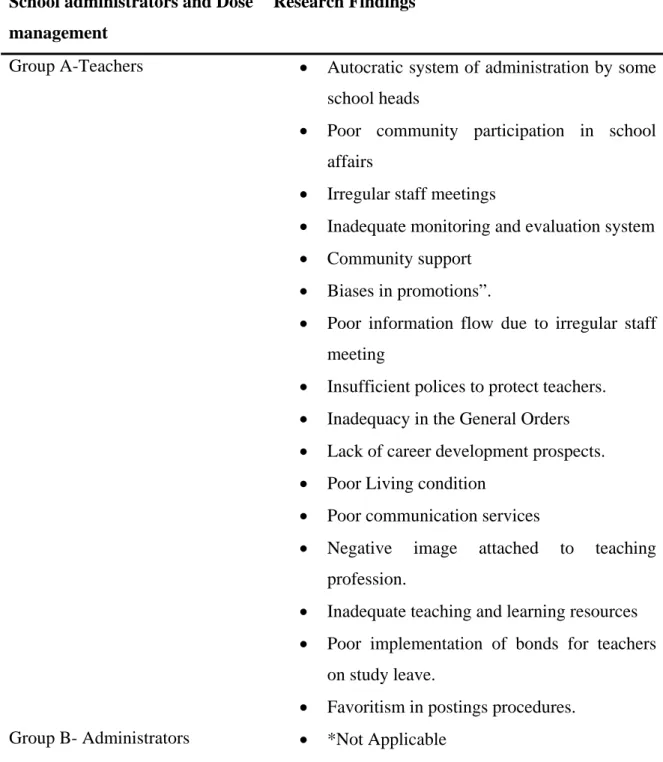
As evident in table 4.2, the respondents looked at management in too levels.
The first level focused on the school whiles the second level looks at DoSE. Some of the
teachers felt that most of the school heads are using the old fashion autocratic way of management. They only give directives which are meant to be obeyed. A few of them said that their school management was very interactive and democratic; they were given the opportunity to have their say in school affairs. Notwithstanding, they all agreed that communication is the most important issue in school management. Those who are satisfied with their school management said that there was constant information flow from the head to the teachers and vise versa. One of them went further to say “ if you want to manage people very well, you have to communicate with them constantly so that you can harness your collective resources” . Some of the school heads only have staff meetings once or twice a year. This goes further to confirm the lack of communication between school heads and teachers. Some of them lauded the participation of the Parent – Teacher Association in their various schools. One of them said that the reason for staying in a school for another year was because of the encouragement he got from the parents.
He said “parent participation was really so good, it in fact made me to stay in the school for another year. Teachers from region three felt that the Parent Teacher Association in their schools where very dormant and only participates in school affairs on ceremonial bases. This is a cause for concern because they believe that “there should be a bridge between the school and the community”.
All of the respondents felt that that despite the decentralization of education in The Gambia, much is desired to be done in terms of management. Some of them said that education officials only visit schools on ceremonial bases and they felt that there should be closer collaboration between the Department of State for education and the teachers on the ground. They also call for frequent meetings between DoSE and teachers; this will
serve as a way of dialogue and problem identification and finding solutions to teachers’
problems.
2. Foreign Teachers in UK
The former foreign teachers felt that there should be more meaningful participation of Parent teacher Associations in school affairs. They complained that even when the principals call for PTA meetings; it is always poorly attended by the parents.
3. Former Gambian Teachers in UK and US
The former teachers in the US all felt satisfied with their school management. One of them said that the management in the schools he taught was “friendly, professional and caring”. They gave a contrast between the commitment levels of PTAs in rural areas as compared to urban areas. Teachers are given more respect by communities in rural areas than urban areas. The second respondent from the US also reiterated the high commitment of parents to school affairs which facilitated a flow of information between school authorities and the parents. Comparatively, the former teachers UK also praised their school management style but they equally condemned the lack of proper PTAs in their respective schools. One of them even went further to express his satisfaction over the way his former school principal manages school affairs. He asserted that “obviously we are all given the opportunity to air out views during staff meetings” On the other hand he agreed that “community participation was minimal” as “ there was no PTAs in the two schools I have taught”.
Group B-Administrators 1. School Principals
Evidently, majority of the teachers interviewed valued information flow in school management. This they said, can be facilitated through information sharing. Information sharing to them is based on regular meetings and having their views considered by school principals. All the school principals interviewed admitted having a maximum of two staff meetings a year. This might be a big blow to the teachers who feel that there should be information sharing and a forum to voice out their concerns, regards the running of their respective schools.
2. Senior Management team
Of recent, the structure of the management system at the Department of state for education has shifted from being centralized to being decentralized. All regional Directorates are now headed with Regional Directors who are the overseers of education matters in the region. All other directorates have regional representation (DoSE 2006).
The effectiveness of this initiative is confirmed by one of the regional Directors who elaborated that “we are able to implement our own programs and have the opportunity to work with communities at local level’’. This has led to higher and more constructive participation of communities in school affairs through the setting up of PTAs in all schools, especially at rural level. PTAs are now playing a pivotal role in the running of schools and also serve as watch dogs for school expenditures. This is reiterated by one of
the regional director who said that “in region five (5), if you have to cash a cheque as a principal, the chairman of the PTA has to endorse it first”.
Table 4.2 Summary of findings on school administrators and DoSE management School administrators and Dose
management
Research Findings
Group A-Teachers • Autocratic system of administration by some school heads
• Poor community participation in school affairs
• Irregular staff meetings
• Inadequate monitoring and evaluation system
• Community support
• Biases in promotions”.
• Poor information flow due to irregular staff meeting
• Insufficient polices to protect teachers.
• Inadequacy in the General Orders
• Lack of career development prospects.
• Poor Living condition
• Poor communication services
• Negative image attached to teaching profession.
• Inadequate teaching and learning resources
• Poor implementation of bonds for teachers on study leave.
• Favoritism in postings procedures.
Group B- Administrators • *Not Applicable
* This indicates that the respondents do not see this factor as an issue in teacher turnover.
Discussion
Table 4.2 shows that responses from group A and B point to the fact that management issues are seen by some, as a big issue while others view it as a lesser issue in teacher turnover. Majority of respondents from Group A values information sharing and consultation between school principals and members of the SMT as the way forward in educational management. This seems to be in contrast with what the school principals and the members of the SMT pointed out as issues in management. If teachers are asking for regular staff meetings to share information and on the other hand school principals only hold meetings twice to three times a year, then they are far from reaching the expectations of the teachers. This could be a management lapse that can contribute to teacher turnover. If teachers feel left out of the running of school affairs, then they will tend to venture into other jobs where they will feel more welcomed by managers who share information with them.
Other factors Group A-Teachers 1. Local Teachers
Various issues have been raised regards teacher turnover apart from salary and management issues. Table 4.3 shows that there is more to teacher turnover than these two factors addressed above. It is evident from the interviews with the local teachers that issues of salary and allowances are not the only problem that leads to teachers leaving the teaching profession in large numbers. Some of them see teaching as a way of contributing to nation building. One of the teachers posited that he continue to teach “not only
because of the salary but I see it as a responsibility to try to contribute to nation building”.
As such, he is well motivated by the fact that the community are giving him the full support he needs. The local teachers also seem to have a common voice on the issue of promotions. They all have reservations on the criteria used in promotion of teachers in The Gambia. One of them said ‘I have been teaching for 14years but am still in the same grade level with no promotion whatsoever”. As a religious education teacher, he went further to say “despite all that, I am satisfied, because I see teaching as a spiritual obligation”. Evidently, there is lack of a proper monitoring and evaluation system for teachers. The lack of proper evaluation for teachers might be the reason for a longevity- based system of promotion. The teachers believe that promotion should be “based on two things, longevity and merit, but I think merit should supercede longevity”. One of them even went further to say “promotions are not done accordingly; there is biases in their promotions”.
The teachers also reiterated the problem of poor information flow between school management and teachers. They generally agreed that their respective schools do not conduct regular staff meetings to share information with the staff. Some of them felt that their school heads just give orders which are meant to be obeyed and do not seek their view points in the running of the school. Most of them call for proper policies to be put in place by the government to address the problems of teachers. They felt that the General Orders is not adequate to address the needs of teachers. Only one of the teachers acknowledged laying hands on a copy of the General orders. One of them went further to
say that the General Orders is “… just there in theory but in practice I don’t think it is enforced”.
Another important factor high lighted by the teachers is the issue of career development. They all have a consensus on the fact that teachers are not given enough on-the-job training to develop them further. Only one of the teachers said that he attended termly workshops for staff development in his school. This he said has helped him to
“learn things that I can use in the classroom”. He continued further to say that ‘these are workshops geared towards career development for teachers”. To confirm the importance these teachers give to training, one of them said, “ if we have lot of that kind of training, I will forever be a teacher”.
The teachers pointed out the lack of proper housing and basic services like telephones and regular supply of water as a contributing factor to teacher turn over. Teachers posted in remote areas are do not have access to good housing and telephone facilities. One of them said ‘there is no electricity, no pipe borne water; I have to live in a thatched house”.
The road conditions are in a poor state and it takes lot of time and effort to travel to their families from their place of posting. A teacher from region five said “road transportation is also poor, it takes several hours to travel to the main road…”.
The fast Track Initiative has contributed to availability of teaching/learning resources in the schools. Despite this, teachers still complain of the inadequacy of teaching/learning materials in the school system. A teacher lamented how difficult it is to teach certain
subjects in the sciences with out the proper teaching aid. He said “if you want to teach electricity, you have to demonstrate to them, “because they will learn quicker that way”.
This is practically impossible in a school that does not have electricity.
Another factor raised by a teacher is the negative image people now attach to the teaching profession. A teacher lamented that the reason for negative attitude towards the teaching profession is the fact that ‘it does not pay well and many people therefore feels it is degrading to be a teacher”. To show that extent to which Gambians look low upon the teaching profession, one of the teachers said “it is not uncommon to hear somebody saying, can you help my child to get a job, even if it will be teaching”. This clearly demonstrates that teaching is the last profession on most people minds.
A cause for concern is also the issue of bonding of teachers given scholarships by The Gambia government to go for further studies. Scholarships are offered to teachers to go on further studies in institution in and outside The Gambia. The sign a contract with the Government through the Personnel management Office that they will come back to work for the Government at the end of their studies. Most of them never honor such kind of bonds. Even their guarantors are not accountable in the event that they fail to come back to serve the conditions in the contract. A teacher stated the reason for teachers’ lack of honor for the bonds they sign so as to be granted study leave by the government and he said thus;
“ I think the bond issue is only there formerly and it is never properly implemented. Most teachers will not honor the bond and they won’t be
punished according to the terms and conditions of the bond, even if they stay in the country. The guarantors of the bond holders are not force to repay the money if the teacher fails to turn up”.
The above statement confirms the seriousness of the issue of bonding teachers on study leave. Lack of proper implementation of bonds is a sure way for teachers to leave the teaching profession even after the government invests a lot of money on their training and development.
2. Foreign Teachers in UK
Acknowledging that salary is not the main factor for leaving the teaching profession in The Gambia, the foreign teachers interviewed felt that there are other more pressing problems responsible for there resignation and subsequent travel to UK. The former teachers from Sierra Leone and Nigeria acknowledged that the communities they were teaching lack electricity and there is sometimes lack of pipe borne water in the town. As one of them lamented “there was no electricity and even sometimes pipe borne water”.
He went further to say that he has to “walk for a mile to make a telephone call”.
A factor to note in the reason for the foreign teachers’ leaving the teaching profession in The Gambia is the lack of job security. Foreign teachers are employed on yearly bases.
This means that they are only given a one year contract to teach and they have to reapply at the end of the contract. They are not entitled to any form of benefit at the end of the contract. This is confirmed by one of them as the reason for leaving. They strongly believe that working in UK will earn them more benefits and a well secured job than The
Gambia. This is in contravention of the Commonwealth Teacher Recruitment Protocol (2004) to which the Gambia is a signatory. The teacher from Sierra Leone said that going to UK “will make it possible to have better benefits such as retirement benefit”. The protocol states that “ wherever appointed, recruited teachers shall enjoy employment conditions not less than those of nationals of similar status and occupying similar positions” (CTRP 2004, Page 12).
Inadequate teaching/learning materials in schools also serve as a deterrent for foreign teachers to stay in The Gambia to teach. One of the teachers said that “most of my students don’t have the required text books for my subject”.
The foreign teachers also confirmed that they are not entitled to further training. This is also in contravention of the Common wealth Teacher recruitment Protocol to which The Gambia is a signatory. The protocol states that “the recruiting countries should also provide dedicated programs to enable such teachers to achieve fully qualified status in accordance with domestic requirements of recruiting country’(CTRP, 2004, page 12).
3. Former Gambian Teachers in UK and US
It is evident from their responses that information flow plays a pivotal role in raising their satisfaction level as teachers. These teachers also admit that the school management in their respective former schools was very good. They were given the opportunity to raise their concerns in staff meetings; one of them thus said “we are all given the opportunity to air our views and concerns in staff meetings”. Not withstanding, they also
pointed out there were very limited teaching/learning resources which has very much hindered their ability to teach effectively.
They also felt that there is no proper monitoring and evaluation system set for teachers in The Gambia. One of them went further to say “I was not aware of any appraisal system and that I was never evaluated during the course my one year teaching, not by my school management or DoSE”. This may be the reason for them not viewing the promotion criteria as fair. One of them even said “when positions are vacant, then they advertise it and the people apply and how they get promoted, only them and the Personnel Management Office (PMO) knows”.
Group B-Administrators 1. School Principals
Statistics from various principals’ respondents shows the fact that there is a very high number of foreign teachers in junior and senior schools in The Gambia. In one of the senior schools, out of 48 teachers, only 7 of them are Gambian. In another junior school, apart from the principal all the teachers are non-Gambians. The bulk of these foreign teachers come from Nigeria, Sierra Leone, Liberia and Ghana. The principals said that teachers quit their jobs mostly at the end of term or end of the academic year. Some of the teachers leave unceremoniously for other schools or for other countries such as the UK and the US. One of the reasons given for teachers leaving one school for another is to get the double shift allowance (this is paid to teachers who teach both in the morning and in the afternoon in schools that operate both morning and afternoon classes because of
lack of teachers or infrastructure). Not much action is taken to address the problem of teachers quitting their jobs unceremoniously. The only action taken by one of the principals is to write to the Board of Directors of the School but with no apparent action taken by the Board.
Principals also cited family obligations as one of the reasons for teachers to leave their jobs. As apparent in the statistics from the schools, most of the teachers in the junior and senior schools are foreigners which may account for their sudden departure for family reasons.
Poor living condition is also given as a reason for teacher turnover in schools. As the bulk of the teachers in the Junior and senior schools are foreigners, they find it very hard to adapt to some of the conditions they face in their places of postings. If posted, for example, to a place without telephone services, it may be very difficult for a foreign teacher to stay for long as it will be practically impossible to be in constant touch with their families back home.
A concern raised by the school principal is the issue of indiscipline in schools. They reiterated their worries with regard to the growing student indiscipline and violence in schools. This they say may subsequently lead to teachers leaving when they can no longer cope with the issue of student indiscipline.
Inadequate teaching and learning resources is also identified as a course for concern in teacher turnover in junior and senior schools by principals. They do admit that the FTI has greatly helped in the provision of teaching/learning resources in schools but yet still there is more to be done for effective and efficient teaching and learning to take place.
2. Senior Management team
A point of concern by the SMT is the fact that “Gambians with high potentials and academically oriented do not opt for the teaching profession”. The high number of foreign teachers in Gambian schools can therefore be attributed to this fact. If Gambians do not want to teach, then education management has no choice but to hire foreign teachers who may just be using The Gambia “as a way to get to America and Europe”, hence the high number of teacher turn over in junior and senior public schools. Majority of Gambian teachers “do not want to go on postings in the provinces”.
The SMT also mention the laxity in the bonding contracts for teachers on study leave as a contributing factor to the high rate of teacher turnover in The Gambia. When teachers go on further studies, they are given study leave for the duration of the study. It can either be a study with salary or without salary. A contract is signed by the teacher with the government with two Gambians serving as guarantors. In the even that a teacher do not honor the contract, the guarantors are suppose to pay back to government all expenses incurred on salary and cost of training if the scholarship is from the government.
The system is so loose that sometimes even if the bonded teacher does not come back, the guarantors are not obliged to pay back the government all expenses as per the contract.
Sometimes it takes up to a year before the salary of the absconded teacher is stopped because of lack of proper implementation and monitoring of contracts at DoSE. This is confirmed by one of the regional directors who said “we have teachers whose names are on the payroll and they don’t come back”. He ended up saying that more effort is being put in place to make sure that bonded teachers adhere to the terms and conditions of their bonds. He said that “DoSE is trying to take a strong stance to ensure that, teachers who have been bonded serve the bond”.
Another issue for teacher turnover pin pointed by the SMT is the lack of a proper monitoring and evaluation mechanism for teachers. A system was started but ceased to exist just after a short period of time. One of the regional directors acknowledged that
“there was something that started but I thing DoSE had some problems and they stopped”.
Another SMT said that there was an appraisal system put in place but it only lasted for a year. Lack of a good appraisal system with set indicators for promotion is a major factor in teacher turnover in The Gambia.
Legislation issues are also highlighted as a course for concern for teachers in The Gambia. Two of the SMT said that there are no laws put in place for sexual harassment of female teachers. This contributes to female teachers living the teaching profession. They felt that there is no legislation to guard them against sexual harassment by men.
Teaching/learning resources and housing is no longer viewed as a main issue in teacher turnover by the SMT. Since the interventions from the FTI and the ADB projects,
they all agree that there is massive improvement on resources and housing for teachers, especially those in remote areas of the country.
Table 4.3 Summary of findings on other factors in teacher turnover Other Factors Research Findings
Group A-Teachers • Community support
• Biases in promotions”.
• Poor information flow due to irregular staff meeting
• Insufficient polices to protect teachers.
• Inadequacy in the General Orders
• Lack of career development prospects.
• Poor Living condition
• Poor communication services
• Negative image attached to teaching profession.
• Inadequate teaching and learning resources
• Poor implementation of bonds for teachers on study leave.
• Favoritism in postings procedures.
Group B- Administrators • Most Gambians do not want to be teachers.
• Laxity in the bonding contracts for teachers on study leave.
• Lack of a proper monitoring and evaluation/appraisal.
• Lack of specific legislations to safeguard teachers against sexual harassment.
• Poor housing facilities in rural areas
• Job insecurity(contract-based)
• Lack of career development prospects
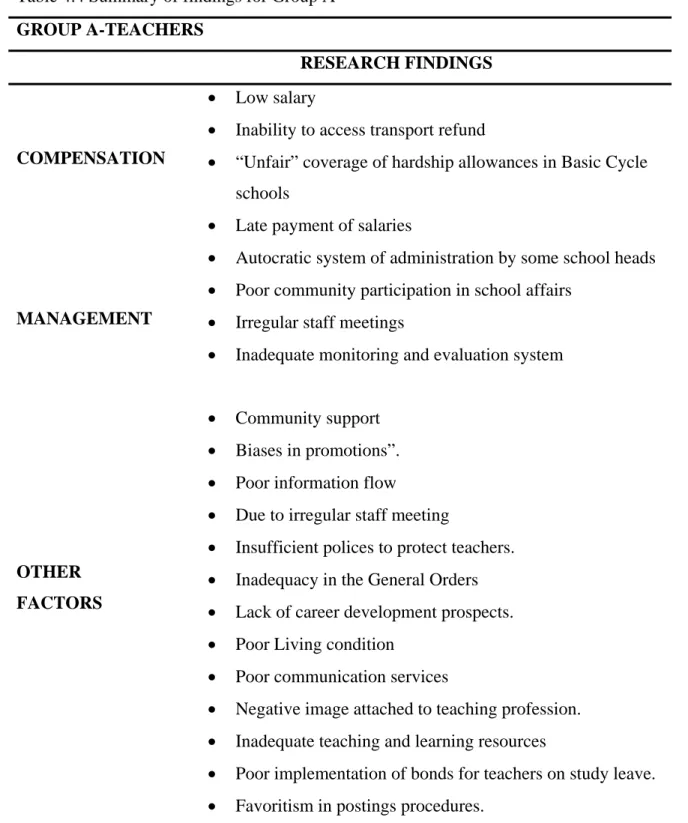
Table 4.4 Summary of findings for Group A GROUP A-TEACHERS
RESEARCH FINDINGS
COMPENSATION
• Low salary
• Inability to access transport refund
• “Unfair” coverage of hardship allowances in Basic Cycle schools
• Late payment of salaries
MANAGEMENT
• Autocratic system of administration by some school heads
• Poor community participation in school affairs
• Irregular staff meetings
• Inadequate monitoring and evaluation system
OTHER FACTORS
• Community support
• Biases in promotions”.
• Poor information flow
• Due to irregular staff meeting
• Insufficient polices to protect teachers.
• Inadequacy in the General Orders
• Lack of career development prospects.
• Poor Living condition
• Poor communication services
• Negative image attached to teaching profession.
• Inadequate teaching and learning resources
• Poor implementation of bonds for teachers on study leave.
• Favoritism in postings procedures.
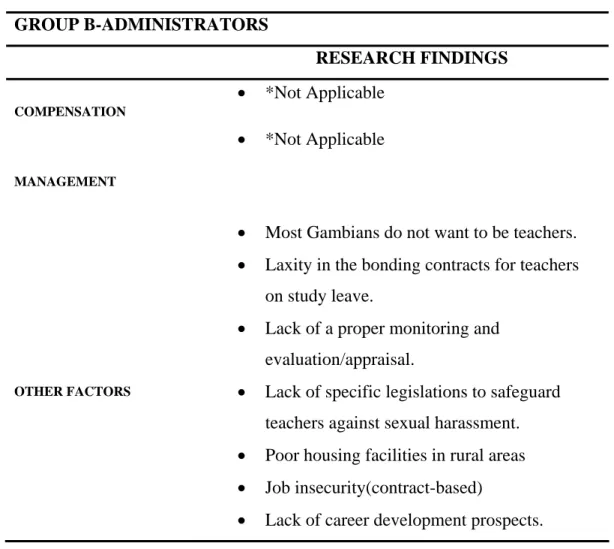
Table 4.5 Summary of findings for group B GROUP B-ADMINISTRATORS
RESEARCH FINDINGS
COMPENSATION
• *Not Applicable
MANAGEMENT
• *Not Applicable
OTHER FACTORS
• Most Gambians do not want to be teachers.
• Laxity in the bonding contracts for teachers on study leave.
• Lack of a proper monitoring and evaluation/appraisal.
• Lack of specific legislations to safeguard teachers against sexual harassment.
• Poor housing facilities in rural areas
• Job insecurity(contract-based)
• Lack of career development prospects.
* This indicates that the respondents do not see this factor as an issue in teacher turnover.
Summary of research findings
The summary of research findings in tables 4.4 and 4.5 is a cause for concern. One would have anticipated that the problem of teacher turnover in public junior and senior schools in The Gambia could be attributed squarely to compensation and benefit issues.
Lots of factors contribute to teacher turnover as evident in the two tables above. Where ever there is a sense of being neglected or being insecure, performance will surely go
down and when the employee sees a better opportunity they will quit. Most of the respondents feel that education management could have done more to alleviate some of their problems. They also feel that the evaluation of teachers is completely absent thereby making them question the criteria used in promoting teachers. If the Department of State for education cannot evaluate teachers on a routine bases, then it is justifiable for them to question the fairness of the whole system of promotion. Foreign teachers complement government effort in trying to provide enough teachers to schools. The fact that they are given only a one year contract at a time discourages most of them and they will either go to another country or leave the public schools completely. Unless Gambians are ready to take up teaching as a profession, the situation will continue to be bleak.
There is a sharp contrast between responses from Group A and that of Group B. In as much as the teachers are trying to point out the factors that lead them to quit the teaching profession, members of the SMT seem to be pointing out to the efforts being put in place to curb the high rate of teacher turnover in public junior and senior schools. For example, one of the SMT was able to point out the hardship allowance as a means of motivating teachers in rural areas to stay. This is a good move but when interviewed, a teacher though acknowledge the hardship allowance as a good venture, sees it as an unfair treatment. The teacher went further to explain how teachers in the same school do not all benefit from the Hardship allowance just because some of them teach at the lower basic level and the other teach at the upper level. Therefore one can conclude that it is not what kind of allowance the teachers are given, but to what extend do they view the allowance as fair?