192
A Case Study on Two Adult EFL Learners’ Uses of English
Dictionaries
Hsu-ling Chung (鍾旭玲) Jong-shing Liang (梁中行)
National Pingtung University of Education
Abstract
All English learners use English dictionaries to learn new words or to enhance their English ability. While reading in English, however, most of them may rely too much on the dictionary, or use it unselectively, which in fact, may cause more problems than help to their comprehension. Research also shows that English learners with different proficiency levels may employ different strategies in using the dictionary. This study thus, aims to explore two adult EFL learners’ dictionary consultation behavior, with a focus on seeking reasons that affect their dictionary consultation behaviors while reading in English. A high level and a low level learner took part in the study. They were requested to read an English article and mark the words that rendered them to look up the dictionary; then, through stimulated recall they provided reasons for looking up these words. It is found that the less proficient learner consulted the dictionary much more frequently and for more words, which suggests that language proficiency does affect the ways these two learners used the dictionary. It is also found that while they both tried to attack unknown or uncertain words with morphological knowledge, the less proficient learner consulted the dictionary mainly because he did not know or was unfamiliar with the words, yet the more proficient learner had three more concerns for consulting the dictionary: (1) when the same part of a word’s spelling appearing in another word, (2) when a given word seemed to imply relevant hints to the topic of the reading, and (3) when a word was deceptively easy but in fact, hard to figure out. These concerns suggest that she is more selective in using the dictionary than the other one. To sum up, EFL learners’ dictionary consultation behavior is shaped by many factors, in addition to language proficiency. The paper concludes with implications for pedagogy and future research.
193
Introduction
Nowadays, most of the latest information is transmitted in English. So, an ability to read in English has become a prerequisite for most college students in Taiwan who are now either acquiring new knowledge or studying a new subject. Research shows that various factors will affect the reading comprehension of EFL learners (English as a foreign language), such as knowledge about English, reading strategies, prior world knowledge, and even reading purposes, and that among these factors, vocabulary knowledge is believed to be the most influential in their reading comprehension and also a significant predictor of their reading proficiency (Bernhardt & Kamil, 1995; Nation & Coady, 1988; Qian, 1999, 2002; Hudson, 2007).
Studies also show that EFL learners use differing strategies to attack unknown or uncertain words in reading English, for instance, guessing from context, looking up a dictionary, or ignoring (Gu & Johnson, 1996; Hulstijin, 1993). Different strategies will also be adopted for different purposes. If a learner, for example, reads an English article only for pleasure or killing time, he or she may not bother to look up an unknown word and rather, may simply try to figure out its meaning from the context. On the contrary, if the major purpose for the same reader is to learn new information or to pass an examination, he or she may spare no time to look up a dictionary for the same word. Clearly, different purposes will drive the same reader to use different strategies to face the same lexical problem.
EFL learners’ English proficiency level is also a variable affecting their reading comprehension. Hulstijn (1993) found that learners with a smaller vocabulary size tend to consult the dictionary more often than those with larger vocabulary knowledge. Knight (1994) claimed that it is inappropriate to encourage all learners, especially lower level learners, to guess the meaning of a word from the context, for they just may not have enough vocabulary knowledge to do so. But, more proficient learners usually have a better ability to guess the meaning of an unknown word from context. Gu & Johnson (1996) also found that the high proficiency language learners used more strategies in learning a new language than the lower proficiency learners did, the strategies commonly used by the better learners included guessing, using dictionary strategies, contextual encoding of new vocabulary, and paying attention to word structure, and that the less proficient learners believed that memorization strategy was the most useful strategy in helping them to learn English.
194 these reasons
As regards the usefulness or necessity of consulting dictionaries while reading, two opposing viewpoints have been brought up. Those against the use of dictionary while reading argue that looking up a dictionary will slow down the learners’ reading speed, cause the reading process inefficient, and much worse, interfere their reading comprehension (Bensoussan, Sim & Weiss, 1984; Nation, 2009). Those in favor of using a dictionary while reading believe that dictionary consultation can not only benefit the learners’ reading comprehension but also enlarge their vocabulary size (Knight, 1994; Luppescu & Day, 1993). To the latter, Knight (1994) even adds that because their limited vocabulary knowledge, lower level students would benefit the most from using a dictionary while reading.
, they find it necessary to rely on the dictionary for assistance.
Despite the contrary arguments on the role of a dictionary in reading English, research in learning strategies has found that EFL readers with better language proficiency are more flexible in using a dictionary either to learn a new word or to guess the meanings of unfamiliar words, than their lower proficiency counterparts (Gu & Johnson, 1996; Hulstijin, 1993). In other words, they tend to be more selective in using dictionary. According to Prichard (2008), using dictionary selectively is an ability of “looking up enough words to enable comprehension but [at the same time] using other strategies as often as possible” (p. 220). Prichard (2008) himself has conducted a study on Japanese university students’ dictionary consultation behavior to examine the role played by “selective dictionary use” in EFL reading. He found that a third of the surveyed students overused dictionaries and a quarter of the words consulted were neither necessary nor useful to learn. These findings led him to conclude that these learners were unaware, or incapable, of using dictionaries in a selective way while reading in English and thus, to help them to be more “selective” in using a dictionary, an explicit instruction on how to use a dictionary should be included in the language curriculum.
Prichard’s study highlights the issue of being selective in dictionary use, but he fails to discuss possible reasons that might affect these Japanese students’ overuse of dictionaries. Yet, to design a proper instruction to help EFL learners become selective dictionary users, an understanding of these possible factors is requisite. Thus, the present study aimed to explore how adult EFL learners with different proficiency levels in Taiwan use dictionaries while reading in English. The research questions guiding this study are as follows:
1. Do Taiwanese adult EFL learners with different English proficiencies use dictionaries differently? If so, in what ways do they differ?
195
Literature Review
Lexicon is an important element in learning a language. To know a new English word, a dictionary is a useful tool for EFL learners, for it provides various information they should know about the word, for instance, its meaning, its grammatical function, and how to use it. Tono (2001) found that what EFL learners need most from a dictionary are the definitions of the words they don’t know. Of course, a dictionary is also a reliable source for EFL learners to enlarge their vocabulary size or clear up any confusion they have about an uncertain word. Yet as briefly mentioned earlier, people have different opinions on the role a dictionary plays in the process of learning English. For example, some studies show that using a dictionary while reading can help EFL learners to improve their reading comprehension and at the same time increase their vocabulary knowledge (Knight, 1994; Luppescu & Day, 1993; Summer, 1988), while others warn that dictionary use will cause more harm than help to the learners because, for instance, it will take them longer time to complete the reading task, or it may interrupt their comprehension flow of the text (Bensoussan et al., 1984; Nation, 2009). Despite these opposing arguments, using a dictionary to look up a word is advisable, if not necessary, in many circumstances. For example, as Laufer (1997) illustrates, when a L2 reader with insufficient vocabulary encounters a new word, it is sometimes unlikely to figure out the meaning of the word from the context because there are too many unknown words for him or her to establish a knowledge base to guess. By the same token, it is unlikely for a L2 reader to guess the meaning of an unfamiliar word from the context where no or not enough clues are provided about the given word, or even when the given word is deceptively similar to other words but in fact, may cause more confusion to the reader.
Some comparative studies have examined learners’ achievements in vocabulary learning or reading comprehension resulting from using a dictionary or not (Bensoussan et al., 1984; Knight, 1994; Luppescu & Day, 1993; Summer, 1988). However, Prichard (2008) focused on the concept of selectivity in dictionary consultation. He conducted a study on how Japanese university students used English dictionaries and found many of the students tended to overuse the dictionary because many of the words they had consulted were neither relevant to the main ideas of the reading text nor frequent or useful enough for them to learn. In other word, it is the problem of using dictionaries unselectively that had troubled these Japanese university students’ reading in English. The same problem may also have disturbed many Taiwanese students as they read in English.
196
become an essential source for them to obtain information about the language. For the similar reasons, English teachers in Taiwan also recommend it as an efficient tool for students to improve their English. Yet it seems that very little attention has been paid to helping them to become “selective” dictionary users.
Likewise, not many studies conducted in Taiwan explore the role of dictionary use in English learning. One of the rare exceptions is Wang (2007), who found that proper instruction on dictionary skills did help junior high school EFL students in completing reading comprehension tasks. Tsui (2007) also carried out a survey to unearth the needs of Taiwanese learners in choosing a dictionary for English learning. He found that with different tasks learners would use different types of dictionaries. For example, when completing a writing task, they preferred using an English-to- English dictionary, but with a reading comprehension task, an English-to-Chinese dictionary would be their first priority. Overall, most learners in Tsui’s study reported a preference of using English-to-Chinese dictionaries. Due to the increasing popularity of electronic dictionary in Taiwan, Wang (2006) compared the advantages of pocket electronic dictionaries to those of paper dictionaries in reading comprehension and incidental vocabulary acquisition of college English majors. The findings show no difference in reading comprehension with the two types of dictionaries, and both types of dictionaries help learners in vocabulary learning.
197
The Study
The Participants
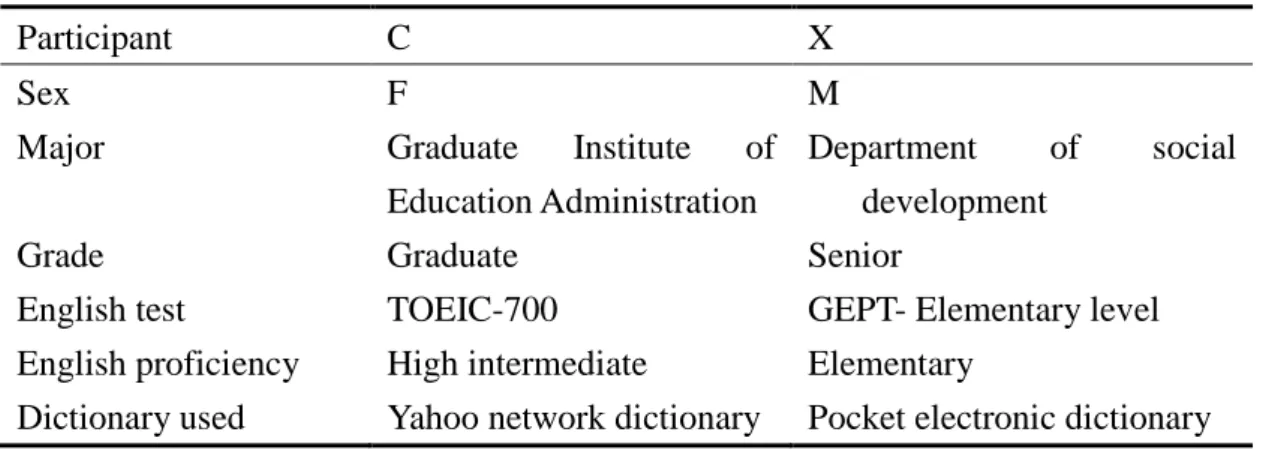
Two adult learners voluntarily participated in the case study, a graduate student and a university student in National Pingtung University of Education (NPUE). Their background information (e.g., gender, major, and English proficiency) is summarized in Table 1. Their respective English language proficiency was based on the scores of Test of English for International Communication (TOEIC) or General English Proficiency Test (GEPT) they had taken before the conduct of this study. Participant C took TOEIC when she was an undergraduate and participant X passed the elementary level of GEPT in his junior high. At the beginning of the study, they were given a copy of consent form (Appendix A) and asked to sign it if they agreed to participate in the stud y.
Table 1: Background information of the participants
Participant C X
Sex F M
Major Graduate Institute of
Education Administration
Department of social development
Grade Graduate Senior
English test TOEIC-700 GEPT- Elementary level
English proficiency High intermediate Elementary
Dictionary used Yahoo network dictionary Pocket electronic dictionary
The Material
198 Procedure
To explore how they used dictionaries in reading English, the two learners were each provided a handout printed with the assigned article to read. They were encouraged to look up the dictionary whenever necessary. For the convenience’s sake, they were requested to bring in their own dictionaries, which were Yahoo online dictionary and a pocket electronic dictionary.
To ensure they actually understood the words in the reading article or not, they were requested to mark two different symbols near the words to differentiate two types of words, unknown or uncertain, and then to ensure whether or not they used the dictionary for these underlined or marked words, they were requested to write down the Chinese definition or explanations of the words they found in the dictionary. For example, when seeing an unknown or never-see-before word, they would draw a line under it, such as bullet. When a word looked familiar but uncertain to them, a triangle would be marked above it. For the word that had been consulted, the Chinese definition or explanation should be written near it, such as either (或者 huò zhě).
Right after the reading session, they were requested to translate the article orally into Mandarin to display their comprehension of it. After the oral translation, a stimulated recall was conducted with them in order to seek reasons why they looked up the words during the reading process.
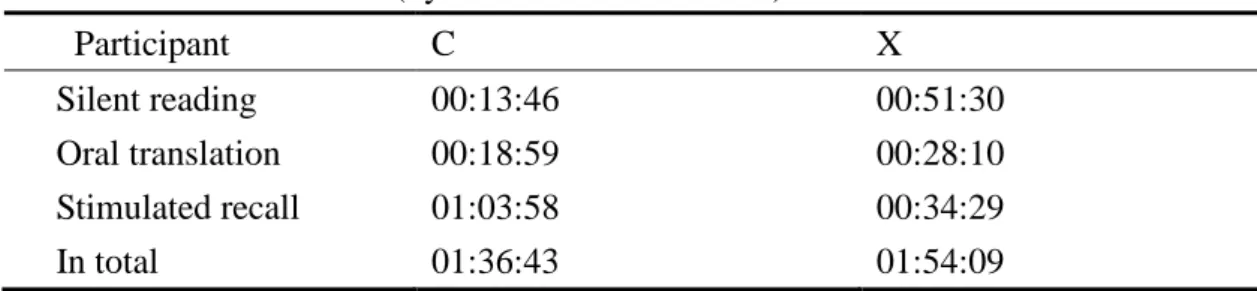
The respective time for the entire procedure (including reading the article, oral translation, and stimulated recall) used by the two participants is listed in Table 2. Participant C spent about an hour and half in total and Participant X about an hour and fifty minutes.
Table 2: Time for silent reading, oral translation, and stimulated recall (by hour : minute : second)
Participant C X Silent reading 00:13:46 00:51:30 Oral translation 00:18:59 00:28:10 Stimulated recall 01:03:58 00:34:29 In total 01:36:43 01:54:09 Data Collection
199
The participants’ notes
The participants’ notes referred to anything marked on the reading material by the participants throughout the reading and translation tasks, including the symbols for the unknown and uncertain words that they had looked up and the Chinese translations of these English words. (See the Procedure section.) These notes were taken as evidence that the participants had actually looked up the words while reading.
The retrospective reports
The retrospective reports were transcribed from the stimulated recall protocol, in which the participants revealed possible reasons for consulting the dictionary. Based on the notes they marked on the reading material, the participants were respectively asked to verbalize reasons for looking up the words. A question guide had been devised to lead them to recall and report their retrospections (See Appendix C). The guide focused on how they dealt with the unfamiliar and uncertain words while reading. To allow them to express their thinking as thoroughly as possible, they were encouraged to use their native language, Mandarin Chinese.
Observation notes
While the two participants were reading the article, the first researcher (Hsu-ling) sat beside them, observing and note-taking any relevant information, such as, when a dictionary was used and for what words, in what situation the participants took notes, and so on. The purpose of the observation task was aimed to develop proper questions for the stimulated recall conducted later.
The major data for analysis included the participants’ notes and the retrospective reports from the stimulated recalls. The analysis was divided into two phases. First, to understand how many words unknown or uncertain to the participants, the words with an underline or triangle on the handouts were calculated. Next, based on the Chinese translations written on the handout, the number of words that had been actually looked up was counted.
Data analysis
200
Results and Discussion
As data analysis reveals, the two participants indeed used dictionaries in a quite different manner; specifically, they differed in the number and type of the words they looked up.Two major reasons may account for such differences: the different language proficiencies they own and the different reading procedures they adopted. In the following, differences in how they used the dictionary will be presented and later, factors causing such differences will be discussed.
Differences in the two learners’ dictionary consultation behavior
Different numbers of the words looked up
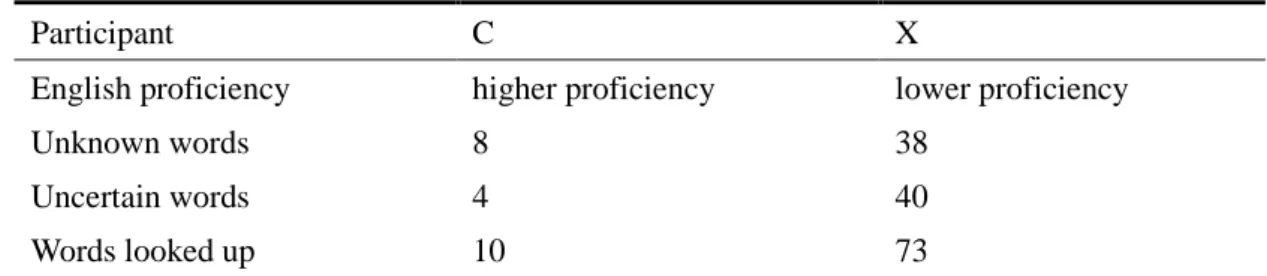
The first difference between the two learners’ dictionary consultation behaviors is in the different numbers of the words they had checked. As Table 3 shows, Participant C, who once got a score of about 700 on a TOEIC test, looked up only 10 words (about 2%) of the full text of 573 words. By contrast, Participant X, who passed the elementary level of GEPT, consulted 73 words in total (about 13% of the full text). In other words, the number of the words consulted by Participant X was about 7 times more than that by Participant C.
Table 3: List of the unknown words, uncertain words, and words looked up
Participant C X
English proficiency higher proficiency lower proficiency
Unknown words 8 38
Uncertain words 4 40
Words looked up 10 73
One obvious reason for the different numbers of the words consulted may be their differing linguistic proficiencies. During the stimulated recall, they were asked respectively if they had considered it necessary to consult these words. Participant C admitted that only two words, in fact, really needed checking, but Participant X replied that he had to know all the words, maybe except for three, or he could only vaguely understand what the article said. In other words, Participant X was pressed much harder than Participant C by an urge to consult the consultation in dealing with this reading task. So, due to his limited English ability, he needed much more help from the dictionary in reading, a similar finding also reported by Hulstijin (1993).
Different types of words consulted
201
difference between the ways they used the dictionary.
The three function words that Participant X had consulted were though, either, might, which respectively function as a conjunction, a determiner and a modal verb in the text. To find possible reasons why he consulted these three function words, his retrospective reports and the notes he had made while reading were reread and re-analyzed. As shown in the notes, all these function words were marked as uncertain words by him. And in the retrospective report he pointed out the reason for consulting these words: to verify their actual meanings. Since these words are listed in GEPT Elementary Level Word List from the Language Training & Testing Center (LTTC) (2003), yet he was still uncertain of their exact meanings, it can be inferred that he looked up these words mainly because of a lack of solid knowledge of them.
Another interesting point merits mention. Further examination of the Chinese translations of the meanings of the three words, as written on the reading handout by Participant X, it is found that the definition of either written by him was not quite right. He wrote down the Chinese characters 或者 (huò zhě or) for the English word either. But based on the Chinese-English version of Oxford Advanced Learner’s English- Chinese Dictionary (OALECD), the word either functions as an adverb and denotes a choice from the two options provided while used as或者 (huò zhě or). However, because in the assigned reading either appears in front of the noun group, it should work as an adjective or a determiner to modify group. Therefore, the proper definition for either in this context should be a determiner to refer to one or the other option offered, according to OALECD. In other words, the problem Participant X was faced with here was that he did not realize the grammatical connection between the two words either and group in the sentence, so he was led to choose an improper explanation of either from the dictionary. A vicious circle then arises. That is, while insufficient grammatical competence drives lower learners to consult dictionary frequently, frequent dictionary consultation may not guarantee a better understanding of the word consulted and further, a better comprehension of the reading.
Factors affecting the participants’ consultation behavior
202
he did not know or was unfamiliar with those words, yet the higher level participant displayed more selectivity in consulting the dictionary. In the following paragraphs, the differing reading procedures they adopted will be discussed first and later, in what ways Participant C was more selective in using the dictionary than Participant X.
The relationship between reading procedures and dictionary consultation
As clearly shown in the observation notes and the stimulate recall reports, the two participants followed different reading procedures, which further affected the ways they used the dictionary. In a general term, Participant C took a so-called good reader path in comprehending the article. First, she skimmed the entire article without checking the dictionary; in her first reading of the article, she only marked the words unknown or uncertain to her and meanwhile, tried to figure out their meanings either from the context or by using the morphological knowledge she possessed, such as root morphemes or affixes. It was until the second time of reading that she decided which words to look up. As she explained,
Excerpt 1
I first skimmed the article. When I read the first paragraph and saw the word, sip, I was confused about why the word, sip, was here. Then, I skipped it. I probably needed to read through the first paragraph and then I would know what it meant. …We need to read a great deal of amount of information in order to get the main idea. Therefore, I skimmed the article as much as I can.
<我會先做掃瞄,我可能第一段看了,看到那個 sip 就陷入那個字的困頓裡面,
哦說為什麼這邊會出現 sip,那我就會跳過。我可能先看完第一段,那大概這個 可能是它形容的一個用法,...,就是我們要看很多大量的東西。就簡化它的意思 吧。所以就是大量去掃瞄。>
In the above reflection, Participant C recalled that she first skimmed the article as much as possible to get a general picture of the article. As she failed to grasp what she had read in the text, she would continue reading and try to seek clues that might help her to associate the reading with her prior knowledge. She explained this way,
Excerpt 2
I read through the paragraphs. I did not understand the first paragraph, but I talked to myself, ‘It is ok.’ I kept reading the second paragraph. Because there was information in the second paragraph which connected with a key word which I read previously, then maybe I can figure out the meaning.
<我是一段一段地看。就是第一段看完,看不懂,沒關係,我還是會繼續看第二
203 我就大概可以把意思捉出來。>
When explaining how she dealt with the unknown words, she said that she had learned how to analyze a word based on its roots or prefix and that this knowledge had helped her to identify or guess an unfamiliar word. As she explained,
Excerpt 3
When I see a word, I am used to dividing a word into half. Because I have learned root morphemes and prefix in class, I am used to doing so. Then, I might see some parts of the word that I am familiar with. Some said that some English words are formed in this way.
<我看到一個字我就會把它劃一半。因為以前我們有上過那個字根字首的課啦。
所以就習慣會畫一半。就是把你自己看得懂的東西。人家說英文字有些都是這樣 結合的嘛。>
By contrast, Participant X followed a different path in completing the reading task. He tended to follow a bottom-up way (Celce-Murcia & Olshtain, 2007) because he continuously checked with the dictionary on a sentence-by-sentence basis. As he explained,
Excerpt 4
I read through a sentence, then marked the unknown words and looked them up.
<一段句子先看過一遍,然後把不會的先弄出來,然後就去查。>
As a matter of fact, in his retrospective reports, Participant X said that while reading the article, he would immediately go to look up an unknown/uncertain word when he could not understand the sentence in which the word was located. Thus, he seems to only rely on dictionary consultation to cope with unfamiliar words throughout the reading process. So, in other words, he would rather give up than put effort to searching possible clues to figure out the meanings of the words.
204
Reasons for the higher level learner to use dictionary
As mentioned earlier, Participant C is a more selective dictionary user than Participant X. While they both used morphological knowledge to guess the unknown words, Participant C had more concerns for using the dictionary. Four concerns have been identified in the data that had caused her to consult the dictionary: 1) why the same part of the spelling of a given word appeared in another word; 2) how relevant a given word was to the context; 3) when the given word was a kind of deceptive transparent words, and 4) when she intended to increase her vocabulary size. Each of the four concerns will be further detailed as follows.
The same constituent spelling in different words
In analyzing why some words cause troubles to English learners, Laufer (1997) points out one special type of words and she calls them “synforms” (p. 26); that is, a word shares the same spelling (or similar sound) as another word but these two words bear different meanings, for example, price/prize, or reduce/deduce/induce. The same problem had also bothered Participant C in her reading of the article. As she explained why she consulted the word bulletins in the following,
Excerpt 5
When I saw the word (her finger pointed to the word bulletins), I recognized part of its spelling bullet. … Because I didn’t understand what bulletins meant, I thought it might have something to do with bullet. …I put a question mark here and wondered what relationship there was between bullet and bulletins. I talked to myself, ‘It’s ok’ and thought it was probably about health.… And I felt the word was not a key point here anyway, so I skipped it and kept reading….Why I looked up the word, bulletins, because I saw bullet at the end of the article. It made me wonder why bullet appeared again here, and then I thought to myself: there might be other meanings this word had, so I decided to check the word.
205
misled her to associate it with bullet. So, she at first did not bother to check the meaning of bulletins because she assumed it was not a key word. But as she read on and saw the word bullet, appearing in the sentence of the last paragraph “There is not a magic bullet” (p. 33), her curiosity or uncertainty was stirred up at this moment. She began to ponder whether there were other meanings for the word bullet that she had not yet been aware of; driven by the uncertainty, she decided to look up the meanings of bullet and bulletins. Clearly, Participant C originally misjudged the morphological structure bulletins and mistook its meaning. Her experience lend strong support to the observation that the same spelling appearing in two different yet look-alike words, or “synforms,” such as bullet and bulletin in this case, does cause problems to EFL learners and thus, leads them to consult the dictionary.
The word’s relevance to the context
Another concern causing her to refer to the dictionary is whether a given word was relevant to the topic of the reading. Here is one example of this concern.
Excerpt 6
I had looked up this word. It’s 議程yì chéng (a list of items to be discussed at a meeting). The article said that we should get some sources of information. Moreover, we probably need to do something. …Then, I thought all this information seems to lead us a direction, so I thought it was necessary to look it up.
<我也查了,是議程。…它說我們必須要有一些資訊的來源嘛。和我們可能必須
去做一些什麼事情。…那我想說這應該是一個給我們一個方向嘛,那我想這個有 查的必要性。>
206
In the same article referred to previously, Laufer (1989) mentions another kind of words that often trouble EFL learners is the word which looks easy to interpret but in fact, is not. One possible reason causing their inability to guess its meaning is because the word has a deceptive morphological structure, a kind of deceptive transparent words, according to Laufer (1989). As she explains, a deceptively transparent word is “a word which seems to provide clues to its meaning but does not” (p. 11). Participant C was also hard hit by the same problem, which caused her to look up the word painstaking in the reading. As she explained in Excerpt 7 below,
The pseudo-familiarity word
Excerpt 7
Researcher: Did you look up the word? Painstaking. <這個字你有查嗎?painstaking>
Participant C: Yes, I did. As before, I divided the word into half. This is pains (痛苦tòng kŭ pain). I was not able to associate it with the meaning of the word in thinking. Therefore, I decided to look it up and it was the meaning of 不辭辛勞 (bù cí xīn láo, really hardworking)
<我有查。...我也會把它分一半。這個是 pains痛苦,沒有辦法去
聯想,所以我就想說,不辭辛勞我把它查出來了。>
.
Here, Participant C clearly stated that she had attempted very hard to analyze the morphological structure of the word painstaking in order to guess its meaning, but she still failed to come up with a possible meaning from its constituents. As a consequence, she had to consult the dictionary. From the outlook, painstaking is comprised of pain+s+taking and thus, is easy to be misinterpreted as something relating to pain. It is then no surprise that painstaking would give Participant C a hard time and drove her to reach the dictionary.
Building up vocabulary
The last reason for participant C consulting the dictionary was her attempt to increase her vocabulary knowledge. As she stated in Excerpt 8,
Excerpt 8
Researcher: You looked up the words, pharyngeal and esophageal. Why? <pharyngeal咽喉的,跟食道的這兩個字你查了,為什麼?> Participant C: Just simply wanted to know. It did not matter if I didn’t look
207
<就是單純的想知道。如果不查也沒差啦。可是就是想要知道它
是什麼意思。>
When asked why she still looked up the words which she thought did not at all interfere her understanding of the article, she answered, “as long as I started to consult a dictionary for an unknown word, I would be keen on looking up the definition for the rest of unknown words.” In other words, she was pushed to consult these words simply because of a desire of knowing more vocabulary words. This seems a common learning strategy among Taiwanese EFL students. Lai (2005) also reported a similar finding. She found that one major reason for the participants of her study to look up a large number of words is to “check all the unknown words if time permits so as to build up their vocabulary” (Lai, 2005, p. 44). Like these students, Participant C also made use of this reading experience to build up her vocabulary base by checking these two words she might have never met before. Her attempt of this kind echoes the common observation that a major purpose of using the dictionary for EFL learners is to improve their English ability.
Conclusion and Implications
This small-scale case study showed that the two adult EFL learners with different English proficiencies performed differently in their reading procedures and dictionary consultation behavior. The higher proficiency learner, Participant C, used more strategies in reading an English article and she could be categorized as a good dictionary user. In other words, when facing an unknown or unfamiliar word, she would analyze the meaning of the reading or refer to the context in which the word appears prior to checking the dictionary.
Two implications can be drawn from the findings of this study for English teachers in Taiwan. First, they may help increase their students’ reading ability by teaching them to make use of some reading strategies, such as guessing from the context, applying morphological rules, and consulting the dictionary selectively. And second, an understanding of many factors that may affect learners’ consultation
208
behavior may provide them a useful reference in designing a proper instruction to help students become more efficient and selective dictionary users.
Finally, dictionary consulting behavior is a much more complex issue than it was treated in the study. In other words, more factors than those discussed here will have impact on EFL learners’ reading processes. This study included only two participants who read only one article, and examined only one variable, differing language proficiency. Many other factors are obviously untouched. So, future studies may explore whether dictionary consultation behavior will differ if more participants with a larger range of English proficiency levels are involved. It is also worthwhile to explore relationship between different genres of reading and learners’ dictionary consultation behavior.
References
Bensoussan, M., Sim, D., & Weiss, R. (1984). The effect of dictionary usage on EFL test performance compared with student and teacher attitudes and expectations. Reading in a Foreign Language, 2, 262–276.
Bernhardt, E. B., & Kamil, M. L. (1995). Interpreting relationships between L1 and L2 reading: Consolidating the linguistic threshold and the linguistic interdependence hypotheses. Applied Linguistics, 16, 15–34.
Celce-Murcia, M., & Olshtain, E. (2007). Discourse and context in language teaching. New York: Cambridge.
Fromkin, V., Rodman, R., & Hyams, N. (2003). An introduction to language. Boston: Wadsworth.
Gu, Y., & Johnson, R. (1996). Vocabulary learning strategies and language learning outcomes. Language Learning, 46, 643–679.
Hudson, T. (2007) Teaching second language reading. New York: Oxford.
Hulstijin, J. H. (1993). When do foreign-language readers look up the meaning of unfamiliar words? The influence of task and learner variables. The Modern Language Journal, 77, 139–147.
Knight, S. (1994). Dictionary use while reading: The effects on comprehension and vocabulary acquisition for students of different verbal abilities. The Modern Language Journal, 78, 285–299.
Lai, S-F. (2005). The role of English dictionary use in Universities of Technology students’ reading tasks. Master Thesis, Southern Taiwan University, Tainan. Laufer, B. (1989). A factor of difficulty in vocabulary learning: deceptive transparency.
In P. Nation & R. Carter (Eds.), Vocabulary acquisition (pp. 10-20). Retrieved
209
Laufer, B. (1997). The lexical plight in second language reading: Words you don’t know, words you think you know, and words you can’t guess. In J. Coady & T. Huckin (Eds.), Second language vocabulary acquisition (pp. 20–34). New York, NY: Cambridge University Press.
LTTC (2003). GEPT Elementary Level Word List. Retrieved February 10, 2011, from http://www.lttc.ntu.edu.tw/academics/geptelist.htm
Luppescu, S., & Day, R. (1993). Reading, dictionaries, and vocabulary learning. Language Learning, 43, 263-287.
Macaro, E. (2003). Teaching and learning a second language. London: Continuum. Nation, I.S.P. (2009). Teaching ESL/EFL reading and writing. New York: Routledge. Nation, P., & Coady, J. (1988). Vocabulary and reading. In R. Carter & M. McCarthy
(Eds.), Vocabulary and language teaching (pp. 97-110). London: Longman. Prichard, C. (2008). Evaluating L2 readers’ vocabulary strategies and dictionary use.
Reading in a Foreign Language, 20, 216–230.
Qian, D. D. (1999). Assessing the roles of depth and breadth of vocabulary knowledge in reading comprehension. The Canadian Modern Language Review, 56, 282–308.
Qian, D. D. (2002). Investigating the relationship between vocabulary knowledge and academic reading performance: An assessment perspective. Language Learning, 52, 513–536.
Summers, D. (1988). The role of dictionaries in language learning. In R. Carter & M. McCarthy (Eds.), Vocabulary and language teaching (pp. 111–125). London: Longman.
Tono, Y. (2001). Research on dictionary use in the context of foreign language learning. Tübingen: Niemeyer.
Tsui, C. (2007). Factors for choosing English dictionaries for EFL learners. Master Thesis, National Kaohsiung Normal University, Kaohsiung.
Wang, H-W. (2006). Comparisons between pocket electronic dictionaries and paper dictionaries in reading comprehension and incidental vocabulary acquisition of English-Major college students. Master Thesis, National Kaohsiung Normal University, Kaohsiung.
210
Appendix A--1
Consent Form (Chinese Version)
我是鍾旭玲,目前就讀於國立屏東教育大學英語學系碩士班。現正致力於碩 士論文研究,研究主題是了解在英文閱讀過程中,影響英語學習者使用英文字典 的因素。由於我的研究對象是成人英語學習者,故在此誠摰邀請您參與本研究。 此研究將歷時約兩個小時。您將閱讀一篇英文文章。閱讀過程中,我將觀察 您閱讀文章及使用英文字典的情形。為了解您對文章的理解程度,閱讀之後,將 請您口頭翻譯文章內容。口頭翻譯之後,我將與您進行一次訪談。在您的允許下, 訪談過程將全程錄音。 本研究結果僅供學術研究之用。您的隱私會受到保護,個人姓名將不會呈現 在研究報告上。如有需要,將以匿名方式呈現。研究過程中,您可以隨時要求停 止觀察或錄音,及退出參與此研究。若您對我的研究結果有興趣,我會很樂意與 您分享和討論。如果有任何問題或建議,亦懇請您不吝賜教。 現在請您決定是否參與本研究,您的簽名表示您已詳閱此份同意書,並且願 意參與本研究。謝謝! 參與者簽名 日期
Appendix A--2
Consent Form (English Version)
My name is Chung, Hsu-ling. I am a graduate student in the Department of English at National Pingtung University of Education. I am conducting a research project for my master thesis. The purposes of the study are to develop an understanding of adult learners’ dictionary consultation behaviors in English reading and to explore the factors causing the English dictionary use. You are cordially invited to participant in this study.
The study will last about two hours. You will read an English article. While reading, I will observe your reading procedures and dictionary use. To know how much you comprehend the article, you will orally translate the English article into Chinese after reading. In the final phase of this study, I will conduct an interview with you. With your permission the interview will be audio-recorded.
The result of this study will be only used for the academic research. Your privacy will be protected, and your name will not be presented in the final or any other reports. You may ask to stop the observation/recording or withdraw from this study at any time. If you are interested in the results of this study, I will be glad to share and discuss with you when it is concluded. If you have any questions or suggestions, please feel free to contact with me.
211
form indicates that you have read the information above and have decided to participant.
Signature of the participant Date
Appendix B
Getting smart about science
“You can’t believe everything you read, but what can you believe?”
Every day, we sip a steady stream of health news about something we could eat or drink, and how it will help save us from some health nightmare—or help cause it. Avoid refined sugar. Take fish oil pills. Drink coffee.
So here’s the good news, according to experts who study disease and risk: You can pretty much ignore almost all of these health bulletins, with a few exceptions:
Exercise, eat a balanced diet, don’t be fat, drink only in moderation and, whatever you do, don’t smoke.
This is not to say science is pointless. After all, it was the painstaking work of scientists that conclusively proved smoking is a health disaster.
But being a good consumer of science news means understanding how scientific studies work. Sometimes, findings that sound spectacular may be completely useless to you- though important to other scientists working on the bigger picture.
Coffee: Good or bad?
A recent study published in the American Journal of Epidemiology followed 39,000 middle-aged Japanese people for 13 years and found that the people who reported drinking one or more cups of coffee a day were about half as likely to get oral, pharyngeal or esophageal cancer as the others. That sounds like a great excuse to order another cappuccino, since these are some of the deadlier cancers.
But before you do, consider that the study’s findings tell us only about relative risk-the cancer risk for coffee drinkers in relation to non-coffee drinkers. Half as much risk sounds like a lot, but the bottom line is that very few people in either group got cancer. In other words, the absolute risk is low, coffee or no coffee.
It’s also important to realize that studies like this are done for reasons other than to change your coffee habit. The idea is to examine unresolved questions in science, and it’s rare for any individual study to settle them.
Scientific knowledge is like a snowball rolling down a hill. As more studies produce more supporting evidence, the snowball grows until eventually doctors start asking patients to alter their behavior and public health officials call for changes.
212
for a link between coffee and cancer is a very small one. And there are a lot of small snowballs out there.
Thinking critically about science news
When assessing health news, think of yourself as a consumer of information and decide whether you’re buying. Harvard University professor and author Kimberly Thompson offers some basic advice:
1. Get empowered. Ask yourself: Who put out the information, and do they have an agenda? Am I getting the whole story? Who were the people in the study? Am I really like them or not? Do I have a health condition that means the results don’t apply to me?
2. Consider tradeoffs. If eating a specific food might raise your risk slightly of getting some disease, consider all the risks and benefits. Do you love that food? Consider that adding something to your diet- like coffee- for a health benefit might mean also adding some health risk, like consuming many thousands of extra calories in cream and sugar.
3. And always remember, “there is not a magic bullet,” Thompson said. It’s what you do over time—whether you exercise, eat well and so on—that matters.
From Studio Classroom Advanced, October 2009, (pp. 32-33)
Appendix C
Questions for Stimulated recall
213
(16) 閱讀這篇文章時,你使用 字典,為什麼?
你最常使用的字典是 -你最喜歡的字典是