
調查英文閱讀動機、策略使用與閱讀能力的關係 – 台灣高中生個案研究
114
0
0
全文
(2) Powered by TCPDF (www.tcpdf.org).
(3) Powered by TCPDF (www.tcpdf.org).
(4) ACKNOWLEDGEMENTS The valuable literature attracted me to the reading field. The wise professors guided me to follow the reading boulevards and create my own trails, as well as escape from the occasional blind alleys. First of all, my deepest appreciation goes to my advisor, Dr. Hsin-Hsin Yang. She always gave me a lot of space to develop my thesis, whereas offered me precious guidelines and suggestions at a critical time. Her trust, support and encouragement led me to accomplish the task confidently. I am also grateful to Dr. Shwu-Mei Hwang and Dr. I-Fang Chung, my committee members. They pointed out the defects in my thesis, refined on the paper with their expertise and insightful views; therefore, let me ponder over the correct direction to rectify and complete my paper successfully. In addition, I would like to express my gratitude to all the professors who had taught me in Pingtung University, as their instruction built up my knowledge of paper writing. Moreover, thank for my friends, Rex and Lydia, because their spirit support gave me the strength to overcome the difficulty. Of course, I am deeply indebted to my family for their acceptance, especially my mother’s tolerance and company during the tedious days. Finally, let me show my greatest thankfulness to my father for his blessing and protection in the heaven.. i.
(5) 摘要 在過去數十年來,閱讀動機、閱讀策略及閱讀理解之間的關係一直是熱門的探 討議題。本研究旨在探討台灣高中生,英文閱讀成就動機 、後設認知閱讀策略及 閱讀理解之間的關係。本研究在量的部分,實驗方式為邀請四十二位即將參加大學 入學考試的高三學生,在學期開始與學期結束時,接受前後測閱讀動機與閱讀策略 的問卷調查及前後測閱讀測驗,並依其英文閱讀成績分為高、中、低三組。在質的 部分,實驗方式為邀請 6 位學生,分別從高、中、低三組,隨機選出各兩位,進行 放聲思考閱讀。研究結果顯示: (1) 高成就組學生比低成就組學生有顯著較強的成 就動機,然而,中成就組與低成就組學生之間的差異未達顯著; (2) 高成就組學生 比低成就組學生顯著使用較多的閱讀策略項目,然而,中成就組與低成就組學生 之間的差異未達顯著; (3) 大學入學考試結束後,中成就組與低成就組學生的表現成 就動機下降,但其精熟成就動機與高成就組的表現及精熟成就動機增加,然而,三 組的增減變化,皆未達顯著; (4) 接受一學期的課堂英文閱讀教學後,三組學生的後 設認知閱讀策略使用及英文閱讀成績均提升,然而,三組的策略增加及成績提升部 份,皆未達顯著; (5) 高成就組學生比低成就組學生能更有效及更有彈性地使用閱 讀策略,並且更有決心圓滿完成放聲思考閱讀的任務。大體而言,量化研究與質化 研究的結果能互相呼應。. 關鍵詞: 閱讀動機、閱讀策略、閱讀能力 ii.
(6) ABSTRACT The issue of the relationships between reading motivations, reading strategy use and reading comprehension has been a perpetual hot topic for decades. The present study aims to investigate the relationships between EFL students’ achievement goals, reading strategies based on SORS and reading competency in the senior high school setting. Regarding the quantitative study, the differences in achievement goals and reading strategies between 3 levels of proficiency of 42 students were investigated. Besides, the influence of the college entrance examination and the English reading instruction in class on achievement goals, reading strategies and reading performance between 3 levels of proficiency of students was explored. As to the qualitative study, when the individual students performed the think-aloud task, their achievement goals, reading strategy use and reading scores were probed. The results show High-achievers had significantly stronger achievement goals than Low-achievers’, whereas the difference between Mid-achievers and Low-achievers was not significant. Besides, the performance goal decreased in Midand Low-achievers, whereas the mastery goal increased in 3 levels of proficiency of students after they completed the college entrance examination; however, all the differences were not significant. On the other hand, High-achievers used significantly more reading strategy items than Low-achievers, whereas the difference between Mid- and Lowachievers was not significant. Moreover, all the reading strategy use and reading scores increased in 3 levels of proficiency of students after the English reading instruction in class, whereas all the differences were not significant. Finally, High-achievers were more flexible and effective to employ the reading strategies and more determined to succeed in the thinkaloud task than Low-achievers. In general, the results of the quantitative and qualitative research were consistent. Keywords: reading motivation, reading strategy, reading competency iii.
(7) TABLE OF CONTENTS Acknowledgements.................................................................................................. i. Chinese Abstract...................................................................................................... ii. Abstract..................................................................................................................... iii. Table of Contents..................................................................................................... iv. Tables......................................................................................................................... vii. CHAPTER ONE INTRODUCTION................................................................... 1. Background and Motivation…….................................................................... 1. Purpose of the Study......................................................................................... 3. Research Questions........................................................................................... 3. Significance of the Study.................................................................................. 4. Definition of Terms………………........................................................……... 5. CHAPTER TWO LITERATURE REVIEW..................................………….... 7. The Nature of Reading Comprehension……......................................……... 7. Motivation and Language Learning………...........................................….... 9. Reading Motivation and Reading Comprehension.....................……... 10. Reading Strategy and Language Performance...................................……... 12. Reading Strategy Use and Reading Comprehension…................……. 13. The Relationships among Motivation, Reading Strategy and Reading Comprehension……………............................................................................. 17. Summary………………………………………....................................……... 20. CHAPTER THREE METHODOLOGY……….......................................……. 22. Research Design Procedures………………........................................……... 22. Participants…………………………………........................................……... 23. iv.
(8) Instruments…………………………………........................................……... 24. Questionnaires…………………………........................................……... 24. Reading Comprehension Tests……………..................................……... 25. The Reading Material……………………....................................……... 26. Classroom Observation…….……..……….........................................……... 26. Data Collection and Analyses……..………........................................……... 27. Reading Task: Think-aloud…….................................................……... 27. Reliability and Trustworthiness…......................................................……... 28. CHAPTER FOUR RESULTS…………….…….......................................……. 29. Reliability…………………….……..………........................................……... 30. Cronbach’s Alpha……………….……........................................……... 30. Reliability Coefficients………….……........................................….…... 30. Achievement Goals and Reading Strategies between three Levels of Achievers. 31. Differences in SHSS’ Achievement Goals after a Semester……..…........... 37. Differences in SHSS’ Reading Strategy Use after a Semester...........….….. 41. Summary…………………….……..………........................................……... 46. The Individual Students’ Reading Strategies and Achievement Goals...... 48. Subject One: James and His Transcript…….……................................ 48. James’ Reading Strategies and Achievement Goals…….……............. 49. Subject Two: Ann and Her Transcript…….…….................................. 50. Ann’s Reading Strategies and Achievement Goals…….……............... 50. Subject Three: Leo and His Transcript…….…….................................. 51. Leo’s Reading Strategies and Achievement Goals…….……................ 52. Subject Four: Eva and Her Transcript…….……................................... 54. Eva’s Reading Strategies and Achievement Goals…….……................ 54. v.
(9) Subject Five: Tim and His Transcript…….…….................................... 55. Tim’s Reading Strategies and Achievement Goals….……................... 56. Subject Six: Flora and Her Transcript………..….................................. 58. Flora’s Reading Strategies and Achievement Goals……….................. 58. Summary…………………….……..………........................................…….... 60. DISCUSSION…………….…….......................................…………………….….. 62. Motivation and Language Learning..………..................……....................... 62. Reading Strategy and Language Performance..………................................ 63. Motivation, Reading Strategy and Reading Competency....................... 66. CHAPTER FIVE CONCLUSION…………….….......................................…... 68. Summary of the Study……….……..………........................................…...... 68. Pedagogical Implications….……..………........................................….......... 70. Limitations and Reflections………........................................…..................... 71. Suggestions for Future Research…........................................….......................... 72. REFERENCES…………….…….......................................…………………….... 73. Appendix A……….……..………........................................…........................ 80. Appendix B……….……..………........................................…........................ 81. Appendix C……….……..………........................................…........................ 82. Appendix D……….……..………........................................…........................ 85. Appendix E……….……..………........................................…........................ 88. Appendix F……….……..………........................................…........................ 96. Appendix G……….……..………........................................…........................ 103. vi.
(10) TABLES Table 1. Research Design Procedures................................................................... 23. Table 2. Descriptive Statistics for 42 Subjects..................................................... 24. Table 3. Classroom Observations during English Reading Lessons.................. 26. Table 4. Six Participants’ Background Information............................................ 27. Table 5. Reliability Measurements of Motivations and Reading Strategies...... 29. Table 6. Pearson Correlations between Pre- and Post-Scores............................ 30. Table 7. Pearson Correlations between Motivations and Reading Strategies..... 31. Table 8. Descriptive Statistics for Three Levels of English Reading Achievers. 31. Table 9. Means and Standard Deviations for Achievement Goal Types............ 32. Table 10 Paired t-Tests for Mean Difference between Motivation Types........... 33. Table 11 Means and Standard Deviations for Reading Strategy Types............. 34. Table 12 Paired t-Tests for Mean Difference between Strategy Types............... 34. Table 13 Levene’s Test of Homoeneity of Variances............................................ 35. Table 14 ANOVA Summary Table by Three Levels of Reading Achievers....... 36. Table 15 Correlations between Achievement Goal Types and Reading Scores. 37. Table 16 Gains of Achievement Goal Types and Reading Scores....................... 37. Table 17 Correlations between L-achievers’ Motivation Types and Reading Scores. 38. Table 18 Gains of L-achievers’ Motivation Types and Reading Scores.............. 39. Table 19 Correlations between M-achievers’ Motivation Types and Reading Scores. 39. Table 20 Gains of M-achievers’ Motivation Types and Reading Scores............ 40. Table 21 Correlations between H-achievers’ Motivation Types and Reading Scores. 40. Table 22 Gains of H-achievers’ Motivation Types and Reading Scores............. 40. Table 23 Paired t-Tests on Motivations and Reading Score by Achievement Level. 41. vii.
(11) Table 24 Correlations between Reading Strategy Types and Reading Scores... 42. Table 25 Gains of Reading Strategy Types and Reading Scores......................... 42. Table 26 Correlations between L-achievers’ Strategy Types and Reading Scores. 43. Table 27 Gains of L-achievers’ Strategy Types and Reading Scores.................. 43. Table 28 Correlations between M-achievers’ Strategy Types and Reading Scores. 44. Table 29 Gains of M-achievers’ Strategy Types and Reading Scores................. 44. Table 30 Correlations between H-achievers’ Strategy Types and Reading Scores. 45. Table 31 Gains of H-achievers’ Strategy Types and Reading Scores................. 45. Table 32 Paired t-Tests on Strategy Types and Reading Score by Achievement Level. 46. Table 33 James’ Reading Strategies in the Think-Aloud Task............................ 50. Table 34 Ann’s Reading Strategies in the Think-Aloud Task............................. 51. Table 35 Leo’s Reading Strategies in the Think-Aloud Task.............................. 53. Table 36 Eva’s Reading Strategies in the Think-Aloud Task.............................. 55. Table 37 Tim’s Reading Strategies in the Think-Aloud Task.............................. 57. Table 38 Flora’s Reading Strategies in the Think-Aloud Task........................... 60. Table 39 Comparison of Six Participants’ Reading Strategies............................ 65. viii.
(12) CHAPTER ONE INTRODUCTION Background and Motivation Reading is the foundation of lifelong learning which opens up a window for people to contact the diverse world in written texts or those on the Internet. Through reading, people can absorb ancestors’ experiences and acquire wisdom and knowledge. Nowadays, English is the most prevailing language in the world, so English reading is very important for people to access more extensive knowledge and valuable information. Psychology provides us with several theories of the L2 learning process and one of the major frameworks is Information Processing (IP). According to Saville-Troike (2012), IP regards L2 learning as the acquisition of complex cognitive skills. Learners start from controlled processing acquiring lower-order skills to automatic processing acquiring higher-order skills with continuous practice and then develop the restructuring or reorganization of mental representation. The theory of IP effectively corresponds to the three models of reading comprehension: bottom-up, top-down and interactive. Besides, the proper employment of metacognitive reading strategies such as global, problem-solving and supporting types in second language reading would facilitate students’ reading comprehension (Ahmadi, Ismail, & Abdullah, 2013; Carrell et al., 1989). In second language (L2) or foreign language contexts, L2 learners have much wider ranges of language proficiencies than L1 learners. While L2 students learn to read, they must enlarge their linguistic knowledge (e.g. vocabulary, grammar, phonology etc.), deal with transfer effects, and learn to use L2-specific resources such as translation, glosses and bilingual dictionaries (Celce-Murcia & Olshtain, 2007; Grabe & Stoller, 2002). Based on Hudson (2007), vocabulary is a considerable factor in L2 reading. 1.
(13) proficiency from the perspective of language knowledge. Some studies also indicated that depth and breadth of vocabulary knowledge could significantly predict the reading comprehension scores (Qian, 1999, 2002). From a psychological perspective, some L2 learners are more successful than others; the differences may result from learners themselves such as age, sex, aptitude, motivation, cognitive style, personality, and learning strategies (Saville-Troike, 2012; Weiner, 2005). Regarding L2 reading motivation, it is likely to find different motivations as L1 reading. Some of these differences in motivation may derive from academic goals, prior educational instruction or socialization practices. Besides, students’ self-perceptions, emotional attitudes toward English reading, interest in specific topics, and willingness to read English texts and learn from them also affect their motivations for English reading. As for L2 learning strategies, readers tend to utilize various conscious and unconscious strategies in reading comprehension process (involving selecting, organizing and integrating) to construct meanings from written message (Grabe & Stoller, 2002; Mayer, 1996). Moreover, many students’ knowledge of L2 comes from direct instruction in the classroom or outside reading. In such cases, students develop a greater metalinguistic awareness as a resource for reading (Grabe & Stoller, 2002). That is, L2 students may monitor their strategies on vocabulary, morphology, grammar, and discourse knowledge, which reasonably extend to a more developed metacognitive awareness. Thus, in the field of second/foreign language studies, metacognitive reading strategy awareness is one of the effective ways to facilitate students to a better reading understanding (Ahmadi, Ismail, & Abdullah, 2013; Carrell et al., 1989). Besides, the choice of reading strategies is also affected by some related factors such as the nature of readers’ motivation, cognitive style, personality, opportunities for learning, sex and aptitude (Saville-Troike, 2012).. 2.
(14) As far as senior high school students (SHSS) in Taiwan are concerned, they generally need to take the college entrance examination, so one of their prime motivations in English reading should be based on academic goals; that is, the college entrance examination. Besides, when SHSS face the academic examinations, English reading strategy plays an important part to enhance their second language reading comprehension, and the English instruction should be one of the major ways to influence their reading strategy use. Therefore, the issue about relationships between SHSS’ English reading motivation, reading strategy use and reading competency is appealing and enlightening for the researcher to explore. In addition, the related factors such as the college entrance examination and the English reading instruction in class that may influence the three variables during the period are also included in this study. Purpose of the Study There are four purposes for the current study. First, it is conducted to explore the achievement-goal and strategy orientations of SHSS who need to take a college entrance examination in southern Taiwan. Second, the differences of achievement goals and reading strategy use between different reading proficiencies of SHSS are analyzed. Third, the differences in SHSS’ achievement goals, reading strategy use and reading performance between three proficiencies of students after the semester are explored. Fourth, how the individual students were motivated and how they used reading strategies while performing the task are investigated. Research Questions This study aims to answer the following research questions for SHSS in English reading: 1. Are there any significant differences in achievement goals and reading strategy use between High-, Mid-, and Low-achievers?. 3.
(15) 2. Are there any significant differences in SHSS’ achievement goals after a semester (about 4 months)? 3. Are there any significant differences in SHSS’ reading strategy use after a semester (about 4 months)? 4. How do the individual students use reading strategies? Significance of the Study Although the issue of the relationships between reading motivations, reading strategy use and reading comprehension has been a perpetual hot topic, some studies focused on learners’ intrinsic and extrinsic motivations (Huang, 2014; Mucherah and Yoder, 2008; Peng, 2001; Wigfield and Guthrie, 1997; Yu, 2006), other research concentrated on learners’ achievement goals (He, 2008; Wilson and Kim, 2016). Some studies emphasized learners’ strategies based on Oxford’ Strategy Inventory for Language Learning (SILL) (Cheng, 2009; Ghafournia1, 2014; Peng, 2001; Yu, 2006), but other research addressed the strategies according to the Survey of Reading Strategies (SORS) (Huang, 2013; Meniado, 2016). The present study investigated the relationships between EFL students’ achievement goals, reading strategies (SORS) based on different levels of reading competency in the senior high school setting. As the achievement goal is a kind of instrumental motivation, it is appropriate to survey motivations for any practical purpose. Regarding SORS, they are the metacognitive strategies divided into three reading strategy types and can be employed simultaneously on one reading material, so they are more appropriate for the second language reading such as the academic materials (Mokhtari & Sheorey, 2002). Furthermore, this study combined quantitative with qualitative analyses by questionnaires and the think-aloud task, which made this study distinguished from previous research.. 4.
(16) Definition of Terms The following terms are defined for the present study. 1. Lower-level processes: A part of reading comprehension processes includes lexical access, syntactic parsing, semantic proposition formation and working memory activation (Grabe & Stoller, 2002) . 2. Higher-level processes: The other part of reading comprehension processes includes text model of comprehension, situation model of reader interpretation, background knowledge use and inference, and executive control processes (Grabe & Stoller, 2002). 3. Instrumental motivation: For the purpose of a pragmatic value in learning L2, such as expanding occupational opportunities, enhancing reputation and power, accessing scientific and technical information, or passing a course in school (Saville-Troike, 2012). 4. Integrative motivation: Interest in learning L2 because of a desire to associate with the people who use the language, or because of an intention to participate in the community where L2 is spoken. It is dominated by affective factors (Saville-Troike, 2012). 5. High-achievers: Bachman (2005) and Madsen (1983) addressed that before dividing a group into top and bottom sections, the number of participants should be considered. For a large group (i.e. 100 or larger), the top 27% and the bottom 27% should be chosen to maximize the difference. For a smaller group, the top and bottom one-third should be defined. The current study includes 42 available samples; therefore, Highachievers refer to those who reached the top 33% in the scores of the first reading comprehension test. 6. Low-achievers: Likewise, Low-achievers in the current study refer to the participants whose scores of the first reading comprehension test were at the bottom of 33%. 5.
(17) (Bachman, 2005 & Madsen, 1983). 7. Reading strategies: It refers not only to the mental operations, deliberate actions but also to interactive, dynamic and ongoing processes that have the goal of obtaining and construct meaning from connected text effectively (Hudson, 2007; Pani, 2004; Pritchard, 1990; Yang, 2006). 8. Think-aloud: A research method similar to egocentric speech in which participants verbalize their thought when they perform a reading task. Its origins derive from the cognitive psychology (Charters, 2003).. 6.
(18) CHAPTER TWO LITERATURE REVIEW This chapter reviews literature related to reading comprehension, reading motivation, and reading strategy use. First, the nature of reading comprehension will be introduced. Second, motivation and language learning will be stated. Third, reading strategy and language performance will be described. Fourth, the relationships among motivation, reading strategy and reading comprehension will be explored. Fifth, a summary will be presented. The Nature of Reading Comprehension Reading is regarded as a receptive activity (Saville-Troike, 2012). It is a process as well as an ability for meaning-searching and meaning-constructing from written texts (Grabe & Stoller, 2002; He, 2008; McDonell, 2003). Usually, there are different purposes for us to read. Among them, reading for general comprehension is the most basic purpose to support most other reading purposes (Grabe & Stoller, 2002). General reading comprehension is not only a complex ability for readers to understand the text but also an active process to integrate readers’ prior knowledge with new information to construct text meaning (Ahmadi et al., 2013; Grabe, 1991; Meniado, 2016). According to Grabe and Stoller (2002), reading processes could be simplified into lower-level and higher-level processes corresponding to three metaphorical reading models: bottom-up, top-down and interactive models. Bottom-up models think reading follows a mechanical pattern which reaches reading comprehension through lower-level processes such as word recognition abilities and syntactic parsing. Ahmadi et al. (2013) exemplified that the bottom-up model is achieved by learners’ decoding of each word to understand the text meaning. Proponents of this model believe this process makes readers become skilled and proficient quickly. The proficient ability refers to understand frequent letter. 7.
(19) chunks, prefixes, suffixes, and the original words quickly, and the supporters think that fast decoding can increase reading comprehension (Pressley, 1998). However, the critics think the bottom-up process takes a lot of time and leads short-term memory to overload, and readers forget easily when they only remember words separately instead of integrating them into a cohesive understanding. Moreover, students will lack the motivation to read regularly (Ahmadi et al., 2013). Top-down models suppose that reading is directed by reader goals and expectations created by a general monitoring mechanism, under which reading comprehension is reached through the interaction of lower- and higher-level processes such as inference and background knowledge use. The top-down model is achieved by a learner’s background knowledge of content, prior experience of context and culture (Ahmadi et al., 2013; Saville-Troike, 2012). On the other hand, although contexts themselves have no meaning in this model, readers fit contexts into their background knowledge and use some key words to construct the meaning of the texts. However, this model has been criticized for relying too much on readers’ background linguistic and conceptual knowledge and ignoring the importance of the text. Interactive models assume that one can take useful ideas from a bottom-up view and combine them with main ideas from a top-down perspective. Moreover, modified interactive models highlight the number of lower- and higher-level processes depending on various purposes for reading. For example, background knowledge and inferences may play greater roles in developing integrated text comprehension across multiple texts. That is, the interactive model is achieved by not only an interaction between the text information and the learner’s background knowledge but also an integration of different types of metacognitive reading strategies and skills (Grabe, 1991, 2004; Eskey, 2005). Stanovich (1980) introduced the view of “compensation” into the interactive. 8.
(20) model. That is, when learners lack the sufficient background knowledge for a certain text, they will rely on the bottom-up processes to compensate for the necessary schemata information. On the other hand, if learners lack the sufficient bottom-up skills to comprehend a text, they will turn to high level processes. As academic and technical courses demand substantial readings, reading comprehension is also one of the most fundamental study skills in higher education (Meniado, 2016). Motivation and Language Learning According to Saville-Troike (2012), individual motivation is one of the major factors to determine the level of effort which learners make and a key to ultimate level of L2 proficiency. Integrative and instrumental are two most widely discussed types of motivation. Integrative motivation is considered a desire to learn due to interest or interacting with native speakers. Instrumental motivation refers to the perception of practical value in learning L2 such as passing an examination. In addition, intrinsic and extrinsic are another two major types of reading motivation (Komiyama, 2013; Wilson & Kim, 2016). Intrinsic motivation derives from personal curiosity, involvement, or preference for challenge. Extrinsic motivation focuses on competition, recognition, compliance, grades or social sharing (Komiyama, 2013). Goal orientation theory is a social-cognitive concept that explains why students are driven to achieve a task in their academic work; when applied to reading, it analyzes why readers have been initiated to complete their reading tasks (Ames, 1992; Benabo & Tirole, 2003; Duda & Nicholls, 1992; Guthrie & Wigfield, 1999; Weiner, 2005). According to Ellio, Murayama and Pekrun (2011), the achievement goal is defined as an act for the purpose of getting achievement. The purpose of the mastery goal is to develop competence and task mastery, and the purpose of the performance goal is to demonstrate competence. Besides, there are three basic evaluative criteria to identify. 9.
(21) competence – task, self, and other. Task-based goals evaluate competence based on what the task itself requires. As to self-based goals, competence is defined by comparing actual fulfillment with how one has done in the past or has the potential to do in the future. Other-based goals evaluate competence based on others. The concept of achievement goals indicates that mastery-based goals adopt task-based competence and self-based competence as two different standards for evaluation. Regarding performance goals focus mainly on the attainment of other-based competence such as in face-to-face competition. Students with high intrinsic motivation are most likely to have mastery goal orientation, while students with high extrinsic motivation are most likely to have performance goals orientation because their other-based ability can be acknowledged through the successful accomplishment for their appointed tasks (He, 2008; Wilson & Kim, 2016). Reading Motivation and Reading Comprehension Reading is considered to be a motivated act (He, 2008). Many EFL students learn L2 language in order to access scientific and technical information or just pass a course in school. Besides, Midgley et al. (1998) recognized that achievement goal theory has emerged to be a major new direction in instrumental-motivation study. Research has indicated that mastery goals, deemed an intrinsic type of motivation, are more effective in the long run as students with a high mastery goal for reading have stronger intentions and commitments to text comprehension and knowledge construction than those with a low mastery goal (Meece & Miller, 1999; Wilson & Kim, 2016). Performance goals, similar to extrinsic motivation, may have negative effects in the long run as students who usually do well in the short term will gradually lose interest, or give up on a task when the reward is not worthy of effort (Wilson & Kim, 2016). However, in the process of fulfilling performance goals, these struggling learners may also concurrently promote. 10.
(22) their reading skills (He, 2008). Some studies found that reading motivation was positively related to reading comprehension (He, 2008; Huang, 2014; Mucherah & Yoder, 2008; Peng, 2001; Wigfield & Guthrie, 1997; Yu, 2006). Mucherah and Yoder (2008) examined the relationship between middle school students' reading motivation and their performance. First, 388 students (229 girls and 159 boys) from two public middle schools took a standardized test in reading. Then, they were asked to fill out the Reading Motivation Questionnaire. Results showed that students who had higher intrinsic motivation in their reading did better on the test. Students who read mostly with extrinsic motivation did poorly on the test. Wigfield and Guthrie (1997) explored children's multidimensional reading motivation and how children's motivation affected their reading quantity and extensity. One hundred and five 4th- and 5th-grade children were invited to complete a reading motivation questionnaire twice during a school year, and their diaries were observed during the period as well. They found children's reading motivation was proved to be quite different. The intrinsic motivation orientation predicted reading extensity and quantity more strongly than the extrinsic motivation orientation. In general, girls' reading motivation was more positive than that of boys'. However, some studies indicated there was no significant relationship between motivation and reading achievement (Meniado, 2016; Pan, 2008; Wilson & Kim, 2016). Pan (2008) surveyed 427 senior high school students in Taiwan for the relationship between their motivational process and the college entrance examination. Two motivational questionnaires were administered before and after the exam with the interval about four months. Pan found although English learning motivation was not a constant emotional or mental trait, which might change during the learning process, the higher achievers’ learning motivation was usually stronger and more persistent than the. 11.
(23) lower achievers’. However, higher test motivation may not predict better test results. It was the more efforts the students made that the higher academic achievement they would acquire. Reading Strategy and Language Performance Strategies are applied to the text deliberately to achieve particular goals, while skills are utilized in reading unconsciously through expertise, repeated practice or compliance with directions. In fact, when strategies are applied automatically as skills, they are more refined and effective (Paris, Wasik, & Turner 1996). Individuals’ learning strategies may result in differential L2 outcomes, and learners’ choice from among possible strategies is strongly affected by the nature of their motivation, cognitive style, personality as well as their age, sex and aptitude (Saville-Troike, 2012). According to Oxford (1990), learning strategies were classified into six categories: memory, cognitive, compensation, metacognitive, affective, and social strategies. Those strategies are applicable to four language skills-listening, speaking, reading, and writing. Among the learning strategies, the metacognitive and cognitive strategies are most relevant to reading. Cognitive strategies in reading can be allocated to the following components: “recognizing, using topics, guessing from the context, using a dictionary, writing down, imagery, activating background information, summarizing, using linguistic clues, using text markers, skipping the difficult parts’ and repeating words or phrases” (Ahmadi et al., 2013, p. 236). Metacognition refers to the notion of thinking about thinking (Ahmadi et al., 2013; Meniado, 2016). Metacognitive reading strategies help students regulate or monitor cognitive strategies, defined as planned, intentional, goal-directed, and future-oriented mental activities and processes. (Meniado, 2016; Phakiti, 2003; Salataki & Akyel, 2002). Reading strategies were defined by a number of researchers (Hudson, 2007; Pani,. 12.
(24) 2004; Pritchard, 1990; Yang, 2006). Hudson (2007) described reading strategies as any interactive process to obtain the meaning from connected text. Pani (2004) defined reading strategies as the mental operations enabling readers to access a text effectively. Pritchard (1990) defined reading strategies as a deliberate action making readers voluntarily develop an understanding of what they read. Besides, Yang (2006) claimed that reading strategies were dynamic and ongoing process of searching for interrelationships in a text to construct meaning rather than collecting information only. In short, reading strategies are conscious, dynamic, interactive tactics used to promote comprehension for specific reading tasks. Besides, Mokhtari and Reichard (2000) developed a reading strategy questionnaire, MARSI (Metacognitive Awareness of Reading Strategies Inventory), to measure learners’ strategy use while reading academic materials. Based on MARSI, the Survey of Reading Strategies (SORS) questionnaire with 30 items constructed and validated by Mokhtari and Sheorey (2002) divided reading strategies into three categories: global strategies, problem-solving strategies, and support strategies. Global strategies are topdown strategies, with which learners intentionally and carefully plan to monitor their reading such as noting the length and organization of text, and predicting or guessing its meaning. Problem-solving strategies refer to how readers deal with difficult texts directly such as re-reading, visualizing information and adjusting their reading speed. Support strategies are actions readers take to aid in comprehension such as highlighting, using a dictionary and taking notes. Reading Strategy Use and Reading Comprehension Studies indicated that differences existed between proficient readers and less proficient learners in their application of reading strategy, as well as that learning strategy training could facilitate the readers’ reading comprehension or self-efficacy. 13.
(25) (Barnett, 1988; Ghafournia1, 2014; He, 2008; Hu, 2007; Huang, 2013; Huang, 2014; Hudson, 2007; Jime´nez, Garc´ıa, & Pearson, 1996; Kletzien, 1991; O’Malley & Chamot, 1990; Peng, 2001; Yu, 2006). Barnett (1988) examined the reading strategies and the effect of a teaching intervention on reading comprehension by investigating 272 college-level students in French classes. The four of nineteen French language classes were taught with a strategy-training program, while the other fifteen classes were instructed with a standard 4-skill approach during a semester. The result showed the proficient readers appeared more aware of metacognitive reading strategies use in reading comprehension than less proficient ones. Besides, Barnett found the treatment group enhanced their comprehension and self-perception of effective strategy use through the application of context reading strategy. Huang (2013) explored the differences between what teachers thought and what students did in Taiwan. Forty inservice college teachers were invited to experience this online reading platform for oneday workshop and thirty-two EFL students attended regular classes as an experiment: two-hour per class period, once a week for six weeks. During the second to fifth weeks, the students read one article per week, orderly from the easiest to the most difficult, using any or all of the program’s strategy functions to facilitate their reading. Both teachers and students needed to complete a survey and a written reflection on a webbased strategy training program. The program included four types of reading strategy functions (Global, Problem-solving, Support, and Socio-affective). Besides, the students took a pre-test to identify their reading proficiency, and a post-test to examine their reading proficiency progress. The findings indicated that the teachers favored Global strategies while students considered Support strategies like Highlight and Translation more useful. Chi-square analysis showed that the top-10 and bottom-10 groups used different strategies. A further z-test showed the bottom group used heavy Support. 14.
(26) strategies, while the top group used Global strategies more frequently. Hu (2007) grouped 208 senior high school students into high- and low-achievers by Chinese and English reading comprehension tests and the results showed high-achievers used more English reading strategies than low-achievers. Jime´nez, Garc´ıa, and Pearson (1996) examined the question of how bilingualism and bi-literacy affect metacognition by exploring fourteen sixth- and seventh-grade students from three schools. Among them, eight Latina/o students were successful English readers, three Latina/o students were less successful English readers, and three monolingual Anglo students were successful English readers. All of the texts chosen for use during both unprompted and prompted think-aloud process were from instructional materials in schools. Besides, data collection still included interviews, a measure of prior knowledge, and passage recalls. Analysis of the student-generated transcripts produced the identification of 22 different strategies organized into three broad categories: text-initiated strategies, reader-initiated strategies, and interactive strategies. The results showed when the successful Latina/o readers encountered unknown vocabulary, whether English or Spanish text, they were able to figure out a series of strategic solutions to determine the lexical meanings. In contrast, the less successful Latina/o readers used fewer strategies and were often less effective for handling comprehension difficulty in either language. As for the successful Anglo readers, they rarely encountered unknown vocabulary and could flexibly employ their prior knowledge, so the reading task is relatively easy for them to comprehend. Kletzien (1991) explored 48 American high school students of average ability; half of them were in good reading comprehension and half in poor comprehension; he found that proficient readers not only use various strategies, but also use them more frequently than less proficient ones.. 15.
(27) Ghafournial (2014) analyzed the relation between reading ability and learning strategies with 307 Iranian BA students doing a general English course at TeacherTraining University of Mashhad. They were in the age of 22-28, divided into three reading-ability groups according to their scores on the reading section of a Cambridge Practice test. The participants also completed the questionnaire adapted from Oxford’s (1990) classification for learning strategies. The SPSS19 software utilized to analyze the relation revealed that the more proficient students used overall strategies more frequently and more different subcategories of the strategies than less proficient students did. Besides, the more successful learners used more cognitive and metacognitive strategies, the interaction of which then prompt better comprehension. The results also implied that individual autonomy and self-efficacy could be enhanced by language-learning-strategy training and adequate employment. However, not all strategic instruction had effects on learners’ reading comprehension or motivation, as well as not all the relationships between reading strategies and readers’ reading comprehension were predictable or positive (Janzen, 2003; Oxford, Cho, Leung, & Kim, 2004; Vann & Abraham, 1990). For instance, Janzen (2003) examined the influences of strategic reading instruction on two intact classes of third-grade Navajo students in elementary school. One class (21 students) received strategic reading instruction over a school year, while the other class (18 students) received more traditional instruction. At the beginning and end of the study, the participants respectively completed a standardized test of reading proficiency and a questionnaire about their reading strategies. The results indicated that the experimental group enhanced their knowledge of reading strategies by a more variety of responses, but their reading proficiency did not significantly differ from the control group. Oxford et al. (2004) explained that higher-proficiency learners might apply a. 16.
(28) strategy unconsciously and automatically since it had become a skill through long-term practice, or certain strategies were not crucial for higher-proficient readers. Vann and Abraham (1990) stated that less successful learners employed similar strategies as successful ones. Although unsuccessful learners were not necessarily passive strategyusers, they failed to apply the strategies appropriately to the tasks. Besides, it was possible that unsuccessful learners’ perceived reading strategies they reported could be different from the strategies they applied. The Relationships among Motivation, Reading Strategy and Reading Comprehension. Accumulated studies explored the relationships among motivation, reading strategy use and reading comprehension, some showed positive correlations (He, 2008; Huang, 2014; Peng, 2001; Yu, 2006), while some did not (Meniado, 2016; Wilson & Kim, 2016). He (2008) explored the effects of achievement goals on EFL college students’ reading strategy use and reading comprehension. He divided 57 college students in Taiwan into three goal-profile groups according to a goal scale, and all with similar levels of reading proficiency based on their scores of reading proficiency test. Then, the three experimental groups (strong-mastery-strong-performance, strong-mastery-weakperformance, weak-mastery-strong-performance) were asked to verbalize their thoughts when reading an English expository essay, and their reading strategies were captured by the think-aloud method. Next, to measure their reading comprehension, the participants’ oral retellings of the English expository essay were recorded and analyzed. Finally, a reading proficiency test was conducted. The results indicated that the strong-masterystrong-performance (SMSP) group tended to adopt the strategies of CIS (comprehension within individual sentences), CIP (comprehension with individual paragraphs), CAP (comprehension across paragraphs) and MEC (monitoring/evaluating comprehension) more often than SMWP (strong-mastery-weak-performance) group,. 17.
(29) while SMWP group used these types of strategies more often than WMSP (weakmastery-strong-performance) group. Regarding reading comprehension tasks, SMSP group recalled the most idea units and gained the highest scores on the reading test; SMWP group earned the second place, and WMSP group recalled the least and scored the lowest. Although the mastery goal positively predicted the use frequency of CAP and MEC strategies, the performance goal negatively predicted the frequency of the use of CIP, CAP and MEC strategies. In conclusion, SMSP goal profile was associated with the use frequency of reading strategies positively and resulted in higher reading comprehension significantly. Peng (2001) investigated the interplay among motivation, strategy use, academic achievement, and gender with 326 senior high school students from four public senior high schools in Taipei, 162 males and 164 females, each gender two classes. The motivational questionnaire consists of 35 motivation items and modified SILL (Oxford’s Strategy Inventory for Language Learning) consists of 50 strategy items. The students completed the two questionnaires in the early December of 2001, and then students were divided into high-achievement group (the top 25%) and low-achievement group (the bottom 25%) based on their final grades at the end of the semester with the interval about two months. The data indicated that the students were stronger extrinsically than intrinsically motivated, and the higher-achievers’ intrinsic motivation was stronger than lower-achievers’. Besides, the students who had higher intrinsic motivation and higher test scores employed more metacognitive and cognitive strategies than other strategies. Moreover, the higher achievers used all six types of language learning strategies more frequently than the lower achievers did. In general, the participants’ achievement was highly related to their strategy use and motivation. Regarding the relationship between gender and strategy use, there was no significant. 18.
(30) difference either in the overall strategy use, or among the six categories. Yu (2006) surveyed the interplay among motivation, learning strategy use, English academic achievement, gender and English learning span with 133 junior high school eighth-grade students in Pingtung. Their English performance for the entire fall semester was adopted to assess their academic achievement. The motivational questionnaire includes 20 items under two categories: intrinsic and extrinsic. The Strategy Inventory for Language Learning includes 50 items under six categories. The two questionnaires were completed in the early January of 2005. Data Analysis according to the questionnaires and English performance with the interval about one month indicated the students had stronger extrinsic than intrinsic motivation orientation , and higher-achievers had the strongest intrinsic and extrinsic motivations while lowerachievers had the weakest motivations. Besides, the higher-achievers used overall strategies significantly more often than the mid-achievers and lower-achievers; similarly, mid-achievers used strategies more frequently and significantly than lower-achievers. Next, high- and mid-achievers used metacognitive strategies most often while compensation strategies were used most often for low-achievers. Pearson correlation analysis revealed significant and positive associations among motivation, frequency use of strategies and English achievement. Independent t-tests showed no significant difference between gender and motivation, but females used significantly more strategies than males. In addition, females outperformed males on English achievement. Meniado (2016) investigated the relationships among different variables with 60 randomly selected EFL students from an all-male industrial college in Saudi Arabia, but only 43 completed the three sets of questionnaires for the study separately. The Survey of Reading Strategies (SORS) consists of 30 question-items, and the level of motivation was evaluated by a researcher-made inventory including 42 items. Moreover, the. 19.
(31) participants’ reading comprehension was assessed by a reading comprehension test including 40 multiple-choice items. The results revealed there was no significant relationship between participants’ metacognitive strategies and reading comprehension. Besides, there was no correlation between students’ motivation/interest and reading comprehension. However, the correlation between students’ reading motivation/interest and metacognitive reading strategies was positive. Nevertheless, the study in Saudi Arabia, a country where the culture for reading was not so strong, with the relatively small sample could be the factors to lead to the outcome. Wilson and Kim (2016) explored the effect of students’ concept mapping training on achievement goals and reading scores by randomly assigning forty two 5th grade elementary students in South Korea into two groups. The experimental group with the teacher’s concept mapping training for 10 minutes, and then collaborated to work to create a concept map for 3 different reading passages, but the control group did not. All students were asked to fill out pre-questionnaires and post-questionnaires on mastery goals, performance goals and academic self-efficacy. All students were also required to take a pre-TOSEL junior test and post-TOSEL junior test. The data indicated that using concept-mapping training did not enhance mastery goals significantly and mastery goals had no effects on test scores. Nevertheless, the reduced number of samples could be a factor of instable source and outcome. Summary Many theories and literature indicated positive relationships among reading motivation, reading strategy use and reading comprehension. Generally speaking, studies revealed that higher-achievers in L2 reading had more reading motivations, especially stronger intrinsic than extrinsic motivation. Similarly, higher-achievers in L2 reading had stronger achievement goals than those of lower-achievers (He, 2008;. 20.
(32) Weiner, 2005). Besides, higher-achievers used more strategies and used the strategies more flexibly and effectively than lower-achievers. The issue of the interplay of reading strategy use and motivations among high-, mid-, and low-achievers has been perennially interesting and inspiring. However, some studies emphasized learners’ intrinsic and extrinsic composite motivations, but other research addressed learners’ achievement goals such as mastery and performance. Some studies discussed learners’ strategies based on Oxford’ Strategy Inventory for Language Learning (SILL), but other alternatives discussed the strategies according to the Survey of Reading Strategies (SORS). These related theories and literature attracted the researcher to start working on the current study.. 21.
(33) CHAPTER THREE METHODOLOGY In this chapter, the research design procedures are presented first, and then participants, instruments, classroom observation, data collection and analyses are reported in sequence. Finally, the reliability and trustworthiness are provided. Research Design Procedures The participants in an intact class were the third-grade senior high school students who would attend the college entrance examination around the end of this semester. After getting the English teacher’s consent (see Appendices A & B), the researcher collected the students’ simulative examination on reading scores at the beginning of the semester and their college entrance examination on English reading scores around the end of the semester. The first questionnaire, including 16 items under two achievement goal types and 21 items under three reading strategy types, was administered after the simulative examination in the beginning week of the semester. Besides, the second questionnaire, containing the same items as the first one, was administered on the following day after the college entrance examination. During the semester, the researcher observed their English lessons for five weeks, two times per week. Before the end of the semester, the researcher looked for six students to do the think-aloud task. They were selected randomly from High-, Mid- and Low-achievers based on their reading scores of the simulative examination at the beginning of the semester. Each level had two participants. A 187-word narrative English passage was prepared for the six students to verbalize their thoughts while they were performing the task. Simultaneously, the researcher observed their reading behavior, audio-recorded their think-aloud process, and then their reading strategies were analyzed based on their transcripts. Besides, the researcher also interviewed every student briefly about their. 22.
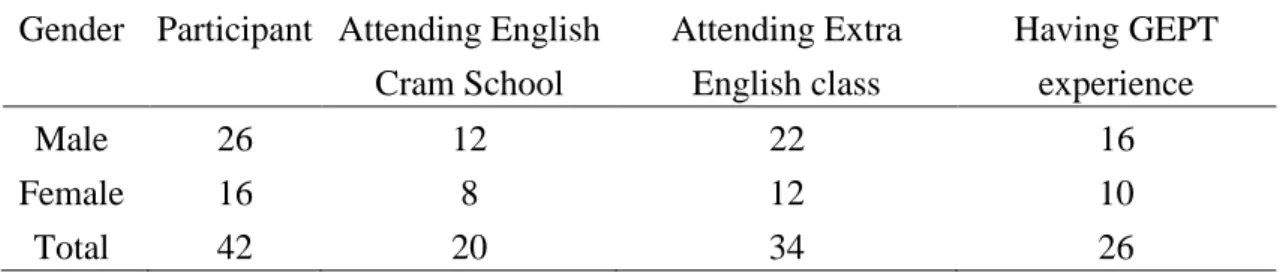
(34) GEPT and English learning experience during the break time. The research design procedures are showed in Table 1. Table 1 Research Design Procedures Sequence The first-half semester:. Instrument. At the beginning of the semester The simulative examination. Participant 46 45. At the beginning of the semester The first questionnaire of motivations Whole class and reading strategies During the semester. Classroom observations. Whole class. During the semester. A short interview. Whole class. During the semester. The reading material of the think-. 6. aloud task, and a reading quiz Around the end of the semester The college entrance examination. 45. Around the end of the semester The second questionnaire of. 43. motivations and reading strategies Total available samples:. 42. Participants Forty-six students (M = 29, F = 17) at their third grade from an intact class of a private senior high school in southern Taiwan were invited to participate in the current study. English was a compulsory subject for all the participants who had to take six hours of English courses every week in this semester. Among them, one student planned to study abroad and did not attend the college entrance examination. Besides, three students didn’t reply the second questionnaire. Therefore, 42 participants (M=26, F=16) were left available. The investigation in the first questionnaire learned that 26 students (62 per cent) had ever had GEPT experience and 34 students (81 per cent) attended extracurricular English class apart from the normal school curriculum. Besides, 20 students (48 per cent) went to English cram school to enhance their English ability (see. 23.
(35) Table 2). From the survey and further interviews, it also revealed that only one student had ever lived abroad. The girl had stayed with her parents for three months in Minnesota, U.S.A. when she was in the kindergarten. Moreover, she had lived with her family for six months in Singapore when she was at the second grade in a primary school, whereas her reading proficiency was intermediate (M-achiever). Of the 26 students who had GEPT experience, only eight received the certificate of GEPT Elementary level and two passed the initial test of GEPT Intermediate level. Table 2 Descriptive Statistics for 42 Subjects Gender Participant Attending English Cram School Male Female Total. 26 16 42. Attending Extra English class. Having GEPT experience. 22 12 34. 16 10 26. 12 8 20. Instruments In the following section, the pre- and post-questionnaires, the reading comprehension tests, and the reading material will be explained. Questionnaires The pre- and post-questionnaires consist of three sections (see Appendices C & D). The first part contains the students’ background information. The second part is comprised with 16 motivational items developed by He (2008) originating from Ames and Archer (1988). A permission to use the scale was sought and granted by professor He. Items A1 to A8 estimate the magnitude of Mastery goals while Items A9 to A16 estimate Performance goals. This 16 five-point Likert items range from Point 1 (very unlike me), Point 2 (unlike me), Point 3 (partly like me), Point 4 (be like me) to Point 5 (very like me). A higher point indicates a stronger tendency of mastery goals or stronger performance goals. The third part involves the survey of 21-item reading strategies 24.
(36) developed by Huang (2014) originating from Mokhtari and Sheorey (2002). This 21 five-point Likert items range from Point 1 (never), Point 2 (seldom), Point 3 (sometimes), Point 4 (usually) to Point 5 (always). A higher point indicates more frequency use of the reading strategy. Besides, the 21 items of reading strategies are grouped into three types: Global strategy category is estimated by nine items (B1, B2, B3, B6, B9, B14, B18, B19, B20); Problem-solving strategy category is measured by seven items (B4, B5, B7, B11, B13, B15, B17) and Support strategy category is assessed by five items (B8, B10, B12, B16, B21). Reading Comprehension Tests The first simulative examination of English subject was performed on summer vacation when some students didn’t attend the extra supplementary course. The second simulative examination of English subject, held in the beginning week of the semester, was also regarded as the pre-reading comprehension test for the current study (see Appendix E). The examination consisted of 56 items of multiple choices adding up to the score of 72, two items of translation from Chinese to English occupying the score of 8, and an at least 120-word composition sharing the score of 20. The researcher adopted the part of 56-item multiple choices as the assessment of participant students’ reading comprehension. The 56 items contained vocabulary score of 15, comprehensive test score of 15, cloze test score of 10, reading test score of 32. Moreover, the 42 students’ reading comprehension ability was classified into High-, Mid- and Low-levels according to the 56-item reading scores. The college entrance examination on English subject held around the end of this semester was regarded as the second reading comprehension test for this current study (see Appendix F). The structure of the examination was the same as the previous simulative examinations. In order to get the original score of 56 items of multiple. 25.
(37) choices (total score was 72), the researcher checked the Grade Comparison Table on English subject and learned the width of interval (6.28) and the limits of each class interval. The midpoint was calculated by the bottom score in each class interval plus 3.14. Then, the individual score of non-multiple-choice items (total score 28) was subtracted from each midpoint score. Therefore, the original score on the 56-item reading comprehension was figured out individually. The Reading Material The 187-word narrative passage was chosen from GEPT-Intermediate level simulation test in AMC English Digest in June, 2014 (see Appendix G). Because the six participants were respectively from High-, Mid- and Low-groups according to the first reading comprehension test, this prepared passage had a popular topic - an artist of silence, coherent contents, and moderate lexical items. Besides, the students were asked to do a quiz of four multiple-choice questions based on this passage after they completed the reading task. Classroom Observation The main items of the classroom observations (10 times) during five weeks are listed in Table 3. Table 3 Classroom Observations during English Reading Lessons The main items: 1.. Classroom management: proactive approaches to make students self-regulated. 2.. Classroom organization: teacher-fronted activities with whole-class work. 3.. Classroom interaction: curricula basically focus on grammar translation. 4.. The use of resources: textbook, workbook, exam exercise paper, supplementary teaching materials, CD, TV. 5.. Classroom instruction: conventional instruction without systematic strategy training, vocabulary expansion using definitions, synonyms, antonyms, analysis of word parts. 26.
(38) Data Collection and Analyses According to Merriam and Tisdell (2016), data analyses are the process of constructing meaning out of the collected data including inductive and deductive reasoning. In the quantitative research, the data were collected from the participants’ response to the pre- and post-questionnaires, their scores on the pre- and post-reading comprehension tests, and then the statistical software SPSS 20 was applied to compute and analyze the data. In the qualitative research, the data were collected from the six participants’ think-aloud transcripts, their quiz scores on the reading material, and the researcher’s observation note during their reading task. Then, the researcher integrated the findings for patterns, differences, and unique happenings (Liang, 1999; Merriam & Tisdell, 2016). The six participants’ background information is explicated in Table 4. Table 4 Six Participants’ Background Information Participant James Ann Leo Eva Tim Flora. Gender Male Female Male Female Male Female. Reading Ability High High Middle Middle Low Low. GEPT experience Intermediate initial test, passed Elementary level Elementary level No Elementary test, failed No. Reading Task: Think-aloud First, the six students were selected randomly from three levels of proficiency of 42 participants, two members each level. Then, they were informed of the purpose of this study in advance. After getting their parents’ agreement, they participated in the thinkaloud task. The reading task was held in a spare classroom, one at a time during their free time. At the beginning, the students scanned the passage, “Marcel Marceau”, consulted the problematic words or phrases with a dictionary, and then wrote down their Chinese meanings. The students’ own cellphone with an on-line dictionary was allowed.. 27.
(39) Moreover, the researcher audio-recorded the participants’ think-aloud translation of the passage by a cellphone. They were also asked to describe which reading strategies they adopted for each sentence during the reading task. Simultaneously, the researcher observed each student’s reading process and took notes. After completing the reading task, each participant was asked to do the quiz of four multiple-choice questions. Reliability and Trustworthiness To examine the reliability of achievement goals and reading strategy categories, the Cronbach’s alpha values were calculated by SPSS 20 based on both pre- and postquestionnaires. Besides, Pearson correlation coefficients were computed for paired preand post-reading scores as well as paired pre- and post-questionnaire scores. Then, correlations between achievement goals and reading strategy categories were computed. On the other hand, in order to persuade the readers that the findings of a study are valid and reliable, a well-organized study with appropriate techniques and the rigorous criteria in qualitative research are necessary. Internal validity involves the match in research findings and reality. Reliability concerns whether the results are consistent with the data collected. Triangulation is the famous strategy to support the internal validity and ensure consistency. Besides, member-check is an important way to identify whether the researcher’s analyses are biased (Merriam & Tisdell, 2016). Therefore, the researcher employed triangulation for the six volunteers, inquired their GEPT experience before the think-aloud task, observed their reading behavior in the thinkaloud task process, checked their questionnaires, quizzed their reading comprehension about the reading material, and analyzed their think-aloud transcripts. In addition to triangulation, member-check was utilized by giving the six participants their translated Chinese transcripts for confirmation. Besides, ethical consideration such as the right to privacy and the notion of informed consent was also taken into account in the study.. 28.
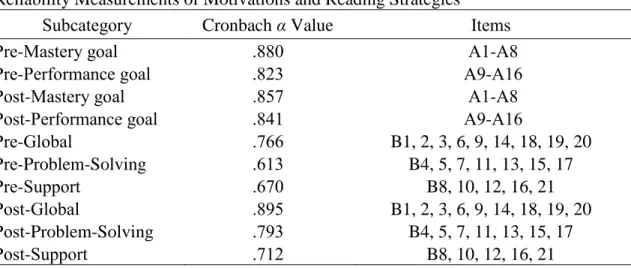
(40) CHAPTER FOUR RESULTS This chapter presents the findings of this study. First, the reliability of Cronbach’s alpha values and Pearson correlation coefficients is demonstrated. Next, the differences in achievement goals and reading strategy use among three levels of English achievers are explored. Third, the influence of the related factors on three levels of achievers’ achievement goals is detected. Fourth, the effects of the related factors on three levels of achievers’ reading strategy use are displayed. Fifth, a summary of the quantitative study is presented. Sixth, the individual students’ reading strategy use and achievement goals in their think-aloud task are probed. Seventh, a summary of the qualitative study is presented. Finally, the integrative discussion is examined. Reliability Cronbach’s Alpha Table 5 demonstrates that the values of Cronbach’s α on eight items of Mastery type and eight items of Performance type have high reliability in both pre- and postquestionnaires and that Cronbach’s α value of nine items of Global type, seven items of Problem-solving type, and five items of Support type also have moderate to high reliability in both pre- and post-questionnaires. Table 5 Reliability Measurements of Motivations and Reading Strategies Subcategory Cronbach α Value Items Pre-Mastery goal .880 A1-A8 Pre-Performance goal .823 A9-A16 Post-Mastery goal .857 A1-A8 Post-Performance goal .841 A9-A16 Pre-Global .766 B1, 2, 3, 6, 9, 14, 18, 19, 20 Pre-Problem-Solving .613 B4, 5, 7, 11, 13, 15, 17 Pre-Support .670 B8, 10, 12, 16, 21 Post-Global .895 B1, 2, 3, 6, 9, 14, 18, 19, 20 Post-Problem-Solving .793 B4, 5, 7, 11, 13, 15, 17 Post-Support .712 B8, 10, 12, 16, 21 29.
(41) Reliability Coefficients The figures in Table 6 show that Pearson correlation coefficients have high correlations between the pre- and post-reading scores (r = .79, p < .01) as well as all the other pre- and post-questionnaire scores (p < .01). In a word, their correlations are significant and positive. Table 6 Pearson Correlations between Pre- and Post-Scores PostPreN=42 M SD M Reading score. Pearson SD. r. p. 29.74. 11.92. 27.71. 9.63. .79. <.001**. Mastery. 3.62. .78. 3.46. .77. .54. <.001**. Performance. 3.60. .69. 3.62. .70. .44. .004**. Global. 3.88. .66. 3.71. .55. .63. <.001**. Problem-solving. 3.43. .74. 3.29. .59. .51. .001**. Support. 3.22. .71. 3.10. .66. .62. <.001**. **p < .01, two-tailed, *p < .05, two-tailed. The statistic figures in Table 7 show the Pearson correlation coefficients of three types of achievement goals with four types of reading strategy categories in both preand post-scores. Among the 24 correlation coefficients, 21 correlations are significantly and positively high except that pre-Performance goal with pre- Problem-solving category (r = .20), pre-Support category (r = .06), and pre-Overall category (r = .24), have lower Pearson correlation coefficients (p > .05).. 30.
(42) Table 7 Pearson Correlations between Motivations and Reading Strategies Pre-. Post-. Pre-. Mastery goals. Post-. Pre-. Performance goals. Post-. Achievement goals. Pre-Global. .65**. .31*. .62**. Pre-Problem-solving. .62**. .20. .54**. Pre-Support. .49**. .06. .37*. Pre-Overall strategy. .69**. .24. .60**. Post-Global. .62**. .36*. .63**. Post-Problem-solving. .48**. .49**. .61**. Post-Support. .59**. .37*. .61**. Post-Overall strategy. .63**. .45**. .69**. **p < .01, two-tailed, *p < .05, two-tailed. Achievement Goals and Reading Strategies between Three Levels of Achievers To answer the first research question if there are any significant differences in achievement goals and reading strategy use among High-, Mid-, and Low-achievers, the 42 participants were divided into three levels of reading proficiency according to their simulative examination in the beginning week of the semester. The learners who obtained the top one third scores were classified to be High (H)-achievers, the learners at the bottom one third scores to be Low (L)-achievers, and the rest to be Mid (M)achievers (see Table 8). Table 8 Descriptive Statistics for Three Levels of English Reading Achievers Low-achievers Mid-achievers High-achievers Numbers. Total. 13. 16. 13. 42. Range of scores. 14-22. 23-29. 30-58. 72. Average scores. 18.39. 26.31. 38.77. 27.71. The means and standard deviations for the 42 students’ Mastery, Performance and. 31.
(43) Achievement goal types based on their pre- and post-questionnaires are presented in Table 9. The figures show that High-achievers had higher scores than Mid-achievers, and M groups had higher scores than Low-achievers. The L-achievers seemed more performance-motivated than mastery-motivated either in the pre- or post-questionnaires, whereas the M- and H-achievers seemed more performance-motivated in the prequestionnaires but more mastery-motivated in the post-questionnaires. However, the results of paired sample t-tests in Table 10 reveal there were no significant mean differences between their Mastery and Performance goals whatever the groups were ( L-, M- or H-achievers), whether in pre- or post-questionnaires ( L group: t(12) < +2.179 or > -2.179, p > .05, M group: t(15) < +2.131 or > -2.131, p > .05, H group: t(12) < +2.179 or > -2.179, p > .05). On the other hand, the means of all Mastery and Performance goals are over 3.46 on a five-point scale for total 42 students, which indicates the students were with upper-intermediate achievement goals. Table 9 Means and Standard Deviations for Achievement Goal Types Motivation. Low-achievers. Mid-achievers. High-achievers. Total. n=13. n=16. n=13. N=42. types M. SD. M. SD. M. SD. M. SD. Pre-Mastery. 3.07. .51. 3.56. .63. 3.73. 1.01. 3.46. .77. Pre-Performance. 3.36. .54. 3.73. .69. 3.76. .81. 3.62. .70. Pre-Achievement. 3.21. .35. 3.64. .46. 3.75. .77. 3.54. .58. Post-Mastery. 3.11. .67. 3.58. .67. 4.17. .67. 3.62. .78. Post-Performance. 3.28. .67. 3.51. .57. 4.04. .66. 3.60. .69. Post-Achievement. 3.19. .37. 3.54. .47. 4.11. .54. 3.61. .58. 32.
數據
相關文件
To provide suggestions on how to implement Reading and Writing across the Curriculum (R/WaC) in the school English Language curriculum; and.. To share experiences on implementing
help students develop the reading skills and strategies necessary for understanding and analysing language use in English texts (e.g. text structures and
reading scheme, cross-curricular projects and RaC, etc.) in consideration of the pedagogy and connection with the curriculum of English Language from the case study of exemplars
reading scheme, cross-curricular projects and RaC, etc.) in consideration of the pedagogy and connection with the curriculum of English Language from the case study of exemplars
For example, the teacher librarians teach students reading strategies while English and Chinese language subject teachers provide reading materials for students to
Reading and discussion task: Read the descriptors for Level 4 under ‘Content’ in the marking criteria and identify areas for guiding the students to set their goals for the
Expecting students engage with a different level of language in their work e.g?. student A needs to label the diagram, and student B needs to
Making use of the Learning Progression Framework (LPF) for Reading in the design of post- reading activities to help students develop reading skills and strategies that support their
