Inspection of magnetic semiconductor and clustering structure in
CoFe-doped ZnO films by bias-dependent impedance spectroscopy
J. C. A. Huang
Department of Physics, National Cheng Kung University, Tainan, Taiwan, Republic of China and Department of Applied Physics, National University of Kaohsiung, Kaohsiung, Taiwan, Republic of China H. S. Hsu
Department of Physics, National Cheng Kung University, Tainan, Taiwan, Republic of China 共Received 20 April 2005; accepted 2 August 2005; published online 23 September 2005兲
Diluted magnetic semiconductor and cluster dominated structure of CoFe-doped ZnO films have been systematically investigated by bias-dependent impedance spectroscopy. The complex impedance spectroscopy of 5 mol % CoFe-doped ZnO film can be fitted by an equivalent circuit employing two sets of parallel resistance共R兲 and capacitance 共C兲 components in series, representing the oxide grain and grain boundary contribution, respectively. For 10 mol % CoFe-doped ZnO film, a third RC component together with a single resistance element, which are likely due to the presence of metal clusters and metal-oxide interface, have to be taken into account to fit the impedance spectroscopy. By applying a dc bias of 0⬃1.5 V, the relaxation contribution from different structural origin can be clearly identified. The bias-dependent impedance spectroscopy demonstrates significant sensitivity to the formation of CoFe clusters in ZnO. © 2005 American Institute of Physics. 关DOI:10.1063/1.2058211兴
Diluted magnetic semiconductors 共DMSs兲 have been of much interest and extensively studied since the theoretical investigations of room temperature 共RT兲 ferromagnetism in transition-metal共TM兲 doped oxides and semiconductors. In particular, II-VI-based magnetic semiconductors such as TM-doped ZnO has been investigated as a promising DMS for implementing spintronic and opto-spintronic device.1–3A key work to realize a good DMS structure is to suppress the formation of magnetic clusters. It is noted that the magnetic clusters in host materials are often difficult to detect by struc-tural measurement such as x-ray diffraction because of the size of the clusters being down to nanometer or even subna-nometer scale. Transmission electron microscopy共TEM兲 and x-ray absorption fine structure共XAFS兲 are the more persua-sive techniques,4–6 but they are time-consuming or require synchrotron radiation light source. Techniques such as temperature-dependent transport behavior and magnetization measurements have also been employed to study the
forma-tion of magnetic clusters in doped oxides and
semiconductors.7,8However, the origin of ferromagnetism in these materials remains a very controversial topic.
The impedance spectroscopy, the frequency response of the electrical properties, can provide evidence to identify re-laxation mechanisms due to grains, grain boundaries, or macroscopic heterogeneities by equivalent circuit analysis.9–11 In this Letter, we demonstrate that the bias-dependent impedance spectroscopy is a sensitive technique to distinguish a DMS dominated structure from a clustering phase. Samples with clustering phase show contributions from clusters and metal-oxide interfaces. This technique opens a new and simple route to identify the formation of metal clusters doped in host oxides.
CoFe 共5 mol %兲 and CoFe 共10 mol %兲-doped ZnO films of about 500 Å were prepared by ion-beam sputtering from two separate targets. The samples were grown on sap-phire 共0001兲 substrates at room temperature. The magnetic properties were probed by a commercial superconducting
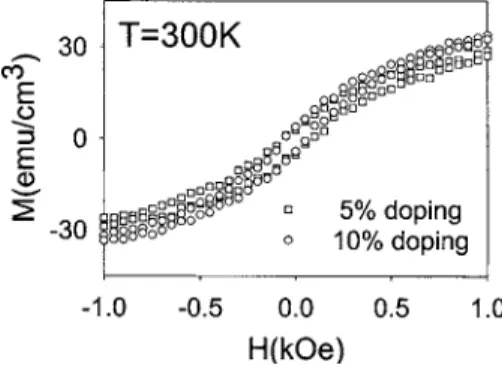
quantum interference device共SQUID兲. Figure 1 displays the magnetic hysteresis loops at 300 K for the CoFe共5%兲- and CoFe共10%兲-doped ZnO films. Although both samples yield similar RT ferromagnetism by SQUID and bulk structure by x-ray diffraction共not shown here兲, they show distinct com-plex impedance spectra owing to distinct microstructure as described in the following.
The complex impedance spectroscopy was carried out by Hewlett Packard 4294 A impedance analyzer using two-point contact in a frequency range from 500 Hz to 110 MHz with a fixed oscillating voltage 500 mV under dc bias volt-age Vdc from 0 to 1.5 V. The real and imaginary parts of complex impedance, Z共f兲=R共f兲+iX共f兲, as a function of fre-quency for the 5% and 10% doped samples are shown in Fig. 2共a兲. For both samples, the real part of the complex imped-ance initially remain almost at a certain constant, follows by a down step in the frequency range of 104to 107Hz. In con-trast, the imaginary part of the impedance shows a character-istic peak at a frequency of about 105Hz. This characteristic peak shifts toward lower frequency as the CoFe doping con-centration increased from 5% to 10%. The variation of the characteristic peak of X共f兲 is attributed to different type of
FIG. 1. Magnetization of the CoFe共5%兲- and CoFe 共10%兲-doped ZnO films as a function of applied field at 300 K.
APPLIED PHYSICS LETTERS 87, 132503共2005兲
0003-6951/2005/87共13兲/132503/3/$22.50 87, 132503-1 © 2005 American Institute of Physics Downloaded 30 Sep 2009 to 140.116.208.53. Redistribution subject to AIP license or copyright; see http://apl.aip.org/apl/copyright.jsp
electrical relaxation as discussed below. Figure 2共b兲 shows the Cole–Cole plot, i.e., −X共f兲 versus R共f兲, of the CoFe 5% and 10% doped samples in normalized log–log scale. For comparison, we show the Cole–Cole plot in linear scale in the inset of Fig. 2共b兲. For the CoFe 共5%兲 doped sample, the characteristic slope of 0.5 in log scale关Fig. 2共b兲兴 in the low frequency regime corresponds to the curvature a semicircle in linear scale关inset of Fig. 2共b兲兴, which obeys single grain-boundary relaxation mechanism.12 In contrast, for the CoFe 共10%兲 doped sample, the corresponding characteristic slope is about 0.7关Fig. 2共b兲兴, implying that more than one grain-boundary-like relaxation mechanism appears in this case. The results provide an insight into the modeling of electrical relaxation mechanism of the two samples, which in turn re-veal the variation of their micro-structural origins even though they display similar magnetic hysteresis loops and bulk structure.
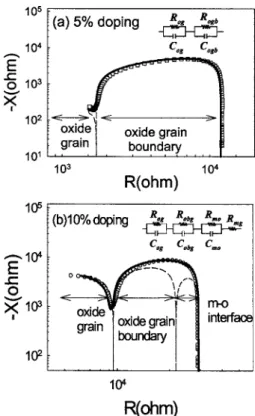
The equivalent circuit composed of resistance 共R兲 and capacitance共C兲 elements has been utilized in analysis of the measured ac impedance spectra. For the CoFe 共5%兲-doped ZnO sample, two sets of parallel RC components in series 关as illustrated in Fig. 3共a兲兴, have been employed to model the complex impedance spectra
Z = R + iX =共1/Rogb+ iCogb兲−1+共1/Rog+ iCog兲−1, 共1兲 where Rogband Cogbrepresent the resistance and capacitance of the oxide grain boundary contribution dominated in the low frequency regime, and Rog and Cog represent the oxide grain interior contribution dominated in the high frequency regime, respectively. The solid curve in Fig. 3共a兲 is obtained by the best fit关i.e., superposition of the two dash curves in Fig. 3共a兲 from Eq. 共1兲兴 of the experimental data, which re-veals good agreement of the theoretical model with the im-pedance spectrum.
In contrast, Eq.共1兲 fails to fit the impedance spectra data for the CoFe共10%兲-doped ZnO sample unless a third set of parallel RC element in the low frequency regime together
with a single resistance element are also taken into account, as illustrated in Fig. 3共b兲. Indeed, the single resistance 共Rmg兲 element indicates the formation of CoFe clusters and the third RC component共Rmoand Cmo兲 suggests the existence of another interfacial electrical effect, likely resulting from the interfaces between the metal clusters and the host oxide. Therefore, an equivalent circuit model for the 10% doped sample can be expressed as
Z = R + iX = Rmg+共1/Rmo+ iCmo兲−1+共1/Rogb
+ iCogb兲−1+共1/Rog+ iCog兲−1, 共2兲 where Rmg stands for metallic grain resistance and Rmoand
Cmorepresent the RC contribution from metal cluster-oxide interfaces, respectively. It is noticed that Rmg共in the order of 101– 102⍀兲 is smaller compared with R
mo, Rogband Rog共in the order of 103– 104⍀兲. Thus, R
mgcontributes much less to the overall of complex impedance. In addition, the relaxation time 共= RC兲 is an intrinsic characteristic property of the materials and is independent of the sample geometry. Owing to the distinct RC contributions, the oxide grain, oxide grain boundary, and metal-oxide interface show different relax-ation time constants. Hence, the contribution from various RC components can be clearly identified by frequency-dependent impedance spectroscopy. For convenience of the readers, the values of the fitting time constants for the CoFe 5% and 10% doped samples are summarized in Table I.
It is expected that the grain interior exhibit faster relax-ation behavior than grain boundary for semiconducting ma-terials such as zinc oxide. For CoFe 5% and 10% doped ZnO films, the time constants due to oxide grain og are in the order of 10−13– 10−12sec, as fitted by the above equivalent circuit models. Another mechanism with relatively slower FIG. 2. 共a兲 The complex impedance spectra of the CoFe 共5%兲- and CoFe
共10%兲-doped ZnO films as a function of frequency. 共b兲 The Cole–Cole plots of the two samples in normalized log-log scale. Inset of共b兲 shows the Cole–Cole diagrams of the two samples in linear scale.
FIG. 3. The Cole–Cole plots of the共a兲 CoFe 共5%兲-doped and 共b兲 CoFe 共10%兲-doped ZnO films. The experimental data 共open symbols兲 are best fitted by the equivalent circuit equations共solid curves兲. The dash curves describe the contribution from the oxide grain, grain boundary and metal cluster-oxide interfaces.
132503-2 J. C. A. Huang and H. S. Hsu Appl. Phys. Lett. 87, 132503共2005兲
relaxation is attributed to the presence of oxide grain bound-ary. For both samples, the time constants due to oxide grain boundaryogb are in the order of 1⫻10−9 sec. The assign-ment of the oxide grain interior and oxide grain boundary contribution is consistent with the “brick-layer” model for polycrystals.13 The third electrical process appears in CoFe 10% doped sample with slowest relaxation 共mo⬃4 ⫻10−9sec兲 is likely associated with metal cluster-oxide con-tacts. To explore and identify possible relaxation mecha-nisms, an additional dc bias voltage共Vdc兲 has been adopted to measure the impedance spectra.
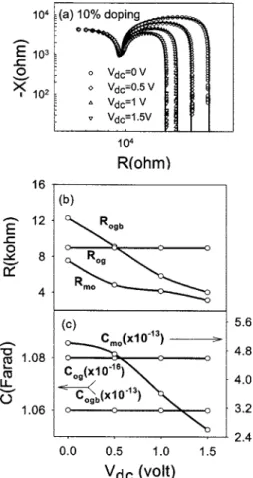
Excellent agreement of the equivalent circuit models and experiments has been confirmed with Vdc from 0 to 1.5 V. For example, Fig. 4共a兲 shows the bias dependent impedance spectra for the CoFe 10% doped sample. The results can be well described by Eq.共2兲, as illustrated by the solid curves in Fig. 4共a兲. For clarity, the R and C fitting parameters are plot-ted as a function of Vdc, as shown in Figs. 4共b兲 and 4共c兲, respectively. In contrast to the invariance of Rog contributed by the oxide grain interior, both Rogband Rmodecrease with
increasing Vdc. This is reasonable because the oxide grain boundary and metal-oxide interfaces generally contain some defects, which in turn result in the trap states of carriers. The trap states can provide conducting channels when carriers are injected from an electrode. The decrease of Rogb and Rmo with increasing Vdccan be related to the increase of conduct-ing channels because of the provision of more injected car-riers. On the other hand, Cog and Cogb remain almost un-changed with the increase of Vdc, while Cmo decreases monotonically with increasing Vdc from 0 to 1.5 V. The in-dependence of Cog and Cogbon Vdc suggests that the oxide grain and grain boundary still effectively act as simple ca-pacitors in spite of the increase of injected carriers by addi-tional dc bias. In contrast, the decrease of Cmowith increas-ing Vdc implies the existence of depletion-region-like Schottky barriers in metal cluster-oxide interfaces, due likely to the interfacial polarization effect.
Similar RC-Vdcbehavior using the Eq.共1兲 has also been obtained for the 5% doped sample. The appearance of Rmo and Cmofor the 10% doped sample confirms the formation of Schottky barriers caused by metallic cluster-oxide interfaces which is, however, absent for the 5% doped sample. The results are also in good agreement with the XAFS measure-ments to correlate the radial distribution functions with the presence of any magnetic clusters. For the 10% doped sample, the average size of the clusters is about 1 nm, as estimated from the fitting of magnetization-temperature curve.14The bias-dependent impedance spectroscopy, there-fore, demonstrates significant sensitivity to the formation of CoFe clusters in ZnO. We conclude that this technique can be applied to inspect the formation of metallic clusters in transition metal doped oxide or semiconductor systems.
This work has been supported by the National Science Council of the ROC under Grant No. NSC 94-2120-M-006-008 and Micro-Nano Technology Research Center of Na-tional Cheng Kung University under Grant No. H93-A930. The authors would like to give thanks to Professor Y. H. Lee, Professor S. Y. Chu, and Mr. P. C. Kao for kindly assistance of using the impedance analyzer.
1S. J. Pearton, C. R. Abernathy, D. P. Norton, A. F. Hebard, Y. D. Park, L. A. Boatner, and J. D. Budai, Mater. Sci. Eng., R. 40, 137共2003兲. 2M. Venkatesan, C. B. Fitzgerald, J. G. Lunney, and J. M. D. Coey, Phys.
Rev. Lett. 93, 177206共2004兲.
3S. Ramachandran, Ashutosh Tiwari, and J. Narayan, Appl. Phys. Lett. 84, 5255共2004兲.
4S. A. Chambers, T. Droubay, C. M. Wang, A. S. Lea, R. F. C. Farrow, L. Folks, V. Deline, and S. Anders, Appl. Phys. Lett. 82, 1257共2003兲. 5J. H. Park, M. G. Kim, H. M. Jang, S. Ryu, and Y. M. Kim, Appl. Phys.
Lett. 84, 1338共2004兲.
6J. C. A. Huang, H. S. Hsu, Y. M. Hu, C. H. Lee, Y. H. Huang, and M. Z. Lin, Appl. Phys. Lett. 85, 3815共2004兲.
7R. J. Kennedy, P. A. Stampe, E. Hu, P. Xiong, S. V. Molnár, and Y. Xin, Appl. Phys. Lett. 84, 2832共2004兲.
8A. Punnoose, M. S. Seehra, W. K. Park, and J. S. Moodera, J. Appl. Phys.
93, 7867共2003兲.
9A. K. Jonscher, Nature共London兲 264, 673 共1977兲.
10A. Pelaiz-Barranco, M. P. Gutierrez-Amador, A. Huanosta, and R. Valen-zuela, Appl. Phys. Lett. 73, 2039共1998兲.
11J. C. A. Huang and C. Y. Hsu, Appl. Phys. Lett. 85, 5947共2004兲. 12A. K. Jonscher, Dielectric Relaxation in Solids共Chelaea Dielectrics,
Lon-don, 1983兲, p. 85.
13J. R. Macdonald, Impedance Spectroscopy Emphasizing Solid Materials
and Systems共Wiley, New York, 1987兲, Chap. 4.
14See, for example, the analyzing procedures described in Ref. 6. TABLE I. Fitting results of the time constants for the CoFe共x兲-doped ZnO
films.
x og共s兲 ogb共s兲 mo共s兲
5% 1.43⫻10−13 9.34⫻10−10 … 10% 9.54⫻10−13 1.30⫻10−9 3.78⫻10−9
FIG. 4. 共a兲 The Cole–Cole plots for the CoFe 共10%兲-doped ZnO films at various dc bias voltages共open circles兲 and fitting results 共solid curves兲. The variations of the fitting parameters for共b兲 resistance and 共c兲 capacitance as a function of the dc bias voltage. The lines in共b兲 and 共c兲 are guiding to the eyes.
132503-3 J. C. A. Huang and H. S. Hsu Appl. Phys. Lett. 87, 132503共2005兲