Research Express@NCKU - Articles Digest
1 of 4
Research Express@NCKU Volume 22 Issue 5 - June 8, 2012 [ http://research.ncku.edu.tw/re/articles/e/20120608/3.html ]
Highly Efficient Quantum-Dot-Sensitized Solar Cell
Based on Co-sensitization of CdS/CdSe
Yuh-Lang Lee
*and Yi-Siou Lo
Department of Chemical Engineering, College of Engineering, National Cheng Kung University [email protected]
Adv. Funct. Mater.,19, (2009) p604-609
I
ntroductionDye-Sensitized solar cells (DSSCs) are considered to be alternative to conventional solid-state solar cells recently due to the low production cost and high efficiency1. In this present, semiconductor quantum dots (QDs) were utlitized as the inorganic dye and assembled onto mesoporous TiO2 film by chemical bath deposition for solar cell application.
Results and discussion
Figure 1 shows the UV-Vis spectrum of various TiO2/QDs, for the composite sensitizer (CdS/CdSe and CdSe/CdS), it indicate co-sensitization effect of CdS and CdSe can clearly be observed by the extending of absorption range and the increase of absorbance, representing CdS and CdSe possess the comp on light harvesting. Using both of CdS and CdSe quantum dot might enhance QD-SSCs performance. Table 1
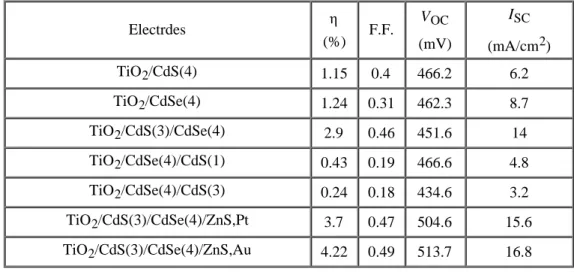
The open circuit potential (VOC), short circuit current (ISC), fill factor (FF), and the total energy conversion efficiency (η) of QD-SSC prepared with the different QDs, CBD layer, QDs assembled order and cell structure are listed in Table 1.
The efficiencies measured for the CdSe- and CdS-sensitized cells are 1.24% and 1.15%, respectively. The higher efficiency of former is attributed to its broader light-absorption range which leads to a higher ISC (8.7 mA/cm2) compared with that of the CdS-sensitized device (6.2 mA/cm2). On the other hand, the FF of the CdSe-DSSC is smaller than that of CdS-DSSC, probably due to the low driving force for the electron injection. To decipher the co-sensitization effect of CdS and CdSe QDs in the cascade structure, the incident photon to current conversion efficiencies (IPCE), measured from the ISC monitored at different excitation wavelengths, are shown in Figure 2 for various devices. In general, the IPCE spectra of CdS- and CdSe-sensitized devices are consistent with the corresponding UV-vis spectra shown in Figure 1. IPCE values over than 50% can be achieved by the TiO2/CdS device, but the values obtained by the TiO2/CdSe device are only about 30%. This result indicates that excited electrons
Research Express@NCKU - Articles Digest
2 of 4
Figure 1. UV-vis absorption spectra of a bare TiO2 film and TiO2 films sensitized by various QDs.
Figure 2. IPCE measured as a function of wavelength for QD-DSSCs prepared using various QD-sensitized TiO2 electrodes.
Table 1. Parameters obtained from the I-V curves of QD-DSSCs using various electrodes.
Electrdes η (%) F.F. VOC (mV) ISC (mA/cm2) TiO2/CdS(4) 1.15 0.4 466.2 6.2 TiO2/CdSe(4) 1.24 0.31 462.3 8.7 TiO2/CdS(3)/CdSe(4) 2.9 0.46 451.6 14 TiO2/CdSe(4)/CdS(1) 0.43 0.19 466.6 4.8 TiO2/CdSe(4)/CdS(3) 0.24 0.18 434.6 3.2 TiO2/CdS(3)/CdSe(4)/ZnS,Pt 3.7 0.47 504.6 15.6 TiO2/CdS(3)/CdSe(4)/ZnS,Au 4.22 0.49 513.7 16.8
in CdS QD can inject more efficiently, than those in CdSe, into TiO2 and collected by the electrode. When CdSe is deposited on a CdS-coated electrode, TiO2/CdS/CdSe, a much higher IPCE is obtained compared to both of CdS- and CdSe- sensitized devices. In the short-wavelength region (< 500 nm) where both CdS and CdSe are photoactive, the increment of IPCE due to the introduction of CdSe can partially be attributed to
the contribution of CdSe in the light harvest. This result also implies that the presence of CdS between TiO2 and CdSe doesn’t inhibit the transport of excited electrons from CdSe to TiO2. On the other hand, when CdS is deposited on TiO2/CdSe, the IPCE of the TiO2/CdSe/CdS device is lower than that of
TiO2/CdSe and TiO2/CdS devices, which means that introduction a CdSe layer between TiO2 and CdS is detrimental to the transport of excitons and, therefore, the co-sensitization effect cannot be achieved.
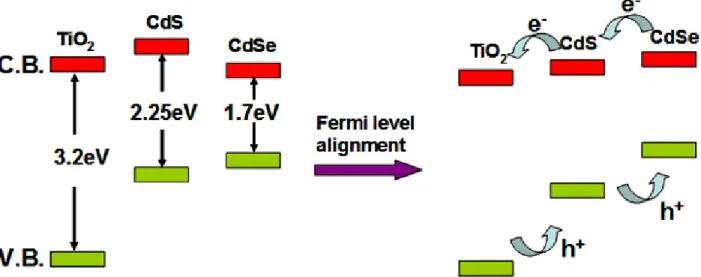
The band edges of TiO2, CdS, and CdSe in bulk are schematically shown in Figure 3a. After alignment of the Fermi level at the CdS/CdSe interface, the related
Research Express@NCKU - Articles Digest
3 of 4
Figure 3. Relative energy levels of TiO2, CdS, and CdSe before (a), and after Fermi level alignment (b).
band edges for the TiO2/CdS/CdSe device is inferred to be a stepwise structure as shown in Figures 3b. Both the lower edge of the conduction band and upper edge of the valence band increase in the order: TiO2 < CdS < CdSe. That is, the insertion of a CdS layer between TiO2 and CdSe elevates the conduction band edge of CdSe, giving a higher driving force for the injection of excited electrons out of CdSe layer. This is the reason why a higher IPCE was obtained for the TiO2/CdS/CdSe device in the long-wavelength region, compared with the TiO2/CdSe device. When both CdS and CdSe are photoexcited under white light illumination, the stepwise structure of the band-edge level is advantageous not only to the electron injection but also to the hole-recovery for both the inner CdS and outer CdSe layers. On the contrary, in the TiO2/CdSe/CdS device, the conduction and valence band edges of intermediate CdSe will be higher respected to those of CdS. In such an energy structure, energy barriers exist for injecting an excited electron from outer CdS layer and transferring a hole out of inner CdSe, which causes a low IPCE of the TiO2/CdSe/CdS device.
Due to ZnS could be used as a passivation layer to protect QD materials from photocorrosion. In this work, ZnS is coated on the TiO2/CdS(3)/CdSe(4) photoelectrode for improving the performance of the device. The related I-V characteristics are list in Table 1. Compared with the device without ZnS, the ISC, VOC and FF increase due to the introduction of ZnS. Therefore, the efficiency (η) increases from 2.90 % to 3.70%.
In the previous studies on DSSC, Pt-coated FTO (or ITO) substrates were commonly used as counter electrodes due to the stability and catalytic activity of Pt for I2 reduction. However, the cyclic voltammetric (CV) measurement indicates the S-modified Au(111) electrode has a higher activity than S-modified Pt(111) surface. Based on this result, by using an Au counter electrode to assemble the QD-DSSC, ISC, VOC and FF were increased in comparison with the device using Pt counter electrode. Therefore, the efficiency (η) increases from 3.70 to 4.22 %.
Reference
Research Express@NCKU - Articles Digest