行政院國家科學委員會專題研究計畫 期中進度報告
慢性 B 型肝炎患者接受 adefovir dipivoxil 或 entecavir 長期治療後,B 型肝炎病毒的基因序列變化與抗藥性的相關
性(1/2)
計畫類別: 個別型計畫
計畫編號: NSC93-2314-B-006-090-
執行期間: 93 年 08 月 01 日至 94 年 07 月 31 日 執行單位: 國立成功大學分子醫學研究所
計畫主持人: 張定宗 共同主持人: 楊孔嘉
計畫參與人員: 劉紋君,吳毅晉
報告類型: 精簡報告
處理方式: 本計畫可公開查詢
中 華 民 國 94 年 5 月 25 日
行政院國家科學委員會補助專題研究計畫
□ 成 果 報 告
□期中進度報告
(計畫名稱)
慢性B 型肝炎患者接受adefovir dipivoxil 或entecavir 長期治療後,B 型肝炎病毒 的基因序列變化與抗藥性的相關性
The relationship between the significant changes of hepatitis B virus sequence and drug resistance in patients with prolonged adefovir dipivoxil and entecavir treatment
計畫類別:■ 個別型計畫 □ 整合型計畫 計畫編號:NSC 93-2314-B-006-090-
執行期間: 93 年 08 月 01 日至 95 年 07 月 31 日
計畫主持人:張定宗 共同主持人:楊孔嘉
計畫參與人員: 劉紋君、吳毅晉
成果報告類型(依經費核定清單規定繳交):■精簡報告□完整報告
本成果報告包括以下應繳交之附件:
□赴國外出差或研習心得報告一份
□赴大陸地區出差或研習心得報告一份
□出席國際學術會議心得報告及發表之論文各一份
□國際合作研究計畫國外研究報告書一份
處理方式:除產學合作研究計畫、提升產業技術及人才培育研究計 畫、列管計畫及下列情形者外,得立即公開查詢
□涉及專利或其他智慧財產權,□一年□二年後可公開查詢 執行單位:成功大學醫學院分子醫學研究所
中 華 民 國 2005 年 05 月 26 日
慢性B 型肝炎患者接受adefovir dipivoxil 或entecavir 長期治療後,B 型肝炎病毒 的基因序列變化與抗藥性的相關性
The relationship between the significant changes of hepatitis B virus sequence and drug resistance in patients with prolonged adefovir dipivoxil and entecavir treatment
一、中文摘要:
關鍵詞:病毒突破、抗藥性突變株、自然病程、病毒穩定型、病毒清除型、病毒起 伏型
此計畫的目的是針對長期服用抗病毒藥物如adefovir dipivoxil或entecavir的慢性B型 肝炎病人,找出新的抗藥性病毒株的表現;了解用藥過程中,病毒突變的情況及可 能機制,進一步評估抗藥性病毒與其複製效率的相關情形。我們已完成 23 位曾接 受lamivudine治療產生抗藥性病毒株的患者的血清收集及相關檢測,這些病人已服 用entecavir至少 1 年。我們將這些長期服用entecavir未能治癒的病人分為三組,第一 組為用藥至少半年後發生B型肝炎病毒急劇上升 1 log10 以上(breakthrough)的病 人;第二組為用藥後B型肝炎病毒量維持高濃度(HBV DNA>106 copies/ml)且下降幅
度小於 2 log的病人;第三組為用藥後B型肝炎病毒量下降幅度大於 2 log卻仍未能清
除的病人。針對這三組病人不同時間點的B型肝炎病毒,以PCR及定序方式做病毒 全長 3.2kb的基因序列分析及比較。結果顯示第二組的病人,其核苷酸序列在HBV P 基因有 1.6%突變率,在S基因有 1.7%突變率,在C基因有 4.7%突變率以及X基因有 2.8%突變率,相較於其他兩組的突變率明顯偏高。各組病人的HBV核苷酸變化比 較,統計上顯示有若干核苷酸有特殊不同的變化。此外我們也進一步分析未用藥自 然病程病人在病程中病毒序列變化以及突變率的觀察,自然病程之病人也依據病毒 動態分類為三組,Stationary pattern、Declining pattern以及Wavering pattern。分析結 果發現,第一組的病人抽血第一點病毒(baseline)至最後一點抽血日之病毒(endpoint) 的基因體序列全長每日平均突變率是 0.0000335;第二組的病毒基因體序列全長每 日平均突變率是 0.0000744;第三組的病毒基因體序列全長每日平均突變率是 0.0000805,第一組病毒序列的突變率明顯低於其他兩組。由此可知病毒的突變率 高,容易導致宿主的發炎反應,屬於Declining 或Wavering 病程表現;病毒的突變 率低,不易引發免疫反應,病毒的起伏亦不大,屬於Stationary的病程。
二、英文摘要
Keywords:Viral breakthrough、drug resistance mutants、natural course、Stationary pattern、Declining pattern、Wavering pattern
Antiviral drugs of hepatitis B virus (HBV) are classified into immunomodulating agent and nucleoside analogous. Adefovir dipivoxil and entecavir, as nucleoside analogous, can efficiently inhibit HBV replication and demonstrate superior antiviral activity for patients failing lamivudine. However, some patients are unresponsive to these drugs. The aim of this study is to investigate the emergence and characteristics of new HBV mutants resistant to adefovir dipivoxil or entecavir which the patients have taken for a long period.
Twenty-three patients who failed at least 24-week lamivudine treatment had drug resistant viruses and took entecavir for at least 1 year (the majority for 3 years). However, some patients still failed to the entecavir treatment. We classified patients unresponsive to entecavir into three groups. The first group includes patients who received these antiviral drugs at least half year and got HBV DNA breakthrough with increase of viral titer more than 1 log. The second group includes patients whose HBV DNA was still high (HBV DNA>106 copies/m) and its reduction was less than 2 log. The third group includes patients whose HBV DNA reduction was more than 2 log but still higher than 106 copies/ml. HBV full length genomic sequencing and comparison at different time points before and during the treatment will be determined for these 3 groups. From another patient of the second group with entecavir treatment, preliminary results showed 41nt (1.6%) mutation at P gene, 17nt (1.7%) at S gene, 30nt(4.7%) at C gene and 13nt(2.8%) at X gene. The significant mutation will be further investigated for its drug resistance in HepG2 cell lines with HBV expressed baculovirus infection. On the other hand, we also analyze the viral mutation rate and sequence variation in natural course patients. These patients were classified into stationary pattern, declining pattern and wavering pattern.
We analyze the viral sequences in baseline and endpoint to count the mutation rate between the two time points and point out the sequence specificity. In the results, we indicate the mutation rate of viral full length is 0.0000335 in stationary pattern;the mutation rate of viral full length is 0.0000744 declining pattern;the mutation rate of viral full length is 0.0000805 in wavering pattern. The mutation rate is much lower in
stationary pattern than the other two patterns.
三、研究計畫之背景與目的
Treatment of chronic hepatitis B is directed at interrupting the natural history by suppressing HBV replication before development of any significant irreversible liver damage. Effective antiviral therapies should be followed by suppression of HBV-DNA, normalization of transaminase levels, and a durable HBeAg seroconversion to anti-HBeAg antibody. Two major classes of antiviral therapies are immunomodulating agents (i.e. interferon alpha) and nucleoside analogues. Lamivudine, as one of the nucleoside analogues, efficiently suppresses HBV replication, ameliorates disease, and improves liver histology. However, the development of lamivudine resistance mutations within the YMDD motif of the hepatitis B virus polymerase occurs in 14%~32% of the patients after 1 year of therapy. The prevalence of these mutants increases with time, 67%
of the patients are infected with lamivudine-resistance mutants after 4 years treatment1.
The other two nucleoside analogous, adefovir dipivoxil and entecavir have recently been shown to have potent anti-HBV activity superior to lamivudine, yet the incidence of adefovir resistant mutation at weeks 48, 96 and 144 became 0%, 3.0% and 5.9%, respectively2. On the other hand, a clear dose-response relationship was observed for entecavir with higher dose showing greater viral suppression. The proposed mechanism of action of entecavir is competitive inhibition with dGTP, chain termination and inhibition of first strand synthesis. Until now no report investigated any mutation related with drug resistance. Interestingly, some of our patients failed to the entecavir prolonged treatment. The aim of this study is to investigate the emergence and characteristics of new HBV mutants resistant to entecavir which the patients have taken for a long period. HBV full length genomic sequencing before and during antiviral treatment will be determined in patients who had breakthrough of serum HBV DNA. HBV full length can be amplified by PCR and detected by ABI 310 sequencer with ten primers. After getting the HBV sequences, the data are imported into software for analysis. This study may illustrate possible mechanism of drug resistance and provide further information for the development of new treatment.
On the other hand, we also analyze the mutation rate of hepatitis B virus genome in natural course patients from baseline to endpoint. The patients can be classified into three
patterns. HBV full length genomic sequencing from baseline to endpoint will be determined in patients. HBV full length can be amplified by PCR and detected by ABI 310 sequencer with ten primers. After getting the HBV sequences, the data are also imported into software for analysis. We will analyze the mutation rate per day and identify the significant HBV mutants comparing with patterns. By the way, we can point out the similarities and dissimilarities of chronic hepatitis B progresses between patients with drug and natural course patients. We also will understand the role of drugs in the progresses and think about viral kinetic following the full course of disease.
四、結果
Patients had viral breakthrough during long term entecavir treatment
We have found that 8 patients still failed to the entecavir prolonged treatment. Some are unresponsive to Entecavir treatment and some have viral breakthrough during the prolonged treatment (Fig.1).
HBV sequence and amino acid differences during breakthrough of serum HBV DNA or elevation of serum ALT with entecavir therapy
The significant changes of HBV nucleotide and protein sequences from the serum of seven of eight patients who failed to the entecavir prolonged treatment were indicated.
Some mutation, such as rtG256S, rhK151R, xG66A, xT66A and xV127I, happen in three groups after breakthrough which may relate with drug resistance or HBV replication efficiency and even some strains may be the resistant mutant originally. There are four significant sites, which may specifically correlated with the drug resistance among the nucleotide changes and amino acids changes during the different stage of entecavir treatment (from baseline to VL1, from VL1 to VP1). Comparing group1 and group3, the sequential changes of serum ALT and HBV DNA levels with entecavir indicate that the group1 got HBV DNA breakthrough with increase of viral titer more than 1 log and the group3 kept stable HBV DNA levels but were not clearness. In addition, the three peptide sites at tp95,sp48 and rt222 have different expression between group1 and group3. The tp95Y, sp48S/L and rt222T may be the important sites correlated with HBV breakthrough resulting from drug resistance or induce HBV replication rate (Fig2). The mutation rate at HBV four genes randomly expression. The group2 which includes patients whose HBV DNA was still high (HBV DNA>106 copies/ml) and its reduction was less than 2 log has
higher mutation rate than group1 and group2. However, no significant difference is between group1 and group2 (Fig3).
The identification of the three patterns of natural course patients
In order to analyze the mutation rate of hepatitis B virus genome in natural course patients from baseline to endpoint, we classified the patients into three patterns. The Xi means initial HBV DNA;the Xm means the first minimal HBV DNA;the Xp means the maximal HBV DNA before Xm; the Xq means the maximal HBV DNA after Xm. The pattern1, stationary pattern, means “log(Xp/Xm)≦1.5 and log(Xq/Xm)≦1.5 ; the pattern2, declining pattern, means”log(Xi/Xm)>1 and log(Xp/Xm)>1.5 and log(Xq/Xm)≦1.5” ; the pattern3, wavering pattern, means”log(Xq/Xm)>1.5 or log(X1/Xm)≦1 and log(Xp/Xm)>1.5 and log(Xq/Xm)≦1.5”(Fig4.)
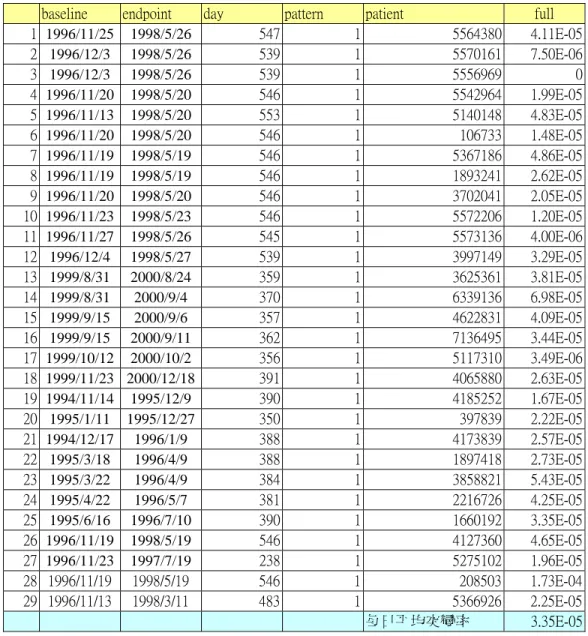
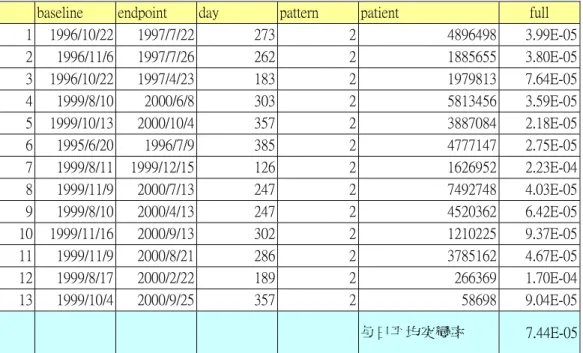
The mutation rate of HBV genome patients from baseline to endpoint in natural course According to the mutation rate of HBV genome sequence comparing with three patterns from baseline to endpoint, the mutation rate per day of the full length HBV sequence in stationary pattern is 0.0000335(table1.). The mutation rate per day of the full length HBV sequence in declining pattern is 0.0000744 (table2.)and in wavering pattern is 0.0000805(table3.). The mutation rate of pattern1 is significant lower than the other two patterns.
五、討論與未來工作
The tp95Y, sp48S/L and rt222T may be the important sites correlated with HBV breakthrough resulting from drug resistance or induce HBV replication rate. Then we will construct the HBV expressed baculovirus modle with the three sites to investigated the correlation between the mutant and drug resistance or HBV replication efficiency. This study may illustrate possible mechanism of drug resistance and provide further information for the development of new treatment.
On the other hand, the patients can be classified into three patterns in natural course patients. We analyze the mutation rate per day and identify the significant HBV mutants comparing with patterns. According to the mutation rate of HBV genome sequence comparing with three patterns from baseline to endpoint, the mutation rate of pattern1 is significant lower than the other two patterns. The higher the mutation rate is, the more
immune response induces. The Declining and Wavering patterns with high mutation rate in HBV sequence in the progresses of disease may result from immune selection. By the way, we can point out the similarities and dissimilarities of chronic hepatitis B progresses between patients with drug and natural course patients. We also will understand the role of drugs in the progresses and think about viral kinetic following the full course of disease. In the future, we will define the significant distinction of HBV nucleotide and amino acid sequences among the three patterns and further probe into the association and correlation between the HBV sequences and viral kinetic progresses.
Fig2. The significant changes at HBV genomes comparing group 1 and group3 or genotype B and genotype C strains (tp:terminal protein, rt: reverse transcriptase, rh: RNase H, sp: spacer of polymerase)
Fig3. The mutation percentage of HBV four genes comparing entecavir naïve point and highest point after breakthrough during entecavir treatment
Fig4. The three patterns of the natural course patients. (A) stationary pattern;(B) declining pattern;(C) wavering pattern.
-3 -2 -1 0 1 2 3 4 5 6 7 8 9 10 11
0 2 4 6 8 10 12 14 16 18 20
追蹤月數
Bil ALT HBeAg HBeAb HBV DNA Chiron PCR
(C) Xp
Xm Xq Xf
-3 -2 -1 0 1 2 3 4 5 6 7 8 9 10 11
0 2 4 6 8 10 12 14 16 18 20
追蹤月數
Bil ALT HBeAG HBeAb HBV DNA Chiron PCR
(A)
-3 -2 -1 0 1 2 3 4 5 6 7 8 9 10
0 2 4 6 8 10 12 14
追蹤月數
Bil ALT HBeAg HBeAb HBV DNA Abbott
(B)Xi Xp Xm
Xi Xf Xf
Table 1. the mutation rate of HBV sequences from baseline to endpoint in stationary pattern patients (pattern1)
baseline endpoint day pattern patient full
1 1996/11/25 1998/5/26 547 1 5564380 4.11E-05
2 1996/12/3 1998/5/26 539 1 5570161 7.50E-06
3 1996/12/3 1998/5/26 539 1 5556969 0
4 1996/11/20 1998/5/20 546 1 5542964 1.99E-05
5 1996/11/13 1998/5/20 553 1 5140148 4.83E-05
6 1996/11/20 1998/5/20 546 1 106733 1.48E-05
7 1996/11/19 1998/5/19 546 1 5367186 4.86E-05
8 1996/11/19 1998/5/19 546 1 1893241 2.62E-05
9 1996/11/20 1998/5/20 546 1 3702041 2.05E-05
10 1996/11/23 1998/5/23 546 1 5572206 1.20E-05
11 1996/11/27 1998/5/26 545 1 5573136 4.00E-06
12 1996/12/4 1998/5/27 539 1 3997149 3.29E-05
13 1999/8/31 2000/8/24 359 1 3625361 3.81E-05
14 1999/8/31 2000/9/4 370 1 6339136 6.98E-05
15 1999/9/15 2000/9/6 357 1 4622831 4.09E-05
16 1999/9/15 2000/9/11 362 1 7136495 3.44E-05
17 1999/10/12 2000/10/2 356 1 5117310 3.49E-06
18 1999/11/23 2000/12/18 391 1 4065880 2.63E-05
19 1994/11/14 1995/12/9 390 1 4185252 1.67E-05
20 1995/1/11 1995/12/27 350 1 397839 2.22E-05
21 1994/12/17 1996/1/9 388 1 4173839 2.57E-05
22 1995/3/18 1996/4/9 388 1 1897418 2.73E-05
23 1995/3/22 1996/4/9 384 1 3858821 5.43E-05
24 1995/4/22 1996/5/7 381 1 2216726 4.25E-05
25 1995/6/16 1996/7/10 390 1 1660192 3.35E-05
26 1996/11/19 1998/5/19 546 1 4127360 4.65E-05
27 1996/11/23 1997/7/19 238 1 5275102 1.96E-05
28 1996/11/19 1998/5/19 546 1 208503 1.73E-04
29 1996/11/13 1998/3/11 483 1 5366926 2.25E-05
每日平均突變率 3.35E-05
Table 2. the mutation rate of HBV sequences from baseline to endpoint in pattern2 patients
baseline endpoint day pattern patient full
1 1996/10/22 1997/7/22 273 2 4896498 3.99E-05
2 1996/11/6 1997/7/26 262 2 1885655 3.80E-05
3 1996/10/22 1997/4/23 183 2 1979813 7.64E-05
4 1999/8/10 2000/6/8 303 2 5813456 3.59E-05
5 1999/10/13 2000/10/4 357 2 3887084 2.18E-05
6 1995/6/20 1996/7/9 385 2 4777147 2.75E-05
7 1999/8/11 1999/12/15 126 2 1626952 2.23E-04
8 1999/11/9 2000/7/13 247 2 7492748 4.03E-05
9 1999/8/10 2000/4/13 247 2 4520362 6.42E-05
10 1999/11/16 2000/9/13 302 2 1210225 9.37E-05
11 1999/11/9 2000/8/21 286 2 3785162 4.67E-05
12 1999/8/17 2000/2/22 189 2 266369 1.70E-04
13 1999/10/4 2000/9/25 357 2 58698 9.04E-05
每日平均突變率 7.44E-05
Table 3. the mutation rate of HBV sequences from baseline to endpoint in pattern3 patients
baseline endpoint day pattern patient full
1 1996/11/20 1997/12/10 385 3 4726843 5.97E-05
2 1996/11/27 1998/3/4 462 3 75975 2.29E-05
3 1996/11/19 1999/3/17 848 3 2837829 1.17E-05
4 1996/11/6 1997/12/17 406 3 4952080 2.07E-04
5 1996/11/6 1997/12/17 406 3 4191499 2.04E-04
6 1996/11/5 1997/12/27 417 3 4680545 1.79E-05
7 1996/10/16 1998/1/21 462 3 2946850 9.69E-05
8 1996/11/19 1998/2/24 462 3 5284592 4.91E-05
9 1999/9/6 2000/9/4 364 3 7251032 6.83E-05
10 1995/3/4 1995/12/30 301 3 371107 3.51E-05
11 1995/3/31 1996/1/31 306 3 4458407 1.14E-04
每日平均突變率 8.05E-05
六、參考文獻
1 Liaw YF. Management of YMDD mutations during lamivudine therapy in patients with chronic hepatitis B. J Gastroenterol Hepatol 2002 Dec;17 Suppl 3:S333-S337
2 Marcellin P. Advances in therapy for chronic hepatitis B. Semin Liver Dis 2002;22 Suppl 1:33-6
七、計畫成果自評
This research had pointed out the mutation site of HBV in patients with entecavir treatment successfully and finished the studies of this plan in the first years. On the other hand, we had also compared the HBV sequences in the patients with entecavir and natural course patients to count the mutation rate and indicate significant nucleotide and amino acid sequences in the different patterns classified by viral kinetic. Therefor, we will use cell model to prove which mutation site in HBV is correlated with drug resistance and we will also observe the quality and quantity of variation of HBV sequence by sequence analysis and statistics analysis to reflex the regulation between host and virus.