Human Rights Council
Working Group on the Universal Periodic Review Eighteenth session
27 January – 7 February 2014
National report submitted in accordance with paragraph 5 of the annex to Human Rights Council resolution 16/21
*Eritrea
* The present document has been reproduced as received. Its content does not imply the expression of any opinion whatsoever on the part of the Secretariat of the United Nations.
General Assembly
Distr.: General 8 November 2013 Original: EnglishContents
Paragraphs Page I. Background ... 1–3 3 II. Methodology and consultation process ... 4 3 III. Legal and institutional framework ... 5–9 4 IV. Key national priorities ... 10 5 V. Progress on recommendations ... 11–90 6 A. Rights of the child (Recommendations 25, 42, 73–78) ... 11–24 6 B. Gender equality, FGM and domestic violence ... 25–41 9 C. Detention center, torture and involuntary disappearance ... 42–49 13 D. Poverty eradication and Millennium Development Goals ... 50–81 14 E. Follow up on UPR process ... 82 19 F. Technical assistance ... 83 19 G. Implementation of the constitution and the establishment of independent body 84 19 H. Invitation to Human Rights Special Procedures ... 85 20 I. Cooperation with Special Procedures and UN Treaty Bodies ... 86 20 J. Right to life, physical integrity and security ... 87–88 20 K. Enforced and involuntary disappearance ... 89 21 L. Accession to conventions... 90 21 VI. Challenges, constraints best practices and achievements ... 91–102 21 A. Challenges ... 91–93 21 B. Constraints ... 94–95 22 C. Best practice ... 96–102 22
I. Background
1. The human rights performance of the State of Eritrea was reviewed on 30 November 2009 and finally adopted in March 2010 by the Working Group under the UN Universal Periodic Review mechanism. The review attracted quite a number of States that participated in the interactive dialogue. The key human rights concerns and issues raised during the review revolved around the following: ( )general recommendations and conventions that require accession or ratification; (ii) gender equality, (iii) female genital mutilation, (iv) domestic and sexual violence against women; v) rights of the child; vi) millennium development goals; vii) poverty eradication; viii) implementation of the Eritrean constitution; ix) establishment of an independent human rights body; xii) follow up on UPR recommendations and technical assistance; x) detention conditions, torture and involuntary disappearance; xi) the right to life; xii) cooperation with the group on enforced and involuntary disappearance; and xiii) invitation to special procedures of the Human Rights Council.
The content and basis of the report
2. This report highlights the methodology, consultation process, as well as the legal and institutional frameworks that have been put in place for the promotion and protection of human rights in Eritrea. It also presents the achievements, best practices, constraints, challenges, and the progress made during the reporting time on the accepted recommendations. The basis for this report are as follows: (i) Resolutions 60/251, 5/1 of the Institution Building; (ii) the recommendations that the Government of the State Eritrea voluntarily accepted during the first cycle; (iii) human rights related conventions and declarations to which the State of Eritrea is a party ; and best practices that are slated for emulation and benchmarking. This second National Report is submitted in accordance with the Human Rights Council Resolutions 16/21, and paragraph 5 of the Annex to Resolution 5/1 of the Institution Building.
The portfolio of human rights coordination
3. The responsibility to promote and protect human rights falls under all concerned government stakeholder ministries and departments. Nonetheless, the portfolio of coordinating the activities and the collection of interim progress reports at a national level was vested in the Ministry of Foreign Affairs. The Eritrean delegation that presented +the 2009 report were mandated to coordinate the follow-up of the recommendations as well as joint drafting of this report. Several rounds of consultations at both national and sub- national levels were undertaken in the drafting of the report under the guidance of the Minister of Foreign Affairs. The delegation worked with various stakeholders involved in the promotion and protection of Human rights and fundamental freedoms in the society to produce this report. The Delegation was also mandated to attend the sessions of the United Nations Human Rights Council, the African Human and Peoples’ Rights Commission and other related fora with the aim of sharing experiences on the subject matter.
II. Methodology and consultation process
4. Broader participation and higher responsibility were ensured in the development of the Second UPR Report. A Steering Committee chaired by the Ministry of Foreign Affairs was established. The Committee is composed of representatives from the following ministries: Foreign Affairs; Justice; Labor and Human Welfare; National Development;
Education; Health as well as the National Security Agency. Other sectoral ministries
provided information to the committee as requested. Civil Society organizations such as the National Unions of Youth and Students, Women, Workers were also represented on the committee. Meetings were held with all concerned bodies. Additional inputs from the UN Country Team in Eritrea were also accommodated in the report.
III. Legal and institutional framework
New legislations enacted since 2009
5. The Judiciary Branch of the State of Eritrea is drafting new Codes that will substitute the Transitional Codes of Eritrea. The drafting process is at its final stage.
Eritrea’s international obligations are naturally taken into account in drafting the new codes. Inputs from sectoral ministries and, especially the Ministry of Foreign Affairs, have been solicited in the efforts of harmonizing domestic law with international commitments of the State of Eritrea. Furthermore, the GOSE has adopted the following new legislations as highlighted below.
1. Water Proclamation No. 162/2010
6. The right to life is inseparably linked with access to basic necessities and services such as food and water. The Government issued Water Proclamation No. 162/2010 to reinforce the promotion and protection of the citizens’ basic social and economic rights.
Article 4(1) of this Proclamation clearly stipulates that all water resources in the country are the common property of the people of Eritrea and the State shall regulate them to ensure their management in a balanced and sustainable manner. Article 5(1) further provides that any person shall have the right to use water resources in compliance with the provisions of the Proclamation. The scarcity of water resources within the context of Eritrea both in quantitative and qualitative terms is the driving force behind this timely law. The State is duty-bound to ensure that every citizen accesses clean and safe water. Furthermore, the legislation also takes into consideration issues of affordability and rights of economically disadvantaged communities to access water. In this vein, the GOE has put in place schemes to subsidize the costs associated with the provision of basic water services for the disadvantaged segments of society (Article 20(2)).
2. Proclamation No. 170/2012 to Establish the Eritrean Crops and Livestock Corporation
7. Proclamation No. 170/2012 was issued to strengthen the national policy on food security with the ultimate objective of ensuring and increasing access to food at the household level. This provision is predicated on enhancing and securing the basic right to food.
3. Proclamation No.173/2013 to privatize State Owned Enterprises
8. In 2012 and 2013, several laws were enacted to privatize and transform state-owned enterprises into share companies. The objective was to liberalize trade. This was done in tandem with the relaxation of guidelines on foreign currency control. It is expected that these laws will boost trade and investment, thus alleviating poverty and improving the standard of living. The laws will further contribute to a more fair distribution of national resources and encourage the economic participation of citizens at home and abroad through increased investment in the home country.
4. Proclamations No. 166/2012, 167/2012, 168/2012 and Legal Notice No. 120/2012 9. These legislations were promulgated by the government in 2012 with the aim of enhancing access to and better delivery of justice. The amendments encompass appropriate changes in the jurisdiction of courts; refinement of the procedural laws as well as the introduction of new laws of more effective enforcement. The cumulative effect and objectives of the said proclamations are:
(a) The adjudication of minor civil litigations by Community Courts enhances people’s access to justice with less cost. The new arrangement allows citizens to have access to judicial services within their vicinity resulting in less expenses and energy. The types of cases that have been assigned to community courts are those which have social character and that can best be solved at the community level.
(b) The new laws and guidelines of enforcement ensure that the delivery of justice is swift thereby augmenting the overall efficiency and effectiveness of the judicial system.
(c) Independent and accountable judicial services: the new laws have introduced more stringent procedures and rules to hold the judicial and prosecutorial personnel more accountable for their functions and responsibilities.
(d) More importantly, the new legislation will bridge the acute shortage of qualified legal professionals that the judiciary is experiencing. It also reduces the financial resources needed to expand and provide qualitative judicial services.
IV. Key national priorities
10. Human Rights issues have cardinal importance to the Government of Eritrea. In this vein, Government key national priorities are geared towards creating and enhancing the conducive environment for its citizens to exercise their fundamental human rights in the broadest definition of the term. The GoSE’s unequivocal commitment to achieve this goal must naturally be gauged with the enormous challenges that it has to grapple with. In this context, the GoSE has been pursuing the following key priorities:
(a) Safeguarding the sovereign rights, territorial integrity, and political independence of the State and people of Eritrea from flagrant violation, aggression, occupation, unwarranted sanctions, and belligerent stances of hostile powers;
(b) Effecting social justice by ascertaining universal or wide access to food security, health, education, infrastructural facilities as well as the reduction of rural/urban disparity and the construction of roads, dams, building of schools and health centers and hospitals throughout the country within the framework of balanced and even development;
(c) Human resource development: As the centerpiece to development, human capital has been and remains a matter of high priority to the Government of Eritrea. In this connection, the GOE has long embarked on various programmes that bolster human dignity, human security and human development. Access to free education up to the tertiary level; the provision of health services at highly subsidized cost, regular budgetary allocations for the upkeep of disadvantaged segments and groups of society; and various activities that preserve the cultural heritage, customs and traditions of the society are all geared towards; and
(d) Environmental Protection: A number of +environmental protection laws have been enacted. Among other things, the Government has put in place guidelines for environmental assessment and protection against pollution in the mining sector in accordance with international standards.
V. Progress on recommendations
A. Rights of the Child (Recommendations 25, 42, 73–78)
11. All human rights treaties require time for implementation and progress is generally incremental. In this context, the current report only provides an update on measures taking during the reporting period on the rights and welfare of children.
1. Promoting the human dignity of children
12. The policies and strategies of the GOE on the protection and promotion of the dignity of children emanates from the deep-rooted Eritrean culture that favours the children’s right to develop to their fullest potential, and an embedded culture that caters to their special needs.. The GOE views the family as the primary social institution crucial for the overall development of the child. During the period under review, efforts were made to:
(i) strengthen the family unit to provide a better environment for the growth and development of children; (ii) empower communities to coordinate and promote good childcare and appropriate socialization practices; (iii) create favourable grounds for orphans to remain within their communities; and (iv) strengthen the coping mechanisms of caretaking families through income-generating support. In short, various activities were implemented to empower families through community-based interventions such as the Community Based Reunification Program of orphans. A more detailed exposition on these aspects are found in Eritrea’s 2011 fourth periodic report for the Convention on the Rights of the Child (CRC) as well as subsequent reports of the State of Eritrea.
(a) Community Based Orphan Reunification Programme
13. The Government has reintegrated orphans in extended families to enhance the provision of care and protection in a family environment. During the reporting period, over 4,646 orphans, including AIDS orphans, were integrated with their relatives. Economic support in the form of cash grants for income generating activities and school materials for children were provided to 1,565 care-taking families. During the reporting period, 45 children were placed for adoption with volunteer families. In addition, 140 orphans were accommodated in 12 group homes in order to receive the necessary social support. 343 orphans are also hosted in institutions managed by the Government and NGOs. However, the government is acutely aware of the need for greater outreach of these schemes in order to render support to more beneficiaries.
(b) Protection of street children
14. During the last three years, about 3,978 disadvantaged street children were assisted annually with school materials to pursue their education and to prevent them from drifting back into the streets. Similarly, about 3,940 disadvantaged children were provided annually with cash grants for school uniforms and textbooks. 424 children from poor families that dropped out from school were provided with various types of vocational skills training programs appropriate to their age. These include carpentry, leather works, electrical and auto mechanic skills. Each trainee was also supported with protective gears, cash allowances and insurance fees. Private and government owned enterprises are participating in these schemes. The scaling up of this initiative will require the collective efforts of all stakeholders.
2. Child education
15. The Government considers education as a fundamental human right. As such, all children, irrespective of their ethnicity, language, sex, religion, disability and other status, are entitled to mandatory educational access and opportunities. This includes refugee children who have access to educational opportunities in Eritrea. In this regard, the government has made the provision of free basic education compulsory for all school age children. The education system of Eritrea is directed at the promotion and development of the child’s personality, talents and mental and physical abilities to their fullest potential.
(a) Pre-primary schooling
16. Pre-primary schooling is an integral part of the basic education system for children up to the age of six years. Pre-school is provided in a comprehensive and integrated learning program for two years and known as the Kindergarten and Program of Integrated Rural Community Care Services (RCCS). The pre-school curriculum emphasizes the foundations of language skills as well as the social relationships for holistic development of the child. Mother tongue is the medium of instruction at this level. The government continues to make efforts to expand access to pre-school education giving much attention to rural and remote areas. The statistical information of the Ministry of Education (MoE) indicates that total enrolment at the pre-primary education has increased by 29 percent in the academic year 2011/12 as compared to 2007/2008. The Government however, realizes that there is a lot to be done in the early childhood education.
(b) Elementary level education
17. Elementary level education comprises of grades 1–5 for children whose ages range from 7–11 years. As indicated in the educational policy of Eritrea, mother tongue is the medium of instruction at this level. The main purpose of elementary education is to give children a firm grounding in basic essential learning skills. Its general objective is to have all children complete with at least minimum learning achievement. The total Gross Enrolment Ratio (GER) at this level was 99 percent in 2011/2012 academic year. This represents a significant increase when compared to the academic year 2007/2008 which was 77 percent. The total net enrolment ratio was 58 percent during 2007/2008.
(c) Middle School Education
18. Middle school education is the end of the basic education cycle in the Eritrean education system. This level consists of 3 years of schooling from grades 6–8 for age groups of 11–13. English is the medium of instruction at this level. The Gross Enrolment Ratio showed modest increase from 65 percent to 68 percent from the year 2007/2008 to 2011/2012. However, the Net Enrolment Ratio (NER) increased at a higher rate than the GER which in 2007/2008 academic years stood at 39.8 percent for male and 32.2 percent for female students. In the year 2011/2012, this increased to 40 percent for male and 37 percent for female students.
(d) Secondary education
19. Secondary education prepares learners for further education and/or for the work force. Moreover, it encompasses related practical studies that are correlated with and have relevance to the individual learner’s interests and national development needs. The MoE’s essential indicators for 2011/2012 illustrate that the total GER was 34percent. This is slightly higher than the rate for the academic year 2007/2008 which stood at 32 percent.
Female GER was 28 percent and 27 percent respectively for the stated time of reporting.
The total NER, however, declined by one percent (from 23 to 22 percent) during the
reporting period. Female NER nonetheless showed a slight increase from 19.2 percent to 19.8 percent.
(e) Special needs education (inclusive education)
20. The GOE recognizes that children with special needs deserve special attention, protection and assistance. There are three schools currently operational to cater for children with special needs. These are one government school for blind children and two non- governmental schools for the deaf. In the academic year 2011/2012, a total of 176 students enrolled in these three schools out of which 43 percent were female students. However, the Government provides support, in terms of curricula development, capacity building and other technical issues. Those who complete their education in these specialized elementary schools are routinely enrolled in the regular middle schools. Recently, the Government established twenty five pilot schools for children with special needs located across the country. These schools are equipped with basic equipment and pedagogic resource rooms where additional support is given to children with learning difficulties. Government’s long term strategy is to provide inclusive education in all schools, with the active involvement of communities.
(f) Complementary Elementary Education (CEE)
21. This program, which was initiated in the 2011/2012 academic year, caters to school- age children in rural and remote areas who were out of school for different reasons. The program is provided for children aged 9-14. Total enrollment in the academic year stood at 6,829; 65 percent were female students. This program was conducted in 68 centers in rural and remote areas of the country with the help of 581 facilitators; 18 percent were females.
Those who complete the three year CEE program transfer to the next level within the regular school system.
(g) Physically/mentally impaired children (children with special needs)
22. In Eritrea, there are four associations for persons with disabilities: namely, the National Patriotic Association for the Disabled Persons, the Eritrean Association for the Blind, the Association for the Deaf and the National Association of Autism and Down Syndrome. These associations play complementary role in the improvement of the quality of life of Children with Disabilities (CWD), and in sensitizing families and communities about their special needs, including love and affection that are essential for their self- esteem.
3. Child labor
23. Eritrea acceded to the ILO Convention on the Minimum Age for Work in 1999.
Domestic laws have been harmonized to conform to the principles enshrined in the (CRC).
The Eritrean Labor Proclamation No.118/2001 limited minimum age for admission to employment at 14 years. The Proclamation also prohibits enforcing of contracts against people below the age of 18 years. The Government has introduced a regulation to ensure that a person below the age of 18 years cannot be engaged in an occupation that jeopardizes his/her physical, mental, spiritual, moral or social development. The Labor proclamation addresses many basic, work related, rights starting from hiring and firing of employees.
4. Administration of juvenile justice
24. The Government has taken modest steps to improve the protection of children in conflict with the law. It has established a probation service providing counseling and integrating children in conflict with the law into schools and neighborhoods after their release. Judicial cases for children in conflict with the law are heard in closed chambers
separate from adult offenders. However, separate correctional facilities are not yet to in place. The Government provides facilities to ensure that a child who is detained or imprisoned is separated from adults in their place of detention. The Eritrean laws prohibit the use of torture, inhuman or degrading treatment of punishment against any person, including children who are detained.
B. Gender equality, FGM and domestic violence
1. General introduction
25. As duly reflected in the first Report, female empowerment and other rights of women were one of the strongest sides of Eritrea’s liberation struggle. This legacy coupled with the policies pursued thereafter, has greatly improved the social standing of women. In the post-independence period, the Government complemented the achievements of the liberation struggle with relevant statutory laws. As it happens, the political and economic rights of Eritrean women are explicitly guaranteed and enshrined in the Eritrean Constitution and other pertinent laws in force; including the Transitional Civil Code, the Transitional Penal Code, the Land Proclamation, the Election of Regional Assemblies Proclamation and the Proclamation to Abolish Female Circumcision. During the reporting period, the following activities were undertaken by the Government in its drive to fulfill its ideals and objectives.
26. Given the importance of gender in poverty reduction, Eritrea has gone a long way towards achieving gender equity. The Government is committed to promoting gender equality, as enshrined in the Constitution, and is making efforts to ensure women‘s empowerment. According to the 2009 Human Development Report, 22 percent of seats in parliament in Eritrea were held by women and 18 percent of the Ministers are women.
Despite all the challenges, Eritrea is likely to achieve the MDG 3 on gender equality.
(a) Economic Empowerment
27. The Government cannot afford to marginalize women as they constitute about half of the population. Therefore, the steady and purposeful amelioration of the economic status of women has remained one of the main preoccupations of the Government. During the reporting time, the Government implemented various economic empowerment programs including micro credit schemes. Beneficiaries of this program are displaced women returnees, demobilized fighters and other women-headed households. At a cost of about 103,335,640:00 Nakfa (690,000 USD); 15,591 vulnerable women were provided in the past year with start-up credit for small commercial enterprises such as mini-shops, household poultry, farming and vegetable gardening. This is about 50 percent increase from 2008.
28. This project has been providing women from rural areas with wheeled cart-tankers with donkeys to ferry water. The project has several fold goals of alleviating the burden of women in fetching potable water from long distances on their backs. It frees up time for young girls, who are often tasked with this chore, thereby encouraging parents to send their girls to school, and provides them with income generating means through the sale of water.
In 2012 alone, some 4,919 women from remote areas were beneficiaries of this project. In 2012 alone, 19,813 women benefited from the project.
(b) Vocational training
29. The Government has implemented vocational training programmes to produce semi- skilled and skilled workers. The chief aim is to create opportunities for gainful employment and economic growth. The National Center for Vocational Training and six other technical schools spread throughout the country are providing the training for students. In the
2011/2012 academic year, a total of 4,640 students were enrolled out of which 38 percent were female students.
30. Non-formal skills development and training is also implemented to help create self- employment and income generation. There is one major informal skill development center that has traditionally provided apprenticeship targeted at the informal sector of the economy. Girls and other disadvantaged groups are encouraged to participate in this type of training. In this framework, the NUEW provides handicraft training such as tailoring and embroidery, weaving and basketry whose popularity could be gauged by the 10 percent increase of enrolment every year especially since 2008.
(c) Adult and continuing education
31. The MoE provides literacy and post-literacy programs, and continuing education and training opportunities. In the academic year 2011/2012, 52, 747 adults participated in adult literacy programs in 947 centers with the help of 2,311 facilitators. Women constituted 95 percent of the participants.
(d) Girls’ education
32. Government believes that education in general and education of girls in particular is a prerequisite for sustainable social, political and economic development. In line with Government policy, the participation, retention, and achievement of girls as well as women have been a priority in the education system. Much effort has been made to bridge the gender gap in education and to enhance the quality of girls’ education. This is based on the right approach, which is in line with the Convention for the Elimination of All Forms of Discrimination against Women (CEDAW). The National Union of Eritrean Women has also presented the 4th CEDAW Report during this reporting period. The focus is on enhancing girls’ education in-terms of access, quality and achievement. This is expected to contribute significantly to the achievement of the MDGs and Education for All (EFA) Goals on girls’ education and empowering women in the long run. Some of the interventions made by the MoE during the last five years on Girls’ Education are outlined below:
• Additional lessons were provided in some schools to female students in English and mathematics.
• Material incentives such as donkey and household utensils as well as cash were provided to female students in rural and remote areas to encourage them to learn and to reduce the burden of their house hold chores.
• Female students who traveled long distances to school were also provided with bicycles.
• In rural areas, new middle and secondary schools were constructed as near as possible to villages, with additional aim of retaining female students. In 2010/2011, 42 elementary, 48 middle, and 8 secondary schools were opened.
• Frequent meetings and campaigns were conducted with parents, in villages and remote rural areas, on sending their girls to school.
• Financial awards were given every year at the national level to role model female teachers.
• Boarding schools have been opened in various parts of the country to help girls in rural and remote areas.
33. As a result, girls and women are achieving parity with male students in the teaching- learning process, hence narrowing the gender-gap in all aspects of developmental issues.
The information on girls’ education indicates that during the period 2011/2012, the gender parity index at the pre-primary, elementary, middle and secondary levels were 49, 45, 44, and 43 percent respectively.
(f) Women workers
34. NCEW is instrumental in ensuring fundamental workers’ right in the work place.
Some of the main objectives of NCEW are to promote the national economy and development through which social and economic interest and justice are achieved and workers’ rights are ensured. The encouragement and promotion of female participation in the development of trade skills and equal pay for equal work is considered for gender equity and women’s health and safety.
35. Article 41 (1) of Labor proclamation explicitly provides for an employer to pay equal starting wages for the same type of work without discrimination on grounds of gender. Furthermore, Article 65 (1) stipulates that women may not be discriminated against in regard to any opportunity or treatment in employment and remuneration on the basis of their sex. This specific clause is not enshrined in the international Convention but emanates from cherished values and practices that were nurtured during the long struggle of independence. The equal treatment of both sexes and disadvantaged groups is, indeed, deeply entrenched in the Eritrean societal values and morals.
(g) Female Genital Mutilation (FGM)
36. This practice has been deeply rooted in the cultural and religious beliefs of some communities and thus a significant number of young girls had been affected. To confront this formidable challenge, the Government outlawed this practice by Proclamation 158/2007. The Proclamation has been a milestone toward banning the practice of FGM/C.
Indeed, government bodies in collaboration with other stakeholders have been intensifying anti-FGM/C campaigns. Sensitization seminars have taken place in villages and towns; not to mention the big cities that are densely populated. In addition, heavy penalty is imposed on those who perform FGM/C and their collaborators. The Government believes that these campaigns will, among others, contribute in curbing the harmful traditional practice of FGM/C. Radio, television and newspapers, as the main media outlets; conduct frequent information dissemination on the rights of the child and against the practices of early marriage as well as on harmful traditional practices. The Government has also launched concrete programs aimed at engaging the previous FGM practitioners into alternative means of livelihood and source of income. Despite meager resources, the government has integrated FGM/C into reproductive health program. About 7,200 mothers were reached during anti-natal and post-natal care services.
Figure 1: FGM/C rate for all women, under 15 and under 5 year girls
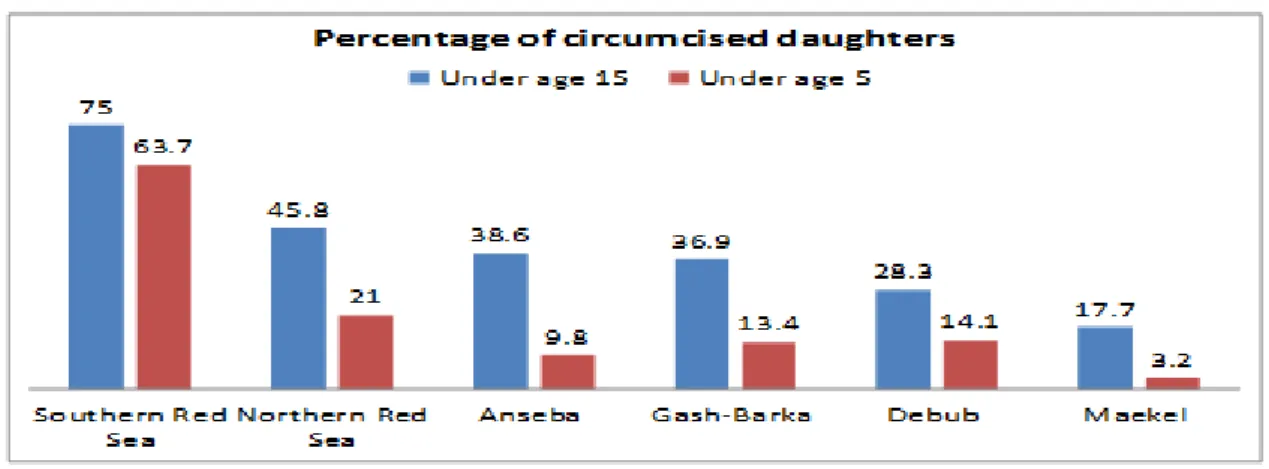
37. According to figure 2, in the Southern and Northern Red Sea regions, circumcision of girls under the age of 5 remains at 63.7 percent and 21 percent respectively. In order to achieve and sustain the gains made in other Zobas, the collective efforts of the national and international communities must refocus on the marginalized areas.
Figure 2: Regional prevalence rate for under 15 and 5 years (EPHS 2010)
38. In the last five years, enforcement of the FGM/C legislation has been very effective thereby contributing towards the promotion of child rights. For example, 207,416 FGM related disputes were brought to the courts. One such court case is a complaint filed in Southern Zone regional court involving a priest who opposed the law prohibiting FGM. He was sued by the regional office of the National Union of Eritrean Women (NUEW). He was found and penalized. Overall, 155 cases were penalized across the country. However, challenges still remain in addressing the unequal Zoba enforcement, migration of circumcisers, reaching nomadic populations and translating knowledge to behavioral changes.
(h) Domestic and sexual violence (Recommendations 55, 58–61)
39. The Government pursues a strict policy of zero-tolerance for sexual violence. Article 589 (2a) of the Transitional Penal Code of Eritrea (TPCE) criminalizes a person who compels or induces a child under 15 years of age to submit to sexual intercourse. This offense is punishable by rigorous imprisonment for up to 15 years. Apart from this, any other sort of sexual outrage or indecent act on a child under 15 years of age or between 15- 18 years of age is penalized under Articles 594 and 595 of the TPCE.
40. Rape, especially involving underage children, carries a strong social stigma and is very rare in Eritrea. There has never been, however, a reported case of rape that has gone unpunished. The laws of the country explicitly protect the child against abuse and torture, including sexual exploitation. All law enforcement institutions and the public at large are morally aware and educationally sensitized of their responsibilities to protect children from any form of abuse or torture. Particular mention may be made to a case of an individual who was convicted for rape and convicted for 10 years without parole.
(i) Under-age marriage
41. Proclamation No. 1/1991 specifies that any contract of marriage made between persons below 18 years of age is null and void, and that the spouses and witnesses to such marriage shall be punishable under the Penal Code. In exceptional circumstances and with reasonable cause, however, children below 18 years may be authorized to marry provided the girl is not less than 14 and the boy is at least 16. The very exceptional process involves family arbitrators and deference to the conditions of the child with the best interest of the
minor in mind. Sensitization programs have been conducted by involving community, traditional and religious leaders including children themselves to enforce this legislation and curb the practices of early marriage. For example, there are 10 cases of underage marriages which are currently being handled in our legal system; most are awaiting verdict.
C. Detention center, torture and involuntary disappearance
1. Prisoners’ conditions
42. The underlying objectives and main purpose of the Eritrean Correctional and Rehabilitation Services (ECRS) is to rehabilitate convicted individuals so that they would become law-abiding and productive citizens when they reintegrate into the society once released.
(a) Education
43. The national educational policy is implemented in all prisons and correctional centers. Inmates are encouraged to participate in the national University Entrance Examinations. This was interrupted for two years due to some technicalities. However, since 2010, the prison services in consultation with the Ministry of Education have managed to sort that out and inmates are participating in the examinations. For instance in this academic year, 28 prisoners from two facilities (Sembel and Tsetserat) have participated in the national matriculation examinations.
(b) Entertainment
44. Since 2009, the prison and rehabilitation services provides access to all inmates to radio, TV including Satellite services and print media to help them get informed and updated on national and international affairs. A variety of indoor and outdoor sport activities have also been introduced to enhance the physical fitness and mental well-being of the inmates. Periodic tournaments are also held within and between prison services. All major prison facilities have a cultural troupe of their own.
(c) Health services
45. Major prison services have their own health facilities that are equipped with basic laboratories. Serious cases are referred to national health facilities. The National Referral Hospital in Asmara has a designated section for in-patient services to prisoners.
(d) Religious rights
46. Every inmate has the right to unencumbered religious belief and practice in accordance with Article 2; numbers 2–9 of the Prisons Services Regulations. Prisoners are therefore allowed to pray, fast and observe other rites that are observed in their respective religions and beliefs. In the largest prison (at Semble), for instance, there are one Chapel and a Mosque for inmates.
(e) Awareness raising and capacity building program
47. Police officers who violate the rights of a detained person are indicted and brought to a court of law if and when the offence committed is grave. There are internal codes of conduct and disciplinary measures for petty offences. There are well established avenues where the police force meets with the general public. For instance, there are periodic seminars, publications geared towards public awareness that edifies the public and responds to questions brought about by individuals on any legal issues. On the issue of capacity building, the Department of Police always trains its officers by providing short courses and
seminars. Most notably, there is a training center for police officers in the town of Dekemhare.
2. Torture
48. Torture has already been criminalized in the domestic legal system in particular in the Transitional Penal Code of Eritrea. Moreover, evidence collected under such event is inadmissible in courts of law according to Article 35 of the Transitional Criminal Procedure Code.
3. Involuntary disappearance
49. Please refer hereunder to recommendation (K).
D. Poverty eradication and Millennium Development Goals
1. MDG progress and prospects
50. Eritrea is fully committed to the achievement of the MDGs. The country is on track with health related MDGs: MDG4 (on reducing child mortality), MDG5 (on improving maternal health) and MDG6 (on combating HIV/AIDS, malaria and other diseases). There are also indications of good progress in MDG 3 (ensuring gender equality), and 7 (ensuring environmental sustainability). However, accelerated efforts are still needed for MDGs 1(eradication of poverty and hunger) and 2 (universal access to primary education). In this regard, the GOE has made food security “a priority of priorities” and is implementing construction of micro-dams across all Zobas in an effort to enhance the livelihood of communities and to reduce and eliminate poverty and hunger.
(a) Social justice
51. Social justice is an integral pillar of the policies and development programmes of the Government. In practice, the Government pursues concrete fiscal, investment and infrastructural expansion policies that enhance a more equitable distribution of the wealth of the country. Focus on deprived areas and endeavors to reduce the urban/rural developmental gap are key elements of this balanced approach.
(b) Right to social security
52. Social security is guaranteed in the Constitution of Eritrea as well as in other pertinent laws; notably (i)the National Pension Scheme, Proclamation 135/2003 (ii) the Public Sector Pension Scheme, Proclamation 136/2003, and (iii) the Marty’s’ Survivors Benefit Scheme, Proclamation 137/2003. In addition, the labor law has provisions for various short-term benefits for invalidity, sickness, maternity, employment injury as well as family allowances.
(c) Martyr’s Survivors Scheme
53. To alleviate the plight of martyrs’ families and their orphaned children, the Government has been providing ERN 500 per martyr per month through the Martyrs’
Survivors Benefit scheme. In total, the Government has disbursed about ERN 961 million (USD 64 million) during the reporting period (2010–2012). The safety net provided by this scheme, together with other supplementary social programmes, goes a long way towards alleviating the economic hardship that martyr’s families and offspring may face. In many instances, school attendance of martyr’s children was secured without interruption and the emotional instability of the orphans as a combined result of these programmes.
54. These programmes are also supported by Eritrean citizens at home and abroad in the form of cash and other grants in kind.
(d) Right of returnees
55. Right of returnees (Recommendation 107): The Government of Eritrea recognizes and has accorded all rights to those who return to their home country. Eritrea encourages voluntary repatriation and is against forced deportation and the refoulement of those who may have left the country illegally and in violation of the immigration laws. The Government is working to establish a mechanism to facilitate access to relevant international bodies, particularly the United Nations High Commissioner for Refugees, to returned migrants and asylum seekers for independent monitoring and reporting in accordance with Recommendation 107 in the UPR. On the other hand, several rehabilitation and reintegration programmes have been implemented for those who have returned to the county on their own volition. Furthermore, the GOE diligently pursues active and multi-layered policies aimed at engaging the Diaspora communities in the socioeconomic, political and cultural affairs of the country. The robust bond thus cultivated paves the way for the smooth reintegration of returnees.
(e) Health promotion
56. The National Health Policy of Eritrea is guided by the principle that: “the enjoyment of the highest attainable standard of health is one of the fundamental rights of every human being”. This policy guideline is put into action through: (i) construction of new health facilities, (ii)upgrading and rehabilitation of the existing ones, iii) providing equipment, drugs and other essential supplies, and iv) institutional and human capacity developments in spite of financial and resource constraints. As a result, 60 percent of the population have access to health care within 5 km while 40 percent have access to health facility within 10 km radius.
(f) Child health
57. The Government pursues a holistic approach to improve child health that depends on the implementation of several interrelated strategies. The GOE’s overall goal with regard to child and adolescent health care is to ensure that all Eritrean children – newborns, infants, young children, school children, children out of school and adolescents – have access to good quality health care at all levels; including health facilities, schools, and communities.
58. Eritrea has made great strides toward reducing child mortality through a mixture of strategic interventions, including routine immunization and care through the formal health care system, community-based care (C-IMCI), and nationwide immunization and supplementation campaigns that reach over 90 percent of children. Immunization coverage for the third dose of DPT and Hepatitis B to children between 12 and 23 months stands at around 90 percent. Eritrea is certified for eliminating neonatal tetanus and for being polio free. With all of the above mentioned strengths in the immunization program, Eritrea was globally awarded by GAVI (Global Alliance for Vaccine Initiative) on October 17, 2009 in Hanoi Vietnam, for high and sustained immunization coverage.
59. MDG 4 calls for reducing under-five mortality by two-thirds between 1990 and 2015. Between 1990 and 2010, Eritrea has already reduced under-five mortality by 57.4 percent. Hence, Eritrea needs to reduce under-five mortality by only 10 percent more to achieve MDG 4 by the target year 2015. Of 69 countries identified by the United Nations 2008 ‘Global Countdown’ report as priorities for the reduction of maternal, neonatal and child mortality, only 16 were considered to be on-track in 2008. Eritrea is one of only three countries in sub-Saharan Africa to achieve this distinction.
(g) Maternal mortality
60. MDG 5 calls for reducing maternal mortality ratio by 3/4th between 1990 and 2015.
Hence, according to the UN estimate, in order to achieve MDG5, Eritrea needs to reduce maternal mortality ratio by only 6 percent more up to 2015.
61. The UN estimate identifies Eritrea one of three countries in Sub Saharan Africa who are on track to achieve MDG 5. Globally the 69 percent reduction in maternal mortality in Eritrea between 1990 and 2008 is exceeded only by six countries namely: Maldives (95 percent), Romania (84 percent), Iran (80 percent), Bhutan (79 percent), Estonia (76 percent) and Equatorial Guinea (73 percent).
62. Overall, 34.1 percent of all births in the five years preceding the 2010 EPHS were attended by a health professional, indicating an increase of 20.5 percent from that reported in the 2002 EDHS (28.3 percent). The 2010 EPHS revealed that nearly nine in ten (88.5 percent) of mothers received antenatal care from health professionals (doctor, nurse, midwife) for their most recent birth in the five years preceding the survey, an increase of 25.9 percent from that reported in the 2002 EDHS (70.3 percent).
(h) HIV/AIDS
63. Eritrea is committed to halting the spread of HIV and other infectious diseases.
Examining the data on trends in the annual number of AIDS cases and AIDS deaths, as well as trends in available data on HIV prevalence among pregnant women, blood donors, and VCT clients suggest a reversal and stabilization of HIV infection rates in the general population. The HIV prevalence has been reversed while still at low level, with a current estimate at 0.9 percent in the general population.
64. During the reporting period, the Government assisted 5,654 persons infected and affected by HIV/AIDS by providing monthly cash assistance to procure food to improve their nutritional status and enhance their immune system. Monthly NKF 500 was given to each victim of HIV/AIDS who are on life-extending medication in order to help buy nutritious food. Reports from various administrative zones indicate that the support has been very crucial in the survival of the patients.
(i) Malaria
65. Malaria is endemic in Eritrea. The major cause of malaria is Plasmodium Falciparum (93 percent), Anopheles Arabians being the main vector. In the river valleys, dams and irrigation areas malaria transmission tends to be perennial. The country faced serious malaria epidemics in 1998 following unusual heavy rainfall and Elnino of 1997.
66. Considering the importance of malaria as a public health problem, the Government launched a Roll Back Malaria Strategy in July 1999. Since then, including the reporting time, the Government in collaboration with the general populace and national and international partners has been intensively working to reduce the incidence, prevalence and death due to malaria through community involvement in environmental management and other activities, bed net distribution, training health professionals in malaria prevention and control and malaria case management and ensuring availability of drug and supplies to treat it. The overall malaria morbidity has gone down by 90 percent, while the overall mortality due to malaria has decreased by 86 percent, since 1999.
2. Social sector services
(a) Right to food
67. Erratic and irregular rainfall has periodically resulted in harvest shortfall. These perennial problems are however being mitigated due to the rigorous food security and other development programs that the Government has undertaken. Indeed, it has been already six years since the country stopped receiving emergency humanitarian relief assistance.
68. Eritrea considers access to food for all its citizens as a fundamental human right and has invested heavily in comprehensive and long-term programmes of food security. At the moment Eritrea is not self-sufficient in food production. But it has put in place various measures, including commercial importation to ensure adequate food stocks and making food prices affordable through selective subsidies. The development and expansion of agro- industries is also encouraged to ensure adequate supply of vital food commodities to the domestic market at reasonable prices.
(b) Health service
69. The Government has committed itself to the principles of health for all through primary health care reflected in the national PHC policy adopted in 1999. The policy was followed by the adoption of a five year strategic plan which was initiated in 2000. The working principles of the policy are based on equity, comprehensiveness of service, cost effectiveness of technology and interventions, incorporation of other sectors, decentralization, human resources development, etc. The Government heavily subsidizes the health service but clients have to pay nominal prices for consultations and drugs. The protection of the health of its citizens is one of the priority engagements of the Government.
It has been relentlessly investing heavily in the establishment of health facilities throughout the country, with great emphasis in reaching out the remote and previously neglected areas of the country. Nationwide, there are 321 health facilities, comprising of a hierarchy of referral hospitals, community hospitals, health stations, clinics (including 7 mother-child care clinics).
70. Eritrea is certified amongst the first African countries for its endeavors on health management system. Skillful management system with well-equipped health care services is one fir which Eritrea is best renowned. Health for all is the motto in Eritrea. The goal is to provide sustainable and excellent health care that is effective, efficient, accessible, acceptable and affordable to all citizens.
71. Eritrea happens to be one of the only three sub-Saharan countries that are on track to meet “Millennium Development Goal 4” child survival targets; and one of the seven countries to have managed to reduce child mortality by more than half.
(c) Right to education
72. The country has managed to triple the enrolment rate in primary education from a very low base. The Government has also expanded access to tertiary education by opening seven new colleges and has established a hands-on management school in the country to increase the efficiency of the Civil Service and managers of Public Enterprises.
73. The Government considers education as being central to its economic development and therefore places the sector high on its development agenda. The education system is now focusing on access to the tertiary level since studies have shown that investment in higher education does lead to economic growth through improvements in labor productivity. Specifically, the National Education Policy of 2003 highlights the government‘s commitment to the development of the sector as well as the critical role education plays in the country‘s socio-economic development. In the past eight years, the
Government has pursued a decentralization strategy in the higher education system through the establishment of seven new institutions at various regions of the country; expansion of existing facilities; provision of distance learning to those who cannot access regular programs; and promotion of gender equity in the provision of tertiary education. It has also instituted a staff training program aimed at producing qualified staff to gradually replace expatriate staff. Focus is also placed on the training for refugee teachers. As a result, transition to tertiary education has increased to about 23 percent in 2009, compared to 10–
15 percent before the opening of these colleges.
74. At the same time, the Government has intensified capacity building and systems strengthening activities for community level, sub-Zoba, Zoba and national level sector personnel. It is also in the process of upgrading infrastructure to assure efficient data collection and management as well as overall effective delivery of quality education services.
(d) Right to water and sanitation
75. Eritrea has been prioritizing improved water sanitation in order to alleviate people’s living standards. Dams, water reservoirs and water diversion schemes, embankments and other critical infrastructural installations have been constructed throughout the country in the past decades. As a result, 95 percent of the urban and 78 percent of the rural area now have clean water. Eritrea is indeed among a handful of countries that has achieved the above 85 percent improved water access in the continent.
76. Eritrea has made significant progress in accelerating rural sanitation coverage through the adoption of the community led total sanitation approach. The adoption of CLTS has ensured increased participation, involvement and engagement of communities in identifying needs, developing and implementing sanitation solutions, applying indigenous technical know-how and taking ownership of sanitation interventions. Through this, and according to MoH report (2011), the improved rural sanitation coverage has progressed from a low of round 2 per cent, to 16.3 percent.
(e) Community empowerment
77. The GOE puts much premium to the active involvement of the community in running their own affairs. Most developmental programmes at the Zoba level have inputs from the locality concerned. The governance structure itself emphasizes local empowerment through greater devolution to Zoba Administrations that have increasing latitude in mapping out and implementing development programmes at the local level. The introduction of Community Courts is closely associated with the concept of delegating adjudication of certain civil disputes at the local level. The Zobas have also legislative bodies with jurisdiction on local issues.
(f) Integrated Rural Development Schemes (IRDP)
78. The IRDP consists of five principal components; agriculture; education; health;
energy; and, water, sanitation, and the environment. Progress has been made in rural electrification that has enabled many villages to have access to electricity for the first time in their history. There is also an on-going renewable energy programme, which aims to diversify energy generation and to harness an environmentally clean source of energy.
79. The IRDP focuses on constructing micro dams and has put in place a program of terracing and afforestation to control and contain environmental degradation and the effects of climate change.
3. Transforming the life of the Nomadic Communities
80. The Government recognized early on the important role of transport, especially the road network, in economic and social development. Consequently it invested, and continues to invest, heavily in this sub-sector. As a result, vast areas of the country that were previously inaccessible or accessibly only with great difficulty have now been opened up.
Consequently, segments of the population that were marginalized previously are having now access to various social series. Infrastructural connectivity is in turn encouraging the emergence of permanent settlements and facilitating the delivery of social amenities.
Nomadic education
81. To promote nomadic education, the GOE formulated the Nomadic Education Policy Framework in collaboration with nomadic communities, other ministries and bilateral and multilateral agencies. In the academic year 2011/2012, sixty five (65) schools were serving the nomadic community; ten of these were boarding schools. Total enrolment in these schools was 6,844, of which 43 percent were female students. A national consultation workshop on nomadic education was conducted to identify where exactly the problems facing the nomadic groups lie, as well as to draw appropriate strategies and implementation plans. Experiences of some neighbouring as well as other countries were shared during this workshop.
E. Follow up on UPR process
82. Follow up on UPR Process and recommendations (Recommendation 39): as discussed in the introduction, a national committee under the guidance of the Ministry of Foreign Affairs was established to follow up the UPR process in general and the status of the recommendations in particular.
F. Technical assistance
83. The Universal Periodic review and technical Assistance (Recommendations 126–
137): recently the Government of Eritrea has extended invitation to the High Commissioner for Human Rights to send a technical team in order to consolidate Human Rights Issues and seek assistance if necessary. The Government has also been working with the EU and Other partners to explore potential areas of Cooperation.
G. Implementation of the constitution and the establishment of independent body
84. Recommendations 17–21 on the Implementation of the Constitution and 22–24 on the Establishment of an independent body: Article 32(11) of the Eritrean Constitution envisages the establishment of a national institution to promote and protect human rights.
The provision provides for the National Assembly to establish a standing committee in order to promote and protect the rights of Eritrean citizens through, inter alia, the establishment of forums where the complaints and petitions of citizens are heard and addressed. Unfortunately, this instrument has not been made operational due to the realty obtaining in the country. The border war and Ethiopia’s continued occupation of sovereign Eritrean territories have resulted in the interruption and delay of some aspects of the constitutional process that had begun with much earnest in the earlier years. The provision is nonetheless enshrined in the Constitution and will be duly implemented in the period ahead. In this Connection, we urge the Human Rights Council to shoulder its responsibility
to address the issue of continued Ethiopian occupation that resulted to the denial of human rights and fundamental freedoms of our people including, but not limited to; the right to live in peace in the internationally demarcated and recognized territories in the appropriate agenda item. No doubt, the occupation of Eritrean Sovereign Territories constitutes violation of the UN Charter upon which this council is established and expected to work.
H. Invitation to Human Rights Special Procedures
85. Standing Invitation to United Nations Human Rights Special Procedures Recommendations 26–35): As accepted by the Government of Eritrea during the First Cycle, invitation to Human Rights Special Procedures will be considered on a case by case basis. Accordingly, the Government will consider extending invitations to Special Procedure mandate holders in the future provided these are established in accordance with accepted international norms.
I. Cooperation with Special Procedures and UN Treaty Bodies
86. Cooperate with Special Procedures and UN Treaty Bodies (CERD AND CESCR) (Recommendations 36, 37): In order faithfully discharge its international obligations, the GOE has submitted overdue reports on SEDAW and the Convention on the Rights of the Child. The Government has also responded to many questioners and letters from those bodies. On the issue of cooperation with Special Procedure of the Human Rights, the Government has responded positively to Communications brought by the Compliant Procedure of the Human Rights Council and to the Council itself during the 20th and 21st Sessions. During that time, the Government has attended all the sessions. To date, the Government has attended all the Regular Sessions of the Council since the 19th Session with the objective of working closely with the Council. However, Eritrea has wrongly been targeted with politically motivated Resolutions that denigrate the ongoing efforts of the Government on promoting and protecting Human rights and Fundamental Freedoms.
Eritrea believes that country specific resolutions do not serve the advancement of the noble cause of human rights. It is also a double standard and a deviation from the UPR Process that creates a forum for constructive engagement of engages for every UN Member State.
J. Right to life, physical integrity and security
87. Right to life, physical integrity and security (Recommendation 43): the right to life is safeguarded in all the National laws including the Constitution and Transitional Codes of Eritrea. Besides, the new legislations that were enacted for the safety and wellbeing of the Human Person are complementary to this right (see part III Legal and institutional frame work).
88. For the past ten years or so, Eritrea has remained to be a target of malicious and concerted practices of “human trafficking”. The life and person of Eritrean nationals has been violated to the extent that many have either lost their life in the process or have been subjected to organ harvesting or both. The Government has expressed its concern on human trafficking involving Eritrean nationals and has requested the UN to launch an independent and transparent investigation of this abominable affair so as to bring to justice the culpable parties.
K. Enforced and involuntary disappearance
89. Cooperate with the Working group on Enforced and Involuntary Disappearance (Recommendations 7 and 13): The Transitional Civil Procedure Code of Eritrea of 1991 provides for Habeas corpus. Furthermore, political abduction is a criminal act under the Transitional Penal Code of Eritrea. In this regard, the Government is ready to cooperate and had previously responded to the group by providing information on the status of some Ethiopians. Discussions are currently underway with the UN in Eritrea with relevant mandates on concrete areas of cooperation for combating human trafficking.
L. Accession to conventions
90. The statutory procedures for signing and ratifying the Conventions that Eritrea had not signed so far but which were discussed and accepted in the first UPR cycle were set in motion. The Steering Committee is pleased to report the government’s finalization of the internal juridical processes of approval and endorsement of all these Conventions, namely the Convention Against Torture (CAT Recommendations 1–6, 9, 10, 14, 15); the International Convention on the Rights of People with Disabilities (Recommendations 1, 9); and the ILO Convention on Worst Forms of Child Labor (Recommendation 12). The Government has also ratified the International Convention on the Protection of Migrant Workers and their Immediate Families (Recommendation 16).
IV. Challenges, constraints, best practice and achievements
A. Challenges
1. Occupation of sovereign Eritrean territories
91. One of the main constraints of the Government of Eritrea to fulfill its international and national obligations in promoting and protecting Human Rights and Fundamental Freedoms is the continued occupation of Sovereign Eritrean Territories by Ethiopia. In this regard, there are around 70,000 internally displaced Eritreans. The issue of occupation has entailed, among other things, the prolongation of the national service and other onerous burdens on the country and its people. Unnecessary expenditure for defense as well as undesirable delays in the constitutional process are byproducts of this reality. On the occasion, the Government calls upon the Council to give due regard to the continued violation of basic human rights including; but not limited to, the right to live in peace.
2. Sanctions
92. Eritrea’s sovereign territory remains under Ethiopian occupation with all its deleterious consequences. In addition, the UN Security Council has not only failed to assume its legal and moral obligations to tolerate with impunity Ethiopia’s occupation of sovereign Eritrean territories in violation of the UN Charter, international law and the final and binding arbitral ruling of the Eritrea Ethiopia Boundary Commission for the past 11 years but it has imposed unwarranted sanctions against Eritrea under the prodding of the United States. The impact of this sanction on human rights is undoubtedly negative. The GOE avails this occasion to call for the rescinding of these sanctions.
3. Political motivated resolutions
93. To add insult to injury, Eritrea has been subjected to a litany of accusations of gross violations of human rights in the areas of civic, political, economic, social and cultural
domains. The facts on the ground illustrate that these accusations are not valid and are mainly motivated by sinister political agendas. The steady progress the country has and is making on the different facetes of fundamental human rights that this report has tried to highlight and the GOE’s principled commitment to these rights accentuate, in our view, the variance between the reality on the ground and the concerted campaigns that Eritrea’s detractors have unleashed for other ulterior motives.
B. Constraints
94. In spite of marked progress in several areas, Eritrea is certainly facing enormous constraints and challenges. Among the main challenges/constraints are:
(a) Economic Challenges.
(b) Institutional challenges in terms of human, material, financial and organizational capacities.
(c)Absolute and/or relative shortage of some types of health professionals and specialists.
(d) Limited appropriate vocational training centres.
(e) Climate change and its implications on water resources development and management.
95. Nonetheless, as imposing as there constraints are to Eritrea’s development efforts, the People and Government of Eritrea will continue to invest in the future of their country confident that their determination, perseverance, and sacrifices are bound to pay off in the end.
C. Best practice
96. Decisive role of the family as a social institution in the promotion and protection of human rights and innovative approaches in early childhood development. Community Based Approach to deal with all social problems in general and the approach to orphans and other vulnerable children and persons with disability is not only cost effective, sustainable but also pays attention to the needs of the individual and places him/her within own social context.
97. Heavily subsidized health system and free education up to tertiary level.
98. People centred approaches that promote responsible participation and the emphasis given to local governance system at the lowest level and empowerment of the community’s magistrates system.
99. The integration of moral and civic education and campaigning at all levels in the national education system and in all non formal settings; organized life set ups for the upbringing of a new generation and the transfer of values as a cultural heritage.
100. Adherence to some key principles of several conventions despite not being a party such as the 1951 Refugee Convention and the Convention on the Rights of Persons with Disabilities. In terms of rights of refugees, the State of Eritrea has demonstrated good track record regarding access to some important rights for 3,149 Somali refugees such as physical safety, religious freedoms, freedom of movement, birth registration, as well as access to courts, education and healthcare. However, there is room for improvement in some areas, including but not limited to, establishment of formal asylum procedures with