Chapter Four Results and Discussion
This chapter describes and explains the results of the study. It contains two
sections. In the first section, the statistical results concerning the effects of
meaning-inferred gloss and meaning-given gloss and theeffectsoftheparticipants’
proficiency level will be presented and compared. In the second section, the
performance of the meaning-inferred group and the meaning-given group will be
discussed; the performances of participants of different proficiency levels will also be
explored.
4.1 Results
In this section, analyses of data by the SPSS are presented as follows. First, the
participants’baselineknowledgeofthetwenty targetwordsisreported.Second,the participants’word gain between thepre-test and the immediate post-test and their
word retention between the pre-test and the delayed post-test were examined by a
series of t-tests. Next, to explore the effects of proficiency level in conditions of
different gloss types, a series of t-tests was conducted; a two-way ANOVA was
conducted to find out whether there was interaction between learners’proficiency
level and different gloss types.
4.1.1 Results of the Pre-test, the Immediate Post-test and the Delayed Post-test
The participants’mean scores in the pre-test, the immediate post-test, the delayed
post-test, are presented in Table 4-1 below.
Table 4-1 The Results of the Three Vocabulary Tests
Group Pre-test Immediate test Post-test
N Mean SD Mean SD Mean SD
MI(all) 90 2.42 2.45 10.94 4.02 8.23 4.79
MI-high 47 3.68 2.40 12.43 4.03 10.57 4.79
MI-low 43 1.05 1.63 9.33 3.36 5.67 3.25
MG(all) 85 2.35 2.84 7.62 3.58 5.33 3.24
MG-high 44 3.66 3.18 8.43 4.22 6.09 3.14
MG-low 41 0.95 1.45 6.76 2.52 4.51 3.19
As shown in Table 4-1, the participants attained higher scores in the immediate
post-test and the delayed post-test than they did in the pre-test, which suggested that
there were some vocabulary gain and word retention in the present study. Participants
in the meaning-inferred (MI) group, including those of high proficiency level and low
proficiency level, had better performances than participants in the meaning-given
(MG) group; the better performances of participants in the meaning-inferred group
than those in the meaning-given group suggested that there was difference in the
effects of meaning-inferred gloss and meaning-given gloss.
4.1.1.1 The Participants’Vocabulary Gain and Retention
The participants’vocabulary gain between the pre-test and the immediate
post-test and their word retention between the delayed post-test and the pre-test are
presented in Table 4-2 below.
Table 4-2 The Participants’Vocabulary Gain and Retention
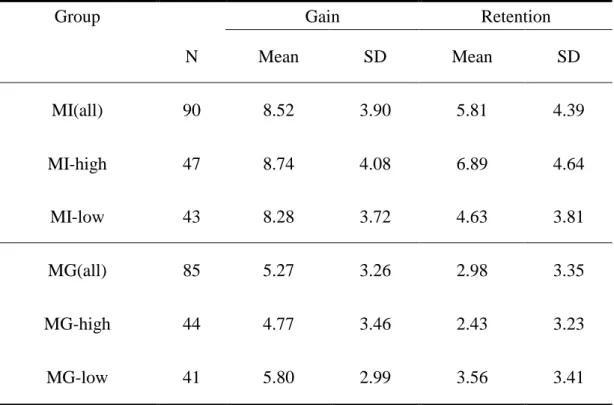
Group Gain Retention
N Mean SD Mean SD
MI(all) 90 8.52 3.90 5.81 4.39
MI-high 47 8.74 4.08 6.89 4.64
MI-low 43 8.28 3.72 4.63 3.81
MG(all) 85 5.27 3.26 2.98 3.35
MG-high 44 4.77 3.46 2.43 3.23
MG-low 41 5.80 2.99 3.56 3.41
According to Table 4-2, the participants in the meaning-inferred group had better
performance in vocabulary gain and word retention than the participants in the
further explore whether the effects of meaning-inferred gloss and meaning-given
gloss were statistically different, results through the analysis of SPSS are presented in
detail in the following section.
4.1.2 Participants’BaselineKnowledgeoftheTargetWords
The participants in the present study were supposed to have little knowledge and
had an equal start because the target words chosen were beyond learners’vocabulary
size based on the administration of the vocabulary pilot test as mentioned in Chapter
Three.
To confirm that the participants in the meaning-inferred (MI) group and the
participants in the meaning-given group had fair baseline knowledge of the target
words, an independent –samples t-test was conducted. Other two
independent-samples t-tests were also conducted to corroborate the equal baseline
vocabulary knowledge among learners of high proficiency level and learners of low
proficiency level.
The results of the participants’baseline knowledge displayed in the vocabulary
pre-test were shown in Table 4-3.
Table 4-3 The Comparison of Participants' Correct Target Items on the Pre-test
Group N Mean SD Sig.
MI-all 90 2.42 2.45 0.86
MG-all 85 2.35 2.83
MI-high 47 3.68 2.40
MG-high 44 3.66 3.18
0.97
MI-low 43 1.05 1.63
MG-low 41 0.95 1.45
0.78
The mean score in MI group and the mean score in MG group on the pre-test was
different by .07, without reaching a significant level (p>.05); thus, the participants in
the meaning-inferred (MI) group and the participants in the meaning-given (MG)
group were statistically equal in their baseline knowledge.
Aside from the equal baseline knowledge between MI group and MG group, the
results also verified that there were also no significant differences among the
participants of high proficiency level and among the participants of low proficiency
level. As shown in Table 4-3, the mean scores for the two groups of high proficiency
level were different by .02, without reaching significant difference (p>.05); the mean
scores for the two groups of low proficiency level were different by .10, showing no
significant difference (p>.05).
4.1.3 Incidental Vocabulary Learning from Meaning-inferred Gloss and
Meaning-given Gloss
To know if meaning-inferred gloss and meaning-given gloss generated learners’
vocabulary gain, both groups’performances on the immediate post-test were
compared with those on the pre-test through paired-samples t tests. Furthermore, to
examine the retention of the acquired target words, comparison of both groups’
performances on the delayed post-test and the pre-test were also made via
paired-samples t tests.
4.1.3.1 Vocabulary Gain
Comparisons of the participants’scores of the pre-test and scores of the
immediate post-test are presented in Table 4-4.
Table 4-4 The Participants’Vocabulary Gain between the Pre-test and the Immediate Post-test
Pre-test (Pre)
Immediate Post-test (Imm)
Sig.
(Pre-Imm)
Group N Mean SD Mean SD
MI(all) 90 2.42 2.45 10.94 4.02 0.00**
MI-high 47 3.68 2.40 12.43 4.03 0.00**
MI-low 43 1.05 1.63 9.33 3.36 0.00**
MG(all) 85 2.35 2.84 7.62 3.58 0.00**
MG-high 44 3.66 3.18 8.43 4.22 0.00**
MG-low 41 0.95 1.45 6.76 2.52 0.00**
** p<.01, two-tailed
As shown in Table 4-4, the mean scores of both groups’and their sub-groups’
(low proficiency level and high proficiency level) immediate post-test were higher
than those on the pre-test. Among the tested twenty target words between the pre-test
and the immediate post test, the average score of the meaning-inferred group gained
8.52 and the meaning-given group increased by 5.27, with the score differences both
reaching a significant level (p<.05). The significant vocabulary gain was also present
in the participants of high proficiency level and the participants of low proficiency
level within the meaning-inferred group and the meaning-given group. The
statistically significant increases in scores of the immediate post-test revealed that the
participants had vocabulary growth from reading materials enhanced with either
meaning-inferred gloss or meaning-given gloss.
4.1.3.2 Vocabulary Retention
Comparisons of the participants’vocabulary retention between the delayed
post-test and the pre-test were shown in Table 4-5.
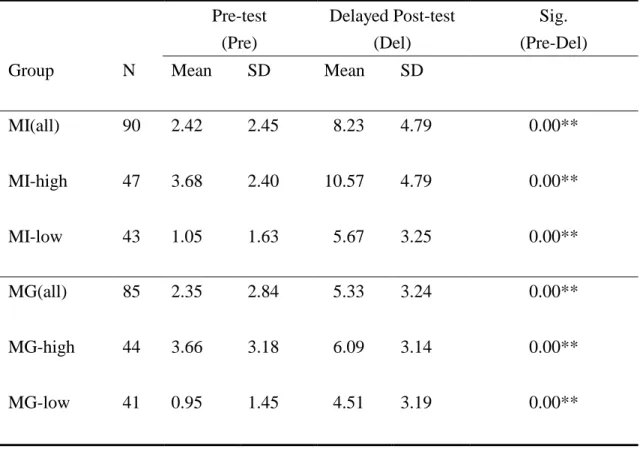
Table 4-5 The Participants’Vocabulary Retention between the Delayed Post-test and the Pre-test
Pre-test (Pre)
Delayed Post-test (Del)
Sig.
(Pre-Del)
Group N Mean SD Mean SD
MI(all) 90 2.42 2.45 8.23 4.79 0.00**
MI-high 47 3.68 2.40 10.57 4.79 0.00**
MI-low 43 1.05 1.63 5.67 3.25 0.00**
MG(all) 85 2.35 2.84 5.33 3.24 0.00**
MG-high 44 3.66 3.18 6.09 3.14 0.00**
MG-low 41 0.95 1.45 4.51 3.19 0.00**
** p< .01
According to the statistical results in Table 4-5, the mean sores of the delayed
post-test were higher than the mean sores of the pre-test for participants in the
meaning-inferred group and participants in the meaning-given group. The average
score of the meaning-inferred group rose by 5.81 and the meaning-given group
increased by 2.98, with both scores found to be significantly different at .01. The
significant vocabulary retention between the pre-test and the delayed post-test was
also present in the participants of high proficiency level and the participants of low
proficiency level within the meaning-inferred group and the meaning-given group.
The significant increase in scores of the immediate post-test and the delayed
post-test, shown in Table 4-4 and Table 4-5 demonstrated meaning-inferred gloss and
meaning-given gloss in the reading text not only generated vocabulary gain but also
led to vocabulary retention.
4.1.4 Comparison of the Effects of Meaning-inferred Gloss and Meaning-Given
Gloss
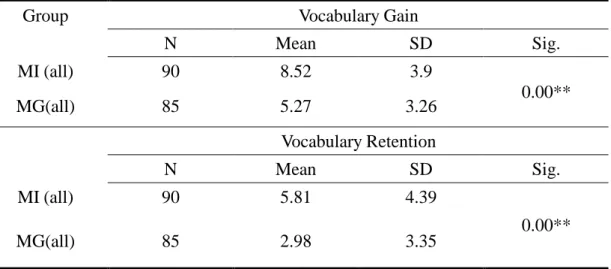
To answer the research question on whether meaning-inferred multiple-choice
gloss generate greater effects than meaning-given singular gloss on incidental
vocabulary learning in terms of vocabulary gain and retention, two t-tests were
conducted and the statistical results are presented in Table 4-6.
Table 4-6 Comparisons of the Effects of Meaning-inferred Gloss and Meaning-given Gloss
Group Vocabulary Gain
N Mean SD Sig.
MI (all) 90 8.52 3.9
MG(all) 85 5.27 3.26 0.00**
Vocabulary Retention
N Mean SD Sig.
MI (all) 90 5.81 4.39
MG(all) 85 2.98 3.35 0.00**
**p<.01
The results showed that meaning-inferred multiple-choice gloss generated
greater effects than meaning-given singular gloss both in vocabulary gain and
retention. As Table 4-6 showed, the participants in the meaning-inferred gloss (MI)
group performed better than the participants in the meaning-given gloss (MG) group
in both vocabulary gain and retention by 3.25 and 2.84 respectively, with the
differences of their mean scores reaching a significant level (p<.01). Such results meet
our expectations in the present study that meaning-inferred gloss benefit learners
more than meaning-given gloss in incidental vocabulary learning.
4.1.5 Comparisons of the Effects of Meaning-inferred Gloss and Meaning-given
Gloss for Learners of Different Proficiency Level
To further explore whether the effects of meaning-inferred gloss outweigh the
effects of meaning-given gloss for learners of high proficiency level and learners of
low proficiency level, a series of t-tests were conducted and the results are presented
as follows.
4.1.5.1 Comparisons of Effects on Vocabulary Gain
The comparisons between the effects of meaning-inferred gloss and the effects of
meaning-given gloss on vocabulary gain for learners of high proficiency level and low
proficiency level are presented in Table 4-7 below.
Table 4-7 Comparisons of Effects of Meaning-inferred Gloss and Meaning-given Gloss on Vocabulary Gain for Learners of Different Proficiency Level
Group Vocabulary Gain
N Mean SD Sig.
MI
(high) 47 8.74 4.08
MG
(high) 44 4.77 3.46
0.00**
MI
(low) 43 8.28 3.72
MG
(low) 41 5.80 2.99
0.00**
**p<.01
As Table 4-7 showed, learners of high proficiency level in the meaning-inferred
(MI) group attained higher scores in vocabulary gain than those in the meaning-given
(MG) group by 3.98, with their mean scores reaching a significant level (p<.01).
Learners of low proficiency level in the meaning-inferred (MI) group had better
performance in vocabulary gain than those in the meaning-given (MG) group by 2.43,
and the difference was also statistically different (p<.01). The better performances in
the meaning-inferred groups indicated that meaning-inferred gloss had greater effects
than meaning-given gloss on vocabulary gain for learners of high proficiency level
and low proficiency level.
4.1.5.2 Comparisons of Effects on Retention
The comparisons between the effects of meaning-inferred gloss and the effects of
proficiency level are shown in Table 4-8.
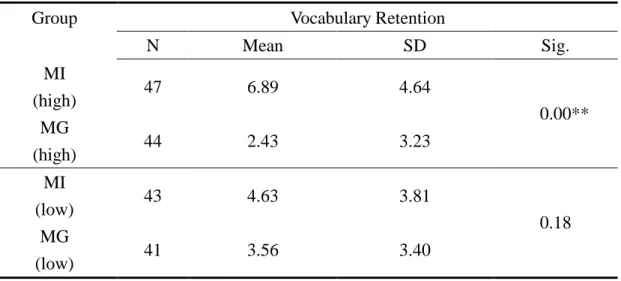
Table 4-8 Effects of Meaning-inferred Gloss and Meaning-given Gloss on Vocabulary Retention for Learners of Different Proficiency Level
Group Vocabulary Retention
N Mean SD Sig.
MI
(high) 47 6.89 4.64
MG
(high) 44 2.43 3.23
0.00**
MI
(low) 43 4.63 3.81
MG
(low) 41 3.56 3.40
0.18
**p<.01
As shown in Table 4-8, learners of high proficiency level in the meaning-inferred
(MI) group had higher scores in retention of target words than those in the
meaning-given (MG) group by 4.46, with the difference in their mean scores reaching
a significant level (p<.05). However, though learners of low proficiency level in
meaning-inferred (MI) group got higher scores than those in meaning-given (MG)
group by 1.07, the difference in mean scores was not statistically significant (p>.05).
To be specific, the better effects of meaning-inferred gloss than meaning-given gloss
on vocabulary retention worked only on learners of high proficiency level, since the
significant difference was not found in learners of low proficiency level.
Drawing from the above results in Table 4-7 and Table 4-8, it was found that
meaning-inferred gloss was more effective in generating vocabulary gain for learners
of both high proficiency level and low proficiency level. But in terms of effects on
retention, the greater effects of meaning-inferred gloss only worked better on learners
of high proficiency level, not on those of low proficiency level. For learners of low
proficiency level, though meaning-inferred gloss had significantly better effects than
meaning-given gloss on vocabulary gain, its significantly positive effects on
vocabulary retention was not seen.
4.1.6 The Influence of Proficiency Level on the Effects of Vocabulary Learning in
the Meaning-inferred (MI) Group and the Meaning-given (MG) Group
To explore whether learners’proficiency level affects vocabulary learning in
reading materials with different types of gloss, the following section examines the
performances of the participants of high and low proficiency levels in different gloss
groups.
4.1.6.1 In the Meaning-inferred Group
Comparisons between the performances of high proficiency learners and the
performances of low proficiency learners in meaning-inferred condition are presented
in Table 4-9.
Group Vocabulary Gain
N Mean SD Sig.
MI (high)
47 8.74 4.08
MI (low)
43 8.28 3.71 0.57
Vocabulary Retention
N Mean SD Sig.
MI (high)
47 6.89 4.64
MI (low))
43 4.63 3.81 0.01**
**p<.01
As shown in the table , the participants of high proficiency level and the
participants of low proficiency level displayed similar performance in vocabulary gain,
with no significant difference (p>.05) in their mean scores. But in terms of vocabulary
retention, the participants of high proficiency level attained higher scores than the
participants of low proficiency level by 2.26, with their mean scores reaching a
significant different level ( p<.01).
The insignificant difference in vocabulary gain for learners of different
proficiency levels, as shown above, suggested that learners’proficiency level did not
affect their vocabulary learning when reading materials with meaning-inferred gloss.
On the other hand, significant difference in vocabulary retention was found, which
suggested that learners’proficiency level affected their word retention when reading
materials with meaning-inferred gloss. To be exact, if learners possess higher
proficiency level, their vocabulary retention of new picked-up words is likely to be
better than those with lower proficiency level.
4.1.6.2 In the Meaning-given Group
Torealizewhetherlearners’proficiency level affected their vocabulary learning in
reading materials with meaning-given gloss, comparison between the performances of
high proficiency level and low proficiency level were made and the results were
presented in Table 4-10.
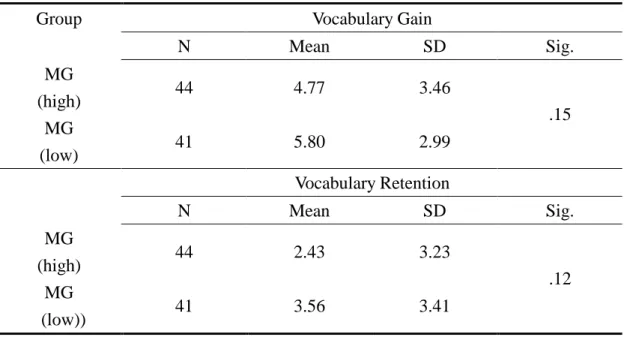
Table 4-10 The influence of proficiency level in meaning-given group
Group Vocabulary Gain
N Mean SD Sig.
MG
(high) 44 4.77 3.46
MG
(low) 41 5.80 2.99
.15
Vocabulary Retention
N Mean SD Sig.
MG
(high) 44 2.43 3.23
MG
(low)) 41 3.56 3.41
.12
As seen in the above table, no significant difference was found in vocabulary
gain and retention (p>.05), suggesting that proficiency level did not affect learners’
However, what was unexpected in the findings was that learners of low
proficiency level achieved slightly higher scores in both vocabulary gain and
retention than learners of high proficiency level, though the differences were not
significant.
In view of the findings, it is plausible to draw the conclusion that when learners
are engaged in reading materials with meaning-given gloss, their proficiency level
will not be a crucial factor in their vocabulary gain and retention.
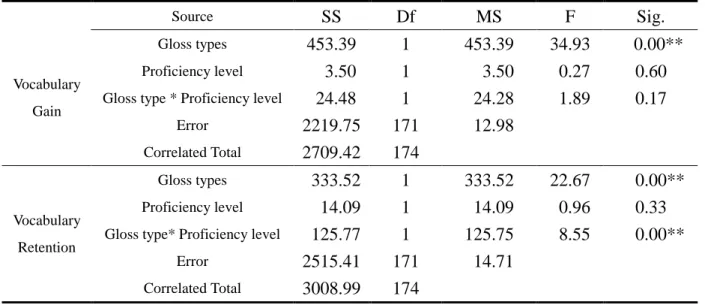
4.1.7 The Relationship between GlossTypesand Learners’Proficiency Level
To find out whether there is relationship between gloss types and learners’
proficiency levelin learners’vocabulary gain and retention,atwo-way ANOVA was
conducted and the results are presented in Table 4-11.
Table 4-11 Tests of Between Subjects Effects in two-way ANOVA
Source SS Df MS F Sig.
Gloss types 453.39 1 453.39 34.93 0.00**
Proficiency level 3.50 1 3.50 0.27 0.60
Gloss type * Proficiency level 24.48 1 24.28 1.89 0.17
Error 2219.75 171 12.98
Vocabulary Gain
Correlated Total 2709.42 174
Gloss types 333.52 1 333.52 22.67 0.00**
Proficiency level 14.09 1 14.09 0.96 0.33
Gloss type* Proficiency level 125.77 1 125.75 8.55 0.00**
Error 2515.41 171 14.71
Vocabulary Retention
Correlated Total 3008.99 174
**p<.01
As shown in Table 4-11, when learners were engaged in reading materials
enhanced with gloss and their main purpose was for comprehension of the text, gloss
types affected their vocabulary gain and retention at a significant level (p<.01). Unlike
gloss types that played a crucial role in vocabulary learning,learners’proficiency
level was not a critical factor in vocabulary gain and retention (p>.05) when they were
reading gloss-enhanced materials. As for the interrelationship between gloss types and learners’proficiency level,Table4-10 revealed that there was non-significant
interactionsbetween glosstypesand learners’proficiency levelin termsofvocabulary
gain (p>.05). However, as for word retention, significant interaction (p<.05) between glosstypesand learners’proficiency leveldid exist.
4.1.8 Summary of the Overall Results of the Present Study
Based on the above findings, a summary on the results of the present study is
made as follows.
1. Gloss, whether in the form of meaning-inferred gloss or singular meaning-given
gloss, is beneficial not only in generating vocabulary gain but also in leading to
word retention for learners who are engaged in meaning-based reading.
2. Overall, meaning-inferred gloss is more effective than meaning-given gloss in
3. When learners’proficiency level is taken into consideration, meaning-inferred
gloss is more productive in vocabulary gain for learners of high proficiency level
and low proficiency level than meaning-given gloss. However, in terms of the
effects on word retention, the greater effects are only found in learners of high
proficiency level.
4. In meaning-inferred condition,learners’proficiency levelaffects their word
retention only. That is, learners’proficiency level has no effects on vocabulary gain.
5. In meaning-given condition,learners’proficiency levelneitheraffectsvocabulary
gain nor affects word retention.
6. When learners are reading gloss-enhanced materials,itisglosstypes,notlearners’
proficiency level, that determine how much vocabulary they can gain or retain
incidentally from reading.
7. There is no significant interaction between glosstypesand learners’proficiency
level in vocabulary gain, but in terms of word retention, the significant
interrelationship between gloss types and proficiency level does exist.
4.2Discussions
The section is comprised of two sections where the findings are utilized to
answer the proposed questions in Chapter one. The effects of meaning-inferred gloss
and meaning-given gloss are discussed in section 4.2.1; comparisons between
meaning-inferred gloss and meaning-given gloss are presented in 4.2.2 and 4.2.3, and
the factor of learners’proficiencylevel is discussed in section 4.2.4.
4.2.1 Benefit of Incidental Vocabulary Learning from Glosses
The result in section 4.1.3 that glosses, whether in the form of meaning-given
gloss or meaning-inferred gloss, are beneficial in generating learners’incidental
vocabulary learning while reading is in line with the findings of previous research
(Hulstijn et al., 1996; Jacobs et al., 1994; Mondria, 2003; Nagata, 1999; Paribakht &
Wesche, 1997; Rott, 2003, 2005; Watanabe, 1997; Yoshii, 2006).
There are several factors that can account for the effectiveness of gloss on
learners’incidental vocabulary learning. To begin with, the use of gloss arouses learners’noticing to the target words, which is a crucial process in
vocabulary-learning (Schmidt, 1992). With its salience due to being bold-faced, gloss
successfully draws learners’attention, thus creating an ideal vocabulary-learning
condition of “consciousness-raising”and “input-enhancement”(Rutherford &
that enhances learners’attention to target words, gloss also helps learners to connect
the word form to its meaning immediately, thus consolidating the form-meaning
association, which is a vital component of knowing a word (Rott & Willaim, 2003).
Last, with a view to comprehending the reading material, learners are more likely to
read back and forth between the target words and the gloss, thus triggering more
lexical processing; such lexical processing of the target words is beneficial to
vocabulary learning (Jacobs et al, 1994).
4.2.2 The Greater Effects of Meaning-inferred Gloss than Meaning-given Gloss
The present study reveals the greater effects of meaning-inferred gloss than
meaning-given glossin learners’vocabulary gain and retention,asisillustrated in
section 4.1.4. The superiority of meaning-inferred gloss to meaning-given gloss in learners’incidentalvocabulary learningcorresponds to the findings of previous
studies (Hulstijn, 1992; Nagata, 1999;.Rott & William, 2003; Rott, 2005).
Findings of the present study corroborate the positive effects of meaning-inferred
gloss, which Hulstijn proposed and described as a “compromise between
meaning-inferred method and meaning-given gloss”(1992). In consistent with the
result of Hulstijn’s finding (1992), the present study showed a higher vocabulary gain
and retention from the multiple-choice meaning-inferred gloss than from the
meaning-given gloss on the immediate post-test and the delayed post-test. Like
Nagata’s study (1999), in which immediate feedback of the correct item of word
meanings was provided, the present study verified the importance and necessity of
teachers’immediate feedbacks of meaning-inferred gloss. Such emphasis on the
correct feedback also echoes with Hulstijn’s statement that the procedure of
meaning-inferred gloss should only be used when teachers’immediate feedbacks are
available in order to avoid the influence of incorrect inference on learners. Last, the
findings of the positive effects of meaning-inferred gloss in the present study confirm
Rott’s statement that meaning-inferred gloss is beneficial in strengthening the
form-meaning connection because of learners’more mental processing of target items.
As is expected, the finding of the significantly better effects of meaning-inferred
gloss in the present study contradicts with Watanabe’s (1997) finding that showed no
significant difference between meaning-given and meaning-inferred gloss. Such
inconsistence is expected; by offering students the correct feedback of multiple-choice
gloss after reading, the present study manages to address the problem of Watanabe’s
study, in which students in the meaning-inferred group were not informed of the
correct alternative of word meaning. Next, contrary to Mondria’s (2003) finding that
meaning-inferred method is more time-consuming and thus less efficient than
meaning-given method, the present study demonstrates the positive effects of
than wild guessing of word meanings. Such positive effects of meaning-inferred gloss
support Hulstijn’s (1992) claim that multiple-choice meaning-inferred gloss serves
well as a compromise between meaning-given gloss and wild guessing of words
meaning. In Hulstijn’s words, the multiple-choice meaning-inferred gloss retains the
advantages of the inferring method while reducing the risk of inferring, such as wrong
inference, lack of problem-solving skill and lack of sufficient contextual clues; the
multiple-choice meaning-inferred gloss can compensate the limited information in the
context by providing learners with a cue, and reduce the chance of wrong inference to
the chance of selecting distractors, and thus are appropriate even for learners with
less-developed problem-solving skills.
Drawing from the results of the study, it is reasonable to make the following
statements. When learners are engaged in reading mainly for comprehension, they are
more likely to acquire the unknown words in the text when they have inferred the
meaning through multiple-choice meaning-inferred gloss than when the meaning is
directly given to them. Besides, to reduce the inherent risk of wrong inference that mightlead to wrong retention ofword meaning,teachers’immediatefeedbacksofthe
correctmeaning ofword afterlearners’decision-making process is strongly
recommended.
4.2.3 Factors Accounting for the Greater Effects of Meaning-inferred Gloss than
Meaning-given Gloss
To explore the factors that account for the greater effects of meaning-inferred
gloss than meaning-given gloss, the fundamental difference between
meaning-inferred gloss and meaning-given gloss should be examined first. It is
apparent that the most striking difference between meaning-inferred gloss and
meaning-given gloss is the presence of decision-making process. Thus, we will
examine what is involved in the decision-making process based on mental effort
hypothesis and involvement load construct to account for the greater effects
meaning-inferred gloss generates than meaning-given gloss.
4.2.3.1 In-depth Processing of Words: Mental Effort Hypothesis & Involvement
Load Hypothesis
The finding that meaning-inferred gloss outperforms meaning-given gloss in the
present study can be attributed to the more in-depth processing of the target words
that meaning-inferred gloss triggers on the basis of mental effort hypothesis and the
involvement load hypothesis.
According to research in human memory, the chance that a new lexicon will be
stored in long-term memory is determined by the depth of processing in the encoding
process (Craik & Lockhart, 1972; Craik & Tulving, 1975; Jacoby, Craik, &Begg,
engaged in deep processing of the words while encountering them. Such deep
processing includes elaboration of word form and meaning and the context or
learners’previous knowledge (Ellis, 1994; Laufer & Hulstijn, 2001). When learners in
the meaning-inferred group are asked to infer the meaning of the encountered words,
they have to exert more mental efforts than when they are given the meaning of the
encounter words. To be specific, they have to assign a proper meaning to the target
words by elaborating the context and employing their previous knowledge of the
context words to make a good choice of the word meaning. Because of more mental
efforts in decoding or elaborating form and meaning, the participants in the
meaning-inferred group can retrieve and recall the word better than the participants
with less mental processing of words in the meaning-given group.
In addition to in-depth processing and more mental efforts, the involvement load
hypothesis (Laufer & Hulstijn, 2001) can also account for the greater effects of
meaning-inferred gloss. According to the hypothesis, need, the cognitive search and
evaluation activities are essential components in lexical acquisition and retention.
When learners in the meaning-inferred group are given multiple-choice gloss, they
were given a problem-solving task. The problem-solving task of the multiple-choice
gloss presented an extrinsic need and enhance learners’motivation to assign a
concrete meaning to the target words; the need to assign a meaning will in turn lead
learners to allocate attention to processing the target words by searching for meaning
in the context and evaluating their hypothesis on the semantic information of the
words. Thus, compared to meaning-given gloss, which requires less mental effort
and involvement of learners, the use of multiple-choice meaning-inferred gloss
triggers a deeper processing of words, requires more involvement from learners and
thus enhances the subsequent word acquisition and retention.
4.2.4 Interaction between Gloss Types and Learners’Proficiency Level in terms of
Word Retention
Although the result in 4.1.7 shows that learners’proficiency level was not a
determining factor in learners’vocabulary gain and retention, there was still
interaction between gloss type and learners’proficiency level in terms of vocabulary
retention. To be specific, the result in Table 4-9 reveals that learners of high
proficiency level and learners of low proficiency level in the meaning-inferred group
displayed similar performance in vocabulary gain, but in terms of retention, those of
high proficiency level outperformed significantly better than those of low proficiency
level. In other words, the positive effects meaning-inferred gloss generated were not
found in the delayed post-test tests for learners of low proficiency level. The
following section will explore the above results.
4.2.4.1 Influence of Proficiency Level on Vocabulary Learning from
Meaning-inferred Gloss
Contrary to the expected outcome, the present study shows that proficiency level,
on the whole, is not a determining factor in vocabulary learning from gloss, though
more detailed examination showed some difference in terms of word retention for
learners of high proficiency level and low proficiency level.
The insignificant difference in vocabulary learning from meaning-inferred gloss
between learners of high proficiency level and learners of low proficiency level in the
present study may be attributed to the following factors. For one thing, the definition
of the proficiency level in the present study may not be flawless enough. In the
present study, the participants were confined to the same school and they were
classified only according to the grade they were in. Thus, it is possible that their
proficiency level is not discrepant enough. Different results may have yielded if we
had recruited participants with more discrepancy in proficiency level, such as junior
high school students and senior high school students. For another, the present study
offered immediate feedback after the participants finished their meaning-inferred
multiple-choice gloss. The immediate feedback could redress the wrong inference
resulting from low proficiency. Thus, the participants of high proficiency level and the
participants of low proficiency level displayed similar performance in the subsequent
immediate post-tests.
Despite the fact that the present study failed to provide statistical proof to show
the importance of proficiency level in meaning-inferred vocabulary learning, there is
still possibility that proficiency level may be a factor, if we take the correct inference
rate into consideration. As Mondria stated (2003), the precondition for successful
learning from meaning-inferred method to take place is that learners should infer the
meaning of the words correctly, as incorrect meanings will also be retained. The
correct inference of words depends on rich contextual clue of the text, learners’
knowledge of the context words and learners’skill at inferring, all of which are related
to learners’proficiency level. To be specific, if learners are not proficient enough, they
may have difficulty accessing the contextual clues of the words because of limited
knowledge of the context words, which in turn lead to their poor inference of the
unknown words and affects their vocabulary learning.
4.2.4.2 Factors Accounting for the Absence of Significant Positive Effects on
Word Retention for Learners of Low Proficiency Level
A striking result in the present study is that the positive effects generated by
meaning-inferred gloss in the immediate post-test for learners of low proficiency level
were not seen in the delayed post-test. That is, the positive effects only occur in
effects on word retention only pertain to learners of high proficiency level. First,
given the fact that incorrect inference may be retained (Grace, 1998; Mondria, 2003),
it is reasonable to argue that proficiency level affects word retention, since it is a
crucial factor to decide whether learners can make correct inference of the unknown
words. As mentioned above, the less proficient learners, because of their insufficient
knowledge of the context words and poor skill at inferring, are more inclined to make
incorrect inference of word meanings. The incorrect inference of word meanings
might be redressed in the immediate post-tests because of the teachers’immediate
feedback of the correct meanings, but it still interfered with the learners in their
delayed post-test and led to their inferior performance in word retention. Last, learners
of higher proficiency level, because of more previous knowledge of the context words
and greater accessibility to the rich contextual clue, are more likely to make correct
associations of the word meanings by more readily triggering appropriate schemata
and, hence, the likelihood of committing the correct meaning to memory (Grace,
1998).