行政院國家科學委員會專題研究計畫 成果報告
演化式模糊類神經推論系統於營建管理之應用(II)
計畫類別: 個別型計畫
計畫編號: NSC92-2211-E-011-054-
執行期間: 92 年 08 月 01 日至 93 年 10 月 31 日 執行單位: 國立臺灣科技大學營建工程系
計畫主持人: 鄭明淵
計畫參與人員: 蔡明修、吳育偉
報告類型: 精簡報告
報告附件: 出席國際會議研究心得報告及發表論文 處理方式: 本計畫可公開查詢
中 華 民 國 94 年 1 月 21 日
行政院國家科學委員會專題研究計畫成果報告
演化式模糊類神經推論系統於營建管理之應用(Ⅱ)
Evolutionary Fuzzy Neural Inference System (EFNIS) for
Construction Management (Ⅱ)
計畫編號:NSC 92 –2211-E-011-054執行期限:92 年 8 月 1 日至 93 年 10 月 31 日 主持人:國立台灣科技大學營建系 鄭明淵教授 共同主持人:
計畫參與人員:國立台灣科技大學營建系 蔡明修、吳育偉
中文摘要
營建管理目的是成功完成專案,本研 究中提出以「演化式專案成功度預測模式」
來預測專案成功度。此模式結合基因演算 法、模糊理論與類神經網路之優點,模式 中應用基因演算法進行最佳化,透過模糊 理論處理近似推論,類神經網路則用於學 習尋找輸入變數與輸出變數間的關係,此 外,「演化式專案成功度預測模式」整合
CAPPR找出專案成功度影響因子。測試結果
也顯示出「演化式專案成功度預測模式」
可作為人工智慧決策支援系統來輔助專案 管理員即時控管專案。
關鍵詞:專案成功度、預測、模糊理論、
類神經網路、演化式模糊類神經 推論模式
Abstract
The purpose of construction management is to successfully accomplish projects. This research proposes an Evolutionary Project Success Prediction Model (EPSPM) to dynamically predict project success. Genetic Algorithms (GAs), Fuzzy Logic (FL), and Neural Networks (NNs) are hybridized to develop the model. In the model, GAs are primary used for optimization, FL for approximate reasoning, and NNs for input-output mapping. Furthermore, the EPSPM integrates CAPPR to select factors that influence project success. The validation results show that the proposed EPSPM could
be used as an intelligent decision support system for project mangers to control projects in a real time base.
Keywords: Project success; Prediction;
Fuzzy logic; Neural networks;
Evolutionary Project Success Prediction Model (EPSPM)
INTRODUCTION
From an owner’s perspective, the definition of a successful project is one that meets or exceeds budgetary and schedule expectations. On the other hand, a less-than-successful project fails to meet budgetary and/or schedule expectations (CII 1996). Project managers are responsible for project success. To ensure that the projects can be accomplished successfully, project managers have to continuously monitor the project performance, so that they can take proper corrective actions to control the project.
Project outcomes are affected by different factors at diverse time points. During the course of a project, predicting project outcomes at different stages need to analyze dissimilar factors (Russel et. al. 1997). A dynamic prediction methodology is thus required for project mangers to continuously monitor the project performance. However, as every time point has numerous time-dependent variables affecting the project outcomes. In addition, due to the nature in construction industry, those variables are uncertain (Barraza et al. 2000).
To dynamically predict the project outcomes under such complex and uncertain circumstances is never easy. Despite human experts can judge project outcomes according to their knowledge, the significant of these judgments are restricted by their subjective cognitions and/or limited knowledge.
Artificial intelligence (AI) is concerned with building computer systems that solve the problem intelligently by emulating the human brain. AI technology provides techniques for the computer programs to carry out a variety of tasks, at which humans are currently better (Haykin 1999).
Consequently, AI paradigms are appropriate for solving project management problems (Ko 2002). The most popular AI paradigms are Genetic Algorithms (GAs), Fuzzy Logic (FL), and Neural Networks (NNs). The combination of GAs, FL, and NNs offset the demerits of one paradigm by the merits of another (Martin and Jain 1999). In the last few years, several articles have been devoted to the study of fusing GAs, FL, and NNs to derive a better model performance than those using a single conventional method (Linkens and Nyongesa 1996).
The primary purpose of this research work is to hybridize GAs, FL, and NNs to develop an Evolutionary Project Success Prediction Model (EPSPM). Basic concepts, model development process, and model validation are addressed in the paper.
MODEL ARCHITECTURE
The architecture of the EPSPM is shown in Fig. 1. The proposed EPSPM is a fusion of GA, FL, and NN paradigms. The combination of GAs, FL, and NNs offset the demerits of one paradigm by the merits of another. In the formulated model, FL is primarily concerned with imprecision and approximate reasoning; NN with fuzzy input-output mapping; and GAs with optimization. The influencing factors of project success are selected using CAPP®, the Continuous Assessment of Project Performance software (CII 1996).
Input patterns Fuzzifier
(FL)
Defuzzifier (FL) Rule base
+ Inference engine
(NNs)
MF NNs’ parameters
and topology
Optimization (GAs)
Defuzzification parameters
Control flow Functional object
Legend
Data flow Database
Influencing Factors Selection (CAPP®)
Fig. 1. The EPSPM architecture
The model is developed based on FL that mimics the high level of human inference process. FL and NNs are complementary technologies. The combination of these two technologies into an integrated system appears a promising path towards the development of intelligent systems capable of capturing qualities characterizing the human brain (Canuto et al. 1999; Rajasekaran and Vijayalakshmi Pai 2000). In Fig. 1, fuzzy inference engine and fuzzy rule base in the traditional FLS are replaced by the NN. NN’s architecture and the recall of neural processing are used to represent the functions of the rule base and the inference engine respectively.
Although the integration of FL and NN is more reasonable than traditional FL to simulate the characteristics and process of human inference, the NN has demonstrated the difficulty in selecting an appropriate topology for learning different tasks as well as appropriate parameters for a network. In addition, the determination of suitable distribution for the MFs, for solving disparate problems is time consuming and difficulties increases with problem complexity. GA is an effective approach to conquer the drawbacks of FL and NNs (Gorzalczany and Gradzki 2000). Therefore, the EPSPM employs GA to simultaneously search for the fittest shapes of MFs, optimum NN topology, and optimum parameters of NN.
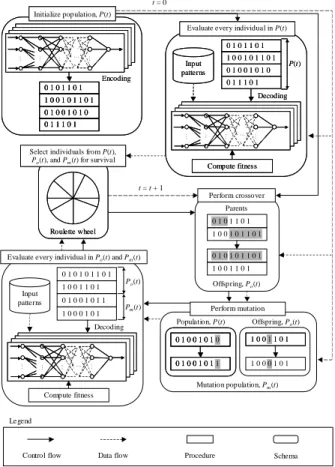
MODEL ADAPTATION PROCESS The EPSPM concurrently searches for the optimum MFs, NN topologies, and NN
parameters using GA. The adaptation process of the EPSPM is shown in Fig. 2. In the process, P(t) denotes a population at generation t , )Po(t is an offspring population at generation t , and Pm(t) indicates a mutation population at generation
t . Each procedure is defined in next sections.
1 0 0 0 1 0 1 Roulette wheel
Select individuals from P(t), Po(t), and Pm(t) for survival
Roulette wheel Select individuals from P(t),
Po(t), and Pm(t) for survival
0 1 0 0 1 0 1 0
0 1 0 0 1 0 1 1 0 1 0 0 1 0 1 0 0 1 0 0 1 0 1 0
0 1 0 0 1 0 1 1 0 1 0 0 1 0 1 1
1 0 0 1 1 0 1 1 0 0 1 1 0 1 Perform mutation Population, P(t) Offspring, Po(t)
Mutation population, Pm(t) Input
patterns
Compute fitness Evaluate every individual in Po(t) and Pm(t)
Decoding 0 1 0 0 1 0 1 1 0 1 0 1 0 1 1 0 1 1 0 0 1 1 0 1
1 0 0 0 1 0 1 Po(t)
Pm(t) t = 0
0 1 0 1 1 0 1 1 0 0 1 0 1 1 0 1
0 1 0 1 0 1 1 0 1 1 0 0 1 1 0 1 Perform crossover
Parents
Offspring, Po(t) t = t + 1
… … ……
…
0 1 0 1 1 0 1 1 0 0 1 0 1 1 0 1 0 1 0 0 1 0 1 0 0 1 1 1 0 1 Initialize population, P(t)
Encoding
… … ……
… … … ……
… … … ……
… … … ……
…
0 1 0 1 1 0 1 1 0 0 1 0 1 1 0 1 0 1 0 0 1 0 1 0 0 1 1 1 0 1 0 1 0 1 1 0 1 1 0 0 1 0 1 1 0 1 0 1 0 0 1 0 1 0 0 1 1 1 0 1 Initialize population, P(t)
Encoding
Input patterns
Compute fitness Decoding
P(t) 0 1 0 1 1 0 1 1 0 0 1 0 1 1 0 1 0 1 0 0 1 0 1 0 0 1 1 1 0 1 Evaluate every individual in P(t)
… … ……
…
Input patterns
Compute fitness Decoding
P(t) 0 1 0 1 1 0 1 1 0 0 1 0 1 1 0 1 0 1 0 0 1 0 1 0 0 1 1 1 0 1 Evaluate every individual in P(t)
… … ……
… … … ……
… … … ……
… … … ……
…
… … ……
… … … ……
… … … ……
… … … ……
…
Control flow Procedure
Legend
Data flow Schema
Fig. 2. EPSPM Adaptation Structure Initialize Population
The first step of the adaptation process is to randomly generate a set of initial solutions.
Each solution encodes model variables into a binary string to simulate a natural chromosome. Every string comprises of two segments: MF sub-string and NN sub-string.
Two codification methods, Summit and Width Representation Method (SWRM) and Block Representation Method (BRM), proposed by Ko (2002) are employed to encode MFs and NNs into sub-strings. The SWRM and BRM encode MFs and NN by a fixed and variable sub-string, respectively.
Therefore, the EPSPM encodes the problem using variable length gene code. The lengths of the sub-strings depend on the characteristics of the variables including the
required variable precision, amount of variables, and variable domains.
Evaluate Individuals
The purpose of evaluation is to evaluate the fitness of chromosomes. At the beginning generation (t =0), the EPSPM evaluates ξ individuals. Since the model adopts an enlarged sampling space, the EPSPM evaluates )(σ +τ individuals when t>0 where σ is the offspring population and τ is the mutation population.
The aim of the adaptation process is to obtain a model with high accuracy and good generalization properties. The model accuracy on input patterns can be improved by increasing the network complexity.
However, an accurate model fit to input patterns does not mean that the overall problem behaviors are captured well. A large network size has higher computational cost.
Also, in general, it suffers from overfitting of data in input patterns and deterioration of generalization properties (Maier et al. 2000).
Thus, the objective of the EPSPM is to preserve the acceptable prediction accuracy using the fittest shapes of MFs with the minimum NN topology and optimum NN parameters, which is posed as an optimization problem. The objective function of the model, fob , is a combination of model accuracy and model complexity as given in Equ. (1).
mc c s c
fob = aw× er + cw× (1)
where caw is the accuracy weighting coefficient, ser is the prediction error between actual output and desired output, ccw is the complexity weighting coefficient, and mc is the model complexity which is simply formulated by the number of active connections in the network. The fitness function is the reciprocal of objective function.
Evaluate Fitness Function
Fitness is a major index to evaluate status of chromosomes. The bigger fitness value achieves the model objective, the better. In this research, fitness function is the reciprocal of objective function and is given by Equ. (2).
k k ob fi
v =v1 (2) where fik
v and obk
v are the fitness and objective values of chromosome k . Perform Crossover
The crossover repeatedly exchanges high performance notations in the search for better and better performance. It operates on a pair of chromosomes (parents) at a time and produces two children by exchanging the parent features. The EPSPM uses one-cut-point crossover and exchanges right parts of their parents. After crossover, the summit positions of MFs, widths of MFs, hidden layers, hidden neurons, interconnections, biases, and activation slopes of parents are exchanged.
Perform Mutation
The mutation produces spontaneous random changes in various chromosomes. It protects against premature loss of important notations. For EPSPM, the purpose of mutation is to adjust the value of summits and widths of MFs, interconnections, weights, biases, and activation slopes for better performance. It alters one or more genes with a probability (p ), which is smaller than or ge equal to mutation rate ( pmu). Mutation operation compares the gene’s pge with pmu bit by bit. If pge ≤ pmu, then value of gene will be altered.
Select Individuals
The selection process emulates the survival-of-the-fittest mechanism in nature. It selects a new population with respect to the probability distribution based on fitness for survival. In regular GAs, parents are replaced by their offspring through crossover, and mutation alters some gene alleles. A new population is selected from a regular sampling space that contains partially or all mutated parents and offspring (Holland 1975). However, since genetic operators (crossover and mutation) are blind in nature, produced offspring and mutated chromosomes may be worse than their origins. As a result, some fitter chromosomes
are lost in the evolutionary process. To cope with those problems, the EPSPM uses a modified enlarged sampling space that contains population, offspring population, and their mutation.
MODEL VALIDATION
Procedures required to implement the EPSPM are described as follow:
Select Influencing Factors
Influencing factors required to predict project outcomes depend on time point. This research validates the performance of the proposed EPSPM in predicting project outcomes at the time point of 67%
completion. CAPP® is employed to dynamically identify time-dependent variables in the first step of application.
Using the CAPP® “Graphics” part, 10 of 76 time-dependent variables whose significance level below 0.1 at 67% completion are identified. The CAPP® analyzes the significance level of each variable based on 54 projects. These projects are real data collected by Russell et al. (1996) from the 16 representative Construction Industry Institute (CII) member companies.
Collect Input and Test Patterns
The original patterns are acquired from the CAPP® system database with CII’s kind permission. The database contains 54 projects which are the same data used to analyze the significance level. This study selects 15 available projects from the database where construction type is process plant projects, designer contractor type is lump sum construction contract, and the stability of projects is at the completed stage.
The 12 of them are treated as input patterns for evolvement, and the other three of 15 projects are selected as test patterns. Since this validation attempts to predict project outcomes at 67% completion, values of time-dependent variables at 67% completion are collected.
Preprocess Data
The EPSPM transfers input data to MF
degree values through management values.
Since one of the most frequently used conditional management numbers is five, the present research work linearly arranges the five conditional management values. Also, considering the new input’ values may be greater or smaller than variable data ranging in the patterns, this research slightly enlarges the fuzzy region from 0 to 1, to -0.10 to 1.10.
The CAPP® software divides project performance into four types: successful, on time or on budget, less-than-successful, and disastrous. Hence, this research linearly defines related values for four project performances from 0 to 1.
Execute Adaptation Process
Fig. 3 depicts the evolutionary process of EPSPM. The model converges at 5923rd generation with 0.0293 Root Mean Square Error (RMSE) and 65 interconnections.
0
2000
4000
6000
0 0.1 0.2 0.3 0.4
20 40 60 80 100 120
Generation Prediction error (RMSE)
Model complexity (Interconnections)
Fig. 3. Evolutionary Process Validate the Derived Solution
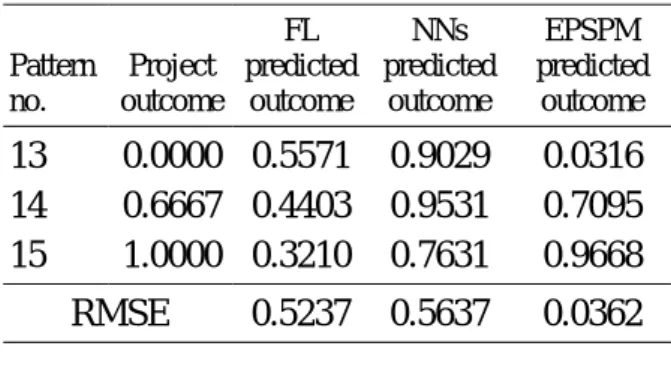
The proposed methodology predicts project outcomes using multiple time-dependent variables. The performance of FL, NNs, and EPSPM is compared in Table 1. In the table, the EPSPM’s generalization ability considerably surpasses FL and NNs. The proposed methodology promotes the prediction accuracy and efficiency in construction management.
Furthermore, it deals with uncertainty and complex input-output mappings in project success prediction. This validation uses 67%
time point as an example. The same method can be applied to any time point to predict project outcomes.
Table 1. Generalization Comparison
CONCLUSIONS
This paper has presented research into the comprehensive descriptions of developing a project success prediction model, EPSPM.
The model uses GAs to simultaneously search for the fittest MFs with the minimum NN structure and optimum NN parameters. It is one of the first researches fuses GAs, FL, and NNs in project success prediction, which promotes the AI technology in project management.
Due to the possible project outcomes inferred at current time point, project managers can make proper decisions to control projects, such that they can take corrective actions as early as possible to accomplish projects successfully. Besides, the proposed methodology enables project managers to dynamically monitor project performance changes over time. Using the information offered by the EPSPM, project managers can improve preproject planning, assess current project state, obtain early warning of problems, and establish preventive and corrective action plans.
The proposed model searches for the optimum solutions based on simulating natural evolution process. However, the theory behind the algorithm has not been fully discovered yet. An emerging question in this research is how the model parameters influence the adaptation process and how to acquire the knowledge between model parameters and generated optimum solution.
REFERENCES
[1] Aggarwal, R., and Song, Y. (1997). “Artificial neural networks in power systems. Part 1.
Pattern no.
Project outcome
FL predicted
outcome
NNs predicted
outcome
EPSPM predicted
outcome
13 0.0000 0.5571 0.9029 0.0316 14 0.6667 0.4403 0.9531 0.7095 15 1.0000 0.3210 0.7631 0.9668
RMSE 0.5237 0.5637 0.0362
General introduction to neural computing.”
Power Engineering Journal, 11(3), 129–134.
[2] Barraza, G. A., Back, W. E., and Mata, F. (2000).
“Probabilistic monitoring of project performance using SS-curves.” Journal of Construction Engineering and Management, ASCE, 126(2), 142–148.
[3] Canuto, A. M. P., Howells, W. G. J., and Fairhurst, M. C. (1999). “Fuzzy multi-layer perceptron for binary pattern recognition.”
Proceedings of the 1999 7th International Conference on Image Processing and its Applications, IEE, Stevenage, England, 1, 260–264.
[4] CII (1996). Predictive tools: closing the performance gap, Research Summary, RS107-1, The Construction Industry Institute, Austin, Texas.
[5] Goldberg, D. E. (1989). Genetic algorithms in search, optimization, and machine learning.
Addison-Wesley, Reading, Massachusetts.
[6] Gorzalczany, M. B., and Gradzki, P. (2000). “A neuro-fuzzy-genetic classifier for technical applications.” Proceedings of IEEE International Conference on Industrial Technology, IEEE, Piscataway, New Jersey, 1, 503–508.
[7] Haykin, S. (1999). Neural networks: A comprehensive foundation, Prentice-Hall, Upper Saddle River, New Jersey.
[8] Holland, J. H. (1975). Adaptation in natural and artificial systems. The University of Michigan Press, Ann Arbor, Michigan.
[9] Klir, G. J. and Yuan, B. (1995). Fuzzy sets and fuzzy logic: Theory and applications. Prentice Hall PTR, Upper Saddle River, New Jersey.
[10] Ko, C. H. (2002). “Evolutionary fuzzy neural inference model (EFNIM) for decision-making in construction management.” PhD thesis, National Taiwan University of Science and Technology, Taipei, Taiwan.
[11] Ko, C. H. and Cheng, M. Y. (2003), “Hybrid use of AI techniques in developing construction management tools”, Automation in Construction, 12(3), 271–281
[12] Linkens, D. A., and Nyongesa, H. O. (1996).
‘‘Learning systems in intelligent control: An appraisal of fuzzy, neural and genetic algorithm control applications.’’ IEE Proc.: Control Theory Appl., 143(4), 367–386.
[13] Maier, H. R., Sayed, T., and Lence, B. J. (2000).
“ Forecasting cyanobacterial concentrations using B-spline networks. ” Journal of Computing in civil engineering, ASCE, 14(3), 183–189.
[14] Martin, N. M., and Jain, L. C. (1999).
‘‘Introduction to neural networks, fuzzy systems, genetic algorithms, and their fusion.’’ Fusion of neural networks, fuzzy sets, and genetic algorithms: industrial applications, L. C. Jain and N. M. Martain, eds., CRC Press, Boca Raton, Fla., 3–12.
[15] Rajasekaran, S., and Vijayalakshmi Pai, G. A.
(2000). “Simplified fuzzy ARTMAP as pattern recognizer.” Journal of Computing in Civil Engineering, ASCE, 14(2), 92–99.
[16] Russell, J. S., Jaselskis, E. J., and Lawrence, S. P.
(1997). “Continuous Assessment of Project Performance.” Journal of Construction Engineering and Management, ASCE, 123(1), 64–71.
[17] Zadeh, L. A. (1965). “Fuzzy sets.” Information and Control, 8(3), 338–353.
[18] Zadeh, L. A. (1994). “Soft computing and fuzzy logic.” IEEE Software, 48–56.
行政院國家科學委員會補助專題研究計畫成果報告
※※※※※※※※※※※※※※※※※※※※※※※※※※
※ ※
※ 演化式模糊類神經推論系統於營建管理之應用(Ⅱ) ※
※ ※
※※※※※※※※※※※※※※※※※※※※※※※※※※
計畫類別:█個別型計畫 □整合型計畫 計畫編號:NSC-92-2211-E-011-054 執行期間:92 年 8 月 1 日至 93 年 10 月 31 日
計畫主持人:鄭明淵 教授 共同主持人:
計畫參與人員:蔡明修、吳育偉
本成果報告包括以下應繳交之附件:
□赴國外出差或研習心得報告一份
□赴大陸地區出差或研習心得報告一份
□出席國際學術會議心得報告及發表之論文各一份
□國際合作研究計畫國外研究報告書一份
執行單位:國立台灣科技大學營建系
中 華 民 國 94 年 1 月 31 日