國立成功大學補助優秀新進教師暨研究人員
學術研究計畫成果報告
IMS 緊急服務於救災之應用
IMS Emergency Service in Disaster Relief
年度編號:1010029
會計編號:D101-36A04
執行期間:101/09/01 ~ 102/2/28
計畫類別:個別型計畫
國科會計畫編號:100-2218-E-006-015-MY2
計畫主持人:蔡孟勳
計畫參與人員:莊琮暉、余仲剴、李冠賢
執行單位:資訊工程系
中 華 民 國 102 年 4 月 26 日
國立成功大學補助優秀新進教師暨研究人員
學術研究計畫成果報告
IMS 緊急服務於救災之應用
年度編號:1010029
執行期間:101/09/01 ~ 102/2/28
主持人:蔡孟勳(資訊工程系)
中文摘要:
近年來,天然災害發生的頻率有顯著地增加。儘管資訊科技亦蓬勃發展,至今資訊技術 仍未被有效地應用於災害防救。毫無疑問地,天然災害已陸續突顯出目前緊急通訊系統的 不足之處。在現今的緊急通訊系統中,災害警報是透過傳統的電視與無線電廣播,而救災 任務則仰賴傳統的 GSM 與衛星通話。這些傳統的技術都無法滿足災害警報與醫療急救的時 間急迫性。在本計畫中,我們針對次世代行動網路提出了一個有效率且具有彈性的緊急通 訊系統,並以一雛型系統證實其所具備的高效率與可行性。
關鍵字:緊急通訊; IP 多媒體子系統; 行動服務開發; 次世代行動網路
Abstract:
In recent years, the frequency of disaster occurrence significantly increases. Although the information technology is advanced as well, the advantage of leveraging information technology on disaster prevention and recovery has not been effectively utilized yet. Undoubtedly, natural disasters have already exposed the deficiency of existing emergency communications system. In this system, disaster warning subsystem is built upon conventional TV and radio broadcasting, while the rescue mission relied on basic GSM and satellite communications. These traditional technologies can not satisfy the critical timing requirements of disaster warning and emergency medical service. In this project, we describe an efficient and flexible methodology to develop emergency communications system in next generation mobile networks. We also propose a proof-of-concept prototype to show the feasibility and efficiency of the proposed methodology.
Keywords: emergency communications; IP Multimedia Subsystem (IMS); mobile service creation; Next Generation Mobile Network
1 Introduction
In recent years, the frequency of disaster occurrence significantly increases [1]. On the other hand, the information technology has advanced considerably over recent years. However, the advantage of leveraging information technology on disaster prevention and recovery has not been effectively utilized yet.
During Typhoon Morakot in 2009, Taiwan experienced serious damage from flooding and mudslide. From the disaster warning process and the rescue mission, we noticed the deficiency of the existing emergency communications system. The disaster warning subsystem was built upon conventional TV and radio broadcasting for limited audience, and the rescue missions solely relied on basic GSM and satellite communications that offer merely basic services such as emergency call.
Recently, Japan was severely damaged by a 9.0-magnitude earthquake and subsequent tsunamis. We noticed the urgent timing requirement of tsunami warning procedure, which is issued by Pacific Tsunami Warning Center (PTWC) [2]. PTWC claims that it takes 10-20 minutes to initiate tsunami warning information on Tsunami Information Bulletin (in PTWC) after the earthquake happens. Unfortunately, PTWC also states that, after tsunami warning information is issued, people may only have a few minutes to move to higher ground (for saving their lives). In this case, traditional TV and radio broadcasting is obviously not sufficient to notify people in disaster-prone areas in time. From the lesson of Typhoon Morakot and Japan Earthquake, we learned that it is desirable to accommodate more advanced emergency services in mobile telecommunications network.
As mobile technologies evolved from the second generation (or 2G) to the third generation (or 3G), the mobile networks provided users to access Internet. However, the mobile services provided in the mobile environment are not quite different from that in 2G. Therefore, as the mobile technologies evolve from 3G to the fourth generation (or 4G), the next generation mobile applications are expected to be developed with more underlying technology support.
In the mobile industry, Parlay X Web Services provide a high level of abstraction and simplification of application integration. It is intended to stimulate the development of next-generation service applications by third parties (i.e., companies other than the mobile operators). Attempts on mobile applications from a different perspective have been made alongside the increasing interest in Web technology [3] [4] [5]. Mobile services are mutually linked in the form of Open API, enabling mashup using the Web services.
In [6], we have discussed emergency call with location tracking and Push-to-talk over Cellular (PoC) services for rescue mission. These two useful emergency services can only be provided by mobile operators. In this project, we describe an efficient and flexible methodology to develop emergency communications system which can be developed by a third party (e.g., PTWC) in next generation mobile networks. We also propose a proof-of-concept prototype called
“ALLSurvive” to show the feasibility and efficiency of the proposed methodology.
2 Proposed Scheme
2.1
Problem DefinitionEmergency communications system consists of three stages:
At disaster warning stage, disaster warning center alerts people in disaster-prone areas as soon as it determines the occurrence of disasters.
At emergency reporting stage, victims ask for help by reporting emergent condition through emergency call (e.g., by dialing 112) to the Public Safety Answering Point (PSAP) [7].
At rescue and medical care stage, rescue teams search for victims/injuries and try to save their lives.
At “disaster warning” and “rescue and medical care” stages, the timing requirement is critical, and more advanced communications technologies are expected to increase survival rate.
Challenges of these two stages are further discussed as follows.
As to disaster warning, there are many research works on how to rapidly determine earthquake magnitude and tsunami information [8] [9]. From [8] and [9], it is possible now to generate tsunami warning within 15 minutes after the earthquake happens (that is consistent with what PTWC claims). However, as described in Section I, after tsunami warning information is issued, people may have only a few minutes to move to higher ground. To increase survival rate, people in disaster-prone areas must be alerted in only a few seconds. In this case, traditional TV and radio broadcasting is obviously not sufficient to notify people in disaster-prone areas in time.
Unsurprisingly, alerting through mobile phones is the most promising method for disaster warning.
Until now, disaster warning through mobile phones can only be issued by mobile operators, resulting in undesired information dispatching delay from the disaster warning center to the mobile operators. Furthermore, there is no standard procedure for handset-based disaster warning.
The disaster warning center cannot control how the people in disaster-prone areas will be alerted.
The study in [10] suggests that mobile operators could make wider use of cell broadcasts to provide warning to their customers in disaster-prone areas. However, not all operators have the cell broadcast messaging function activated in their network, and many handsets do not have the capability to support cell broadcast. To address these issues, without considering cell broadcast,
we discuss disaster warning methodology that can be provided by third parties for all legacy mobile phones and smartphones.
If, unfortunately, people in disaster-prone areas could not escape to safe areas in time, they would need rescue/medical care as soon as possible. Take earthquake as an example, the initial
“golden hours” (usually meaning the first 24 hours) are crucial for the rescue of victims trapped in fallen buildings and flooding. In Kobe earthquake occurred in 1995, more than 80% of victims rescued on the first day finally survived, but less than 30% rescued on the second day survived [11].
One of the critical factors that affects survival rate is the urgent timing requirement of medical care. A seriously-injured victim needs first aid in several minutes to support his/her life [12]. A slightly-injured victim also needs medical care in several hours. However, during a disaster, official rescue teams are heavily loaded; it is almost impossible for victims to ask for help in time from official rescue team. To resolve this issue, we may ask for help from nearby persons with first aid capability. But, how can we find such persons? In this project, we address this issue by proposing an efficient communications methodology to find nearby first-aid personnel/rescue teams.
2.2
Parlay XDeveloping applications within telecommunications networks used to mean dealing with many proprietary APIs. Those vendor-specific APIs creates a barrier to a larger pool of software developers with little knowledge of the underlying networks. In an era of agility, cost, and time-to-market, this slows down the pace of service development and revenue growth. The Parlay group, an industry consortium formed by IBM, AT&T, BT, Cisco, and others, address the needs by developing the Parlay X APIs. These API adopts open industry standard like Web services, meaning Web application developers could use skills they are already familiar with and easily extend their innovation into the telecommunications industry. The APIs defined include short messaging, multimedia messaging, user location, account management and others.
The Parlay APIs, developed also by the Parlay group, aim at providing core network functionalities to third-party developers. The APIs are designed to be independent of the underlying telecom networks. Thus, developers could concentrate on the business logic and service creation, avoiding the hassles like dealing with core network migration. While providing a level of abstraction, the Parlay APIs, however, still involve many complex method calls and require a good understanding of each involving Service Control Function (SCF). Web application developers could hesitate when confronting with these difficulties. The Parlay X provides a much simpler level of abstraction relative to Parlay, and also provides a SOAP-based Web Service interface, making it more friendly to the community of web application developers. Without loss of generality, we consider Parlay X in the remainder of this report.
Many Parlay X-compliant middleware products or offerings have been developed over the years. One such product is the WebSphere software for Telecom offering from IBM [4].
WebSphere software for Telecom (WsT, for short) provides a loose federation of components that run in and leverage IBM’s robust WebSphere web application development environment and application server runtime. These components are:
WebSphere Telecom Web Services Server
WebSphere Presence Server
WebSphere XML Document Management Server
The Telecom Web Services Server, or TWSS, enables application developers to rapidly and easily leverage telecom network capabilities in their applications through the exposed Web services Parlay X APIs. Services can be reused and shared among other service implementations.
The exposed services include, but not limited to, Third Party Call, Short Message Service (SMS), Multimedia Messaging Service (MMS), and Location Service. Besides, Access Gateway allows policy enforcement of the service requesters, providing services such as traffic monitoring and authorization.
The WebSphere Presence Server (PS) provides a SIP-based access method and aggregator to user and device presence and awareness information. The WebSphere XML Document Management Server (xDMS) provides an HTTP-based XML document management system coupled with a SIP-based notification engine.
2.3
Emergency Communication System DesignIn this section, we propose an efficient emergency communications system based on Parlay X APIs.
Figure 1 illustrates the proposed emergency communications system architecture. In this figure, Normal Users/First Aid Personnel (NUs/FAP; Figure 1 (1)) and Rescue Team Members (RTMs; Figure 1 (2)) use mobile phones to access the mobile telecommunications core network (i.e., the IP Multimedia Subsystem or IMS; Figure 1 (b)) through radio access network (Figure 1 (a)). Note that first aid personnel are normal users with first aid capability. In the IMS, SMS and MMS are provided by SMS Server and MMS Server (Figure 1 (3)), respectively. IMS Signaling is carried out by Call Session Control Functions (CSCFs; Figure 1 (4)). The Gateway Mobile Location Center (GMLC; Figure 1 (5)) supports Location Service.
Figure 1. System Architecture of the Emergency Communications System
Parlay X Service Platform (Figure 1 (c)) is deployed between the IMS and Emergency Communications Application Network (Figure 1 (d)). In the Parlay X Service Platform, Parlay X Gateway (Parlay X GW; Figure 1 (7)) provides Parlay X APIs for the third parties (i.e., applications developed in the Emergency Communications Application Network) to access the internal components in the IMS. The PS (Figure 1 (8)) provides a SIP-based access method and aggregator to user and device presence and awareness information. The xDMS (Figure 1 (6)) provides an HTTP-based XML document management system coupled with a SIP-based notification engine.
In the Emergency Communications Application Network, Disaster Warning Center (DWC;
Figure 1 (9)) initiates warning procedure for each determined disaster occurrence. For example, in Japan Earthquake, PTWC is a major DWC which generates tsunami warning notification. A normal user may set up an emergency call to the nearest PSAP (Figure 1 (10)) through CSCFs to ask for medical assistance or rescue mission. Rescue Mission Control Center (RMCC; Figure 1 (11)) administrates rescue missions by managing official/civil rescue teams and first aid personnel.
At disaster warning stage, DWC queries GMLC (through Parlay X GW) for NU list with location in disaster-prone areas as soon as it determines the occurrence of a disaster. To notify NUs in disaster-prone areas, DWC may send SMS/MMS messages to the NUs through SMS/MMS Server. Note that SMS and MMS are best-effort services. The NUs may not receive the messages in time (e.g., in one minute). To guarantee that the NUs are notified in several seconds, DWC may set up voice calls to the NUs through CSCFs. After the calls are established,
DWC plays announcement to warn the NUs.
At emergency reporting stage, a victim/injury sets up an emergency call to the PSAP, reports emergent conditions, and asks for help. The PSAP queries GMLC for victim/injury’s location, stores the information as well as the reported information in xDMS, and then notifies RMCC to arrange rescue/medical care mission for the victim/injury.
At rescue and medical care stage, the system is administrated by RMCC. RMCC retrieves the victim/injury’s information from xDMS and presence status of FAP/RTMs from PS. Based on the retrieved information, RMCC schedules rescue/medical care missions according to urgency of each case. Note that FAP are normal users with first aid capability; they spread all over the country, and are more likely to provide victims/injuries first aid in time. Since first aid capability is licensed, RMCC can easily organize FAP through organizations like Red Cross.
In this system, mobile operators only need to deploy xDMS, Parlay X GW and PS. They do not need to know how emergency communications applications are implemented. DWC, PSAP and RMCC can directly communicate with NUs/FAP/RTMs through mobile phones without involvement of mobile operators. This feature is important because of the critical timing requirement in disaster prevention and recovery.
When the mobile operators deploy new mobile services, they only need to update the software on Parlay X GW. For example, when Chunghwa Telecom deploys Push-to-talk over Cellular (PoC; a walkie-talkie like group communications service [13]) service, a set of PoC-related Parlay X APIs is also installed on Parlay X GW. Then RMCC can initiate a PoC session among RMCC, RTMs, FAP, and even the victims/injuries.
3
Prototype: ALLSurviveIn this section, we describe a prototype called “ALLSurvive” based on the architecture introduced in the previous section. To show how “ALLSurvive” works, we take Japan Earthquake occurred in 2011 as example, and investigate the tsunami warning procedure as well as the rescue mission control for medical care.
Figure 2 illustrates the geographical representation of the Japan Earthquake in IBM WsT simulator. The epicenter is at distance of 129 kilometers, east of Sendai, Honshu, Japan (marked by a star symbol in Figure 2). The inner concentric circle represents distance of 100 kilometers from the epicenter, while the outer circle represents 150 kilometers. In this example, there are three normal users: Alice is within the inner circle (i.e., with distance less than 100 kilometers), while Bob and Carol is between these two circles (i.e., with distance between 100 kilometers and
Figure 2. Geographical Representation of Japan Earthquake in WsT Simulator
150 kilometers).
Generally speaking, risk is inversely proportional to the distance from the epicenter. The urgency of notifying people is also inversely proportional to the distance. To ensure these three normal users having enough time to move to higher ground, Alice must be notified in tens of seconds, while Bob and Carol must be notified in one or two minutes.
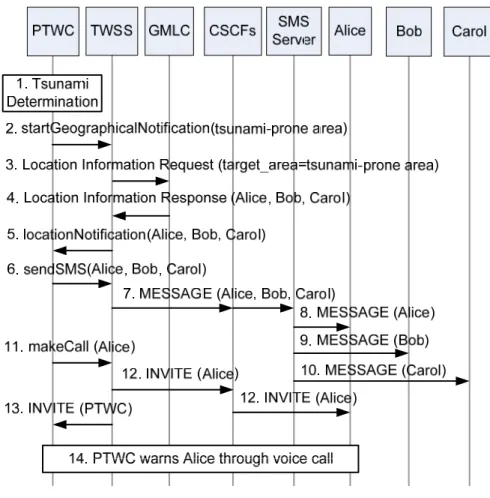
1) PTWC determines the occurrence and affected range of a tsunami. PTWC decides that normal users within 100 kilometers should be notified through voice call (that is, as soon as possible), and normal users within 150 kilometers should be notified through SMS. In this case, Alice will be notified through both voice call and SMS, while Bob and Carol will be notified through only SMS.
2-5) PTWC queries the GMLC for user list with location within tsunami-prone areas (150 kilometers from the epicenter in this example) through TWSS by using Parlay X startGeographicalNotification() and locationNotification(). TWSS translates these two functions to Location Information Request and Location Information Response signals exercised in the mobile core network.
Figure 3. Tsunami Warning Procedure
Figure 3 illustrates the message flow for tsunami warning with the following steps:
6-10) PTWC sends SMS messages to notify users Alice, Bob and Carol through TWSS, CSCF and SMS Server by using Parlay X sendSMS(). Invoking of this function is then translated to SIP MESSAGE signals.
11-14) PTWC sets up a call to Alice through TWSS and CSCF by using Parlay X makeCall().
Invoking of this function is then translated to SIP INVITE signals. After the call is established, PTWC plays announcement to warn Alice to move to higher ground immediately.
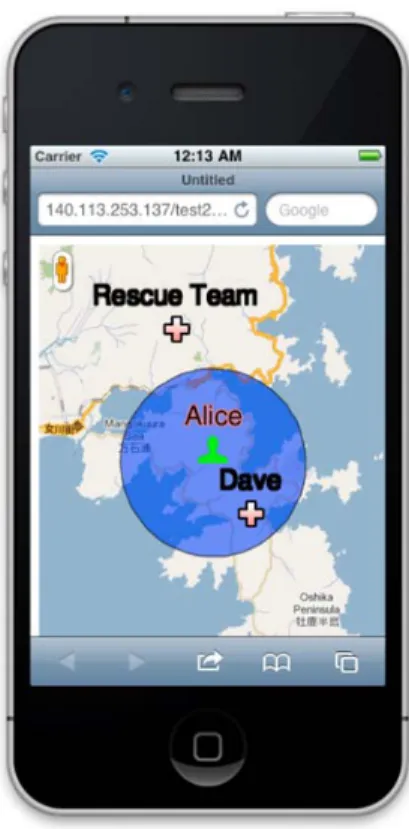
If, unfortunately, Alice is injured when she tries to move to higher ground, she may need medical care immediately. She sets up an emergency call to the PSAP to ask for help. The PSAP requests RMCC to organize a rescue/medical care mission for Alice. RMCC retrieves Alice’s information from xDMS and presence status of FAP/RTMs from PS. RMCC notices that the nearest rescue team is a little far from Alice, and its presence status is busy (i.e., the rescue team may not leave for Alice at once). RMCC also notices that Dave, one of the FAP, is close to Alice, and his presence status is available. RMCC immediately sets up a call to Dave and asks him for helping Alice.
Figure 4. User Interface of Alice’s Smartphone
After confirmation from Dave, RMCC notifies Alice to keep calm and wait for Dave’s help.
Dave’s presence status is updated as busy. If Alice’s mobile phone is a smartphone, she can see Dave approaching her on a map as illustrated in Figure 4. In this figure, the circle indicates distance of 5 km from Alice. Rescue Team is more than 5 km away from Alice, while Dave is within 5 km. If Alice wants, she can communicate with Dave when he is on the way. After helping Alice, Dave’s presence status is updated as available again.
4 Conclusion
Natural disasters have exposed the deficiency of existing emergency communications system. These traditional technologies can not satisfy the critical timing requirements of disaster warning and emergency medical service. In this project, we described an efficient and flexible methodology to develop emergency communications system in next generation mobile networks.
In the proposed system, disaster warning center can directly warn normal users through mobile phones without involvement of mobile operators. When a new mobile service is introduced, it can be supported by the proposed system through simple software update for the Parlay X gateway.
We also proposed a proof-of-concept prototype called “ALLSurvive” to show how to satisfy the critical timing requirement. In this prototype, normal users in disaster-prone areas can be warned through voice calls or SMS messages depending on their locations. When official rescue/medical care teams are far away from victims/injuries or when they are busy, rescue mission control center can search for nearby first aid personnel and ask them to help the victims/injuries.
References
[1] M.R.S. Dilley, B. Chen, U. Deichmann, A. Lerner-Lam and M. Arnold, “Natural Disaster Hotspots: A Global Risk Analysis”, The World Bank, 2005
[2] Pacific Tsunami Warning Center (PTWC), http://ptwc.weather.gov/
[3] R. Chen, V. Shen, T. Wrobel and C. Lin, “Applying SOA and Web 2.0 to Telecom: legacy and IMS Next-Generation Architectures,” IEEE 5th International Conference on e-Business Engineering (ICEBE), 2008
[4] H.-Y. Lee, R. Chen and Y.-B. Lin, “An Internet-mobile platform for NGN/IMS applications,”
IEEE 7th International Conference on e-Business Engineering (ICEBE), 2010
[5] R. Chen, M.-H. Tsai, T. Wrobel, J.-M. Chen, S.-H. Wang, S.-S. Ku, J.-H. Jung, and J.-Y.
Jeng, “When Social Networking Meets the Next Generation Network,” unpublished [6] Y.-B. Lin, M.-H. Tsai and Y.-K. Tu, “IMS Emergency Services: A Preliminary Study,”
IEEE Wireless Communications, 18(1): 6-14, 2011
[7] M.-H. Tsai, Y.-B. Lin and H.-H. Wang, “Active Location Reporting for Emergency Call in UMTS IP Multimedia Subsystem,” IEEE Transactions on Wireless Communications, 8(12):
5837-5843, 2009
[8] A. Hoechner, A. Y. Babeyko and S. V. Sobolev, “Enhanced GPS inversion technique applied to the 2004 Sumatra earthquake and tsunami,” Geophysical Research Letters, 35, L08310, 2008
[9] G. Blewitt, C. Kreemer, W. C. Hammond, H.-P. Plag, S. Stein and E. Okal, “Rapid determination of earthquake magnitude using GPS for tsunami warning systems,”
Geophysical Research Letters, 33, L11309, 2006
[10] R. Samarajiva, “Mobilizing Information and Communications Technologies for Effective Disaster Warning: Lessons from the 2004 Tsunami,” New Media Society 7(6):731–747, 2005
[11] K. Smith and D. N. Petley, “Environmental Hazards: Assessing Risk and Reducing Disaster,”
Routledge, New York, USA, 2009
[12] S. Su and C.-L. Shih, “Modeling an emergency medical services system using computer simulation,” International Journal of Medical Informatics, 72: 57-72, 2003
[13] M.-H. Tsai and Y.-B. Lin, “Talk Burst Control for Push-to-talk over Cellular,” IEEE Transactions on Wireless Communications, 7(7): 2612-2618, 2008