EXPLORING THE LIVEDVD ONLINE SELF-LEARNING SYSTEM EFFECTS ON
ENGLISH LEARNING MOTIVATION
Da-Fu Huang
1Shi-Geng Lin
21
Department of Applied English, Southern Taiwan University of Science & Technology
2
Graduate Institute of Applied English, Southern Taiwan University of Science & Technology
ABSTRACT
This study investigated the effects of the LiveDVD self-learning system on English learning motivation of students at a Taiwanese technical university.
Modeled on the ARCS motivation model of Keller (1987), this study validated the ARCS model, examined the effects of Majors and English Levels on motivation, and tested the proposed structural model involving the effect of the ARCS model on self-assessed English skills. Five hundred and twenty-seven students of three English ability groups completed a survey questionnaire. Statistical procedures including confirmatory factor analysis, factorial ANOVA, and structural equation modeling were performed to address the research questions. The participants were found to have overall positive motivation toward the LiveDVD System in terms of the ARCS model. English Level had significant influence on Attention, with students of Mid and Low-level groups paying more attention to the LiveDVD system than High-level group students. For Satisfaction, aside from the main effect of English Level, the English Level*Major interaction effect was also found to be statistical. For non-engineering majors, students of mid and low English abilities were found to have higher satisfaction with the LiveDVD System than high proficiency students, while for Mid-level groups, non-engineering students had higher satisfaction with the self-learning system than engineering students.
Only Confidence of the ARCS in the proposed structural model was found to have significant effect on English Skill, students with stronger confidence tending to have higher English abilities.
Keywords: LiveDVD, ARCS, English learning motivation
Introduction
1. Motivation and Background
Lack of learning motivation of students, especially those of vocational and technological universities, has long been claimed to cause ineffectiveness of English education in Taiwan.
Teaching approaches geared towards initiating self-directed learning via technology-mediated support with a view to enhancing learning motivation have hence been gaining ascendancy in English learning settings across different educational levels in Taiwan. Multimedia provides variety and excitement to a computer-supported teaching and learning environment, adapting instruction to the diverse learning preferences of students (Zaidel & Luo, 2010). Advanced multimedia instruction heightens visual aspects of communication, provides dynamic learning experiences and raises learning results (Wang, 2008). Multimedia materials such as DVDs and VODs as effective self-directed learning aids enhance students’ comprehension and memory, increase their motivation, and promote their concentration on the content in a near natural environment (Astleitner & Wiesner, 2004; Deimann & Keller, 2006; Guariento & Morley, 2001).
As a good example of self-directed learning aids, the Online VOD Self-learning System, brand named “LiveDVD” and the first of its kind in Taiwan, was set up by Southern Taiwan University of Science & Technology (STUST) to enhance English learning motivation of students.
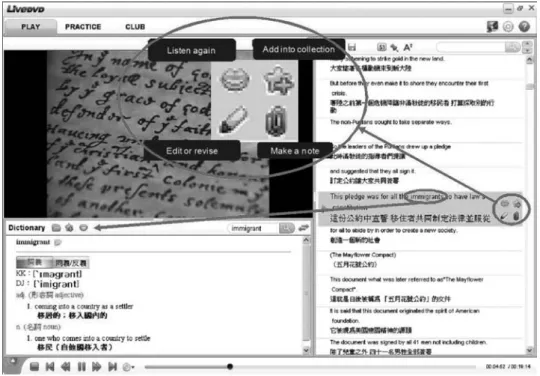
Accessible only within the school campus via the Internet, the LiveDVD system has quite a few strong features, including repeated listening and speaking practice, individualized vocabulary and sentence collection, highlight and word counts of GEPT and TOEIC related vocabulary contained in a VOD, dictionary, target expression searching, English and/or Chinese subtitle display, and online self-assessment, as featured in Figure 1.
Best multimedia, however, would remain useless unless facilitated through an effective mechanism to initiate students into the utmost use, which can be monitored and analyzed through the system management interface, another strong feature of the LiveDVD system. As a course requirement, students viewed designated films based on teachers’ recommendations and students’
voting results. The statistics of students’ use behaviors and preferences of the LiveDVD system were tracked by the system, and reported regularly to the department chairs as well as the English class teachers. English teachers and department heads as well would take action to push those students who fell behind in the LiveDVD learning. Students were also tested on their learning achievement of the assigned films on LiveDVD at the semester end.
2. Purpose of the Study
In an EFL learning environment where the deficient target language input has put the low- motivation technological and vocational students in an even more disadvantageous status of learning English, setting up a useful learning aid such as LiveDVD should be a significant measure to help enhance their English learning motivation. Yet, empirical research is necessary to ascertain whether and how LiveDVD affects learning motivation after students use the self-learning system for a semester, and how learning motivation can possibly affect English ability. This study therefore aims to understand the extent to which LiveDVD affects learning motivation, whether majors and English ability levels have effects on learning motivation, and whether learning motivation affects English skills. Specifically, this study attempts to address the following research questions:
(1) How is the participants’ learning motivation after using LiveDVD for a semester?
(2) Do English ability levels and majors have any effect on students’ learning motivation based on the ARCS model?
(3) Does learning motivation modelled on the ARCS model have an effect on the English skills of the participants?
Figure 1 The LiveDVD system with English self-learning features
Literature Review
Using multimedia to develop learners’ comprehension has been widely investigated in the past decades (Snyder & Colón, 1988; Weyers, 1999). Quite a few studies, in addition, have shown the important role of motivation in language learning, particularly in the successful acquisition of a second language (Gardner & Lambert, 1972; Gardner, 1976; Oxford & Shearin, 1994; Dörnyei, 2001). The following will be devoted to a review of the published research on these two crucial factors in the context of second or foreign language learning.
1. Multimedia
The use of the aid of multimedia, such as DVD, computer, graphics, and broadcast, in the teaching and learning of a language is both common and expected. Several studies have found that a combination of media, such as audio and visual aids can facilitate language learning (Edasawa, Takeuchi, & Nishizaki, 1990; Holobow, Lambert, & Sayegh, 1984; Parry, & Meredith, 1984). Sequential or simultaneous use of a variety of media formats in a given presentation or self-study program also benefits learning (Terrell, 1993). As Liou (1997) noted, learners achieve a better understanding of a given combination of audio with texts. Video films are able to present complete communication situations. When learners simultaneously watch and hear the video films, the information from the screen can help them understand when and where the action is taking place. The combination of sound and vision is dynamic, immediate and accessible (Lonergan, 1992). Kearsely and Marquardt (2001) claimed that the virtual world is more real than the standard classroom because students can access actual life. Besides, their learning activities are realistic.
Multimedia has been widely investigated for teaching language (Astleitner & Wiesner, 2004; Mayer, 1997; Weyers, 1999). For example, multimedia helps learners to gain broad access to oral communications audio visually (Smith, 1997; Willberschied & Berman, 2004).
Moreover, interactive video or materials have changed students from passive observers to active participants (Chavez, 1998; Goh, 2002; Keller, 1983). Teaching with technology designed with both authenticity and uniqueness is capable to create sufficient information to provide learners maximum linguistic and cultural input, and to increase learners’ motivation (Stempleski &
Arcario, 1992). The different aspects of authenticity created by multimedia technology (Rost, 2002) are facilitating to language learning (Kramsch & Andersen,1999), for they provide rich input for the EFL learning environment by integrating phonetic, syntactic, semantic, pragmatic, and socio-cultural features (Guariento & Morley, 2001). Prior literature nevertheless also showed
that multimedia technology, when overused or appropriately embedded into class learning, could bring about negative effects on language learning. Secules, Herron & Tomasello (1992), for instance, pointed out the likely contexts where watching videos could constrain comprehension or acquisition of language skills. Sherman (2003) suggested that teachers not simply play audio visual aids with bilingual subtitles for improvement of EFL learners’ comprehension, but take more time to identify the needs of their students as well. Moreover, Gonzalez (1990) noted that over use of videos could bore students, and that teachers should clearly lay out the listening or viewing objectives to prevent students from minimizing language acquisition.
2. Learning Motivation
Motivation is the crucial factor that urges and maintains behavior overtime. Motivation not only influences how people will devote to their assignment but also makes up for the deficiencies of learners’ learning condition. In language learning, motivation has been recognized as one of the primary factors which affect the success of learning the target language (Dörnyei, 1998).
Positive learning motivation helps learners participate in what they learn, contributes to their progress in mastering a foreign language and helps them build better language ability. On the contrary, passive learning motivation causes resistance to learn. Pintrich, Marx and Boyle (1993) explicated motivation as an internal factor to inspire, guide, and sustain the actions. After interacting with personal characters, motivation will further affect behaviors.
Psychologists also consider motivation as one of the major determinants of academic achievement and work productivity (Keller, 1987). Keller (1979) believed that external conditions could be successfully constructed to facilitate and enhance learners’ motivation on education, and held that most instruction design lacked the intention to motivate. With that in mind, Keller (1984, 1987) integrated several learning theories and developed the ARCS (Attention, Relevance, Confidence, and Satisfaction) model.
In foreign language education, researchers have been investigating the relations between learning motivation and target language achievements for decades. Gardner and Lambert (1972) found that L2 achievements were related to both language aptitude and motivation, and distinguished the integrative and instrumental motivation. Ryan and Deci (2000) proceeded to distinguish extrinsic and intrinsic motivation. Marshall (1987) defined “motivation to learn”
as the meaningfulness, value, and benefits of academic tasks to the learner, and many research studies have shown that intrinsic and extrinsic motivations are related to language learning.
Intrinsic and extrinsic motivations are not opposite, and they are regarded as a continuum (Dörnyei, 2001). Intrinsic motivation is the most self-determined form of motivation (Noels,
Clement, & Pelletier, 2001), and it refers to doing an activity for the inherence satisfaction of the activity itself. Deci and Ryan (1985) emphasized that intrinsic motivation indicated that people who chose what to do in the tasks for their own sake instead of any apparent reward, and the intrinsically motivated behaviors were aimed at bringing about certain internally rewarding consequences, feelings of competence and self-determination. Intrinsic motivation referred to motivation to engage in an activity because that it was enjoyable and satisfying to do, or giving feelings of accomplishment (Lepper, 1988; Noels, Pelletier, Clément, & Vallerand, 2003).
Extrinsically motivated learners, in contrast, learn to pursue external goals such as good grades and satisfying recognition, or some separable outcomes or rewards (Brown, 2000; Lepper, 1988;
Noels, Clément, & Pelletier, 2001).
3. ARCS Motivation Model
Based on a synthesis of motivational concepts and a problem-solving approach, Keller (1979) proposed the ARCS model to address the systematic development and use of motivational instruction, believing that external conditions could be successfully constructed to facilitate and increase learners’ motivation. The ARCS model was designed to be used in conjunction with traditional, cognitive domain instructional design models. The four components of the ARCS model are: Attention, Relevance, Confidence, and Satisfaction. Attention assesses students’
interest and curiosity to the course they learn over time. Relevance assesses how much students feel related to what they study. Confidence describes students’ positive attitudes of achieving success through personal control. Satisfaction checks if students are satisfied with what they learn and can extend their knowledge to future life (Keller, 1983, 1987). An instructional design model based on psychological motivation and proven in numerous studies to be effective (Keller, 1987), the ARCS model provides instructors or instruction designers with motivational aspects of instruction, and has been widely discussed in the prior literature.
Liu (2003), for example, used the ARCS theory to analyze how the designed teaching strategies could possibly arouse students’ learning motivation toward science class. Audio-visual teaching material, science stories telling, and learning environments swift were used to attract learners’ attention. For establishing relevance, teaching materials were designed to incorporate students’ previous experience and examples in daily life. Helping students to set learning goals for themselves and providing specific criteria for evaluation helped increase students’ confidence.
Extrinsic rewards for progress and verbal reinforcement of self-pride then served to strengthen learners’ satisfaction. The students who received ARCS motivation instructional treatment were found to better perform than those who used the traditional material in science class. As another
ARCS-based study employing a multimedia picture book, Ko (2011) examined effects of learning motivation on math achievement. Twenty-two students were assigned to the experimental group and used the picture book in the math lesson for five weeks, and the other twenty-two students were assigned to the control group and took general math instruction. The results showed the experimental group had significantly higher learning motivation and expectations toward mathematics than the control group. In addition, students of experimental group recognized the value of the ARCS motivation model and interactive multimedia books in the math class.
In still another study where a motivation enhanced material was created based on the ARCS model, Wang, Li and Ikeda (2007) reported the motivational approach to revising a programming training self-study material in a university. Sixty students in the motivation enhanced group accomplished significantly more tasks than those who used the traditional material. The significant differences were also found in the posttest average scores and the enhanced group participants’ positive responses concerning their subject understanding and enjoyment levels.
Similarly, Lin (2009) reported the effects of instructional strategies and learners’ goal orientation on elementary school students’ motivation, satisfaction and learning performance within ARCS integrated experiential learning activity. Students who took experiential learning cycle with ARCS model were found to have higher learning motivation in computer courses and possessed positive satisfaction toward the learning activity. Positive effects of the ARCS model were manifested as well in Yen (2010), which aimed to find whether the underachieved students improved their English learning achievement and motivation via the ARCS-based remedial instruction. Eight fourth-grade elementary underachieved students receiving a 14-week remedial English instruction were found to achieve a significant gain in motivation and English learning.
Method
1. Research Design
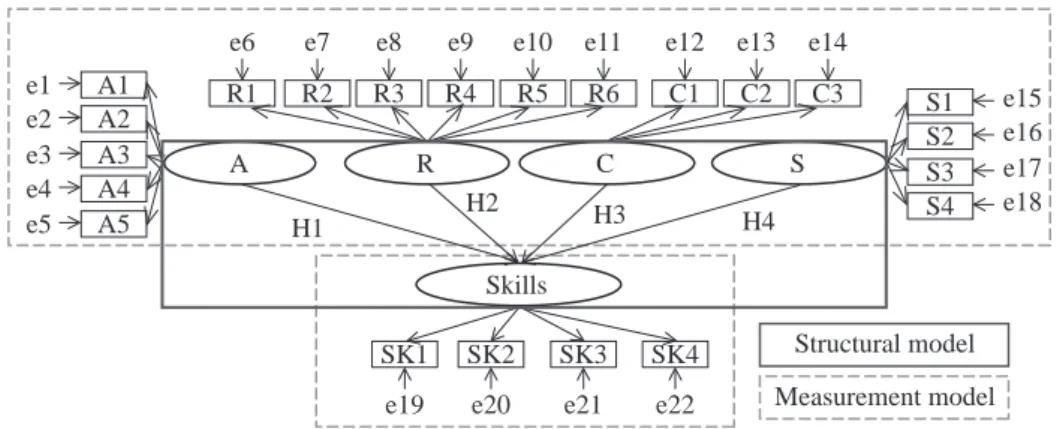
This study employed a questionnaire survey to collect data and performed confirmatory factor analysis as well as structural equation modelling to validate the proposed structural model based on the ARCS model. A learning motivation model was proposed in the study, as represented in Figure 2, which consists of the four components of ARCS (Attention, Relevance, Confidence, Satisfaction) and the component of English Skills. It is hypothesized furthermore in the proposed model that the four components of the ARCS have effects on English Skills.
2. Participant
Twelve classes of first-year non-English major undergraduate students participated in the study by completing the motivation survey. The students were placed at required English classes of three English levels (High, Mid, Low) according to their entry English ability to facilitate English learning. As a class requirement, the students did after-class self-directed English learning by viewing the films at the LiveDVD platform, and were invited to complete the questionnaire on English learning motivation at the end of semester.
3. Instrument
The major research instrument was a survey questionnaire, the Questionnaire on LiveDVD Learning Motivation, designed to investigate students’ learning motivation and their self-assessed English skills after using LiveDVD for a semester. The question items were carefully stated so that the participants can clearly and fully understand each item and give valid responses.
Written in Chinese, the questionnaire was composed of three parts (see Appendix A). The first part collected background information of the participants, such as their registration numbers, departments, and the English proficiency groups where they were placed. The second part had two sections, consisting of a total of 30 questions aimed at understanding participants’ ARCS- based motivation with the use of LiveDVD and the motivational effect on English skills. To elicit responses regarding participants’ English learning motivation, items 1 to 26 in the first section were based on the four components, A (Attention), R (Relevance), C (Confidence), and S (Satisfaction) of Keller’s (1987) ARCS motivation model as well as Keller’s (2010) Instructional Materials Motivation Survey (IMMS). IMMS was designed to measure reactions to
A1 R1
SK1 SK2 SK3 SK4
e19 e20 e21 e22
R2 R3 R4 R5 R6 C1 C2 C3
e6 e7 e8 e9 e10 e11 e12 e13 e14 A2
A3 A4 A5 e1 e2 e3 e4 e5
S1 S2 S3 S4
e15 e16 e17 e18
A R C
Skills
S H1
H2 H3 H4
Structural model Measurement model
Figure 2 The proposed structural equation model
self-directed instructional material, and to be in correspondence with the theories comprising the ARCS motivation model (Keller, 1987). The other four items (27~40) requested participants to self-assess their English skills (writing, reading, listening, and speaking) compared to their entry English ability. The question items were formulated on the six-point Likert scale, ranging from “1”
(Strongly Disagree) to “6” (Strongly Agree). Negatively worded items (6, 7, 20) were reverse coded for data analysis. A Cronbach’s α of 0.94 was obtained, indicating a high reliability and acceptability of the scale.
4. Data Collection and Analysis
The participants were introduced to LiveDVD at the fall semester of 2011, and were required to use LiveDVD to watch at least one designated English movie within a semester. Six hundred and seventy-seven questionnaires were distributed at the end of semester to twelve classes, and with their consent the participants completed the questionnaires in their English classes.
The questionnaire instrument was first piloted on two classes of students and modified to insure a high reliability of the instrument, which was then used in the formal study for data collection. After collection of 527 valid questionnaires, confirmatory factor analysis and reliability analysis were conducted using SPSS 18.0 and AMOS 18.0 to check the convergent and discriminant validity of the instrument to validate the ARCS structural and measurement models. After validation of the scale constructs, descriptive statistics of the questionnaire data was obtained to address research question one. To address research question two, the two-way factorial ANOVA along with the post hoc comparison test was performed via SPSS v.18.0 to obtain the main and interaction effects of Majors and English Levels on the ARCS motivation.
Moreover, structural equation modeling (SEM) using AMOS 18.0 was performed to test the proposed structural model with respect to the effect of the ARCS latent variables on the English Skill latent variable. The results served to respond to research question three.
Result
1. Confirmatory Factor Analysis
Factor analysis employing principal component and Varimax extraction methods extracted five components, cumulatively accounting for ca. 72% of the total variation. With a minimal loading value of 0.60 for each item, a total of 22 question items were loaded on the 5 factors:
Attention (5 items), Relevance (6 items), Confidence (3 items), Satisfaction (4 items), and English Skills (4 items). Table 1 summarizes the extracted factors along with their items, and the cumulative variance accounted for by the five components.
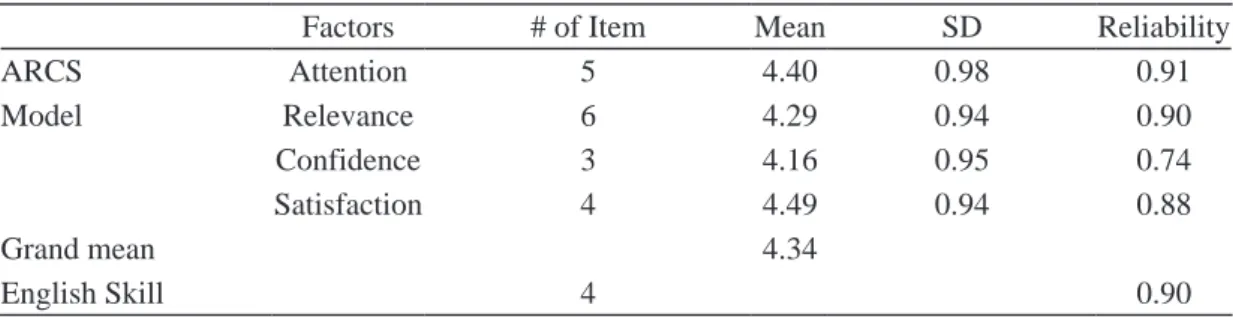
Table 2 indicates a fairly high grand mean of the ARCS model as well as a high mean for each of the 4 motivation dimensions, indicating the participants’ moderate to high motivation toward the self learning via LiveDVD. As shown in Table 2, the reliability of the five factors arrived at a relatively high level except for that of Confidence, which was considered acceptable according to Nunnally (1978).
2. Two-way Factorial ANOVA
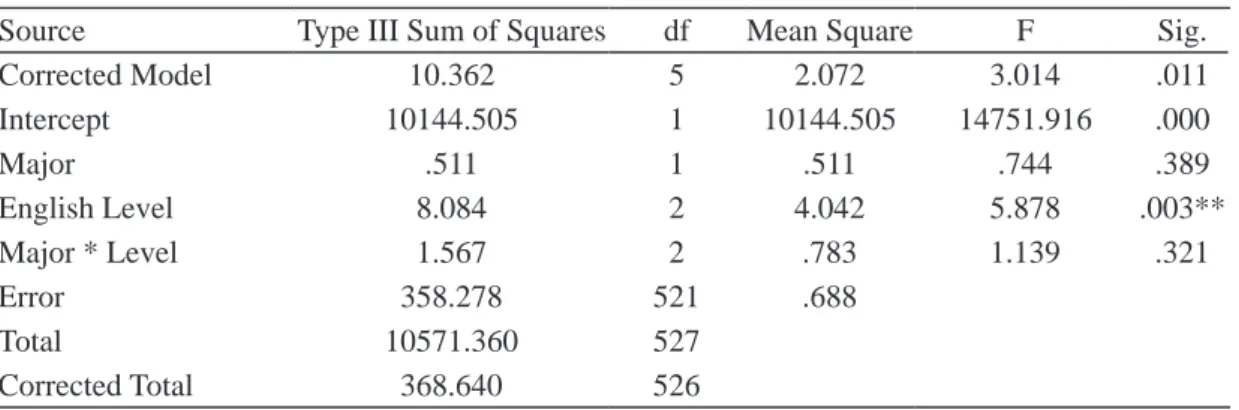
A two-way ANOVA was performed to examine the effects of the variables of Group (or Majors) and English Level on the ARCS Motivation. As shown in Table 3, significant main effect of English Level (F = 5.88, p < .01), and no interaction effect, was found for Attention of ARCS Model. Post-hoc comparison showed Level A to be significantly lower in Attention (p < .05) than
Table 1 Extracted factors and cumulative percentage of variance accounted for
Rotation Sums of Squared LoadingsComponent Items
Total Before Varimax Rotation
Total After Varimax Rotation
% of Variance Cumulative %
Relevance 8/9/10/11/12/13 13.42 4.92 18.24 18.24
Attention 1/2/3/4/5 2.70 4.29 15.87 34.11
Satisfaction 22/23/24/26 1.40 3.94 14.58 48.69
Skills 27/28/29/30 0.98 3.48 12.90 61.59
Confidence 15/18/19 0.89 2.76 10.22 71.81
Table 2 Descriptive statistics and reliability of five extracted factors
Factors # of Item Mean SD Reliability
ARCS Attention 5 4.40 0.98 0.91
Model Relevance 6 4.29 0.94 0.90
Confidence 3 4.16 0.95 0.74
Satisfaction 4 4.49 0.94 0.88
Grand mean 4.34
English Skill 4 0.90
Level B and Level C, with a mean difference of -.26 (p = .012) between Level A and Level B, and a mean difference of -.28 (p = .010) between Level A and Level C.
On the Satisfaction side, the main effect of English Level (F = 7.96, p < .01) and interaction effect between Major and English Level (F = 3.33, p < .05) were also found for Satisfaction of the ARCS Model, as indicated in Table 4.
According to Table 5 below, the simple main effect of Major showed a significant difference (F = 10.346, p = .000) among non-engineering majors, where both Level B and Level C significantly surpassed Level A students in Satisfaction. The simple main effect of English Level showed a significant difference (F = 6.453, p < .05) between non-engineering and engineering majors of Level B, the former significantly surpassing the latter in Satisfaction.
Table 3 Two-way ANOVA for Attention of the ARCS Model
Source Type III Sum of Squares df Mean Square F Sig.
Corrected Model 10.362 5 2.072 3.014 .011
Intercept 10144.505 1 10144.505 14751.916 .000
Major .511 1 .511 .744 .389
English Level 8.084 2 4.042 5.878 .003**
Major * Level 1.567 2 .783 1.139 .321
Error 358.278 521 .688
Total 10571.360 527
Corrected Total 368.640 526
Table 4 Two-way ANOVA for Satisfaction of the ARCS Model
Source Type III Sum of Squares df Mean Square F Sig.
Corrected Model 14.716 5 2.943 4.652 .000
Intercept 10562.019 1 10562.019 16691.946 .000
Major .313 1 .313 .495 .482
English Level 10.075 2 5.037 7.961 .000**
Major * Level 4.216 2 2.108 3.332 .036*
Error 329.669 521 .633
Total 10968.938 527
Corrected Total 344.385 526
3. Structural Equation Modelling
Structural equation modeling can be divided into two parts: a measurement model and a structural model. The measurement model deals with the relationships between observed variables and latent variables. In more specific terms, the measurement model aims to establish the relationship between the measured and the latent variables, primarily through confirmatory factor analysis to validate a measurement scale. The structural model, on the other hand, tests the hypotheses regarding causal relationships between latent variables through path analyses, and explores the fit statistics of a structural model. In compliance with recommendations of Anderson and Gerbing (1988), the SEM analytical procedures were divided into two phases in this study.
In the first stage, the confirmatory factor analysis and the Cronbach’s alpha coefficient analysis of each dimension and question item were performed to validate the convergent validity and discriminant validity of the scale, and hence the measurement model. In the second phase, the proposed structural model was tested to verify the causal relationships between latent variables, and examine the overall structural model fit.
3.1 Convergent validity
The Maximum Likelihood Estimation method was employed via AMOS 18.0 to obtain the Composite Reliability (CR) and the Average Variance Extracted (AVE) of each dimension.
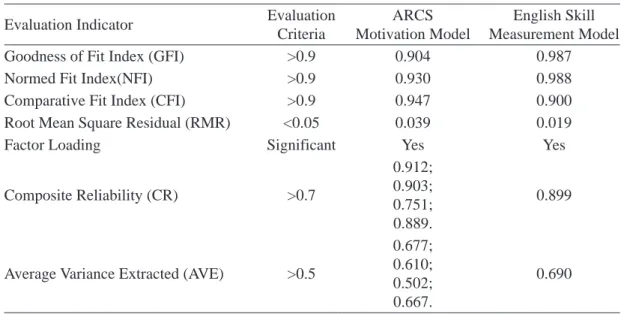
The first measurement model validated for convergent validity was the ARCS motivation model. As summarized in Table 6, the essential criteria proposed by Bagozzi and Yi (1988) for assessing convergent validity were all met by the model; the RMR being 0.04 (< 0.05), and
Table 5 Simple main effect of Major and English Level on Satisfaction of the ARCS Model
Sum of Squares df Mean Square F Sig Post Hoc
Major
Engineering
1.092 2 .546 .878 .417Non-engineering 13.318 2 6.659 10.346 0.000**
Level B > Level A, Level C > Level A
English LevelLevel A
1.156 1 1.156 1.531 .218Level B
3.418 1 3.418 6.453 .012*Non-engineering >
Engineering
Level C
.080 1 .080 .128 .721the GFI, NFI, CFI, 0.90, 0.93, 0.95 respectively. All the components of the ARCS motivation model remained internally consistent. In addition, as shown in Table 6, the factor loading of each variable was significant and higher than 0.50, the CR of each dimension was over 0.70, and the AVE of each dimension was higher than 0.50. As to the convergent validity for the English Skill measurement model, all the criteria were also satisfied as shown in Table 6.
3.2 Discriminant validity
In this study, the discriminant validity was evaluated in light of two criteria proposed by Gaski and Nevin (1985). First, the correlation coefficient of two dimensions should be less than one. Second, if the correlation coefficient of two dimensions is lower than the Cronbach’s alpha reliability coefficient, it indicates discriminant validity between these two dimensions. A third criterion to test discriminant validity was proposed complying with the approach of Fornell and Larcker (1981). If the correlation coefficient of two dimensions is lower than the square root of AVE, it indicates these two dimensions have discriminant validity. Correlations of the five factors were compared with the CR and square root of AVE, and as shown in Table 7, the five components of the structural model were also shown to have adequate discriminant validity complying with the afore-mentioned criteria.
Table 6 Estimates of Convergent Validity of the ARCS Model
Evaluation Indicator Evaluation
Criteria
ARCS Motivation Model
English Skill Measurement Model
Goodness of Fit Index (GFI) >0.9 0.904 0.987
Normed Fit Index(NFI) >0.9 0.930 0.988
Comparative Fit Index (CFI) >0.9 0.947 0.900
Root Mean Square Residual (RMR) <0.05 0.039 0.019
Factor Loading Significant Yes Yes
Composite Reliability (CR) >0.7
0.912;
0.903;
0.751;
0.889.
0.899
Average Variance Extracted (AVE) >0.5
0.677;
0.610;
0.502;
0.667.
0.690
3.3 Validation of the structural model 3.3.1 Overall model fit
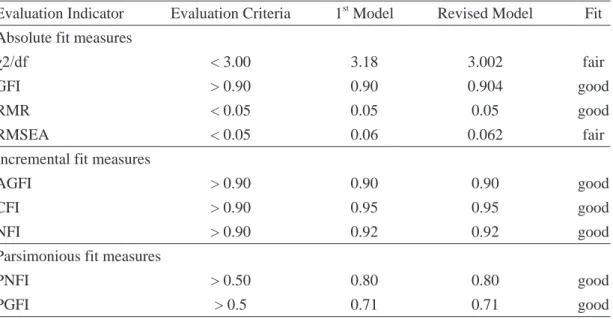
The overall model fit criteria were used to assess whether overall the model fits the sample data. There were various indices for model fit measurement, which had been classified by Hair, Black, Babin, Anderson and Tatham (2006) into three types: absolute fit measures, incremental fit measures and parsimonious fit measures. Absolute fit measures, such as Chi-square statistic, Goodness-of-fit Index (GFI), Root mean square residual (RMR) and Root Mean Square Error of Approximation (RMSEA), were used to determine whether the overall model could predict covariance matrix distribution. Incremental fit measures, such as Adjusted Goodness of Fit Index (AGFI), Normed Fit Index (NFI) and Comparative Fit Index (CFI), were used to assess model fit. Parsimonious Normed Fit Index (PNFI) and Parsimonious Goodness-of-Fit Index (PGFI) of Parsimonious fit were used to adjust model measurement to decide the fit level achieved.
Table 8 indicated the measures of the three types of model fit indices. Overall, the measures of the first model met the evaluation criteria except for χ2/df, GFI, RMSEA and AGFI, which did not satisfy but came very close to the desired value of the index. Following the suggestion of Chiou (2003) to improve the overall model fit through indications of Modification Index (MI), an error covariance between two error terms (e8 and e9) was added to the first model. The modification resulted in fit measures which were much closer to the suggested criteria, and hence a fair to good result in terms of the overall model fit assessment.
3.3.2 The structural model
After validating the validity and reliability of the measurement models and achieving an adequate model fit, the proposed hypotheses were tested to ascertain the effects of the ARCS model on English Skill. The regression coefficients of path analyses were used for testing the
Table 7 Correlations, CR, and AVE of the structural model components
Attention Relevance Confidence Satisfaction English Skill CR AVE
Attention 0.823 0.912 0.677
Relevance 0.718 0.781 0.903 0.610
Confidence 0.525 0.636 0.709 0.751 0.502
Satisfaction 0.75 0.71 0.555 0.817 0.889 0.667
English Skill 0.318 0.397 0.445 0.339 0.831 0.899 0.690
Cronbach’s
α
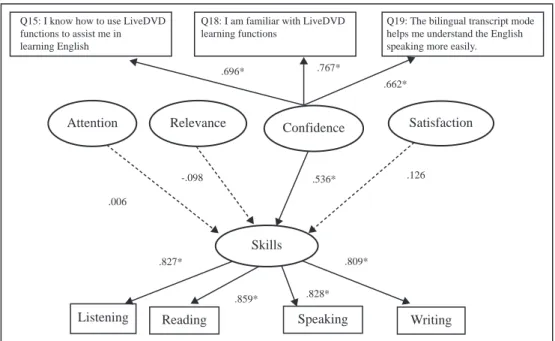
0.908 0.9 0.744 0.884 0.898hypotheses of the present study (as represented in Figure 1), and the results of path coefficients of the structural model and corresponding hypotheses were presented in Table 9 and Figure 3.
The expected relationship between confidence and self-evaluated skills showed a positive and strong correlation, and thus Hypothesis 3 was supported. However, for the remaining three paths, the direct effects of Attention, Relevance, and Satisfaction on Skills were not statistical, and thus not supported.
The relationships among the latent variables of the proposal structural model were illustrated in Figure 3, which showed the results of the direct and indirect effects of the proposed model between each factor of ARCS motivation model and English Skill. The solid line along with coefficients represented a statistical estimate, and the non-statistical estimates were indicated through dashed lines.
Table 8 Overall Model Fit Measures of the Proposed Model
Evaluation Indicator Evaluation Criteria 1st Model Revised Model Fit Absolute fit measures
χ2/df < 3.00 3.18 3.002 fair
GFI > 0.90 0.90 0.904 good
RMR < 0.05 0.05 0.05 good
RMSEA < 0.05 0.06 0.062 fair
Incremental fit measures
AGFI > 0.90 0.90 0.90 good
CFI > 0.90 0.95 0.95 good
NFI > 0.90 0.92 0.92 good
Parsimonious fit measures
PNFI > 0.50 0.80 0.80 good
PGFI > 0.5 0.71 0.71 good
Table 9 Summary of hypotheses results
Hypothesized path Standardized Regression Weights Estimate t-value Results
H1:Attention→Skills 0.006 0.055 NH Not Rejected
H2:Relevance→Skills -0.098 -0.905 NH Not Rejected
H3:Confidence→Skills 0.536*** 6.045 NH Rejected
H4:Satisfaction→Skills 0.126 1.26 NH Not Rejected
Discussion
The participants’ fairly positive attitude toward LiveDVD System suggested that the online self-learning system is a worthwhile resource for students. However, Mid and Low-level students tended to have higher attention to, and higher satisfaction with, the learning system than High- level students, implying that while boosting the learning motivation of lower-achievement students is important, the system may need to be modified in the designing of learning features to appeal to higher-achievement students too. The precedence of Mid and Low-level over High- level students in attention and satisfaction also raised the issue of the credibility of the placement test, which might have placed medium proficiency students into High-level Group, and reversely, High-level students into Mid-level Group. Particular attention should be focused on the placement of incoming students who were not admitted into the university through the regular recruitment channel requiring the vocational and technological college entrance examination on English. To place into proper ability classes those students without the score report of the college entrance English examination, a placement test therefore should be developed by STUST, which however was not as reliable as the entrance examination. Instead of a written test with only multiple choice items, listening and oral tests can also be given to attain a better
Attention Relevance
Skills
Confidence Satisfaction
Listening Reading Speaking Writing
Q15: I know how to use LiveDVD functions to assist me in learning English
Q18: I am familiar with LiveDVD learning functions
Q19: The bilingual transcript mode helps me understand the English speaking more easily.
.696* .767*
.662*
.536* .126 -.098
.006
.827* .809*
.828*
.859*
Figure 3 The structural equation model with parameter estimates
estimate of students’ English proficiency and hence a more reliable placement result. Aside from improvement of the placement test, teachers of High-level classes could highlight the useful features of the learning system, and guide them to utilize the features in a way that would benefit the higher-achievement students most. This implication seems to be particularly relevant for non- engineering students given the finding that Mid-level and Low-level non-engineering students were more satisfied with the learning system than High-level counterparts. A more practical strategy for appropriate and meaningful placement can be considered to place students into two ability levels for engineering or non-engineering students if no wide enough range of English ability is evident among them.
As to the validation of the ARCS model, only Confidence was found to have direct effect on students’ English ability, reflecting the important role of self-confidence in the learning process of technological and vocational university students, who tended to have lower learning motivation and lower self-confidence as well. Relative to the other constructs of the ARCS model, Confidence was found to be the most prominent dimension that would influence students’
perceived English ability required in doing self-access learning in the EFL learning contexts. On the other hand, students’ self-confidence in English ability was to a great extent also affected by their perceived familiarity with or facility of the learning features of the online self-learning system. This research thus called attention to the reinforcement of self-directed learning resources with user-friendly, customized, and practical features to build students’ confidence in using the available resources, which would affect their perceived English learning progress and eventually learning motivation.
Conclusion and Implication
This study investigated the technological university students’ motivation of using LiveDVD Self-learning System by testing an ARCS measurement model and a structural model comprising the latent variables of ARCS and English Skill. The results of the study indicated an English Level effect on Attention, and a Major effect as well as a Major*English Level interaction effect on Satisfaction, High-level students being less attentive to and satisfied with the online self- learning system. Several implications of these findings are in order. First, it is necessary to improve the placement test reliability and validity to insure placing students into appropriate classes on the basis of their actual English abilities. In addition, the teaching plan for High- level classes should be modified to address how the learning resources can be best utilized by
higher-achievement students to cater to their learning needs. More important, Confidence was validated to be the sole construct of the ARCS motivations that would influence English ability, a result that highlights the critical need of constructing self-directed learning resources in a way that would facilitate student utilization to inspire self-confidence. The results of this research are significant and applicable to technological and vocational higher education institutions in Taiwan with similar student backgrounds for purposes of English education reform and curriculum improvement.
References
Anderson, J. C., & Gerbing, D. W. (1988). Structural equation modeling in practice: A review and recommended two-step approach. Psychological Bulletin, 103(3), 411-423.
Astleitner, H., & Wiesner, C. (2004). An integrated model of multimedia learning and motivation.
Journal of Educational Multimedia and Hypermedia, 13(1), 3-22.
Bagozzi, R. P., & Yi, Y. (1988). On the evaluation of structural equation models. Journal of the
Academy of Marketing Science, 16(1), 74-94.
Brown, H. D. (2000). Principles of language teaching and learning. New York, NY: Longman.
Chavez, M. M. T. (1998). Learner’s perspectives on authenticity. IRAL-International Review of
Applied Linguistics in Language Teaching, 36(4), 277-306.
Chiou, H. J., (2003). Structural equation modeling: theory, technology and application of
LISREL. Taipei: Yeh Yeh Book Gallery.
Deci, E. L., & Ryan, R. M. (1985). The general causality orientations scale: Self-determination in personality. Journal of Research in Personality, 19(2), 109-134.
Deimann, M., & Keller, J. M. (2006). Volitional aspects of multimedia learning. Journal of
Educational Multimedia and Hypermedia, 15(2), 137-158.
Dörnyei, Z. (1998). Motivation in second and foreign language learning. Language Teaching,
31(3), 117-135.
Dörnyei, Z. (2001). Motivation strategies in the language classroom. Cambridge, England:
Cambridge University Press.
Edasawa, Y., Takeuchi, O., & Nishizaki, K. (1990). Use of films in listening comprehension practice. IALL Journal of Language Learning Technology, 23(3), 21-34.
Fornell, C., & Larcker, D. F. (1981). Structural equation models with unobservable variables and measurement error: algebra and statistics. Journal of Marketing Research, 18(3), 382-388.
Gardner, R. C. (1976). Second language learning: A social psychological perspectives. Canadian
Modern Language Review, 32(3), 198-213.
Gardner, R. C., & Lambert, W. E. (1972). Attitudes and motivation in second language learning.
Rowley, Mass.: Newbury House.
Gaski, J. F., & Nevin, J. R. (1985). The differential effects of exercised and unexercised power sources in a marketing channel. Journal of Marketing Research, 22(2), 130-142.
Goh, C. C. M. (2002). Exploring listening comprehension tactics and their interaction patterns.
System, 30(2), 185-206.
Gonzalez, A. (1990). Video materials production and use in intensive language instruction: The experience of the University of South Carolina’s Master’s in international business program.
ProQuest Education Journal, 23, 769-785.
Guariento, W., & Morley, J. (2001). Text and task authenticity in the EFL classroom. ELT
Journal, 55(4), 347-353.
Hair, J. F., Black, W. C., Babin, B. J., Anderson, R. E., & Tatham, R. L. (2006). Multivariate data
analysis (6th Ed.). Upper Saddle River, NJ: Prentice-Hall.
Holobow, N. E., Lambert, W. E., & Sayegh, L. (1984). Pairing script and dialogue: Combinations that show promise for second or foreign language learning. Language Learning, 34(4), 59- 74.
Kearsley, G., & Marquardt, M. J. (2001). Info structures: Technology, learning and organizations.
Web-Based Training, 27-32.
Keller, J. M. (1979). Motivation and instructional design: A theoretical perspective. Journal of
Instructional Development, 2(4), 26-34.
Keller, J. M. (1983). Motivational design of instruction. In C. M. Reigeluth (Ed.), Instructional
design theories and models: an overview of their current status (pp. 384-434). Hillsdale, NJ:
Lawrence Erlbaum Associates.
Keller, J. M. (1984). The use of the ARCS model of motivation in teacher training. Aspects of
Educational Technology, 17, 140-145.
Keller, J. M. (1987). Development and use of the ARCS model of motivational design. Journal of
Instructional Development, 10(3), 2-10.
Keller, J. M. (2010). Motivational design for learning and performance: The ARCS model
approach. New York, NY: Springer.
Kramsch, C., & Andersen, R. W. (1999). Teaching text and context through multimedia.
Language Learning & Technology, 2(2), 31-42.
Ko, W. J. (2011). The Effects of Integrating the ARCS Motivation Model and the Interactive
Multimedia Picture Book on Teaching Elementary School Mathematics (Unpublished
master’s thesis). Tunghai University, Taiwan.Lepper, M. R. (1988). Motivational considerations in the study of instruction. Cognition and
Instruction, 5(4), 289-309.
Lin, C. Y. (2009). The Effects of Instructional Strategies and Goal Orientation on Elementary
School Students within an ARCS Integrated Experiential Learning Activity (Unpublished
master’s thesis). National Taiwan Normal University, Taiwan.Liou, H. C. (1997). Exploring multimedia in the classroom: Insights and implications from some empirical research. In G. M. Jacobs (Ed.), Language classrooms of tomorrow: Issues and
responses. Anthology 38 (pp. 118-133). Singapore: SEAMEO Regional Language Centre.
Liu, H. Y. (2003). The Learning Motivational Strategies of the Science Teacher to Arouse the
Students in the Elementary School (Unpublished master’s thesis). National Pingtung
University of Education, Taiwan.Lonergan, J. (1992). Using a video camera to evaluate learners’ classroom performance. In S.
Stempleski, & P. Arcario (Eds.), Video in Second Language Teaching: Using, Selecting, and
Producing Video for the Classroom (pp. 93-105). Alexandria, VA: TESOL.
Marshall, H. H. (1987). Motivational Strategies of Three Fifth-Grade Teachers. The Elementary
School Journal, 88(2),135-150.
Mayer, R. E. (1997). Multimedia learning: Are we asking the right questions? Educational
Psychologist, 32(1), 1-19.
Noels, K. A., Clément, R., & Pelletier, L. G. (2001). Intrinsic, extrinsic, and integrative orientations of French Canadian learners of English. Canadian Modern Language Review,
57(3), 424-442.
Noels, K. A., Pelletier, L. G., Clément, R., & Vallerand, R. J. (2003). Why are you learning a second language? motivational orientations and self determination theory. Language
Learning, 53(S1), 33-64.
Nunnally, J. C. (1978). Psychometric Theory (2nd Ed.). New York, NY: McGraw-Hill.
Oxford, R., & Shearin, J. (1994). Language learning motivation: expanding the theoretical framework. The Modern Language Journal, 78(1), 12-28.
Parry, T. S., & Meredith, R. A. (1984). Videotape vs. audiotape for listening comprehension tests:
An experiment. OMLTA Journal, 47-53.
Pintrich, P. R., Marx, R. W., & Boyle, R. A. (1993). Beyond cold conceptual change: The role of motivational beliefs and classroom contextual factors in the process of conceptual change.
Review of Educational Research, 63(2), 167-199.
Rost, M. (2002). Teaching and researching listening. Upper Saddle River, NY: Pearson Education Limited.
Ryan, R. M., & Deci, E. L. (2000). Intrinsic and extrinsic motivations: Classic definitions and new directions. Contemporary Educational Psychology, 25(1), 54-67.
Secules, T., Herron, C., & Tomasello, M. (1992). The effect of video context on foreign language learning. The Modern Language Journal, 76(4), 480-490.
Sherman, J. (2003). Using authentic video in the language classroom. Cambridge, England:
Cambridge University Press.
Snyder, H. R., & Colón, I. (1988). Foreign language acquisition and audio-visual aids. Foreign
Language Annals, 21(4), 343-348.
Smith, B. (1997). Virtual Realia. The Internet TESL Journal, 3(7), 1-5.
Stempleski, S., & Arcario, P. (1992). Video in second language teaching: Using, selecting, and
producing video for the classroom. Alexandria, VA: Teachers of English to Speakers of
Other Languages (TESOL), Inc.Terrell, T. D. (1993). Comprehensible input for intermediate foreign language students via video.
IALL Journal of Language Learning Technologies, 26(2), 17-23.
Wang, L. (2008). Developing and evaluating an interactive multimedia instructional tool:
Learning outcomes and user experiences of optometry students. Journal of Educational
Multimedia and Hypermedia, 17(1), 43-57.
Wang, W., Li, F., & Ikeda, M. (2007). Proposal and evaluation of the “Motivation-Oriented”
teaching method in programming education. Japan Journal of Educational Technology,
31(3), 349-357
Weyers, J. R. (1999). The effect of authentic video on communicative competence. The Modern
Language Journal, 83(3), 339-349.
Willberschied, L., & Berman, P. M. (2004). Effect of using photos from authentic video as advance organizers on listening comprehension in an FLES Chinese class. Foreign
Language Annals, 37(4), 534-540.
Yen, S. C. (2010). An action study of appling “ ARCS motivation model” in English remedial
instruction for underachieved students in an elementary school (Unpublished master’s
thesis). National Taichung University of Education, Taiwan.Zaidel, M., & Luo, X. H. (2010). Effectiveness of multimedia elements in computer supported instruction: Analysis of personalization effects, students’ performances and costs. Journal of
College Teaching & Learning (TLC), 7(2), 11-16.
作者簡介
黃大夫,南臺科技大學應用英語系,副教授(通訊作者)
Da-Fu Huang is an Associate Professor of Department of Applied English, Southern Taiwan University of Science & Technology, Tainan, Taiwan. (Corresponding Author)
林詩耕,南臺科技大學應用英語研究所,研究生
Hung-Chun Chen is a Master Student of the Graduate Institute of Applied English, Southern Taiwan University of Science & Technology, Tainan, Taiwan.
收稿日期:民國102年12月31日 修正日期:民國103年03月27日 接受日期:民國103年03月28日
Appendix A
The Questionnaire on LiveDVD Learning Motivation
Dear students,
This questionnaire serves to investigate the college freshmen’s English learning motivation, and self-evaluated skills after using LiveDVD. For this questionnaire, there is no “right” or “wrong” answer. Please rest assured that all your responses will be used for academic research only. Please truthfully respond to the question items based on what you think is true about your current status.
Thank you very much for your assistance.
Background information 1. Student’s ID:
2. College: □ Engineering □ Non-Engineering
3. English proficiency: □ Group A □ Group B □ Group C
Item. ARCS motivation model: Attention
Strongly disagree Disagree Somewhat disagree Somewhat agree Agree Strongly agree
1 Using LiveDVD to learn English is full of interest.
2 LiveDVD is competent to fulfill my requirements of entertainment and learning English.
3 LiveDVD raises my motivation of learning English.
4 I want to keep using LiveDVD because it supplies sufficient movies.
5 The content of movies can help me to concentrate.
6 The format of subtitles in LiveDVD distracts my attention.
7 Using LiveDVD is boring and without attraction.
Item ARCS motivation model: Relevance
Strongly disagree Disagree Somewhat disagree Somewhat agree Agree Strongly agree
8 To learn English by watching movies matches my hobbies.
9 To learn English by using LiveDVD matches my expectations of learning English.
10 To use LiveDVD is helpful for English learning.
11 To use LiveDVD is helpful for me to learn English in future.
12 I try to use the sentences or vocabularies which I learned from LiveDVD in my daily life.
13 LiveDVD offers an authentic phenomenon of English conversation and it is very important for learning English 14 LiveDVD is able to inspire my desire of learning
English.
Item ARCS motivation model: Confidence
Strongly disagree Disagree Somewhat disagree Somewhat agree Agree Strongly agree
15 I know how to utilize the extra functions of LiveDVD to assist me to learn English (for example: dictionary).
16 I am confident that LiveDVD can help me to learn English well.
17 LiveDVD contributes to my confidence of learning English.
18 I am familiar with the functions provided by LiveDVD.
19 It helps me easily get the point by playing both Chinese and English captions at the same time.
20 I am not familiar with all functions provided by LiveDVD
Item ARCS motivation model: Satisfaction
Strongly disagree Disagree Somewhat disagree Somewhat agree Agree Strongly agree
21 I hope to remain using LiveDVD to help my English learning.
22 I like to watch movies through LiveDVD in order to learn English.
23 To use LiveDVD is my first choice in the self-learning center.
24 Using LiveDVD makes me feel pleasure.
25 I like to devote myself on using LiveDVD.
26 LiveDVD provides me a different experience of learning English.
Item Self-evaluated skills
Strongly disagree Disagree Somewhat disagree Somewhat agree Agree Strongly agree
27 In comparison with semester beginning, my English listening ability is better.
28 In comparison with semester beginning, my English oral conversation ability is better.
29 In comparison with semester beginning, my English reading ability is better.
30 In comparison with semester beginning, my English writing ability is better.
LiveDVD 線上影片英語自學系統對 英文學習動機影響之探討
黃大夫
1林詩耕
21
南臺科技大學應用英語系
2
南臺科技大學應用英語研究所
摘 要
本文探討 LiveDVD 線上影片學習系統對科大學生英文學習動機之影 響。本文主要以 Keller (1987) 之 ARCS 學習動機模型為基礎,提出英文能 力與四個動機因素關係之結構模型,並利用驗證性因素分析與結構方程統計 方法來檢視該模型之配適度。此外,本文也利用多因子變異數分析探討學生 之主修與能力分級是否在四個動機因素呈現顯著差異。527 位科大學生有效 完成填寫一份問卷,結果發現:(一) 學生對 LiveDVD 系統之四個動機因素
整體都呈現正向結果;(二) 在注意力因素部分,中與低能力組學生顯著大於
高能力組;(三) 在滿意度因素方面,除了有顯著英文能力等級主要效果外,
英文能力等級與主修變數也有顯著交互作用效果;在非工科學生方面,中與 低能力等級學生對 LiveDVD 滿意度大於高能力等級學生;另外,在中能力 等級學生而言,非工科學生對 LiveDVD 滿意度高於工科學生;(四) 在所提 結構模型配適度驗證方面,只有信心潛在變數對學生英文能力有顯著影響,
信心愈高則自評英文能力愈高。