行政院國家科學委員會專題研究計畫 成果報告
MgSiO3-CaSiO3-FeSiO3 輝石之弹性性質及行為在高溫高壓 下之研究
研究成果報告(精簡版)
計 畫 類 別 : 個別型
計 畫 編 號 : NSC 94-2119-M-006-007-
執 行 期 間 : 94 年 12 月 01 日至 95 年 10 月 31 日 執 行 單 位 : 國立成功大學地球科學系(所)
計 畫 主 持 人 : 龔慧貞
計畫參與人員: 博士班研究生-兼任助理:汪金寶
碩士班研究生-兼任助理:黃瀚偉、林崎堉、王婉琳
報 告 附 件 : 國外研究心得報告
出席國際會議研究心得報告及發表論文
處 理 方 式 : 本計畫可公開查詢
中 華 民 國 96 年 02 月 11 日
行政院國家科學委員會補助專題研究計畫
MgSi -CaSi -FeSi 輝石之弹性性質及行為在高溫高壓下之研究O3 O3 O3
計畫類別:個別型計畫
計畫編號:NSC 94-2119-M-006-007-
執行期間: 94 年 12 月 01 日至 95 年 10 月 31 日
計畫主持人:龔慧貞
計畫參與人員: 汪金寶、黃瀚偉、林崎堉、王婉琳 成果報告類型(依經費核定清單規定繳交):■精簡報告
本成果報告包括以下應繳交之附件:
■赴國外出差或研習心得報告一份 執行單位:成功大學地球科學
中 華 民 國 96 年 2 月 13 日 關鍵詞(keywords): Pyroxene, mantle, high pressure, elasticity
輝石、地函、高溫及高壓、彈性性質、合成
I
中文摘要
雖然地球內部結構可直接由地震波波 速及密度-深度剖面來決定。然而,地球內 部成份及溫度梯度必須配合實驗所得數據 來解釋,尤其是構成地函(mantle)礦物相的 彈性性質數據。近來由於彈性波波速的測量 技術與高壓技術的結合,使得許多地函礦物 相在高壓、高溫下的彈性性質可以在實驗室 中已被測量,例如:橄欖石(olivine)及其 高壓相 (wadselyite, ringwoodite)、石榴 子石(garnet)、鈣鈦礦(perovskite)結構矽 酸鹽等相。而在這些地函礦物組成的資料 中,輝石(pyroxenes)之彈性性質在高溫、
高壓之下的資料最為缺乏。其資料已成為檢 測前人文獻中不同的地函組成模型的重要 依據,因此輝石之彈性性質研究有其迫切與 必 需 性 。 本 計 劃 將 著 重 於 MgSiO3-CaSiO3-FeSiO3輝石系列的彈性性質 研究。藉由這些研究結果可瞭解相變時彈性 行為所對應的晶體結構改變。此期計劃進度 將報告輝石樣品之合成。
關鍵字:輝石、地函、高溫及高壓、彈性性 質、合成
英文摘要
Seismological studies provide the most direct observation of the structure of the Earth's interior. However, the composition and the temperature of the Earth must be constrained by the measured laboratory data.
Elastic properties of mantle minerals are crucial in constructing accurate velocity-depth profiles for candidate mantle compositions and placing constraints on the composition of the Earth’s mantle by comparing with the characteristic features observed in seismic wave velocities. This project will utilize the MHz/GHz ultrasonic interferometry interfaced with multi-anvil pressure/DAC (diamond anvil cell) to study the elastic properties of pyroxene at high pressures and high temperatures. This proposal is focused on the study of elastic properties of system MgSiO3-CaSiO3-FeSiO3 pyroxenes. This report presented the synthesis of pyroxene specimens at first stage for the ultrasonic measurements.
Keyword: Pyroxene, high pressure and high temperature, mantle, elasticity, synthesis
前言
The most direct petrological evidence for the composition and mineralogy of the mantle is from the compositions of basaltic magma and from the xenoliths in kimberlite pipe. These specimens have demonstrated the mineral phases of upper mantle to be a combination of olivine, pyroxene and garnet. However, the known depth of these rock specimens only extends down to 200 km deep roughly. The petrological models below 200 km of Earth mantle are relying on the experimental demonstrations. Another issue arises which composition model can interpret the physical properties of the mantle.
Fortunately, the seismological observations provide the most direct information concerning the physical state of the Earth deep interior; the variation of wavespeeds and density as functions of depth. Interpretation of such seismic profiles provides constraints on the composition, mineralogy and temperature distribution of the interior of the Earth. A pioneer work of Birch (1952) provides a strategy to interpret the composition of the Earth interior based on mineral elasticity. With the mantle phases identified and their proportions established by experiments, the compositional models can be tested using the elastic properties of the mantle phases.
研究目的
In order to test the compositional models of the Earth mantle using the seismological observations, the elasticity of candidate mantle phases have to be measured in the laboratory as functions of pressure and temperature. Recent developments of acoustic
techniques in large volume high-pressure apparatus and diamond anvil cells have made possible to measure the elasticity of materials at high pressure and/or high temperatures.
The pressure and temperature derivatives of the elastic moduli are essential for constructing precise mineralogical models for Earth’s mantle (e.g. Bina and Wood, 1987;
Weidner, 1985; Rigden et al, 1992; Duffy and Anderson, 1989; Ita and Stixrude, 1992).
The main minerals of Earth’s upper mantle are believed to be olivine, orthopyroxene, clinopyroxene and garnet; different models attribute varying amounts of these minerals to the upper mantle. Previous studies have arrived at differing conclusions regarding the olivine content of Earth’s upper mantle; from 60% to near or below 40% (Bass and Anderson, 1984; Weidner and Ito, 1987; Duffy and Anderson, 1989; Ita and Stixrude, 1992;
Li et al., 2001). In these mineralogical models, the pyroxene (ortho- and clino-) component is varying from less 20% up to near 40%. Among these mantle phases, the pyroxenes are the least studied. Lacks of the elasticity measurements at high pressure and temperature, the discussions of the physical state of the upper mantle (Goes et al., 2000;
Röhm et al., 2000; Cammarano et al., 2003) have used the temperature and pressure derivatives of pyroxenes (i.e. orthoenstatite and diopside) concluded from the systematic studies (Anderson, 1988; Duffy and Anderson, 1989). Using the assumed elastic properties of pyroxenes, it noted that for upper-mantle composition models and depths, the relative sensitivity of elastic velocities to temperature and composition is not sufficient to distinguish the temperature and compositional factors (e.g., Röhm et al., 2000; Cammarano et al., 2003). Thus, it is important to
2
measure the mantle composition pyroxenes to identify the composition model of upper mantle.
文獻探討
Up to date, the elastic properties of pyroxenes have been measured spanned a wide range of mantle compositions but limited at ambient conditions, including Cr-bearing diopside (CaMgSi2O6) (Levin et al., 1979;
Isaak et al., 2003), jadeite (NaAlSi2O6) (Kandelin and Weidner, 1988), Hedenbergite (Kandelin and Weidner, 1988) and Omphacite (Bhagt et al., 1992). The high pressure elasticity measurements of pyroxene are mainly limited on orthoenstatite component ((Mg, Fe)SiO3, Webb and Jackson, 1994; Chai et al., 1997; Flesch et al., 1998; Kung et al 2004). Some selected elastic constants of MgSiO3 orthoenstatite have been measured up to 1200° C (Jackson et al., 2004), however, which the data are insufficient to provide the complete elastic moduli to discuss the physical state at the upper mantle.
Based on the field (reviewed by McDonough and Rudnick, 1998) or experimental observations (e.g. Irifune, 1987) in different compositional models, the representative composition of orthopyroxene in the upper mantle is orthoenstatite (Mg,Fe)SiO3 and of clinopyroxene is the solid-solution between diopside ((Mg,Ca)SiO3)and enstatite (MgSiO3). In this
project, we emphasize studying the elastic behavior of orthopyroxene and elasticity of clinopyroxene (Ca-bearing phase) at high pressure and temperature using GHz/MHz ultrasonic techniques in conjunction with in-suit X-radiation techniques (in-house or synchrotron radiation source).
研究方法
In order to study the elasticity and elastic behavior of pyroxenes at high pressure and temperature, GHz/MHz ultrasonic techniques in conjunction with in-suit X-radiation techniques, i.e. synchrotron radiation source, will be employed. We will focus the studies of elastic behavior of Fe-rich pyroxene across phase transformation and elasticity of pyroxene along the join of diopside-enstatite (Mg2Si2O6-CaMgSi2O6). Both projects are carried out in parallel. The end-member compositions are investigated for the first-order approach the elastic behavior of phase transition and elasticity of pyroxenes.
To do so, the pyroxenes used in this study are the synthesized specimens. This is the major part of project carried out by PI and the research group during from 2005/12 to 2006/10.
Synthesis of specimens in current project included two parts; single crystals of Fe-rich pyroxene and polycrystalline samples for GHz and MHz ultrasonic measurements, respectively. The synthesis procedures are described as followed.
1) Synthesis of single crystals of FeSiO3 – The size of single crystals for GHz measurement is about 150~250 μm. The synthesis works was carried out in piston cylinder collaborating with Prof. TC Liu of National Taiwan Normal University, Taiwan and in large-volume multi-anvil apparatus collaboration with Dr. B. Li of Stony Brook University, U.S.. Two different starting materials were used for the synthesis of FeSiO3; one is the mixture of fayalite (Fe2SiO4) and amorphous silica (SiO2) provided by Prof. D. Lindsley of Stony Brook
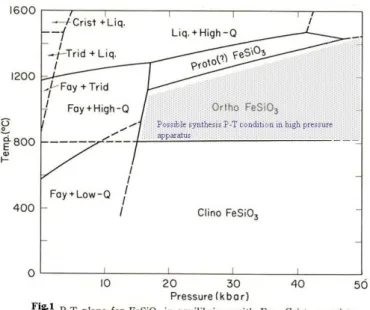
University, U.S., and the other one is the mixture of fayalite and quartz powder. Single crystals of ortho- FeSiO3 pyroxene was synthesized at high pressure (above 15 kbar) at high temperature (Fig. 1).
2) Synthesis and hot-pressing polycrystalline specimens
A series of selected composition of starting materials between orthoenstatite (En, MgSiO3) and diopside (Dio, CaMgSi2O6) for synthesis and hot-pressing were prepared as the glass form synthesized by Dr. Philippe Courtial, University of Munich, Germany.
To obtain well-sintered polycrystalline, the hot-pressing pressure was reached up to 5 GPa for this series of composition. The specimen size were varied from 2~3 mm, depending on
the MHz ultrasonic experimental conditions.
Therefore, these synthesis/hot-pressing experiments were preformed in the multi anvil press in the high-pressure laboratories outside of Taiwan (i.e. Stony Brook University in the U.S., Ehime University in Japan).
結果與討論 Synthesis of FeSiO3
–in piston cylinder apparatus at NTNU (National Taiwan Normal University)
Six runs were carried out using the mixture of fayalite and quartz powder or fayalite and amorphous silica for the synthesis.
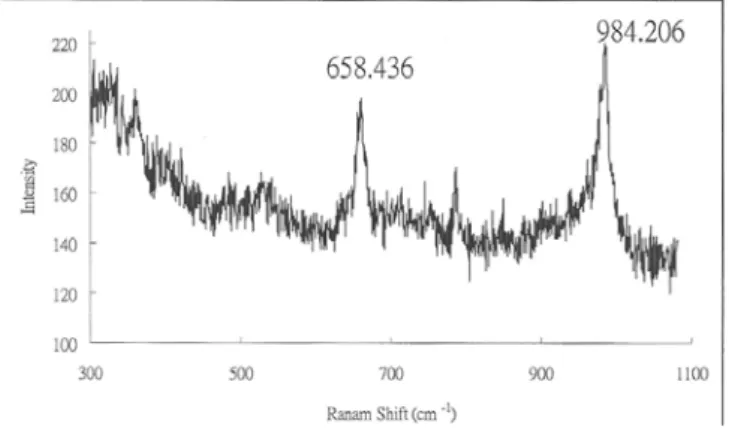
The synthesis P-T conditions were tabulated in Table 1. In order to obtain large size of single crystals, sometimes the fluid (H2O here, run4, 5 and 6) was sealed into capsule to enhance the grain growth. The synthesized specimens in the piston cylinder were analyzed using the Raman spectroscopy and the microprobe (EDS mode). From the analyzed results, the FeSiO3 specimens synthesized in the piston cylinder have been obtained from runs 4, 5 and 6 which have been adding the H2O. The Raman data showed that only run2 product was crystalline and the experimental runs sealed with H2O as glass. From the microprobe data, the
Table 1 experimental conditions in the piston cylinder apparatus
Run 1 Run 2 Run 3 Run 4 Run 5 Run 6
Capsule Au Au-Pd Au-Pd Au-Pd Au-Pd Au-Pd
Pressure 1.8~1.9GPa 1.8~1.9GPa 1.8~1.9GPa 1.8~1.9GPa 1.8~1.9GPa 1.8~1.9GPa Temperature 1050℃ 1100℃ 1000℃ 900℃ 900℃ 900℃
Water ratio (wt%) N/A N/A 10% 10% 10% 10%
Time 9 hours 56 hours 7 hours 7 hours 1 5 hours 24 hours
4 Figure 2. Raman pattern of FeSiO3 from Run 2. Two
characteristic peaks of 658.436cm-1 and 984.206cm-1 are shown.
compositions of final products from run 2, 4, 5 and 6 present as FeSiO3 composition.
However, the grain size of single crystals from run 2 was around 20 μm in diameter that the size is too small for our purpose of ultrasonic measurements. The analysis results are tabulated in Table 2 and shown in Fig. 2.
- in multi anvil apparatus.
Two synthesis runs of FeSiO3 were performed in the multi anvil apparatus at Stony Brook University, New York, U.S.. The starting material was the mixture of Fe2SiO4 and amorphous SiO2. 3 ~ 5 μl of H2O with starting powder was added in the sealed Ag capsule. The running conditions were ~ 3 GPa, and 900 degree C for 12 hours (USB05) and 36 hours (USB07). The final product of USB05 was mixed single crystals with size of
~50 μm of SiO2, Fe2SiO4 and FeSiO3.
However, the Ag capsule of run USB07 was molten that results in small size of crystal
aggregate as final product. The cause of capsule molten remains unknown.
Synthesis and hot-pressing of solid-solution of enstatite-diospide
The polycrystalline specimens of composition join along enstatite-diospide were synthesized and hot-pressed in multi anvil press in High Pressure Laboratory of Ehime University, Japan and Stony Brook University, U.S., respectively. The sizes of polycrystalline specimens were from 2 to 3 mm in diameter and ~2 mm in length. The specimen with 3 mm in diameter was used for the purpose of characterization and 2 mm size for the MHz-ultrasonic measurement at high pressure conditions. The synthesis and hot-pressing conditions for this suit of mantle composition pyroxenes were at ~5 GPa, from temperature of 900 degree C to 1000 degree C with different soaking and annealing time in order to prepare the well-sintered and equilibrium -textured specimens for the ultrasonic measurement. In general, the polycrystalline specimens were well-sintered that the bulk density reaches about 98% of theoretical density. The chemical composition of the glass starting powders and hot-pressed samples (En100, Dio100 and Dio85) were remaining the same within the uncertainty, expect the composition of Dio70En30 (hereafter refered as Dio70). From
Compound Run4 Run5 Run6
SiO2 45.60 45.88 45.23
FeO 54.34 54.15 54.70
Cation(calculate with 6O) - - -
Si 2.002 2.009 1.992
Fe 1.995 1.983 2.015
Table 2. The composition of specimens from run4 to run 6
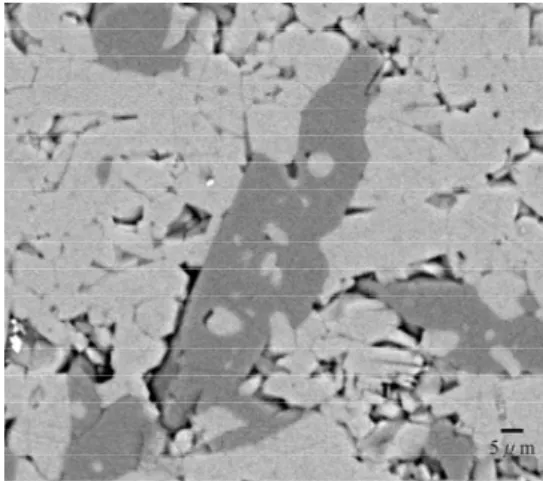
BEI image, the bulk composition Di70 presented two phases after hot-pressed (Fig. 3).
The compositions of two phases in Di70 were
~Di90 (Fig.4 bright color phase) and ~En90 ( Fig. 4 dark color phase), analyzed using microprobe (EDS mode). The synthesis of composition Di70 has illustrated the previous study (Gasparik, 1990) that there is a miscibility gap along the join of enstatite and diopside.
At current stage, we have obtained few
polycrystalline specimens with compositions of En100, Di100 and Di85, that we will characterize the sound velocity at ambient conditions for the high pressure work. As for the single crystals of FeSiO3, we were able to obtain some single crystals but their crystal size was too small for our study. We are still trying to find a synthesis technique to grow the large crystal size of FeSiO3 for our purpose.
致謝
We thank the kindly helps from the research groups of Profs. TC Liu and T. Irifune of National Taiwan Normal University, Taiwan and Ehime University, Japan for the synthesis of pyroxene specimens.
參考文獻
Anderson, D.L. (1988) Temperature and pressure derivatives of elastic constants with application to the mantle. Journal of Geophysical Research, 93, 4688-4700.
Fig. 3 Composition analysis of bulk composition Di70 after subjected ~5 GPa and 900~1000 degree C. Two phases were observed: Di90 and En90.
Bass, J.D., D.L. Anderson. (1984) Composition of the upper mantle:
geophysical tests of two petrological models. Geophysical Research Letters, 11, 237-240.
Bina, C.R., Wood, B.J. (1987) Olivine-spinel transitions: experimental and thermodynamic constraints for the nature of the 400 km seismic discontinuity.
Journal of Geophysical Research, 92, 4853-4866.
Birch, F (1952) Elasticity and constitution of the Earth’s interior, J. Geophys. Res., 57 227-286.
Bhagat, S.N., J.D. Bass, J.R. Smyth. (1992) Single-crystal elastic properties of
Fig. 4 BEI image of bulk composition Di70. The composition of dark phase is En90 and bright phase Di90.
6
omphacite C2/c by Brillouin spectroscopy.
Journal of Geophysical Research, 97, 6843-6848
Cammarano, F., Goes, S., Vacher, P., and Giardini, D. (2003) Inferring upper-mantle temperatures from seismic velocities.
Physics of the Earth and Planetary Interiors, 138(3-4), 197-222.
Chai, M., Brown, J.M., and Slutsky, L.J.
(1997) The elastic constants of an aluminous orthopyroxene to 12.5 GPa.
Journal of Geophysical Research-Solid Earth, 102(B7), 14779-14785.
Duffy, T.S., Anderson, D.L. (1989) Seismic velocities in mantle minerals and the mineralogy of the upper mantle. Journal of Geophysical Research, 94, 1895-1912.
Flesch, L.M., Li, B.S., and Liebermann, R.C.
(1998) Sound velocities of polycrystalline MgSiO3-orthopyroxene to 10 GPa at room temperature. American Mineralogist, 83(5-6), 444-450.
Goes, S., Govers, R., and Vacher, P. (2000) Shallow mantle temperatures under Europe from P and S wave tomography.
Journal of Geophysical Research-Solid Earth, 105(B5), 11153-11169.
Ita, J. and Stixrude, L (1992) Petrology, elasticity and composition of mantle transition zone. Journal of Geophysical Research-Solid Earth, 97(B5) 6849-6866.
Irifune, T. (1987) An experimental investigation of the pyroxene-garnet transformation in a pyrolite composition and its bearing on the constitution of the mantle. Physics of the Earth and Planetary Interiors, 45(4), 324-336.
Isaak, D.G., and Ohno, I. (2003) Elastic constants of chrome-diopside: application of resonant ultrasound spectroscopy to monoclinic single-crystals. Physics and
Chemistry of Minerals, 30(7), 430-439.
Kandelin, J., Weidner, D.J. (1988a) Elastic proerties of hedenbergite. Journal of Geophysical Research, 93(1063-1072).
Kung, J., Li, B.S., Uchida, T., Wang, Y.B., Neuville, D., and Liebermann, R.C. (2004) In situ measurements of sound velocities and densities across the orthopyroxene ->
high-pressure clinopyroxene transition in MgSiO3 at high pressure. Physics of the Earth and Planetary Interiors, 147(1), 27-44.
Levien, L., Weidner, D.J., and Prewitt, C.T.
(1979) Elasticity of Diopside. Physics and Chemistry of Minerals, 4(2), 105-113.
Li, B.S., Liebermann, R.C., and Weidner, D.J.
(2001) P-V-V-p-V-s-T measurements on wadsleyite to 7 GPa and 873 K:
Implications for the 410-km seismic discontinuity. Journal of Geophysical Research-Solid Earth, 106(B12), 30579-30591.
McDonough, W.F., Rudnick, R.L. (1998) Mineralogy and composition of the upper mantle. 139-164 p. Mineralogical Society of America, Washingtog, DC.
Rigden, S.M., G. D. Gwanmesia, I. Jackson, R.
C. Liebermann. (1992) Progress in high-pressure ultrasonic interferometry, the pressure dependence of elasticity of Mg2SiO4 polymorphs and constraints on the composition of the transition zone of the Earth's mantle. AGU, Washington, DC.
Rohm, A.H.E., Snieder, R., Goes, S., and Trampert, J. (2000) Thermal structure of continental upper mantle inferred from S-wave velocity and surface heat flow.
Earth and Planetary Science Letters, 181(3), 395-407.
Webb, S.L., and Jackson, I. (1993) The Pressure-Dependence of the
Elastic-Moduli of Single-Crystal Ortho-Pyroxene (Mg0.8fe0.2)Sio3.
European Journal of Mineralogy, 5(6), 1111-1119.
Weidner, D.J. (1985) A mineral physics test of a pyrolite mantle. Geophysical Research Letters, 12, 417-420.
Weidner, D.J., Ito, E. (1987) Mineral physics constraints on a uniform mantle composition. 439-446 p. Terra Scientific, Tokyo.
Synthesis of mantle pyroxene at Ehime University, Matsuyama, Japan
PI, Assistant Prof. Jennifer Kung (龔慧貞) and the first-year MS student, Ms Chi-yu Lin (林崎 ) spent three and four weeks, respectively, in the Geodynamics Research Center (GRC) for the work of synthesis of mantle
pyroxenes, which is a part of project of National Science Council (MgSiO3-CaSiO3-FeSiO3 輝石之弹性性質及行為在高 溫高壓下之研究).
Geodynamics Research Center (GRC) is an advanced research center of Ehime University for studies of the structure, constitution, and dynamics of the Earth's deep interior. There are three research groups in GRC:Ultra High Pressure Laboratory (UHPL), Seismological Laboratory (SL), Physical Measurements Laboratory (PML). In this trip, PI, Kung, and Ms Lin mainly collaborated with the groups of UHPL and PML working on the synthesis and hot-pressing of polycrystalline pyroxenes, MgSiO3 (orthoenstatite) and (Ca,Mg)SiO3 (diopside) for ultrasonic measurements. In order to obtain proper size of sintered specimen for MHz ultrasonic measurement, the large volume high-pressure apparatus is necessary facility for high pressure and temperature work. This research center has equipped four high pressure apparatus for the high pressure synthesis and experimental works; 700 ton split-cylinder apparatus, 100 and 1000 ton cubic apparatus and 2000 ton split-sphere apparatus. To characterize the high pressure specimens, the research center also equipped the various facilities for the analysis, e.g. Micro- focus X-ray diffractometer, electron microprobe analyzer, and SEM-Raman spectroscopic analyzer.
Synthesis at GRC, Ehime University
High pressure synthesis work, in general, includes loading sample, the assemblage of cell parts, and working on the high-pressure apparatus. In this laboratory, the cell parts for the high-pressure assembly have to be fabricated from the raw materials, like MgO and the other ceramic blocks and metal foils. Every single user in this laboratory has to prepare their own cell parts for their high-pressure experiments. There are some advantages for the self-
preparing processes are that the user would understand the design mechanism for the cell parts and the user would have capability of changing their own design according to the experimental purpose. Therefore, the first one third part of staying, PI, Kung, and Ms Lin were learning for the preparation of the cell parts for high-pressure synthesis works, fabricating MgO octahedrons, pyrophyllite gaskets, LaCrO3 thermal insulators, Re furnaces, Ta electronic contacts, and WC anvil cubes.
The work in the second period of staying was mainly to prepare the sample powder, load the sample and assemble the cell for high-pressure synthesis. After the high-pressure cell was assembled, the synthesis work was carried out in the 2000-ton split-sphere high-pressure apparatus. The controls of high-pressure apparatus and the heating process were using the computer controlling systems. PI’s three-week staying at Ehime was assisting the
preparation of experiments and the communication between Ms Lin and the Japanese colleagues in the high pressure laboratory. The forth week of staying, Ms Lin was able to work independently and communicate well with Japanese colleagues in the laboratory.
Four-week synthesis at Ehime, we have prepared couple compositions of polycrystalline pyroxene specimens for ultrasonic measurements, the end-member MgSiO3 (OEN) and (Ca,Mg)SiO3 (Dio). One specimen with
composition of En30Dio70 was the first-time attempted to synthesize for ultrasonic work. We also attempted to grow the large single-crystal of FeSiO3 pyroxene at high pressure conditions. After unloaded the specimens from high pressure conditions, Ms Lin has carried out the characterization of the specimens in the laboratory of GRC, like density measurements and micro X-ray diffraction. The X-ray diffraction data also showed that the glass starting material was transformed to pyroxene structure after high pressure and temperature conditions. The bulk densities of polycrystalline specimens were within 2% of their own theoretical densities, that the specimens could be qualified for the ultrasonic measurement.
The academic discussions with research members at GRC
During the staying at Ehime, PI, Kung, and Ms Lin also had intense discussions with various members of GRC on various subjects. We joined the regular meetings and seminars of GRC on Fridays. Furthermore, Kung had some in depth discussions with seismologist, Prof. Zhao, Dapeng on the structure and dynamics of Earth and the mineral physicist, Prof. Tsuchiya, Taku on the recent development of computer simulation of elasticity and phase transition of mantle minerals. At the same period of time, Kung also shared office with the other foreign visitor, Prof.
Brunet, Fabrice of Laboratire de Geologie, Ecole Normals Superieure, Paris, France and had some discussions on the subject of thermodynamics. These discussions would help to integrate and link the fields between the mineral physics and geophysics, and also shed lights on the future research directions in mineral physics in Taiwan.
Future work of synthesis of pyroxene for ultrasonic measurements
This trip we have succeed to synthesize and hot-press some pyroxene specimens (OEN and Dio) for ultrasonic measurements. The synthesized specimen with composition of En30Dio70 was first-time synthesized for ultrasonic work and is under examination by Raman spectroscopy and electronic microprobe at National Cheng Kung University. We believe that the results from En30Dio70 sample will provide some information for the synthesis work for the join composition between enstatite and diopside in the future. For FeSiO3 pyroxene, we have obtained the right composition in the synthesis run at Ehime but the grain size of crystals were not large enough for single-crystal GHz ultrasonic measurement. Knowing the current pressure-temperature conditions, we
believe we can obtain some crystals for the ultrasonic measurements if we adjust few synthesis conditions in the future experiments.
In summary, we have very good experimental results from the works in the High Pressure Laboratory,
Geodynamics Research Center, Ehime University, Japan. These experiments have set some theoretical foundation in the future pyroxene synthesis. During the staying, both PI, Kung, and Ms Lin have obtained excellent
stimulations from the academic discussions. The most important is that Ms Lin is the first-year master student who has gained a lot of academic experience working in such a foreign research laboratory within four weeks. On the same note, Ms Lin’s experience also helps the start of high pressure research in Taiwan.
Acknowledgement
Both Kung and Lin would like to thank the assistance of Mr. Yuji Higo in the laboratory and of Ms. Yukiko Ono in administration work during the staying at Ehime.
Photos of the High Pressure Laboratory of Ehime University
2000 ton split-sphere high pressure apparatus for synthesis work.
Milling machine for preparing the cell parts.
Lathe machine for preparing the cell parts.
Lin prepares the WC anvil cubes.
Higo (Postdoctoral fellow) teaches Lin to assemble the cell parts.
Part of assembly for high pressure synthesis.
Lin finishes the cell assembly for high pressure work.
Lin loads the cell assembly in the high pressure apparatus.
Lin pushes the lower guideblock into the press for high pressure run.
學生赴日本愛媛大學進行高壓礦物合成實驗報告
年度編號: 會計編號:A94-0900 院別/系所:理學院/地球科學所 申請人:林崎堉
承蒙研發處企劃組及理學院惠予補助,學生得以前往日本愛媛大 學進行高壓合成實驗的訓練。此次由指導教授龔慧貞教授與愛媛大學 教授共同指導學生高壓合成實驗的詳細步驟,以及實驗原理。此趟實 驗主要著重在於輝石(MgSiO3 - CaSiO3)之端成份與中間成份的合 成。再將合成的樣品進行 X 光繞射、拉曼、掃瞄式電子顯微鏡、穿 透式電子顯微鏡、超聲波量測等的實驗,藉以瞭解合成之樣品之各種 物理及化學性質。利用量測樣品的結果,進而討論實驗步驟、實驗器 材之改良與設計。
輝石在地函中含有相當重的比例,目前研究結果對於 MgSiO3 與
(Ca, Mg)Si2O6 之物理、化學性質有一定程度上的瞭解,但是對於其 中間成份(即含鈣的濃度)之物裡性質,尚未有充分的瞭解,而此不 固定化學組成是否會影響到地函物質的性質,都是研究的目標。藉由 研究輝石的物理、化學性質,來瞭解地球內部的構造及化學組成,再 與震波資料,理論的密度數據互相比對,來解開地球內部之組成與性 質之謎。期能瞭解地球內部構造之機制。
Synthesis of mantle pyroxene at Ehime University, Matsuyama, Japan
PI, Assistant Prof. Jennifer Kung (龔慧貞) and the first-year MS student, Ms Chi-yu Lin (林崎 ) spent three and four weeks, respectively, in the Geodynamics Research Center (GRC) for the work of synthesis of mantle
pyroxenes, which is a part of project of National Science Council (MgSiO3-CaSiO3-FeSiO3 輝石之弹性性質及行為在高 溫高壓下之研究).
Geodynamics Research Center (GRC) is an advanced research center of Ehime University for studies of the structure, constitution, and dynamics of the Earth's deep interior. There are three research groups in GRC:Ultra High Pressure Laboratory (UHPL), Seismological Laboratory (SL), Physical Measurements Laboratory (PML). In this trip, PI, Kung, and Ms Lin mainly collaborated with the groups of UHPL and PML working on the synthesis and hot-pressing of polycrystalline pyroxenes, MgSiO3 (orthoenstatite) and (Ca,Mg)SiO3 (diopside) for ultrasonic measurements. In order to obtain proper size of sintered specimen for MHz ultrasonic measurement, the large volume high-pressure apparatus is necessary facility for high pressure and temperature work. This research center has equipped four high pressure apparatus for the high pressure synthesis and experimental works; 700 ton split-cylinder apparatus, 100 and 1000 ton cubic apparatus and 2000 ton split-sphere apparatus. To characterize the high pressure specimens, the research center also equipped the various facilities for the analysis, e.g. Micro- focus X-ray diffractometer, electron microprobe analyzer, and SEM-Raman spectroscopic analyzer.
Synthesis at GRC, Ehime University
High pressure synthesis work, in general, includes loading sample, the assemblage of cell parts, and working on the high-pressure apparatus. In this laboratory, the cell parts for the high-pressure assembly have to be fabricated from the raw materials, like MgO and the other ceramic blocks and metal foils. Every single user in this laboratory has to prepare their own cell parts for their high-pressure experiments. There are some advantages for the self-
preparing processes are that the user would understand the design mechanism for the cell parts and the user would have capability of changing their own design according to the experimental purpose. Therefore, the first one third part of staying, PI, Kung, and Ms Lin were learning for the preparation of the cell parts for high-pressure synthesis works, fabricating MgO octahedrons, pyrophyllite gaskets, LaCrO3 thermal insulators, Re furnaces, Ta electronic contacts, and WC anvil cubes.
The work in the second period of staying was mainly to prepare the sample powder, load the sample and assemble the cell for high-pressure synthesis. After the high-pressure cell was assembled, the synthesis work was carried out in the 2000-ton split-sphere high-pressure apparatus. The controls of high-pressure apparatus and the heating
preparation of experiments and the communication between Ms Lin and the Japanese colleagues in the high pressure laboratory. The forth week of staying, Ms Lin was able to work independently and communicate well with Japanese colleagues in the laboratory.
Four-week synthesis at Ehime, we have prepared couple compositions of polycrystalline pyroxene specimens for ultrasonic measurements, the end-member MgSiO3 (OEN) and (Ca,Mg)SiO3 (Dio). One specimen with
composition of En30Dio70 was the first-time attempted to synthesize for ultrasonic work. We also attempted to grow the large single-crystal of FeSiO3 pyroxene at high pressure conditions. After unloaded the specimens from high pressure conditions, Ms Lin has carried out the characterization of the specimens in the laboratory of GRC, like density measurements and micro X-ray diffraction. The X-ray diffraction data also showed that the glass starting material was transformed to pyroxene structure after high pressure and temperature conditions. The bulk densities of polycrystalline specimens were within 2% of their own theoretical densities, that the specimens could be qualified for the ultrasonic measurement.
The academic discussions with research members at GRC
During the staying at Ehime, PI, Kung, and Ms Lin also had intense discussions with various members of GRC on various subjects. We joined the regular meetings and seminars of GRC on Fridays. Furthermore, Kung had some in depth discussions with seismologist, Prof. Zhao, Dapeng on the structure and dynamics of Earth and the mineral physicist, Prof. Tsuchiya, Taku on the recent development of computer simulation of elasticity and phase transition of mantle minerals. At the same period of time, Kung also shared office with the other foreign visitor, Prof.
Brunet, Fabrice of Laboratire de Geologie, Ecole Normals Superieure, Paris, France and had some discussions on the subject of thermodynamics. These discussions would help to integrate and link the fields between the mineral physics and geophysics, and also shed lights on the future research directions in mineral physics in Taiwan.
Future work of synthesis of pyroxene for ultrasonic measurements
This trip we have succeed to synthesize and hot-press some pyroxene specimens (OEN and Dio) for ultrasonic measurements. The synthesized specimen with composition of En30Dio70 was first-time synthesized for ultrasonic work and is under examination by Raman spectroscopy and electronic microprobe at National Cheng Kung University. We believe that the results from En30Dio70 sample will provide some information for the synthesis work for the join composition between enstatite and diopside in the future. For FeSiO3 pyroxene, we have obtained the right composition in the synthesis run at Ehime but the grain size of crystals were not large enough for single-crystal GHz ultrasonic measurement. Knowing the current pressure-temperature conditions, we
believe we can obtain some crystals for the ultrasonic measurements if we adjust few synthesis conditions in the future experiments.
In summary, we have very good experimental results from the works in the High Pressure Laboratory,
Geodynamics Research Center, Ehime University, Japan. These experiments have set some theoretical foundation in the future pyroxene synthesis. During the staying, both PI, Kung, and Ms Lin have obtained excellent
stimulations from the academic discussions. The most important is that Ms Lin is the first-year master student who has gained a lot of academic experience working in such a foreign research laboratory within four weeks. On the same note, Ms Lin’s experience also helps the start of high pressure research in Taiwan.
Acknowledgement
Both Kung and Lin would like to thank the assistance of Mr. Yuji Higo in the laboratory and of Ms. Yukiko Ono in administration work during the staying at Ehime.
Photos of the High Pressure Laboratory of Ehime University
2000 ton split-sphere high pressure apparatus for synthesis work.
Milling machine for preparing the cell parts.
Lathe machine for preparing the cell parts.
Lin prepares the WC anvil cubes.
Higo (Postdoctoral fellow) teaches Lin to assemble the cell parts.
Part of assembly for high pressure synthesis.
Lin finishes the cell assembly for high pressure work.
Lin loads the cell assembly in the high pressure apparatus.
Lin pushes the lower guideblock into the press for high pressure run.
學生赴日本愛媛大學進行高壓礦物合成實驗報告
年度編號: 會計編號:A94-0900 院別/系所:理學院/地球科學所 申請人:林崎堉
承蒙研發處企劃組及理學院惠予補助,學生得以前往日本愛媛大 學進行高壓合成實驗的訓練。此次由指導教授龔慧貞教授與愛媛大學 教授共同指導學生高壓合成實驗的詳細步驟,以及實驗原理。此趟實 驗主要著重在於輝石(MgSiO3 - CaSiO3)之端成份與中間成份的合 成。再將合成的樣品進行 X 光繞射、拉曼、掃瞄式電子顯微鏡、穿 透式電子顯微鏡、超聲波量測等的實驗,藉以瞭解合成之樣品之各種 物理及化學性質。利用量測樣品的結果,進而討論實驗步驟、實驗器 材之改良與設計。
輝石在地函中含有相當重的比例,目前研究結果對於 MgSiO3 與
(Ca, Mg)Si2O6 之物理、化學性質有一定程度上的瞭解,但是對於其 中間成份(即含鈣的濃度)之物裡性質,尚未有充分的瞭解,而此不 固定化學組成是否會影響到地函物質的性質,都是研究的目標。藉由 研究輝石的物理、化學性質,來瞭解地球內部的構造及化學組成,再 與震波資料,理論的密度數據互相比對,來解開地球內部之組成與性 質之謎。期能瞭解地球內部構造之機制。