Hole escape processes detrimental to photoluminescence efficiency
in a blue InGaN multiple-quantum-well diode under reverse bias conditions
T. Inoue and K. Fujiwaraa兲
Kyushu Institute of Technology, Tobata, Kitakyushu 804-8550, Japan J. K. Sheu
Institute of Electro-Optical Science and Engineering, National Cheng-Kung University, Tainan, Taiwan 70101, Republic of China
共Received 1 February 2007; accepted 16 March 2007; published online 17 April 2007兲
Photoluminescence共PL兲 properties of a blue In0.3Ga0.7N multiple-quantum-well共MQW兲 diode with an additional n+-doped In0.18Ga0.82N electron reservoir layer共ERL兲 have been investigated at 20 K as a function of reverse bias under indirect barrier excitation. A PL intensity ratio of MQW/ERL is observed to be significantly quenched by increasing the reverse field due to electron-hole separation and carrier escape, in spite of observed blueshifts, when the excitation power is decreased by two orders of magnitude. The PL intensity reduction suggests that the hole escape process plays an important role for determination of the PL efficiency under the reverse bias. © 2007 American Institute of Physics. 关DOI:10.1063/1.2723683兴
Despite the realization of blue and green light-emitting diodes 共LEDs兲 based on InGaN/GaN quantum-well 共QW兲 heterostructures,1,2 the origin of the very bright emission characteristics is still controversially discussed.3–8A peculiar property of this material system is the observation of effi- cient luminescence, although the density of misfit disloca- tions can be as high as 1010cm−2. Therefore, we expect the existence of a particularly important mechanism, which is responsible for the enhancement of the radiative efficiency in the presence of a very high defect density. Previously quan- tum confinement effects on the InGaN alloy well and effi- cient carrier capturing by the localized radiative recombina- tion centers have been claimed to be important for the origin of the high emission efficiency. Quite recently, importance of very efficient hole capture processes by localizing valence states associated with atomic condensates of In–N for radia- tive recombination efficiency is pointed out.9,10 Thus, all of the previous studies infer that carrier capture processes to- ward radiative recombination centers and prohibition of es- cape to nonradiative defective sites play an important role for the determination of the radiative recombination efficiency.3–13 In relation to assessment of the radiative re- combination efficiency, we have recently investigated the temperature dependence of the electroluminescence共EL兲 in- tensity for a specially designed blue InGaN / GaN multiple-QW 共MQW兲-LED containing an additional n+-doped InGaN electron reservoir layer 共ERL兲.14,15 This LED exhibits a significant improvement of the EL efficiency, in particular, for lower temperatures, when a forward bias necessary to obtain a certain injection current is high due to the reduced hole conductivity.
In this letter, photoluminescence 共PL兲 properties of the blue InGaN MQW-LED with ERL have been investigated with a special emphasis on external field effects on the ra- diative recombination processes. The existence of n+-type ERL below the active MQW layer allows us to monitor how the photogenerated carrier distribution across the active MQW region influences the PL efficiency by changing exci-
tation power as a function of field strength. Observed PL intensity reduction induced by the reverse fields suggests im- portance of hole escape processes from the MQW for the determination of the PL efficiency.
An InGaN / GaN MQW-LED with an additional n+-doped In0.18Ga0.82N ERL was grown by metal-organic vapor-phase epitaxy.16The emission region of the LED con- sists of a triple In0.3Ga0.7N QW with a nominal width of 2.5 nm separated by 6.5 nm GaN barriers. Details of the MQW-LED heterostructure were described previously.15,16 PL spectra have been recorded over a wide spectral range as a function of forward and reverse bias voltages at 20 K with a lock-in detection technique, using a He–Cd laser at 325 nm for indirect photoexcitation at various excitation powers of 0.1– 10 mW共power density of ⬃1–102W / cm2兲.
Figure 1共a兲shows PL spectra of the diode taken with a 10 mW laser power and at 4.25, 2.0, 0, and −3.0 V. When excited from the surface p-GaN cap layer, the MQW diode shows a main blue MQW emission band around 480 nm, which is strongly redshifted due to carrier localization from absorption band tails, as confirmed by photocurrent spectra 共not shown兲. In addition to the main blue emission band, a distinct PL band at 405 nm is observed only for the diode with ERL, but not for a similar MQW diode without it.
Therefore, the PL band at 405 nm is identified as originating from the ERL located below the active MQW layer. A broad short-wavelength emission band is also observed around 380– 440 nm, the origin of which is not clear at present. A small but sharp PL band observed at 355 nm is ascribed to bound excitons in the GaN layers. A broad PL band due to yellow emissions around 575 nm is also observed, only when the GaN barriers are indirectly photoexcited. When the forward bias is decreased and the reverse bias is increased to
−3 V, the PL intensity of the main blue band is considerably decreased, accompanying blueshifts, while the emission in- tensity of the n+-doped ERL remains the same without any peak shifts. These results indicate that the external field is applied to the MQW region only and that the quantum con- fined Stark effect results in the compensation of the internal
a兲Electronic mail: [email protected]
APPLIED PHYSICS LETTERS 90, 161109共2007兲
0003-6951/2007/90共16兲/161109/3/$23.00 90, 161109-1 © 2007 American Institute of Physics
Downloaded 22 Oct 2009 to 140.116.208.44. Redistribution subject to AIP license or copyright; see http://apl.aip.org/apl/copyright.jsp
piezofield, which is opposite to the p-n junction field direction.5,13
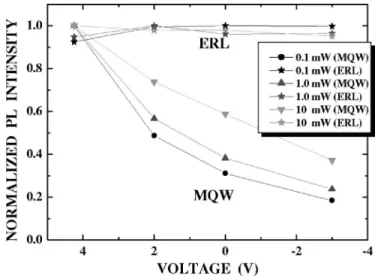
On the other hand, when the excitation power is de- creased by two orders of magnitude to 0.1 mW, two substan- tial differences appear in the PL spectra, as shown in Fig.1共b兲. That is, a PL intensity ratio of MQW/ERL is ob- served to be drastically increased at a forward bias of 4.25 V 共near the flatband condition兲 due to a decrease of photon penetration depth 共relative decrease of the ERL emission兲 and preferential photoexcitation of the front MQW region near the p-type clad layer. Secondly, the MQW PL intensity is significantly quenched by increasing the reverse field due to field-induced electron-hole separation and resultant carrier escape, in spite of observed blueshifts. Figure2shows nor- malized, wavelength-integrated PL intensity for MQW and ERL as a function of applied reverse bias at excitation pow- ers of 0.1, 1.0, and 10 mW. It is clear that the PL intensity for MQW significantly decreases with increasing the reverse field and the reduction is stronger under the weak excitation power, while the ERL emission remains to be nearly con- stant. This field-induced PL intensity reduction dependent on the photoexcitation power suggests that the hole escape pro-
cess plays an important role for determination of the blue PL efficiency under the reverse bias conditions, as discussed in the following.
The bias dependence of the PL spectra significantly changes by decreasing the excitation power and the PL in- tensity decreases very rapidly with increasing the reverse bias共external field兲 under the weak excitation 关see Fig.1共b兲兴.
Note that the PL intensity decreases to 18%, when the re- verse bias is increased to −3 from +4.25 V. We attribute these PL spectral variations with decrease of the excitation power to the decreased excitation depth. This hypothesis can be easily confirmed because of the existence of the ERL.
That is, the n+-type ERL which is located below the active region is more weakly photoexcited by the weak photoexci- tation. We observe systematical decreases of the PL intensity for ERL relative to the main blue emission band, when the excitation power is decreased to 0.1 from 10 mW. But it is not surprising to find out that the ERL PL band does not show any discernible changes in intensity with bias at all excitation levels, since the ERL is heavily doped to n+type 共⬃1019cm−3兲. However, when the reverse bias is increased, the intensity of the main PL band around 480 nm certainly decreases more slowly under the intense excitation, in con- trast to the case of the weak excitation.
These variations of the PL intensity quenching by the reverse bias共reverse field兲 at various excitation powers can be explained in the following ways. Figure3 illustrates the potential diagram of the MQW diode under the共a兲 weak and 共b兲 intense excitation conditions. When the photon penetra- tion depth is shallow as in Fig. 3共a兲, the photogenerated electron-hole pairs are not uniform across the MQW layer and more carriers are excited in the front well layer near the p-type barrier. Therefore, the photogenerated holes can es- cape more easily from the active well layer, when the reverse field is increased, leading to the rapid decreases of the PL intensity. However, under the intense excitation 关see Fig. 3共b兲兴 the MQW layer is rather uniformly excited and photoexcited carriers are generated deep into the bottom well layer. This is evidenced by the strong increase of the PL intensity for ERL. Therefore, the PL intensity of the main blue band results in slow decrease with increasing reverse bias, since holes generated in the bottom well near the ERL
FIG. 1. PL spectra of a blue In0.3Ga0.7N MQW-LED with an additional n-type In0.18Ga0.82N electron reservoir layer共ERL兲 as a function of forward 共positive兲 and reverse 共negative兲 bias voltages at 20 K under 共a兲 intense 共 10 mW power兲 and 共b兲 weak 共0.1 mW power兲 indirect excitations at a wavelength of 325 nm. Note that the main PL peak around 480 nm shows a moderate共strong兲 intensity reduction in 共a兲 关in 共b兲兴 with increasing the re- verse bias voltage, accompanying blueshifts, while the ERL emission at 405 nm does not change its intensity. A small line seen at 650 nm is due to the laser scattering.
FIG. 2. Normalized, wavelength-integrated PL intensity for MQW and ERL bands as a function of reverse共negative兲 bias voltage at three different excitation powers of 0.1, 1.0, and 10 mW.
161109-2 Inoue, Fujiwara, and Sheu Appl. Phys. Lett. 90, 161109共2007兲
Downloaded 22 Oct 2009 to 140.116.208.44. Redistribution subject to AIP license or copyright; see http://apl.aip.org/apl/copyright.jsp
must tunnel through the multiple barriers to escape to the p electrode. This result means that the hole escape process in- stead of the electron-hole wave function overlap changes is playing an important role in the radiative recombination ef- ficiency in the active InGaN MQW layer under the reverse bias conditions. In other words, the PL emission efficiency under the reverse field is limited and reduced by the tunnel- ing escape of holes, in spite of the fact that the QW po- tential is flattened as a result of the compensation of the piezoelectric field by the reverse field, as confirmed by Stark blueshifts.
Very recently, Chichibu et al.9reported by studying pos- itron annihilation experiments in InGaN alloys and QW lay- ers that the hole capture processes by localizing valence states associated with atomic condensates of In–N play a very important role for the radiative recombination efficiency in InGaN materials. Our observation of the external field effects on the PL efficiency under the different photoexcita- tion depths may also indicate the importance of the hole capture 共localization兲 processes in the active regions, since the radiative recombination efficiency is strongly modified by the hole escape ability under the presence of high density defects.
In summary, photoluminescence properties of a blue In- GaN MQW diode with a n+-type ERL have been investigated
as a function of bias voltage and excitation power. When the reverse bias is increased, the PL intensity of the main blue emission decreases due to external field-induced carrier es- cape from the radiative recombination centers within the wells, but the degree of reduction strongly depends on the excitation power because of the different photon penetration depths. Enhanced escape of photoexcited carriers under the weak photoexcitation suggests that hole escape processes play an important role in the radiative recombination effi- ciency in the active region of the diodes.
The authors would like to thank K. H. Ploog for helpful discussion on the importance of hole trapping for lumines- cence efficiency, H. Kostial and U. Jahn for sample die bond- ing and wiring, and N. Otsuji, H. Katou, and A. Satake for experimental assistance. This work was supported in part by the Grant-in-Aid for Scientific Research from the Ministry of Education, Culture, Sports, Science and Technology 共No.
16360157兲.
1S. Nakamura and G. Fasol, The Blue Laser Diode共Springer, Berlin, 1997兲.
2I. Akasaki and H. Amano, Jpn. J. Appl. Phys., Part 1 36, 5393共1997兲.
3S. Chichibu, T. Azuhata, T. Sota, and S. Nakamura, Appl. Phys. Lett. 69, 4188共1996兲; 70, 2822 共1997兲.
4Y. Narukawa, Y. Kawakami, S. Fujita, and S. Nakamura, Phys. Rev. B 55, R1938共1997兲.
5T. Takeuchi, S. Sota, M. Katsuragawa, M. Komori, H. Takeuchi, H. Amano, and I. Akasaki, Jpn. J. Appl. Phys., Part 2 36, L382共1997兲.
6Y. Narukawa, Y. Kawakami, S. Fujita, and S. Nakamura, Phys. Rev. B 59, 10283共1999兲.
7K. P. O’Donnell, R. W. Martin, and P. G. Middleton, Phys. Rev. Lett. 82, 237共1999兲.
8A. Hori, D. Yasunaga, A. Satake, and K. Fujiwara, Appl. Phys. Lett. 79, 3723共2001兲; J. Appl. Phys. 93, 3152 共2003兲.
9S. F. Chichibu, A. Uedono, T. Onuma, B. A. Haskell, A. Chakraborty, T. Koyama, P. T. Fini, S. Keller, S. P. Denbaars, J. S. Speck, U. K. Mishra, S. Nakamura, S. Yamaguchi, S. Kamiyama, H. Amano, I. Akasaki, J. Han, and T. Sota, Nat. Mater. 5, 810共2006兲.
10O. Brandt and K. H. Ploog, Nat. Mater. 5, 769共2006兲.
11A. Hangleiter, F. Hitzel, C. Netzel, D. Fuhrmann, U. Rossow, G. Ade, and P. Hinze, Phys. Rev. Lett. 95, 127402共2005兲.
12H. Aizawa, K. Soejima, A. Hori, A. Satake, and K. Fujiwara, Phys. Status Solidi C 3, 589共2006兲.
13U. Jahn, S. Dhar, M. Ramsteiner, and K. Fujiwara, Phys. Rev. B 69, 115323共2004兲.
14Y. Takahashi, A. Satake, K. Fujiwara, J. K. Sheu, U. Jahn, H. Kostial, and H. T. Grahn, Physica E共Amsterdam兲 21, 876 共2004兲.
15N. Otsuji, K. Fujiwara, and J. K. Sheu, J. Appl. Phys. 100, 113105共2006兲.
16J. K. Sheu, G. C. Chi, and M. J. Jou, IEEE Photonics Technol. Lett. 13, 1164共2001兲.
FIG. 3.共Color online兲 共a兲 Under the weak excitation the photon penetration depth is shallow, so that the photoexcited holes from the active MQW re- gions can escape more easily, leading to the rapid decreases of the PL intensity with increasing the reverse bias.共b兲 Under the intense excitation the MQW layer is rather uniformly excited so that the main MQW band is more slowly decreasing with increasing the reverse bias, since photogener- ated holes deep in the MQW regions need to traverse many barriers to escape from the active region.
161109-3 Inoue, Fujiwara, and Sheu Appl. Phys. Lett. 90, 161109共2007兲
Downloaded 22 Oct 2009 to 140.116.208.44. Redistribution subject to AIP license or copyright; see http://apl.aip.org/apl/copyright.jsp