行政院國家科學委員會專題研究計畫 成果報告
陽離子型界劑/磷脂質混合系統在脂雙層與單分子層中薄膜 性質之研究
研究成果報告(精簡版)
計 畫 類 別 : 個別型
計 畫 編 號 : NSC 95-2221-E-041-023-
執 行 期 間 : 95 年 08 月 01 日至 96 年 07 月 31 日 執 行 單 位 : 嘉南藥理科技大學化妝品應用與管理系
計 畫 主 持 人 : 周宗翰
計畫參與人員: 大學生-兼任助理:李珈霈
助理教授(本計畫主持人):周宗翰
報 告 附 件 : 國外研究心得報告
出席國際會議研究心得報告及發表論文
處 理 方 式 : 本計畫可公開查詢
中 華 民 國 96 年 10 月 07 日
行政院國家科學委員會補助專題研究計畫 ▉ 成 果 報 告
□期中進度報告
陽離子型界劑/磷脂質混合系統在脂雙層與單分子層中薄膜 性質之研究
計畫類別:▉ 個別型計畫 □ 整合型計畫 計畫編號:NSC 95 - 2221 - E - 041 - 023
執行期間: 95 年 08 月 01 日至 96 年 07 月 31 日
計畫主持人:周宗翰 共同主持人:
計畫參與人員: 李珈霈
成果報告類型(依經費核定清單規定繳交):■精簡報告 □完整報告
本成果報告包括以下應繳交之附件:
□赴國外出差或研習心得報告一份
□赴大陸地區出差或研習心得報告一份
■出席國際學術會議心得報告及發表之論文各一份
□國際合作研究計畫國外研究報告書一份
處理方式:除產學合作研究計畫、提升產業技術及人才培育研究計畫、
列管計畫及下列情形者外,得立即公開查詢
□涉及專利或其他智慧財產權,□一年□二年後可公開查詢
執行單位:嘉南藥理科技大學妝品系
中文摘要
在本研究中,陽離子型微脂粒的製備是由陽離子界面活性劑與磷脂質所構成。這裡所 使 用 的 陽 離 子 型 界 面 活 性 劑 (DXDAB) 為 dioctadecyldimethylammonium bromide (DODAB)、dipalmitoyldimethylammonium bromide (DPDAB)、dimyristoyldimethylammonium bromide (DMDAB)分別具有 18-18、16-16、14-14 等不同雙碳鏈長度。而製備微脂粒所使用 的材料微帶兩性離子的飽和磷脂質 hydrogen soybean phosphatidylchloine (HSPC)與不飽和的 磷脂質 egg phosphatidylchloine (EPC)。本計畫擬進行雙成分混合 DXDAB/PCs 脂雙層的物 化薄膜性質的測試,其中包含有粒徑(particle size)、界面電位(zata potential)。再者,將微脂 粒樣品放在室溫 24℃下,觀察不同比例混合微脂粒穩定性隨時間的變化。
除此之外。本計劃亦進行了 25℃下氣/液界面上陽離子型界劑與磷脂質(DHDAB/HSPC) 混合單分子層表面壓等溫線的量測。進一步探討 DXDAB 與 HSPC 間的交互作用‧最後,
本研究將對於這些雙成分混合系統在微脂粒中的特徵與在單分子層的行為,其關聯性進行 進一步的討論。
關鍵詞: 陽離子型微脂粒,陽離子型界劑,磷脂質,粒徑,界面電位,穩定性,單分子層
Abstract
Cationic liposomes composed of cationic surfactants and phosphatidylcholines are prepared in this study. Cationic surfactants which used here are DXDAB including dioctadecyldimethylammonium bromide (DODAB), dipalmitoyldimethylammonium bromide (DPDAB), dimyristoyldimethylammonium bromide (DMDAB) with different alkyl side chains length. Phosphatidylchloines (PCs) including saturated zwitterionic lipids, hydrogen soybean phosphatidylchloine (HSPC), and unsaturated lipid, egg phosphatidylchloine (EPC), are used to prepare small unilamellar vesicles. The physicochemical membrane properties of binary mixed DXDAB/PCs lipid bilayers will be examined in terms of liposomal particle size and zeta potential.
The stability of liposomes changed with time will be recorded at 24℃ storage.
In this project, surface pressure – per molecular area (π-A) isotherms of mixed cationic surfactants/hydrogen soybean phosphatidylcholines (DPDAB/HSPC) monolayers at the air/water interface is carried out at 25℃. Furthermore, experimental data is deeply to explore the DPDAB /DXPC interaction. Finally, the relevance of the observations for these binary mixed systems to the behavior in a liposomal domain and in a monolayer will be discussed.
Keywords: cationic liposomes, cationic surfactant, phosphatidylcholine, particle size, zeta potential, stability, monolayer.
1.前言
微脂粒是藉由磷脂質分散在水中而形成的層狀球狀物。由於其同時具備有脂雙層及水 溶液相區間,所以其可攜帶親水性及疏水性的藥物,而且具有生物可分解性及最低的毒性,
在過去二十年已有許多研究的重點集中在建立微脂粒為藥物輸送的載體 [Gregoriadis, 1988;Florence, 1999]。此外,為了能使藥物到達特定的細胞,主動標定的微脂粒藥物輸送 系統也已經廣泛被研究 [Gregoriadis, 1988]。
另一方面,基因治療法針對淋巴癌或是相關的血癌為一種新的治療方法 [Kipps, 2001]。基於安全上的考量,非病毒性(nonvirus)的載體,陽離子型微脂粒(cationic liposomes) 已被視為一種具有潛力的基因傳遞載體 [Tomlinson and Rolland, 1996; Lasic, 1997;Zhang, et al., 2005] 。 這 種 載 體 本 身 帶 正 電 可 與 帶 負 電 的 DNA 形 成 複 合 物 。 此 種 cationic liposome/DNA 複 合 物 (lipoplex) 在 體 內 和 體 外 的 測 試 證 實 已 可 將 DNA 引 導 入 細 胞 [Felgner, et al., 1987 and Brighham, et al., 1989]。目前已有幾種複合物劑型進入臨床癌症治療 上的測試與評估 [Nabel, et al., 1993;Hui, et al., 1997]。
在 1980 年後期,以 cationic liposome 為基礎,在體外 transfection 實驗的結果重新引起 了以微脂粒輸送 DNA 的興趣[Felgner, et al., 1987]。以 alkyl trimethyl ammonium 界面活性劑 為基礎的微胞也被用來當做 DNA 複合物。但是結果顯示低的 transfection 效能和毒性。當 使用混合 diacyl-磷脂質或膽固醇(cholesterol)雙層微脂粒發現可以增加 transfection 效能。然 而,一般而言單鏈陽離子型界劑是具有毒性的,有趣的是在這些系統中其毒性有減少的趨 勢[Pinnadewuge et al., 1989]。儘管如此,單鏈的界面活性劑由於具有比 diacyl-磷脂質較高 的 CMC(大約>10-3,-5M),在稀釋時可能會從微脂粒的薄膜中脫離出。因此有許多新的脂質 (lipid)、DC-Chol 或帶電的聚電解質等帶正電的材料被合成出來改善 transfection 效能和毒性 [Felgner, et al., 1987;Zhou and Huang, 1989;Leventis and Silvius, 1990;Gao and Huang, 1991]。
在 cationic liposomes 應用上,常用的帶正電兩性材料為 dioctadecyl dimethyl ammonium bromide/choline 及 dioleoyloxyl-3-(trimethyl-ammonio) propane (DOTAP)兩大類。基於低成本 的考量,本研究將以 diakyl dimethyl ammonium bromides (DXDABs)為帶正電的添加物分別 與各種不同磷脂質 DSPC、DPPC、DMPC 混合作為製備 cationic liposomes 的系統,由於短 碳鏈的 diakyl dimethyl ammonium bromides 鹽類是水溶性的和強的界面活性,所以本研究將 選用碳鏈長度≥14 的 diakyl dimethyl ammonium bromides 鹽類進行探討,這是由於這類的 界面活性劑是非水溶性的且具有較強的凡得瓦爾力。雖然有許多研究對於 cationic vesciles (液胞)進行構造和型態學的探討如 cryo-TEM [Gustafsson, et al., 1995;Templetion, et al., 1997],freeze-fracture electron microscopy [Sterberg, 1996],synchrotron X-ray scattering [Rädler, et al., 1997;Koltover, et al., 1998;Lasic, et al., 1997] 及 optical and fluorescence microscopy [Koltover, et al., 1999;Maier and Rädler, 1999]。這些文獻中已經證實好的 DNA-complex 構 造圖片取決於兩個重要參數依次為 lipid 的組成(例如,lipid 類型與量)及陽離子與 DNA 的 電荷比例。然而,這些文獻主要是探討 DOPE-DOTAP 混合系統,較少探討 DXDAB-DOPE 混合系統。為了能了解 cationic liposomes 混合系統,因此本研究將針對不同磷脂質與不同 雙碳鏈長度的陽離子界面活性劑混合系統,利用脂雙層與脂單分子層系統分別對 HSPC、
EPC 與 DODAB(18-18)、DPDAB(16-16)、DMDAB(14-14)等混合系統進行廣泛及深入的研 究。
本計畫的主題將藉由微脂粒與脂質單分子層進行混合 lipid/cationic surfactant 薄膜物化
性質之研究,依序分別進行純成分的 DODAB(18-18)、DPDAB(16-16)、DMDAB(14-14)、
不 同 碳 鏈 飽 和 度 磷 脂 質 分 子 ( 包 含 HSPC 、 EPC) 及 DODAB/HSPC 、 DODAB/EPC 、 DPDAB/HSPC、DPDAB/EPC、DMDAB/HSPC、DMDAB/EPC 混合系統的微脂粒製備、粒 徑及表面電位(zata potential)的量測及其穩定性的觀察。除此之外,本研究也將針對這些混 合系統進行氣/液界面單分子層表面壓-每分子佔據面積(π-A)等溫線的實驗進一步透過熱力 學的分析進行混合度(miscibility)及分子間交互作用的探討。
2.實驗
Cationic liposomes 的製備
將 HSPC、EPC 分別與 DODAB(18-18)、DPDAB(16-16)、DMDAB(14-14)依照實驗所 設計的不同莫耳比例混合溶於氯仿/甲醇(v/v=1/1)的溶劑中。將配製好的溶液置於旋轉真空 濃縮儀的 25 ml 圓底瓶中,控制在適當的溫度和轉速下,適當的減壓速度抽真空移除溶劑。
待溶劑完全移除後於瓶底可留下一薄層。添加 2ml 的純水於其中。以強烈的 vortex 進行水 合約 20 min。再使用嘉南藥理科技大學新添購的水注式超音波(Misonix Inc.)震盪器於 4℃的 水浴下,將水合後微脂粒懸浮液的粒徑打小,約打二十分鐘,每震盪十分鐘停一分鐘。可 得固定脂質濃度為 20mg/ml 的微脂粒溶液。
Cationic liposomes particle size 與 zeta-potential 的量測
將上述的微脂粒溶液進行微脂粒粒徑(particle size)和界面電位(zeta-potential)的量測。
在量測前,需先將製備好的微脂粒溶液取 1ml 通過 450nm polycarbonate 濾膜(Nuclepore Co.)。微脂粒溶液的粒徑與界面電位是利用嘉南藥理科技大學化妝品研究所今年新採購同 時兼具 zatasizer 和 particle sizer 功能的分析儀器(LS 200Q Beckman Coulter ) 控制在 37℃
下進行量測。同時長時間觀察不同比例混合 DXDAB/phospholipid 微脂粒在 24℃室溫儲存,
微脂粒的粒徑與界面電位隨時間的變化。
表面壓-每分子佔據面積等溫線(surface pressure – area, Π−A isotherm)的量測
本計畫使用 Langmuir 槽(KSV, Instruments Ltd., Finland)進行氣/液界面單分子層的實 驗‧它是由疏水性物質如 Teflon 所作成的方形槽子,內部可裝水溶液。上方有可移動式阻 隔棒(moveable barrier)可控制界面面積的大小。將材料溶於有機溶劑中,再散佈於水面上可
形成單分子層。藉由單分子層存在時的表面張力(γ)與乾淨水溶液的表面張力(γ0)的差可得一
表面膜壓(Π),其定義如下:
Π = γ0−γ
表面張力的量測可透過威式平板法(Wilhelmy plate)而獲得。因為γ0>γ,當壓縮阻隔棒 時,單分子層面積減小,分子表面密度會增加,γ會減少,Π便會增加。因此可得表面壓與 每分子佔據面積的關係圖‧每次實驗之前一定要先徹底清洗乾淨槽子。然後,將其充滿純 水,控制阻隔棒(barrier)重複的空白壓縮全部槽子的表面積以確定表面的乾淨程度。當整體 地壓縮-伸展的過程,若表面壓的跳動少於±0.3 mN/m,則表示整個水表面可說是乾淨的。
接下來用微量注射器將配好的不同比例 cationic surfactants/phospholipids 混合單分子層溶液 均勻散佈於乾淨的水面上,再等待 20 分鐘讓溶劑揮發。等到溶劑揮發後,藉由電腦控制阻 隔棒在氣/液界面以每分鐘 5cm2 的速度進行壓縮,便可獲得Π−A isotherm。下層水溶液相 (subphase)的溫度則是由外接恆溫水槽來控制,其溫度的誤差範圍約在±0.1℃內。
3.結果與討論
圖 1.和圖 2.分別顯示室溫下,混合 HSPC/DODAB、HSPC/DPDAB 與 HSPC/DMDAB 陽離子型微脂粒的平均粒徑與界面電位隨時間變化之關係圖。混合 HSPC/DODAB 微脂粒 結果顯示 HSPC 微脂粒添加 DODAB 後粒徑可維持至少 40 天的穩定性。而且,以組成為 HSPC/DODAB=3/7 或 1/9 可形成較小的粒徑。界面電位的結果則顯示有隨所添加 DODAB 比例增加而增加的趨勢,但是界於+45~+60mV。混合 HSPC/DPDAB 微脂粒結果顯示 HSPC 微脂粒添加 DPDAB 對其粒徑穩定性的影響。圖中可發現 HSPC/DPDAB 微脂粒可維持至少 40 天的穩定性,其中又以 HSPC/DPDAB=1/9 微脂粒的粒徑最小。界面電位的結果則顯示 添加 DPDAB 的量越多粒子具有越高的介面電位,其分部範圍約為+40~+65mV。混合 HSPC/DPDAB 微脂粒結果則顯示添加 DMDAB 可使 HSPC 微脂粒粒徑穩定性至少維持三十 天以上,其中有以 HSPC/DMDAB=1/9 的微脂粒所得粒徑最小。從其界面電位的實驗結果 發現其分布範圍為+40~+55mV。整體而言,所添加的陽離子型界面活性劑越多其界面電位 越大。但觀察不同組成微脂粒粒徑的差異性,可發現添加的陽離子型界劑碳鏈長度越長,
粒竟有越小的趨勢。
圖 3.為在室溫下,混合 EPC/DODAB、EPC/DPDAB 與 EPC/DMDAB 陽離子型微脂粒 的平均粒徑隨時間的關係圖。圖中可發現混合系統中的粒徑大小關係為 EPC/DODAB 混合 系統>EPC/DPDAB 混合系統>EPC/DMDAB 混合系統。三種混合系統的粒徑穩定性均可維 持在至少 30 天。其中最小粒徑發生在 EPC/DMDAB=1/9 的微脂粒。圖 4.則是在室溫下,不 同混合 EPC/DODAB、EPC/DPDAB 與 EPC/DMDAB 系統陽離子型微脂粒的界面電位隨時 間變化的關係圖。圖中可發現添加陽離子型界劑可使得 EPC 微脂粒帶正的界面電位。整體 比較下,發現 EPC/DODAB 混合系統的界面電位分布低於 EPC/DPDAB 與 EPC/DMDAB 混 合系統。添加陽離子型界劑含量越高,可得較高界面電位的陽離子型微脂粒。圖 5.是在氣/
液界面 24℃下,不同比例混合 HSPC/DHDAB 單分子層表面壓(surface pressure, Π)-平均每 分子佔據面積(Mean area per molecule, A)的等溫線圖。圖中發現隨著 HSPC 含量的提升,混 合單分子層的極限面積有往左偏移的趨勢。又以 HSPC/DHDAB=7/3 與 5/5 為最小。這表示 HSPC 增加可提使得混合單子層變得較硬。
4.結論
從混合 HSPC/DODAB、HSPC/DPDAB、HSPC/DMDAB、EPC/DODAB、EPC/DPDAB 與 EPC/DMDAB 不同系統陽離子型微脂粒之平均粒徑與界面電位隨時間變化的結果可看出 EPC 陽離子型微脂粒系統的粒徑小於 HSPC 陽離子型微脂粒系統的粒徑。添加陽離子型的 界面活性劑可使 EPC 與 HSPC 微脂粒系統維持 30 天以上的穩定性。HSPC/DMDAB 與 EPC/DMDAB=1/9 可得較小得粒徑及較大的界面電位,可能是碳鏈長度較小可使的球體在 排列時有較高的曲率其電荷密度也增加。當然帶正電的陽離子型微脂粒可粒子間產生較顯 著的電子排斥力,可增加其穩定性。而所添加的陽離子型界劑越多可獲得較高界面電位的 微脂粒但其不是呈線性增加的關係。HSPC/DHDAB 等溫線的結果顯示兩者是互溶的 (miscible)。且隨著 HSPC 比例增加混合單分子層變得較為凝縮的(condensed)。
0 10 20 30 40
Particl e size (nm)
0 50 100 150 200
HS/DO 9/1 HS/DO 7/3 HS/DO 5/5 HS/DO 3/7 HS/DO 1/9
Parti cle size (nm)
0 50 100 150 200
HS/DP 9/1 HS/DP 7/3 HS/DP 5/5 HS/DP 3/7 HS/DP1/9
Days
0 10 20 30 40
P a rt icle siz e ( n m)
0 50 100 150 200
HS/DM 9/1 HS/DM 7/3 HS/DM 5/5 HS/DM 3/7 HS/DM 1/9
0 10 20 30 40
Particl e size (nm)
0 50 100 150 200
HS/DO 9/1 HS/DO 7/3 HS/DO 5/5 HS/DO 3/7 HS/DO 1/9
Parti cle size (nm)
0 50 100 150 200
HS/DP 9/1 HS/DP 7/3 HS/DP 5/5 HS/DP 3/7 HS/DP1/9
Days
0 10 20 30 40
P a rt icle siz e ( n m)
0 50 100 150 200
HS/DM 9/1 HS/DM 7/3 HS/DM 5/5 HS/DM 3/7 HS/DM 1/9
圖 1. 在室溫下,不同比例混合 HSPC/DODAB、HSPC/DPDAB 及 HSPC/DMDAB 陽離子型 微脂粒的平均粒徑隨時間變化之關係圖。
0 10 20 30 40
Zeta potential (mV)
0 20 40 60 80
HS/DO 9/1 HS/DO 7/3 HS/DO 5/5 HS/DO 3/7 HS/DO 1/9
Z eta potenti a l (mV)
0 20 40 60 80
HS/DP 9/1 HS/DP 7/3 HS/DP 5/5 HS/DP 3/7 HS/DP 1/9
Days
0 10 20 30 40
Zeta pot ential (mV)
0 20 40 60 80
HS/DM 9/1 HS/DM 7/3 HS/DM 5/5 HS/DM 3/7 HS/DM 1/9
0 10 20 30 40
Z eta potenti a l (m V)
0 20 40 60 80
HS/DO 9/1 HS/DO 7/3 HS/DO 5/5 HS/DO 3/7 HS/DO 1/9
Z eta potenti a l (m V)
0 20 40 60 80
HS/DP 9/1 HS/DP 7/3 HS/DP 5/5 HS/DP 3/7 HS/DP 1/9
Days
0 10 20 30 40
Zeta pot ential (mV)
0 20 40 60 80
HS/DM 9/1 HS/DM 7/3 HS/DM 5/5 HS/DM 3/7 HS/DM 1/9
圖 2. 在室溫下,不同比例混合 HSPC/DODAB、HSPC/DPDAB 及 HSPC/DMDAB 陽離子型 微脂粒的界面電位隨時間變化之關係圖。
0 10 20 30 40
P a rt icle siz e ( n m)
0 50 100 150 200
EP/DO 9/1 EP/DO 7/3 EP/DO 5/5 EP/DO 3/7 EP/DO 1/9
0 10 20 30 40
P a rt icle siz e ( n m)
0 50 100 150 200
EP/DH 9/1 EP/DH 7/3 EP/DH 5/5 EP/DH 3/7 EP/DH 1/9
Days
0 10 20 30 40
Parti cle si ze (nm )
0 50 100 150 200
EP/DM 9/1 EP/DM 7/3 EP/DM 5/5 EP/DM 3/7 EP/DM 1/9
0 10 20 30 40
P a rt icle siz e ( n m)
0 50 100 150 200
EP/DO 9/1 EP/DO 7/3 EP/DO 5/5 EP/DO 3/7 EP/DO 1/9
0 10 20 30 40
P a rt icle siz e ( n m)
0 50 100 150 200
EP/DH 9/1 EP/DH 7/3 EP/DH 5/5 EP/DH 3/7 EP/DH 1/9
Days
0 10 20 30 40
Parti cle si ze (nm )
0 50 100 150 200
EP/DM 9/1 EP/DM 7/3 EP/DM 5/5 EP/DM 3/7 EP/DM 1/9
圖 3. 在室溫下,不同比例混合 EPC/DODAB、EPC/DPDAB 及 EPC/DMDAB 陽離子型微脂 粒的平均粒徑隨時間變化之關係圖。
Zet a po te nt ia l (m V )
0 20 40 60 80
EP/DO 9/1 EP/DO 7/3 EP/DO 5/5 EP/DO 3/7 EP/DO1/9
Z eta potenti a l (mV)
0 20 40 60 80
EP/DH 9/1 EP/DH 7/3 EP/DH 5/5 EP/DH 3/7 EP/DH 1/9
Days
0 10 20 30 40
Z eta p o tenti a l (mV)
0 20 40 60 80
EP/DM 9/1 EP/DM 7/3 EP/DM 5/5 EP/DM 3/7 EP/DM 1/9
Zet a po te nt ia l (m V )
0 20 40 60 80
EP/DO 9/1 EP/DO 7/3 EP/DO 5/5 EP/DO 3/7 EP/DO1/9
Z eta potenti a l (mV)
0 20 40 60 80
EP/DH 9/1 EP/DH 7/3 EP/DH 5/5 EP/DH 3/7 EP/DH 1/9
Days
0 10 20 30 40
Z eta p o tenti a l (mV)
0 20 40 60 80
EP/DM 9/1 EP/DM 7/3 EP/DM 5/5 EP/DM 3/7 EP/DM 1/9
圖 4. 在室溫下,不同比例混合 EPC/DODAB、EPC/DPDAB 及 EPC/DMDAB 陽離子型微脂 粒的界面電位隨時間變化之關係圖。
0 20 40 60 80 100
Mean area per molecular A 0
10 20 30 40 50 60
Su rface p re ssure (mN/m)
HSPC/DHDAB
0/10 1/9 3/7 5/5 7/3 9/1 10/0
ο
2
圖 5. 在氣/液界面 24℃下,不同比例混合 HSPC/DHDAB 單分子層表面壓(surface pressure, Π)-平均每分子佔據面積(Mean area per molecule, A)等溫線圖。
5.文獻回顧
Brigham, K. L. et al., Am. J. Med. Sci. 1989, 4, 278.
Hui, K. M. et al., Gene Ther., 1997, 4, 783.
Felgner, P. L. et al., Proc. Natl. Acad. Sci. U.S.A. 1987, 84, 7413.
Florence, A.T. in Janoff, A.S. (Ed.), Liposomes Rational Design (introduction). Marcel Dekker, Inc., New York, Basel, (1999).
Gregoriadis, G. (Ed.), Liposomes as Drug Carrier: Recent Trends and Progress, John Wiley&
Sons, New York, (1988).
Gustafsson, J., Arvidson, G., Karlsson, G., Almgren, M., Biochim. Biophys. Acta., 1995, 1235, 305.
Kipps, T. J., Basic Clin. Oncol., 2001, 26, 175.
Koltover, I., Salditt, T., Rädler, J. O., Safinya, C. R., Science, 1997, 275, 810.
Koltover, I., Rädler, J. O., Safinya, C. R., Phys. Rev.Lett., 1999, 82, 1991.
Lasic, D. D., Liposome in gene delivery (ch.6), CRC Press, New York, (1997).
Lasic, D. D., Strey, H., Stuart, M., Podgornik, R., Frederik, P., J. Am. Chem. Soc., 1997, 119,832.
Leventis, R., Silvius, J. R. Biochim. Biophys. Acta, 1990, 1023, 124.
Maier, B., Rädler, J. O., Phys. Rev. Lett., 1999, 82, 1911.
Nabel, G. J. et al., Proc. Nalt. Acad. Sci. U.S.A. 1993, 90, 11307.
Pinnaduwage, P., Schmitt, L., Huang, L., Biochim. Biophys. Acta, 1989, 985, 33.
Rädler, J., Koltover, I., Salditt, T., Safinya, C., Science, 1997, 275, 810.
Sternberg, B., J. Liposome Res., 1996, 6, 515.
Templeton, N. S., Lasic, D. D., Fredrik, P. M., Strey, H. H., Roberts, D. D., Pavlakis, G. N., Nat.
Biotechnol., 1997, 15, 647.
Zhou, X., Huang, L., Biochim. Biophys. Acta, 1989, 1189, 195.
Zhang, J.-S., Liu, F., Huang, L., Advanced Drug Delivery Reviews, 2005, 56, 689.
Poster
Membrane Properties and Cyototoxicity of Cationic Surfactants/Phosphatidylcholine
Mixed Systems
Chia-Hua Liang and Tzung-Han Chou*
Department of Cosmetic Science, Faculty of Pharmacy, Chia Nan University of Pharmacy and Science, Tainan 717, Taiwan, R.O.C.
Introduction
Past two decades, it has been widely studied that the cationic liposomes can be used to mediate the intracellular delivery of DNA into cell [1-3]. Early, the cationic lipid, N-[-1-(2,3-dioleyloxy)propyl]-N,N,N-trimethylammonium chloride has been used to form positively charged liposomes (Lipofectin). However, it is caused more interesting in adding double-chained surfactants such as dialkyl quaternary ammonium salts into liposomes attributed to economic cost consideration.
In present study, cationic surfactants including dioctadecyl dimethylammonium bromide (DODAB), dipalmitoyldimethylammonium bromide (DPDAB), and dimyristoyldimethylammonium bromide (DMDAB) are incorporated into lipid vesicles.
Further, hydrogenated soybean phosphatidylcholine (HSPC), and egg phosphatidylcholine (EPC) are individually used to prepare small unilamellar vesicles at different preparation condition. The physicochemical membrane properties of binary mixed DXDAB/DXPC lipid bilayers will be examined in terms of vesicles particle size. Additionally, the stability tests of cationic vesicles are carried out. The cytotoxicity of cationic vesicles membrane is also examined and discussed in this research.
Experimental
Preparation of cationic liposomes
EPC, HSPC, DODAB, DPDAB, and DMDAB were mixed in the desired molar ratio and dissolved in the CHCl
3
/methanol (v/v=1/1) cosolvent. A lipid thin film was formed by removing solvent under a high vacuum at 45°C. Lipid films were hydrated by adding PBS (pH=7.0), and then sonicated at 4°C. Cationic vesicles with a fixed lipid concentration of 20 mM were attained. Finally, the size distribution was determined by dynamic light scattering.Cytotoxic assay
Human A549 lung cancer cells were maintained in F-12 medium with 10% fetal bovine serum and supplemented with 1% penicillin–streptomycin. The cells were cultured at 37℃ with 5% CO
2
. Then, A549 cells (1 · 104
) were seeded in 96-well plates and then treated with serial concentrations of cationic liposomes in combination for 24 h. After replacing new medium, cell viability was determined by the use of a colorimetric
tetrazolium MTS assay. The absorbance at 490 nm was measured by a spectrophotometer.
Results and Discussion
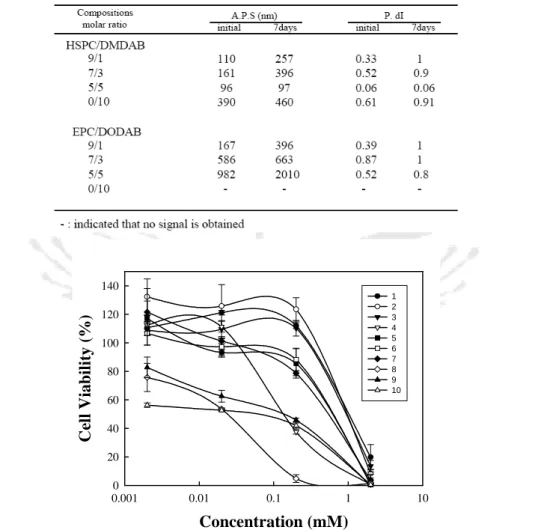
The particle size distributions of cationic vesicles with time at room temperature were listed in Table 1. Adding of cationic surfactants into vesicles did affect stability of liposomes. It has been found that cationic vesicles consisted of HSPC/DMDAB (5/5) is the most stable between these different formulations. Besides, Figure 1 shows the cell viability of cationic vesicles varied with different compositions. One can say that cationic vesicles exhibited more cytotoxicity as increasing molar ratio of DXDAB.
Table 1. The average particle size (A.P.S) and poly dispersity (P.dI) of different cationic
vesicles at initial and 7 days at room temperature were listed.Concentration (mM)
0.001 0.01 0.1 1 10
C el l V ia b il it y (% )
0 20 40 60 80 100 120 140
1 2 3 4 5 6 7 8 9 10
Fig. 1 Cytotoxicity assay of cationic vesicles consisted of HSPC/DODAB with 1: X DODAB
=0.9, 2: X
DODAB
=0.3, 3: XDODAB
=0, 4: XDODAB
=1, 5: XDODAB
=0.5, and consisted of EPC/DPDAB with 6: XDPDAB
=0, 7: XDPDAB
=0.1, 8: XDPDAB
=1, 9: XDPDAB
=0.3, 10:X
DPDAB
=0.5 during 24hr.References
1) P.L. Felgner et al., Proc. Natl. Acad. Sci. USA Vol.81, pp.7413-7417, (1987) 2) P. Pinnaduwage et al., Biochim. Biophys. Acta, Vol.985, pp.33-37 (1989) 3) I. Koltover et al., Science, Vol.281, pp.78-81 (1998)
Poster
Membrane Properties and Cyototoxicity of Cationic Surfactants/Phosphatidylcholine
Mixed Systems
Chia-Hua Liang and Tzung-Han Chou*
Department of Cosmetic Science, Faculty of Pharmacy, Chia Nan University of Pharmacy and Science, Tainan 717, Taiwan, R.O.C.
Introduction
Past two decades, it has been widely studied that the cationic liposomes can be used to mediate the intracellular delivery of DNA into cell [1-3]. Early, the cationic lipid, N-[-1-(2,3-dioleyloxy)propyl]-N,N,N-trimethylammonium chloride has been used to form positively charged liposomes (Lipofectin). However, it is caused more interesting in adding double-chained surfactants such as dialkyl quaternary ammonium salts into liposomes attributed to economic cost consideration.
In present study, cationic surfactants including dioctadecyl dimethylammonium bromide (DODAB), dipalmitoyldimethylammonium bromide (DPDAB), and dimyristoyldimethylammonium bromide (DMDAB) are incorporated into lipid vesicles.
Further, hydrogenated soybean phosphatidylcholine (HSPC), and egg phosphatidylcholine (EPC) are individually used to prepare small unilamellar vesicles at different preparation condition. The physicochemical membrane properties of binary mixed DXDAB/DXPC lipid bilayers will be examined in terms of vesicles particle size. Additionally, the stability tests of cationic vesicles are carried out. The cytotoxicity of cationic vesicles membrane is also examined and discussed in this research.
Experimental
Preparation of cationic liposomes
EPC, HSPC, DODAB, DPDAB, and DMDAB were mixed in the desired molar ratio and dissolved in the CHCl
3
/methanol (v/v=1/1) cosolvent. A lipid thin film was formed by removing solvent under a high vacuum at 45°C. Lipid films were hydrated by adding PBS (pH=7.0), and then sonicated at 4°C. Cationic vesicles with a fixed lipid concentration of 20 mM were attained. Finally, the size distribution was determined by dynamic light scattering.Cytotoxic assay
Human A549 lung cancer cells were maintained in F-12 medium with 10% fetal bovine serum and supplemented with 1% penicillin–streptomycin. The cells were cultured at 37℃ with 5% CO
2
. Then, A549 cells (1 · 104
) were seeded in 96-well plates and then treated with serial concentrations of cationic liposomes in combination for 24 h. After replacing new medium, cell viability was determined by the use of a colorimetric
tetrazolium MTS assay. The absorbance at 490 nm was measured by a spectrophotometer.
Results and Discussion
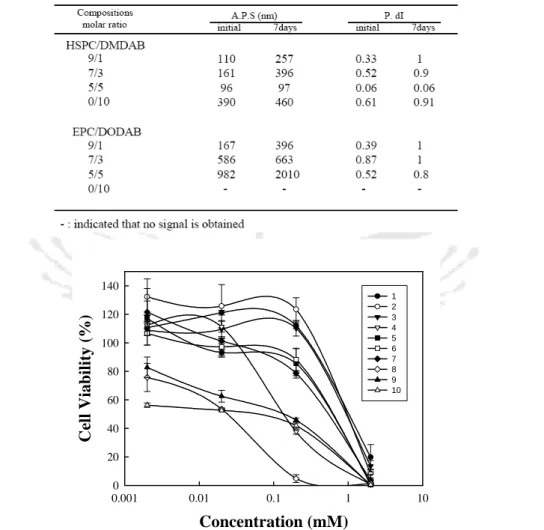
The particle size distributions of cationic vesicles with time at room temperature were listed in Table 1. Adding of cationic surfactants into vesicles did affect stability of liposomes. It has been found that cationic vesicles consisted of HSPC/DMDAB (5/5) is the most stable between these different formulations. Besides, Figure 1 shows the cell viability of cationic vesicles varied with different compositions. One can say that cationic vesicles exhibited more cytotoxicity as increasing molar ratio of DXDAB.
Table 1. The average particle size (A.P.S) and poly dispersity (P.dI) of different cationic
vesicles at initial and 7 days at room temperature were listed.Concentration (mM)
0.001 0.01 0.1 1 10
C el l V ia b il it y (% )
0 20 40 60 80 100 120 140
1 2 3 4 5 6 7 8 9 10
Fig. 1 Cytotoxicity assay of cationic vesicles consisted of HSPC/DODAB with 1: X DODAB
=0.9, 2: X
DODAB
=0.3, 3: XDODAB
=0, 4: XDODAB
=1, 5: XDODAB
=0.5, and consisted of EPC/DPDAB with 6: XDPDAB
=0, 7: XDPDAB
=0.1, 8: XDPDAB
=1, 9: XDPDAB
=0.3, 10:X
DPDAB
=0.5 during 24hr.References
1) P.L. Felgner et al., Proc. Natl. Acad. Sci. USA Vol.81, pp.7413-7417, (1987) 2) P. Pinnaduwage et al., Biochim. Biophys. Acta, Vol.985, pp.33-37 (1989) 3) I. Koltover et al., Science, Vol.281, pp.78-81 (1998)