國立臺東大學兒童文學研究所 博士論文
指導教授:杜明城 博士
從童話走入羅曼史的灰姑娘 從童話走入羅曼史的灰姑娘 從童話走入羅曼史的灰姑娘 從童話走入羅曼史的灰姑娘: : : : 當代流行言情作品與後女性主義 當代流行言情作品與後女性主義 當代流行言情作品與後女性主義 當代流行言情作品與後女性主義
Cinderella from Fairy Tale to Romance:
Contemporary Popular Romances and Postfeminism
研 究 生: 賴育萱 撰
中 華 民 國 一 ○ 二 年 十 一 月
謝誌 謝誌 謝誌 謝誌
博士之路長且遠,終於走到這一頁。
這一頁有我對指導教授杜明城老師深深的感謝,因為老師的鼓勵與協助,使 我能夠順利畢業。也多謝口試委員張子樟老師、阮若缺老師、游珮芸老師以及溫 宏悅老師提供的寶貴意見,讓我的第一本英文論文順利完成。
這一頁也有我對兒文所師長們、博士班同學以及學弟妹們的美好回憶,這一 段求學歷程雖然辛苦,但由於師長們的啟發,同學們以及學弟妹們的陪伴與互相 加油,仍有許多讓人回味的片段。
這一頁不能缺的還有我對同事們的感謝,這幾年來收到的祝福與打氣不曾少 過。也謝謝大表姐在文獻搜尋上提供的幫助,總算讓我在期限內完成論文。
這一頁還要寫下我對家人們的感謝,對於家人的陪伴、包容與照顧,我有說 不完的感動與感激。
最後,在這一頁畫下最後的句點前,感恩天堂的祝福常伴左右,謝天謝地,
我終於拿到博士學位了!
一頁文字雖短,但有滿滿謝意,在此將祝福獻給關心我以及我關心的人。
從童話走入羅曼史的灰姑娘 從童話走入羅曼史的灰姑娘 從童話走入羅曼史的灰姑娘 從童話走入羅曼史的灰姑娘: : : : 當代流行言情作品與後女性主義 當代流行言情作品與後女性主義 當代流行言情作品與後女性主義 當代流行言情作品與後女性主義
作 者 作 者 作 者
作 者 : : : 賴 育 萱 : 賴 育 萱 賴 育 萱 賴 育 萱
國 立 臺 東 大 學 兒 童 文 學 研 究 所 博 士 班
摘 摘 摘 摘 要 要 要 要
本研究以廣受青少年喜愛的本土言情小說及偶像劇為例,探討當代言情作品 如何改寫灰姑娘童話而廣受歡迎。就文本的敘事結構上,以普洛普的形態學分析 法來了解言情小說、偶像劇與童話之間的同質性;就文本內容的表現,則以後女 性主義為視角,檢視其中的性別形象,探討後女性主義論述對於當代讀者的吸引 力。分析結果發現各文本的結構與普洛普所歸納出來的童話構造大致雷同。文本 內容隨著社會趨勢加入後女性主義的概念,性別角色的調整既反映也形塑當代文 化的性別感知。
後女性主義對流行文化的關注,使得流行文化文本能夠被納入青少年文學領 域。後女性主義也鼓勵年輕人嘗試新的事物並對自己的選擇負責,成為主動的慾 望主體。然而,若後女性主義挪用少女一詞,只是為了鼓吹成年女性擁抱青春,
或者將年輕世代的主動性與自我賦權都誘導在消費領域上,就此而言,後女性主 義便無助於青少年(文學)的發展。
關 鍵 詞 關 鍵 詞 關 鍵 詞
關 鍵 詞 ::::灰 姑 娘 、 言 情 小 說 、 偶 像 劇 、 後 女 性 主 義
Cinderella from Fairy Tale to Romance:
Contemporary Popular Romances and Postfeminism Yu-Hsuan Lai
Abstract
This study explores the ways in which contemporary romances rework the Cinderella tale and the reasons why such romance texts are popular in the cases of romance novels and idol dramas favored by teenagers. Vladimis Propp’s approach is applied to examine the structural similarities among romance novels, idol dramas and fairy tales. Gender representations are examined through a lens of postfeminism to explore how the postfeminist discourse appeals to contemporary audiences. The result shows that the morphological structure of each romance text is similar to the general pattern of fairy tales formulated by Propp. The texts adapt to social changes by incorporating postfeminist concepts. Shifted gender representations both reflect and shape cultural sensibilities about gender.
Postfeminism draws more attention to popular culture, creating a space for popular media texts in the field of young adult literature. Young people are constructed as active desiring subjects who can try new things and take responsibilities for their own choices in the postfeminist discourse. However, postfeminism may contribute little to the development of young adult (literature) if the word “girl” is appropriated only for grown women to embrace a sense of youth or the agential power of the young generation is induced only to the commercial realm.
Keywords: : : :Cinderella, Romance novels, Idol dramas, Postfeminism
Table of Contents
Chapter One Introduction: Modern Cinderella and Postfeminism ...1
I. Background and Purpose of the Study...1
II. Literature Review ... 11
III. Methodology of the Study ...27
IV. Samples of Local Romance Texts and Limitations of the Study ...30
Chapter Two The Incarnation of Cinderella:::: The Fairy-tale Structure in Popular Romances ...34
I. Vladimis Propp’s Approach and the Cinderella Tale...34
II. Morphological Analysis of the Romance Texts ...45
III. The Evolution from Fairy Tale to Romance ...61
Chapter Three (Re)casting a Love Spell: Strategies of Reworking an Old Romantic Story ...66
I. Reconstitution of Stereotypical Characters ...67
II. Reactivation of Emotional Responses...70
III. Re-creation of the Modern Prince...74
Chapter Four A Double Face of Modern Cinderella: Two-sided Femininities in Postfeminist Culture ...90
I. Performances of Glamorous and Classed Femininity ...93
II. Domesticity and Feminine Strength ...101
III. Romanticized and Empowered Forms of Female Passivity ... 112
Chapter Five Toward a Happy Ending: The Cooperative Project of Postfeminist Women and Girls ...120
I. Secrets of Creating Successful Romances...120
II. A Happy Ending for Modern Cinderella? The (Dis)advantages of Postfeminism...134
Works Cited ...141
Appendix I
The Morphological Schemes of Six Romance Texts ...162
Appendix II
The Distribution of Character Types among Dramatis Personae...175
Appendix III
Chinese Excerpt from the Dissertation ...180
List of Tables
Table 1 Proppian Functions...34 Table 2 The Distribution of Functions among Seven Roles ...37 Table 3 The Proppian Analysis of the Second Move of “The Beautiful
Wassilissa” ...40 Table 4
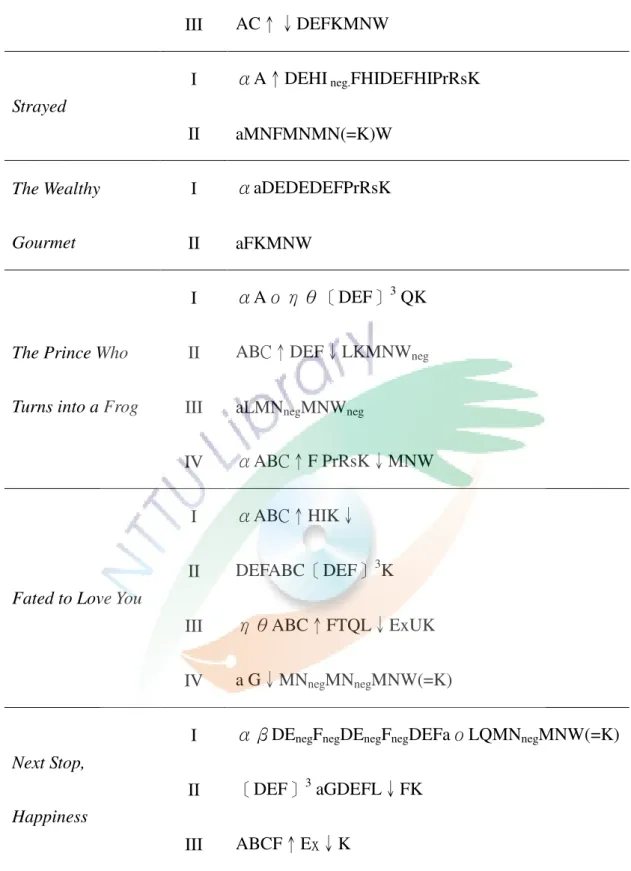
The Morphological Structures of the Romance Texts ...122 Table 5
The Distribution of Fairy-tale Roles between the Protagonists...124
Chapter One
Introduction nn n: Modern Cinderella and Postfeminism I. Background and Purpose of the Study
Romance is one of the well liked genres in contemporary entertainment culture.
Romantic narratives mediated either through printed form or through other media gain great popularity among young people in Taiwan. Romance novels and idol dramas (偶 像劇) are salient examples of domestic cultural products centered on narratives of
love and courtship and targeted at teenage readers/viewers. While some surveys indicate the cross-over appeal of these two cultural products, they are perceived to have enormous appeal for student population. According to an estimate offered by one major publisher of romance novels, junior and high school students constitute about 88 percent of romance readers (Y. Lin 55). Idol dramas, as the name implies, featuring teen idols in order to attract younger viewers than that of traditional TV series, are popular among middle school students, especially teenage girls (Tsao 123).
Besides the narrative focus on the same subject matter, local romance novels and idol dramas have undergone similar developmental process. The popularity of translated works of western romance novels and Japanese trendy dramas (趨勢劇) in
earlier days paves the way for the boom of local romance publishing in the 1990s and the sprout of Taiwanese idol dramas in the early 21st century respectively. Domestic
romance texts become hybrid cultural forms by imitating the foreign media products and injecting elements of local culture. Following the foreign models such as Harlequin romances or Japanese trendy dramas, local romance industry is developed to equal or even to exceed its foreign counterparts in the market share through the process of “strategic hybridism” which creates a synthesis of foreign ingredients and local features within the romance texts (Shuling Huang 4).
The interplay between local romance novels and Taiwanese idol dramas can be seen in several aspects. Many scripts of Taiwanese idol dramas borrow ideas from reading materials which have been circulated in book rental stores such as comic books and romance novels. Some idol dramas are adapted from local romance novels of well-known writers. For instance, Knock Knock Loving You (敲敲愛上你) is based on Hsi Chuan’s (席絹) novel. Shan Fei-hsueh’s (單飛雪) novel is adapted into Love Keeps Going ( 美 樂 加 油 ). Some writers associated with romance novels also
participate in screenwriting or creating tie-in novels for idol dramas. It is common to find devices and conventions of the romantic novels in idol dramas. Besides, pictures of male idols featuring TV shows appear on the cover illustrations of romance novels.
The titles of some romance novels are borrowed from those of popular idol dramas.
Cross-media interaction between printing industry and visual media becomes apparent when recent romance novels rely more heavily on a vivid description to provoke clear
images instead of an implicit reference (C. Yang 325).
Strict adherence to the romantic paradigm of fairy tales is a noticeable textual feature of contemporary popular romances. Local researchers tend to categorize romance novels or idol dramas as romantic narratives that are characterized by the romantic vision of love. The term “fairy tale” is used to describe the typical storyline of a romance novel or an idol drama. For example, the proceeding of the storyline in a romance novel is compared to that of fairy tales in which the protagonists live happily ever after in the end (Wang 1). “[T]he dream-like love story with a resemblance to the fairy tale” is identified as the core of an idol drama that addresses young people’s yearnings for love and romance (Hsueh 12).
As the connection between contemporary romances and traditional fairy tales on the thematic aspect is suggested by romance critics and scholars, their association on the content level is articulated by producers of romance texts. For instance, one publisher released titles such as Cinderella’s Waltz (灰姑娘的華爾滋) in 1999, The Prince Does Not Love Cinderella (王子不愛灰姑娘) in 2002, and No Sleeping
Beauty is Found in the Tower (高塔裡沒有睡美人) in 2003. It also introduced a set of
books intended to rework traditional fairy tales like Made-up Cinderella (彩妝灰姑 娘), Am I Cinderella (我是灰姑娘) and Alternative Cinderella (另類灰姑娘)
published in 2000. “A story about love and fairy tale” was used by a television
network as a slogan to advertise its drama The Prince Who Turns into a Frog (王子變 青蛙) in 2005. Given that the titles of the texts make no allusion to fairy tales,
consumers’ familiarity with the older narrative form enables them to recognize the relation between romance and fairy tale especially when a large number of romance texts emphasize the wealth gap between a rich man and a poor woman. Their romantic union is assumed in the “[narrative] logic of Cinderella” which is viewed as one key to the popularity of romance texts (Tsai 61).
The frequent presence of Cinderella makes her a staple of local romance industry.
Countless romance novels and a large proportion of idol dramas adopt the narrative logic of Cinderella. The widespread use of the Cinderella tale as an intertext in contemporary popular romances perpetuates its association with romantic love despite its alternative meaning as “someone who has a reversal of fortune or radically transforms” in the quest for “fame, success, or a happy life” (Miller 404). Her ubiquity in contemporary love stories attests to the everlasting charm of a wish-fulfillment fantasy in which the female protagonist leaps from rags to riches.
Such a romantic fantasy is alluring for a lot of consumers. However, it may be annoying for many critics.
Feminist critics have for a long time been concerned with the representations of female roles in fairy tales and their effects on the gender identity and behaviors of
young readers. As Marcia K. Lieberman notes, the popular classical fairy tales function as the “primary channels of acculturation” playing an important role in the formation of women’s “psycho-sexual self-concepts, and their ideas of what they could or could not accomplish” (187). She argues these stories reinforce the importance of traditional femininity and utilize the associational patterns to link the figures of the victimized heroines and the ultimate winners who are rescued, rewarded and glorified in the end (193). Karen E. Rowe pays special attention to the romantic paradigm in fairy tales, asserting its potency to shape the romantic expectations of contemporary women and encourage them to “internalize only aspirations deemed appropriate to our real sexual functions within a patriarchy” (211).
The story of Cinderella is a prime example. In line with Lieberman’s complaints about the negative impact of stereotyped representations of gender roles, Linda T.
Parsons reasserts “[f]airy tales and their influence are alive and well and with us today” (136). She views Perrault’s version of Cinderella as a patriarchal fairy tale criticizing its high premium on the heroine’s submissiveness, dependence and beauty:
This Cinderella cannot speak for herself, she cannot act on her own behalf, and she cannot function autonomously: yet she is rewarded with the ultimate prize.
After meek submission, humble, acceptance of her fate, being good to those who abused her, and becoming beautiful, she is rewarded with the prince, yet she did
not thing. (Parsons 144-145).
As Perrault projects his model female in his fairy tale which works as a useful means in “a civilizing process aimed at regulating the inner and outer nature of children”
(Zipes 43), Disney’s cinematic adaptation has a profound influence on adults (Zipes 193). Cinderella, an animated film based on Perrault’s tale, according to Kay Stone, is responsible not only for amplifying the stereotype of a pretty, passive and virtuous heroine, it also magnifies the romantic aspect to attract a wider audience and reinforces the power of “the secular myth of the modern age—the love story” (25).
Many retellings of the Cinderella tale are claimed to alter the embedded meanings and values which are thought inappropriate for modern society. However, fulfillment through coupledom remains an essential part of a happy ending. For example, Ella Enchanted, a Newbery Honor book by Gail Carson Levine, presents a modified Cinderella figure with strong voice and apparent agency. The author tries to blend the issue of girl empowerment with a happy-ever-after end by portraying the heroine as an energetic and rebellious girl. Although the romance ideology is not disrupted, Parson’s feminist reading of the story acknowledges that the story opens up multiple subject positions for the heroine and promotes love based on friendship and mutual respect rather than love at first sight (149).
Similarly, reworked gender representations are evident in the movie Ever After
while this filmic retelling of Cinderella retains a utopian vision of heterosexual romance. Some critics’ treatment about this conventional closure is different from a simplistic view of the oppressive effect of heterosexual relationship in a patriarchal system. A nuanced analysis is offered by John Stephens to illustrate the cultural tendency revealed in the movie. He contends that the film reflects “a modern tendency to shift the utopian ideal (and its inverse) from the domain of state institutions to the domain of individual subjectivity” as the humanistic values of progress, individual agency, and emancipation are embedded in romantic union (208-209). The transgression of gender boundaries in this movie, as Cathy Lynn Preston observes, shows its attempt to respond to the critique of the Cinderella figure as an antifeminist representative (203). It also attempts to “retrieve the romantic possibility of ‘true love’” for a generation “who still harbor a desire for ‘happily ever afters’ but who are also the product of revisionary understanding of what that ‘happily ever after’ might be and how it might be attained” (Preston 200, 204).
The transformation of Cinderella in modern retellings disclaims her status as a victim of sexism and patriarchy. This deployment of a new image of female empowerment in a heterosexual-centered narrative works in contradictory ways to both challenge and reinforce dominant gender ideology. Just as Yeh Ping-chun (葉品 君) concludes in her study of media cultural products based on the Cinderella
archetype, modern Cinderella becomes more independent and shrewd, taking on the role as the “black swan” to subvert the patriarchal order while she may also succumb to a strong desire for a princely male partner due to her longing for affluence and love (89). The approaches adopted by Stephens, Preston and Yeh Ping-chun exemplify the shift of feminist criticism away from simply focusing on the antifeminist implications and passive textual reception. The entry of more and more positive images of women into the popular domain demonstrates the potential of cultural products to adapt to social changes and functions as one of the effective marketing tools. It poses a challenge for critics to elaborate on the relationship between feminism and popular culture. Whether feminism is present in popular culture or whether the radical meaning is neutralized as feminist ideas become part of the mainstream is one of the preoccupations in feminist criticism (Gamman and Marshment 3).
Employing the romantic pattern inherited from fairy tales, contemporary romances incorporate feminist values into the patriarchal script of a heterosexual relationship. The entanglement of feminist and anti-feminist ideas, described by Rosalind Gill as “the postfeminist sensibility” can be seen in these works in which feminism is “simultaneously taken for granted and repudiated” (161). The wide appeal of these romances proves the economic potential of the commodified version of postfeminism.
The commercial success of postfeminism relies not only on the incorporation of feminist agenda but the simultaneous interrogation of the values of second-wave feminism. On one hand, positive gender representations emerge as a response to feminist calls for female empowerment, independence, and freedom of choice. On the other hand, the opposition between feminism and femininity as well as heteronormative discourses which informed second-wave feminist thought is dissolved for a generation growing up with “a historically and materially different experience” and struggling to reconcile “our feminist desires and our feminine desires” (Moseley and Read 240, 238). The articulation of conventional feminine interests expands the meaning of postfeminism as “a feminism that takes up and addresses such issues as popular culture, beauty and body practices, sex/iness, and all those other traditional ‘trappings’ of a particular understanding of femininity, engaging with them in often complex and even contradictory ways” (Braithwaite 27).
Postfeminism, as Ann Brooks explains, occupies a critical position “in regard to earlier feminist frameworks at the same time as critically engaging with patriarchal and imperialist discourses” and intersects with “postmodernism, poststructuralism and post-colonialism” (2, 4). Postmodern emphasis on difference, fractured identities and multiple subject positions validates a refusal of a single feminist agenda and identity.
Shelly Budgeson affirms there are diverse ways to become feminists: “For feminism
difference has meant trying harder to understand the multiple ways of being a woman and by implication the multiple ways of being a feminist” (23). This viewpoint justifies the transition of a collective and activist politics to one of “contradiction and ambivalence” (Banet-Weiser 210).
Local popular romances, whether in a book form or on the screen, have emulated the representational trend of depicting empowered female characters since the 1990s.
Modern Cinderella who turns into a defiant woman has become more prepossessing than her docile predecessor (Wen 113). A successful narrative formula, as Scott McCracken notes, has to satisfy consumers in its predictability and mediate changes in the world (61). As the reformulations of gender representations correspond to the changed cultural climate, structural similarities between fairy tales and contemporary romances provide consumers with great pleasure that is based on “this foreseen and awaited reappearance” of a narrative scheme (Eco 162). Whether pleasures offered by consuming romance texts are conservative or resistive remains controversial. The empowerment/oppression debate in local romance criticism motivates me to compare it with the controversy over postfeminism. To what extent do contemporary romances articulate a politics of ambivalence? In what ways do these works promote the postfeminist discourse? How does the promotion relate to the wide appeal of these texts? This study of local popular romances based on the (new) Cinderella archetype
aims to examine the connection between romantic narratives and fairy tales and explore the popularity of such romance texts in terms of shifted gender representations.
II. Literature Review
This section is divided into three parts. The development of local romance novels and Taiwanese idol dramas is outlined in the first part. The second part includes the discussions of gender politics in romance criticism. Finally, different understandings of postfeminism in recent western academic writings are explored to draw a parallel between the contradictory representations of gender politics and the conflicting definitions of postfeminism.
The romance novels discussed in this study refer to “series romances” or
“category products” which are published and marketed in an industrial mode (F. Lin 251). According to Lin Fang-mei’s observation, Tsi-tai(希代) was the first publishing
firm that ushered in this new production process from Harlequin company. Translated works of American romances were published in the same editorial format, with the same size of the book and a similar cover from 1977 to 1984. Later, it published novels of local writers, imitating the packaging and marketing strategies of Harlequin romances (255). Other publishers followed its footstep to produce local romance novels in similar ways. New books are released regularly in lines with specific names.
They are mass-produced products with uniform book sizes, standardized cover designs and similar page layouts (Hsu 8).
The emergence of this new method in the making of a book upgrades romance novels in book rental stores into sleek cultural products (F. Lin 263). The distribution channel is extended from book rental to mass market retail including chain bookstores, convenience stores, and general merchandising stores (Su-hui Huang 42). Before category romances of local writers dominated the domestic market share, imported works of western romances, Hong Kong romances or adaptations of TV dramas were included in earlier lines (Ya-pei Cheng 85; Lai 32). The enforcement of the copyright law put a ban on unauthorized copies of translated romances and thereby prompted domestic publishing houses to recruit more local romance writers to meet the demand of Taiwanese romance novel market (Hsu 6). With the expansion of local romance publishing, many new lines were established exclusively for works composed by local writers and developed diverse subgenres in the mid-to-late 1990s.
In western romance publishing industry, novels within the same line have similar settings, styles, types of conflicts or certain elements required by publishers to establish distinct features. The names of local romance lines do not connote distinguishing characteristics until some publishers begin lines in which books are characterized by a stronger level of sexuality such as Tsi-tai’s Red Mouth (紅唇情話),
Ho-ma’s(禾馬) Water Tinkle (水叮噹) and Red Cherry (紅櫻桃) (Lai 34; Su-hui
Huang 93). Most names of the lines are just brand names for publishers to promote their books as generic love stories rather than indexical labels for consumers to make a distinction between different story characteristics.
Local category romances dominated the Taiwanese romance novel market from the mid-1990s onwards. The industrial mode of production and distribution makes differentiation between the “commercial romances” and earlier popular romance novels from the 1960s to the 1980s (M. Yang 22; Hsu 7). These market-driven products are seen to mark a departure from classic Chinese romantic fiction in some commentaries while some researchers think they are “impure” and “hybrid” because they are not only influenced by western romance novels but also inherit the writing style of one popular genre of Chinese literature called “mandarin duck and butterfly”
school (鴛鴦蝴蝶派) (S. Li 19; Su-hui Huang 28).
Foreign influences on Taiwanese idol dramas are traceable to the success of Japanese serial dramas in the establishment of an audience base in Taiwan. These Japanese serials are of contemporary romance category called trendy dramas starring handsome actors and beautiful actresses who are well-dressed in designer clothes, live in cosy small apartments, and eat in expensive restaurants on screen (Chua 30). Well received by local audiences through pirated videos and illegal cable service in the
1980s, such dramas attracted urban youths and became hits in the 1990s (Shuling Huang 7). The new name “idol dramas” was introduced by the Taiwan branch of the satellite STAR TV when it started to broadcast Japanese trendy dramas in 1992, capturing audiences’ attention by highlighting the cast (Tsao 14). Later on, other competing cable channels imported Japanese trendy dramas and adopted the same marketing strategy, using the name “idol dramas” to promote the shows (Ke 6).
Meteor Garden(流星花園), the first locally produced idol drama in 2001, was an
adaptation of a Japanese comic book and became such a hit that it stimulated the rise of Taiwanese idol dramas. The domestic market was saturated with 28 or 29 idol dramas per year from 2002 to 2004 (Wu and Chiang 13). Many of the idol dramas were adapted from Japanese comic books during this period. Those based on original scripts also followed the formula of “setting, cast, and music” developed by Japanese trendy dramas (Shuling Huang 11). The characters’ Japanese names, the scenes in Japanese-style houses or the Korean stars included in the cast manifest the hybridization of Taiwanese idol dramas (Shuling Huang 12).
Taiwanese idol dramas distinguish themselves from earlier prime time serials as love dramas that focus on pure love and sweet romance rather than extramarital affairs, struggles in rich families and conflicts between mother and daughter-in-law (N.
Huang 83). They convey strong “belief in love” in contrast with earlier TV dramas
emphasizing mistrust of love (N. Huang 84). Wu Yi-kuo (吳怡國) and Chiang Yi-hui (姜易慧) identify three phases of the development of domestically made idol dramas
as the period of exploration and orientation, the period of competition and elimination, the period of refinement and transformation (19-21). After the first phase between 2001 and 2003, local producers tried substantial experiments with this new TV genre by combining romantic elements with multiple subject matters such as car racing, billiard games, and supernatural events in the second phase from 2004 to 2006 (20).
Despite the diverse subjects, they did not necessarily gain huge popularity. It turned out that variations on the Cinderella formula created a lot of resonance with local audiences measured by higher viewer ratings.
The profit motive results in a rush of production of local romance novels and Taiwanese idol dramas replicating the formula once it proves successful. Local category romances emerging from the late 1980s onwards are considered formulaic texts in local romance criticism. They are often compared with works written by Chiung Yao (瓊瑤), a predominant Mandarin romance novelist before the 1980s. The main characters, as Cheng Ya-pei (鄭雅佩) points out, are endowed with rare
attributes though they are not so perfect as those in Chung Yao’s novels. The hero is a man of a high socioeconomic status like a president of a big company in modern days or an emperor in ancient times. The heroine who used to be fragile turns into an
independent and intelligent woman. She will pursue her love actively instead of awaiting passively while she holds fast to the traditional concept of lifetime monogamy (23-25).
Protagonists in romance novels, according to Hsu Hsiu-pei ( 許秀 珮), are
binarized into “a hardhearted man” and “a softhearted woman”. The hero is bad in the moral, emotional or attitudinal aspect while he is excellent in his career:
The romantic heroes have much in common. They are all handsome, wealthy and powerful. They can be classified into four types: a tall guy, a very determined guy, an arbitrary and an irritable guy. In short, he makes people seized by an oppressive feeling. He may look gentle and polite while he is also sophisticated and gumptious. He may be playful and frivolous. He may be cold and solemn. Or he may be notoriously evil...The male protagonist has the typical look and personality. His attitude toward love is typical as well. His emotional
impotence is typical. (40)
Lai Yu-chin (賴育琴) maintains that protagonists in romance novels are stock
characters. The hero has a good look, a good family background, a good talent but a flawed personality; the heroine is smart but shrewd, or tender but careless (42).
The events described in romance novels usually follow a fixed sequence. The storyline proceeds from “encounter between the potential couple, misunderstandings
and conflicts, a turning point (the heroine’s disappearing act) to a denouement” (Lai 41). Taiwanese idol dramas have a similar narrative path through which the leading characters’ romantic relationship develops in four phases: “the first meeting, courtship, the barriers and the ultimate union” (Hsueh 13). Romance publications and TV productions tend to copy the idea of a previous work that sells well. Exploitation of the successful formula constrains the possibilities of giving it new elements.
Uncreative use of tropes and recurrent stereotypical characters lead critics to charge that the romantic narratives are works of poor originality and conservative ideology.
The formulaic plot development makes category romances largely identical. The writers lacking discernible style are described as “shadow writers” (Y. Lin 1).
Taiwanese idol dramas are criticized for “poorly-written scripts”, “unrealistic plot devices”, “excessive sentiment”, “stiff acting of novices” and “inadequate production budgets” (C. Li 73).
In addition to lack of innovation, a more controversial issue about gender representations draws critical attention. Cheng Yi-wen (鄭伊雯) examines local series
romances released in the late 1980s from a feminist perspective. Her analysis demonstrates patriarchal values are enhanced by the dichotomy between strong males and weak females as well as the endorsement of the virginal heroines in the texts (209). As LinYing-chieh (林英杰) asserts, changes in gender roles occur in category
romances published during the 1990s. Female readers of a new generation prefer a cool and macho hero to a gentle and graceful hero in earlier romances. However, sporadic reworking of gender relations remains contained in the patriarchal system (71-72).
As Lai Yu-chin contends, the glorification of an innocent, chaste and kind heroine in romance texts of the 1990s legitimates the patriarchal order and affirms family values (11). She also detects seeds of changes within the overriding patriarchal context. The portrayal on male physical attractiveness offers the possibility of an active female gaze (69). Besides, a detailed description of the heroine’s sexual pleasure subverts the power structure of heterosexual patriarchy, constructing the female as a desiring subject (77, 79).
The presence of androgynous characters, as Lai Yu-chin concludes, reveals a postmodern turn in romance novels of the 1990s (100). As the trend of crossing gender boundaries continues, it is more common, according to Yang Ming (楊明), to
find heroes with feminine looks in twenty-first-century romance novels (40-41). In addition to the increasing number of heroes of feminine types, heroines classified as the Cinderella type are no longer submissive victims waiting to be rescued. They are active in the pursuit of her happiness or independent-minded enough to abandon the attachment to worldly love. If she remains kind and tolerant, what she seeks for first is
not the love of Prince Charming but her self-growth (M. Yang 48).
Lin Hsin-chieh (林歆婕) states that many Taiwanese idol dramas follow the
Cinderella paradigm, depicting a romantic relationship between a man of a higher socioeconomic status and an ordinary woman who is kind-hearted without economic privileges. Marriage with the male protagonist is the only route through which the female protagonist can achieve success and happiness (119). Such recurrent gender stereotypes and opt-repeated narrative pattern in media texts, as she asserts, reproduce patriarchal ideology and reinforce gender inequality (120).
Monogamous marriage is generally viewed as a patriarchal invention that maintains the status quo and the sexual division of labor. Pamela Regis refutes against the charges made by the critics who claim that the happy ending in marriage enslaves both the heroine and the readers. In Regis’ defense, the ending in marriage or betrothal is not the governing element in determining a text’s meaning but the
“barrier” (the conflict) and the “point of ritual death” (a moment when the romantic union seems impossible) since it is the process rather than the conclusion of the heroine’s quest that romance readers are reading for (14). Moreover, the heroine’s victory, a state of freedom, is manifested when “she overcomes the barrier and is freed from all encumbrances to her union with the hero” (Regis 15). The marriage in the end of romance novels is interpreted by Hsu Hsiu-pei as a signal for satisfaction of
emotional needs:
The utopian imagination of conjugal happiness is extraordinarily significant because most romance readers are aware of women’s difficulties in real life. The nuclear family represents an ideal type that is formed on the basis of romantic love rather than class privilege. Its stability relies on free choices of family members instead of their obligations. It is a site for seeking emotional fulfillment, not for materialistic gains. Therefore, no conflicts should occur. (48) Romance readers, as Wen Tzu-hsin (溫子欣) explains, tend to take up a strategic
reading position in order to derive pleasure from consuming the texts. The happy ending in marriage is interpreted as the heroine’s triumph because she tames the hero at last (116-117). She identifies the interpretative strategy as a resistant reading:
Readers create the meanings they need purposely. Therefore, they reverse women’s inferior positions and strive for gender equality through their romance reading. We cannot make absolute statements about the good or bad impacts of romantic fiction. It is true that patriarchal values are conveyed by reproducing the existing power structure in romance texts. But readers can counterassault against the male-dominated world by interpreting the texts in their own way.
(135)
Janice A. Radway states in her ethnographic study of the Smithon’s romance
readers that the act of reading enables them to “refuse temporarily their family otherwise constant demand” and it can be seen as their attempt to “imagine a more perfect state where all the needs they so intensely feel and accept as given would be adequately addressed (211, 212).
There are disagreements about the role that romance texts play in feminist politics. Radway claims romance reading embodies merely “safe, limited, and barely conscious contestation of patriarchy” while it originates from women’s dissatisfaction with traditional marriages that fail to satisfy their needs (220). Kay Mussel notes that the romance fantasy provides readers with the chance to experience the illusion of change but it fails to promote “genuine change or individual growth” (172). In local critical accounts appear different assessments of the ideological revision within the romance texts. For example, Hsu Hsiu-pei warns readers against being deluded by the patriarchal love fantasy though there are positive significances in the texts. However minor the adjustments in the patriarchal framework are, some researchers believe small changes will accumulate to produce enormous subversive power (Lai 101; Y.
Lin 66).
Differing critical reception of romance texts in part parallels the debate over the mainstreaming and commoditization of feminism in western popular culture. The notion of co-option cannot fully reflect the complex relationship between feminism
and popular culture because the existence of feminism in today’s popular culture has become a form of common sense in which feminist ideas are expressed in a way that does not necessarily correspond with traditional feminist methods and critiques (Genz and Brabon 36). The category of popular feminism, or conceptualized by many as postfeminism, poses a challenge for critics to elaborate on the ambivalent relationship between feminism and popular culture.
The negative reading of postfeminism as antifeminist is offered by Susan Faludi.
She formulates the conservative reaction to feminism as a backlash— “a powerful
counterassault on women’s rights” attempting to “retract the handful of small and hard-won victories” the feminist movement has strived for (xviii). For her, postfeminism is one of the terms coined by the press to stress women’s excessive freedom brought about by women’s movement and then forge the connection of women’s unhappiness with women’s liberation:
[W]omen have achieved so much yet feel so dissatisfied; it must be feminism’s achievements, not society’s resistance to theses partial achievements, that is causing women all this pain. In the ‘70s, the press had help up its own glossy picture of a successful woman and said “See, she’s happy. That must be because she’s liberated.” Now, under the reverse logic of the backlash, the press airbrushed a frown into its picture of the successful woman and announced, “See,
she’s miserable. That must be because women are too liberated.” (Faludi 77) Her anti-media stance is apparent in her accusation of the media’s role as “backlash collaborator” (Faludi 78). She claims the media work well with popular culture and advertising to perpetuate and exaggerate its own false images of womanhood (xv).
The association between postfeminism and backlash in Faludi’s work is elaborated by Angela McRobbie in her discussion about how “the taken into accountness” of feminism in contemporary popular culture leads to the “undoing of feminism” (“Post-feminism” 256, 255). In her analysis, postfeminism as a complexificated form of backlash, draws on feminism to suggest that equality is achieved and discredits its need for renewal (“Post-feminism” 255-256). The irrelevance of feminism for contemporary culture is implied by “a double discourse that works to construct feminism as a phenomenon of the past, traces of which can be found (and sometimes even valued) in the present” (Tasker and Negra 8). Thus, the contradictory nature of postfeminism is characterized by the tension between the acknowledgement and the repudiation of feminism.
As the equation of postfeminism with backlash neglects “how the popular operates as a site of struggle over the meanings of feminism” (Hollow and Mosely 8), Ann Braithwaite finds it necessary to use the term “postfeminism” in a more complex and open-ended way with “an insistence on the plurality of positions and issues” that
it connotes for a whole range of different women (28). Postfeminism, according to Ann Brooks, represents “pluralism and difference” occupying a critical position “in regard to earlier feminist frameworks at the same time as critically engaging with patriarchal and imperialist discourses” (1, 2). This understanding of postfeminism can open up more discussions about how and why elements of feminism become “part of the accepted, naturalized social formation” instead of limiting the possibilities of analysis (Braithwaite 19). In this view, an alternative reading of the relationship between feminism and the popular assumes “a hegemonic negotiation of second-wave ideals” without reducing postfeminism to an overall rejection of feminism (Dow, Prime-Time Feminism 88).
Postfeminism is a highly contested term with multiple definitions just as there are divergent understandings of the relationship between feminism and popular culture. Postfeminism refers to what comes after feminism both in the chronological sense and in the semantic sense (Braithwaite 24). The prefix “post” designates “a journalistic or popular periodisation in which women’s lib is somehow over in the mid 1980s” (Brunsdon 85). Contemporary feminist critics are split on the semantic meaning of “post”. The reading of “post” as “anti” that prevails in the backlash discourse supports the rejection of postfeminist concepts while the prefix “post”
suggests a “critical distance” that allows of new developments of feminism for those
who advocate postfeminist positions (Kalbfleisch 252). Both anti- and pro-postfeminists adopt the “rhetoric of opposition” to represent the relationship between feminism and postfeminism (Kalbfleisch 251). Instead of situating feminism and postfeminism antithetically, the rhetoric of inclusion pits (post)feminism against some Other, facilitating a sense of sisterhood with the identification of a common enemy—patriarchy, for instance (Kalbfleisch 256). In this case, the critical tension
within the (post)feminism coupling is defused (Genz, Postfemininities 21).
This interpretative struggle extends to the signification of contemporary women’s display of traditional femininity. In contrast to viewing conventional femininity as a root of female oppression, women of a new generation refuse to give up the pleasures of feminine adornment and heterosexual romance (Moseley and Read 238). In this postfeminist cultural moment, young women frequently express feminist views in their daily lives while they reject “a particular image of feminist which they associate either with an older generation or else with a stereotypically unfeminine image” (McRobbie, “Shut Up” 409). As Ferriss and Young assert, traditional femininity, once considered a crippling cultural construction for women, is now embraced by younger generation as a choice (87). The re-evaluation of the opposition between femininity and feminism, as Stéphanie Genz notes, is a postfeminist response to “changing qualities of female/feminine/feminist experiences” in a late-twentieth-
and early-twenty-first-century context ( Postfemininities 24). Genz further claims that postfeminism does not refer to a denial of feminism but to an altered stage of gendered conflicts and transformations (Postfemininities 25).
Postfeminism’s reclamation of femininity is read as a threat of patriarchal recuperation or an expression of female power and agency in the critical community.
Much like the debate on the definition, political orientation and ideological influence of postfeminism, many discussions about the progressive or retrogressive dimensions of local romance texts are built on the subversion-restoration argument. From different perspectives, reworked gender representations and gender relations are seen to either subvert the patriarchal order or restore patriarchal values. Just as Sarah Projansky argues, whether feminism or antifeminism is seen as more dominant in the end turns out to be “a matter of interpretation and degree” (“ Mass Magazine” 68).
In Genz’s discussion of the paradoxes of modern-day femininity, she suggests adopting a negotiated stance that goes beyond the binary logic of progress and backlash:
Femininity is pro-agency and anti-victimization—as the process of transforming
and resignifying femininity continually threatens to re-impose phallocentricity and heteronormativity. Postfeminist femininity presents multiple layers of female identification that oscillate between subject and object, victim and
perpetrator. Post-ing femininity (like post-ing feminism) thus involves an amount of rethinking, not a reversal of well-established dualisms, but a process of resignification that is capable of re-inscribing what it also transposes.
(Postfemininities 26)
Her view of contemporary femininity adopts a rhetorical position of anxiety that is proposed by Jane Kalbfleisch to highlight “the conflict, contradictions, and ambiguity” within postfeminism (255).
The purpose of my study is not to “take sides”, in Projansky’s words, in the subversion-restoration argument so as to judge the value of contemporary romance texts. Building on the both/and logic approved in Genz’s and Projansky’s critical practice, I try to situate local romance texts in relation to the debates about postfeminism as well as shifting representations of feminism and gender roles with an attempt to emphasize how the inherent contradictions of postfeminist discourse embedded in the texts speak to certain readers/viewers and create a particular appeal to contemporary young generation.
III. Methodology of the Study
The first significant narratives we encounter, as Authur Asa Berger notes, are fairy tales that manifest the prototypic tale from which other tales and genres evolve (37). He suggests that many elements of popular genres can be found in fairy tales
(38). Familiarity with the structure of fairy tales makes it easy for readers/viewers to acquire the conventional pattern of popular narratives. The recurrent narrative scheme, as Umberto Eco argues, is an essential condition of reading/viewing pleasure (162).
The success of popular romances patterned on the Cinderella tale depends partially on the conventional structure. Vladimis Propp’s approach is helpful to articulate the relationship between fairy tale and romance genre in terms of the formal structure.
Alan Dundes points out the wide applicability of Propp’s approach in the introduction to his book, Morphology of the folktale:
Propp’s analysis should be useful in analyzing the structure of literary forms (such as novels and plays), comic strips, motion-picture and television plots and the like. In understanding the interrelationship between folklore and literature, and between folklore and the mass media, the emphasis has hitherto been principally upon content. Propp’s Morphology suggests that there can be structural borrowings as well as content borrowings. (xiv-xv)
Berger also argues a large number of the functions that Propp elicits in his pioneering study can be found in modern popular culture genres if some functions are slightly adapted (21). Contemporary researchers have applied Propp’s theory to examine popular media texts such as Hollywood films1 and Chinese swordsman novels2.
1 Lu Ni-lin (呂妮霖) applies Propp’s approach to explore a postmodern turn of the narratives in Hollywood movies based on traditional fairy tales. See Lu Ni-lin, “A Postmodern Turn in the Hollywood Cinematic Adaptations of Fairy Tales,” Master thesis, National Chengchi U, 2008.
Although these texts are much longer narratives than Russian folk tales studied by Propp. The concept of “move” proposed by Propp in his study, as Hung Chun-hsiang (洪群翔) explains in his morphological analysis of fantasy literature in the case study
of His Dark Materials Trilogy, can be used to decompose lengthy literary works (32).
In Radway’s study of popular western romance novels, she also employs Propp’s concepts to identify the constant narrative elements of successful romance novels (134). Therefore, morphological analysis is employed in this study to see whether there are certain structural parallels between fairy tale and modern romance genre.
A successful formulaic work, John G. Cawelti maintains, has some “ingenious new type of mystification” within the limits of the conventional structure (10). I will also analyze the content of each text to find out the new elements given to the Cinderella formula. Postfeminist discourses, as mentioned above, manifest the complexity and contradiction in recent representations of gender politics. I believe the underlying perspective of postfeminism in popular romances is concerned with how feminist ideas are incorporated to attract and distract contemporary readers/viewers.
As Sarah Projansky claims, postfeminism appeals to multiple and contradictory audiences due to its versatility (Watching Rape 86). Revised female representations in
2 The Chinese swordsman novel, also called as wuxia (武俠) novel, is one type of Chinese genre fiction, describing the adventures of ancient martial artists. It is also a popular item in book rental stores. Propp’s approach is utilized in Liu Chen-tu’s dissertation to analyze the works of one famous wuxia novelist Jin Yong (金庸). See Liu Chen-tu, “ A study of Jin Yong’s Novels from the Perspective
the texts emerging from the late 1990s onwards require new tools and perspectives to make comparisons with their predecessors identified as the “new woman” character type (Lotz 105). Amanda D. Lotz suggests postfeminism is a useful term to explain the emergence of “new, new women” and analyze recent shifts in ideas about feminism as long as we are aware of its various uses (106). Although postfeminism is a term introduced in the western context, it is applicable to explore representational phenomena of local texts since the feminist movement and popular media texts, as Lotz reminds us, are not confined by national boundaries (112). I would add that the lure of romantic love and the trend toward commercialization do not exist exclusively in western countries. As the myth of sexual freedom was emphasized in local commercial culture in the 1990s, the commoditization of feminism in Taiwan appeared to synchronize with the tempo of the development of postfeminist thoughts during the end of the 20th century (Chiu 262). Therefore, I adopt a lens of postfeminism through which feminist ideas in the romantic narratives are identified to account for the internal contradictions in the texts and their resonance with contemporary readers/viewers.
IV. Samples of Local Romance Texts and Limitations of the Study
The romance novels examined in this study are the works of Hsi Chuan (席絹):
Non-princess in the Castle (城堡裡沒有公主) in 2001, Strayed (迷路) in 2004, The
Wealthy Gourmet (富貴饕家) in 2008. Self-conscious references to Cinderella in
these novels are indicative of the author’s ironic play with the Cinderella formula. The idol dramas chosen for analysis are Sanli (三立) E-Television’s (SET) productions:
The Prince Who Turns into a Frog (王子變青蛙) first aired in 2005, Fated to Love
You (命中注定我愛你) first aired in 2008 and Next Stop, Happiness (下一站幸福)
first aired in 2009. Focusing on a romance between a rich man and a poor woman, these dramas are recognized easily as variations on the Cinderella stories.
Hsi Chuan, dubbed as “queen of romance novels”, is a very famous writer whose works inspire many imitators (Wang 2). Her works always appear in the list of the most frequently rented novels in book rental stores. Therefore, her popularity has received notice from the press and local researchers3. SET is one of the major providers of Taiwanese idol dramas. It is successful in garnering oversea distribution of its productions (Chang 57). Its idol dramas feature original scripts by local writers.
Several of its series have high ratings and spawn imitations. For example, The Prince Who Turns into a Frog is the first idol drama that breaks the previous ratings record
set by Meteor Garden. Its success induces many producers of idol dramas to employ a similar narrative pattern (H. Lin 68). Subsequent works such as Fated to Love You and Next Stop, Happiness get higher ratings. Fated to Love You, in particular, establishes
3 Hsi Chuan’s novels are chosen as subjects in master theses by Wang Mei-yu (王梅郁) and Fan
such a high viewing ratings record that even shows of other TV genres cannot chalk up easily. The success of these dramas makes SET a famous brand for the production of original idol dramas (Ke 14). Hsi Chuan’s novels and SET’s idol dramas are chosen because they are popular. On one hand, they are all products originating from popular culture. On the other hand, they are well-known and well-liked. In addition, explicit references to Cinderella, the princess, or the prince in these texts imply creators’
attempts to remind readers/viewers of the intertextuality between their works and fairy tales.
As Genz asks “Are we past the “post” and/or riding a new feminist wave? Have we arrived in a brave new world or are we doomed to repeat the patterns of the last century?” in her Postfemininities in Popular Culture (24), I intend to readdress these questions in my local context. I choose to focus on romance novels and idol dramas not only because they are representative examples of popular romantic narratives among teenagers but also because the interplay between these two types of media products and postfeminist culture has not been explored in the academic literature. All these texts studied here are domestically produced originals. They are linked thematically as narratives exploring conflicts in inter-class love. They are also interconnected chronologically, appearing in the 2000s. This study is limited to two forms of local romantic narratives in the first decade of the new millennium. Although
my analysis doesn’t extend to other types of media products, I hope my research can contribute to studies in the interrelationship between popular culture and (post)feminism.
Chapter Two
The Incarnation of Cinderellaaaa::::
The Fairy-tale Structure in Popular Romances I. Vladimis Propp’s Approach and the Cinderella Tale
Vladimis Propp’s study aims to find out a systematic way of classifying folktales in terms of the essential components and their relationship to each other. He develops a morphological approach to decompose the tales and proposes that the actions of various characters which he terms “functions” are basic elements of a tale (20).
According to Propp, the function is “an act of a character, defined from the point of view of its significance for the course of the action” (21). He also asserts there are at most 31 functions found in fairy tales. No matter by whom and by what means the functions are performed, they “serve as stable, constant elements in a tale” (21).
31 functions along with the definitions as well as the signs adopted by Propp to represent each function are listed as the table 14.
Table 1
Proppian Functions
Sign Function Definition
α initial situation the members of a family are enumerated or the future hero is
4 As for the examples of each function, see Propp 26-64.
introduced.
β absentation One of the member of a family absents himself from home.
γ interdiction An interdiction is addressed to the hero.
δ violation The interdiction is violated.
ε reconnaissance The villain makes an attempt at reconnaissance.
ζ delivery The villain receives information about his victim.
η trickery
The villain attempts to deceive his victim in order to take possession of him or of his belongings.
θ complicity
The victim submits to deception and thereby unwittingly helps his enemy.
A a
villainy lack
The villain causes harm or injury to a member of a family.
One member of a family either lacks something or desires to have something.
B mediation
Misfortune or lack is made known; the hero is approached with a request or command; he is allowed to go or he is dispatched.
C
beginning counteraction
The seeker agrees to or decides upon counteraction.
↑ departure The hero leaves home.
D
the first function of the
donor
The hero is tested, interrogated, attacked, which prepares the way for his receiving either a magical agent or helper.
E
the hero’s reaction
The hero reacts to the actions of the future donor.
F
receipt of a magical agent
The hero acquires the use of a magical agent.
G
spatial transference
The hero is transferred, delivered, or led to the whereabouts of an object of search.
H struggle The hero and the villain join in direct combat.
J branding The hero is branded.
I victory The villain is defeated.
K liquidation The initial misfortune or lack is liquidated.
↓ return The hero returns.
Pr pursuit The hero is pursued.
Rs rescue Rescue of the hero from pursuit
ο
unrecognized arrival
The hero, unrecognized, arrives home or in another country.
L
unfounded claims
A false hero presents unfounded claims.
M difficult task A difficult task is proposed to the hero.
N solution The task is resolved.
Q recognition The hero is recognized.
Ex exposure The false hero or villain is exposed.
T transfiguration The hero is given a new appearance.
U punishment The villain is punished.
W wedding The hero is married and ascends the throne.
The functions, as Propp notes, logically join together into seven spheres of action that correspond to their respective performers: the villain, the donor, the helper, a princess (and her father), the dispatcher, the hero and the false hero (79-80). He suggests that one character in the story may either perform the actions in one sphere or involve in several spheres of action (80). It is also possible for a number of characters to fulfill actions in one single sphere (81). The relations between the major performers and the functions are shown in the table below.
Table 2
The Distribution of Functions among Seven Roles
Kinds of performers Functions
Villain Villainy, Struggle, Pursuit
Donor (Provider)
The first function of the donor, Receipt of agent
Helper
Spatial change, Liquidation, Rescue, Solution, Transfiguration
Princess (A sought-for person) and her father
Branding, Difficult task, Recognition, Exposure, Punishment, Wedding
Dispatcher Mediation
Hero
Counteraction, Departure, Hero’s reaction, Wedding
False hero
Counteraction, Departure, Hero’s reaction, Unfounded claims
Any plot development proceeding from function A or function a, through intermediary functions to function W or other terminal functions is viewed as a
“move”. A tale may consist of several moves, each of which is created by an obligatory element, either a villainous act or a lack (Propp 92). Propp considers “The Beautiful Wassilissa”5, the Russian version of Cinderella, is a double-move story. In the first move, the female protagonist, Wassilissa, is given by her dying mother a
5 To read the English translation of this tale, see Marie-Louise von Franz, “ The Beautiful Wassilissa,”
Cinderella: A Casebook, ed. Alan Dundes (Madison: U of Wisconsin P, 1988) 203-07.
miraculous doll which comforts her later and helps her finish all the hard work assigned by her evil stepmother. As she is sent to fetch the fire from the witch in the wood, the doll aids her again in completing the tasks given by the witch. Then the witch gives her a skull with burning eyes in it before she returns home. Afterwards, the glowing eyes burn her step-relatives to ashes. The narrative structure analyzed by Propp is presented as: FaBC↑DEF↓U6. In this scheme, the sequence of the
functions is relatively similar to that of the usual tale except for the first element, Function F (receipt of a magical agent), which usually comes after the exit from home.
Such a fluctuation, as Propp argues, is allowable and it does not result in a new compositional system (108).
Propp classifies the tales he examines into four types according to the presence or absence of two pairs of functions: tales with function H (struggle) and function I (victory), tales with function M (difficult task) and function N (solution), tales with both functions H-I and functions M-N, and tales without either (102). “The Beautiful Wassilissa” belongs to the second type since the second move of this story describes how Wassilissa is recognized by her domestic skills such as spinning, weaving and sewing before her royal marriage. The result of Propp’s analysis is tabulated as follows:
6 “The Beautiful Wassilissa” is labeled as Tale No. 104 in the English translation of Propp’s book. Its
Table 3
The Proppian Analysis of the Second Move of “The Beautiful Wassilissa”
Function Event in the story
Initial situation (α) Wassilissa buries the skull and leaves the house
with the doll.
Unrecognized arrival (ο) Wassilissa goes into the town and settles in an old
woman’s house.
Receipt of a magical agent (F) Wassilissa asks the old woman to buy her some flax.
Solution (N) Wassilissa spins fine yarn from the flax.
Receipt of a magical agent (F) The doll makes a loom for Wassilissa to weave.
Solution (N) Wassilissa uses the doll’s machine to finish weaving fine cloth.
Difficult task (M) The king demands that the shirts be sewn.
Solution (N) Wassilissa makes the shirts.
Wedding (W) Wassilissa and the king get married
Neither direct villainy nor any apparent form of a lack appears before the entire action in this move. Propp infers that there is an implied function a (lack) realized by Wassilissa’s longing for a royal bridegroom since all her actions stem from the
situation that the king has no wife (146). He also infers that spinning and weaving are the solutions of tasks while the tasks are foreseen by Wassilissa. He claims that this is a case of preliminary solution, a type of solution coming before the task is set (145).
Based on Propp’s observation, there are two types of heroes. The first type is a
“seeker-hero”, who departs in search of some object. The other one is termed a
“victim-hero”, who experiences the journey without any anticipated goal (39). One might identify the persecuted heroine with a female victimized hero at first glance since she is ill-treated by her step-relatives. However, the heroine’s suffering caused by her stepmother does not motivate her departure; neither does it serve to be the mover of the events. If inferences drawn from the narrative purposes are validated, the seemingly victimized protagonist should become a seeker instead.
Other variants of the Cinderella tale characterized by the shoe test such as the Perrault’s version can illustrate the complication and the ambiguity of Cinderella’s role. David Pace views Cinderella’s desire to go to the ball as function a (lack), assuming a complete analysis can be made by seeking to identify other functions in the following segments of the plot (250). Therefore, if a longing for attending the ball manifests the desire to attract a royal member, the role of the seeker is enacted by Cinderella, who defies her stepmother, going to the ball with her godmother’s gifts, makes the prince fall in love with her, passes the shoe test and marries the prince in