Long-Distance FBG Sensor System using Fiber Ring Laser with
Hybrid Amplifier
Peng-Chun Peng *
1, Kai-Ming Feng
2, Wei-Ren Peng
1, Hung-Yu Chiou
2,
Ching-Cheng Chang
2, and Sien Chi
1,31. Institute of Electro-Optical Engineering, National Chiao-Tung University, Hsinchu, Taiwan 300, R.O.C. 2. Institute of Communications Engineering and Department of Electrical Engineering, National Tsing Hua University,
Hsinchu, Taiwan 300, R.O.C.
3. Department of Electrical Engineering, Yuan Ze University, Chungli, Taiwan 320, R.O.C. Abstract
A fiber Bragg grating (FBG) sensor system using a fiber ring laser with a hybrid amplifier is proposed and demonstrated. The hybrid amplifier comprises an erbium doped waveguide amplifier and a semiconductor optical amplifier. The experiment shows that such the hybrid amplifier has a high amplifier spontaneous emission power and gain spectrum. Moreover, this fiber ring laser can provide a stable multiwavelength output with an optical signal-to-noise ratio over 50 dB even if the FBGs are located at a 25 km remote sensing position.
Keywords: Fiber sensor, fiber Bragg grating, fiber laser, erbium-doped waveguide amplifier, semiconductor optical amplifier
INTRODUCTION
Fiber Bragg gratings (FBGs) are useful optical devices because of their feasibility for multipoint sensing in a smart structure. In general FBG sensor systems, a broadband erbium doped fiber amplifier (EDFA) or light emitting diode is used as a light source. Recently, FBG sensor systems using fiber laser schemes have been the focus of a great deal of research due to their high output power, high resolution for wavelength shift, and high optical signal-to-noise ratio (SNR) against the noisy environments in practical applications [1-3].
Multiwavelength oscillations in a fiber laser source that uses a semiconductor optical amplifier (SOA) is possible because of its inhomogeneous broadening property and broad gain spectrum. Recent an interesting technique is the use of two SOAs in the laser cavity in order to increase both the lasing bandwidth and the average power [4]. However, SOAs have a relatively high noise figure. Adding an extra SOA in the laser cavity will decrease the optical signal-to-noise ratio (SNR) of fiber laser. To overcome this drawback, an EDFA instead of an SOA can be inserted into the multiwavelength laser cavity. The gain can be increased, and the lasing bandwidth also can be broadened. Moreover, the optical SNR is higher than that of the two SOA systems [5].
Erbium doped waveguide amplifiers (EDWAs) are now very attractive for using in metro networks because of their compactness, lower-cost processing, and excellent compatibility with other optical devices. Furthermore, the EDWAs have the advantage of inheriting the fundamental qualities of the EDFAs, such as a low noise figure, negligible polarization dependence, and the absence of inter-channel crosstalk, and they have potential for integration with pump lasers and other optical devices [6]. In this paper, we propose a FBG sensor system in the fiber ring laser scheme
* E-mailΚ[email protected] PhoneΚ+886-3-571-2121 ext. 52992, FAXΚ+886-3-571-6631
17th International Conference on Optical Fibre Sensors, Marc Voet, Reinhardt Willsch, Wolfgang Ecke, Julian Jones, Brian Culshaw, eds., Proceedings of SPIE Vol. 5855 (SPIE, Bellingham, WA, 2005) · 0277-786X/05/$15 · doi: 10.1117/12.624271 860
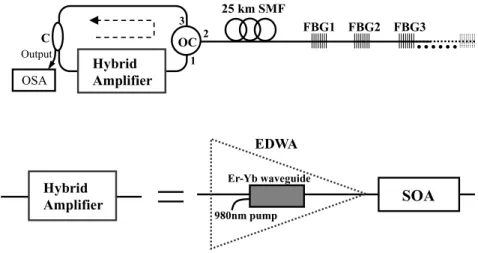
FBG1 FBG2 FBG3 25 km SMF 2 1 3 OC Er-Yb waveguide 980nm pump SOA EDWA Output C Hybrid Amplifier Hybrid Amplifier OSA
with a hybrid amplifier as gain medium. The ring cavity is constructed by a series of FBGs, 25 km single mode fiber (SMF), and both EDWA and SOA are used for the gain medium. In our experiment, such a multiwavelength fiber laser scheme provided a high optical SNR over 50 dB even if FBGs were located at 25 km remote sensing points. In addition, each peak power was stable even if different strains were imposed on the FBG. These features can facilitate a long-distance or a large-scale fiber sensor system and can be easily extended for multipoint sensing applications.
Fig. 1 Schematic diagram of the long-distance FBG sensor system. (OSA: optical spectrum analyzer, C: 1x2 coupler with coupling ratio 90:10, OC: optical circulator, SMF: single mode fiber, EDWA: erbium doped waveguide amplifier, SOA: semiconductor optical amplifier).
EXPERIMENTS AND RESULTS The schematic diagram of the proposed long-distance FBG
sensor system is shown in Fig.1. The fiber ring laser comprises a hybrid amplifier with an EDWA and an SOA, a circulator (OC), a 1x2 optical coupler with coupling ratio 90:10 (C), a section of 25 km SMF, and a series of FBGs simultaneously acting as cavity mirrors and sensing elements. The lasing wavelength is determined by the sensing FBG chain. The EDWA is manufactured by Teem Photonics via a two step ion exchanges process. It has a saturated output power about 10 dBm and an amplified spontaneous emission (ASE) power 3 mW. The SOA has a saturated output power about 13.7 dBm and an ASE power 3.4 mW. In the fiber-laser-based sensor system, the main limitation on the maximum distance and number for the sensors would be the gain medium. To realize the performance of this proposed hybrid amplifier, a tunable laser and an optical spectrum analyzer (OSA) are used to measure the gain spectra.
Wavelength (nm) Gain (dB) 1520 1530 1540 1550 1560 1570 1580 10 15 20 25 30 35 40 45 50 Hybrid Amplifier EDWA SOA
Fig. 2 Optical gain spectra of the EDWA, SOA, and hybrid amplifier when the input power is set at -25 dBm.
Proc. of SPIE Vol. 5855 861
Strain 10 -50 Power (dBm) -90 1551 1561 Wavelength (nm) -30 -70 1553 1559 1555 1557 -10 FBG1 FBG2 FBG3
Fig. 4 Wavelength shifts of FBG3 when different strains were imposed on it.
Fig. 5 Variation of peak power as a function time for each lasing wavelength.
Time (min) Peak power (dBm) 0 2 6 10 -50 -40 -30 -20 -10 0 FBG1 FBG2 FBG3 4 8 0 -30 Power (dBm) -50 1445 1645 Wavelength (nm) -20 -40 1485 16051525 1565 -10
SOA
EDWA 3 mW ASE 23.2 mW ASE of EDWAASE of Hybrid Amplifier ASE
Hybrid Amplifier
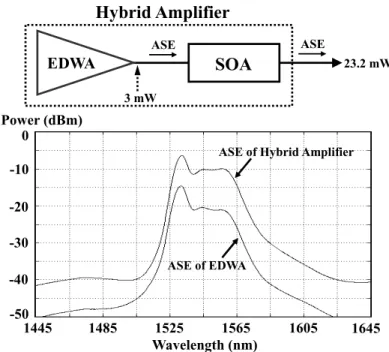
Fig. 3 ASE spectra of the EDWA and hybrid amplifier.
The gain spectra of amplifiers are shown in Fig. 2. The input power was set at -25 dBm. The maximum gain of hybrid amplifier was 36.71 dB at 1532 nm. In contrast with the single EDWA or SOA, the hybrid amplifier has a higher gain. It can facilitate to setup a long-distance or a large-scale fiber sensor system. Moreover, for long-distance sensor system, the light source with high output power is also required. We measure the ASE power of amplifiers. Fig.3 shows the ASE spectra of EDWA and hybrid amplifier. The ASE power from EDWA was only 3 mW. Nevertheless, the hybrid amplifier can increase ASE power form 3 mW to 23.2 mW.
862 Proc. of SPIE Vol. 5855
In our experiment, we examined three sensing FBGs and achieved a triple-wavelength fiber laser for the proposed long-distant sensor system. The Bragg wavelengths of FBG1, FBG2, and FBG3 were 1552.52, 1554.47, and 1556.53 nm. The peak reflectivities of the FBGs were approximately 99%. Under these conditions, the fiber ring laser with hybrid amplifier lased a continuous wave with triple-wavelength simultaneously. Fig. 4 shows the output spectrum of this fiber laser. The optical SNRs provided by FBG1, FBG2, and FBG3 for the sensor system were over 50 dB even if the three sensing points were located 25 km far from the optical spectrum analyzer. The peak power of lased output at triple-wavelength was around -13.3 dBm. Moreover, there were no influence on the lasing wavelengths of FBG1 and FBG2 when the wavelength of FBG3 drifted. The peak power variation of the fiber laser as a function of time is shown in Fig. 5. The fluctuations of the lasing peaks were smaller than 0.58 dB. Such a lasing output is stable and intense enough for the long-distant fiber sensor system.
CONCLUSION
A long-distance FBG sensor system using a fiber ring laser with an EDWA and an SOA was proposed. Because of the inhomogeneous broadening of the hybrid amplifier and the high ASE power, the proposed fiber laser can generate multiwavelength output for multipoint sensing at a long distance. Experimental results showed the multiwavelength fiber laser with stable and intense peak power even if the FBGs were located at a 25 km far sensing position. Furthermore, using EDWA makes the system more compact and has potential for integrating the system on planar waveguides. The proposed fiber sensor system can be used for long-haul or large-scale smart structures.
Acknowledgments
This work was supported in part by the MediaTek Fellowship and in part by the National Science Council of R. O. C. under Contract NSC 93-2752-E-009-009-PAE, Contract NSC 93-2219-E-007-001, and Contract NSC 93-2215-E-155-005.
References
[1] A. D. Kersey, M. A. Davis, H. J. Partrick, M. Leblance, K. P. Koo, C. G. Askins, M. A. Putnam, and E. J. Friebele, “Fiber grating sensors,” Journal of Lightwave Technology, vol. 15, pp. 1442-1463, 1997.
[2] L. Talaverano, S. Abad, S. Jarabo, and M. Lopez-Amo, “Multiwavelength fiber laser sources with Bragg-grating sensor multiplexing capability,” Journal of Lightwave Technology, vol. 19, pp.553-558, 2001.
[3] S. Kim, J. Kwon, S. Kim, and B. Lee, “Multiplexed strain sensor using fiber grating-tuned fiber laser with a semiconductor optical amplifier,” IEEE Photonics Technology Letters, vol. 13, pp. 350-351, 2001.
[4] N. Pleros, C. Bintjas, M. Kalyvas, G. Theophilopoulos, K. Yiannopoulos, S. Sygletos, H. Avramopoulos, "Multiwavelength and power equalized SOA laser sources" IEEE Photonics Technology Letters, vol. 14, pp. 693 - 695, 2002.
[5] D. N. Wang, F. W. Tong, X. Fang, W. Jin, P. K. A. Wai, J. M. Gong, “Multiwavelength erbium-doped fiber ring laser source with a hybrid gain medium,” Optics Communications, vol. 228, pp. 295-301, 2003.
[6] K. C. Reichmann, P. P. Ianonne, M. Birk, N. J. Frigo, D. Barbier, C. Cassagnettes, T. Garret, A. Verlucco, S. Perrier, J. Philipsen, “An Eight-Wavelength 160-Km Transparent Metro WDM Ring Network Featuring Cascaded Erbium-Doped Waveguide Amplifiers,” IEEE Photonics Technology Letters, vol. 13, pp. 1130 - 1132, 2001.
Proc. of SPIE Vol. 5855 863