
英語教學在職專班研究生論文寫作困難與對策 - 政大學術集成
154
0
0
全文
(2) 國立政治大學英國語文學系碩士班 碩士論文. 英語教學在職專班研究生論文寫作困難與對策. (英語教學組). 立. 政 治 大. ‧. ‧ 國. 學. n. er. io. al. sit. y. Nat 指導教授: 黃怡萍博士. Ch. engchi. i n U. v. 研究生:許柔恩撰 國立政治大學英國語文學系碩士班 中華民國一百零二年一月.
(3) 立. 政 治 大. ‧. ‧ 國. 學. n. er. io. sit. y. Nat. al. Ch. engchi. i n U. v.
(4) ETMA Students’ Perceived Difficulties and Their Coping Strategies in Thesis Writing. A Master Thesis Presented to Department of English. 學. ‧ 國. 立. 政 治 大. National Chengchi University. ‧. In Partial Fulfillment. Master of Arts. n. al. er. io. sit. y. Nat. Of the Requirement for the Degree of. Ch. engchi. by Jou-en Hsu January 2013. i n U. v.
(5) Acknowledgement My greatest appreciation goes to the following people who made the thesis possible. First of all, I would like to express the deepest and the most sincere gratitude to my advisor, Dr. Yi-ping Huang for her guidance, insightful suggestions, detailed feedback, and encouragement throughout my research process. Then, my thanks go to the two committee members, Professor Chen-kuan Chen and Professor Chieh-yue Yeh, who gave me profound and professional suggestions to help me improve my thesis. I am also indebted to the nine participants of the present study, who spare their personal time to. 政 治 大. share their writing and advising experiences and valuable ideas to me. Next, I am thankful. 立. for my classmates at graduate school- Kenneth, Leo, and Athena, who reviewed my drafts. ‧ 國. 學. of thesis, examined my interview protocols, inspired my ideas of writing, and encouraged me when I encountered difficulties in thesis writing. Moreover, I deeply appreciate my. ‧. boyfriend- Jr-yuan Wang, who helped me transcribe the interviews, and provided me. y. Nat. io. sit. mental support when I felt frustrated during the thesis writing process. Finally, I would. n. al. er. like to show my heart-felt thanks to my beloved parents. Their support and. i n U. v. encouragement gave me confidence and courage to conquer all the obstacles encountered in thesis writing.. Ch. engchi. iii.
(6) Table of Contents Acknowledgement…………...……………………………………………………….iii Table of Contents…….……………………………………………………………....iv Chinese Abstract………………………………………………………………………x English Abstract……………………………………………………………………...xii. Chapter One: Introduction…………………………………………………………....1 1.0 Introduction……………………………………………………………………….1. 政 治 大 1.2 The Purpose of the Study………………………………………………………….4 立. 1.1 Background and Rationale of the Study…………………………………………..1. 1.3 Research Questions………………………………………………………………..4. ‧ 國. 學. 1.4 Definition of Terms………………………………………………………………..5. ‧. sit. y. Nat. Chapter Two: Literature Review………………………………………………..6. io. er. 2.1 Learning within Social cultural Perspective……………………………………….6 2.2 Before writing theses………………………………………………………………8. al. n. v i n Ch factors………………………………………………………8 engchi U. 2.2.1 Difficulties and. 2.2.2 Coping strategies…………………………………………………………...10. 2.3 While Writing Theses…………………………………………………………….10 2.3.1 Linguistic Difficulties and the Factors……………………………………10 2.3.1.1 Coping Strategies…………………………………………………12 2.3.2 Rhetorical Difficulties and the Factors…………………………………….13 2.3.2.1 Coping Strategies………………………………………………….15 2.4 Identifying the Gap……………………………………………………………….17 2.6 Purpose…………………………………………………………………………18 2.7 Research Questions……………………………………………………………..18 iv.
(7) Chapter Three: Methodology…………………………………………………….19 3.0 Introduction………………………………………………………………………19 3.1 Research Design………………………………………………………………….19 3.2 Context…………………………………………………………………………...19 3.3 Participants……………………………………………………………………….21 3.4 Data Collection Method…………………………………………………………25 3.4.1 Semi-structured Interviews…………………………………………………26 3.4.1.1 Student interviews…………………………………………………26. 政 治 大 3.4.1.3 Artifacts……………………………………………………………..27 立. 3.4.1.2 Teacher Interviews………………………………………………...27. 3.4.2 Procedure for Data Collection………………………...……………………27. ‧ 國. 學. 3.5 Data analysis……………………………………………………………………..30. ‧. 3.6 Validation…………………………………………………………………………32. er. io. sit. y. Nat. 3.7 Roles of the researcher………………………………...…………………………33. Chapter Four: Findings………………………………………………………… 34. al. n. v i n Ch Introduction………………………………………………………………………34 engchi U. 4.0. 4.1 Difficulties Emerge from the Process of Thesis Writing…………………………34 4.1.1 Difficulties in Literature Review…………………………………………...34 4.1.1.1 Students’ Perspectives……………………..………………………34 4.1.1.2 Teachers’ Perspectives…………………..…………………………38 4.1.1.3 Advisor- advisee Pairs……………………………………………39 4.1.1.4 Coping Strategies………………………………………………….39 4.1.1.4. 1 Students’ Perspectives…………………………………..39 4.1.1.4.2 Teachers’ Perspectives…………………………………...42 4.1.1.5 Summary…………………………………………………………..43 v.
(8) 4.1.2 Difficulties in Discussion…………………………………………………..44 4.1.2.1 Students’ Perspectives……………………………………………..44 4.1.2.2 Teachers’ Perspectives…………………..…………………………47 4.1.2.3 Advisor-advisee Pairs…………………………………………….48 4.1.2.4 Coping Strategies to the Difficulties in Discussion...……...……48 4.1.2.4.1 Students’ Perspectives………………….……………..50 4.1.2.4.2 Teachers’ Perspectives………………….……………...51 4.1.2.5 Summary………………………………………………………..51. 政 治 大 4.1.3.1 Students’ Perspectives…………………………………………..52 立. 4.1.3 Difficulties in Results………………………………………………… 52. 4.1.3.2 Teachers’ Perspectives……………………………………………55. ‧ 國. 學. 4.1.3.3 Advisor-advisee Pairs…………………………………………...57. ‧. 4.1.3.4 Coping Strategies to the Difficulties in Results………………..58. sit. y. Nat. 4.1.3.4.1 Students’ Perspectives…………….…………………...58. io. er. 4.1.3.4.2 Teachers’ Perspectives…………………………………60 4.1.3.5 Summary…………………………………………………………61. al. n. v i n Ch Introduction…………………………………………………62 engchi U. 4.1.4 Difficulties in. 4.1.4.1 Students’ Perspectives………………………………………62 4.1.4.2 Teachers’ Perspectives……………………………………….64 4.1.4.3 Advisor-advisee Pairs………………………………………...65 4.1.4.4 Coping Strategies………………………………………………….65 4.1.4.4.1 Students’ Perspectives………………………………...65 4.1.4.4.2 Teachers’ Perspectives………………………………..66 4.1.4.5 Summary………………………………………………………..67 4.1.5 Difficulties in Conclusion………………………………………………….67 4.1.5.1 Students’ Perspectives………………………………………..68 vi.
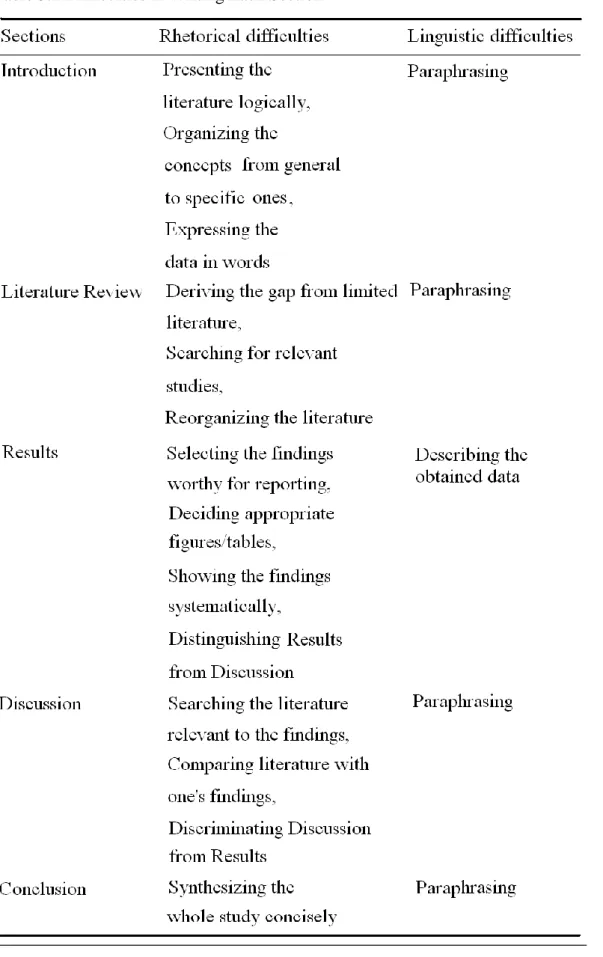
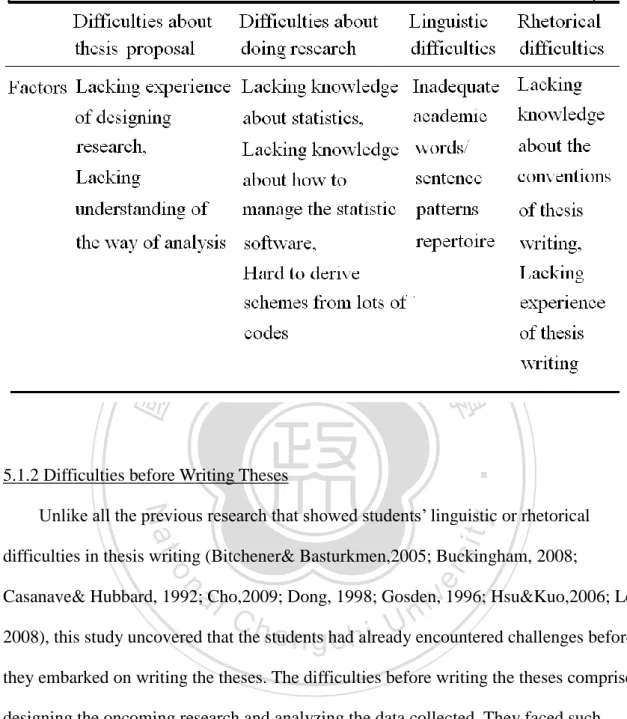
(9) 4.1.5.2 Teachers’ Perspectives………………………………………..69 4.1.5.3 Advisor-advisee Pairs……………………………………………71 4.1.5.4 Coping Strategies……………….…………………………………71 4.1.5.4.1 Students’ Perspectives...………………………………..71 4.1.5.5 Summary…………………………………………………………..73 4.2 Difficulties in the Preparation of Writing………………………………………..73 4.2.1 Difficulties about Research Design………………………………………...73 4.2.1.1 Students’ Perspectives……………………….…………………….73. 政 治 大 4.2.1.3 Advisor-advisee Pairs……………………………………………75 立. 4.2.1.2 Teachers’ Perspectives……………………………………………..74. 4.2.1.4 Coping Strategies………………………………………………..76. ‧ 國. 學. 4.2.1.4.1 Students’ Perspectives……………...……………………76. ‧. 4.2.1.4.2 Teachers’ perspectives………………...…………………76. sit. y. Nat. 4.2.1.5 Summary………………………………………………………..77. io. er. 4.2.2 Difficulties about data analysis…………………………………………….78 4.2.2.1 Students’ perspectives……………………………………………..78. al. n. v i n Ch Teachers’ Perspectives……………………………………………..79 engchi U. 4.2.2.2. 4.2.2.3 Advisor-advisee Pairs……………………………………………...80 4.3.3.4 Coping Strategies………………………………………………….81 4.2.2.4.1 Students’ Perspectives…………………………………...81 4.2.2.4.2 Teachers’ Perspectives…………………………………..82 4.2.2.5 Summary…………………………………………………………84 4.3 Role of Experts………….………………………………………………………..84 4.3.1 Advisor as a Guide……...………………………………………………….85 4.3.1.1 Students’ Perspectives……………………………………………..85 4.3.1.2 Advisors’ Perspectives……………………………………………86 vii.
(10) 4.3.2 Advisor as a Consultant…………………………………………………..87 4.3.2.1 Students’ Perspectives……………………………………………..87 4.3.2.2 Advisors’ Perspectives…………………………………………..89 4.3.3 Advisor as a Reviewer………………….…………………………………..90 4.3.3.1 Students’ Perspectives…………………………………………..99 4.3.3.2 Advisors’ Perspectives…………………………………………91 4.3.4. Experts of Statistics as Consultants………………………………………93 4.3.5 Summary………………………………………………………………….93. 政 治 大 4.4.1 Summary………………………………………………………………...…97 立. 4.4 Role of Peers……………………………………………………………………94. 4.5 Self Role…………………………………………………………………………97. ‧ 國. 學. 4.5.1 Summary………………………………………………………………..….98. ‧. y. Nat. Chapter Five Discussion…………………………………………………… ...100. er. io. sit. 5.0 Introduction……………………………………………………………………..100 5.1 Research Question One…………………………………………………………100. al. n. v i n C hQuestion………………………………………100 Research engchi U. 5.1.1 Answer of the. 5.1.2 Difficulties before Writing Theses………………………………………..103. 5.1.3 Linguistic and Rhetorical Difficulties within the Same Section………….104 5.1.4 The Top Three Difficult Sections and the Least Difficult Section………..105 5.1.5 Difference between the Teachers’ and Students’ Perspectives……………106 5.1.6 Relation between the Writing Difficulties and Novice Writers…………107 5.2 Research Question Two to Four………...………………………………………108 5.2.1 Answer of the Research Questions………..………………………………108 5.2.2 The Relation between the Strategies Adopted and the Types of Difficulties and the Available Resources……………………………………………...110 viii.
(11) 5.2.3 The Role of the Human Resources in the Students’ Thesis Writing Process………………………………………………………………… 111 5.2.3.1 Role of the experts………………………………………………..112 5.2.3.2 Role of peers……………………………………………………..113 5.2.3.3 Role of the self………...…………………………………………114 5.3 Summary………………………………………………………………………114 5.4 Pedagogical Implications……………………………………………………….115 5.5 Limitation of the Study…………………………………………………………118. 政 治 大 5.7 Conclusion………………………………………………………………………119 立. 5.6 Suggestions for Future Research………………………………………………..118. References…………………………………………………………………………121. ‧ 國. 學. Appendixes……………………………………………………………………… 126. ‧. A. Consent Form (Teachers)…………………………………………………...126. sit. y. Nat. B. Consent Form (Students)……………………………………………………127. io. er. C. First Interview Protocol (Students)…………………………………………128 D. Interview Protocol(Advisors)……………………………………………..132. n. al. E. Interview Protocol. v i n (theCCourse Instructor)……...………………………..…136 hengchi U. ix.
(12) 國立政治大學英國語文學系碩士班 碩士論文提要. 論文名稱:英語教學在職專班研究生論文寫作困難與對策 指導教授: 黃怡萍博士 研究生:許柔恩. 論文題要內容:. 政 治 大 英語為外語的環境下,都會在進行研究和論文寫作時遇到困難(Bitchener & 立. 過去研究顯示,以英文為第二語言的研究生,無論在以英語為第二語言或是以. Basturkmen, 2005; Buckingham, 2005; Dong, 1998; Lee, 2008; O’Connor, Greene &. ‧ 國. 學. Anderson, 2006; Onwuegbuzie & Leech, 2006; Reeves, Herrington, & Oliver, 2005),然. ‧. 而,相關研究卻缺乏探究在以英語為外語的環境下,同時身為研究生和在職教師的. y. Nat. 這群學生們所遭遇的困難,及其如何利用可取得的資源去解決論文寫作上的難題。. er. io. sit. 本研究旨在藉由質性個案研究方式,以社會文化學習的角度,特別是 van Lier (2004) 的擴充式建構理論(expanded ZPD),取得更多關於身為學校老師的在職研究生在論文. al. n. v i n 寫作過程中遇到的困難以及解決對策的詳細資訊,以期對論文寫作教學以及論文指 Ch engchi U 導上有所貢獻。本研究共邀請到三組指導教授與研究生,每組包含一位教授與他們. 的兩位研究生。資料來源包含與所有研究參與者的訪談內容、論文寫作相關書籍, 以及學生的論文草稿,最後經由對比原始資料得出研究結果。 研究結果顯示學生在寫論文前遇到的困難是研究設計與處理資料,而在寫論文 各章節時,他們會同時遇到文字上以及文體格式方面的困難。根據各章節的文體要 求,學生們認為文獻回顧、研究發現,以及討論研究結果是最困難的章節,而結論 是困難度最小的章節。而這些困難可歸因於學生為非母語寫作者,以及他們對於學 術規範的不熟悉。此外,本研究也發現,在職班學生可取得的資源包括同儕、專家、. x.
(13) 學術出版品,以及自身。 基於上述發現,本研究提出研究所課程的教師應提供學生更多閱讀學術論文的 機會,以及在課程中融入讓學生可應用課堂所學的任務。指導教授也能事先提醒學 生論文中較為困難的部份,以及告訴學生有哪些可取得資源是有助於論文寫作的。 未來,需要更多人誌學以及日記研究法的方式研究,以期能更深入了解在職研究生 在論文寫作上的需求。. 立. 政 治 大. ‧. ‧ 國. 學. n. er. io. sit. y. Nat. al. Ch. engchi. xi. i n U. v.
(14) Abstract. Though a number of studies have revealed that both the L2 graduate students in English as a Second Language (ESL) and English as a Foreign Language (EFL) contexts may encounter difficulties in conducting research and writing theses (Bitchener& Basturkmen, 2005; Buckingham, 2005; Dong, 1998; Lee, 2008; O’Connor, Greene& Anderson, 2006; Onwuegbuzie & Leech, 2006; Reeves, Herrington& Oliver, 2005), research about how the graduate students who are also in-service teachers in EFL settings. 政 治 大 lacks. Thus, this study aimed to have an in-depth understanding of the difficulties this 立 cope with the difficulties in thesis writing by making use of the sources available still. group of students faced in the process of thesis writing and the ways they adopted to deal. ‧ 國. 學. with the problems via a qualitative case study and with the social cultural perspective of. ‧. learning, especially the framework of expanded ZPD (van Leir, 2004) . Three. sit. y. Nat. advisor-advisee pairs were invited to participate in the present study, and each pair was. io. er. comprised of one advisor and two advisees. Data for analysis were collected from multiple sources, including semi-structured interviews with the participants, the textbook. al. n. v i n of the thesis writing course, and theC drafts of theses. Data U h e n g c h i were analyzed by constant. comparative method (Lincoln & Guba, 1985). The results showed that the students faced difficulties about research design and compiling the data even before writing theses. When writing each section of a thesis, they had troubles both at the linguistic level and the rhetorical level. According to the rhetorical regulations of each section, Literature Review, Results, and Discussion were viewed as the three most difficult sections and Conclusion the least difficult section for the students. Hence, the unfamiliarity of academic conventions and the lower English writing abilities contributed to the difficulties the students faced during thesis writing. Moreover, the findings disclosed that the sources available for the students as in-service teachers included human resources xii.
(15) such as peers and experts, material resources such as academic publications, and inner knowledge from self. Based upon above findings, it is suggested that the courses of graduate schools should provide students more opportunities to read academic texts extensively and practice what they learn in class. Also, the advisors should remind students of the problematic area of a specific section and tell students the resources available in the academic context. In the future, more ethnographic and diary studies are needed to explore what challenges the students who are also in-service teachers encounter in the. 政 治 大 may have different needs in thesis writing 立. thesis writing processes and how they solve these problems because this group of students. ‧. ‧ 國. 學. n. er. io. sit. y. Nat. al. Ch. engchi. xiii. i n U. v.
(16) 立. 政 治 大. ‧. ‧ 國. 學. n. er. io. sit. y. Nat. al. Ch. engchi. i n U. v.
(17) CHAPTER ONE INTRODUCTION. 1.0 Introduction The introduction section provides an overview of the present study, including the background of the study, the purpose of conducting the study, and four emerging research questions.. 政 治 大 Large amounts of studies have examined the L2 graduate students’ research writing 立. 1.1 Background and Rationale of the Study. processes for two reasons (Bitchener & Basturkmen, 2005; Buckingham, 2008; Cho,. ‧ 國. 學. 2009; Dong, 1998; Gosden, 1996; Lee, 2008; Yeh, 2010). First, these studies assume that. ‧. equipping the skill of thesis writing is a prerequisite for graduate students because the. sit. y. Nat. goal of graduate education is to cultivate independent researchers and competent research. io. er. writers (Mullen, 2001). Second, English is a dominant language in research fields (Johns &Swales, 2002). To present one’s research for people around the world, the researchers. n. al. Ch. have to write their articles or theses in English.. engchi. i n U. v. According to previous studies, writing theses in both ESL and EFL settings may pose difficulties about conducting and writing research for the L2 graduate students (Bitchener & Basturkmen, 2005; Buckingham, 2005; Dong, 1998; Lee, 2008; O’Connor, Greene& Anderson, 2006; Onwuegbuzie & Leech, 2006; Reeves, Herrington& Oliver, 2005). For the students conducting their research in ESL environments, they have challenges about designing research (i.e., finding a feasible context to conduct the study, selecting the analytical procedure, etc.), analyzing the obtained data, writing by using correct words and sentences, and writing to meet the academic conventions (Bitchener & Basturkmen, 2005;Dong, 1998; O’Connor, Greene & Anderson, 2006; Onwuegbuzie & 1.
(18) Leech, 2006; Reeves, Herrington, & Oliver, 2005). Likewise, the studies conducted in EFL contexts revealed that the L2 students may face the difficulties about handling the obtained data in data analysis, and choosing appropriate words/ sentence patterns and meeting the rhetorical structure of each section of a thesis in writing (Buckingham, 2005; Lee, 2008). Though prior studies have shown that the graduate students in both ESL and EFL settings may encounter similar difficulties before and during the thesis writing process, literature suggested that the sources available for the students to cope with the difficulties. 政 治 大 books and theses) adopted to deal with the above difficulties are more accessible for the 立. may differ in different contexts. For example, the material sources (e.g., relevant articles,. students in ESL environments (Lee, 2008). The reason is that most academic publications. ‧ 國. 學. are published in ESL countries. What’s more, the students in ESL settings have more. ‧. native peers and thus have more opportunities to ask for those native peers’ help to solve. sit. y. Nat. the linguistic obstacles in thesis writing (Dong, 1998). As for the students in EFL settings,. io. er. though with limited resources, they still utilize the sources at hand to cope with the difficulties they encounter in the writing process, including reading academic texts and. al. n. v i n Ch discussing with peers and experts (Buckingham, 2008; Ferenz, 2005; Lee, 2008; Yeh, engchi U 2010).. In addition to the resources available for the students who write in ESL or EFL settings, whether the writers are full-time students may influence their coping strategies of the challenges faced in thesis writing (Buckingham,2008; Ferenz, 2005). For the students who have other jobs, the sources available for them to deal with the writing problems are not only from their graduate school, but also their working place. According to previous studies, those students’ colleagues can also be the peer reviewers who provide suggestions for the students to cope with the writing difficulties (Buckingham, 2008; Ferenz, 2005). Thus, the L2 students’ writing contexts need to be taken into consideration 2.
(19) when we explore how the students overcome the obstacles encountered in thesis writing. Since prior studies have shown that it is inevitable for the L2 graduate students to interact with others to overcome the obstacles in thesis writing (Buckingham, 2008; Dong, 1998; Ferenz, 2005), it is necessary to investigate how the students write a conventionalized thesis with the assistance of the people who involved in the students’ thesis writing processes with expanded ZPD, the theory related to social cultural perspective of learning (van Leir, 2004). According to Vygotsky (1978), learning takes place when learners interact with other people within the same learning context, even. 政 治 大 from experts, but also people with equal or lower ability, and self (van Leir, 2004). Thus, 立 when receiving scaffolding from more capable others. However, learners not only learn. the acquisition of the knowledge of thesis writing, including the academic writing. ‧ 國. 學. conventions and skills, should be explored by investigating the roles of all the people. ‧. involving in the graduate students’ writing process.. sit. y. Nat. Despite the prevalence of research on the challenges faced by the L2 students. io. er. writing theses in ESL and EFL contexts and relevant coping strategies (Bitchener & Basturkmen, 2005; Casanave & Hubbard,1992; Cho, 2009; Dong, 1998; Buckingham,. al. n. v i n 2008; Ferenz, 2005; Lee, 2008; C Yeh, 2010), few studies h e n g c h i Uhave investigated students’. difficulties in writing each section of a thesis respectively. From the limited research on the problems the L2 research writers may face in writing specific sections of a thesis, the findings reveal that students have different rhetoric troubles when writing different sections for the rhetorical structures and conventions differ among sections (Bitchener & Basturkmen, 2005; Hsu & Kuo,2006; Lee, 2008). Hence, more research is required to explore the challenging parts of each section for the L2 graduate students. In addition, since the prior studies employing quantitative or mixed methods fail to provide detailed information about what difficulties the students may have in writing each sections of their theses and how they solve these problems (e.g., Bitchener & Basturkmen, 3.
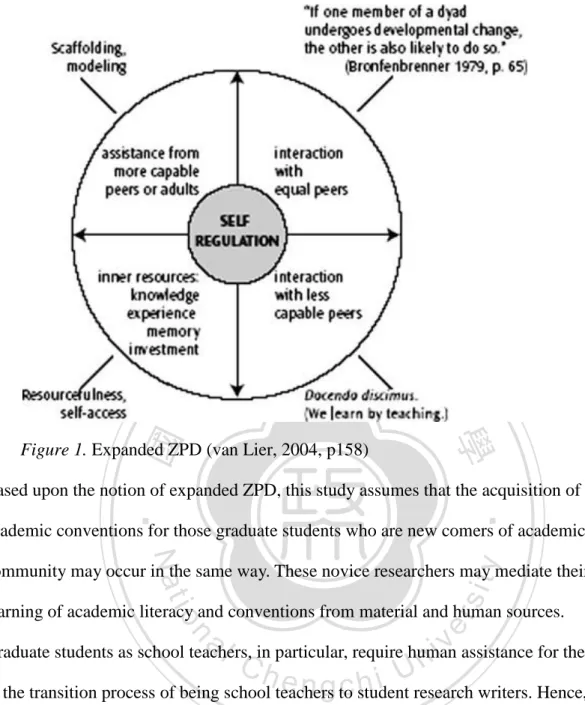
(20) 2005; Dong, 1998), this study adopted a qualitative inquiry. By doing so, more in-depth understanding about how the L2 students complete their theses can be attained through exploring both the students’ and the advisors’ perspectives about thesis writing.. 1.2 The Purpose of the Study Since the studies on the thesis writing processes of the graduate students as in-service teachers in EFL contexts are still lacking, this study aimed to examine how those students overcame the difficulties encountered during their writing processes with. 政 治 大 problematic parts for those students and the sources available for them to solve the 立. expanded scaffolding, the framework proposed by van Leir (2004). By knowing the. troubles, more insights could be offered to the instructors of academic writing, the. ‧ 國. 學. advisors, even the administrator of the school department in adjusting the current. ‧. curriculum design and providing the assistance more in need for the students.. sit. y. Nat. io. er. 1.3 Research Questions. Based upon the purpose stated before, the present study intends to address the four. n. al. research questions.. Ch. engchi. i n U. v. 1. What difficulties do the graduate students as in-service teachers perceive while composing different sections of their thesis theses? What factors may influence their perceived difficulties? 2. How do they cope with these difficulties? 3. What are their sources of assistance? 4. What roles do the human resources play in students’ thesis writing?. 1.4 Definition of Terms (1) Zone of Proximal Development (ZPD) 4.
(21) ZPD is defined as the distance between the learners’ current cognitive level and the potential developmental level. In the current cognitive level, the learners can work independently whereas in the potential development level, the learners need more capable others’ assistance to accomplish certain tasks. (2) Scaffolding Scaffolding represents a tentative coach provided by others and will be removed later when one achieves the target skills. Also, this instructional behavior is interactive in nature and it occurs within ZPD.. 政 治 大 Mediation means regulating one’s action to participate in cultural activities (i.e., 立. (3) Mediation. publishing books, writing articles, etc.) via the interwoven cultural artifacts (e.g.,. ‧ 國. 學. books, paper, computers, etc.) and cultural concepts (e.g., self, literacy, etc.). ‧. To state more clearly, the cultural artifacts are mainly concrete objects and the cultural. sit. y. Nat. concepts are comprised of signs and symbols and the learner can facilitate their. io. (4) ETMA students. er. learning goals by utilizing both material and symbolic tools.. al. n. v i n C hare the in-service teachers ETMA students, by definition, who further their graduate engchi U. studies in the English Teaching in Master of Art (ETMA) program.. 5.
(22) CHAPTER TWO LITERATURE REVIEW 2.0 Introduction In this chapter, the social cultural perspective of learning, the frame to examine graduate students’ acquisition of academic writing, will be elaborated first. Then, studies about the difficulties L2 graduate students may encounter in the process of thesis writing, including the obstacles before and during thesis writing processes, will be shown. Also, the factors contributing to these difficulties will be discussed. The strategies used to. 政 治 大 resources, will be examined from the framework of social cultural theory. Finally, the 立. address to the problems faced in thesis writing, especially the assistance from the human. need to investigate the thesis writing process of graduates who are also in-service teachers. ‧ 國. 學. in an EFL setting is presented, followed by four research questions.. y. ‧. Nat. 2.1 Learning within Social cultural Perspective. er. io. sit. Vygotsky’s (1978) social cultural theory was adopted as a framework of the present study; in particular, three significant concepts were used to examine the process of. al. n. v i n C his that cognitive development learning. The first and the basic concept is socially engchi U. constructed. That is, learning takes place while interacting with others. Secondly, mediation is necessary to reach learning goals. Mediation means regulating one’s own behavior to participate in cultural activities (i.e., publishing books, writing articles, etc.) via the interwoven cultural artifacts (e.g., books, paper, computers, etc.) and cultural concepts (e.g., self, literacy, etc.)(Ratner, 2002). For example, people can interact with each other by using physical tools such as pens and symbolic tools as language to mediate the learning of a new concept (cf. Aı´da, 2006) Third, learning takes place in specific areas, that is, Zone of Proximal Development (ZPD), the distance between current development levels which allows one to work 6.
(23) independently and the potential development level which needs the assistance from more capable others to accomplish work. Connecting with the notion of mediation, ZPD is the plane where people mediate jointly by materials and signs to overcome the hardship encountered and reach the learning goals (Lantolf & Thorne, 2006). Since knowledge and abilities are acquired after interpersonal interaction and there is need of others’ guidance to reach the potential development level, the notion of scaffolding in ZPD is further proposed. According to Vygotsky (1978), scaffolding is temporary assistance provided by experts or more competent others and will be removed when the subjects improve.. 政 治 大 2000). It can also occur among people with equal knowledge and ability, such as a group 立. However, scaffolding can not only be the interaction between expert and novice, (Lantolf,. of learners working cooperatively in order to complete a task (Donato, 1994; Gibbons,. ‧ 國. 學. 2002; van Lier, 2004).. ‧. Expanding the concept that scaffolding can be offered simply by more. sit. y. Nat. knowledgeable others, van Leir (2004) has proposed the concept of “expanded ZPD,” as. io. er. shown in Figure 2.1. In expanded ZPD, providers of scaffolding include experts, peers with equal or lower ability, and self. When receiving assistance from experts, learners can. al. n. v i n Cinformation get models of learning and direct U knowledge. If cooperating h e n g cof hthei desired. with peers of the similar level, knowledge will be co-constructed through the process of interaction. Learning even occurs when assisting less capable learners because doubts will be clarified and knowledge will be reorganized by teaching these people. Also, learning happens when one activates internalized knowledge and existing sources.. 7.
(24) 學. ‧ 國. 立. 政 治 大. Figure 1. Expanded ZPD (van Lier, 2004, p158). Based upon the notion of expanded ZPD, this study assumes that the acquisition of. ‧. academic conventions for those graduate students who are new comers of academic. y. Nat. io. sit. community may occur in the same way. These novice researchers may mediate their. n. al. er. learning of academic literacy and conventions from material and human sources.. i n U. v. Graduate students as school teachers, in particular, require human assistance for they are. Ch. engchi. in the transition process of being school teachers to student research writers. Hence, the study aimed at exploring the difficulties in-service graduate students faced and the source of assistance required in attaining the knowledge and skills of thesis writing in Taiwan.. 2.2 Before writing theses 2.2.1 Difficulties and factors Though studies conducted in English as a Second Language (ESL) settings revealed that the research writers may have troubles before writing theses for the insufficient experience of conducting research (O’Connor et al., 2006; Onwuegbuzie & Leech, 2006; 8.
(25) Reeves et al., 2005), limited evidence was found in the English as a Foreign Language (EFL) settings(Lee,2008). According to the prior studies which were done in the ESL environments, the challenges encountered before writing theses may include difficulties about designing research (i.e., finding a feasible context to conduct the study, selecting the analytical procedure, etc.) and analyzing the obtained data. For example, Onwuegbuzie and Leech (2006), the researchers in America, discussed the function and types of research questions in quantitative and qualitative studies and the analysis techniques used to elicit the answers of these research questions. They indicated that no. 政 治 大 is to link research questions to relevant analyses. The students who conducted 立. matter what kinds of studies the researchers conduct, the challenge in designing research. quantitative research may not be sure what types of analytical procedures they should. ‧ 國. 學. adopt though having taken courses about statistics. Likewise, for the students who do. ‧. qualitative inquiries, they only know the constant comparative analysis and they do not. sit. y. Nat. adjust the way of analyses to the types of their research questions. The reason can be: first,. io. er. the instructors introduce each analyzing technique/method respectively, not in an integrated and holistic manner (Newman & Benz, 1998; Onwuegbuzie & Leech, 2003);. al. n. v i n C h methods do not present second, the textbooks about research the statistical analysis and engchi U correspondent research types together (e.g., Gall, Borg, & Gall, 2003; McMillan & Schumacher, 2001). The studies in both ESL and EFL settings have shown that students may have. problems in processing the obtained data. The ESL students who conducted quantitative studies may face the challenges about how to compile large amounts of obtained data using statistic tools (O’Connor et al., 2006). Similarly, Lee (2008) investigated the EFL graduate students’ difficulties in the thesis composition process via interviews and observation and indicated that the troubles faced by the qualitative researchers was in transcribing the data and translating it to English. Although the students in both ESL and 9.
(26) EFL settings may have problems in processing the data, the literature suggests that the students conducting qualitative research in EFL contexts may feel more challenging to translate data because the lower level of language proficiency.. 2.2.2 Coping strategies Though studies have shown the graduate students’ difficulties designing research and analyzing data, few of them further explore how these students cope with such challenges (O’Connor et al., 2006). The limited literature has revealed that the students. 政 治 大 As the elementary school teachers who conducted action research in their graduate studies 立. tend to cope with the problems about research design by seeking the experts’ assistance.. in America in O’Connor, Greene and Anderson’s (2006) survey indicated, the. ‧ 國. 學. instructions provided by the professors in their program helped them overcome the. ‧. obstacles in research design.. sit. y. Nat. io. er. 2.3 While Writing Theses. 2.3.1 Linguistic Difficulties and the Factors. al. n. v i n C hthe L2 students in U Previous literature has shown that both the ESL and EFL settings engchi. may encounter linguistic difficulties at the lexical level, sentential level, and discourse. level when they have to complete their own theses and the factors that attribute to these linguistic troubles may include: (a) the lower level of English proficiency and (b) the unfamiliarity of the English writing styles (Allison, Cooley, Lewkowicz & Nunan, 1998; Buckingham, 2008; Casanave & Hubbard, 1992; Dong, 1998; Gosden, 1996; Lee, 2008; Silva, 1997). The linguistic difficulties at the lexical and sentential level, according to the prior studies conducted in the ESL and EFL settings, include word choices and the correctness of grammar and sentences patterns. The difficulties at the lexical level for the non-native 10.
(27) postgraduates, as showed in Dong’s (1998) survey of the students and their advisors’ views about thesis and dissertation writing in science in the US, was in choosing vocabulary suitable in academy. The evidence that L2 graduate students may have linguistic difficulties at the sentential level was found in Cho’s (2009) study which investigated both the L2 graduates and professors’ perceptions in journal article writing by adopting survey and interviews in South Korea. The results revealed that sentence structures were the most problematic linguistic area for graduate students when they composed journal papers. Resulting from the lower English proficiency levels (e.g.,. 政 治 大 sentence patterns), the above linguistic problems at the lexical and sentential domains can 立 inadequate repertoire of vocabulary, insufficient understanding of grammar, and unvaried. further contribute to the hardship in describing results explicitly, stating convincing. ‧ 國. 學. claims (Dong,1998; Flowerdew, 1999), expressing ideas precisely in English, and. ‧. plagiarizing (Bitchener& Basturkmen, 2005; Cho, 2009; Dong, 1998; Quian&. sit. y. Nat. Krugly-Smolska, 2008).. io. er. For the research investigating students’ difficulties in writing specific sections of a thesis, the findings, though limited, also revealed that the non-native students may be. al. n. v i n C h L2 graduateUstudents’ perceived difficulties hindered in linguistic domains. Exploring engchi. writing the Discussion section via survey in the ESL setting, Bitchener and Basturkmen (2005) discovered that language problems (e.g., using right words and implementing correct grammar) was the most frequently mentioned challenges. Likewise, Quian and Krugly-Smolska’s (2008) investigation of the obstacles students encountered while writing Literature Review in the EFL setting also showed three kinds of linguistic challenges: selecting words from limited vocabulary repertoire, using suitable sentence structures to express ideas clearly, and paraphrasing. Regarding the writing difficulties at the discourse level, the problems become how to arrange the sentences logically (e.g., the use of transition words) to express the ideas 11.
(28) clearly. The L2 students face these difficulties, for the English writing styles (i.e., cohesion, argument structure) are different from those of native languages (Allison, Cooley, Lewkowicz & Nunan, 1998; Buckingham, 2008; Silva, 1997; Cooley& Lewkowicz, 1995; Dong, 1998, Lee, 2008). Cooley and Lewkowicz (1995) surveyed the L2 graduate students’ perceptions of difficulties when composing thesis in Hong Kong, and the findings showed that the students were confused about organizing the ideas coherently to convey the precise meanings in English. For the Taiwanese TESOL graduate students in Lee’s (2008) study, they also mentioned their difficulties in. 政 治 大. presenting arguments logically because they are unfamiliar with the English writing styles.. 立. ‧ 國. 學. 2.3.1.1 Coping Strategies. ‧. Previous research has shown that to deal with the linguistic difficulties, the students. sit. y. Nat. may take self-regulated strategies by utilizing resources available in academy, including. io. er. reading the publications of research, and asking for the assistance from peers, colleagues, or teachers (Buckingham, 2008; Dong, 1998; Ferenz, 2005; Lee, 2008). Though similar. al. n. v i n C h conducting research strategies can be adopted by the students in both the ESL and EFL engchi U. contexts, the sources available for the L2 students in the two settings to cope with the. linguistic difficulties may differ. For example, the ESL students may have accesses to more publications than those EFL students, for the most of the academic texts are published in ESL countries (Lee, 2008). Even so, the students in the EFL contexts still take the existing texts as models for appropriate linguistic usage (Hsu, 2010). As in Okamura’s (2006) qualitative study, the Japanese research article writers deal with their difficulties caused by limited vocabulary by “reading research articles extensively, increasing experience in writing research, and collecting useful phrases they have ever seen” (p. 69). 12.
(29) As for the human resources, peers who have similar background knowledge and experiences of thesis writing are available for the L2 graduate students in the EFL contexts (Buckingham, 2008; Ferenz, 2005). For the L2 graduate students who were not full-time students, they also mentioned the assistance from their colleagues (Buckingham, 2008; Ferenz, 2005). The peers and co-workers served as reviewers and provided feedback in the linguistic domain. Hence, the L2 graduate students could raise their awareness of the linguistic errors and enhance the clarity of expressions. As for the students conducting their studies in the ESL settings, though having more native peers to. 政 治 大 interact with their native peers, for they were afraid that the language barrier may hinder 立. help them with linguistic problems, the research has found that they were unwilling to. communication (Dong, 1998).. In addition, advisors can be another type of human. ‧ 國. 學. resources. Previous studies have revealed that whether in the ESL or EFL contexts,. ‧. advisors as reviewers help students with the wording of theses, such as correcting the. er. io. sit. y. Nat. errors on word choices and grammar (Buckingham, 2008; Dong, 1998; Yeh, 2010).. 2.3.2 Rhetorical Difficulties and the Factors. al. n. v i n In addition to the languageC problems, the L2 research h e n g c h i U writers, no matter in the ESL. or EFL settings, may have rhetorical difficulties (e.g., what content to be included in each section of theses and how to organize ideas in these sections) since the conventionalized rhetorical structures differ across different sections (Buckingham, 2008; Cooley & Lewkowicz, 1995; Dong, 1998; Hsu & Kuo,2006; Jenkins et al., 1993; Lee, 2008). Meeting the rhetorical requirements of every section can be a hard task for the L2 graduate students because of (a) the lack of the skills required in writing, (b) cultural differences, and (c) the inadequate knowledge about the genre of a specific section (Gosden, 1996; Pennycook,1996; Dong, 1998; Paltridge, 2002; Swales, 2004). Among the sections of a thesis, researchers have been interested in how L2 graduate 13.
(30) students compose Introduction by following the rhetoric structure of this section, such as giving a brief review of the literature and stating the purpose of one’s study by filling the niche of existing literature (Hsu & Kuo, 2006; Swales, 2004). In Hsu and Kuo’s (2006) study, they examined the graduate students’ troubles in writing Introduction by employing survey and interviews in Taiwan. The results of the analyses showed that these writers felt meeting the genre requirements of Introduction was challenging, for they needed to be able to summarize and paraphrase relevant literature. Likewise, the Turkish graduates in Buckingham’s (2008) study also noted the challenges in writing Introduction because. 政 治 大 In addition to Introduction, previous studies have also shown that Literature Review 立. they had to present their ideas in a concise manner.. posed the greatest difficulties to L2 students for the skills required in doing source-based. ‧ 國. 學. writing (e.g. proposing one’s own ideas by examining previous studies critically,. ‧. borrowing others’ statements to support one’s claims) (Lee, 2008; Yeh, 2010). Probing. sit. y. Nat. into the reason why the students may be unskilled in writing Literature Review by. io. er. referring to the prior studies reviewed, cultural difference is the main factor. As Gosden (1996) argued, novice non-native research writers from China and Japan may have. al. n. v i n C hby criticizing previous difficulties in forming their own stance studies, for they tend to engchi U respect and follow predecessors. L2 research writers’ difficulties in borrowing others’ words legally and appropriately could also be ascribed to cultural factors. Since the notions of authorship and ownership of texts come from the Western culture, students with other cultural backgrounds may feel confused about the essence of citation and are more likely to commit plagiarism (Pennycook, 1996). For example, in the Chinese culture, students are used to memorizing significant predecessors’ works. They will not be accused of plagiarism when they incorporate a famous saying in their works without citing it. It will be unnecessary to cite because members within the context share the same knowledge. 14.
(31) Also, researchers have believed that writing Discussion is more cognitive demanding for the students because they had to relate their research findings to the literature by restating the findings of their studies and previous research in order to fit the rhetorical requirements of Discussion section (Bitchener& Basturkmen, 2006). According to Bitchener and Basturkmen (2006), the main problems in writing Discussion were at the linguistic and rhetorical levels, for the students had a lower English proficiency level and the lacking knowledge of the genre of Discussion. As proposed by Paltridge (2002) and Swales (2004), the limited knowledge of the genre of thesis writing can contribute to the. 政 治 大 meet the expectations of academic writing, the L2 research writers need to interact with 立. obstacles in writing different sections of a thesis. Thus, to familiarize the conventions and. the members and texts of the target academic community (Barton & Hamilton, 1998,. ‧ 國. 學. Ferenz, 2005). By doing so, the L2 writers may gradually gain an understanding of the. sit er. io. 2.3.2.1 Coping Strategies. y. Nat. Street, 1998).. ‧. regulations and genres of thesis writing and involve in the academic communities (Lea &. al. n. v i n The L2 research writers in C both the ESL and EFLU h e n g c h i settings may adopt self-regulated. strategies as utilizing the internalized knowledge attained from reading research papers. and seeking for others’ help to deal with the rhetorical difficulties. However, the students in the ESL settings seem to have more opportunities to acquire the knowledge about the characteristics of different sections of a thesis from relevant papers for the studies of thesis genre come from the ESL contexts (Samaraj, 2002; Swales, 2004). Though not every publication is accessible, the students in the EFL environments also try to attain the understanding about thesis genres from limited texts (Buckingham, 2008). In the interviews of Buckingham’s (2008) study, the Turkish graduate students considered reading broadly could facilitate them to write independently, broaden vocabulary, attain 15.
(32) useful chunks or expressions, and learn the academic organization and styles. The results suggested that these students took texts as models to learn word usage, ways of composing each chapter, and the conventions of their academic communities. In other words, they resorted to the texts to cope with their difficulties from the linguistic level (i.e., using appropriate words) to the genre level (i.e., writing the Introduction, Discussion, and Conclusion sections). Despite working alone, the students utilized the inner resources internalized from texts or their own writing experiences to scaffold themselves while encountering the rhetorical troubles, which corresponds to van Leir’s (2004) expanded. 政 治 大 In addition to dealing with writing difficulties by themselves, previous studies have 立. ZPD that self can also be the provider of scaffolding.. shown that students also ask for help from peers and experts. For the students who have. ‧ 國. 學. other jobs, the peers accessible for them are not only the classmates in graduate schools,. ‧. but the colleagues in their work places (Buckingham, 2008; Ferenz, 2005). By discussing. sit. y. Nat. with peers, the ideas of writing will be stimulated and doubts will be clarified through the. io. er. feedback given by them (Ferenz, 2005). Thus, the peers play the role as reviewers and facilitators in students’ theses writing processes. As proposed by van Leir (2004), the. al. n. v i n C h from the advisors knowledge about thesis writing is attained or co-constructed by engchi U interacting with others learners.. Though there are several ways students may adopt to cope with their writing problems, the most common one is resorting to teachers. The findings in Lee’s (2008) qualitative research disclosed that the advisor played the role as “checker”(p. 81) to make sure the students’ theses were on the right track, especially focusing on the ideas presented in each section of theses rather than the linguistic errors. To help students write the sections which fit the conventional rhetoric structure, the roles of advisors can also be facilitators who provide professional suggestions about the contents and organization in each section and the instructor who teach the students directly how to write a satisfactory 16.
(33) section (Lee,2008). Similarly, in Dong’s (1996) investigation of how L2 science doctoral students proposed their own claims in the introductory chapter of dissertations, the students indicated that the instruction given by the advisors was helpful for them to form innovative claims based on previous literature.. 2.4 Identifying the Gap From the literature about the L2 graduate students’ difficulties in thesis writing and the strategies they adopted to cope with these troubles, three gaps can be derived. First,. 政 治 大 especially those graduate students who are also in-service teachers. Although the 立. little research has shown the L2 students’ sources of assistance in the EFL settings,. difficulties faced by the L2 students in the ESL and EFL contexts are the same, it is still. ‧ 國. 學. necessary to investigate the L2 graduate students’ writing processes in different writing. ‧. contexts, such as the in-service students in the EFL settings because the sources available. sit. y. Nat. for the students to facilitate their thesis writing may differ from those in the ESL contexts,. io. er. as shown in Buckingham (2008) and Ferenz’s (2005) studies. In addition, since the writing circumstances of the students as in-service teachers include their working places. al. n. v i n C havailable for themUto deal with the obstacles in thesis and the graduate school, the sources engchi. writing may be different from those regular graduate students. As such, more studies on exploring how the Taiwanese in-service graduate students accomplish their theses are needed to facilitate their writing. Second, since the previous studies showed that the students’ difficulties in writing each section of a thesis differed because the rhetorical structures vary among sections, exploring the writing difficulties students faced when composing every section of a thesis respectively is in need. Third, most of prior studies employing survey as the data collection method failed to provide detailed information about the types of difficulties the students may encounter in writing each section of a. thesis and the coping strategies correspondent to different kinds of troubles. The reason is 17.
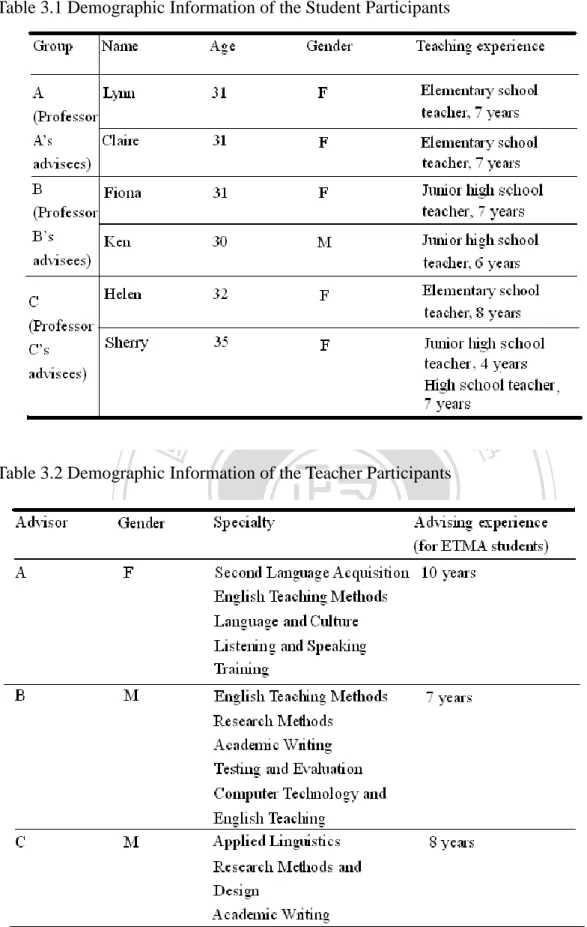
(34) that the participants cannot express their ideas freely in answering the fixed questions in the questionnaire. To compensate for the drawback of quantitative studies, qualitative research designs with interviews should be adopted. During interviews, the participants can feel free to share their thoughts and experience. Thus, more in-depth information about how the students accomplish their theses can be attained from the interviews.. 2.6 Purpose Given the lack of studies on the thesis writing experiences of the L2 graduate. 政 治 大 they completed their theses with a particular focus on the difficulties they faced in writing 立 students as in-service teachers, this study aimed to attain a complete picture of the ways. each section of a thesis and the sources available for them to overcome such difficulties.. ‧ 國. 學. In addition, the types of strategies employed to cope with the difficulties were examined. ‧. with van Leir’s (2004) expanded ZPD, which is in line with social cultural perspective of. sit. y. Nat. learning (Lantolf, 2000; Vygotsky, 1978 ). By so doing, the current study can provide. io. er. insight to the instruction and the assistance required for the graduate students as in-service teachers in the EFL contexts.. n. al. Ch. 2.7 Research Questions. engchi. i n U. v. To guide the current study, the following research questions were proposed: 1. What difficulties do the graduate students as in-service teachers perceive while composing different sections of their thesis theses? What factors may influence their perceived difficulties? 2. How do they cope with these difficulties? 3. What are their sources of assistance? 4. What roles do the human resources play in students’ thesis writing? 18.
(35) CHAPTER THREE METHODOLOGY. 3.0 Introduction In this chapter, the research design-a qualitative case study methodology used to address the four research questions will be discussed first. Then, the description of the research site and the participants will be presented. Third, the data collection methods, including the interviews, artifacts, and the procedure of collecting the data will be. 政 治 大 proposed by Lincoln and Guba (1985) will be introduced and then how the researcher 立. displayed. Fourth, the constant comparative method, a way to analyze the obtained data. implemented this analyzing method in the study will be showed.. ‧ 國. 學 ‧. 3.1 Research Design. sit. y. Nat. A qualitative case study was adopted in the present study because previous relevant. io. er. studies conducted quantitatively could not provide elaborate information about students’ perceived difficulties in thesis writing. To complement the deficiency of quantitative. al. n. v i n C h case study, for studies, this study employed a qualitative a case is contextualized in nature; engchi U thus, data can be gathered from multiple sources and the information derived from it may provide complete description of the case chosen (Yin, 2009). Based on the research questions, the case here refers to graduate students who are English in-service teachers in the English Teaching in Master of Arts (ETMA) program. By investigating this group of graduate students with a qualitative manner, we attained detailed information about how these in-service English teachers complete their theses in English by coping with the difficulties they encountered in thesis writing.. 3.2 Context 19.
(36) The study was conducted at a well-known public university in northern Taiwan. The reason of choosing this university lay in that more data was accessible to the researcher. Since studies have shown that writing thesis in English may cause difficulties for L2 graduate students and the present study aimed to explore how graduate students as in-service teachers deal with their difficulties in thesis writing, the ETMA program in this school was chosen based on the following reasons: First, the graduate students in this program have to write their thesis in English. Second, the researcher has more opportunities to get accessible data from this program. Third, the researcher was more. 政 治 大. likely to get the participants’ trust and then attained rich data for she had similar experiences of thesis writing.. 立. The ETMA program in the target university was established in the late 1900s to meet. ‧ 國. 學. the need of professional development of teachers. The purpose of this program is to. ‧. enhance teachers’ English ability, English teaching techniques, and ability in conducting. sit. y. Nat. research. Hence, this program requires students to take courses about English teaching. io. er. and utilize what they learn in graduate school in conducting their own research and writing theses. To equip students with the knowledge of research, two courses are. al. n. v i n included in the curriculum design ofCthe ETMA program. U h e n g c h i The first one is the required. course-EFL Research Methods. The other course, Experimental Design and Statistical Inference, was designed as an elective course to enhance students’ ability in conducting quantitative research. This course will be available for the students every two academic years and the students can acquire the knowledge about the ways of data analysis commonly adopted in quantitative research (e.g., t-test, Analysis of Variance). Aiming at preparing students with the capability of composing their theses, Research Paper Writing, another elective course available for the students every two years, was part of the curriculum design of the ETMA program. In the Research Paper Writing Course, the instructor will let students know how to compose the thesis section by section and then let 20.
(37) students practice the concepts learned in class (i.e., the keys of each section) by writing thesis proposals.. 3.3Participants The participants recruited in this study included six students and three teachers. Since the purpose of this study is to explore the graduate students as in-service teachers’ thesis writing experience, the student participants were recruited by the following criteria: first, they must have completed their thesis within three years to make sure they wouldn’t. 政 治 大 Second, they needed to take the thesis writing course so whether this experience 立. forget their writing process and the curricular design of the thesis writing course they took.. facilitated their thesis writing process could be revealed.. ‧ 國. 學. Regarding the teacher participants, they must be the advisors of the student. ‧. participants. Also, one of them was the instructor of the thesis writing course. The reason. sit. y. Nat. of setting the criteria of choosing teacher participants could be two. First of all, since this. io. er. study attempted to attain data about students’ writing problems from multiple sources, the advisors could provide information about the difficulties the student participants. al. n. v i n C htheir views. Second,Uthe statements of the course encountered in writing theses from engchi. instructor could be used to triangulate the student participants’ ideas about the thesis writing course. In short, these teachers were invited to join this study as a way to validate. students’ perceptions about the course they took and the writing difficulties they faced. Therefore, three advisor-advisee groups, including two students and one supervisor in each group, were recruited. That is, a total of nine people partook in this study. The background information about the students and the teachers is displayed in Table 3.1 and Table3.2. Pseudonyms are used to identify individual participants.. 21.
(38) Table 3.1 Demographic Information of the Student Participants. 立. 政 治 大. ‧ 國. 學. Table 3.2 Demographic Information of the Teacher Participants. ‧. n. er. io. sit. y. Nat. al. Ch. engchi. i n U. v. From Table 3.1and Table 3.2, we know that Professor A, Lynn, and Claire were the A 22.
數據
相關文件
A genre is more dynamic than a text type and is always changing and evolving; however, for our practical purposes here, we can take genre to mean text type. Materials developed
Making use of the Learning Progression Framework (LPF) for Reading in the design of post- reading activities to help students develop reading skills and strategies that support their
- promoting discussion before writing to equip students with more ideas and vocabulary to use in their writing and to enable students to learn how to work in discussion groups and
• School-based curriculum is enriched to allow for value addedness in the reading and writing performance of the students. • Students have a positive attitude and are interested and
To help students appreciate stories related to the theme and consolidate their knowledge and language skills in writing stories, the English Club has organised a workshop on story
To ensure that Hong Kong students can have experiences in specific essential contents for learning (such as an understanding of Chinese history and culture, the development of Hong
Task: Writing an article to the school newspaper arguing either for or against the proposal which requires students to undertake 50 hours of community service, in addition to
Graduate Masters/mistresses will be eligible for consideration for promotion to Senior Graduate Master/Mistress provided they have obtained a Post-Graduate
