行政院國家科學委員會專題研究計畫 成果報告
整合 STEPml 及 WfMC 為核心技術之協同產品構型管理研
究
計畫類別: 個別型計畫
計畫編號: NSC93-2416-H-009-008-
執行期間: 93 年 08 月 01 日至 94 年 07 月 31 日
執行單位: 國立交通大學管理科學學系(所)
計畫主持人: 張力元
報告類型: 精簡報告
報告附件: 出席國際會議研究心得報告及發表論文
處理方式: 本計畫可公開查詢
中 華 民 國 94 年 8 月 29 日
行政院國家科學委員會補助國內專家學者出席國際學術會議報告
2005 年 3 月 6 日
報告人姓名
張力元服務機構
及職稱
時間
出國開會
地點
自 2005 年 2 月 27 日至
2005 年 3 月 2 日 (共四天)
澳大利亞 阿德雷德
Adelaide, SA, Australia
本會核定
補助文號
NSC 93-2416-H-009-008
**研究計畫補助出席國際會
議,共發表壹篇論文**
會議
名稱
(中文) 2005 國際製造科技領袖會議
(英文) International Manufacturing Leaders Forum, 2005
發表
論文
題目
(中文) 全球競爭力之製造科技
2
Meeting Report
International Manufacturing Leaders Forum, 2005 (IMLF 2005)
Adelaide, SA, Australia
Feb 27-Mar 2, 2005
By
Professor Charles Trappey
Department of Management Science
National Chai Tung University
Hsinchu (300), Taiwan
Introduction
The International Manufacturing Leader’s Forum (IMLF 2005) was held by the
University of South Australia, (UniSA) with support from IBMAustralia. The location
of the conference was Glenelg, the beach side resort of Adelaide and the conference
venue was the Stamford Hotel. The conference featured international keynote
speakers as well as over 200 global participants.
Attending the Conference
In addition to the President of ITRI, the Lord Mayor of Adelaide, and the Vice
Chancellor of the University of South Australia, there were several very important
keynote speakers:
z Global Innovation, Global Markets: R.Buderi (MIT)
z Life Cycle Engineering, Prof. Ham Bao (Old Dominion University, USA)
z Invention and Innovation, Chris Heyring.
z Delivering an Integrated Innovation Infrastructure, Peter Robin (IBM)
z Rapid Product Development (Prof. Bill Appelbe)
z
An Internationalization Strategy for China’s Manufacturing Industry and
Technical Standard, Prof. Zhu Li。
z
Strategically Managing the Interface between Industry and Public Research
Institutions (Dr. Johnsee Lee 工研院院長李鍾熙博士)
z Cooperative Research Centers, Dr. Geoff Vaughan
topic areas:
z Supply Chain Management
z Reconfigurable Manufacturing Systems
z Logistic Management Systems
z Distributed and Adaptive Manufacturing Systems
Social Activities and Interactions
During the conference, several professors from the United Kingdom, Italy, and
Japan were introduced. Dinner was spent with faculty from Tokyo that worked for
Toyota Motor Corporation.
Thoughts and Feedbacks
The International Manufacturing Leader’s Forum is an exceptionally well
organized conference that combines academic scholars as well as international
business leaders. The real benefit of the conference was to meet scholars from Japan
that were involved with robotics, academics from the United Kingdom that were
involved with entrepreneurship and scholars from Italy that were developing new
math models for electronic commerce. I expect that the next conference, which we
promoted to be held in Taiwan, will be even more successful.
Information Brought Back from the Conference
1.
CD-ROM Full Paper Proceedings
2.
Forum Guide
3.
Papers and Forum Abstracts
4.
Adelaide, SA tourist information
5.
International Journal, Law and Information
6.
International Journal, Behavior and Information Technology
7.
IBM PLM Introduction Materials
Proceedings of the International Manufacturing Leaders Forum on “Global Competitive Manufacturing” 27th February - 2nd March 2005, Adelaide, Australia
1
Developing Silicon Intellectual Property E-Trade Mechanisms for
System on Chip Design and Reuse
Amy J.C. Trappey, Felix T.L. Lin
Department of Industrial Engineering & Engineering Management National Tsing Hua University
Charles V. Trappey
Department of Management Science National Chiao Tung University
Hsinchu (300), Taiwan [email protected]
Abstract
The integration of IC design and manufacturing (IDM) is a major trend in the modern management paradigm of semiconductor supply chain. In order to shorten the time-to-market for complex system-on-chips (SoC), the reuse of silicon intellectual properties (SIPs) for fast IC design becomes a critical factor in the success of semiconductor IDM. In this research, a prototype system called the Knowledge Services and Trade Platform (KSTP) is developed for trading silicon intellectual property over the Internet. A mobile agent behaviour model is used for negotiations and knowledge acquisition. The agent-based prototype considers factors of efficiency, cost and precision while acquiring knowledge about intellectual property needed for SoC design and fabrication. For trade partner matching, fuzzy set theory evaluation models are developed. The matching model efficiently and consistently suggests suitable partners for trade under different circumstances. The ultimate goal of the research is to provide an autonomous and collaborative trade platform for SIP exchanges in semiconductor industry.
Keywords: Silicon Intellectual Property (SIP), System on Chip (SoC), Knowledge Services,
E-Trade, Mobile Agent
1. Introduction
The purpose of this paper is to demonstrate the design and development of a prototype mobile agent-based platform for Silicon Intellectual Property (SIP) search, acquisition and trade across the Internet. The Knowledge Service and e-Trade Platform (KSTP) enhances SIP collection and exchange and provides matching mechanisms for SIP trades. SIP buyers and sellers post their requirements and, then, KSTP agents are sent out to search and evaluate suitable partners for SIP trade based on fuzzy decision models. The research background and literature covering SIP, software agents, mobile agent technology, and applications are reviewed in Section 2. Section 3 describes the system architecture, the process scope, and the key function modules for SIP
collection, monitoring, and trade matching. In Section 4, the prototype implementation is described. The discussion covers the implementation of mobile agent behaviour models for SIP collection, monitoring and trade matching. Section 5 presents the research contribution and points out future research directions.
2. Literature Review
This section reviews the research background and literature for the design and reuse of silicon intellectual property (SIP), software agent technology, and mobile agent technology and its applications.
2.1 Silicon Intellectual Property for Design and Reuse
SIP is a block of intellectual property that is created or designed for re-use in the development of integrated circuits and system-on-chip designs. The classes of SIP include soft, firm or hard, depending on the level of implementation [1]. Soft IP components represent algorithms and architecture specified in RTL (Register-Transfer Level) code which must be optimized to implement the code as circuits in silicon. Successful optimization, which may only yield minor
improvements on the silicon chip, can translate into millions of dollars in production costs. Firm IP components are soft components with established semiconductor designs that have estimates for performance, area, and power demand. Hard IP is IP that has been tested and verified in physical silicon form [2]. According to Moore’s Law, the number of transistors per integrated circuit (IC) will grow exponentially while the microelectronics technologies (e.g., microassembly, thin-film structures, and semiconductor integrated circuits) continue to advance [3]. There currently is a significant gap between SoC manufacturability and design-ability. IC design productivity is difficult to achieve due to the enormous complexity of SoC layouts. In order to reduce design time, several approaches have been studied to enable SIP reuse and synthesis. For SIP reuse, it is
assumed that SoC designs can be assembled from many different blocks of SIP [4] and that the use of hard IP quickly facilitates the speed of design. Thus, the reuse and public trade of SIP (even soft and firm IP) is considered to extend the life and investment returns on component level IC designs.
2.2 IP Malls for SIP Trade
For sales over the Internet, there must be a way to represent technical descriptions in such a way that buyers from around the world can quickly find and identify the benefits and compatibility of the design. Thus, the IP Mall identifies the virtual component category and delivers a technical description that helps the engineer quickly evaluate the suitability of the design. In addition to a search engine, the customer needs tools and services to help manage negotiations and trade. Customer service is a critical part of the offering, as is the ability to provide legal assistance, negotiate and trade documents, and configure contracts through the use of templates that model standard business practices.
The business process workflow begins with the creation of the intellectual property at the IP provider’s worksite. Each component that has been verified for design and re-use is considered a Stock Keeping Unit or SKU. The SKU’s require management as well as a business processes for trade. The business process include keeping stock, catalog management, protection of the property, and managing tools used to convert different portions of the property into formats requested by buyers, distributors, and other IP Malls. Whether the IP mall is promoting the property through a catalog, negotiating a price, or moving business documents between partners, customer service is the foundation of the trade process. Thus, the design of an IP mall is customer centric and all business processes flow-back to the provision of customer service.
The IP mall can access meta-level information stored on a company’s design platform. The mall is the place for customers to locate and trade a wide variety of IP and is not the permanent storage repository of other people’s intellectual property. Various design management tools (e.g., Synchronicity’s IP Gear) store a company’s virtual component designs and pass the related
information to the IP mall to facilitate trade. The mall acts as a trade exchange platform and sellers post catalog data and other information to the site to satisfy online customer queries. If the
information provided attracts the interest of the buyer, then the buyer can begin the trade
negotiation process. The process can be a direct sale or require detailed negotiations over the terms and conditions of sale.
Once the customer enters the mall, an authorized search for intellectual property can be requested. When a user finds IP of interest among different alternatives from different suppliers, then the IP mall notifies the provider with an e-mail message that there is a potential customer. The next steps involve the on-line trade process whereby the purchase order is negotiated, verified, and signed. The mall moves business documents between buyers and sellers in a secure environment. In order for the documents to move between the information systems of the all parties involved, a standard data model for the business documents is described. Given a standard data model, the information can be seamlessly transmitted between different enterprise document formats. For the case being developed in Taiwan [5], the IP content provider sends the IP metadata-level description to satisfy an IP mall request. The IP mall portal provides a place for customers to shop for blocks of
intellectual property. Thus, IP mall is a self-contained virtual shopping area containing various retailers, businesses, consultants, and service providers that are linked by common passageways. All of the players in the mall co-exist with a shared purpose, to engage in the trade of IP and the provision of related services. Virtual component designers are like stores in a physical retail mall since they maintain and manage an inventory of SKU’s. Visitors to the mall can shop along the
3
passage ways to get a feel for the latest trends, compare prices, negotiate terms and conditions, and hire experts to draft legal agreements, or conduct market surveys.
2.3 Software Agent Technology
A software agent is a type of computer software that executes a specific task with unique features. They are autonomous, goal-oriented, collaborative, flexible, self-starting, communicative, adaptive and mobile [6]. Beside these features, Wooldridge [7] describes software agents as having social ability and responsiveness for self-adjustment during collaboration. Mobile agents are a type of software agent that can migrate from one host to another autonomously in a computer network [8]. The mobile agent can be dispatched to a remote host to accomplish a specific task. Telescript was the first mobile agent framework developed by General Magic, Inc. [9]. The programs executed in Telescript can migrate to the remote host over the network. Several Java-based environments have been developed over the past ten years to create mobile agents. For example, the IBM Japan research group has developed Aglet technology as a framework for constructing mobile agent applications [10]. An Aglet agent can be dispatched to a remote host that has a Tahiti application running on the Java Virtual Machine (JVM).
3. KSTP System Design and Analysis
SIP is circulated in the upstream and midstream of the IC product lifecycle in semiconductor industry. When IC designers are designing new chips at the host site, task-specific mobile agents are dispatched by the host to other sites to collect SIP information. The remote sites could be the IC manufacturers, SIP designers and SIP distributors. After the mobile agents return with data, the documents will remain in the local host for references.
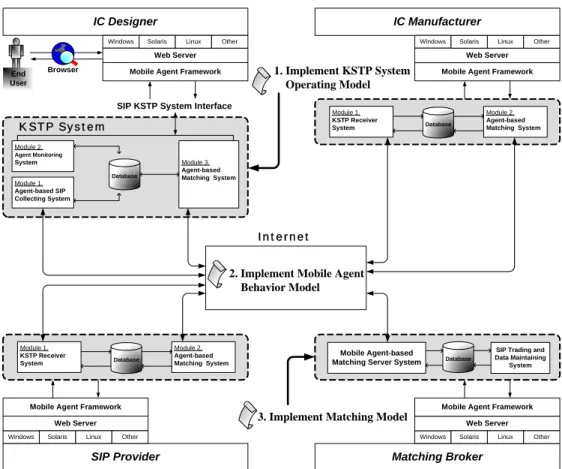
The KSTP provides a matching mechanism for SIP trading. Both buyers and sellers can maintain their matching data and fuzzy membership functions. The broker agent will make suggestions after evaluation and dispatch mobile agents to deliver the suggestions to the buyers and sellers. The four major roles interacting on the KSTP are IC designer, SIP provider, IC manufacturer, and matching broker. Figure 1 shows the relationship of all models and roles in the KSTP architecture.
3.1 KSTP Operating Model
The KSTP operating model is responsible for the main functional construct. The model is implemented for each role, with the major focus on the interfaces with SIP users and providers. The operating model consists of the agent-based SIP collection module, the monitoring module and the matching module.
IC Designer SIP Provider IC Manufacturer Matching Broker End User Windows Web Server Solaris Linux Other
SIP KSTP System Interface Browser Module 1. Agent-based SIP Collecting System Module 2. Agent Monitoring System Module 3. Agent-based Matching System
3. Implement Matching Model 1. Implement KSTP System Operating Model
Windows
Web Server Solaris Linux Other
Windows
Web Server Solaris Linux Other Windows
Web Server Solaris Linux Other
Mobile Agent Framework
Database
Mobile Agent Framework Mobile Agent-based
Matching Server System Database
Mobile Agent Framework
Mobile Agent Framework
Database Module 2. Agent-based Matching System Module 1. KSTP Receiver System KSTP System Database Module 2. Agent-based Matching System Module 1. KSTP Receiver System
2. Implement Mobile Agent Behavior Model
Internet
SIP Trading and Data Maintaining
System
Figure 1. The KSTP architecture with related models and roles 1) Agent-based SIP collection module
This module enables external communication. After submitting the keywords for search, users can invoke the mobile agents to collect SIP via the Internet from remote sites. The module also includes the receiving sub-module operating on the locations of SIP providers and IC manufacturers. The receiving sub-module supports the mobile agents to acquire SIP data and documents from the remote hosts.
2) Agent-based monitoring module
KSTP users logon to the monitoring module to receive the status report of SIP collection. If the agents finish the tasks, users can review and download the SIP documents from this module. The module also reports the work-in-progress of agents at the remote or host sites.
3) Agent-based matching module
The module works for IC designers, SIP providers, IC manufacturers and matching brokers. The matching server is located at the site of a matching broker. The sub-systems are located at the other sites. Both buyers and sellers can maintain their trading data and membership functions as a decision model at the matching broker site. After the matching process is completed, the mobile agents return to the original hosts and update the suggestion list into the database.
3.2 Mobile Agent Behaviour Models
There are two main types of mobile agent behaviour models developed in KSTP, i.e., the SIP collection behaviour model and the SIP trade matching behaviour model.
3.2.1 Behaviour Model for SIP Collection
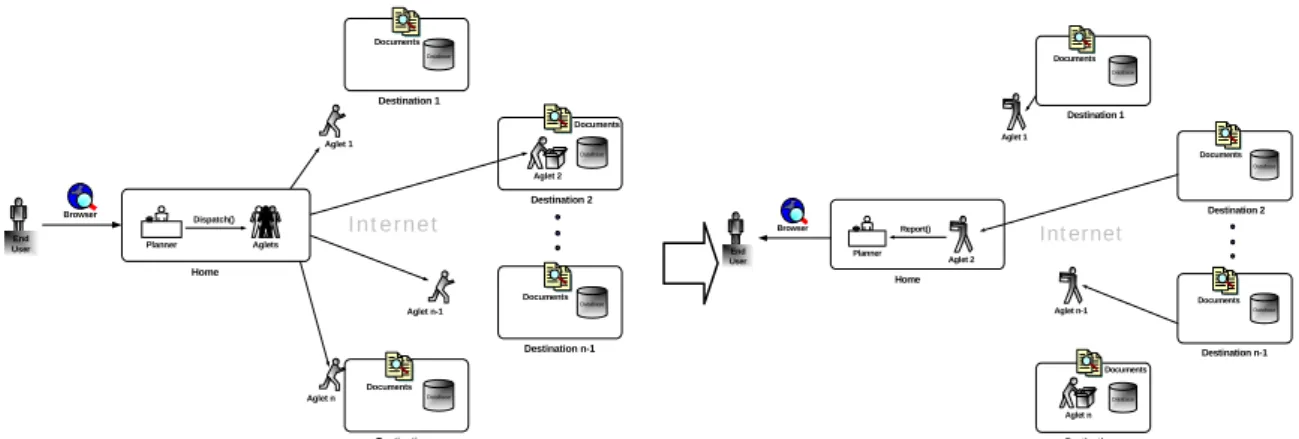
To improve the efficiency of asynchronous SIP search, the model is regarded as a collaborative, real-time procedure that takes advantage of mobile agents to authorize the remote tasks. After each agent is dispatched to the remote host, it starts the request independently at the remote site. This behavioral model is implemented in the KSTP for parallel execution to improve the SIP search results. Figure 2 shows the concept of parallel execution and collaboration. When mobile agents finish the job at the remote host, they will report back to the manager agent at the original host and
5
deliver the SIP documents. The local manager agent will automatically declare the mission accomplished after all mobile agents have returned from given tasks.
Planner Aglets Aglet 1 Destination 1 Destination 2 Destination n-1 Destination n Aglet n-1 Aglet n Dispatch() Database Database Database Database Aglet 2 Internet Home Documents Documents Documents Documents End User Browser Planner Destination 1 Destination 2 Destination n-1 Destination n Report() Database Database Database Database Internet Home Aglet 2 Aglet n Aglet n-1 Aglet 1 Documents Documents Documents Documents End User Browser
Figure 2. The concept of parallel execution, collaboration, and independent reporting
3.2.2 Behaviour Model for SIP Matching
Mobile agents serve as coordinators in the SIP matching process. Both buyer and seller not only maintain their related data (such as membership functions and matching data), but also decide whether or not they want to join the matching process conducted by the agent-based matching server. The deadline set by the administrator will be the basis for the broker agent to begin the matching evaluation. When the matching starts, the system locks itself to prevent further modification of the buyer and seller data. The broker agent retrieves the buyers’ and sellers’ matching data from database, and calculates the performance indices based on the membership functions defined by each buyer and seller. When the broker agent finishes the process, it will assign mobile agents to deliver the trading suggestions to the remote hosts of buyers and sellers. Figure 3 shows the concept of the agent behaviour model for SIP matching.
Mobile Agent Based Matching System Broker Agent Database Matching Model End User Planner M ain ta in D ata Buyer 1 Browser R epo rt B ack End User Planner Buyer 2 Browser End User Planner Buyer n Browser Maintain Data Report Back Mai ntain Dat a Re po rt Ba ck Planner Seller 1 End User Browser Planner Seller 2 End User Browser Planner Seller m End User Browser Internet Internet Mai ntain Dat a Rep ort Bac k Maintain Data Report Back M ainta in D ata R epo rt B ack
Information flow based on Web Information flow based on Mobile Agent Figure 3. The agent behavioral model for SIP matching
3.2.3 Fuzzy Evaluation Model for Buyer-Seller Matching
When an IC design company decides to use someone’s SIP to speed up its ID design, it will be very useful to use a consistent matching function via the KSTP matching system. In this research, fuzzy sets theory is utilized to form the evaluation model for the matching process. The matching model helps the buyers and sellers reduce the searching and comparing time for finding suitable trading partners. Further, the evaluation model provides a rational and consistent method for e-trade matching. The logic is that the broker evaluates buyers and sellers using their self-defined membership functions. Then, the broker can list the performance values for all potential buyers and sellers. The performance value implicates the strength of each trading partner.
high, the acceptance of the trading partner is high as well. When the suggestion list has n trading partners, it can be ranked and ordered by the performance values for content collection. Finally, both buyers and sellers can evaluate trading partners based on the suggestions and select preferred partners for SIP trade.
4. KSTP System Implementation
The KSTP prototype is implemented on the Internet with the SIP documents for search and collection formatted using the XML Schema. The roles and behaviours of mobile agents constructed for KSTP operations are described below.
4.1 Agent-based SIP Collection and Monitoring System
The buyers or sellers logon to the system via a Web browser. After the users enter the keyword for the search, the system invokes agents to conduct the SIP collection mission. An IC designer works as an SIP user, while an IC manufacturer or an SIP vendor is an SIP provider. There are four agents in the SIP user’s host, including KSTP, Barracks, Marine and Statistician agents. Each agent is in charge of different stages of the SIP collection. For the SIP provider, there are two agents – the Guard and Retriever agents. The Guard agent is in charge of verifying the Marine agent and the Retriever agent helps the Marine agent accesses the local database after authorization is approved. When the Retriever agent finds the SIP documents that the user requires, it delivers the SIP documents to the Marine agent. Then, the Marine goes back to the original host for reporting. The collaboration sequence for the mission is illustrated in Figure 4. Further, when the Marine agents start the SIP collection task, users can login to the monitoring system (Barracks) to query the status of the agent activities. A real-time status report can be generated by the monitoring agent.
KSTP Agent Barrack Agent Marine_ipuser Agent Internet IP User IP Provider Marine_ipuser Agent 1 2 3 invoke Invoke Invoke many Marine dispatch Guard_ipprovider Agent 4 Retriever_ipprovider Agent invoke 5 6 7 8 Statistician Agent 9 Move Report back Report back Invoke
Figure 4. The SIP collection task and agent collaboration flow
4.2 Agent-based SIP Matching System
The agent-based SIP matching system supports the SIP buyers and sellers to start the matching process. The goal is to suggest the most suitable trading partners. The agent-based SIP matching system is located at the matching broker site. There are two types of users, i.e., the general user (SIP buyer or seller) and the brokerage administrator. The system consists of a registration module, the trading-data maintenance module, the membership-function maintenance module and the administrator maintenance module. The relationship between the users and the modules is shown in Figure 5.
7 Registration
module
Membership function maintenance module
Buyer or seller Login the website Trading data maintenance module Administrator module Database
Administrator Login the website
Figure 5. The relationship between the roles and modules
Both buyers and sellers can maintain their trading data via the “trading data maintenance module.” The users choose the SIP they want to trade (buy or sell) in order to decide trading partners in the matching process. The system requests the users to enter some information according to the users’ company demographics. Buyers and sellers can also create, delete, query and update the fuzzy membership functions using the “membership function maintenance module.” The membership functions establish the criteria for the matching process. When the users want to add a new
membership function, they select an index from the system which becomes the default value. There are several default membership functions in the system for users to select and modify that suit the users concerns. In addition, the users can remove an old membership function if they consider it as unnecessary. Updating the parameters is also permitted in this module, which is shown in Figure 6.
Figure 6. The membership function maintenance module
When the matching deadline expires, the system initiates the matching process in order to find suitable partners. At the time, a Detector agent from the matching broker’s site will detect the deadline automatically. If the Detector agent finds the deadline is expired, it will invoke the Broker agent to start the matching evaluation. The Broker agent will retrieve the users’ data including matching data and membership functions. After confirming the players, the Broker agent starts to evaluate the data based on the matching fuzzy model. When the process is completed, the Broker will provide each player’s suggestion list ranked by each trading partner’s performance value. Then, the Broker agent will pass the information to the Distributor agent for dispatching Marine matching agents to the player’s host. When the Marine matching agent arrives at the remote host, the
Receiver matching agent will insert the matching results into the local database. The collaboration flow of the agents and the matching processes is shown in Figure 7.
Felix, insert a new membership function for a buyer.
Welcome Felix. Please update the membership function for the buyers vote.
Detector Agent Database Broker Agent Invoke The deadline is not expired Check deadline Retrieve database Database Matching process
Invoke Distributor Agent
and pass matching result Distributor Agent
Marine_matching Agent
Invoke & pass matching result Pass matching result Internet Move Receiver_matching Agent Database Access database
Buyer or Seller Login the website Check the matching result Access database Marine_matching Agent Move
Figure 7. The collaboration of agents and the matching process
5. Conclusion
SIP management and public trading are becoming very important in reducing SoC time-to-market. In this research, mobile agent technology is applied to SIP Knowledge Service and e-Trading Platform (KSTP). The contribution of the research is to demonstrate agent-based SIP reuse by improving the efficiency of IP data collection and trade partner evaluation. Therefore, this research presents the mobile agent-based thinking for KSTP construction. For SIP collection, KSTP
provides an asynchronous and parallel execution for SIP information acquisition via mobile agent technology. Moreover, the approved helps users reduce the IP search cost and time. For SIP trading, the research also provides a matching model to reduce trading complexity. When there are a large number of buyers and sellers in the marketplace, the matching model becomes a consistent method for partner screening. Thus, SIP providers can maintain their own management rights while allowing SIP information sharing under the KSTP design. SIP users and providers are also equipped with rational and consistent tools for SIP partner search.
The research presents the methodology of constructing the KSTP applying mobile agent technology. However, there are still issues to research concerning SIP integration and plausible business models. The uncertainty of business practices may impede the purchase and reuse of SIPs. Therefore, further research on the decision models of SIP trades and reuses under different circumstances will be required to fully automate the concept.
References
[1] Hunt, M., & Rowson, J.A. Blocking in a system on a chip. IEEE Spectrum 1996; pp. 35-41.
[2] Embedded Controller Products: Optimized Image Compression for Embedded Controllers, Image
Power, accessed December 2003 at
http://www.imagepower.com/products/default.asp?url=embedded/index.html
[3] Moore, G.E., Cramming more components onto integrated circuits, Electronics 1965; Vol. 38, No. 8. [4] Gajski, D.D., Wu, A.C.-H., Chaiyakul, V., Mori, S., Nukiyama, T., & Bricaud, P. Essential issues for IP reuse. Proc. of the ASP-DAC. Design Automation Conference 2000; pp. 37 –42. [7] Coors, H., Madrid, N.M., & Seepold, R. Hardware/software co-design for IP objects based on CORBA 1999; Fall VIUF Workshop, pp. 63 –68.
[5] Chang, C.Y., and Trappey, C.V. (2004), The national si-soft project. Applied Surface Science 2003: Vol. 216, pp. 2-7.
[6] Maamar, Z. Association of users with software agents in e-commerce. Electronic Commerce Research
9
[7] Wooldridge, J. Intelligent Agents: Theory and Practice. The Knowledge Engineering Review 1995;
10(2), pp. 115-152.
[8] Papaioannou, T., & Edwards, J. Using mobile agents to improve the alignment between manufacturing and its IT support systems. Robotics and Autonomous Systems 1999; Vol. 27, Issue 1-2, pp. 45-57.
[9] White, J. E. Telescript technology: the foundation for the electronic marketplace. White Paper, General Magic, Inc., USA, 1994.
(http://xenia.media.mit.edu/~nelson/research/masters-proposal/proposal-full/node9.html) (http://www.genmagic.com/Telescript/Whitepapers/wp1/whitepaper-1.html).
[10] Lange, D. B., & Oshima, M., Programming and Deploying JavaTM Mobile Agents with AgletsTM, Reading, Massachusetts: Addison-Wesley Press; 1998.
Acknowledgement
This research is partially supported by the National Science Council and the Ministry of Economic Affairs in Taiwan, R.O.C..