Journal of the European Ceramic Society 16 (1996) 583-586 0 1996 Elsevier Science Limited 0955-2219(95)00166-2
Printed in Great Britain. All rights reserved 09%2219/96/$15.00
The Corrosion Behaviour of A1203 Toughened by
Ag Particles
W. H. Tuan & W. 13. Chou
Institute of Materials Scienc:e and Engineering, National Taiwan University, Taipei, Taiwan 10764 (Received 7 June 1994; revised version received 16 August 1995; accepted 27 August 1995)
Abstract
The strength and toughness of alumina can be enhanced by adding silver inclusions. In the present study, the corrosion behaviour of such AI,O,/Ag composites in nitric acid is investigated. The strength of the composites containing 2.5 ~01% sil- ver is not aflected after the corrosion test. However, the weight loss of the icomposites containing 10 ~01% silver is increased with increasing corrosion time. The strength and the toughness of the compos- ites after corrosion are signtficantly degraded. For example, the strength of the composites containing 10 ~01% silver is decreased by 50% and the tough- ness by 30%, when the composites are soaked in nitric acidfor 1000 h.
1 Introduction
Ceramics are superior for their chemical stability and therefore are frequently used in hostile envi- ronments. However, the application of ceramics as structural components has been limited by their brittleness. Recent studies suggest that the tough- ness of alumina can be isignificantly enhanced by adding silver inclusions. l-3 A key question then arises concerning the ability of such composites to resist corrosion, since initial failure will expose the metal reinforcement to the environment. In the present study, the corrosion behaviour of silver- toughened alumina in nitric acid is investigated as a model system representing extreme conditions. The strength and toughness of the composites after the corrosion test have been determined.
2 Experimental Procedures
Alumina (AKP-50, Sumitomo Chem. Co., Ltd, Japan) and various amounts of silver oxide (Ag,O, Johnson Matthey Co., UK) were ball milled together in ethyl alcohol for 4 h. The slurry
was dried with a rotary evaporator. The powder compacts were prepared by uniaxially pressing at 56 MPa. The silver oxide was decomposed to sil- ver and oxygen during initial heating.lm3 Sintering was performed at 1600°C for 1 h in air.
Since the partial pressure of liquid silver at ele- vated temperature is high (10 mmHg at 16OO”C, 23 mmHg at 1700°C),4 a silver-free surface layer was formed.2 After removing the silver-free layer by grinding, the volume fraction of silver after sin- tering was recalculated by counting the point frac- tion on the polished surfaces. The size of silver inclusions was determined by using the linear intercept technique. The polished specimens were thermally etched at 1500°C for 1 h to reveal the grain boundaries of alumina. The size of the matrix grains was also determined by using the linear intercept technique. More than 200 grains or inclusions were counted.
The sintered specimens were machined longitu- dinally with a 325grit resin-bonded diamond wheel at a cutting depth of 5 pm/pass. The silver- free layer was removed during the grinding proce- dure. The final dimensions of the samples were 3 X 4 X 36 mm3. The ground specimens were soaked in an aqueous nitric acid (1 M) solution at 40°C. After a certain time, the specimens were removed, washed in deionized water and subse- quently in acetone for 10 min.
The strength of the samples was determined by the four-point bend technique under ambient con- ditions. The upper and lower spans were 10 and 30 mm, respectively, and a loading rate of 0.5 mm min’ was used. The fracture toughness was deter- mined by the single-edge notched beam (SENB) technique, the notch being generated by cutting with a diamond saw before the corrosion test. The electrical resistivity of the composites was mea- sured by the standard two-probe technique, using silver paint for contacts. Phase identification was performed by X-ray diffractometry (XRD), and the microstructure was observed by a scanning electron microscope (SEM) equipped with an 583
584 W. H. Tuan, W. B. Chou
energy dispersive X-ray spectrometer (EDX). Chemical analysis was also conducted by applying a plasma evaporation technique (TC-136, LECO Co., USA).
3 Results and Discussion
The silver content after sintering, the relative den- sity, the matrix grain size, the size of the silver inclusions and the electrical resistivity of the Al,O,/Ag composites are shown in Table 1. The fracture surfaces of the composites before sinter- ing are shown in Fig. 1. From Table 1, both the strength and toughness of alumina are enhanced due to the addition of silver inclusions. The toughness enhancement is attributed mainly to the plastic deformation of the metallic inclusions. The strengthening effect is attributed both to the matrix refinement and the toughness enhancement.’
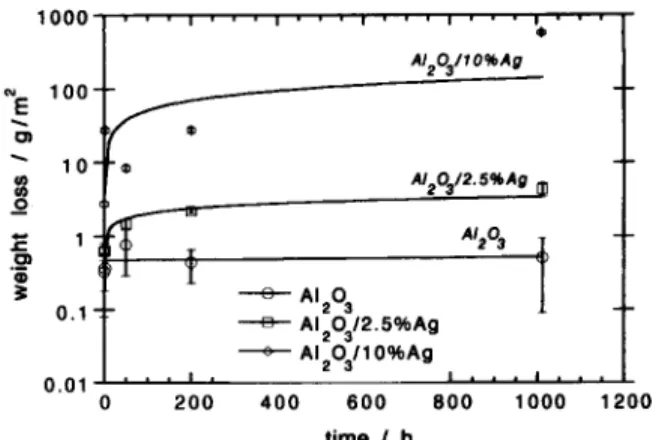
The electrical resistivity of the composite con- taining 2.5 ~01% Ag is higher than that of the composite containing 10 ~01% Ag (Table 1). This indicates that the connectivity of the silver inclusions increases with the amount of silver inclusions. The weight loss of the Al,O,/Ag com- posites is shown as a function of corrosion time in Fig. 2, while the strength and the toughness of the composites are shown in Figs 3 and 4, respec- tively. Each point in the figure is the average value of three testing bars; error bars show one standard
deviation. The weight loss of the alumina speci- mens is negligible as is their strength and toughness change.
0.01
0 200 400 600 600 1000 1200 time I h
Fig. 2. Weight loss of the composites as a function of corrosion time.
450z
time I h
Fig. 3. Flexural strength of the composites as a function of corrosion time.
Table 1. The silver content, relative density, matrix grain size, inclusion size, flexural strength, fracture toughness and electrical resistivity of the A&O,/Ag composites (composites sintered at 1600°C for 1 h)
Silver content after sintering (vol%) Relative density (%) Matrix grain
size (pm) size (km) Inclusion Flexural strength
( MPa) Fracture toughness (MPa rn”‘) Electrical resistivity (fl cm) 0 97.8 5.2 - 325 4.0 1.1 x 1o14 2.5 97.9 4.5 1.2 351 4.6 8.4 x 10¹³ 1.0 96.6 4.1 2.5 394 4.7 1.8 x lOI
Corrosion behaviour of AI,O, toughened by Ag particles 585 it 9 !! 3.5 5 ti
e
(
I 3-- ” ” ’ * ” ” ” ’ 0 200 400 600 600 1000 1200 time / hFig. 4. Fracture toughness of the composites as a function of corrositon time.
3.1 Corrosion behaviour of A1,042*5% Ag composite
From Table 1, it can be seen that the strength and toughness of alumina are enhanced by 8% and 15%, respectively, with 2.5 ~01% silver addition. The weight loss of the composites increases rapidly during the first 2 h of exposure. This results from the dissolution of the exposed silver inclusions.5 Subsequent ,weight loss is negligible. This suggests that the internal silver inclusions are well protected by the alumina matrix. Since the critical flaw size calculated from the strength and
toughness (Table 1) for the as-received composite is 100 pm, the silver inclusions in the composites containing 2.5 ~01% are much smaller than the critical flaw size. Therefore, the presence of the silver-depleted surface layer does not affect the strength of the composites. However, as the exposed silver inclusions are removed after corro- sion, the number of silver inclusions to interact with the crack is decreased. The toughness of the composite is thus reduced as soon as the exposed silver inclusions are dissolved. Since the internal silver inclusions are well protected, the toughness of the composite after corrosion drops by only 15%. 3.2 Corrosion behaviour of Al,OdlO% Ag composite The strength and toughness of alumina is enhanced by 21% and 18%, respectively, with 10 ~01% silver addition. The weight loss of the composite contin- ues to increase with increasing corrosion time. It suggests that the silver inclusions are intercon- nected to each other and therefore corrosion can progress through the structure by leaching out the silver phase. The strength and toughness is dra- matically decreased as the composites are corroded for longer than 200 h. The fracture surface of an A&0,/10% Ag composite after corrosion for 1000 h is shown in Fig. 5. Three distinct regions can be
Fig. 5. (a) Fracture surface of the Al,O,/lO% Ag composite after corrosion for 1000 h. The surface region and the intermediate region (I) are shown in (b), (d) and (c), respectively.
586 W. H. Tuan. W. B. Chou
found on the fracture surface, Fig. 5(a). The region near the surface is shown in Fig. 5(b). The centre of the composite is shown in Fig. 5(d). The inter- mediate region between the surface region and central region is shown in Fig. 5(c). Only limited silver inclusions can be observed in the region near the surface. The central region of the cor- roded specimens is similar to the as-received com- posites, Fig. l(b). In the intermediate region, the surface is covered with small particles, the amount of which is too small to be identified using XRD analysis. However, nitrogen is detected by apply- ing the plasma evaporation technique and silver is detected by using the EDX analysis, suggesting that the small particles are silver nitrate.
After the corrosion test, the specimens were removed from the acid solution and the acid near the surface removed during the subsequent wash- ing steps. Nevertheless, acid remained far into the structure. After drying, silver nitrate particles were deposited on the surface of the alumina grains. Since the toughening agents (silver inclusions) are almost removed completely from the crack front during corrosion, the toughness is reduced signifi- cantly. Pores are left behind after corrosion, thereby degrading the strength. For example, for the composite containing 10% Ag, the toughness is decreased by 30% and the strength by 50% after corrosion for 1000 h.
4 Conclusions
The corrosion behaviour of Al,03/2.5% Ag and Al,03/10% Ag composites in nitric acid has been investigated. For the A&0,/2.5% Ag composites, the silver inclusions are well separated from each other. As the composites are soaked in nitric acid,
only the silver inclusions exposed to the outer surface are dissolved, other silver inclusions within the composites being well protected by the alumina matrix. Therefore, the strength of the Al,OJ2.5% Ag composites is not affected by nitric acid. However, the toughness is reduced slightly. When 10 ~01% silver is incorporated into alumina, the silver inclu- sions are interconnected to each other. Therefore, not only the exposed silver inclusions but also the internal silver inclusions are attacked by the acid. The weight loss of the composites containing 10 ~01% silver is thus increased with increasing corro- sion time. After corrosion in nitric acid, the silver inclusions within the crack front are removed and pores are formed instead, so that the strength and toughness are reduced significantly.
Acknowledgement
The valuable comments given by Prof. R. J. Brook, Oxford University, are gratefully acknowledged.
References 1. 2. 3. 4. 5.
Tuan, W. H. & Chou. W. B., Toughening alumina with silver inclusions. Proc. 2nd Conf of European Ceram.
Sot., ed. G. Ziegler & H. Hausner. Deutsche Keramische Gesellschaft e.V., Germany, 199 1, Vol. 2, p. 1703. Wang, J., Ponton, C. N. & Marquis, P. M., Silver-tough- ened alumina ceramics. Br. Ceram. Trans., 92 (1993) 67. Chou, W. B. & Tuan, W. H., Toughening and strength- ening alumina with silver inclusions. J. Eur. Ceram. Sot.,
15 (1995) 291.
Wise, E. W. & Coxe, C. D., Silver and silver alloys, In
Metal Handbook, ed. T. Lyman. Amer. Sot. Metals, OH, 1961, Vol. 1, p. 1181.
Leach, R. H., Silver and silver alloys. In The Corrosion Handbook, ed. H. H. Chlig. John Wiley & Sons, (1948) p. 314.