Wavelength tunability of second-harmonic generation
from two-dimensional
„2…nonlinear photonic crystals
with a tetragonal lattice structure
L.-H. Penga)and C.-C. Hsu
Department of Electrical Engineering and Institute of Electro-Optical Engineering, National Taiwan University, Taipei, Taiwan, Republic of China
Jimmy Ng and A. H. Kung
Institute of Atomic and Molecular Sciences, Academia Sinica, Taipei, Taiwan, Republic of China
共Received 17 November 2003; accepted 26 February 2004兲
The wavelength tunability of second-harmonic generation共SHG兲 in a two-dimensional nonlinear photonic crystal 共2D NPC兲 on lithium niobate is examined by using a 1.55 m-band optical parametric oscillator. We observed SHG signals that were generated off-axis from the fundamental pump beam and a multiple number of quasi-phase-matchable共QPM兲 wavelengths for a given crystal setting. The spacing between the phase-matched wavelengths increases with the azimuthal rotation angle共兲 in the x – y plane of the crystal. The peak intensity and propagation direction of the SHG signals are found to vary with the pump wavelength and crystal rotation angle. These observations are ascribed to a 2D distribution of high-order reciprocal lattice vectors Gmn() and the corresponding (2)(G
mn) nonlinearities in 2D NPC having a tetragonal structural symmetry.
© 2004 American Institute of Physics. 关DOI: 10.1063/1.1728303兴
The use of the quasi-phase-matching 共QPM兲 technique to enhance nonlinear wave interactions has been actively pursued in nonlinear optics. A QPM structure can be realized in ferroelectric nonlinear crystals by seeking a periodic do-main reversal at every coherent length lc⫽/4(n2⫺n).1
Such material modification can lead to a periodic sign change in the (2) nonlinearity and render a structure-imposed phase factor to compensate the destructive interfer-ence caused by the crystal’s optical dispersion as the inter-acting waves propagate in the crystal. This compensation can result in a constructive nonlinear process and provide an ef-ficient means for laser wavelength conversion.2Recent real-ization of QPM optical parametric oscillators 共OPO兲 and second-harmonic generators共SHG兲 using periodically poled lithium niobate 共PPLN兲3 and potassium titanyl phosphate
共PPKTP兲,4 are representative developments in this field. A
stringent limitation of these one-dimensional 共1D兲 periodi-cally poled QPM devices, however, is their wavelength agil-ity. Let’s take the QPM-SHG process as an example. For a given temperature and incident angle, efficient SHG can only occur at a single wavelength that fulfills the momentum conservation condition, 2k1⫹G⫽k2, where the ki’s are
the wave vectors at the fundamental- and second-harmonic frequencies, respectively, and G⫽/⌳ is the reciprocal lattice vector resulting from a first-order QPM structure with a periodicity of 2⌳. In addition, the temperature and wavelength acceptance bandwidths are very tight. The toler-ance is approximately equal to ⌳/l 共⬃0.1%兲, where l is the length of the crystal.5These effects add to the complexity in using such devices to achieve simultaneous multiwave-length switching/conversion that often is needed in applica-tions such as optical information processing6 and telecom-munication.7
An approach to overcome the constraints on wavelength acceptance bandwidth is to engineer a configuration of the reversed domains such that momentum conservation can be simultaneously satisfied by a number of different wave lengths.8 This approach has been realized in 1D quasiperiodically9 or aperiodically10 poled structures which enabled dual-8 or multiwavelength QPM-SHG,11 and simul-taneous QPM sum frequency generation12 in KTP and lithium tantalate (LiTaO3). Since a quasiperiodic lattice can
be considered as a projection from a higher-dimensional pe-riodic structure onto a particular axis with one or more irra-tional coefficients,9one can envision an expansion of the 1D plural-QPM vector scheme into a two-dimensional共2D兲 pe-riodically poled structure. The added dimension creates a number of possibilities in phase matching. For example, in the 1D periodically poled device, QPM-SHG is limited to creating an SH wave that grows solely in the direction of the fundamental beam, whereas in the 2D case the presence of Gmnvectors in the transverse direction can result in QPM for
several propagation directions of the SH wave.13Theory fur-ther suggests that efficient QPM processes in the latter can lead to simultaneous phase matching of harmonic genera-tions to a higher order.14,15 For example, third- and fourth-harmonic generation,16 and nonlinear SHG wavelength switching17 are optical functionalities that can be realized from a 2D nonlinear photonic crystal共NPC兲.
It is well known that periodic poling of ferroelectric NPC can be facilitated by electric field action to overcome the crystal’s coercive field.18 However, one can often en-counter the troublesome issue of uncontrollable domain merging due to the fringe-field effect.19 The loss of domain fidelity can lead to a demise in the structure-related QPM vectors and is detrimental to the conversion efficiency. Al-though delicate poling techniques such as scanning probe20 and direct electron beam writing21 have been recently dem-a兲Electronic mail: [email protected]
APPLIED PHYSICS LETTERS VOLUME 84, NUMBER 17 26 APRIL 2004
3250
onstrated to realize 2D QPM-NPC on LiNbO3, for practical
applications it is important to develop techniques that pole large-area QPM devices.
We have recently demonstrated a two-step poling method that can be used for fabricating large-area 2D NPC.22 A 2D distribution of (2) showing an orthorhombic lattice structure and domain periodicity as small as 6.6⫻13.6m2 has been reported on a 500-m-thick LiNbO3substrate.23In
this letter, we report the results of our investigation on the wavelength tunability of QPM-SHG from a 2D NPC that is fabricated to quasi-phase match in the 1.55m communica-tions band at room temperature 共30 °C兲. We observed spa-tially distributed SHG signals whose QPM peak intensities and propagation directions depend on the pump wavelength. Furthermore, at an 8° angle of incidence relative to the crys-tal x axis 共the G10direction in the 2D NPC兲, we obtained a wavelength spread of 150 nm in phase-matched fundamental wavelengths. These phenomena are ascribed to a high-order reciprocal lattice vector (Gmn) assisted QPM-SHG process
in the 2D NPC.
Figure 1共a兲 shows the ⫺Z-face micrograph of a 2D NPC fabricated on Z-cut LiNbO3substrate as prepared by the two-step poling technique. If one ignores the occasional imper-fections in the inverted domains, one can clearly resolve a 2D distribution of inverted domains showing a periodicity of 20⫻20 m2 on a square lattice pattern. This device has an area of 6⫻8 mm2. The sample edges are cut parallel to the crystalline x- and y axes and are optically polished. We note here that the spatial distribution of (2) nonlinearity of this sample has a C4v tetragonal symmetry that is different from the C3vtrigonal lattice symmetry of the LiNbO3host crystal.
As shown below, the generation and propagation of
nonlin-ear interacting waves in this new type of photonic crystals depend solely on the C4v domain symmetry and is indepen-dent of the host’s crystal symmetry. The QPM-SHG pro-cesses involving contributions from high-order reciprocal lattice vectors Gmn to satisfy the phase-matching condition
for different incident wavelengths are schematically shown in Fig. 1共b兲. They illustrate simultaneous phase matching and spatial separation of the fundamental and harmonic waves in the 2D NPC structure.
The SHG measurements were conducted by using a pulsed grating-tuned periodically poled LiNbO3optical
para-metric oscillator operating in the 1.55-m band.24By adjust-ing the temperature of the PPLN crystal that has a domain periodicity of 29.5 m, output spanning a spectral range from 1450 to 1640 nm was obtained. The output peak power was 2 kW and the pulse repetition rate was 4 kHz. The fun-damental pump beam was loosely focused into the polished 2D NPC sample with a beam diameter of 100m by a lens of 30 cm focus length, resulting in a peak intensity of 12.5 MW/cm2 inside the crystal. A rotatable stage was attached to the sample mount to vary the azimuth angle of the sample by up to ⫾15°, a process equivalent to varying the incident angle of the pump beam. The SHG intensity distribution in the far field was recorded as the wavelength was changed.
Shown in Fig. 2 are the共a兲 CCD images and 共b兲 normal-ized far-field intensity distribution of QPM-SHG signals from the sample shown in Fig. 1 for fundamental wave-lengths of 1589, 1580, and 1563 nm, respectively. The SHG data were measured with the pump beam propagating along the crystal’s x axis共i.e., 0° incident angle兲. The images were taken by placing an IR sensitive fluorescence card 10 cm away from the sample and intercepting the beams at 90°. We first note a symmetrical distribution of the QPM-SHG sig-nals in a direction transverse to the propagation direction of the pump beam. Similar axial distribution of SHG signals can also be observed 共not shown兲 as the pump beam was made to propagate along the crystal’s y axis. This fourfold rotational symmetry reflects the tetragonal structure of this 2D NPC for the SHG process.25 The peak intensity of the QPM SHG signal and its associated far-field angle were ob-served to be strongly dependent on the incident wavelength. We observed a 66 mW output power and a zero-degree共0°兲 FIG. 1. 共a兲 ⫺Z-etched micrograph showing an NPC consisting of 2D
dis-tribution of inverted domains. The domains have a periodicity of 20⫻20 m2 on a 300-m-thick Z-cut LiNbO
3 substrate.共b兲 Schematic drawing showing multiwavelength QPM-SHG process in共a兲.
FIG. 2. 共a兲 CCD images and 共b兲 normalized far-field SHG intensity distri-bution for the sample in Fig. 1共a兲. The incident wavelengths are, from top to bottom, 1589, 1580, and 1563 nm. Inset: measured SHG efficiency in the
G1,0direction for input at 1589 nm.共c兲 CCD image of the generated third-harmonic signal for the 1589 nm input. The pump intensity was fixed at 12.5 MW/cm2.
3251
far-field angle for the second harmonic of a 1589 nm funda-mental pump input, while the corresponding values were
共16.8 mW, ⫾1.13°兲 for a 1580 nm pump, and 共6.4 mW, ⫾2.25°兲 for a 1563 nm pump, respectively. The mirror
sym-metry in phase-matching angle and the reduction in conver-sion efficiency are reminiscent of a phase-matched second-harmonic generation mechanism due to contribution from the high-order reciprocal lattice vectors G1,0, G1,⫾1, and G1,⫾2,
and their corresponding second-order nonlinearities (2)(G
mn).
The inset in Fig. 2共b兲 shows the power dependence of the conversion efficiency for QPM-SHG due to phase match-ing in the G1,0direction. The conversion efficiency is linear up to a pump intensity of ⬃4 MW/cm2, and the process saturates at a pump intensity above 12 MW/cm2. In addition to QPM-SHG, un-phase-matched higher-order harmonic generation was also observed. Figure 2共c兲 is an image of the third-harmonic 共green兲 output generated by the 1589 nm pump beam at 12.5 MW/cm2. Details of QPM third- and fourth-harmonic generation in tetragonal (2) NPC will be presented in a forthcoming publication.
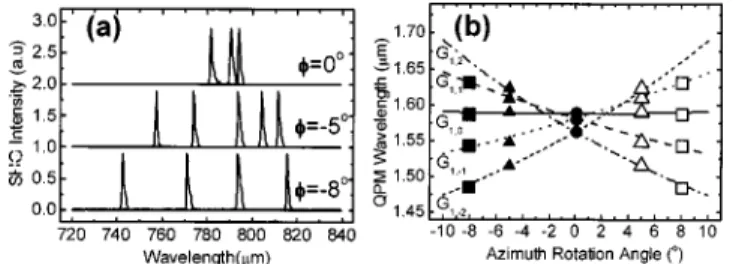
In order to grant a further understanding of QPM-SHG in tetragonal (2) NPC, we azimuthally rotated the sample such that the internal incident angle of the input beam rela-tive to the x 共or y) axis of the 2D NPC can be varied. In doing so, the QPM-SHG process is selectively activated by a suitable reciprocal lattice vector that fulfills the phase-matching condition of 2k⫹Gmn()⫽k2. Illustrated in Fig. 3共a兲 are the normalized SHG spectra as a function of the incident pump wavelength, limited by the tuning range of the OPO. The spectra are measured at an azimuthal rotation angle ⫽0, ⫺5, and ⫺8°, respectively, of the 2D NPC. Ev-ery peak in each spectrum corresponds to a SHG due to quasi-phase-matching for a Gmn in the crystal. The spacing
of phase-matchable wavelengths increases with. The span of the incident wavelengths reaches 150 nm at a ⫺8° inci-dence on the crystal. Meanwhile, the spatial separation be-tween the SHG signal also increases with .
We applied a ray-tracing method to obtain a quantitative analysis of the spatial distribution of the QPM-SHG process. This is equivalent to solving 2k⫹Gmn()⫽k2, where the phase-matching wavelength becomes dependent on the re-ciprocal lattice vector Gmn and the azimuthal rotation angle
in the x – y plane. Here, the material refractive index n() is taken from Ref. 26. Illustrated in Fig. 3共b兲 are the derived dispersion curves overlaid with the experimental data show-ing the dependence of the quasi-phase-matchshow-ing wavelength
on Gmn and. We note the inversion symmetry of the
dis-persion curves with respect to azimuthal rotation angle and the crossover of the G1,⫾ncurves at⫽0°. These are specific
properties due to the C4vdomain symmetry of the tetragonal structure of our 2D NPC. The figure shows that at ⫽0° QPM due to G1,⫾n becomes degenerate and this explains
why only three peaks were observed at⫽0° as compared to five at⬎0 in the experiment. Figure 3共b兲 also clearly illus-trates an increase in quasi-phase-matchable wavelength span by a simple rotation of the 2D NPC. Hence, a bandwidth
⬎150 nm could be obtained with an appropriately designed,
possibly aperiodic inverted domain lattice distribution. This would be beneficial to applications in optical information processing.
In summary, we have demonstrated simultaneous spatial separation and wavelength tunability of QPM-SHG by using a NPC that has a 2D tetragonal distribution in (2) and showed that it could be a promising route to increasing chan-nel spacing and chanchan-nel width in the 1.3 to 1.55 m tele-communications band. These observations are ascribed to the unique dispersion of Gmn() and nonvanishing(2)(Gmn) of
the 2D NPC.
This research was supported by the National Science Council, Grant No. 92-2215-E-002-013 and –M-001-005.
1J. A. Armstrong, N. Bloembergen, J. Ducuing, and P. S. Pershan, Phys. Rev. 127, 1918共1962兲.
2Y. Yamada, N. Nada, M. Saitoh, and K. Watanabe, Appl. Phys. Lett. 62, 435共1993兲.
3L. E. Myers and W. R. Bosenberg, IEEE J. Quantum Electron. 33, 1663 共1997兲.
4H. Karlsson, F. Laurell, and L. K. Cheng, Appl. Phys. Lett. 74, 1519 共1999兲.
5
M. M. Fejer, G. A. Magel, D. H. Jundt, and R. L. Byer, IEEE J. Quantum Electron. 28, 2631共1992兲.
6S. M. Saltiel and Y. S. Kivshar, Opt. Lett. 27, 921共2002兲.
7M. H. Chou, I. Brener, M. M. Fejer, E. E. Chaban, and S. B. Christman, IEEE Photonics Technol. Lett. 11, 653共1999兲.
8
K. Fradkin-Kashi, A. Arie, P. Urenski, and G. Rosenman, Phys. Rev. Lett. 88, 023903共2002兲.
9S.-N. Zhu, Y.-Y. Zhu, and N.-B. Ming, Science 278, 843共1997兲. 10B.-Y. Gu, B.-Z. Dong, Y. Zhang, and G.-Z. Yang, Appl. Phys. Lett. 75,
2175共1999兲.
11H. Liu, S. N. Zhu, Y. Y. Zhu, N. B. Ming, X. C. Lin, W. J. Ling, A. Y. Yao, and Z. Y. Xu, Appl. Phys. Lett. 81, 3326共2002兲.
12J.-L. He, J. Liao, H. Liu, J. Du, F. Xu, H.-T. Wang, S. N. Zhu, Y. Y. Zhu, and N. B. Ming, Appl. Phys. Lett. 83, 228共2003兲.
13
V. Berger, Phys. Rev. Lett. 81, 4136共1998兲.
14X.-H. Wang and B.-Y. Gu, Eur. Phys. J. B 24, 323共2001兲. 15A. H. Norton and C. M. De Sterke, Opt. Lett. 28, 188共2003兲.
16N. G. R. Broderick, R. T. Bratfalean, T. M. Monro, D. J. Richardson, and C. M. De Sterke, J. Opt. Soc. Am. B 19, 2263共2002兲.
17A. Chowdhury, C. Status, B. F. Boland, T. F. Kuech, and L. McCaughan, Opt. Lett. 26, 1353共2001兲.
18R. C. Miller and G. Weinreich, Phys. Rev. 117, 1460共1960兲.
19G. Rosenman, Kh. Garb, A. Skliar, M. Oron, D. Eger, and M. Katz, Appl. Phys. Lett. 73, 865共1998兲.
20G. Rosenman, P. Urenski, A. Agronin, Y. Rosenwaks, and M. Molotskii, Appl. Phys. Lett. 82, 103共2003兲.
21J. He, S. H. Tang, Y. Q. Qin, P. Dong, H. Z. Zhang, C. H. Kang, W. X. Sun, and Z. X. Shen, J. Appl. Phys. 93, 9943共2003兲.
22
L.-H. Peng, Y.-C. Shih, S.-M. Tsan, and C.-C. Hsu, Appl. Phys. Lett. 81, 5210共2002兲.
23L.-H. Peng, C.-C. Hsu, and Y.-C. Shih, Appl. Phys. Lett. 83, 3447共2003兲. 24C.-S. Yu and A. H. Kung, J. Opt. Soc. Am. B 16, 2233共1999兲. 25
J. F. Nye, Physical properties of crystals共Oxford University Press, Ox-ford, 1989兲.
26D. H. Jundt, Opt. Lett. 22, 1553共1997兲.
FIG. 3. 共a兲 Normalized QPM-SHG spectra measured at sample rotation angles of 0, ⫺5, and ⫺8 deg and pump intensity of 12.5 MW/cm2. 共b兲
Dispersion curves of Gmn() in the QPM-SHG process. Lines and dots:
calculated results; symbols: experimental measurements.