行政院國家科學委員會專題研究計畫 成果報告
空間分佈效應對垂直排列之奈米碳管之場發射效應研究
計畫類別: 個別型計畫
計畫編號: NSC91-2216-E-002-039-
執行期間: 91 年 08 月 01 日至 92 年 07 月 31 日
執行單位: 國立臺灣大學材料科學與工程學研究所
計畫主持人: 陳俊維
計畫參與人員: 鐘糧全;黃振家
報告類型: 精簡報告
處理方式: 本計畫可公開查詢
中 華 民 國 92 年 10 月 23 日
空間分佈效應對垂直排列之奈米碳管之場發射效應研究
(91-2216-E-002-039-)
台灣大學材料科學與工程學系 陳俊維
1. 中文摘要
本計劃主要是利用第一原理之計算方
法,探討奈米碳管在電場的作用下,
其奈米碳管表面電子結構變化。並探
討 電 場 滲 透 效 應 (field penetration
effect)對奈米碳管表面功函數變化之
影響。發現電場滲透效應會降低奈米
碳 管 之 功 函 數 , 增 加 其 場 發 射 之 效
率。其結果可解釋為奈米碳管尖端為
類似半導體之模型。。此研究結果以
於 Diamond and Related materials 12,
565, 2003 及 即 將 有 另 外 一 篇 將 於
Diamond and Related materials(2004)發
表,並且有一篇正在 Applied surface
science 審查中。
2. 英文摘要
Field penetration induced charge redistribution effects on the field emission properties of carbon nanotubes have been studied by the first-principles calculations. It is found that the carbon nanotube is polarized under external electric field leading to charge redistribution. The resulting band bending induced by field penetration into the nanotube tip surface can further reduce the effective workfunction of carbon nanotubes (CNTs). The magnitude of redistributed charge ∆Q is found nearly linear to the applied external field strengths. In addition, we found that capped (9,0) zigzag nanotube demonstrates better field emission properties than the capped (5,5) nanotube due to that the charge redistribution of π electrons along the
zigzag-like tube axis is easier than the armchair-like tube. The density of states (DOS) of the capped region of the nanotube is found to be enhanced with a value of 30 % higher than that of the sidewall part for the capped (5,5) nanotube and 40% for the capped (9,0) nanotube under the electric field of 0.33 V/A. Such enhancements of DOS at the carbon nanotube tip show that electrons near the Fermi level will emit more easily due to the change of surface band structure resulted from the field penetration in a high field.
Introduction
Carbon nanotubes have attracted considerable attention due to their unique geometry and prominent electronic properties which demonstrate potential applications in field emission displays [1] and other vacuum microelectronic devices [2]. Its high aspect ratio leads to a large electric field enhancement and a low emission threshold voltage. The other important factor which governs the field emission behavior is the workfunction of the emitter. It is believed that adsorbates on the surface may be responsible for this behavior. In this paper, we have sought to apply the ab inito, plane-wave, density functional theory (DFT) program to investigate the variations of field emission properties of SWNTs due to the influence of foreign adsorbates in terms of chemisorption and physisorption.
2. Simulation Models
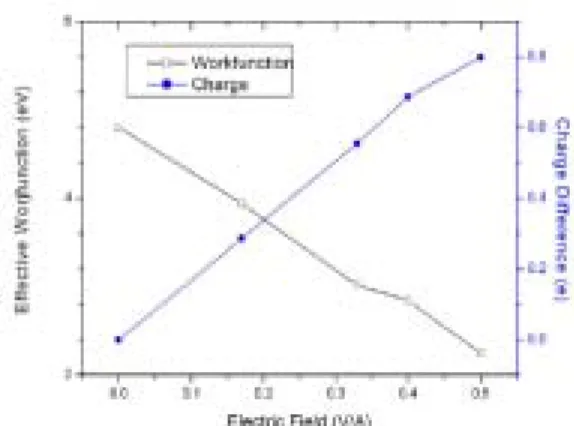
CASTEP code[3,4], which is a plane-wave, pseudopotential program based on density functional theory (DFT). The “effective workfunction” is then defined as the difference between the top of the potential energy curve and the HOMO state. To study field emission properties of the carbon nanotube, a uniform external electric field is applied along with the tube axis by using a sawtooth-type potential to be compatible with the periodic condition. In the presence of external electric field, the electrons along the tube axis are redistributed and this leads to the variation of the effective workfunction as well. The effective workfunction defined as the difference between the Fermi level and the top of potential profile is then reduced with the applied field due to the accumulation of charge at the tube tip, which raises the Fermi level of CNTs. The capped CNT has a higher workfunction value compared to the open-ended ones under no applied field. With the external electric field, the capped CNT now shows a lower value of workfunction than its open-ended counterpart due to a larger amount of charge redistribution in the capped end of CNTs. The field penetration into the fullerene-like nanotube tip leading to further reduction of effective workfunction accounts for the ideal emission application of CNTs compared to the metallic tip regarded as a perfect conductor where no field penetration is observed. The effect of band bending induced by field penetration near the semiconductor surface has been discussed by Tsong[5]. CNTs can be therefore an excellent field emitter candidate with the combination of the metallic tube body and semiconducting tip end. The former is good for electron transport, and the latter is good for
electron emission due to the band bending occurring by field penetration.
1. Fig.1 Variations of the effective workfunction of a capped (5,5) single-walled carbon nanotube tip and the corresponding charge redistribution under difference electric field.
Result and Discussion
Geometric Effect
The calculated workfunctions with and without external electric field are summarized in Table I. The relaxed structure of the open-ended nanotube as shown in Table I has a smaller diameter at its mouth with a shorter C-C bond length of 1.23 A than 1.43 A before relaxation. The formation of triple bonds at the tube mouth is also seen experimentally in the morphology of multiwalled carbon nanotubes [17]. The charge
Table I. The effective of workfunction and the amount of charge redistribution of CNTs.
redistribution after structural relaxation of the open-ended nanotube is shown in Fig.3, which indicates a substantial decrease of spilling-out of
electron density at the nanotube tip after structural relaxation, which reduces the surface dipole. The valence electrons at the mouth of the open-ended nanotube give the states of higher occupied energy levels and this leads to a reduction of its workfunction with a value of 4.39 eV at zero electric field. When the external electric field is applied, the open-ended CNT shows a higher effective workfunction compared to the capped ended CNT due to less amount of charge redistribution. The close-ended CNT exhibits a further reduction in its workfunction with a value of 3.75 eV at zero electric field and the resulting lower workfunction can be attributed to the presence of a relatively small dipole on the C-H bond, Cδ−−Hδ+, owing to the different electronegativity between C and H. The potential difference across the dipole lower the distance between the Fermi energy and the vacuum level, leading to a reduction of workfunction. The effective workfunction of the close-ended CNT can be further reduced when the field along the axis is applied. Such enhanced field emission properties from CNT by hydrogen termination have also been reported by the recent experiment carried by Zhi et al[6] using hydrogen plasma treatment on CNTs. Similar phenomena are also seen in the H-terminated diamond surface, which leads to its negative electron affinities [7].
Adsorbate Effect
To study the influence of different adsorbates on the workfunctions of CNTs, a systematic study of interactions between various adsorbates and the capped nanotube surface is carried out. Both physisorption and chemisorption on the carbon nanotube surface are taken into account. Firstly, to explore the effect of physisorption on the
carbon nanotube surface, water and H2
molecules are chosen to study their influence on the workfunction variations respectively. The binding energy of the water-nanotube system exhibits a value of 0.03 eV at zero electric field, consistent with the experimental observation that adsorption of water molecules on the CNT’s surface is physisorption and it can be easily removed under a higher temperature. When we apply the external electric field at 0.33 V/A, the binding energy of water molecule with the nanotube significantly increases to a value about 0.6 eV. In addition to lowering the gap between the LUMO and the HOMO, the density of states (DOS) around the LUMO state in the water-nanotube system is also being enhanced significantly as shown in Fig.2.
These states resulting from water adsorbates are able to act as tunneling states for electrons emitting from the nanotube into the vacuum, which accounts for the observed field emission enhancement after introducing water adsorbates [8]. These results indicate that the observed field emission enhancement is mainly due to the strong interaction between polar water molecules and nanotubes under electric field. On the other hand, the non-polar H2 molecule, located parallel
to the top pentagon surface, is found to have less influence on the workfunction of the nanotube at zero electric field, giving a value of 4.76 eV similar to the clean nanotube of 4.78 eV. The binding energy does not show a significant variation as seen in the water-nanotube system after applying the same external field of 0.33 V/A. H2 molecules are known to physisorb on
the outer surfaces of carbon nanotubes and are easily desorbed in a high field environment. This may explain the lack of influence of H2
molecules on the field emission characteristics of carbon nanotubes.
Fig.2 The increase of density of states (DOS) of on the nanotube surface under external electric field of 0.33 V/A.
We now consider the effect of chemisorption on the nanotube surface. The hydrogen-terminated capped structure is found to have a lower workfunction of 3.95 eV than 4.78 eV for a clean capped nanotube. The C atoms vary from being a sp2-like planar configuration before relaxation to being a sp3-like tetrahedral configuration after relaxation. The resulting lower workfunction can be attributed to the presence of a relatively small dipole on the C-H bond, Cδ−−Hδ+, owing to the different electronegativity between C and H as mentioned above. The lower of workfunction will be more
enhanced if more C-H bonds are formed. It is found that the carbon nanotube is easily contaminated with oxygen atoms in the air by forming C-O bonds on the surface. The model for the oxygen-terminated nanotube surface is shown in Fig.3(b). Oxygen molecules are now bonded with two carbon atoms on the tip to form a C-O-O-C four-membered ring and the weaker π bonds between two carbon atoms are replaced by two stronger C-O σ bonds, exhibiting a fourfold configuration of carbon atoms. This model is found to have a workfunction 0.4 eV higher than the clean nanotube. Due to the larger electronegativity of O atoms, the C-O bond will produce a surface dipole, Cδ+-Oδ−-, lowering the band energies inside the surface with respect to the fixed vacuum level. The above results indicate that H-terminated surface will lower the workfunction of the carbon nanotube and O-terminated surface will raise the workfunction of the carbon nanotube.
Fig3. The charge redistribution of the capped carbon nanotube surface terminated by hydrogen and oxygen atoms respectively. transfers from H
4. Conclusion
The capped nanotube shows a workfunction of 4.78 eV in a good agreement with experimental findings. The effective
workfunction is lowered under external electric field due to charge redistribution at the surface. In addition, the effects of adsorbates on the workfunctions of nanotubes exhibit different behavior between physisorption and chemisorption. In the physisorption process, the polar molecule like water interacts strongly with the carbon nanotube surface under electric field, which enhances field emission by increasing the density of states (DOS) around the Fermi level. In the chemisorption process, the formations of chemical bonds between the adsorbate and nanotube lead to charge redistribution on the nanotube surface, by varying its surface dipole as well as its workfunction.
Acknowledgements
This work is supported by National Science Council, Taiwan with the project number NSC 91-2112-M-002-060-
References
[1] Q. H. Wang et. al., Appl. Phys. Lett. 72, 2912(1998)
[2] Phys.World, 13 29-53 (2000)
[3] M.C. Pyane et al. Rev. Mod. Phys. 64, 1045 (1992)
[4] V. Mailman et al.,Int. J. Quant. Chem., 77, 895-910 (2000).
[5] T.T. Tsong, Surface Sciences 81, 28-42,1979 [6] C.Y.Zhi et al. Appl. Phys. Lett. 81,1690-1692 (2002)
[7] G. Zhou et.al. Phys.Rev. Lett. 87,095504 (2001);
[8] Amitesh Maiti et. al. Phys. Rev. Lett.,87,155502,(2001)