EFFECTS OF AN ILLUSTRATION ON GLOBAL
COMPREHENSION AND DETAIL RECALL
OF A TECHNICAL TEXT
Beryl Chinghwa Lee
Assistant Professor, Center of General Education, China Medical University
Abstract
Previous studies indicate that readers may benefit from receiving the text and visual aids together. The study aims to investigate whether illustrated text and non-illustrated text have different effects on global comprehension and immediate recall among L2 readers of different English proficiency levels. The participants involved in the study were 60 freshmen from departments of biomedical technology and sports medicine. They were equally divided into three groups (i.e., Advanced, Medium, and Low) based on the scores of their TOEFL reading test. They were asked to read a technical text and answer related questions. The results indicate proficiency has effects on students’ global comprehension and detail recall. Illustration, however, does not play a role, as shown by the statistical data. Revision of the study design is necessary to find out whether the results are skewed by the limitations.
Requests for reprints should be sent to Beryl Chinghwa Lee, General Education Center, China Medical University, 91 Hsueh-Shih Road, Taichung 404.
INTRODUCTION
In the higher education context in Taiwan, there is an increasing tendency for educators to adopt English written teaching materials, such as textbooks for L1 speakers. Reading authentic textbooks could be very discouraging for students being educated in second language. However, previous studies (e.g. Hudson 1982, Liu 2004) indicate that readers may benefit from receiving the text and visual aids together. As illustrations are an integral part of the textbook (Trimble, 1985), I would like to investigate the effects of its use on L2 freshmen’s global comprehension and detail recall of a technical text. The effects, however, would be attributed to the picture-text combination, not to the illustration alone, as noted by Hannus and Hyona (1999).
LITERATURE REVIEW
Benefits from Illustrated text
The research on human memory indicates that if both a verbal and a pictorial representation can be constructed of the stimuli, memory for to-be-learned materials is improved. According to dual coding theory (Pavio 1986, as cited in Hannus and Hyona 1999, Liu 2004), it can be assumed that memory for illustrated text will become richer in detail than memory consisting of text alone. This concept is based on the idea that illustrated texts encourage learners to construct not only propositional representation based on written materials but also pictorial representation with the assistance of illustrations. Another possible explanation is that when similar information is provided, more elaborate semantic processing will ensue both verbally and pictorially and therefore result in better comprehension and memory of the illustration text content (Hannus and Hyona, 1999). For instance, Baluerka (1995) compared the effects of instructions, outlines, and illustrations on the acquisition of information from a scientific passage and found that for the true-false recognition task,
illustration led to a significantly higher performance than the other two instructional aids.
Learner Characteristics and Illustration Benefits
As Rosenblatt (1994) noted that there was no generic reader, it is safe to assume that readers with different characteristics might respond to illustrated texts differently. For example, Hudson’s (1982) study indicates that picture plus questions and predictions was more effective for L2 readers at lower proficiency level. Based on the finding, he concluded that visual imagery via picture cues could overcome disadvantages of lower proficiency level readers.
In the same vein, Hannus and Hyona (1999) investigated effects of illustrations on learning authentic textbook materials among 108 ten-year old children of high and low intellectual ability in Finland. They found that comprehension scores were improved by the presence of illustrations for high-ability children, but not for low-ability children. The finding also indicated that the presence of illustration improved the learning of illustrated text content, but not that of nonillustrated text content.
Liu (2004) investigated the role of comic strips on adult ESL learners’ reading comprehension. From the subjects’ immediate recall protocols, she found that the low level students receiving the high-level text with the comic strip scored significantly higher than those who receive the high-level text only. It is also found that providing a comic strip with the high-level text did not improve the high proficient students’ recall performance.
THE STUDY
Research Questions
My study is intended to seek the answers to the following two research questions, in which the illustrated text content refers to the information covered by both the
illustration and the text while the non-illustrated text content refers to that covered only by the text.
(1) Does the illustration have different effects on global comprehension of non-illustrated text content among L2 readers of different English proficiency levels?
(2) Does the illustration have different effects on immediate detail recall of illustrated text content among L2 readers of different English proficiency levels?
Based on the literature review, I predict that the finding of my study would support the null hypothesis of the first research question but not that of the second question.
Participants
84 students from departments of biomedical technology and sports medicine were invited to take part in the study. The participants enrolled in my English class, which was provided in a medical University in Taiwan in the 2nd semester of 93rd academic year. The students had taken the author’s English course in the 1st semester of the same academic year, in which they had taken TOEFL reading test. For the study, the subjects were equally divided into three groups of 28 members (i.e. Advanced, Medium and Low); the grouping was based on the scores of their TOEFL reading test. However, given that the performance of students at the bottom part of Advanced, for example, might be close to that of the upper part of Medium, I decided to take the first 20 students from the Advanced, middle 20 students from the Medium and the last 20 students from the Low group. Therefore, only the data of these 60 subjects were subject to analysis. The mean scores of TOEFL and 1st semester Freshmen English of the 60 subjects are shown in Table 1.
Table 1: Subjects’ mean scores of TOEFL and 1st semester English
Proficiency/Mean TOEFL Score 1st Freshmen E. Score
Advanced 523 92
Medium 450 80
Low 357 65
Instrumentation
The Text
The text is an adapted magazine article of 7 paragraphs from Newsweek 1975, which is collected in the textbook Reader’s Choice. The article describes a new piece of equipment designed to help blind people, with a pictorial aid accompanying the passage to illustrate the spatial relationships of the parts of the device. As for the text itself, excluding the illustration, there are 695 tokens in the text, 335 different types, with type-token ratio 0.48, (computed by VocabProfile), Flesh-Kincaid Grade Level score 12 and Fleshing Reading Ease score 50.5 (computed by Flesh).
One text-alone version and one illustrated version were made for the study; the former was made simply by removing the pictorial aid. The illustration was placed on the same page with the text. To be more specific, it was next to paragraphs 4 and 5, which were tightly associated with the illustration.
Students were assigned to read either the text-alone version or the illustrated version; the assignment was based on the ranking of their TOEFL scores mentioned earlier. For example, if the first student in the Advanced group was assigned the illustrated version, the second student was assigned the text alone version. In this way, I intended to avoid the proficiency factor. In other words, attempts were made to avoid, for example, favoring the students of higher proficiency in the same group by giving them the illustrated version.
of proficiency level and text type on it. For instance, Advanced group with text alone type was marked as AX, meaning there was no illustration with the text; on the other hand, AO refers to the Advanced group member assigned illustrated text type.
The Tests
The first dependent measure consisted of 5 short answer questions, used to elicit students’ global comprehension of the article; each item addressed a main idea of each paragraph, excluding paragraphs 4 and 5, which were tightly linked to the visual aid. The score of the global comprehension ranges from 0-5. No partial credit was given.
The second dependent measure was composed of 8 true/false questions for the detail recall about the two illustration-related paragraphs. The use of a true/false quiz was due to the fact that it was extremely difficult to develop sufficient items and adequate distractors on the basis of only two paragraphs. To minimize the guess effect, however, in addition to true and false options, the third option I do not know was offered. Moreover, next to false, students were provided with space to write down the correct answer. The scores of the true/false quiz range from 0 to 8. In other words, as long as the subjects ticked the right answer (true or false) for one item, they would receive one point. Like the short answer questions, no partial credits were awarded. The correction of the false statement was not taken into account, however.
Familiarity Survey
After the main idea comprehension test, subjects were administered a survey in regard with their familiarity with the background knowledge of the given device. They were asked to check among no idea of, slight idea of, rough idea of and full awareness
Statistical Tools
The independent variables of the study include subjects’ English proficiency
(Advanced, Medium and Low) and illustration of the text (illustrated vs. text-alone). The dependent variables are students’ scores of main idea comprehension of the nonillustrated text content and scores of true-false quiz on details of illustrated text content. Since I did not know how to employ SPSS to deal with a mixed design, I used 3 × 2 between subjects factorial design twice. Two-way ANOVA was run to get the results of the effects of the use of illustration on main idea comprehension and detail recall.
Procedure
I administered the tests to my students in three English classes on May 6 and May 11 respectively. Before the test, I first asked the students to check whether the text given was in accordance with the label on the envelope. The purpose was to make sure that all O members got the illustrated version and X members got the text alone version.
After that, students were asked to put back the text into the envelope. The researcher then gave the first page to each student, which was composed of (1) a short cover letter, (2) a consent form, and (3) a vocabulary test consisting 4 lexical items involved in both the text and the illustration. (The vocabulary study later was aborted; therefore, I would not discuss it in my paper.)
Once students finished the first page, they should raise their hands to indicate that they were ready to go to stage 2, in which they got the question sheet from me and took out the reading text from the envelope to read.
Since the subjects answered the questions with the text in hand, they were asked to answer in Chinese so that it would not be possible for those who had partial or little comprehension of a certain paragraph to copy sentences from the text to serve as answers. In other words, I tried to prevent the subject from earning credits they did not
deserve. In this stage, the subjects were allowed to spend as much time as they like to read the text and to answer the questions.
After they finished this part, they should put the text and answers back to the envelope and went to stage 3. Stage 3 consisted of (1) a subject familiarity survey and (2) the same vocabulary test as the one in stage 1. After this, they moved to stage 4, in which they answered 8 true/false questions without the text. The whole process, i.e. from stage 1 to stage 4, took less than one hour.
I graded the short answer questions and true/false quizzes by myself only once; therefore, there was no intra- or inter-reliability to claim.
Results And Discussion
Familiarity survey
The scores of familiarity were awarded from 0 to 3, from 0 for no background knowledge at all to 3 for full awareness. The mean score for all of the 60 subjects was .35, which showed that the subjects were rather unfamiliar with the device designed for the blind kid.
Subjects’ mean scores of the tests
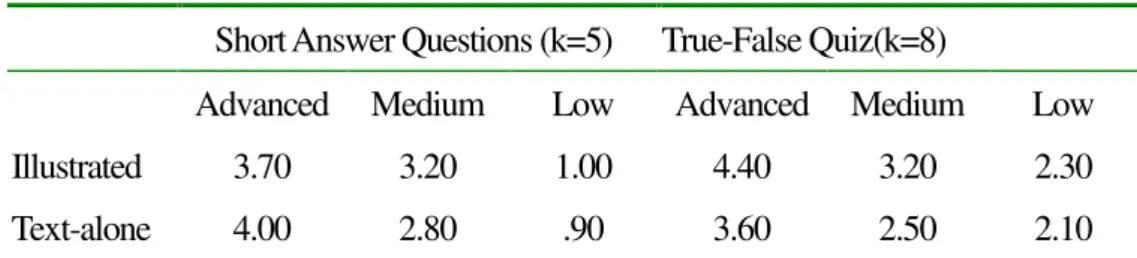
Table 2: Mean Scores of Short Answer Qs and T/F Quiz Short Answer Questions (k=5) True-False Quiz(k=8)
Advanced Medium Low Advanced Medium Low Illustrated 3.70 3.20 1.00 4.40 3.20 2.30 Text-alone 4.00 2.80 .90 3.60 2.50 2.10
Main idea comprehension
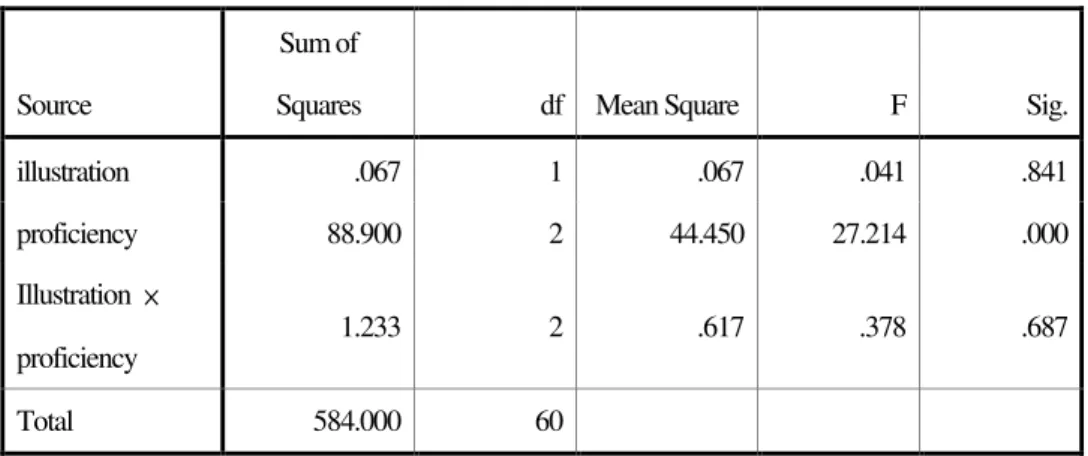
Table 3 shows the effects of the illustration on readers’ performance of answering the 5 short answer questions, which were intended to elicit the subjects’ main idea comprehension.
Table 3: Tests of Between-Subjects Effects Dependent variable: scores of short answer questions
Source
Sum of
Squares df Mean Square F Sig.
illustration .067 1 .067 .041 .841 proficiency 88.900 2 44.450 27.214 .000 Illustration × proficiency 1.233 2 .617 .378 .687 Total 584.000 60
a R Squared = .506 (Adjusted R Squared = .460)
As noted, only proficiency reaches significant level of (P ﹤0.05), meaning that the three groups performed significantly different in this regard. However, the illustration did not play a role in their understanding of the main ideas of the technical text (0.841﹥0.05) The result is consistent with Hannus and Hyona (1999), who observed that the presence of illustrations brought about a learning benefit for illustrated text content, but the beneficial effect did not reach to nonillustrated text content.
Immediate Detail Recall
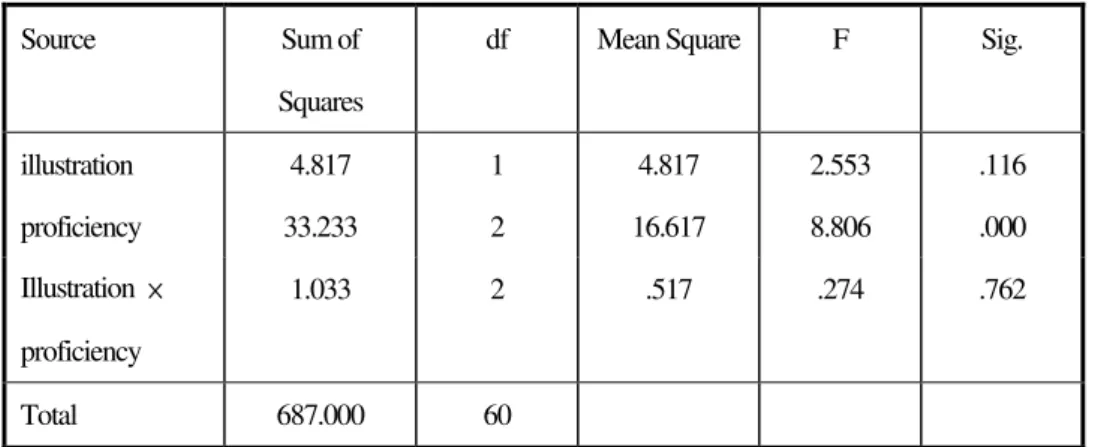
Table 4 shows the result of the detail recall comparison. Again, proficiency affected the performance of the subjects in this regard (0.00﹤.05) but the presence of the illustration did not (0.116﹥0.05). The result of the detail recall is not consistent with dual coding theory or the previous studies that indicate illustration benefits. One
possible explanation is my instrument, i.e. the true/false quiz, was not sensitive to elicit the effects of the illustration on the readers’ detail recall.
Table 4: Tests of Between-Subjects Effects
Dependent Variable: T/F test scores
Source Sum of
Squares
df Mean Square F Sig.
illustration 4.817 1 4.817 2.553 .116 proficiency 33.233 2 16.617 8.806 .000 Illustration × proficiency 1.033 2 .517 .274 .762 Total 687.000 60
a R Squared = .277 (Adjusted R Squared = .210)
CONCLUSION AND THE WAY FORWARD
Although the results of my study did not support my hypothesis, the evidences
are not robust enough to refute the previous research, especially when my study design still leaves something to be desired. My future efforts aim to replicate the study with some revisions. First of all, to avoid attention effect, I will not remind the readers to closely examine the illustration. Instead, in addition to the familiarity survey, another survey will be made to investigate (1) whether the readers make use of the illustration to aid their comprehension of the text, and (2) whether they think the illustration are beneficial for their comprehension. For the latter, a 5-point Likert scale will be used to elicit their perceptions of usefulness of the visual aid.
Secondly, given that the true/false quiz might not be a valid tool, as suggested, I will use recall protocols as data. However, this could be a big challenge. For the time being, I have only 2 general guidelines in mind.
(1) Readers are allowed to answer in Chinese as Bernhardt (1991) argues that recall in the native language could reflect the construct of L2 comprehension.
(2) A weighted prepositional analysis is preferred.
In this way, I hope I can acquire more convincing results to explain effects of the illustration on global comprehension and detail recall.
Acknowledgements
I am grateful for the participants of the study. This study is funded by a grant from China Medical University with the award number CMU96-174.
REFERENCES
1. Balluerka, N. (1995). The influence of instructions, outlines, and illustrations on the comprehension and recall of scientific texts. Contemporary Educational
Psychology 20, 369-375.
2. Bernhardt, E. B. (1991). Reading Development in a Second Language:
Theoretical, Empirical, and Classroom Perspectives. New Jersey: Ablex
Publishing Corp.
3. Hannus, M. and Hyona, J. (1999). Utilization of illustration during learning of science textbook passages among low- and high-ability children. Contemporary
Educational Psychology 24, 95-123.
4. Hudson, T. (1982). The effects of induced schemata on the “short circuit” in L2 reading: Non-decoding factors in L2 reading performance. Language Learning
32, 1-32.
5. Liu, J. (2004). Effects of comic strips on L2 learners’ reading comprehension.
TESOL QUARTERLY 38 (2), 225-243.
6. Trimble, L. (1985). English for Science and Technology. New York: Cambridge University Press.
7. Rosenblatt, Louise, M. (1994). The transactional theory of reading and writing. In Ruddell, R. B., Ruddell, M.R., and Singer. H. (Eds.) Theoretical Models and