「沒有絲毫干擾」
—莫札特的鋼琴是否有膝槓桿踏板?
羅伯特.格羅曼
摘 要
從現存莫札特與他人的往來書信,清楚可見,莫札特非常喜愛他的沃爾 特古鋼琴。沃爾特古鋼琴是他在維也納期間唯一擁有過的,也是他在巡迴演 出時經常使用的鋼琴。沃爾特古鋼琴現今仍存在於薩爾茲堡。為了準確地瞭 解莫札特的音樂和他演奏的表現方式,薩爾茲堡的音樂學者和鋼琴家,對於 沃爾特古鋼琴進行了詳細的研究與分析。 其中,音樂學家萊徹姆(Michael Latcham)於 1997 年的《早期音樂》 (Early Music)期刊,發表了關於沃爾特古鋼琴的研究和觀察。其中最重要 的論點,即「膝槓桿踏板」。膝槓桿踏板設置於鋼琴的鍵盤下方,以膝蓋接觸 來控制制音器的運作。萊徹姆推測,膝槓桿踏板很可能是在莫札特去世之 後,才被添加到沃爾特古鋼琴上。若莫札特在他最後九年的生命中,是用沒 有膝槓桿踏板的沃爾特古鋼琴來演出和作曲,那當代的鋼琴家對於莫札特音 樂的認知與理解,可能會有劇烈的改變。許多西洋音樂史上的重要作品,亦 可能會以新的觀點被認知。 萊徹姆的論點遭到了嚴肅的批評和質疑。同時,即使許多專家與學者都 認知到確切的證據尚未被發現與證實,仍提出了各自的論點及其背後的依 據。本文將從歷史和音樂的觀點,來討論各論證的內容,並嘗試探討一些可 能被忽視的考慮,以嘗試證明,莫札特生前所用的沃爾特古鋼琴,很可能沒 有膝槓桿踏板。 關鍵詞:莫札特、踏板、古鋼琴、沃爾特、鋼琴From the significant body of surviving correspondence between Wolfgang Amadeus Mozart and those close to him, it is clear that the composer loved his Walter fortepiano, the only such instrument he owned during his adult life in Vienna and his instrument of choice for his performances throughout the city. Leopold Mozart wrote, in a letter to his daughter Maria Anna (Nannerl) on March 12, 1785, articulating the frequency with which the instrument was transported for performances throughout the city, “Since I have been here, your brother’s Fortepiano Flügel has been taken from home at least a dozen times to the theatre or to some other house.”1
Wolfgang’s son, Carl, would later attest to his father’s attachment to the instrument, writing:
More remarkable is the wing shaped pianoforte which I own and for which my father had a special preference to such a degree that he not only wanted to have it in his study all the time, but exclusively used this and no other instrument in all his concerts, regardless whether they took place at Court, at the palaces of noble statesmen or at the theatre and other public places. By the way, this instrument is also interesting insofar as it is one of the first so-called Fortepianos with hammer action made by the at that time famous Anton Walter.2
Carl Mozart, who later received the instrument from his mother, donated the instrument to the Mozarteum in Salzburg where it can still be found to this day, to the benefit of modern musicians and scholars. Many fortepiano specialists, including the music scholar Michael Latcham, have closely studied the Walter instrument and created replicas in order to better understand and more accurately recreate Mozart’s music. After Latcham examined this fortepiano along with other instruments made by Gabriel Anton Walter, he suggested, in a 1997 Early Music article, that the piano, in its current state, might not truly represent the instrument
1
Emily Anderson, ed., The Letters of Mozart and his Family (London: Macmillan, 1985), 888–89.
2
Eva Badura-Skoda, “The Anton Walter fortepiano – Mozart’s beloved concert instrument: A response to Michael Latcham”, Early Music 28/3 (2000), 469–473.
that Mozart knew.3 In his thorough analysis of alterations to the instrument, Latcham demonstrates significant changes to the piano’s action and, through comparison with other Walter instruments whose dates of construction are better ascertained, dates these alterations to a period after Mozart’s death.
His most significant hypothesis, though, concerns the addition of the knee levers that control the damper-raising mechanism. Latcham demonstrates quite conclusively that the addition of the knee levers was a modification made after the initial completion of the instrument. Furthermore, he proposes not only the possibility, but the likelihood, that the knee levers were added within the same time frame as the aforementioned alterations to the action – namely, after Mozart had died. If Latcham is correct and it is true that Mozart composed and performed for the last nine years of his life on an instrument which possessed no knee levers, the modern pianist’s understanding of Mozart’s music would be altered and some of his most important and well-known compositions would be revealed in a new light. These assertions have been met with serious criticism and questioning. Indeed, there are good historical justifications in support of the conventional wisdom that Mozart had, used, and appreciated the knee lever feature. The modern pianist’s use of pedal in performance of Mozart’s music would therefore be quite justified. If this conventional wisdom is misguided, a historically informed performer might feel compelled to to alter his or her approach to much of Mozart’s piano music in performance. 4 Several music scholars, including Paul Badura-Skoda, Eva Badura-Badura-Skoda, Malcolm Bilson, Richard Maunder, and David Sutherland, have participated in the debate and have submitted their own arguments and evaluations of the evidence at hand. Though each of these contributors recognizes that a definitive proof has yet to be discovered, each adds
3Michael Latcham, “Mozart and the Pianos of Gabriel Anton Walter”, Early Music 25/3
(1997), 382–400.
4
It should be noted, however, that this present study aims not to offer an interpretive directive or an opinion on the values or motivations for “historical authenticity” in performance (a debate with a long history of insightful perspectives), but rather to provide evidence in search of an objective truth which may influence a performer’s approach and interpretation.
additional considerations which affect the likelihood of Mozart owning an instrument without knee levers. This study will survey, present, and evaluate both the historical and musical arguments from the two sides of the issue and will submit additional considerations that may have been overlooked by these scholars.
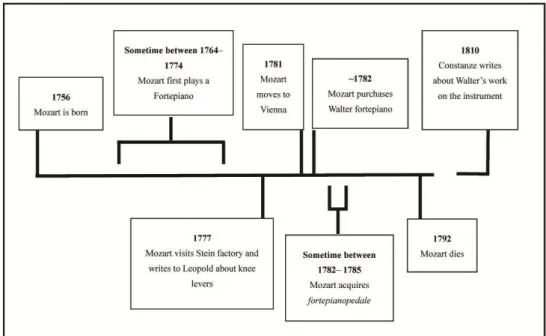
Figure 1. Mozart’s acquisition of the Walter fortepiano
Mozart’s keyboard instruments
Before examining the evidence from either side of the knee lever debate, it will be helpful to establish a contextual understanding of Mozart’s experiences with a variety of keyboard instruments throughout his life. It will be particularly instructive to clarify the facts and suppositions regarding his ownership of the Walter instrument. Throughout his childhood, as noted by musicologist Richard Maunder, Mozart had only a limited exposure to the fortepiano and the instrument played, at most, a minor role in the young composer’s development as a musician.5 At the time that Mozart was born in 1756, the fortepiano was still a rare instrument and, indeed, somewhat of a novelty; the Mozart family, in fact, would not own a fortepiano until 1780, well after Wolfgang had already left Salzburg to tour Europe
5
See Richard Maunder, “Mozart’s Keyboard Instruments”, Early Music 20/2 (1992), 207– 219, at 207, 209–12, and 214–19.
and, ultimately, take up residence in Vienna.6 Before the acquisition of this fortepiano, an instrument made by Johann Ignaz Egedacher, the Mozart family’s primary instruments were a two-manual harpsichord built by Christian Ernst Friederici, likely acquired in June 1763, and a number of clavichords of varying sizes, including one by Friederici and one by Johann Andreas Stein.
As his musical upbringing at home did not benefit from the presence of a fortepiano, it is worth considering when, perhaps, the young Mozart was first exposed to this new instrument. It is somewhat difficult to answer this question with certainty due to the period’s lack of standardized terminology to distinguish a fortepiano from a harpsichord, but based on a study of Mozart’s letters and travels, it is possible to make a few assertions about the earliest and latest that this first exposure to the fortepiano might have occurred. At the very earliest, Mozart may have seen a fortepiano in 1764 during a visit to family friend Johann Gottfried Eckard in Augsburg. Although there is no documentation supporting the claim that the Eckard family owned a fortepiano, it is not inconceivable that they might have. It is also possible that Mozart might have encountered a fortepiano in Vienna in either 1767 or 1773.7 The first clearly documented instance of a performance by Mozart on the fortepiano is from the winter of 1774–75:
Last Winter in Munich I heard two of the great Klavierspieler, Mr. Mozart and Capt. von Beecke; my host, Mr. Albert … has an excellent fortepiano in his house. There I heard these two giants wrestling at the Klavier. Mozart is a very strong player and plays at sight everything that is put in front of him.8
Even on this visit to the Eckard family, though, Leopold seems to have been concerned that Nannerl have access to a harpsichord, showing that, at this point, it would necessarily be expected to encounter a fortepiano.9 It is also worth noting
6 Ibid., 212. 7 Ibid., 213. 8 As quoted, ibid., 214 9 Ibid., 210.
that Mozart’s strong relationship with the harpsichord continued into his Vienna years and perhaps even as late as 1783.10
The clavichord also remained an important part of Mozart’s work until the end of his life. Of course, the instrument had little to do with Mozart’s public performances, but the five-octave clavichord which he owned in Vienna until his death was closely linked to his compositional process. The instrument, which survives and also resides in Salzburg, bears a note in the handwriting of Constanze Mozart, reading, “On this clavier, my late husband composed The Magic Flute, La Clemenza di Tito, the Requiem and a new Masonic cantata in time of five months. This I can confirm as his widow Constanze, Etatsräthin of Nissen."11 It suffices to say that once the fortepiano came into Mozart’s life, he certainly did not abandon the connections to the older keyboard instruments that were cultivated throughout his development as a young musician.
In any case, Mozart certainly had at least a strong familiarity with the features and possibilities of the fortepiano when he visited the workshop of the aforementioned craftsman, Stein, in 1777. Writing to his father on October 17, 1777, he describes, in detail, the virtues of Stein’s instruments in superlatives.12
Of particular note for this study is Mozart’s evaluation of Stein’s knee lever mechanism, which will be addressed later in detail.13
After a few more years of traveling to Mannheim, Paris, and Munich, Mozart settled in Vienna in March of 1781. It is not known exactly when he acquired the Walter piano, but it is generally agreed that this purchase occurred sometime in 1782.14 Then, at some point between 1782 and 1785, Mozart had a unique
10
Ibid., (1992), 211.
11
“Mozarthaus Vienna: Mozart's clavichord in Vienna.”
https://www.wien.gv.at/rk/msg/2014/10/28008.html. (Accessed 2/20/2016)
12
Although, as Maunder notes, some of the evaluations of the instrument’s features sounds more likely to be Stein’s sales pitches than Mozart’s own evaluations. Is it possible that Mozart was not as familiar with all of the technical workings of a fortepiano as his letter might imply? See ibid., 214.
13
See note 34 below.
14
instrument created as an appendage to the Walter fortepiano, which he called in letters a fortepianopedale. Leopold described the adjoining instrument in the aforementioned 1785 letter to Nannerl, writing:
“[Wolfgang] has had a large fortepianopedale made which is under the instrument and is about two feet longer and extremely heavy. Each Friday, it has to be taken to the Mehlgrube, and then to the respective residences of Count Zichy and to Prince Kaunitz.”15
From all accounts, it seems that the pedal department lay underneath the Walter instrument and probably had its own set of strings, which were played by the feet using a pedal keyboard resembling that of an organ. As Leopold noted, this instrument was transported regularly to performances during the elder Mozart’s visit to Vienna, and other accounts corroborate Wolfgang’s use of the instrument for performances of the K. 466 and K. 467 concertos, which occurred in 1785 during Leopold’s visit to Vienna.16
It should also be noted that the fortepianopedale was not merely a sort of novelty that Mozart used only in the 1785 season; rather, evidence exists of Mozart’s use of the pedal board until as late as 1788, as described by Maunder and David Rowland in their joint article:
At home, he liked extemporizing on [the pedal piano] to visitors, as for example on 24 August 1788, when his Danish visitors Preisler and Rosing commented on the extraordinary effect made by the pedals.17
Unfortunately, while the pedal department was still present at the time of his death and was listed in an inventory of his estate, the original fortepianopedale no
15
Anderson (1985), 471.
16
In fact, in measures 88-90 of the first movement of the manuscript for K. 466, one can find the only notes ever written by Mozart to be explicitly played on the fortepianopedale. It is, therefore, safe to assume that Mozart used these pedals ad
libitum, and that the absence of explicitly notated use of the pedal instrument does not
imply that Mozart did not employ it. See Richard Maunder and David Rowland, “Mozart’s Pedal Piano”, Early Music, 23/2 (1995), 287–296.
17
longer exists, having been sold or lost by Constanze or Carl after Mozart’s death.18 Eva Badura-Skoda agrees, writing, “Not long after Mozart's death Constanze got rid of this separate pedal piano, which may show her lack of concern for her husband's instruments.”19
Even though modern scholars have only a limited amount of information regarding the details and specifications of the fortepianopedale, its existence and Mozart’s use of the device clearly relate to the knee lever topic at hand. This relevance will be discussed later in further detail.
Arguments based on historical observations
Armed with this background contextual information, we can more fully appreciate and analyze Latcham’s arguments regarding the knee levers. Generally speaking, Latcham’s article comprises an exhaustive examination of Mozart’s piano and the other Walter fortepianos of this era. His study provides a detailed account of the features and significant technical specifications of the eighteen different surviving Walter instruments that can be dated to 1800 or earlier. Through this study, Latcham demonstrates the development of the features and technologies that Walter employed and refined throughout this period of his career. In particular, Latcham uses this study to articulate the rapid development of the approach to piano design and construction that is found among instruments of the final decades of the 18th century. He argues that many of these Walter instruments cannot stand as ideal period instruments for Mozart’s music and are not necessarily instructive for better understanding it. Though Mozart’s instrument is not the singular focus of the article, he does address it in detail and frequently uses this instrument as the basis for comparison with others.
After discussing similarities between Mozart’s piano and a Walter instrument currently held in the Haydn-Haus in Eisenstadt, he assesses the three alterations he determined to have been made to Mozart’s instrument: the adjustable rail for the
18
Maunder (1992), 216.
19
escapement hoppers (the movement of which is used to adjust the let-off of the escapement), the hinge rail for the escapement hoppers, and the knee levers.20 The evidence of alterations to this instrument supports a more general claim made by Latcham that all of the early pianos made by Walter have been “substantially altered.”21
For the first two of the above modifications, he provides convincing evidence, which has been generally accepted by other scholars, for the dating of these alterations. Summarizing his evaluations, he writes:
There is little doubt that it was Walter who substantially changed the action in Mozart’s piano, and that he did so after about 1790. The design of the action in the piano of the Walter firm hardly changed between about 1790 and about 1810. The action in the Mozart piano must thus have been altered roughly between these dates.22
A conclusion suggested by his examination of the hinge rail leads to another significant question regarding the degree to which the fortepiano, in its current state, represents the instrument that Mozart owned – namely, Latcham argues that the instrument originally lacked the prellmechanik action which it currently has. This investigation, however, falls somewhat outside of the present study.
In comparison to the specific dating of the modifications to the action, the evidence Latcham provides for the dating of the knee lever addition certainly leaves room for debate. Latcham, himself, admits a lack of certainty, and says that there is “no way of knowing when they were added or by whom.” He does, however, demonstrate that the knee levers are mechanically linked to the original hand levers, in a similar fashion to those in another Walter instrument, catalogued by Latcham as W:c.1785a, currently in the Germanisches Nationalmuseum in Nuremberg. These hand levers performed the same function as the subsequently added knee levers, but their use was clearly more restrictive to the performer, as an
20 Latcham (1997), 388–391. 21 Ibid., 384. 22 Ibid., 391.
engagement and disengagement of the mechanism required the freedom of one of the player’s hands. A use of such technology would, of course, not permit the same subtle and selective implementation that knee levers enable. Still, based on his analysis, Latcham claims, “It is probable that when Mozart owned and played his Walter piano it had no knee levers.”23
The argument that at least some changes were made to Mozart’s instrument after his death is substantiated by a letter written by Constanze to Carl on January 17, 1810, in which she describes Walter’s additional work on the instrument. She writes:
The instrument is as good as it was, and I may even say better than it was, first because I have been very careful of it and second because Walter, who made it, was so kind once again to releather it and completely restore it for me.24
While there is no explicit mention of an addition of knee levers present in Constanze’s letter, neither is there a reference to the significant changes to the action mechanism that Latcham has convincingly argued took place after Mozart’s death. Either those alterations, therefore, would have taken place on another one of the instrument’s trips to Walter’s workshop or Constanze had not been particularly observant of the work that Walter had done on this particular occasion.
Other supporting arguments come from Latcham, Maunder, Rowland, and David Sutherland. In his examination of other Walter instruments, Latcham argues that Walter continued to create hand-lever-only fortepianos until as late as 178925 (although this claim is contested, albeit indirectly, by Paul Badura-Skoda in a 2002 article).26 While knee levers were increasing in popularity in the 1780s, it is helpful to know that Walter created hand lever-only varieties throughout this
23 Ibid., 388. 24 As quoted ibid., 391. 25 Ibid., 396. 26
Paul Badura-Skoda, “Mozart without the Pedal?”, The Galpin Society Journal, 55 (2002), 332–350, at 336.
decade, one of which may have been Mozart’s. Maunder offers an even stronger assertion about the absence of knee levers in instruments of this time period, claiming, “every single surviving Viennese fortepiano of the 1780s was built with only hand levers.”27
He recognizes that many of these instruments were modified to function with knee levers. However, he seems to suggest that every unmodified fortepiano from 1780s Vienna was built with hand levers only, offering a few examples of such instruments as evidence to substantiate this claim. On the other hand, this assertion is considered somewhat by Paul Badura-Skoda, who writes:
During more than fifty years of my fascination with 18th-century fortepianos with Viennese action, I have come across more than forty instruments of this period prior to 1800, all of them with knee levers. A few of them might have been originally conceived with hand levers, later altered, but most of them had knee levers from the outset. The most precious among these was Mozart's own Anton Walter pianoforte in Salzburg.28
The final sentence of this quote, notwithstanding, Badura-Skoda perhaps leaves some room for considering the existence of instruments later modified to append knee levers, but the claim still stands in opposition to Maunder’s, although Badura-Skoda provides limited evidence in support of this argument.
Both Sutherland and Rowland point to the existence and use of the fortepianopedale as evidence in support of the hypothesis that the piano did not have knee levers. Sutherland writes:
Concerning the recent controversy in your pages on the question whether or not Mozart's piano had knee-levers for lifting the dampers, it seems possible to me that both parties in this dispute are overlooking an important point: the fact that Mozart had a pedal piano which he
27
Richard Maunder, “Correspondence: Mozart’s Walter Fortepiano”, Early music 29/4 (2011), 669.
28
habitually employed in public performances in his late years. Would not the pedal piano have made it inconvenient (perhaps impossible) to use knee levers for raising the dampers? … It is amazing that in all our rage for authentic performance so little attention has been paid to Mozart's pedal piano.29
Rowland also attests to the difficulty of concurrently employing the pedal board and the knee levers, should they have been present together, writing, “most of the time … performing on the pedal board precludes the use of the sustaining lever.”30
Of course, one could conceive of a non-simultaneous use of the pedalboard and knee levers if the construction of the fortepianopedale provided a firm surface on which the performer could rest his foot while not playing pedal notes. Indeed, Paul Badura-Skoda writes:
A reconstructed pedal board for my Walter copy, (based on the very few extant pedal pianos) has a board above the front end of the pedal keys where the feet can rest and easily operate the knee levers.31
Alternatively, Rowland also admits the possibility of occasionally using the knee levers in conjunction with the pedal board, writing:
It is some-times possible to raise the dampers, in those cases where the left foot sustains a bass note for some time, allowing the rest of the body to remain still while the right knee is raised.32
Still, the potential incongruity of the knee lever and pedal board is an important consideration in this debate, as the specific technical features of the fortepianopedale’s construction are not known.
As mentioned earlier, there has been significant criticism and questioning of
29
David A. Sutherland, “Correspondence: Mozart’s Walter fortepiano”, Early Music, 29/2 (2001), 334.
30
Maunder and Rowland (1995), 295.
31
Paul Badura-Skoda (2002), 334.
32
Latcham’s hypotheses in the form of both historical/deductive arguments and musical/inferential observations. Historical inquiries stem from an intuitive question posited most clearly by Paul Badura-Skoda: “Why should Mozart have been willing to miss for the rest of his life an advantage which he had so fully appreciated up to 1777?”33 Of course, Badura-Skoda asks this question in reference to the letter mentioned earlier from Mozart to his father, in which he lauds the features and quality of the Stein fortepianos upon his visit to the craftsman’s workshop. After extolling many features of the Stein pianos, including the rapidness of the dampers, the evenness of tone, the uniqueness of the escapement mechanism, the durability of the sound boards, and overall level of care that Stein puts into his work, Mozart writes:
The device too which you work with your knee is better on [Stein’s] than on other instruments. I hardly have to touch it and it already works; and as soon as one moves the knee away, only a little, not the slightest reverberation can be heard.34
This often-cited excerpt seems to clearly demonstrate Mozart’s familiarity with the function of knee lever controlled damper raising mechanisms and his experience in using them prior to his October 1777 visit to Augsburg. Badura-Skoda’s question, therefore, seems quite reasonable and intuitive. If Mozart understood the benefits knee levers had to offer over hand levers in 1777, why then would he purchase a piano without them in 1782? If Mozart had wanted to acquire a Stein instrument with its superior knee lever technology in 1782, it should have been possible to purchase one as there were indeed several Stein fortepianos around Vienna.35
If Mozart did value the knee levers so highly and the instrument he purchased did not possess this feature, it begs an explanation for why he might have chosen this fortepiano. On one hand, it is certainly possible that Mozart found the level of
33
Paul Badura-Skoda (2002), 336.
34
Anderson, The Letters of Mozart and his Family, 478.
35
craftsmanship of Walter’s instruments to be even higher than those of Stein. After all, this purchase took place five years after the visit to Stein’s workshop, in a time when technology differed greatly from craftsman to craftsman and from year to year. Perhaps Mozart found significant value in the fuller sound provided by Walter’s triple strung treble notes as compared to Stein’s double strung instruments?36 Or maybe Stein’s instruments, known to have been quite expensive, were beyond Mozart’s budget at the time, after the composer had recently moved into a more expensive apartment.37 Indeed, Malcolm Bilson notes the simplicity of the case of Mozart’s instrument as an indication that it may have been less expensive.38
On the other hand, it is also worth considering the possibility that Mozart was not as familiar with knee levers as his 1777 letter might suggest. This portion of the letter is most certainly written as a thinly veiled request to his father to purchase a Stein instrument; Leopold writes back on October 23 that the instruments are simply too expensive.39 Not only would it have been natural for Mozart to praise the virtues of the instruments in great detail, but it also would be understandable for Mozart to sell the idea of a purchase to his father. To Maunder, the features conveyed by Mozart suggest that he might have been won over by Stein’s salesmanship. He writes, “Mozart was obviously impressed, even though some of what Stein told him (especially about his soundboard-seasoning techniques) may strike us as exaggerated sales-talk.”40 One could certainly conceive of a situation in which, through his demonstration of the knee lever feature, Stein persuaded a previously unconvinced (or less informed) Mozart of its importance and inspired him to write the cited passage. Nevertheless, these possible explanations are not completely satisfying in response to what appears to be a reasonable and intuitive
36
Paul Badura-Skoda (2002), 336.
37
Maynard Solomon, Mozart: A Life (New York: Harper Collins, 1995), 298.
38
Malcolm Bilson, “Correspondence: Mozart’s Walter fortepiano”, Early Music, 29/2 (2001), 333.
39
Anderson (1985), 480
40
question posed by Badura-Skoda.
Several other questions raised by Paul Badura-Skoda, Eva Badura-Skoda and Malcolm Bilson call for examination. Eva Badura-Skoda points out that the dates of the instrument’s construction and purchase are unknown and notes that the instrument was almost certainly not new at the time of purchase. In such a case, some of the alterations to the instrument, then, may have taken place before Mozart ever walked into Walter’s showroom. In another possible situation, it is conceivable that the changes occurred upon Mozart’s request at the time of purchase.41
Paul Badura-Skoda also asks why Constanze would have added knee levers to Mozart’s piano after he had died. He asks:
If these alterations were made after Mozart's death, for whose benefit were they made? It is known that Mozart made the highest demands on the precision and functioning of his instruments.42
Even without questioning Mozart’s high requirements of his instrument, though, one could certainly imagine that, nineteen years after Mozart’s death, Constanze may have wanted to modify the instrument with new technology for her son’s benefit. Alternatively, it is possible that Constanze did not specifically ask for these alterations but, rather, that Walter took it upon himself to make changes to the instrument. Constanze’s wording in the aforementioned letter to Carl certainly leaves this possibility open: “Walter, who made it, was so kind once again to releather it and completely restore it for me… ”43
Even Bilson portrays Walter as a person who might have been motivated himself to improve the instrument for its own sake, writing:
Walter was still … experimenting, improving, literally exploding with ideas, and it is likely that many of the changes made when Mozart
41 Eva Badura-Skoda (2000), 472. 42 Paul Badura-Skoda (2002), 335. 43 As quoted in Latcham (1997), 391.
acquired the instrument and subsequently (there appear to be several interventions) could have stemmed from Walter’s own desire for improvements, not necessarily from Mozart’s request.44
If Walter had the boldness to alter the instrument when Mozart owned it, he certainly could have taken it upon himself to make changes to it years after Mozart’s death.
Paul Badura-Skoda’s strongest argument concerns the curious anachronism that this alteration would have displayed, if it were indeed carried out as late as 1810. He writes:
Besides, why should Constanze have bothered to have an outmoded device built in? In 1810 knee levers were obsolete, practically all pianos were already built with pedals instead of knee levers. It makes little sense that the rather tight fisted Constanze, a good singer, but not a professional pianist, should have ordered a costly alteration before sending the instrument to her son in Milan who – unlike his brother Franz X. Mozart was not a professional pianist either.45
While the modern pedal mechanism of today’s pianos was first achieved by Sebastien Erard, Paris in 1810,46 pedals had been gradually taking over the role of knee levers during the first decade of the nineteenth century. Therefore, if Walter had indeed added the knee levers soon before Constanze’s 1810 letter, this would have constituted the addition of an outdated technology. Still, this argument does not negate a possibility that the knee levers were added sooner after Mozart’s death, perhaps in the 1790s on an earlier trip to Walter’s workshop.
Bilson also argues about the sense of modifying such an outdated instrument. After commenting about the ease with which a skilled craftsman could modify a
44
Malcolm Bilson, “Did Mozart Pedal?”, in Essays in Honor of László Somfai on His 70th
Birthday, ed. László Vikárius and Vera Lampert (Lanham, Maryland: The Scarecrow
Press, inc., 2005), 182.
45
Paul Badura-Skoda (2002), 337–8.
46
hand lever-only instrument to function with knee levers, he writes:
As mentioned above, in 1810 such an instrument would have been far too conservative to be of use musically, so why 'improve' it at that time at all? What might such changes have done to its value as an 'artifact of the great man’?47
This argument, though, relies on too many assumptions about Constanze’s motivations to be terribly convincing. Earlier in his letter, Bilson argued that Constanze felt that the instrument should receive particular care to be preserved as a relic of her late husband. He writes:
Constanze seems to know that this instrument, for which (according to his son Carl) Wolfgang had had particular preference and affection, needed looking after as one of the most important artifacts of her very important late husband. Why would she, some years after his death, have desired, or even allowed for that matter, this instrument to be so altered?48
If we entertain his argument, however, it is reasonable to then question the whereabouts of the fortepianopedale which accompanied Mozart’s beloved Walter. If preserving his prized instrument was so crucial to his legacy, how did the two parts of this hybrid instrument become separated after Mozart’s death?
Arguments based on musical examples
Thus far, I have attempted to present and summarize the most significant historical and deductive arguments presented in the numerous articles and essays written on the debate. Many of the arguments against Latcham’s claim, though, cite Mozart’s compositions, in an attempt to demonstrate that a performance of his
47
Bilson (2001), 334.
48
works on a Viennese fortepiano demands the use of knee levers to successfully render Mozart’s intentions and, therefore, that Mozart’s instrument must have had this feature. In their articles, Paul Badura-Skoda, Eva Badura-Skoda, and Malcolm Bilson present excerpts from Mozart’s compositions that, they argue, indicate Mozart’s instrument must have had knee levers.
Before examining the examples they cite, though, it is worthwhile to consider what such an investigation can endeavor to demonstrate. In the absence of explicit indications to employ a certain type of damper raising device, a notational convention that did not become accepted practice until the early nineteenth century, is it even possible to find undeniable evidence to support either side of this claim in his music? One must admit that, to a certain extent, it is not. Considering the degree to which our understanding of musical notation and performance has changed since the late eighteenth century, and the possibility that it has changed even more than musicologists may believe, we cannot allow even the most learned music scholar to speak definitively for Mozart’s intentions in this arena. However, one should be willing to accept Paul Badura-Skoda’s premise that, ultimately, these musical examples constitute arguments in favor of or in opposition to the probability of his claim. While they cannot ultimately return a definitive affirmation or rejection that a simple mention in Mozart family correspondence might deliver, they may help to demonstrate a degree of likelihood that Mozart had knee levers.49 Granting, then, that there is at least some value to examining these arguments based on Mozart’s compositions, we will discuss them in detail.
Ultimately, the criterion for determining the value of these examples will be whether they illustrate the requirement of employing the knee lever in order to execute what can be best surmised as Mozart’s compositional intentions. While it is tempting to ask, given a passage, whether Mozart would have been likely to use a knee lever that might be at his disposal in performance, this question cannot ultimately illustrate that Mozart had knee levers on his instrument, as the knee
49
I certainly cannot conceive of any example of notated music that would imply Mozart’s instrument lacked knee levers. Any passage that must be played without the aid of knee levers could undoubtedly be played on an instrument which has them.
levers do not represent a requirement for execution.
According to Paul Badura-Skoda, there are several categories of passages that either require the use of a damper raising feature, or are at least greatly improved by it. These six categories – arpeggios, notes that can only be sustained with “pedal,” repeated portato notes, broken chords, hand crossings in lyrical movements, and high notes requiring a singing quality – demonstrate varying levels of persuasiveness. One can add to this list an additional category of examples addressed by Bilson – legato octave passages.50
Beginning with the least convincing categories, we can address the examples that Badura-Skoda cites for the singing quality of sustained high notes. The examples that he references include the second movement of the Piano Concerto in D minor, K. 466, mm. 40–44, and the entrance of the soloist in the first movement of the Piano Concerto in C minor, K. 491 (mm. 100–118), both of which feature a lyrical melody in the right hand over a spare accompaniment. Addressing these and similar passages, Badura-Skoda notes that, “a single note played with pedal has much more resonance than without it.”51 While it is true that raising the dampers will enrich the tone quality of such a note, this feature certainly is not a requirement for execution, and therefore provides no additional evidence toward the knee levers’ existence on Mozart’s instrument. We can quickly dismiss such examples as bearing negligibly on our current debate.
Figure 2. K. 466/II, m.40
Similarly, Badura-Skoda suggests the necessity of pedaling of repeated portato notes, such as those in the Andante cantabile con espressione of Piano
50
Bilson (2005), 185–8.
51
Sonata in A minor, K. 310 in measure 64 and in measure 15 of the Adagio of the C minor Sonata, K. 457. Badura-Skoda writes that, “In certain types of passages the piano strings should not be 'beaten' by the hammers, but put into gentle continuing vibration.”52
Again, the pedal would likely help to improve the sound quality, but this is certainly not a necessity in execution of these passages. In another example, a modern performer might find it necessary to pedal the repeated portato notes in the left hand of the Andante of the C major concerto, K. 467, for instance, but, as Bilson articulates, this pattern bears a very close resemblance to left hand figuration in the Andante of the early B-flat Concerto, K. 39,53 a piece written undoubtedly for performance on the harpsichord. If Mozart found it appropriate to perform the latter on the harpsichord, he most likely would not have found it offensive to play K. 467 without knee levers, especially considering the sustained bass notes which provide an extra connecting resonance to the texture and the added resonance of the fortepianopedale, which we know to have been employed in a performance of this work.
Figure 3. K. 467/II, mm.23-24 compared to K. 39/II, mm. 15-16
Also largely unsubstantiated is the argument for the necessity of pedal in broken chord passages. Badura-Skoda offers three examples from the aforementioned second movement of the D minor concerto, K. 466: the chords outlined in quarter notes in measure 49 and the two passages of figuration in measures 113-116 and 142-143. In the former example, he justifies the need for pedal by simply commenting about the need for additional volume in performance with orchestra.54 Once again, the question that should be asked is whether Mozart
52 Ibid., 346. 53 Bilson (2005), 194. 54
would have not written such a passage if he didn’t have pedals. As justification for the second and third examples, he writes, simply, “Whose feet would not itch to use the pedal here?”55
To this one would have to respond, “only the pianist who did not have pedals.”
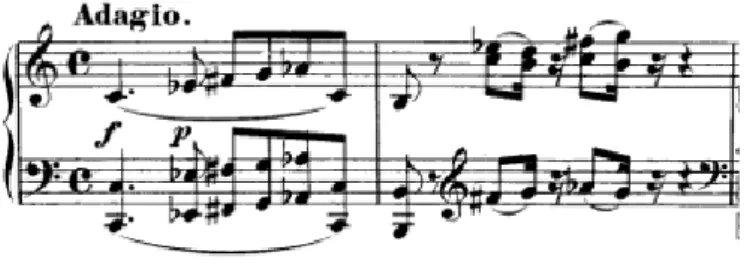
Arpeggios constitute somewhat more convincing evidence than the categories mentioned above. While arpeggio examples like the opening flourish of the C minor Fantasy K. 396 or the ending of the opening section of the Adagio of K. 457 (m. 16) can certainly be performed “dry” (without the use of any sustaining feature), the aesthetic of the arpeggio as a wash of harmony is better achieved with the assistance of the pedal or knee levers. On the other hand, the opening arpeggios of the D minor Fantasy, K. 397 demonstrate the possibility of so-called “finger pedaling,” the holding over of notes with the fingers, to create a more sustained arpeggio sonority. Although Mozart only indicates sustaining the two left hand D’s, a pedaling effect could be imitated with a sustaining of the rest of the notes of the arpeggio. This approach would be far simpler to execute than it would be to notate through a complex combination of various note values and ties. Alternatively, this passage seems particularly appropriate for the engagement of hand levers to create a resonant sonority.
Figure 4. Openings of K. 397 and K. 396
One could even apply the finger pedaling practice to the abovementioned opening of K. 396 by holding the lowest four notes of the arpeggio in the left hand. Interestingly, Badura-Skoda also cites an arpeggio passage in K. 394, the Fantasy and Fugue. Measures 46–50 feature a descending pattern of diminished seventh
“high notes needing a singing quality” above.
55
arpeggios, which Badura-Skoda feels would be rendered more effectively with the aid of the pedal.56 However, this piece is written in a markedly antico style, and is even occasionally performed on the harpsichord nowadays. One might expect to find a similar passage in a Bach fantasia or toccata, in which a performer could certainly make an argument for abstaining from pedal usage in his pursuit of a more historically authentic performance.
Figure 5. K. 396, m. 46
Paul Badura-Skoda cites only one example, previously suggested by Eva Badura-Skoda, for the necessity of knee levers in hand crossing passages in lyrical movements: Variation 4 from the A major Sonata, K. 331. So far, this is arguably the most convincing example of a passage that would likely suffer from lack of pedaling. In order to execute the character of Andante grazioso, the employment of the pedal is indeed somewhat necessary. He writes:
In Mozart’s variation movement from K. 331, this hand crossing passage is not found in a fast movement but in an ‘Andante grazioso’, and in addition, this variation features a legato touch. Here the high notes in the third bar sound more 'gracious' with a bell-like quality produced by pedal.57
Of course, the passage can be performed without the aid of the pedal, but not with the ease and flexibility that the pedal affords the performer.
56
Ibid., 343.
57
Figure 6. K. 331, Variations 4 and 3
More convincing still is the preceding variation from the same sonata, suggested by Bilson. In the third variation, the right hand features a legato octave melody that is awkward to execute with a literal interpretation of the slurs without the aid of knee levers. Of course, one could quickly change fingers 4–5 on descending octaves and 5–4 on ascending octaves, but this is quite burdensome and will lead, one way or another, to a less convincing performance than a skillful use of the knee lever. It seems highly unlikely that this finger-changing is what Mozart had in mind. Another octave passage cited by Bilson is the opening of the C minor Fantasy, K. 475. However, this passage is much more manageable without pedal due to the slow tempo, and the ability to make two of the three voices truly legato with adept fingering changes alone.
Figure 7. K. 475, opening
The most persuasive of the categories is undoubtedly that which Paul Badura-Skoda calls “notes which can only be sustained with ‘pedal.’” He first cites the penultimate cadence of the aforementioned Adagio from K. 310 (measures 83–4), claiming “only a very large hand can sustain the low note c beneath the second trill without the help of a pedal.”58
While it might be easier to employ the pedal
58
through the trill, I personally do not find that the stretch of a minor seventh from the bass C to the B flat of the trill with the second finger of the left hand to be exceptionally difficult, despite the fact that my hands are not abnormally large.
Figure 8. K. 310. m. 83
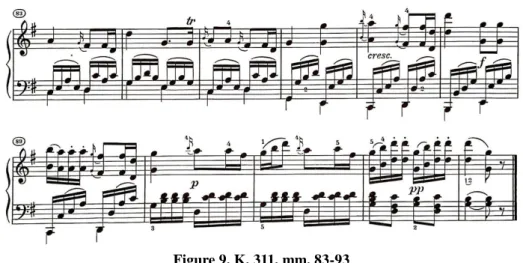
While the above example is not particularly strong, Paul Badura-Skoda focuses mostly on a passage initially observed by Eva Badura-Skoda that had been noted by those participating in the debate. The Badura-Skodas argue that this example, the final eleven measures of the Andante con espressione of the Sonata in D major, K. 311, relies quite significantly on the aid of knee levers in order to render Mozart’s intentions. In this passage, one finds a double stemming of bass notes, which indicate they are to be held for a quarter note value, while the left hand arpeggiates up to a twelfth, thirteenth, or fourteenth above the bass note. If this notation is to be taken literally, then the aid of a knee lever or pedal is indeed indispensable, as it would be impossible for even a large-handed pianist to reach the arpeggiated notes while still sustaining the quarter notes in the bass. While Maunder asserts that the staccato indication in some of the right hand octaves during this passage would preclude the use of knee levers,59 the left hand would be noticeably disjointed without the pedal, and the double stemming of the bass notes would be rendered effectively meaningless. In fact, the staccato markings in measure 89 are not found in Mozart’s handwritten manuscript of this passage.
59
Figure 9. K. 311, mm. 83-93
These last three examples do, indeed, seem to indicate a degree of reliance on the knee levers or pedals in order to execute that which most scholars and musicians assume to be Mozart’s intentions. One might be tempted to see these examples as a “smoking gun” indication that Mozart’s piano must have had knee levers. However, there is a serious flaw in following this logic to conclude that these examples stand as the definitive evidence that Mozart had knee levers on his Walter piano; those most convincing examples, K. 331 and the two variations from K. 311, were composed in 1778 and 1777 respectively, four to five years before Mozart purchased the instrument in question.60 While it is certainly true that Mozart might have continued to perform older compositions throughout his life, it would be imprudent to argue that, because Mozart twice composed pieces that required the knee lever in the 1770s, an instrument he purchased in the 1780s must have had them. Perhaps it is even stronger evidence to the contrary; if the most compelling examples that scholars can produce as evidence of Mozart’s reliance on knee levers were composed before he acquired the fortepiano in question, might the absence of similar figures after 1782 indicate the nonexistence of a knee lever
60
While the scholarship is slightly inconclusive about the dates of these compositions (see Maunder (1992)., 217), the point remains that no conclusive example supporting Badura-Skoda’s arguments were composed after 1783, at the latest. See John Irving,
Mozart’s Piano Sonatas: Contexts, Sources, Style, (Cambridge: Cambridge University
to enable their execution?
Additional considerations
After this thorough discussion of music examples, it is important to regain our initial perspective of this inquiry. While these excerpts do not seem to definitively demonstrate the fact that Mozart’s piano had knee levers, such proof likely could not be reasonably expected. One should not fault the Badura-Skoda camp for failing to find it.
After examining the arguments presented by the various music scholars, I find that, on the whole, there were three observations that were not given appropriate weight throughout this debate. These considerations affect our contextual understanding of Mozart as a composer and a performer so recognition of these perspectives might affect the likelihood of Mozart owning a piano without knee levers.
The most general consideration is the fact that musicians and keyboard performers of the late eighteenth century considered pedaling in a much different manner than do modern pianists. To musicians of the Classical era, the knee lever, hand lever, or damper pedal provided primarily not a means of aiding in the practicality of executing certain passages, but rather created a more general effect. In fact, the manner in which these features were often employed more closely resembled the use of ornamentation or timbral changes rather than a functional aid in producing a legato connection. In 1763, for example, C.P.E. Bach described “the undamped register,” as being “the most pleasing and, once the performer learns to observe the necessary precautions in the face of its reverberations, the most delightful for improvisation.”61
On the other hand, French composer and virtuoso pianist Louis Adam wrote in 1804 that, “those who use [pedals] with discretion in order to embellish and sustain the sound of a beautiful tune and a beautiful
61
C.P.E. Bach, Essay on the True Art of Playing Keyboard Instruments, trans. William J. Mitchell (New York: W. W. Norton, 1949), 431.
harmony certainly deserve the praise of connoisseurs.”62
Paul Badura-Skoda comments about Adam’s treatise and identifies his directive not to “over-pedal,” suggesting that the pedal is typically employed in a manner more similar to modern pedaling than we might initially assume.63 Still, this treatise was written over a decade after Mozart’s death, in a time period during which instruments and performance practices were undergoing great change. Bilson also agrees that the overtone-rich pianos of Mozart’s time would not need the level of pedal that modern pianos require in order to “warm up” the sound, writing that Mozart would have used pedal not as “a sauce” but rather to engage the “undamped register”.64 It is, therefore, with less security that a modern pianist can speak to the importance of knee levers to Mozart, as it is possible that Mozart had a very different conception of the role of damper raising features than do contemporary pianists.
Second, while the fortepianopedale is addressed by some of the parties involved in the debate, none fully considers the uniqueness of Mozart’s motivation for creating this hybrid instrument. Eva Badura-Skoda seems to summarily conclude that Mozart’s intention in adjoining the pedal board was simply to enhance the instrument’s volume and register, writing:
It is quite clear that Mozart wanted to enrich the sound of his precious fortepiano with this pedal piano, to make his concert instrument even louder and the range wider. For this reason, he acquired the pedal piano which he – as a trained organist – quickly learned to play.65
This explanation seems highly insufficient in recognizing the opportunities afforded to the performer to conceive of radically different music, and also characterizes the appendage instrument as a natural and typical solution to the problem of the limited volume of the fortepiano. In comparison, Maunder notes
62
Louis Adam, Méthode de piano du Conservatoire, Chapter 10: The manner of using the pedals (Paris 1804), 170–173. 63 Paul Badura-Skoda (2002), 341. 64 Bilson, (2005), 191. 65 Eva Badura-Skoda (2000), 471.
that there is only one existing example of an arrangement such as Mozart’s dating from the same general time period – a Brodmann pedal piano from c. 1815 (a dating that is even considerably later than Mozart’s instrument).66
Slightly earlier (in 1806), an article appeared in the Allgemeine musikalische Zeitung, suggesting that these pedal pianos were made by “several good makers.”67
On one hand, it is interesting to consider once again Leopold Mozart’s letter to Nannerl above, in which he describes the appendage instrument to his daughter. The lack of a detailed description of the instrument perhaps suggests such an arrangement was not unheard-of. Still, the general absence of both writings about fortepianopedale instruments and surviving examples suggest that these configurations of pedal fortepianos were not commonplace.
It is reasonable to ask, then, whether a fortepiano without knee levers would have been more unusual than Mozart’s fortepianopedale. It seems to me, at least, that the latter would be much more unique. As noted earlier by Rowland and Sutherland, a pedal board may have precluded any use of a knee lever mechanism. Isn’t it possible, then, that Mozart had envisioned creating this unique arrangement even before purchasing the Walter fortepiano? In such an event, might it have been entirely reasonable, knowing that his feet would be occupied, to seek out an instrument without knee levers?
Lastly, those who insist that Mozart must have had knee levers on his Walter fortepiano don’t seem to fully appreciate the implications of Mozart’s deep relationships with the harpsichord and clavichord, the instruments with which he truly grew up. He first learned the fundamentals of music on these instruments, first composed, performed, and improvised on them, and saw the harpsichord and clavichord at every stop on every tour throughout his youth. Though he may have first seen a fortepiano at age eight, it was the harpsichord that played the most significant role in his development as a musician, well into his teenage years. Additionally, as mentioned previously, the clavichord remained an important part
66
Maunder (1992), 216.
67
of Mozart’s compositional process into the 1780s. So as an expert harpsichordist and clavechordist, Mozart must certainly have mastered the difficulties presented by instruments lacking knee levers and found it natural to circumvent the problems that the instruments presented. It seems feasible that Mozart would have been able to forego knee levers and still perform in superlative fashion on the fortepiano. This question of musical approach certainly brings to mind Beethoven’s often quoted (and possibly apocryphal) criticism of Mozart, as relayed by Czerny, that Mozart “had a fine but choppy way of playing, and no legato.”68
After this detailed discussion of the arguments and perspectives involved in this debate, it should again be emphasized that conclusive evidence has yet to be found. If the Walter fortepiano did indeed have knee levers during Mozart’s life, one would imagine, given the vast amount of historical documentation preserved to this day, including the voluminous Mozart family correspondence, numerous accounts of Mozart’s performances and teaching activity, and inventory descriptions, that a single mention of knee levers between 1782 and 1791 would have been uncovered. In the absence of such an unequivocal confirmation, we are left with the evidence presented in this debate. To review, Latcham’s suggestion – that the knee levers were added after Mozart’s death – is based primarily on the supposition that two alterations were made to the instrument at the same time. Other evidence from Latcham, Maunder, Sutherland, and Rowland support the likelihood of this claim, but this feasibility is drawn into question by Paul and Eva Badura-Skoda and by Bilson, who ask why Mozart would have been satisfied without knee levers. While the Badura-Skoda camp ultimately falls short in demonstrating Mozart’s reliance on such technology through examples from his compositions, I still find that the burden of proof rests on Latcham and that he ultimately fails to deliver. After all, the conventional belief that Mozart used and appreciated knee levers is not at all unfounded. While one must admit the possibility of Latcham’s hypothesis, the examination of all the evidence leads to a
68
Konrad Wolff, Masters of the Keyboard, Enlarged Edition: Individual Style Elements in
the Piano Music of Bach, Haydn, Mozart, Beethoven, Schubert, Chopin, and Brahms
conclusion that it is more likely and more reasonable to assume that the Walter fortepiano did indeed have knee levers during Mozart’s lifetime.
Though such a verdict aligns with the established understanding of Mozart’s instrument and his musical style, this doesn’t mean that this investigation leaves the modern Mozart performer exactly where he might have begun. It is significant to note the fact that many leading musicologists struggle to find definitive examples of passages whose execution require the use of the damper pedal. This suggests at least a possibility of performing Mozart’s music without its usage entirely. While a tasteful and thoughtful performer would certainly approach Mozart’s music with careful deliberation about pedal usage, the feasibility of Mozart owning a piano with no knee levers would likely push the performer to exhibit an even more selective and differentiating use of the pedal. Additionally, the unusual nature of Mozart’s fortepianopedale leads the modern pianist to reevaluate his understanding of compositions that have been established firmly in the musical canon as well as the nature of Mozart’s drive for innovation. This spirit of experimentation and exploration can be easily overlooked either in approaching works which are so canonical or in assessing a Classical style that was so influential and ubiquitous that it has affected all of the music which followed. A knowledge of Mozart’s spirit of innovation underscored by the existence and usage of the fortepianopedale helps to regain a contextual understanding of Mozart’s music. Finally, the recognition that Mozart’s keyboard skills were forged at the harpsichord helps the historically informed performer to reorient his understanding of Mozart’s technique and musical style, as even his latest fortepiano compositions were performed with fingers that knew the pluck of the harpsichord jack long before the impact of the fortepiano hammer.
Bibliography
Adam, Louis. Méthode de piano du Conservatoire, Article 10 De la manière de se server des pédales, Paris, 1804, 170–173.
Anderson, Emily, ed. The Letters of Mozart and his Family. London: Macmillan, 1985.
Bach, C.P.E. Essay on the True Art of Playing Keyboard Instruments, trans. William J. Mitchell. New York: W. W. Norton, 1949.
Badura-Skoda, Eva. “The Anton Walter fortepiano – Mozart’s beloved concert instrument: A response to Michael Latcham.” Early Music 28/3 (2000): 469– 473.
Badura-Skoda, Paul. “Mozart without the Pedal?” The Galpin Society Journal, 55 (2002): 332–350.
Bilson, Malcolm. “Correspondence: Mozart’s Walter fortepiano.” Early Music, 29/2 (2001): 333.
Bilson, Malcolm. “Did Mozart Pedal?”, in Essays in Honor of László Somfai on His 70th Birthday (2005), ed. László Vikárius and Vera Lampert, 182.
Crombie, David. Piano. San Francisco: Miller Freeman Books, 1995.
Irving, John. Mozart’s Piano Sonatas: Contexts, Sources, Style. Cambridge: Cambridge University Press, 1997.
Latcham, Michael. “Mozart and the Pianos of Gabriel Anton Walter.” Early Music 25/3 (1997): 382–400.
Maunder, Richard. “Mozart’s Keyboard Instruments.” Early Music 20/2 (1992): 207–219.
Maunder, Richard. “Correspondence: Mozart’s Walter Fortepiano.” Early music 29/4 (2011): 669.
Maunder, Richard and David Rowland. “Mozart’s Pedal Piano.” Early Music, 23/2 (1995): 287–296.
“Mozarthaus Vienna: Mozart's clavichord in Vienna.” (Unsigned Article). https://www.wien.gv.at/rk/msg/2014/10/28008.html. (Accessed 2/20/2016)
Sutherland, David A. “Correspondence: Mozart’s Walter fortepiano.” Early Music, 29/2 (2001): 334.
Solomon, Maynard. Mozart: A Life. New York: Harper Collins, 1995.
Vikárius, László and Vera Lampert, ed. Essays in Honor of László Somfai on His 70th Birthday, ed. and Vera Lampert. Lanham, Maryland: The Scarecrow Press, inc., 2005.
Wolff, Konrad. Masters of the Keyboard, Enlarged Edition: Individual Style Elements in the Piano Music of Bach, Haydn, Mozart, Beethoven, Schubert, Chopin, and Brahms. Bloomington: Indiana University Press, 1990.