
從優選理論分析台灣閩南語的重疊構詞 - 政大學術集成
83
0
0
全文
(2) An OT Approach to Reduplication in Taiwan Southern Min. BY. 立. 政 治 大. Ching-Han Hsu. ‧ 國. 學 y. sit. io. n. al. er. Nat. Graduate Institute of Linguistics in Partial Fulfillment of the Requirements for the Degree of Master of Arts. ‧. A Thesis Submitted to the. Ch. engchi. July, 2011. i n U. v.
(3) 立. 政 治 大. ‧. ‧ 國. 學. n. er. io. sit. y. Nat. al. Ch. engchi. July, 2011. i n U. v.
(4) 立. 政 治 大. ‧. ‧ 國. 學. n. er. io. sit. y. Nat. al. Ch. engchi. i n U. Copyright @ 2011 Ching-Han Hsu All Rights Reserved iii. v.
(5) Acknowledgements 時光飛逝,畢業不是結束,而是開始,準備邁入新階段,迎接下一個挑戰。 首先,我要感謝我的指導教授蕭孙超老師,感謝您這三年的照顧,在學業上, 您總是鼓勵我積極投稿,給予我許多寶貴的意見,更讓我學會從不同的角度分析 問題,非常感謝您每次撥空為我修改摘要、修改論文、寫推薦信,您總是耐心的 為我指點迷津;在生活上,您總是教導我做人處事的道理也勉勵我隨時要保持樂 觀、愉悅的心情,您爽朗的笑聲是音韻理論工作室充滿活力的泉源! 同時,我要感謝我的口試委員台師大英語系林蕙珊老師、台師大國文系吳瑾 瑋老師在百忙之中撥冗擔任口試委員,感謝兩位老師對於論文計劃書答辯以及論 文答辯時指出盲點並提供許多寶貴的意見與看法,使我的論文能更臻完美,真的 太感謝你們了! 接著我要感謝求學時的所有師長,感謝徐嘉慧所長,感謝您讓我擔任您國科 會計畫助理;感謝學富五車的莫建清老師、才華洋溢的何萬順老師、溫柔高雅的 黃瓊之老師、美麗大方的萬依萍老師、教學認真的鍾曉芳老師,謝謝您們在課堂 上的指導並傳授寶貴的知識與人生經驗,使我的學術生涯更為精進、充實;在此 也要特別感謝惠鈴助教學姊在論文答辯瑝天鼓勵我、替我加油,每瑝所上有任何 問題,您都可以馬上為大家解決。. 立. 政 治 大. ‧. ‧ 國. 學. n. al. er. io. sit. y. Nat. 我也要感謝大學求學時的語言學啟蒙者忻愛莉老師、澤田深雪老師、楊玲珿 老師、王本瑛老師,感謝您們的諄諄教誨並撥空我寫推薦信。感謝一路上一直關 心我論文進度的大學同學、小學同學,能夠認識你們是我的榮幸! 接下來我要感謝音韻理論工作室的夥伴:綠茜學姊、啟美、雯琪、子權,每 瑝遇到困難,因為有大家的互相勉勵與陪伴,所有的困難都能迎刃而解,懷念每 週一聚的日子,懷念一起去泰國、美國參加研討會的點點滴滴,也感謝音韻理論 工作室的所有學長姐、學弟妹有你們的存在讓我的研究生涯充滿歡笑聲!感謝明 德學姊、芮華學姊、旺楨學姊、復真學姊、麗婷學姊在論文計畫口試前為我加油 打氣,讓我能順利通過口試!我也要感謝碩班三年的同班同學,能跟你們同班真 的很幸福! 最後,我要感謝生命中最重要的家人:父親許三寶先生、母親周清虹女士、 以及可愛的妹妹許款鈞。感謝你們無時無刻默默支持我、鼓勵我、一路栽培我, 並且給予生活上與經濟上的支持,讓我能夠全心投入課業。在此也要感謝男友何 俊昇先生一直在身旁陪伴我、照顧我,常常帶給我歡笑,讓我可以短暫忘卻完成 論文的壓力。碩班三年,要感謝的人真的太多太多了!這本論文是屬於大家的!. Ch. engchi. iv. i n U. v.
(6) TABLE OF CONTENTS Acknowledgements ..................................................................................................... iv Chinese Abstract ........................................................................................................vii English Abstract ........................................................................................................viii. Chapter 1 Introduction ............................................................................................... 1 1.. Introduction .................................................................................................................. 1. Chapter 2 Literature Review ...................................................................................... 4 2.1. Introduction .................................................................................................................. 4. 2.2. Theoretical Background ............................................................................................... 4. 立. 政 治 大. Optimality Theory ............................................................................................... 4. 2.2.2. Correspondence Theory ....................................................................................... 7. 2.2.3. Generalized Alignment Constraint ...................................................................... 8. 2.2.4. Alignment of Different Edges ............................................................................. 9. 2.2.5. Anchoring Constraint......................................................................................... 11. 2.2.6. Cophonology ..................................................................................................... 12. ‧. ‧ 國. 學. 2.2.1. er. io. sit. y. Nat. al. v i n Ch Adjacency Constraint......................................................................................... 14 engchi U. Previous Studies on Reduplication ............................................................................. 14. n. 2.3. 2.3.1 2.3.2. Chiang (1992) .................................................................................................... 16. 2.3.3. Lu (1999) ........................................................................................................... 19. 2.4.. Stress and Neutral Tone in Reduplication ................................................................. 21. 2.4.1. Duanmu (1990) .................................................................................................. 21. 2.4.2. R. Cheng (1994) ................................................................................................ 23. 2.4.3. R. Cheng (1997) ................................................................................................ 25. 2.5. Summary .................................................................................................................... 26. Chapter 3 ABB and AAB Reduplication in Taiwan Southern Min ...................... 27 3.1. Trisyllabic Reduplication ........................................................................................... 27 v.
(7) 3.2. ABB Reduplication .................................................................................................... 30. 3.2.1. ABB Adjective Full Reduplication.................................................................... 30. 3.2.2. OT Analysis of ABB Full Reduplication ........................................................... 31. 3.2.3. Stress on ABB and ABB Verb Partial Reduplication ........................................ 32. 3.2.4. OT Analysis of ABB Partial Reduplication ....................................................... 34. 3.3. AAB Reduplication .................................................................................................... 38. 3.3.1. AAB Verb and AAB Adjective Full Reduplication .......................................... 38. 3.3.2. AAB Verb Partial Reduplication ....................................................................... 41. 3.3.3. OT Analysis of AAB Partial Reduplication ...................................................... 42. 3.4. 政 治 大. Summary .................................................................................................................... 44. 立. Chapter 4 Quadrisyllabic Reduplication in Taiwan Southern Min ...................... 47 Full Reduplication ...................................................................................................... 48. ‧ 國. 學. 4.1. AABB Reduplication ......................................................................................... 50. 4.1.2. ABAB Reduplication ......................................................................................... 53. Partial Reduplication .................................................................................................. 56. sit. y. Nat. 4.2. ‧. 4.1.1. 4.2.2. ABCB Reduplication ......................................................................................... 59. al. v i n Ch Summary .................................................................................................................... 62 engchi U n. 4.3. er. ABAC Reduplication ......................................................................................... 56. io. 4.2.1. Chapter 5 Conclusion ................................................................................................ 65 5.1. Thesis Summary ......................................................................................................... 65. 5.2. Further Issues ............................................................................................................. 68. References ................................................................................................................... 70 Vita .............................................................................................................................. 73. vi.
(8) 國. 立. 政. 治. 大. 學. 研. 究. 所. 碩. 士. 論. 文. 提. 要. 研究所別:語言學研究所 論文名稱:從優選理論分析台灣閩南語的重疊構詞 指導教授:蕭孙超 研究生:許淨涵 論文提要內容:(共一冊,17,391 字,分五章十五節). 立. 政 治 大. ‧ 國. 學. 本文以優選理論為框架探討台灣閩南語三字組及四字組重疊構詞,三字組及 四字組重疊構詞可分成完全重疊與部分重疊,重疊詞要緊鄰其對應詞基越好,此. ‧. 外,對於四字組部分重疊構詞有對整方向不一致的體現,筆者認為不同的制約排. sit. y. Nat. 序會產生不同的重疊規則,並採用音韻共存理論(Cophonology Theory)來解釋閩. al. er. io. 南語多元的重疊構詞策略是由多個次語法運作的結果。在三字組重疊構詞,根據. v. n. 句法結構判斷主重音的位置,主重音的分佈影響重疊的規則,但有語意強調某成. Ch. engchi. i n U. 份時,主重音會轉移且會使原成份之本調喪失變成輕聲,有主重音的音節才可進 行重疊構詞,同時,重疊詞要越緊鄰其對應詞基。在四字組完全重疊構詞,語意 的強調與弱化影響詞基音節以及音步的重疊運作,音節與音步制約層級不同可解 釋不同的重疊規則;在四字組部分重疊構詞,不同於過去研究以單一方向對整制 約論證,筆者提出雙向的對整制約來解釋四字組部分重疊構詞。簡言之,本篇論 文藉由優選理論的觀點,首度就閩南語重疊構詞提出一個整體分析。. vii.
(9) Abstract. This thesis examines the derivation of the reduplication in Taiwan Southern Min under the framework of Optimality Theory. Reduplication can be divided into two categories. One is trisyllabic reduplication and the other is quadrisyllabic reduplication. Besides, each type of the trisyllabic and quadrisyllabic reduplication has both partial and full reduplication. This thesis adopts Cophonology Theory to account for the subgrammar of the divergent reduplications. Based on Locality. 政 治 大. Generalization, the reduplicant should be adjacent to its corresponding base. In. 立. trisyllabic reduplication, from the perspective of syntactic relation, stress affects the. ‧ 國. 學. derivation of the reduplication. The primary stressed syllable is the only syllable which can be reduplicated. This thesis proposes constraint *RED(W) to require this. ‧. condition. In quadrisyllabic reduplication, given the base is disyllable AB, semantic. y. Nat. io. sit. weakness and stress closely relate to the full reduplication AABB and ABAB. The. n. al. er. different ranking of the Adjacency-BR-by-syllable and Adjacency-BR-by-foot. i n U. v. explains the full reduplication. In quadrisyllabic partial reduplication, this thesis. Ch. engchi. proposes the different edges alignment constraint Align(RED, R; Rightmost Monosyllabic Morpheme, L) and Align(RED, L; Leftmost Monosyllabic Morpheme, R) to explain ABAC and ABCB, respectively. In summary, based on the constraint-based theory, and the interaction of Nonhead stress, Focal stress, *RED(W), alignment, anchoring, adjacency, and contiguity constraint, this thesis has given a general explanation of the reduplication in Taiwan Southern Min.. viii.
(10) Chapter 1 Introduction. 1.. Introduction. 政 治 大 McCarthy and Prince 1993, 1994/2003, among others) to investigate trisyllabic and 立. This thesis adopts Optimality Theory (Prince and Smolensky 1993/2004;. In the previous studies of reduplication in. quadrisyllabic reduplication in Taiwanese.. ‧ 國. 學. Taiwanese, Chiang (1992) argued that only suffixation (not prefixation) is involved in. ‧. all reduplications. In the case of quadrisyllabic reduplication, Chiang (1992) and Lu. sit. y. Nat. (1999) adopted prosodic morphology to governed reduplication. The prosodic. io. er. template confined the size of the reduplication to the limited template. This thesis provides a non-derivational approach, OT, to examine reduplication in Taiwanese.. al. n. v i n C hsuffixation is involved Following Chiang‘s argument that in Taiwanese reduplication, engchi U this thesis proposes the related constraints to examine the derivation of reduplication.. This thesis takes Optimality Theory as the framework to examine reduplication, in. particular. trisyllabic. and. quadrisyllabic. reduplication.. Trisyllabic. and. quadrisyllabic reduplication has a close relation to phonology, morphology, semantic, and syntax. From the disyllable AB base, A is reduplicated to form AAB or B is reduplicated to form ABB to differentiate the meaning. In AAB, for example, hian55 khui0‘open’which is a focus reading → hian33 hian55 khui0 ‗open‘ (emphasis on the verb hian55 ‗uncover‘). In ABB, hian33 khiu55‘open’which is a regular reading → hian33 khiu33 khiu55 ‗open‘ (emphasis on the resultative khui55 ‗open‘). 1.
(11) 2. Quadrisyllabic reduplication includes full reduplication and partial reduplication. In full reduplication, the disyllable AB reduplicates fully to form AABB or ABAB. AABB is a strong form, and ABAB is a weak form. In AABB, for example, tshing khi ‗clean‘ → tshing tshing khi khi ‗very clean‘. In ABAB, for example, tshing khi ‗clean‘ → tshing khi tshing khi ‗a bit clean‘. In partial reduplication, the trisyllable base ABC reduplicates syllable A or B to form ABAC or ABCB which has an emphatic function. In ABAC, for example, bo li iu ‗without any reason‘ → bo li bo iu ‗without any reason‘ (emphatic meaning). In ABCB, for instance, kha tshiu nng ‗legs and hands are. 政 治 大 This thesis examines the reduplication based on following questions. First, what 立. exhausted‘ → kha nng tshiu nng ‗legs and hands are exhausted‘ (emphatic meaning).. is the direction of the reduplication? Second, what is the motivation to decide which. ‧ 國. 學. syllable should be reduplicated in the disyllable? Third, where is the reduplicant. ‧. located? Fourth, is it right reduplicated or left reduplicated? Fifth, how does adjacency. sit. y. Nat. relation between the reduplicant and the corresponding base exist in quadrisyllabic. io. er. reduplication? Besides, in full reduplication, how does the same base undergo two reduplications? For example, in tshing khi ‗clean‘ → tshing tshing khi khi ‗very clean‘. al. n. v i n C hclean‘. The last one, and tshing khi tshing khi ‗a bit in partial reduplication, for engchi U. example, do bo li iu ‗without any reason‘→ bo li bo iu ‗without any reason‘ (emphatic meaning), and kha tshiu nng ‗legs and hands are exhausted‘ → kha nng tshiu nng ‗legs and hands are exhausted‘ (emphatic meaning), follow the same or different. direction in reduplication? The organization of the thesis is given below. Chapter 1 gives a brief introduction of the research issues and describes the trisyllabic and quadrisyllabic reduplication of Taiwan Southern Min. Chapter 2 reviews some related theoretical backgrounds, some previous studies about how reduplication is undergone, and how the neutral tone affect the stress and semantic. Chapter 3 and Chapter 4 adopt.
(12) 3. Optimality Theory to examine trisyllabic reduplication and quadrisyllabic reduplication in Taiwan Southern Min, respectively. Chapter 5 concludes this thesis.. 立. 政 治 大. ‧. ‧ 國. 學. n. er. io. sit. y. Nat. al. Ch. engchi. i n U. v.
(13) Chapter 2 Literature Review. 2.1 Introduction. 政 治 大 related theoretical background including Optimality Theory (hereafter OT) (Prince 立 This chapter comprises three sections. Section 2.2 gives an overview of the. and Smolensky 1993/2004; McCarthy and Prince 1993, 1994/2003; McCarthy 2008),. ‧ 國. 學. Correspondence Theory (McCarthy and Prince 1995), and Cophonology (as proposed. ‧. by Anttila and Cho 1998, Inkelas and Zoll 2007, among others), an alternative version. sit. y. Nat. of OT. Section 2.3 reviews some previous studies on reduplication. Section 2.4. io. in Taiwanese. Section 2.5 is the summary of this chapter.. n. al. 2.2 Theoretical Background. Ch. engchi. er. describes the previous studies on how stress and neutral tone influence reduplication. i n U. v. 2.2.1 Optimality Theory Prince and Smolensky (1993/2004), McCarthy and Prince (1993, 1994/2003), and McCarthy (2008) proposed Optimality Theory to highlight the interaction between constraints. These constraints are prevalent in the universal grammar. Under the framework of Optimality Theory, the universal constraints experience a ranking arrangement to reveal diverse types of language phenomena. In generative grammar,. 4.
(14) 5. it is forbidden to violate the universal grammar. In contrast, in Optimality Theory, constraints (universal grammar) are violable. The violation of the constraint depends on the ranking of the specific languages. The higher the ranking constraint, the less it can be violated, the lower the ranking, the more it can be violated. The distinction between Optimality Theory and traditional generative grammar is that Optimality Theory stresses the process of the evaluation of the surface form under the constraint ranking. Optimality Theory does not emphasize the process of serial derivation which the generative grammar focuses on. Since Optimality Theory is nonderivational, the. 政 治 大 following chart (1). The operation undergoes two steps, Generator (GEN) and 立. evaluation of the ranking constraint is parallel. The operation is displayed as in the. Evaluator (EVAL). An input in the GEN can create unlimited output candidates. ‧ 國. 學. which are the potential surface forms. And then, the set of candidates enters another. ‧. mechanism, EVAL. The EVAL is composed of the ranking constraints which are the. sit. y. Nat. universal grammars. These constraints are in conflict, and different languages have. io. er. their own constraint ranking. In the process of EVAL, the candidate which violates the higher ranking constraints the least is the optimal candidate called optimal output.. n. al. (1). Ch. engchi. (1) Generator. i n U. v. Evaluation. Constraint1. Constraintn. Constraint2. Candidate1 Candidate2 Input. . . Candidaten-1 Candidaten. >>. >>. Optimal Output.
(15) 6. (2) Input. Constraint A. Constraint B. Constraint C. Candidate1. Constraint D. * *!. Candidate2. * *!. Candidate3. Optimality Theory is displayed with the tableau as shown above in (2). This tableau is divided into two parts. In the left column, the upper left is the input and the other columns show the candidates. In the right column, the ranking constraints are. 政 治 大. ranked lower from left to right. From this tableau, it can be seen that the Constraint A. 立. which is on the furthest left is inviolable, and Constraints C and D are the lowest The dash line between Constraint C and Constraint D means that. ‧ 國. 學. ranking constraint.. Constraint C and Constraint D are at the same level in the ranking. The shadow in the. ‧. tableaux means whether the constraint violated is or not is undecided. When the. Nat. When the. sit. y. candidate violates the constraint, it gains an asterisk * (violation mark).. n. al. er. io. candidate violates a higher ranking constraint, it gains an exclamation mark (!). i n U. v. which means fatal and the candidate is ruled out. According to tableau (2), Candidate2. Ch. engchi. violates Constraint A, the highest ranking constraint, so Candidate2 is ruled out. Candidate3 violates Constraint B, and Candidate1 violates Constraint C. In this tableau, Constraint B is ranked higher than Constraint C and Candidate3 is ruled out. Candidate 1 is the optimal output which is indicated by a pointed finger . Prince (2000a) introduced a different tableaux format, the comparative tableaux. The traditional tableaux focused on constraint violations, the comparative tableaux stresses favoring relations. For each losing candidate in the tableaux, the constraint chooses whether it favors the winner over the loser, or favors the loser over the winner, or favors neither. An example is given below..
(16) 7. (3) Comparative tableau /bad/. *Voiced. IDENT([voice]). *. *. **W. L. a. bat b.. bad. In tableau (3), *Voiced is ranked higher than IDENT([voice]). *Voiced favors the winner over the loser since [bad] violates *Voiced twice. IDENT([voice]) favors the loser over the winner since the loser [bad] do not violate IDENT([voice]). From the. 政 治 大. ranking argument, the optimal candidate is candidate a.. 立. ‧ 國. 學. 2.2.2 Correspondence Theory. Correspondence Theory (McCarthy and Prince 1995) is used to examine the. ‧. identification between two language representations, such as between input and. al. n. (4) Correspondence (McCarthy and Prince 1995:262). Ch. engchi. er. io. sit. y. Nat. output or between output and output. The schema of Correspondence is given in (4).. i n U. v. Given two strings S1 and S2, correspondence is a relation Ʀ from the elements of S1 to those of S2. Element α ϵ S1 and βϵ S2 are referred to as correspondence of one another when αƦβ.. To investigate reduplication, Output-Output Correspondence Theory is proposed to examine the output base and the reduplicant. The model proposed by McCarthy and Prince (1995) is illustrated below..
(17) 8. (5). (McCarthy and Prince 1995:252). Input:. /Affix+stem/. (AfRED+Stem). (I-R Faithfulness). (I-B Faithfulness) R. Output:. B (B-R Identity). 政 治 大 input-reduplicant faithfulness to examine the identification between stem (input) and 立 Correspondence Theory consists of three identifications. The first is. the reduplicant (output). The second is input-base to check the identification between. ‧ 國. 學. input (stem) and output base. The third is B-R faithfulness to check the identification. ‧. between output (base) and output (reduplicant). This thesis will examine the. n. al. er. io. 2.2.3 Generalized Alignment Constraint. sit. y. Nat. identification between the output base and the reduplicant in Taiwanese.. i n U. v. McCarthy and Prince (1993a) proposed the alignment constraint to capture the. Ch. engchi. syntax and phonology sharing the same edge, as discussed in Selkirk (1986) and the morphology and the phonology sharing the same edge, as discussed in Inkelas (1989). In addition, the alignment constraint summarizes the whole grammatical categories such as prosodic or syntactic categories adapting the sharing edge. (6) Generalized Alignment. (McCarthy & Prince 1993a). Align ( Cat1, Edge1, Cat2, Edge2) = def Cat1. Cat2 such that Edge1 of Cat1 and Edge2 of Cat2 coincide.. Where Cat1, Cat2. ProsCat. GramCat.
(18) 9. Edge1, Edge2 {Right, Left} GramCat:{Word, Stem, Root, Affix…} ProsCat:{Prwd, foot, syllable, Mora…}. ProsCat and GramCat in the above refer to any kind of prosodic and grammatical categories. This schema explains that a designated edge of each morphological or prosodic constituent in Cat1 coincides with a designated edge of another. 政 治 大 account for the relation between 立 different categories in linguistics. This thesis will. morphological or prosodic constituent in Cat2. Alignment constraint is proposed to. ‧. ‧ 國. 學. examine the reduplication of Taiwanese through Alignment constraints.. 2.2.4 Alignment of Different Edges. sit. y. Nat. McCarthy (1993a) proposed Align(, L, , R) which captures much of the. n. al. er. io. perspective of the Peripherality Condition on extraprosodicity (Harris 1983, Hayes. i n U. v. 1980, 1991). If the left edge of each syllable must coincide with the right edge of. Ch. engchi. another syllable, then the syllables should come one after the other in a chain uninterrupted by any free-standing non-syllabified elements. Labrune (2002), in examining the simple abbreviated loanword in Japanese under the constraint-based framework, proposed the constraints that govern the prosodic organization and the length of the abbreviated form. Labrune argued that the length of the abbreviated loanword can be predicted from the prosodic structure of the base. Labrune (2002) proposed constraint ALIGN (A, Right, HeadFoot of B, Left) to describe the relation between the simple abbreviated loanword and the head foot (accented mora)..
(19) 10. (7) ALIGN (A, Right, HeadFoot of B, Left):The right edge of the abbreviated word (A) coincides with the left edge of the head (accented) foot of the base (B).. ALIGN (A, Right, HeadFoot of B, Left) is an output-to-output correspondence constraint demanding the alignment of the right edge of the abbreviated word (A) with the left edge of the head (accented) foot of the base (B). This different edges. 政 治 大 head foot of the base, i.e., the 立accented mora.. alignment ensures that the site of the truncation coincides with the left edge of the. ‧ 國. 學. The right edge of A and the left edge of the head foot of B coincide in way similar to the two halves of a broken plate, as in {kosume}+{tikku} < kosumetíkku. ‧. ―cosmetic‖, where the alignment constraint ALIGN (A, Right, HeadFoot of B, Left) is. sit. y. Nat. satisfied. Bonet and Lloret (2003) proposed two cross alignment constraints to. n. al. er. io. account for the peripheral position of the epenthesis vowel in the clitics.. (8). Ch. engchi. i n U. v. Bonet and Lloret (2003). a. Align(V-CL): Align the right edge of V(erb) [-tense] with the left edge of a pronominal clitic. b. Align(CL-V): Align the left edge of V(erb) [+tense] with the right edge of a pronominal clitic.. These two constraints account for the position of clitics according to the verb. For example, in /tiɾɛm#nə/ → [tiɾɛmnə] ‗let‘s throw some‘, [tiɾɛm] is ‘throw’ and.
(20) 11. [nə] is ‘some’. The right edge of V(erb) coincides with the left edge of the pronominal clitic. In /n#tiɾə/ → [ən#tiɾə] ‘S/he throws some’. The left edge of V(erb) coincides with the right edge of the pronominal clitic. In order to examine the partial reduplication ABAC and ABCB in Taiwanese, chapter four will propose different edges alignment constraints to account for the partial reduplication, the reduplication of which is not adjacent to its corresponding base.. 2.2.5. Anchoring Constraint. 政 治 大. Anchor constraints (McCarthy & Prince 1993a, 1995a, b) are used to determine. 立. which edge of the base of the reduplication will be in correspondence with the. ‧ 國. 學. reduplicative morpheme. Anchoring emphasizes the positional faithfulness between the reduplicant and the corresponding base. If it is a suffix, the constraint ranking will. ‧. be Anchor-BR-right >> Anchor-BR-left. In contrast, if it is a prefix, the constraint. y. Nat. n. al. er. io. given in (9).. sit. ranking will be Anchor-BR-left >> Anchor-BR-right. The definition of anchor-BR is. (9) Anchor-BR-Left/Right. Ch. i n U. v. McCarthy and Prince (1999). engchi. The left (right) peripheral element of R corresponds to the left (right) peripheral element of B, if R is to the left (right) of B.. (10) a.. lo-. R. lofa B. b.. –gulu kugulu. R B. Anchor-BR explains the relative direction of the reduplicant in the base. In the examples above, (10a) exhibits the left anchor, and (10b) the right anchor..
(21) 12. Nelson (2003) assumed that, rather than positing mirror anchoring constraints in the grammar, that is, right anchor or left anchor, only the left edge can be targeted. Under the Positional Anchoring view (11), anchoring then targets only ―privileged‖ positions.. (11). Positional Anchoring:. (Nelson 2003). a.. Anchoring can target the initial position (important for root access).. b.. Anchoring can target a stressed position (acoustically prominent).. c.. The right edge does not qualify as a target for anchoring.. 立. 政 治 大. ‧ 國. 學. Nelson proposed a privilege position, that is, only the left edge is targeted for anchoring. However, in Taiwanese reduplication, Anchor-BR-L and Anchor-BR-R. ‧. coexist.. sit. n. al. er. io. Cophonology. y. Nat. 2.2.6. i n U. v. Cophonolgoy approach (Inkelas and Zoll 2007; Antilla and Cho, 1998; Orgun,. Ch. engchi. 1996) accounts for the co-existing distinct subgrammars if the language shows diverse phonological patterns. Cophonologies within a language have been motivated independently in morphologically conditioned phonology to handle variation (Anttila 1997/2002). In cophonology, reduplication is viewed as the double occurrence of a morphological constituent meeting a particular morphosemantic description. Cophonology departs from previous theories in which the reduplication is treated as an abstract morpheme, RED, whose substance is provided by phonological copying. In cophonology, reduplication and base are both generated by the morphology as part of a construction which also embodies semantic and phonological generalizations.
(22) 13. about the output of reduplication (Inkelas 2005). Three morphological constituents play a role in the cophonology to undergo reduplication: the two daughters and the mother. The daughters are stem-forming constructions that independently generate two semantically identical stems; the mother is the reduplication construction itself, which puts the two stems together and associates the result with a particular meaning. Each constituent in the construction is associated with a cophonology:. (12). (Inkelas 2005:76). Daughter 1: Cophonology X. 學. Daughter 2: Cophonology Y. ‧. ‧ 國. 立. Mother node: 治 政 Cophonology Z 大. sit. y. Nat. io. n. al. er. The core concept of Cophonology can be display by the grammar lattice below.. (13). Ch. engchi. A grammar lattice of language L. i n U. v. (Inkelas and Zoll 2007). Master Ranking Cons1 >> {Cons2, Cons3}. Cophonology A Cons1 >> Cons2 >> Cons3. Cophonology B Cons1 >> Cons3 >> Cons2. In this grammar lattice, the core grammar of Language L is located in the superordinate node, the ―Master Ranking‖. Constraints in the core grammar are partially ranked. That is, Cons1 dominates Cons2 and Cons3, but the ranking of.
(23) 14. Cons2 and Cons3 is not specified. Such specification is determined in the two subgrammars in Language L which is composed of Cophonology A and Cophonology B. In Cophonolgoy A, Cons2 dominates Cons3, while in CophonologyB, Cons3 dominates Cons2. The perspective of Cophonology can account for the quardrisyllabic reduplication in Taiwanese such as where tshing khi ‗clean‘ becomes tshing tshing khi khi ‗very clean‘ and tshing khi tshing khi ‗a bit clean‘. The same mother produces different daughters.. 政 治 大. 2.3 Previous Studies on Reduplication. 立. 2.3.1 Adjacency Constraint. ‧ 國. 學. Lunden (2004) proposed adjacency constraint to emphasize the adjacent relation between the reduplicant and the corresponding base. In addition, Lunden (2004). ‧. proposed the notion of locality generalization which means the reduplicant should be. sit. y. Nat. as close to the corresponding base as possible. In the previous studies of reduplication,. n. al. er. io. the direction of alignment and anchoring should be the same so that the reduplicant is. i n U. v. adjacent to the base and it can be predicted correctly. When it is a prefix, the. Ch. engchi. constraint ranking will be Align(RED, Prwd)-Left >> Align(RED, Prwd)-Right and Anchor-BR-left >> Anchor-BR-right. However, Lunden (2004) proposed adjacency constraint to solve the different direction of the alignment and anchoring so that the reduplicant can be predicted correctly. When the adjacency is ranked higher than the alignment or anchoring, the output will be consistent with the notion of locality generalization (14) and the reduplicant is adjacent to the corresponding base. But when the adjacency is ranked lower than the alignment or anchoring, the output will violate locality generalization. This thesis will examine the reduplication in Taiwan Southern Min among the interaction between alignment, anchoring, and adjacency..
(24) 15. Lunden (2004) considered the adjacency a family constraint as given in (13).. (14). Locality Generalization: Reduplicants tend to be adjacent to their correspondent base.. (15) Adjacency-BR constraint family. a. Adjacency-BR-BY-SEG:Every segment in the reduplicant is next to its correspondent base. 政 治 大 b. Adjacency-BR-BY-σ:Every syllable in the reduplicant is next to its 立 correspondent base.. ‧ 國. 學. c. Adjacency-BR-BY-Foot:Every foot in the reduplicant is next to its. ‧. correspondent base.. sit. y. Nat. n. al. er. io. Adjacency-BR-by-syllable is a bridge between the anchoring constraint and. i n U. v. alignment constraint. The anchoring constraint is a positional faithfulness constraint. Ch. engchi. which requires the element in a specific position in the input to appear in the output. The alignment constraint is a placement constraint which requires the element should be placed in the pointed position to obey the language rule. The adjacency constraint combines the positional faithfulness and the placement. In reduplication, the reduplicant should be adjacent to its corresponding base. This argument justifies the positional faithfulness and placement between the reduplicant and its corresponding base as shown below (16)..
(25) 16. (16). (Lunden 2004:13). /RED+gabadu/. Anchor-BR- Left. Adjacency-BR. Align(RED, Prwd)-Right. a. ga-gabadu. *. b. gabadu-du. *!. c. gabadu-ga. *!. 政 治 大. According to the locality generalization, the reduplicant should be adjacent to its. 立. corresponding base. Even though there is a different direction of anchoring and. ‧ 國. 學. alignment, adjacency has its function to produce the most appropriate output. In this. ‧. tableau, Candidate b. violates the highest constraint Anchor-BR-Left and is ruled out. Candidate c. violates adjacency-BR since -ga is not adjacent to the corresponding. y. Nat. io. sit. base. Candidate a. violates the lowest ranked constraint Align(RED, Prwd)-Right.. n. al. er. Candidate a. is the optimal output.. 2.3.2 Chiang (1992). Ch. engchi. i n U. v. Chiang (1992) examined the reduplication of Chinese dialects along the prosodic morphology which has the constraint template to the reduplication. In presenting phonological, morphological, and semantic arguments, Chiang (1992) proposed that the reduplication of Chinese dialect is suffixation, which means right spread from the base to the reduplicant template. Her argument is first based on the changes in grammatical category since in some cases monosyllabic reduplication changes the grammatical category of the original word. The examples are given below..
(26) 17. (17). a. tsui N → [tsui tsui]Ad j water ‗juicy, watery‘ b. moN → [mo mo]Adj fur ‗furry‘. The second argument for suffixation is neutral tone. Suffixes in some Chinese languages, especially in the Mandarin family, are often distressed and surface with. 政 治 大. neutral tones. However, prefixed reduplicatioin are never subject to such reduction.. 立. Chiang notes that it is possible in Linzi Mandarin for the X1X2 form to have two. ‧ 國. 學. pronunciations, one with regular tones for both of the syllables X1 and X2, and the other with the sandhi tone in X1 and the neutral tone in X2, as shown in (18a) and. ‧. (18b), respectively.. n. al. er. io. sit. y. Nat (18) a. po53 → po53 po 13 thin ‗thin‘. Ch. engchi. i n U. v. b. po53 → po 13 po thin ‗thin‘. The third argument is the reduplication of noun and verb. In some Chinese languages, the meaning of a reduplicated noun XX is identical to that of the form including a monosyllabic X and a diminutive suffix ‗zi‘, as exemplified in the Wuhan language below (19a). In Mandarin, the evidence supports the argument that the.
(27) 18. origin of the suffixation lies in the phonological properties of the second syllable of the monosyllabic reduplicated verb. This syllable bears a neutral tone which implies it is a suffix, as in (19b). (19) a. Tshuan tshuan = tshuan zi Circle circle suf ‗circle‘. b. wo xiang qu zou zou I think go walk walk ‗I want to go walking for a while.‘. 立. 政 治 大. In summary, Chiang (1992) proposed that suffixation reduplication in Chinese. ‧ 國. 學. dialects may occur through three conditions. First, the reduplication may change the syntactic category. Second, the tone of the reduplicant may lose its base tone and. ‧. became a neutral tone. Third, the reduplication could be replaced by the diminutive.. y. Nat. io. sit. In quadrisyllabic reduplication, the prosodic plays a crucial role. There are a few. n. al. er. conditions that should be considered to derive the quadrisyllabic coordinate. i n U. v. compound, that (a), there exists a four syllable template σασασβσβ, where (i) α≠β; (ii) α. Ch. engchi. and β need not be specified as particular grammatical category but only serve as indexes for association lines linking morphemes and the prosodic template, that (b), AαBβ and XαYβ occupy two different tiers, that (c), the word on each tier undergoes left-to-right mapping, and that (d) the unassociated morpheme fills in the remaining slots. When only one morpheme occurs on a tier, a spreading rule applies to create a doubly linked structure. An example is given below, as (20)..
(28) 19. (20) a. tian σα. di σβ bian. word. σα. σβ. Type:AXBX tianN bianV diN bianV sky change earth change. word. ‗totally change‘. b. tian. di. σα σβ. word. σα σβ. bian. 立. di. 學. σα σβ. 政 治 大. word. ‧ 國. c. tian. word. σα σβ. ‧. bian. word. io. sit. y. Nat. n. al. er. Chiang emphasizes the function of the template in that the target is to achieve the. i n U. v. requirement specified in the template, no matter how the quadrisyllabic coordinate. Ch. engchi. words are formed. Unlike Chiang, this thesis adopts OT (Smolensky and Prince 1993/2004) which is a non-derivational approach to examine the quadrisyllabic reduplication.. 2.3.3 Lu (1999) Lu (1999) followed prosodic morphology to examine trisyllabic reduplication. He saw Taiwanese as being with a prosodic foot, that is, with an iambic foot and a trochaic foot. In the syllable AB, it is the iambic foot when A is the sandhi tone and B is the base tone. In contrast, it is trochaic foot when A is the base tone, and B is the.
(29) 20. neutral tone. The iambic foot associates from left to right and the trochaic foot associates from right to left. Examples are given below as (21a) and (21b).. (21) a.. F. b.. W. S σ. σ. S σ σ. σ. ‗eat all‘. tsiah liau. 立. F W σ. 政 tsiah治liau 大‗eat all‘. ‧ 國. 學. Lu (1999) also examined the quadrisyllabic reduplication along the prosodic. ‧. morphology. There are two kinds of partial reduplication. One is ABAC, the other is. sit. y. Nat. ABCB. When the reduplicant is the first syllable, it right spread in the template, and. n. al. er. io. when the reduplicant is the last syllable, it left spread in the template. The order of the reduplication is given below. (22). Ch. engchi. a. li σ. σ. iu σ. σ ‘without‘. bo bo. ‗reasons‘. li. bo iu. no reason no reason ‗without any reasons‘. i n U. v.
(30) 21. b. ka σ. ‗legs and hands‘. chiu σ. σ. σ. ‗exhausted‘. nng ka. nng. chiu. nng. legs. soft hands. soft. 政 治 大. ‗hands and legs are exhausted‘. 立. ‧ 國. 學. The quadrisyllabic template is set up according to the prosodic template. The disyllabic compound associated first to the template, and the single reduplicant. ‧. associated to the template and right spread when the reduplicant occurs before the. sit. y. Nat. compound (22a). When the reduplicant occurs after the compound, the single syllable. n. al. er. io. associated to the template and left spread (22b).. Ch. engchi. 2.4. Stress and Neutral Tone in Reduplication. i n U. v. 2.4.1 Duanmu (1990) Following Halle & Verguaud (1987) and Halle (1989) who proposed that stress may be sensitive to phonological entities and syntactic entities, Duanmu proposed a non-head stress rule based on the syntactic information. As Chen (1987) said, phonology cannot be syntax-blind but must make much more use of syntactic information. According to Duanmu‘s (1990) ―Nonhead Stress Rule‖, in a syntactic head-nonhead or a nonhead-head relation, the nonhead has greater stress than the head. The relation between head and non-head is defined as follows:.
(31) 22. (23) In. Y is the non-head and Xn is the head.. Xn+1 Y. Xn. (Y = any projection). (Duanmu 1990). Following this definition, the head is any projection of X and the non-head covers modifier, complement, etc. The non-head stress (NHS) is a syntactic head-nonhead relation, and the stress is assigned to the non-head. The NHS is given. 政 治 大. below.. 立. ‧. ‧ 國. 學. (24) In a head-nonhead structure, stress the non-head.. To illustrate the rule, Duanmu exemplified from the Chengdu dialect. Consider. y. Nat. al. n. NP:[niu nai] [chao fan] [ji dan] cow milk. fry. Ch ice. cow‘s milk fried rice. (26). echicken hi n g cegg. er. io. (25). sit. the stress patterns in NPs (boldface = main stress). i n U. v. chicken‘s egg. Verb: [hong shao] [qing duen] [shou xie] red cook. plain stew hand write. to red-cook to plain-stew to hand-write.
(32) 23. (27). Adj:[bing leng] [shen lu] ice. old dark green. This thesis utilizes the non-head stress rule to examine trisyllabic reduplication in Taiwanese.. 2.4.2 R. Cheng (1994). 立. 政 治 大. Neutralization can be accounted for under the framework of Lexical Diffusion. ‧ 國. 學. (Wang 1969). The neutral tone has the function to describe the syntactic relation and the semantic focus. There are two conditions under the neutralization rule: 1) a. ‧. neutralized syllable can only appear at the end of the VP, NP, IP, 2) neutralize the. y. Nat. n. al. Ch. engchi. er. io. neutralization is given below. (The neutral tone is in bold.). sit. numeral and pronoun when they are not the semantic focus. An example of. i n U. v. 1. Mark the boundary of syntactic constituent NP, VP, and IP (28) NP tan35 sian0 sinn0 ‗Mr. Chen‘ *tan35 sian33 sinn55 ‗Mr. Chen‘ (29) VP kiann35 tshut0 lai0 ‗walk outside‘ * kiann35 tshut33 lai35 ‗walk outside‘ (30) IP mng35 ka33 so51 le0 ‗lock the door‘ * mng35 ka33 so51 le55 ‗lock the door‘.
(33) 24. The neutral tone can only occur at the end of the syntactic constituent; therefore, the neutral tone is a sign to mark the end of the syntactic constituent.. 2. Mark the semantic focus (31) be51 nng0 pun0 ‗ buy some books‘ ( semantic focus on the verb) kau55 a51 khan51 wa0 ‗the dog looked at me‘ (focus on the verb) (32) be55 nng33 pun51 ‗buy two books‘ ( semantic focus on the numeral) kau55a51 khan51 wa51 ‗the dog looked at me‘ (focus on the pronoun). 政 治 大 The semantic focus 立 cannot bear a neutral tone in discourse; in contrast, the. ‧ 國. 學. unstressed can bear a neutral tone. In addition to the two functions of neutralized tone mentioned above, the simplification of the phonetic is another factor in neutralization.. ‧. Cheng states that the reason for neutralization is due to the frequent usage of the. y. sit. n. al. er. io. given below.. Nat. function word to cause the fast of speech. The third function of the neutral tone is. Ch. 3. Discriminate internal structural. engchi. i n U. v. (33) VO ( O cannot be neutralized) kiann33 si51 ‗be afraid of being dead‘ afraid death (34) VR ( R can be neutralized) kiann33 si0 ‗scared‘ afraid death The structural neutral tone has semantic distinction. For instance, kiann33 si51 ‗be afraid of being dead‘ has two syntactic structures. In the VO syntactic relation, si51 ‗dead‘ is a base tone; in the VR syntactic relation, si0 is a neutral tone. The.
(34) 25. meaning kiann33 si51 in VO is ‗afraid of being dead‘, and the meaning kiann33 si0 in VR is ‗scary‘. In VO, only the numeral and pronoun can be neutralized. In VR, it depends on the resultative whether the R is neutralized or not. The function of the neutral tone is to contrast the stressed and unstressed. Therefore, the stressed cannot be neutralized. The main purpose of the neutral tone is to bear semantic distinction, that is, to emphasize or to weaken the meaning. In reduplication, the primary stressed syllable undergoes reduplication, and the weaker syllable cannot be reduplicated. This thesis will propose the related constraints to. 政 治 大. examine the trisyllabic reduplication.. 立. 2.4.3 R. Cheng (1997). ‧ 國. 學. Stress has the trait to demonstrate syntactic relation, lexicon, semantic, and. ‧. phonological rules. In the tone language, stress consists of four characteristics (a) a. sit. y. Nat. prominent syllable, (b) a stressed syllable bearing a base tone, (c) an unstressed. io. er. syllable to render no tonal contrast, that is, a neutral tone, which can be divided into two categories, the lexical neutral tone and the structural neutral tone, and (d) a. al. n. v i n C h tone to an unstressed stressed syllable which can spread syllable. The distinction engchi U between the lexical neutral tone and the structural neutral tone is that the lexical neutral tone is lexically determined; in contrast, the structural neutral tone can be easily predicted from the syntactic structure and lexical item such as function word or lexical word. This thesis focuses on the structural neutral tone which consists of aspects, directional verbs, resultatives, etc. Examples are shown below.. (35) Aspect markers kui33 le0 ‗kneel down‘.
(35) 26. (36) Directional verbs khan55 lai0 ‗to lead here‘. (37) Resultatives khui55 khui0 ‗open‘. According to Cheng (1997), nouns, pronouns, directional markers, auxiliaries, resultatives, and complements of degree are in the structural neutral tone. This. 政 治 大 phonological rules. This thesis proposes that stress has a close relation to the process 立 exhibits that stress has a close relation with syntactic relation, semantic, and. of reduplication. Stress is the key to decide which syllable undergoes reduplication,. ‧ 國. 學. that is, only the primary stressed syllable can be reduplicated, while the weaker. er. io. sit. y. Nat. 2.5 Summary. ‧. syllable cannot be reduplicated.. In summary, reduplication has been investigated with the derivational approach. al. n. v i n C researchers in recent years. Nevertheless, few given a systematic explanation for h e n g chave hi U. the process of reduplication such as partial reduplication and full reduplication in Taiwan Southern Min. Following this discussion, the thesis will propose some related constraint under the framework of Optimality Theory (McCarthy and Prince 1993/2004) to provide the possible variation in reduplication. Chapter 3 and Chapter 4 will demonstrate how OT and Cophonology account for the trisyllabic reduplication and quadrisyllabic reduplication, respectively..
(36) Chapter 3 ABB and AAB Reduplication in Taiwan Southern Min. This chapter adopts Optimality Theory (Prince and Smolensky 1993/2004; McCarthy and Prince 1993, 1994/2003; McCarthy 2008) to investigate reduplication. 政 治 大 AAB, which has a disyllable 立base AB. If A is semantically emphasized, A receives a. in Taiwan Southern Min. This chapter examines the trisyllabic reduplication ABB and. ‧ 國. 學. stress. If B is semantically emphasized, B receives a stress. The first question is how the interaction between stress and semantic emphasis may affect reduplication.. ‧. Second, what constraints may account for the reduplication of ABB? Third, what. sit. y. Nat. constraints may account for the reduplication of AAB? This chapter is organized as. n. al. er. io. follows. Section 3.1 is a brief introduction of trisyllabic reduplication. Section 3.2 is. i n U. v. an analysis of how the stress and semantic emphasis affect the reduplication of ABB.. Ch. engchi. Section 3.3 is an analysis of AAB reduplication. Section 3.4 is the summary of this chapter.. 3.1. Trisyllabic Reduplication In trisyllabic reduplication, AB is the base for forming ABB and AAB. Consider. the verb-resultative forms below:. 27.
(37) 28. (1a) hian33 khui55 uncover open. ‗open‘. (1b). ‗open‘. hian55 khui0 uncover open. From the syntactic information, in (1a), the verb-resultative hian33 khui55 ‗open‘, the resultative khiu55 ‗open‘ is the non-head, and the verb hian33 ‗uncover‘ is the head. According to Duanmu‘s (1990) ―Non-head stress rule‖, in the syntactic. 政 治 大 ‗open‘ is stressed, and the立 verb hian33 ‗uncover‘ is an unstressed or a non-primary. relation, the non-head has greater stress than the head. In (1a), the resultative khiu55. ‧ 國. 學. stressed syllable, that is, hian33 ‗uncover‘ is a weaker syllable, and hian33 khui55 ‗open‘ is a regular reading. In contrast, in (1b), the focused reading where the. ‧. semantic focus is on the verb hian55 ‗uncover‘, the resultative khui55 ‗open‘ loses its. sit. y. Nat. base tone and bears the neutral tone to be khui0 ‗open‘.. al. er. io. The semantic distinction between (1a) hian33 khui55 ‗open‘ (khui55 is full tone). v. n. and (1b) hian55 khui0 ‗open‘ (khui0 is neutral tone) has been described above. In (1a),. Ch. engchi. i n U. hian33 khui55 ‗open‘ (khui55 ‗open‘ is full tone), the primary stress is on the non-head, that is, the modifier. In contrast, in (1b), hian55 khui0 ‗open‘ (khui0 ‘open’ is neutral tone), the primary stress is on the verb hian55 ‗uncover‘ which is the head in the syntactic structure. When it is focused reading, the primary stress is on the verb and the weaker syllable is on the resultative. The intrinsic difference between (1a) hian33 khui55 ‗open‘ (khui55 ‗open‘ is full tone) and (1b) hian55 khui0 ‗open‘ (khui0 is neutral tone) is due to the semantic focus. Similar examples are provided below..
(38) 29. (2a) ian55 to51 ‗overturn‘ overturn down (2b) ian51 to0 ‗overturn‘ overturn down (3a) tsiah3 liau51 ‗eat all‘ eat. finish. (3b) tsiah5 liau0 ‗eat all‘. 立. finish. 學. ‧ 國. eat. 政 治 大. (4a) long31 phainn51 ‗bump so that that object is broken‘. Nat. broken. n. al. er. io. bump. sit. (4b) long51 phainn0 ‗bump so that that object is broken‘. Ch. (5a) siu33 ho51 ‗store something well‘ store. y. ‧. bump broken. engchi. i n U. v. well. (5b) siu55 ho0 ‗store something well‘ store well. In these examples, when B of disyllable AB undergoes reduplication such as in (2a), (3a), (4a), (5a), B is the primary stressed syllable and it is reduplicated to form ABB. In contrast, in (2b), (3b), (4b), (5b), A is primary stressed syllable, B is neutral.
(39) 30. tone and A is reduplicated to form AAB. In ABB such as in (6), (7), (8), and (9) and AAB such as in (33) and (34) adjective reduplication, AB cannot exist and have no meaning. Similarly, in the other type of AAB verb reduplication such as (30), (31), and (32), the AB base has no meaning. To examine the AAB and ABB reduplication, this chapter will give a brief OT analysis of full reduplication, that is, ABB adjective, AAB verb and AAB adjective, and will then focus on the analysis of partial reduplication ABB verb and AAB verb under the framework of OT.. 政 治 大 Reduplication 3.2.1 ABB Adjective Full 立 ABB Reduplication. 學. ‧ 國. 3.2. In ABB adjective, when disyllable AB cannot exist, AB does not have any. ‧. meaning, as in the example shown below. The syllable B should reduplicate first to. sit. y. Nat. form BB and attach to the syllable A to become ABB. In this situation, the BB form is. io. n. al. er. the modifier to modify the syllable A. Examples are given below.. (6) sio kun kun hot boiled boiled. Ch. ‗very hot‘. engchi. (7) ling ki ki ‗very cold‘ cold freezing freezing (8) ang ki red spot. ki spot. (9) chau konn konn smelly odor odor. ‗very red‘. ‗very smelly‘. i n U. * sio kun. v. * ling ki ki. * ang ki. * chau konn. According to Daunmu‘s ―non-head stress rule‖ (1990), the non-head syllable is.
(40) 31. the primary stressed syllable, and the head is the weak syllable. When AB cannot exist, the derivation of the AAB does not obey the non-head stress rule since A is a morpheme and B is another morpheme existing independently.. 3.2.2 OT Analysis of ABB Full Reduplication By following Chiang‘s argument, the derivation of reduplication in Chinese dialects is suffixation. The constraint Align(RED, IMP)-Right requires that the. 政 治 大 is a lexicalized word or a fixed 立 expression. The definition is given below.. reduplicant coincide with the right edge of the idiom phrase (IMP). This idiom phrase. ‧. ‧ 國. 學. (10). n. al. er. io. (11). sit. Nat. does not coincide with the right edge of the idiom phrase.. /RED+ ki/. y. Align(RED, IMP)-Right: Assign one violation mark to every reduplicant which. Ch. engchi. Align(RED, IMP)-R. i n U. v. a. ki ki b. ki ki. *W. In tableau (11), Align(RED, IMP)-R favors the winner ki ki over candidate b. ki ki since Align(RED, IMP)-R, requires that the reduplicant coincide with the right edge of the idiom phrase. Candidate b. ki ki violates Align(RED, IMP)-R once since the reduplicant ki ‗freezing‘ is not at the end of the idiom phrase. The optimal output is candidate a. ki ki. In ABB adjective, the syllable B is reduplicated first to form BB.
(41) 32. and to modify the state of A. This thesis focuses on the derivation of AAB and ABB verb partial reduplication; this thesis also gives a brief analysis of ABB adjective full reduplication; however, ABB adjective full reduplication is more complex and is a residual problem for the further research.. 3.2.3. Stress on ABB and ABB Verb Partial Reduplication Partial reduplication ABB and AAB is formed from the disyllable base AB. The. question is when syllable A is reduplicated and when syllable B is reduplicated. In. 政 治 大. this section, I propose that stress decides which part of the base is reduplicated. One is. 立. syntactic stress based on the ‗Non-head stress rule‘ developed in Duanmu (1990), and. ‧ 國. 學. the other is semantic stress, i.e., the focus stress. This thesis proposes two constraints, Nonhead stress (NonHStress) and Focal stress (FocStress) to govern the assignment of. ‧. primary stress The definitions are given below.. sit. y. Nat. n. al. er. io. (12) Nonhead Stress:Assign one violation mark for every primary stressed syllable. i n U. which is not the nonhead in the syntactic structure.. Ch. engchi. v. (13) Focal Stress:Assign one violation mark for every primary stressed syllable which is not semantically focused.. The following tableau gives an OT analysis.. (14) (boldface is the primary stressed syllable) / hian33 khui55 /. Focal Stress. Nonhead Stress. a. hian33 khui55 b. hian33 khui55. *W. The constraint ranking is Focal Stress >> Nonhead Stress. In tableau (14),.
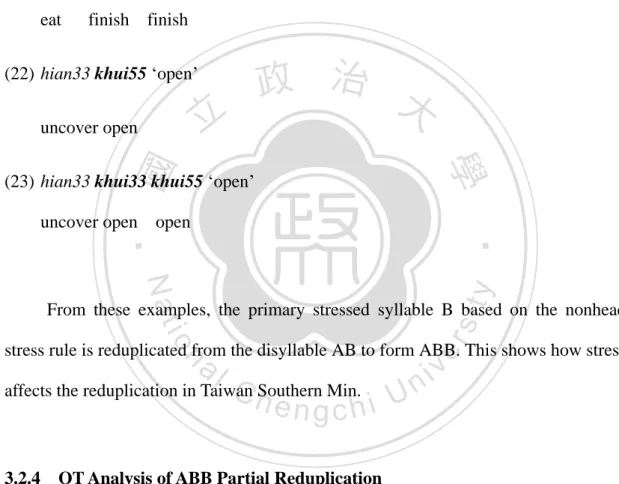
(42) 33. candidate a. is regular reading (not focus on the verb). Since candidate a. hian33 khui55 is a regular reading, constraint Focal Stress is irrelevant and inactive. (15) (boldface is the primary stressed syllable) / hian55 khui0 /. Focal Stress. Nonhead Stress. a. hian55 khui0. * *W. b. hian55 khui0. L. In tableau (15), candidate a. is the focus reading (focus on verb), and the constraint ranking is Focal Stress >> Nonhead Stress. The focused verb bears the base tone and makes the resultative loses its base tone and bear a neutral tone. This focused. 政 治 大. reading is different from the regular reading since in the focused reading stress the. 立. verb and weaken the resultative. Form the ranking argumentation, the stress pattern of. 學. ‧ 國. the AB is explained.. Section 3.2.4 provides an analysis of ABB verb partial reduplication and section. ‧. 3.3.3 gives an analysis of AAB verb partial reduplication. ABB is reduplicated from. Nat. sit. y. the disyllable base AB in which A is the verb and B is the resultative. AB is a. n. al. er. io. resultative compound and AB is a morpheme. The examples of ABB verb partial reduplication are given below.. Ch. engchi. (16) ian55 to51 ‗overturn‘ spill down (17) ian55 to55 to51 ‗overturn‘ spill down down (18) long31 phainn51 ‗bump into broken‘ bump broken. i n U. v.
(43) 34. (19) long31 phainn55 phainn51 ‗bump something so that that is broken‘ bump. broken. broken. (20) tsiah5 liau51 ‗eat all‘ eat. finish. (21) tsiah5 liau55 liau51 ‗eat all‘ eat. finish. finish. 政 治 大. (22) hian33 khui55 ‗open‘. 立. 學. ‧ 國. uncover open. (23) hian33 khui33 khui55 ‗open‘ open. ‧. uncover open. sit. y. Nat. io. er. From these examples, the primary stressed syllable B based on the nonhead stress rule is reduplicated from the disyllable AB to form ABB. This shows how stress. n. al. Ch. affects the reduplication in Taiwan Southern Min.. engchi. i n U. v. 3.2.4 OT Analysis of ABB Partial Reduplication ABB verb reduplication is reduplicated from the disyllable base AB. When syllable B is a full tone which is the primary stressed syllable, syllable B focuses the meaning on the modifier B; this follows Duanmu‘s (1990) ―non-head stress rule‖. This shows that the resultative, which is the primary stressed syllable, is reduplicated. This infers in the syntactic relation the head which is the weaker syllable should not be reduplicated..
(44) 35. The positional faithfulness constraint Anchor-BR-Right and Anchor-BR-Left (McCarthy and Prince 1999) restrict the faithful relation between the base and the reduplicant. This chapter proposes constraint *RED (W) to regulate the weaker syllable cannot be reduplicated. The constraint Adjacency-BR-by-syllable is motivated by the idea that each syllable of the reduplicant wants to be as close as possible to its correspondent syllable in the base (Lunden 2004). The constraint is given below.. 政 治 大 the base that has no correspondent at the rightmost of the reduplicant. 立. (24) Anchor-BR-R: Assign one violation mark for every syllable at the rightmost of. ‧ 國. 學. (25) Anchor-BR-L: Assign one violation mark for every syllable at the leftmost. ‧. of the base that has no correspondent at the leftmost of the reduplicant.. sit. y. Nat. io. er. (26) Adjacency-BR-by-syllable: Assign one violation mark for every syllable in the reduplicant that is not next to its correspondent base. (Lunden 2004). n. al. Ch. engchi. i n U. v. (27) *RED(W):Assign one violation mark for every weaker syllable (unstressed or with non-primary stress) is reduplicated.. The fact that trisyllable ABB is from the disyllable AB base. The constraint Anchor-BR-R should be ranked higher than Anchor-BR-L to prevent from surfacing AAB. *RED(W) prevents the weaker syllable from being reduplicated. Following the perspective of Lunden (2004), base and reduplicant should be as close to each other as possible in the reduplication. Therefore, Adjacency-BR-by-syllable should be ranked.
(45) 36. higher. The ranking argument is given below.. (28) /RED+hian33khui55 /. *RED (W). AnchorBR-R. Adjacency-BR -by-syllable. Anchor-BR-L. a. hian33 khui33 khui55. *. ?. *. b. hian33 khui33 khui55 c. khui33 hian33 khui55. *W. d. hian33 hian33 khui55. *W. *W. e. hian33 khui33 hian55. *W. *W. f. hian33 hian33 khui55. *W. *W. * L. *W. L L. 政 治 大 and f. since, from the perspective of syntactic relation, a weak syllable cannot be 立. In tableau (28), the constraint *RED(W) favors the winner over candidates d., e.,. ‧ 國. 學. reduplicated, and the weaker syllable in candidate d. hian33 hian33 khui55 ‗open‘, candidate e. hian33 khui33 hian55 ‗open‘, and candidate f. hian33 hian33 khui55. ‧. ‗open‘ are reduplicated. Candidates d., e., and f. are ruled out. Anchor-BR-R favors. sit. y. Nat. the winner hian33 khui33 khui55 ‗open‘ over candidates d., e., and f., since in d., e.,. io. al. er. and f. the syllable of the reduplicant does not have a correspondent at the rightmost. v i n C since theh reduplicant i U ‗open‘ e n g c hkhui33. n. edge of the base. Adjacency-BR-by-syllable favors the winner over candidate c. khui33 hian33 khui55. is not next to its. correspondent base. Therefore, Candidate c. is ruled out. In order to rule out candidate b., this thesis proposes Align(RED, IMP)-Right to make the reduplicant coincide with the right edge of the trisyllabic prosodic word in the output. This argument supports Chiang‘s (1992) prediction of the derivation of reduplication is suffixation in Chinese dialects. This argument makes the reduplicant right spread from the corresponding base. To rule out Candidate b., hian33 khui33 khui55, whose reduplicant is not in the end of the idiom phrase, the constraint Align(RED, IMP)-Right is needed to rule it out as in tableau (29)..
(46) 37. (29) /RED+hian33khui55 /. AnchorBR-R. Adjacency-BR -by-syllable. Align(RED, IMP)R. Anchor-BR-L. a. hian33 khui33 khui55. *. b. hian33 khui33 khui55 c. khui33 hian33 khui55. *W. d. hian33 hian33 khui55. *W. *W. e. hian33 khui33 hian55. *W. *W. f. hian33 hian33 khui55. *W. *W. *W. *. **W. *. **W. L. *W. L L. 政 治 大 In this tableau (29), candidate b. is ruled out since the reduplicant khui33 ‗open‘ 立. 學. does not share the same edge with the idiom phrase in the output. Align(RED, IMP)R. ‧ 國. favors the winner over candidate b. hian33 khui33 khui55 ‗open‘. Candidate c.. ‧. khui33 hian33 khui55 ‗open‘ violates Adjacency-BR-by-syllable and Align(RED,. sit. y. Nat. IMP)-R. Adjacency-BR-by-syllable requires that the reduplicant should be as close as possible to its corresponding base. The reduplicant khui33 ‗open‘ in candidate c. is not. io. al. er. . *RED (W). v i n C favor the winner over candidate c.;htherefore, e n g cCandidate h i U c. is ruled out. Anchor-BR-R n. next to its corresponding base. Adjacency-BR-by-syllable and Align(RED, IMP) R. favors the winner over Candidates d., e., and f., since the syllable of the reduplicant does not correspond to the rightmost edge of the base. Candidates d. hian33 hian33 khui55, e. hian33 khui33hian55, and f. hian33 hian33 khui55, are ruled out.. The. constraint *RED(W) favors the winner over candidates d., e., and f. since the weaker syllable in candidate d., e., and f. are reduplicated. Candidate d., e., and f. are ruled out. From the ranking argument, the optimal candidate is candidate a. In ABB, the constraint *RED(W) restricts the weaker syllable in the syntactic structure from being reduplicated and prevents from surfacing quadrisyllabic reduplication hian33 hian33.
(47) 38. khui33 khui55. In ABB reduplication, the constraint ranking is Anchor-BR-R, Adjacency-BR-by-syllable, *RED(W) >> Align(RED, IMP)-R >> Anchor-BR-L, as in (30).. (30). ABB Anchor-BR-R. *RED (W). Adjacency-BR -by-syllable Align(RED, IMP)R. 政 治 大. Anchor-BR-L. 立 AAB Reduplication. ‧ 國. 學. 3.3. In order to examine AAB reduplication, the following section provides an. ‧. analysis of the reduplication of the AAB verb and AAB adjective. This kind of verb,. y. Nat. io. sit. and adjective, the disyllable AB, which is not a word, but two separate morphemes. n. al. er. should reduplicate A to form AA first and plus B to form AAB such as kim kim. i n U. v. khuann ‗look at something carefully‘. In AAB adjective reduplication, AB does not. Ch. engchi. exist independently, and should reduplicate A to form AA first and plus B to become AAB such as lo lo tng ‗very long‘.. 3.3.1 AAB Verb and AAB Adjective Full Reduplication In AAB verb 1 and AAB adjective, when the disyllable AB cannot exist, AB has no meaning. The syllable A should reduplicate first to form AA and attach to the syllable B to become AAB. In this situation, the AA form acts as the modifier to modify the state of B. The examples of AAB verb full reduplication and AAB.
(48) 39. adjective full reduplication are given below.. Verb. ko patient. (33) khuh cough. gold. look. ko tinn patient wait. 立. ‧ 國. 學 ‧. Nat. ka. 政 治 大. ‗slightly light‘. (34) bi bi kng slight slight light (35) ka. ‗wait (for) someone patiently‘. sau ‗cough (in a) sickly (way)‘ cough. khuh cough. Adjective. ‗look (at) something carefully‘. ‗noisy‘. kun. y. gold (32). khuann. kim. sit. (31) kim. n. al. er. io. noisy nosiy boiled. Ch. engchi. i n U. v. According to Daunmu‘s ―non-head stress rule‖ (1990), the non-head is a primary stressed syllable, and the head is the weaker syllable. When AB cannot exist, the derivation of the AAB does not obey the non-head stress rule since A is a morpheme and B is another morpheme existing independently. The situation of AAB verb and AAB adjective is the same as with the ABB adjective.. In the ABB adjective, B is. reduplicated to form BB first and attaches to A. In AAB verb and AAB adjective, A is reduplicated first to form AA to modify the state of B. The constraint Align(RED, IMP)-R requires that the reduplicant coincide with the right edge of the idiom phrase..
(49) 40. (36) AAB verb /RED+ kim/. Align(RED, IMP)-Right. a. kim kim b. kim kim. *W. In tableau (36), Align(RED, IMP)-R favors the winner kim kim over candidate b.. 政 治 大 right edge of the idiom phrase. 立 Candidate b. violates Align(RED, IMP)-R since the. kim kim since Align(RED, IMP)-R, requires that the reduplicant coincide with the. ‧. ‧ 國. kim kim.. 學. reduplicant kim ‗golden‘ is in the initial of the idiom phrase. The winner is candidate a.. Nat. sit. n. al. a. bi bi b. bi bi. er. io. /RED+bi/. y. (37) AAB adjective. v. Align(RED, IMP)-Right. Ch. engchi. i n U. *W. In this tableau (37), Align(RED, IMP)-R favors the winner over candidate b. bi bi ‗slightly‘ since Align(RED, IMP)R requires that the reduplicant coincide with the right edge of the idiom phrase. Candidate b. bi bi violates Align(RED, IMP)-R since the reduplicant bi ‗slightly‘ is in the initial of the idiom phrase. The optimal output is candidate a. bi bi. In AAB verb and AAB adjective, AB does not exist. A and B are separate.
(50) 41. morphemes. B is reduplicated first to become BB to modify the state of syllable A. This thesis gives a brief analysis of AAB adjective and verb full reduplication; AAB adjective and verb full reduplication is more complex and is a residual problem for the further research. This thesis focuses on the derivation of AAB and ABB verb partial reduplication.. 3.3.2. AAB Verb Partial Reduplication AAB verb partial reduplication is different from AAB verb and AAB adjective. 政 治 大 and the resultative, that is, syllable B loses its base tone and bears a neutral tone such 立 full reduplication. The verb in syllable A is semantically stressed to bear the base tone. as hian55 khui0 ‗open‘. This reduplication is different from ABB verb reduplication. ‧ 國. 學. which is composed of a verb and a resultative without placing any emphatic meaning. ‧. on the verb. In the base AB of AAB verb reduplication, the verb has emphatic. sit. ian51 to0 ‗overturn‘. al. n. overturn down. (39). er. io. (38). y. Nat. meaning. These examples of emphatic meaning are given below.. Ch. engchi. ian55 ian51 to0‗overturn‘ overturn overturn down. (40). hian55 khui0. ‗open‘. uncover open. (41). hian33 hian55 khui0 ‗open‘ uncover uncover open. i n U. v.
(51) 42. In verb-resultative, the verb receives the focus so that the verb remains the base tone and the resultatives loses its base tone and bears a neutral tone.. 3.3.3. OT Analysis of AAB Partial Reduplication AAB reduplication is from the disyllable base AB when the focus is on the action;. syllable A gains a primary stressed syllable and syllable B loses its tone value to surface with a neutral tone, that is, a weaker syllable. In AAB, A which is a primary. 政 治 大 should not be reduplicated.. stressed syllable in the base AB, is reduplicated. The constraint *RED(W) regulates a. weaker. syllable. that. 立. The. constraint. Adjacency-BR-by-syllable has effect on the reduplicant to be as close as possible to. ‧ 國. 學. its correspondent base. In AAB, the reduplicant A is reduplicated from the disyllable. ‧. AB base. The ranking of Anchor-BR-L is ranked higher than Anchor-BR-R to prevent. sit. al. n. /RED+ hian55 khui0/. a. hian33 hian55 khui0 ?. er. io. (42). y. Nat. from surfacing unfaithful reduplicant. The constraint ranking is given below.. *RED(W). Ch. Adjacency-BR iv n U -by-syllable. AnchorBR-L. engchi. Anchor -BR-R *. b. hian33 hian55 khui0. *. c. hian55 khui0 hian55. *W. *. *W. L. d. khui0 hian55 khui0. *W. *W. e. hian55khui0 khui0. *W. *W. L. f. hian55 khui0 khui0. *W. *W. L. In this tableau (42), the ranking argument is *RED(W), Anchor-BR-L, Adjacency-BR-by-syllable >> Anchor-BR-R. The constraint *RED(W) favors the winner hian33 hian55 khui0 ‗open‘ over the candidate d. khui0 hian55 khui0 ‗open‘,.
(52) 43. candidate e. hian55 khui0 khui0 ‗open‘, and candidate f. hian55 khui0 khui0 ‗open‘ since the weaker syllable in candidate d., e., and f. are reduplicated. Therefore, candidate d., e., and f., are ruled out. The constraint Anchor-BR-L favors the winner over candidates d., e., and f. since the syllable of the reduplicant does not correspond to the leftmost edge of the base. Therefore, candidates d., e., and f. are ruled out. Adjacency-BR-by-syllable favors the winner and candidate b. over candidate c. hian55 khui0 hian55 since the reduplicant hian55 ‗uncover‘ is not adjacent to its corresponding base. Therefore, candidate c. is ruled out. Constraint Anchor-BR-R. 政 治 大 of reduplicants in candidate a., b., and c do not have correspondent in the right edge of 立. favors the candidate d., e., and f., over the candidate a., b., and c since the right edge. the base. However, Anchor-BR-R is lower ranked and is violable. In order to rule out. ‧ 國. 學. Candidate b., the constraint Align(RED, IMP)-Right is needed to regulate the right. ‧. edge of the reduplicant to coincide with the right edge of the idiom phrase. The. er. io. sit. (43). y. Nat. constraint ranking is shown below.. a l*RED(W) Anchor Adjacency-BR v i -BR-L -by-syllable n Ch engchi U a. hian33 hian55 khui0 n. /RED+ hian55 khui0/. Align(RED, IMP)R. AnchorBR-R. *. *. **W. *. *W. L. *. *W. **W. L. b. hian33 hian55 khui0 c. hian55 khui0 hian55 d. khui0 hian55 khui0. *W. *W. e. hian55khui0 khui0. *W. *W. *. L. f. hian55 khui0 khui0. *W. *W. L. L. In. tableau. (43),. the. ranking. argument. is. *RED(W),. Anchor-BR-L,. Adjacency-BR-by-syllable >> Align(RED, IMP) >> Anchor-BR-R. The winner is hian33 hian55 khui0 ‗open‘. Align(RED, IMP)-R, which requires that the reduplicant should coincide with the right edge of the idiom phrase, favors the winner hian33.
(53) 44. hian55 khui0 ‗open‘ over candidate b. hian33 hian55 khui0 ‗open‘ since in candidate b. the reduplicant hian33 ‗uncover‘ is in the initial of the idiom phrase AAB. Hence, candidate b. is ruled out. Adjacency-BR-by-syllable favors the winner over candidate c. hian55 khui0 hian55 since the reduplicant hian55 ‗uncover‘ is not adjacent to its corresponding base. Candidate d. khui0 hian55 khui0 ‗open‘ is the worst candidate since it violates Anchor-BR-L. The constraint *RED(W) favors the winner over candidates d., e., and f. since the weaker syllable khui0 ‗open‘ is reduplicated. The optimal output is candidate a. hian33 hian55 khui0 ‗open‘. In AAB, *RED(W) avoids. 政 治 大 surface hian33 hian55 khui0 khui0. In AAB partial reduplication, the ranking 立. the weaker syllable in the syntactic structure from being reduplicated and prevent to. argument is Anchor-BR-L, Adjacency-BR-by-syllable, *RED(W) >> Align(RED,. ‧ 國. 學. IMP)-R >> Anchor-BR-R, as in (44).. ‧. io. sit. y. Nat. Anchor-BR-L. *RED (W). Adjacency-BR -by-syllable. n. al. er. (44) AAB. Ch. engchi. i n U. v. Align(RED, IMP)R. Anchor-BR-R. 3.4 Summary This chapter has examined the ABB and AAB reduplication of verbs and adjectives in Taiwan Southern Min. From the syntactic information, when the disyllable AB is a compound and bears the meaning itself, the head is a weaker stressed syllable and the non-head is the primary stressed syllable. According to the.
數據
相關文件
,最長一邊(或直徑)不超過150公分,厚度15公分(含)以上 Stone sheets or slabs, for the assembly of stone tables, not combined with other parts, the largest side of every
vertices’ edges, in this shortest path, the left edge must be relaxed before the right edge. One phase of improvement
Calculating the expected total edge number for one left path started at one problem with m’ edges. Evaluating the total edge number for all right sub-problems #
Reading Task 6: Genre Structure and Language Features. • Now let’s look at how language features (e.g. sentence patterns) are connected to the structure
Which of the following adjectives does not describe King Midas at the beginning of the storyA. “Roses of every shade grew there, and on warm summer nights the air was heavy with
IQHE is an intriguing phenomenon due to the occurrence of bulk topological insulating phases with dissipationless conducting edge states in the Hall bars at low temperatures
According to Shelly, what is one of the benefits of using CIT Phone Company service?. (A) The company does not charge
Output : For each test case, output the maximum distance increment caused by the detour-critical edge of the given shortest path in one line.... We use A[i] to denote the ith element
